AIR CHEVROLET ASTRO 2000 Owners Manual
[x] Cancel search | Manufacturer: CHEVROLET, Model Year: 2000, Model line: ASTRO, Model: CHEVROLET ASTRO 2000Pages: 391, PDF Size: 2.7 MB
Page 3 of 391
ii
Table of Contents
Keys and Door Locks
Keyless Entry System
Hatch
Automatic Transmission
All-Wheel Drive Operation (Option)
Parking Brake
Windows
Tilt Wheel
Turn Signal/Multifunction Lever
Windshield WipersCruise Control
Interior and Exterior Lamps
Mirrors
Storage Compartments
Convenience Net/Luggage Carrier (If Equipped)
Accessory Power Outlets
HomeLink® Transmitter (Option)
Instrument Panel, Warning Lights and Gages
Driver Information System (If Equipped) Seats and Seat Controls
Safety BeltsAir Bag System
Child Restraints
Section
1
Section
2
Seats and Restraint Systems
Features and Controls
Page 4 of 391
Comfort Controls and Audio Systems
Your Driving and the Road
Table of Contents (cont'd)
Braking/Anti-lock Brakes
Steering
Driving Tips for Various Road Conditions
Off-Road DrivingRecreational Vehicle Towing
Loading Your Vehicle
Towing a Trailer Heating and Air Conditioning
Setting the Radio ClockRadio/Cassette Player/CD Player
Radio Theft-Deterrent Feature
Hazard Warning Flashers
Jump Starting
Towing Your VehicleEngine Overheating
Changing a Flat Tire
If You're Stuck
Problems on the Road
iii
Section
5
Section
4
Section
3
Page 7 of 391

vi
GENERAL MOTORS, GM, the GM Emblem,
CHEVROLET, the CHEVROLET Emblem and the
name ASTRO are registered trademarks of General
Motors Corporation.
This manual includes the latest information at the time it
was printed. We reserve the right to make changes in the
product after that time without further notice. For
vehicles first sold in Canada, substitute the name
ªGeneral Motors of Canada Limitedº for Chevrolet
Motor Division whenever it appears in this manual.
Please keep this manual in your vehicle, so it will be
there if you ever need it when you're on the road. If you
sell the vehicle, please leave this manual in it so the new
owner can use it.
We support voluntary
technician certification.
For Canadian Owners Who Prefer a
French Language Manual:
Aux propri‡taires canadiens: Vous pouvez vous
procurer un exemplaire de ce guide en fran†ais chez
votre concessionaire ou au:
DGN Marketing Services Ltd.
1577 Meyerside Dr.
Mississauga, Ontario L5T 1B9
Page 10 of 391

ix
For example,
these symbols
are used on an
original battery:
CAUTION
POSSIBLE
INJURY
PROTECT
EYES BY
SHIELDING
CAUSTIC
BATTERY
ACID COULD
CAUSE
BURNS
AVOID
SPARKS OR
FLAMES
SPARK OR
FLAME
COULD
EXPLODE
BATTERY
These symbols
are important
for you and
your passengers
whenever your
vehicle is
driven:
DOOR LOCK
UNLOCK
FASTEN
SEAT
BELTS
POWER
WINDOW
AIR BAG
These symbols
have to do with
your lamps:
MASTER
LIGHTING
SWITCH
TURN
SIGNALS
PARKING
LAMPS
HAZARD
WARNING
FLASHER
DAYTIME
RUNNING
LAMPS
FOG LAMPS
These symbols
are on some of
your controls:
WINDSHIELD
WIPER
WINDSHIELD
WASHER
WINDSHIELD
DEFROSTER
REAR
WINDOW
DEFOGGER
VENTILATING
FAN
These symbols
are used on
warning and
indicator lights:
ENGINE
COOLANT
TEMP
BATTERY
CHARGING
SYSTEM
BRAKE
COOLANT
ENGINE OIL
PRESSURE
ANTI-LOCK
BRAKES
Here are some
other symbols
you may see:
FUSE
LIGHTER
HORN
SPEAKER
FUEL
Vehicle Symbols
These are some of the symbols you may find on your vehicle.
Page 13 of 391
1-
1-1
Section 1 Seats and Restraint Systems
Here you'll find information about the seats in your vehicle and how to use your safety belts properly. You can also
learn about some things you should not do with air bags and safety belts.
1
-2 Seats and Seat Controls
1
-13 Safety Belts: They're for Everyone
1
-17 Here Are Questions Many People Ask About
Safety Belts
-- and the Answers
1
-18 How to Wear Safety Belts Properly
1
-18 Driver Position
1
-26 Safety Belt Use During Pregnancy
1
-27 Right Front Passenger Position
1
-27 Air Bag System
1
-34 Rear Seat Passengers1
-37 Rear Safety Belt Comfort Guides for Children
and Small Adults
1
-39 Center Passenger Position (Bench Seat)
1
-41 Children
1
-45 Child Restraints
1
-59 Larger Children
1
-62 Safety Belt Extender
1
-62 Checking Your Restraint Systems
1
-63 Replacing Restraint System Parts After
a Crash
Page 25 of 391
1-13
Safety Belts: They're for Everyone
This part of the manual tells you how to use safety belts
properly. It also tells you some things you should not do
with safety belts.
And it explains the air bag system.
CAUTION:
Don't let anyone ride where he or she can't wear
a safety belt properly. If you are in a crash and
you're not wearing a safety belt, your injuries
can be much worse. You can hit things inside the
vehicle or be ejected from it. You can be seriously
injured or killed. In the same crash, you might
not be if you are buckled up. Always fasten your
safety belt, and check that your passengers' belts
are fastened properly too.
CAUTION:
It is extremely dangerous to ride in a cargo area,
inside or outside of a vehicle. In a collision,
people riding in these areas are more likely to be
seriously injured or killed. Do not allow people to
ride in any area of your vehicle that is not
equipped with seats and safety belts. Be sure
everyone in your vehicle is in a seat and using a
safety belt properly.
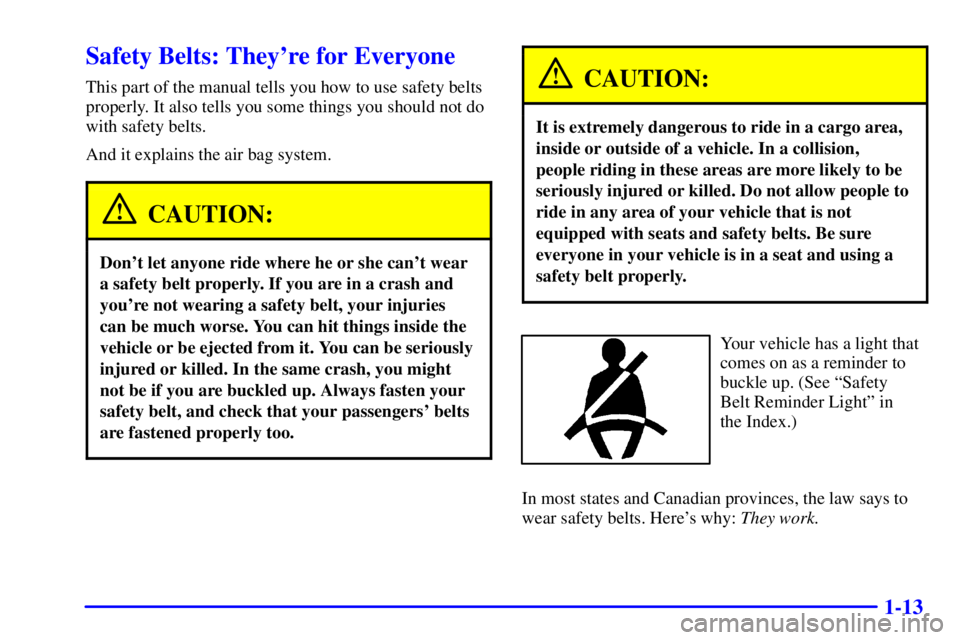
Your vehicle has a light that
comes on as a reminder to
buckle up. (See ªSafety
Belt Reminder Lightº in
the Index.)
In most states and Canadian provinces, the law says to
wear safety belts. Here's why: They work.
Page 29 of 391
1-17
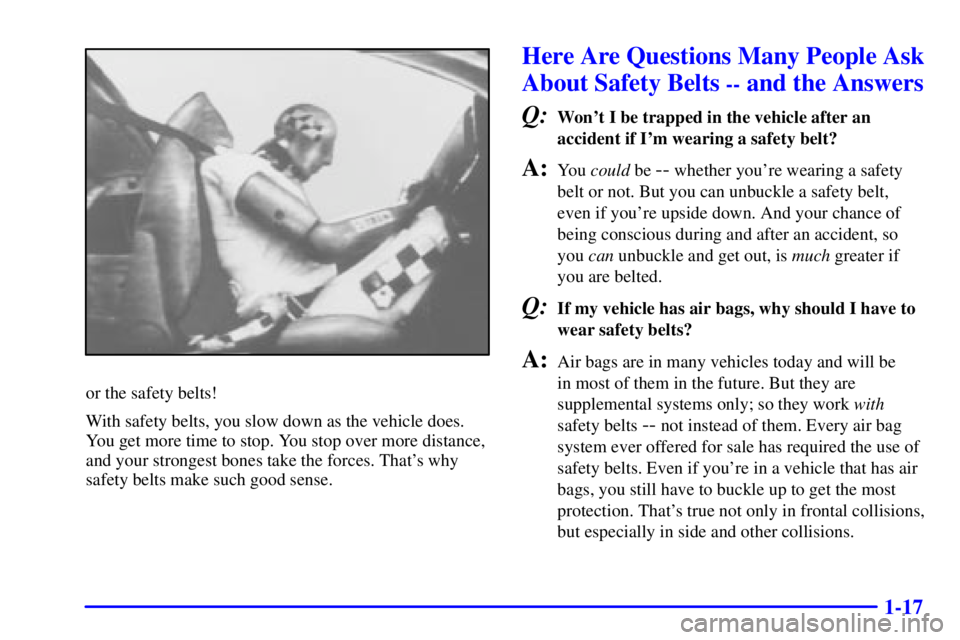
or the safety belts!
With safety belts, you slow down as the vehicle does.
You get more time to stop. You stop over more distance,
and your strongest bones take the forces. That's why
safety belts make such good sense.
Here Are Questions Many People Ask
About Safety Belts
-- and the Answers
Q:
Won't I be trapped in the vehicle after an
accident if I'm wearing a safety belt?
A:You could be -- whether you're wearing a safety
belt or not. But you can unbuckle a safety belt,
even if you're upside down. And your chance of
being conscious during and after an accident, so
you can unbuckle and get out, is much greater if
you are belted.
Q:If my vehicle has air bags, why should I have to
wear safety belts?
A:Air bags are in many vehicles today and will be
in most of them in the future. But they are
supplemental systems only; so they work with
safety belts
-- not instead of them. Every air bag
system ever offered for sale has required the use of
safety belts. Even if you're in a vehicle that has air
bags, you still have to buckle up to get the most
protection. That's true not only in frontal collisions,
but especially in side and other collisions.
Page 39 of 391
1-27
The best way to protect the fetus is to protect the
mother. When a safety belt is worn properly, it's more
likely that the fetus won't be hurt in a crash. For
pregnant women, as for anyone, the key to making
safety belts effective is wearing them properly.
Right Front Passenger Position
To learn how to wear the right front passenger's safety
belt properly, see ªDriver Positionº earlier in
this section.
The right front passenger's safety belt works the same
way as the driver's safety belt
-- except for one thing.
If you ever pull the lap portion of the belt out all the
way, you will engage the child restraint locking feature.
If this happens, just let the belt go back all the way and
start again.
Air Bag System
This part explains the air bag system.
Your vehicle has air bags
-- one air bag for the driver
and another air bag for the right front passenger.
Frontal air bags are designed to help reduce the risk of
injury from the force of an inflating air bag. But these
air bags must inflate very quickly to do their job and
comply with federal regulations.Here are the most important things to know about the air
bag system:
CAUTION:
You can be severely injured or killed in a crash if
you aren't wearing your safety belt
-- even if you
have air bags. Wearing your safety belt during a
crash helps reduce your chance of hitting things
inside the vehicle or being ejected from it. Air
bags are ªsupplemental restraintsº to the safety
belts. All air bags are designed to work with
safety belts, but don't replace them. Air bags are
designed to work only in moderate to severe
crashes where the front of your vehicle hits
something. They aren't designed to inflate at all
in rollover, rear, side or low
-speed frontal
crashes. And, for unrestrained occupants, air
bags may provide less protection in frontal
crashes than more forceful air bags have
provided in the past. Everyone in your vehicle
should wear a safety belt properly
-- whether or
not there's an air bag for that person.
Page 40 of 391
1-28
CAUTION:
Air bags inflate with great force, faster than the
blink of an eye. If you're too close to an inflating
air bag, as you would be if you were leaning
forward, it could seriously injure you. Safety belts
help keep you in position before and during a
crash. Always wear your safety belt, even with air
bags. The driver should sit as far back as possible
while still maintaining control of the vehicle.
CAUTION:
Anyone who is up against, or very close to, any
air bag when it inflates can be seriously injured
or killed. Air bags plus lap
-shoulder belts offer
the best protection for adults, but not for young
CAUTION: (Continued)
CAUTION: (Continued)
children and infants. Neither the vehicle's safety
belt system nor its air bag system is designed
for them. Young children and infants need the
protection that a child restraint system can
provide. Always secure children properly in your
vehicle. To read how, see the part of this manual
called ªChildren.º
There is an air bag readiness
light on the instrument
panel, which shows
AIR BAG.
The system checks the air bag electrical system for
malfunctions. The light tells you if there is an electrical
problem. See ªAir Bag Readiness Lightº in the Index
for more information.
Page 41 of 391
1-29 How the Air Bag System Works
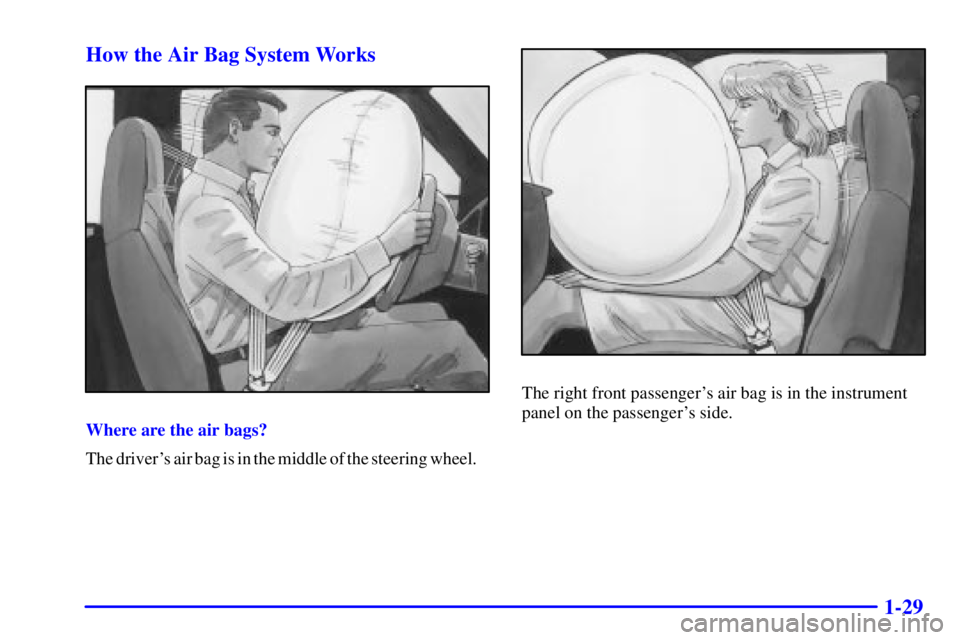
Where are the air bags?
The driver's air bag is in the middle of the steering wheel.
The right front passenger's air bag is in the instrument
panel on the passenger's side.