light CHEVROLET ASTRO 2001 Owner's Manual
[x] Cancel search | Manufacturer: CHEVROLET, Model Year: 2001, Model line: ASTRO, Model: CHEVROLET ASTRO 2001Pages: 388, PDF Size: 2.8 MB
Page 134 of 388
2-55
NOTICE:
Loading cargo that weighs more than 200 lbs.
(91 kg) on the luggage carrier may damage your
vehicle. When you carry large things, never let
them hang over the rear or the sides of your
vehicle. Load your cargo so that it rests on the
slats and does not scratch or damage the vehicle.
Put the cargo against the side rails and fasten it
securely to the luggage carrier. Put the main
weight as far forward as you can.
Don't exceed the maximum vehicle capacity when loading
your vehicle. For more information on vehicle capacity
and loading, see ªLoading Your Vehicleº in the Index.
To prevent damage or loss of cargo as you're driving,
check now and then to make sure the luggage carrier and
cargo are still securely fastened.
Ashtrays and Cigarette Lighter
The cigarette lighter is on the left of the engine
cover console.
To use the lighter, press it in all the way and let go.
When it's done heating, it will pop back out by itself.
NOTICE:
Don't hold a cigarette lighter in with your hand
while it is heating. If you do, it won't be able to
back away from the heating element when it's
ready. That can make it overheat, damaging the
lighter and the heating element.
Page 135 of 388
2-56
NOTICE:
When using the cigarette lighter as an accessory
power outlet, maximum electrical load must not
exceed 20 amps. Always turn off any electrical
equipment when not in use. Leaving electrical
equipment on for extended periods will drain
your battery.
The front ashtray is located above the passenger's side
front cupholder. To remove the front ashtray, open it and
gently pull it slightly past its stop.
To remove the ashtray on the sliding door, open it, then
press down on the inside tab and pull it out.
You may have another ashtray on the driver's sidewall.
Press the right side to turn the ashtray around for use. To
remove the ashtray, open it and gently pull it off the hinge.
NOTICE:
Don't put papers and other things that burn into
your ashtrays. If you do, cigarettes or other smoking
materials could set them on fire, causing damage.
Sun Visors
To block out glare, you can swing down the visors. You
can also swing them from side to side. Your visors may
have an extension that can be pulled out for additional
glare protection.
Visor Vanity Mirror (If Equipped)
Some visors have mirrors built in, with or without
lamps. Just lift the mirror cover on each visor to turn
the lamps on.
Page 137 of 388

2-58 Programming the Transmitter
Do not use the HomeLink Transmitter with any garage
door opener that does not have the ªstop and reverseº
feature. This includes any garage door opener model
manufactured before April 1, 1982.
Be sure that people and objects are clear of the garage
door you are programming.
Your vehicle's engine should be turned off while
programming the transmitter. Follow these steps to
program up to three channels:
1. If you have previously programmed a transmitter
channel, proceed to Step 2. Otherwise, hold down
the two outside buttons on the HomeLink
Transmitter until the indicator light begins to flash
rapidly (after 20 seconds). Then release the buttons.
This procedure initializes the memory and erases any
previous settings for all three channels.2. Decide which one of the three channels you want to
program. Hold the end of the hand-held transmitter
about 2 to 5 inches (5 to 13 cm) away from the
surface of the HomeLink Transmitter so that you can
still see the indicator light.
3. Using both hands, press the hand
-held transmitter
button and the desired button on the HomeLink
Transmitter. Continue to press both buttons
through Step 4.
4. Hold down both buttons until you see the red light
on the HomeLink Transmitter flash rapidly.
The rapid flashing indicates that the HomeLink
Transmitter has been programmed. Release both
buttons once the light starts to flash rapidly.
Page 138 of 388

2-59
If you have trouble programming the HomeLink
Transmitter, make sure that you have followed the
directions exactly as described and that the battery in the
hand
-held transmitter is not dead. If you still cannot
program it, turn the hand
-held transmitter end over end
and try again. The HomeLink Transmitter may not work
with older garage door openers that do not meet current
Federal Consumer Safety Standards. If you cannot
program the transmitter after repeated attempts, refer to
ªTraining a Garage Door Opener with Rolling Codesº
later in this section or contact the manufacturer of the
unit at 1
-800-355-3515.
Be sure to keep the original hand
-held transmitter
in case you need to erase and reprogram the
HomeLink Transmitter.Canadian Owners: During programming, the hand
-held
transmitter may automatically stop transmitting after one
or two seconds. In this case, you should press the button
on the hand
-held transmitter about once a second without
ever releasing the button on the HomeLink Transmitter.
Release both buttons when the indicator light on the
HomeLink Transmitter begins to flash rapidly.
Page 139 of 388

2-60 Operating the Transmitter
Press and hold the appropriate button on the HomeLink
Transmitter. The indicator light comes on while the
signal is being transmitted.
If the hand
-held transmitter appears to program the
HomeLink Transmitter but does not open your garage
door and if the garage door opener was manufactured
after 1996, the garage door opener may have a ªrolling
codeº system. A rolling code system changes the code
of the garage door opener every time you open or close
the garage door.
To determine if you have this system, press the
button on the HomeLink Transmitter that you have
programmed already. If the indicator light flashes
rapidly for one to two seconds then turns solid, the
garage door opener has a rolling code system. In a
rolling code system, the garage door motor head unit
must be trained to the HomeLink Transmitter.
Training a Garage Opener with a
ªRolling Codeº Feature (If Equipped)
If you have not previously programmed the hand-held
transmitter to the HomeLink Transmitter, see
ªProgramming the Transmitterº listed previously.
If you have completed this programming already, you now
need to train the garage door opener motor head unit to
recognize the HomeLink Transmitter. Refer to your garage
door opener owner's manual for the proper transmitter
training procedure for your garage door opener brand.
1. Find the training button on the garage door opener
motor head unit. The exact location and color will
vary by garage door opener brand. If you have
difficulty finding the training button, refer to your
garage door opener owner's manual.
Because of the steps involved, it may be helpful to
have another person available to assist you in
programming the transmitter.
2. Press the training button on the garage door opener
motor head unit. An indicator light will begin to flash
when the motor head unit enters the training mode.
Following this step, you have 30 seconds to start Step 3.
Page 140 of 388

2-61
3. Return to the HomeLink Transmitter in your vehicle
and firmly press and release the HomeLink Transmitter
button you have already programmed for two to
three seconds. Press and release the button again
(you may need to do this step up to three times) to
make sure that the HomeLink Transmitter has been
trained to the garage door opener motor head unit.
Check that the training was successful. The motor head
unit indicator light should no longer be flashing.
The garage door opener should now recognize the
HomeLink Transmitter. You may either use the
HomeLink Transmitter or the hand
-held transmitter to
open the garage door.
If after following these instructions, you still have
problems training the garage door opener, call the
manufacturer of the unit at 1
-800-355-3515.
Erasing Channels
To erase all three programmed channels, hold down the
two outside buttons until the indicator light begins to
flash (after 20 seconds). Release both buttons.
Accessories
Accessories for the HomeLink Transmitter are available
from the manufacturer of the unit. If you would like
additional information, please call 1
-800-355-3515.
Page 142 of 388

2-63
The main components of your instrument panel are the following:
A. Lamp Switches
B. Instrument Panel Cluster Intensity Control
C. Multifunction Lever
D. Hazard Warning Flasher Button
E. Transmission Shift Lever
F. Ignition Switch
G. Rear Defogger Button (Option)
H. Comfort Controls
I. Rear A/C Control (Option)
J. Rear Heater Control (Option)K. Rear Washer/Wiper (Option)
L. Front Ashtray
M. Dome Override Button
N. Hood Release
O. Cigarette Lighter
P. Audio System
Q. Front Storage Compartment
R. Cupholders/Storage Tray
S. Accessory Power Outlets
Page 144 of 388

2-65 Speedometer and Odometer
Your speedometer lets you see your speed in both
miles per hour (mph) and kilometers per hour (km/h).
Your odometer shows how far your vehicle has been
driven, in either miles (used in the United States) or
kilometers (used in Canada).
Your odometer is tamper resistant. The digital odometer
will read 999,999 if someone tries to turn it back.
You may wonder what happens if your vehicle needs a
new odometer installed. If the new one can be set to the
mileage total of the old odometer, then it must be. But if
it can't, then it's set at zero, and a label must be put on
the driver's door to show the old mileage reading when
the new odometer was installed.
Trip Odometer
The trip odometer can tell you how far your vehicle has
been driven since you last set the trip odometer to zero.
The trip odometer will appear in place of your regular
odometer when you press the TRIP button.
To reset the trip odometer, press and hold the
TRIP button. To change back to the regular odometer,
press the TRIP button again.
Warning Lights, Gages and Indicators
This part describes the warning lights and gages that may
be on your vehicle. The pictures will help you locate them.
Warning lights and gages can signal that something is
wrong before it becomes serious enough to cause an
expensive repair or replacement. Paying attention to
your warning lights and gages could also save you or
others from injury.
Warning lights come on when there may be or is a
problem with one of your vehicle's functions. As you will
see in the details on the next few pages, some warning
lights come on briefly when you start the engine just to let
you know they're working. If you are familiar with this
section, you should not be alarmed when this happens.
Gages can indicate when there may be or is a problem
with one of your vehicle's functions. Often gages and
warning lights work together to let you know when
there's a problem with your vehicle.
When one of the warning lights comes on and stays on
when you are driving, or when one of the gages shows
there may be a problem, check the section that tells you
what to do about it. Please follow this manual's advice.
Waiting to do repairs can be costly
-- and even
dangerous. So please get to know your warning lights
and gages. They're a big help.
Page 145 of 388

2-66 Safety Belt Reminder Light
When the key is turned to RUN or START, a tone will
come on for about eight seconds to remind people to
fasten their safety belts, unless the driver's safety belt is
already buckled.
The safety belt light will
also come on and stay on
for about 20 seconds, then
it will flash for about
55 seconds.
If the driver's belt is already buckled, neither the tone
nor the light will come on.
Air Bag Readiness Light
There is an air bag readiness light on the instrument
panel, which shows AIR BAG or the air bag symbol.
The system checks the air bag's electrical system for
malfunctions. The light tells you if there is an electrical
problem. The system check includes the air bag sensor,
the air bag modules, the wiring and the crash sensing
and diagnostic module. For more information on the
air bag system, see ªAir Bagº in the Index.
United States Canada
This light will come on when you start your vehicle, and
it will flash for a few seconds. Then the light should go
out. This means the system is ready.
Page 146 of 388
2-67
If the air bag readiness light stays on after you start the
vehicle or comes on when you are driving, your air bag
system may not work properly. Have your vehicle
serviced right away.
CAUTION:
If the air bag readiness light stays on after you
start your vehicle, it means the air bag system
may not be working properly. The air bags in
your vehicle may not inflate in a crash, or they
could even inflate without a crash. To help avoid
injury to yourself or others, have your vehicle
serviced right away if the air bag readiness light
stays on after you start your vehicle.
The air bag readiness light should flash for a few
seconds when you turn the ignition key to RUN. If the
light doesn't come on then, have it fixed so it will be
ready to warn you if there is a problem.
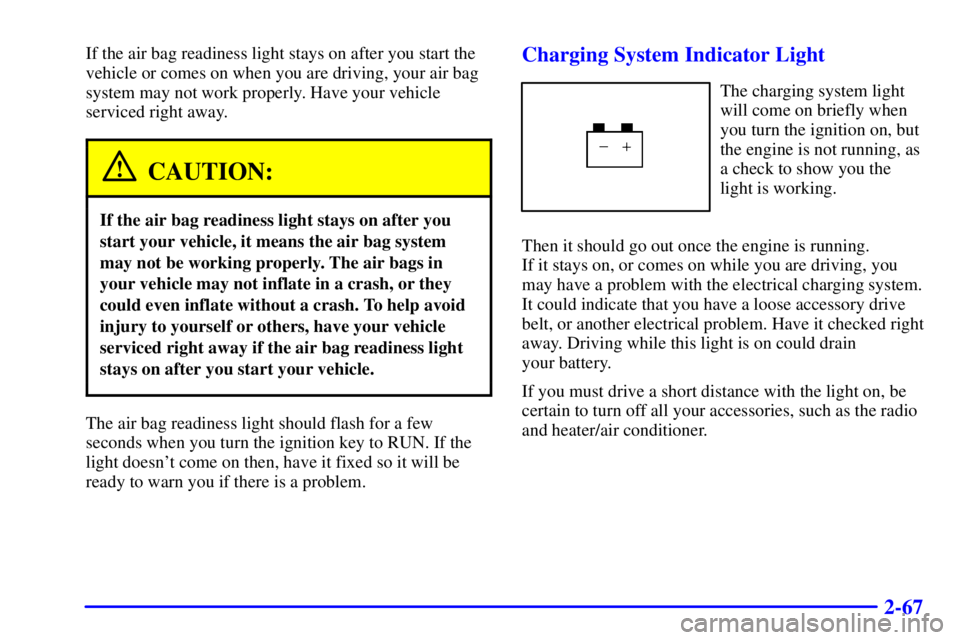
Charging System Indicator Light
The charging system light
will come on briefly when
you turn the ignition on, but
the engine is not running, as
a check to show you the
light is working.
Then it should go out once the engine is running.
If it stays on, or comes on while you are driving, you
may have a problem with the electrical charging system.
It could indicate that you have a loose accessory drive
belt, or another electrical problem. Have it checked right
away. Driving while this light is on could drain
your battery.
If you must drive a short distance with the light on, be
certain to turn off all your accessories, such as the radio
and heater/air conditioner.