flat tire CHEVROLET ASTRO 2003 User Guide
[x] Cancel search | Manufacturer: CHEVROLET, Model Year: 2003, Model line: ASTRO, Model: CHEVROLET ASTRO 2003Pages: 386, PDF Size: 17.31 MB
Page 287 of 386
Used Replacement Wheels
Putting a uscu wheel on your vehicle is
dangerous. You can’t know how it’s been used or how far
it’s been driven. It could fail suddenly
and cause a crash. If you have to replace a
wheel, use a new
GM original equipment wheel.
Tire Chains
Notice: Use tire chains only where legal and only
when you must. Use only
SAE Class ”S” type chains
that are the proper size for your tires. Install them on the rear axle tires and tighten them as tightly
as possible with the ends securely fastened.
Drive slowly and follow the chain manufacturer’s
instructions.
If you can hear the chains contacting
your vehicle, stop and retighten them. If the contact
continues, slow down until
it stops. Driving too
fast or spinning
the wheels with chains on will
damage your vehicle.
If a Tire Goes Flat
It’s unusual for a tire to “blow out” while you’re driving,
especially
if you maintain your tires properly. If air
goes out of a tire, it’s much more likely to leak out
slowly. But
if you should ever have a “blowout”, here are
a few tips about what to expect and what to do:
If a front tire fails, the flat tire will create a drag that
pulls the vehicle toward that side. Take your foot off the
accelerator pedal and grip the steering wheel firmly.
Steer to maintain lane position, and then gently brake to
a stop well out of the traffic lane.
A rear blowout, particularly on a curve, acts much like a
skid and may require the same correction you’d use
in a skid. In any rear blowout, remove your foot from the
accelerator pedal. Get the vehicle under control by
steering the way you want the vehicle to go. It may be
very bumpy and noisy, but you can still steer. Gently
brake to a stop
- well off the road if possible.
If a tire goes flat, the next part shows how to use your
jacking equipment to change a flat tire safely.
5-70
Page 288 of 386
Changing a Flat Tire
If a tire goes flat, avoid further tire and wheel damage
by driving slowly to a level place. Turn on your hazard
warning flashers.
Changing a tire can cause an injury. The
vehicle can slip
off the jack and roll over you
or other people. You and they could be badly
injured. Find a level place to change your tire.
To help prevent the vehicle from moving:
1. Set the parking brake firmly.
2. Put the shift lever in PARK (P).
3. Turn off the engine.
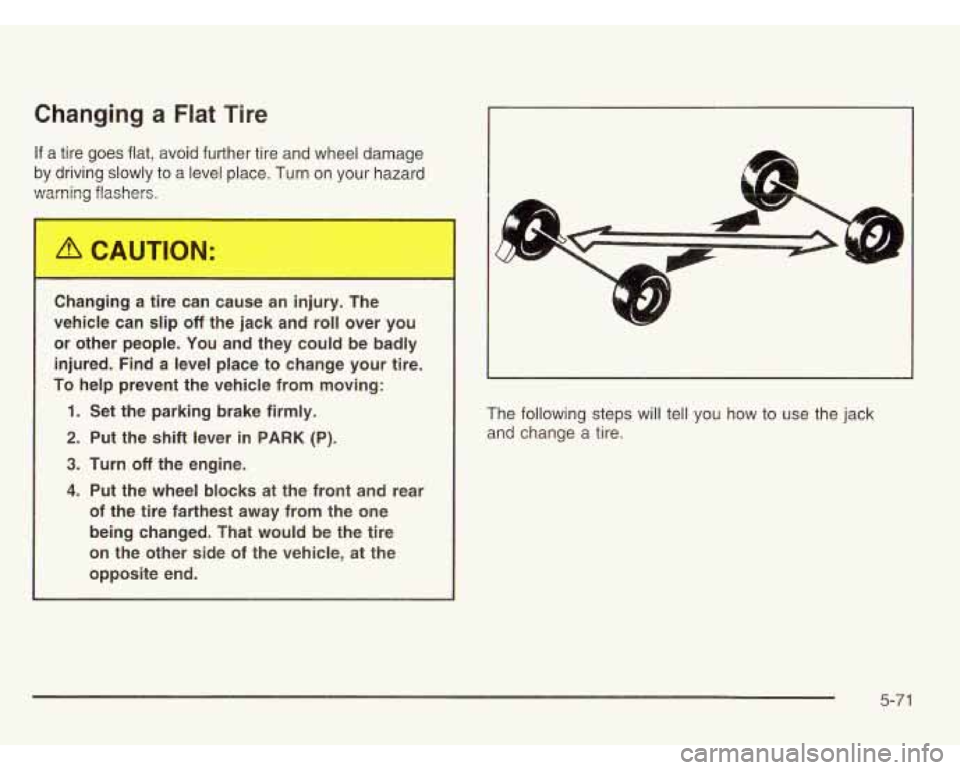
4. Put the wheel blocks at the front and rear
of the tire farthest away from the one
being changed. That would be the tire
on the other side of the vehicle, at the
opposite end. The following steps will tell
you how to
use the jack
and change a tire.
5-7 1
Page 291 of 386
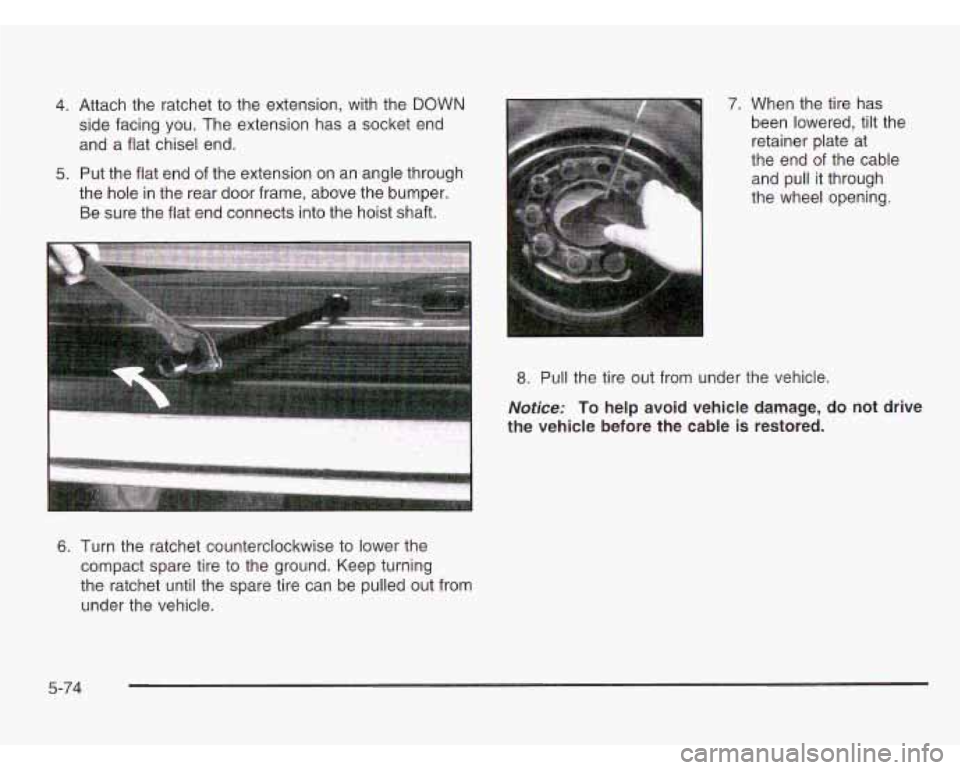
4. Attach the ratchet to the extension, with the DOWN
side facing you. The extension has a socket end
and a flat chisel end.
5. Put the flat end of the extension on an angle through
the hole in the rear door frame, above the bumper.
Be sure the flat end connects into the hoist shaft.
6. Turn the ratchet counterclockwise to lower the
compact spare tire to the ground. Keep turning
the ratchet until the spare tire can be pulled out from
under the vehicle. 7.
When the tire has
been lowered, tilt the
retainer plate at
the end
of the cable
and pull it through
the wheel opening.
8. Pull the tire out from under the vehicle.
Notice: To help avoid vehicle damage, do not drive
the vehicle before the cable
is restored.
5-74
Page 293 of 386
Removing the Flat Tire and Installing
the Spare Tire
1. Before you start, block the front and rear of the
tire farthest away from the one being changed.
Then put your cor-xt spare tire near the flat tire.
I
Getting under a vehicle when it is jacked .I is
dangerous. If the vehicle slips off the jack you
could be badly injured or killed. Never get under
a vehicle when
it is supported only by a jack.
Ra.,.ng your vehicle
..ICIm Lhe jack improperly
positioned can damage the vehicle and even
make the vehicle fall.
To help avoid personal
injury and vehicle damage, be sure to fit the
jack
lift head into the proper location before
raising the vehicle.
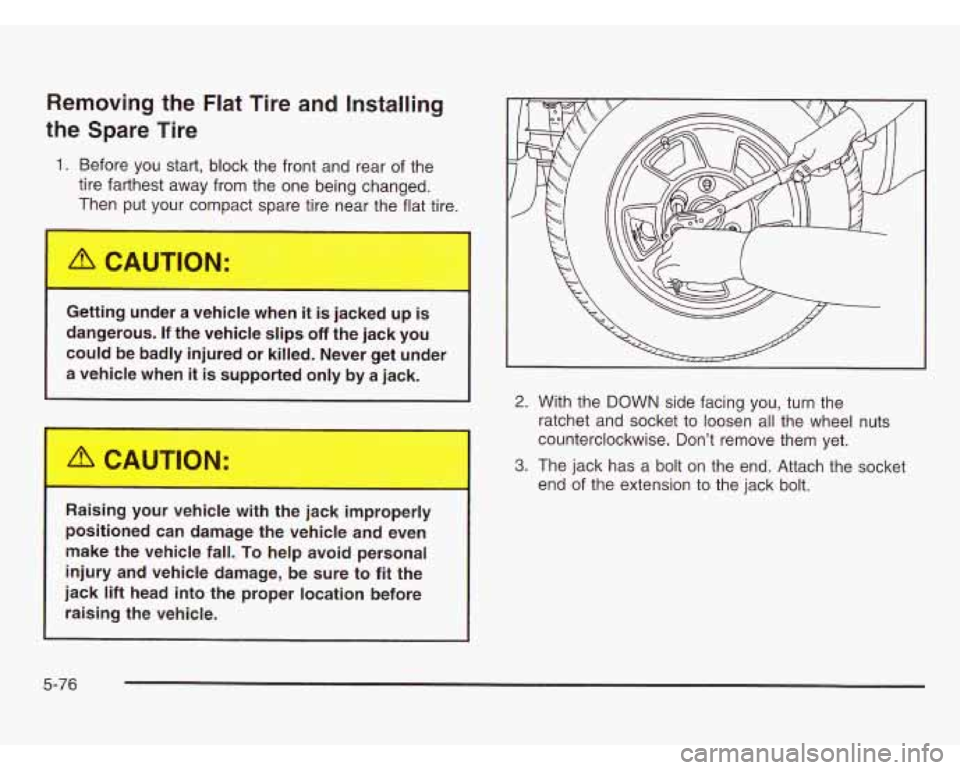
2. With the DOWN side facing you, turn the
ratchet and socket to loosen all the wheel nuts
counterclockwise. Don’t remove them yet.
3. The jack has a bolt on the end. Attach the socket
end of the extension to the jack bolt.
5-76
Page 295 of 386
B' C
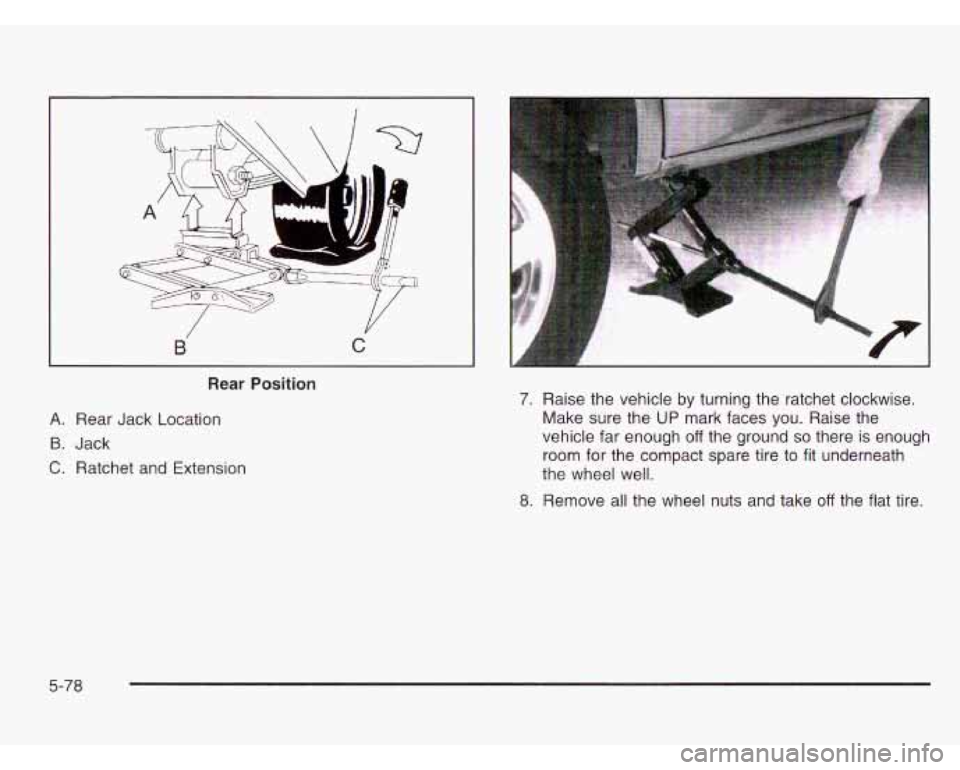
Rear Position
A. Rear Jack Location
B. Jack
C. Ratchet and Extension
..
7. Raise the vehicle by turning the ratchet clockwise.
Make sure the
UP mark faces you. Raise the
vehicle far enough
off the ground so there is enough
room for the compact spare tire to fit underneath
the wheel well.
8. Remove all the wheel nuts and take off the flat tire.
5-78
Page 298 of 386
Stori J a Flat or Spare Tire and Tools
Storing a jack, a tire, or other equipment in the
passenger compartment
of the vehicle could
cause injury. In
a sudden stop or collision,
loose equipment could strike someone.
Store all these in the proper place.
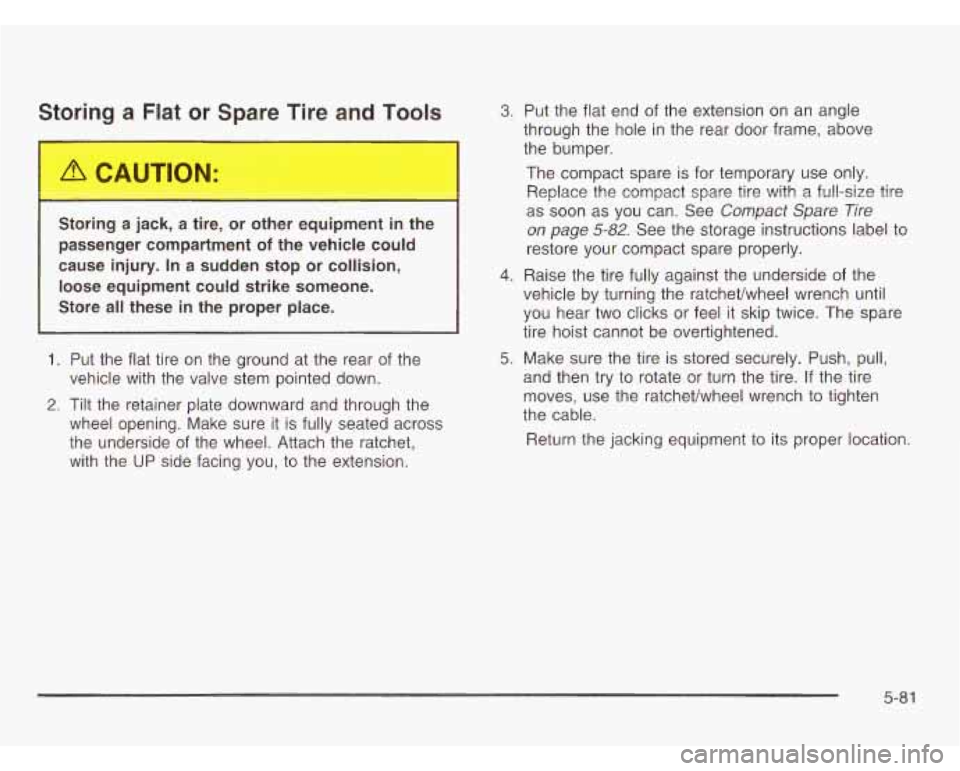
1. Put the flat tire on the ground at the rear of the
vehicle with the valve stem pointed down.
2. Tilt the retainer plate downward and through the
wheel opening. Make sure
it is fully seated across
the underside of the wheel. Attach the ratchet,
with the UP side facing you, to the extension.
3. Put the flat end of the extension on an angle
through the hole in the rear door frame, above
the bumper.
The compact spare is for temporary use only.
Replace the compact spare tire with a full-size tire
as soon as you can. See Compact Spare Tire
on page 5-82. See the storage instructions label to
restore your compact spare properly.
vehicle by turning the ratchevwheel wrench until
you hear two clicks or feel it skip twice. The spare
tire hoist cannot be overtightened.
4. Raise the tire fully against the underside of the
5. Make sure the tire is stored securely. Push, pull,
and then try to rotate or turn the tire. If the tire
moves, use the ratchet/wheel wrench
to tighten
the cable.
Return the jacking equipment to its proper location.
5-81
Page 299 of 386
Compact Spare Tire
Although the compact spare tire was fully inflated when
your vehicle was new, it can lose air after a time.
Check the inflation pressure regularly. It should be
60 psi (420 kPa).
After installing the compact spare on your vehicle,
you should stop as soon as possible and make sure
your spare tire is correctly inflated. The compact spare
is made to perform well at speeds up to
65 mph
(1 05 km/h) for distances up to 3,000 miles (5 000 km),
so you can finish your trip and have your full-size
tire repaired or replaced where you want.
Of course,
it’s best to replace your spare with a full-size tire as soon
as you can. Your spare will last longer and be in good
shape in case you need it again.
Notice: When the compact spare is installed, don’t
take your vehicle through an automatic car wash
with guide rails. The compact spare can get caught
on the rails. That can damage the tire and wheel,
and maybe other parts of your vehicle.
Don’t use your compact spare on other vehicles.
And don’t mix your compact spare tire or wheel with
other wheels or tires. They won’t fit. Keep your spare tire
and its wheel together.
Notice: Tire chains won’t fit your compact spare.
Using them can damage your vehicle and can
damage the chains too. Don’t use tire chains on
your compact spare.
5-82
Page 321 of 386
Maintenance Schedule
Introduction
IMPORTANT-
KEEP ENGINE C ~~
AT THE PROPER
1 LEVEL AND CHANGE AS 1
RECOMMENDED
Have you purchased the GM Protection Plan? The Plan
supplements your new vehicle warranties. See your
Warranty and Owner Assistance booklet or your dealer
for details.
Your Vehicle and the Environment
Proper vehicle maintenance not only helps to keep your
vehicle in good working condition, but also helps the
environment.
All recommended maintenance procedures
are important. Improper vehicle maintenance can
even affect the quality
of the air we breathe. Improper
fluid levels or the wrong tire inflation can increase
the level
of emissions from your vehicle. To help protect
our environment, and to keep your vehicle in good
condition, please maintain your vehicle properly.
Maintenance Requirements
Maintenance intervals, checks, inspections and
recommended fluids and lubricants as prescribed in
this manual are necessary to keep your vehicle in good
working condition. Any damage caused by failure to
follow recommended maintenance may not be covered
by warranty.
6-2
Page 345 of 386
Part B: Owner Checks and Services
Listed in this part are owner checks and services
which should be performed at the intervals specified to
help ensure the safety, dependability and emission
control performance of your vehicle.
Be sure any necessary repairs are completed at once.
Whenever any fluids or lubricants are added to your
vehicle, make sure they are the proper ones, as shown
in Part D.
At Each Fuel Fill
It is important for you or a service station attendant to
perform these underhood checks at each fuel fill.
Engine Oil Level Check
Check the engine oil level and add the proper oil
if necessary. See Engine Oil on page 5-15 for
further details.
Engine Coolant Level Check
Check the engine coolant level and add DEX-COOL@
coolant mixture
if necessary. See Engine Coolant
on page
5-28 for further details.
Windshield Washer Fluid Level Check
Check the windshield washer fluid level in the windshield
washer tank and add the proper fluid
if necessary.
See
Windshield Washer Fluid on page 5-41 for
further details.
At Least Once a Month
Tire Inflation Check
Make sure tires are inflated to the correct pressures.
Don’t forget to check your spare tire. See
Tires on
page
5-63 for further details.
At Least Twice a Year
Restraint System Check
Make sure the safety belt reminder light and all your belts,
buckles, latch plates, retractors and anchorages are
working properly. Look for any other loose or damaged
safety belt system parts. If you see anything that might
keep a safety belt system from doing its job, have it
repaired. Have any torn or frayed safety belts replaced.
Also look for any opened or broken air bag coverings,
and have them repaired or replaced. (The air bag
system does not need regular maintenance.)
6-26
Page 346 of 386
Wiper Blade Check
Inspect wiper blades for wear or cracking. Replace
blade inserts that appear worn or damaged or that
streak or miss areas of the windshield. Also see
Cleaning the Outside of Your Vehicle on page 5-86.
Spare Tire Check
At least twice a year, after the monthly inflation check
of the spare tire determines that the spare is inflated to
the correct tire inflation pressure, make sure that the
spare tire is stored securely. Push, pull, and then
try
to rotate or turn the tire. If it moves, use the wheel
wrench
to tighten the cable. See Changing a
Flat Tire on page 5-71.
Weatherstrip Lubrication
Silicone grease on weatherstrips will make them last
longer, seal better, and not stick or squeak. Apply
silicone grease with a clean cloth. During very cold,
damp weather more frequent application may be
required. See
Part D: Recommended Fluids and
Lubricants on page
6-32.
Automatic Transmission Check
Check the transmission fluid level; add if needed.
See
Automatic Transmission Fluid on page 5-25.
A fluid loss may indicate a problem. Check the
system and repair
if needed.
At Least Once a Year
Key Lock Cylinders Service
Lubricate the key lock cylinders with the lubricant
specified in Part D.
Body Lubrication Service
Lubricate all body door hinges, the body hood, fuel door
and rear compartment hinges, latches and locks
including interior glove box and console doors, hood
latch assembly, secondary latch, pivots, spring anchor,
release pawl and any moving seat hardware. Lubricate
the hood safety lever pivot and prop rod pivot. Part D
tells you what to use. More frequent lubrication may be
required when exposed
to a corrosive environment.
6-27