service schedule CHEVROLET ASTRO 2003 User Guide
[x] Cancel search | Manufacturer: CHEVROLET, Model Year: 2003, Model line: ASTRO, Model: CHEVROLET ASTRO 2003Pages: 386, PDF Size: 17.31 MB
Page 322 of 386
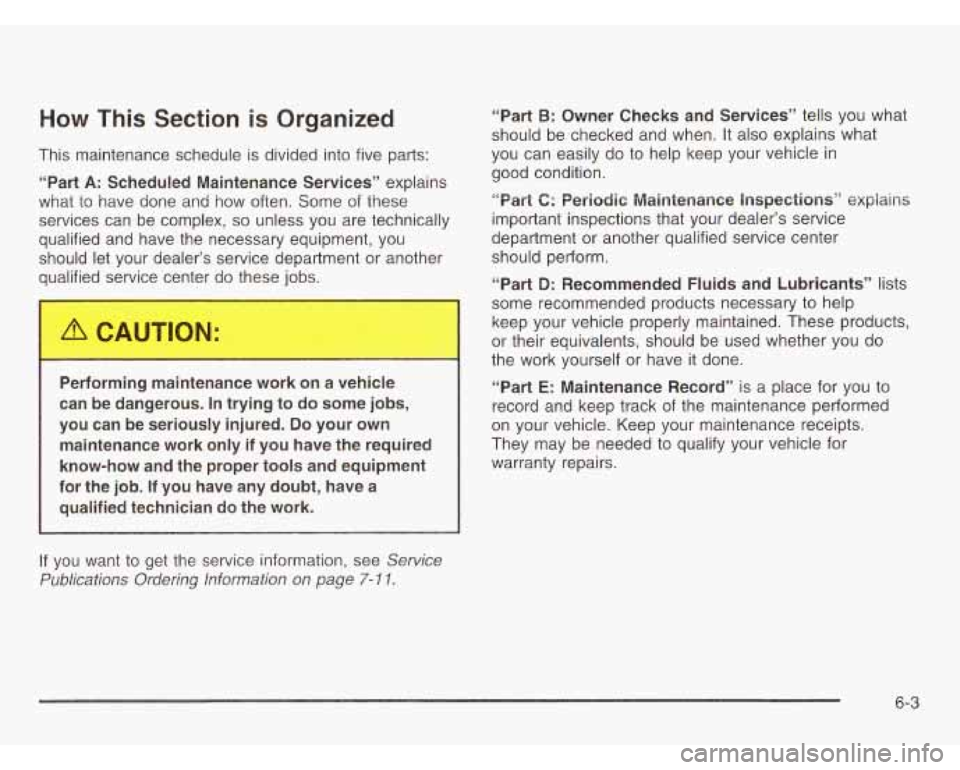
How This Section is Organized
This maintenance schedule is divided into five parts:
“Part
A: Scheduled Maintenance Services” explains
what to have done and how often. Some of these
services can be complex,
so unless you are technically
qualified and have the necessary equipment, you
should let your dealer’s service department or another
qualified serIine center do these
jobs.
Performing maintenance work on a vehicle
can be dangerous. In trying to do some jobs,
you can be seriously injured.
Do your own
maintenance work only if you have the required
know-how and the proper tools and equipment
for the job.
If you have any doubt, have a
qualified technician do the work. “Part
B: Owner Checks and Services”
tells you what
should be checked and when.
It also explains what
you can easily do to help keep your vehicle
in
good condition.
“Part C: Periodic Maintenance Inspections” explains
important inspections that your dealer’s service
department or another qualified service center
should perform.
“Part
D: Recommended Fluids and Lubricants” lists
some recommended products necessary to help
keep your vehicle properly maintained. These products,
or their equivalents, should be used whether you do
the work yourself or have
it done.
“Part
E: Maintenance Record” is a place for you to
record and keep track
of the maintenance performed
on your vehicle. Keep your maintenance receipts.
They may be needed to qualify your vehicle for
warranty repairs.
If you want to get the service information, see Service
Publications Ordering Information
on page 7- I 1.
6-3
Page 323 of 386
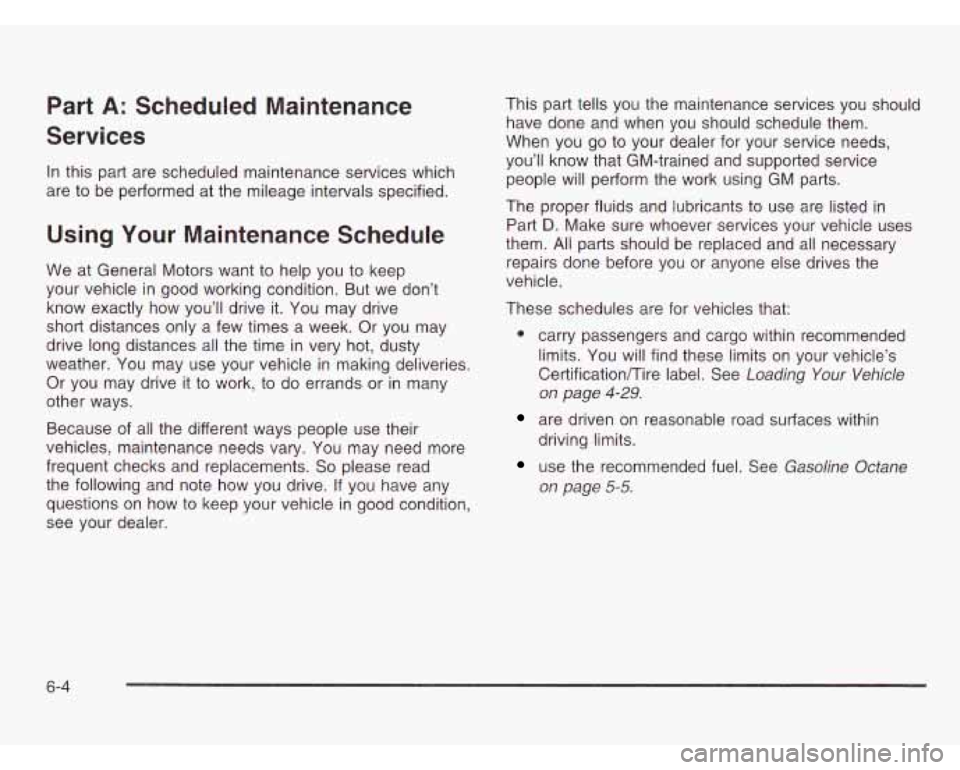
Part A: Scheduled Maintenance
Services
In this part are scheduled maintenance services which
are to be performed at the mileage intervals specified.
Using Your Maintenance Schedule
We at General Motors want to help you to keep
your vehicle in good working condition. But we don’t
know exactly how you’ll drive it. You may drive
short distances only a few times a week. Or you may
drive long distances all the time in very hot, dusty
weather. You may use your vehicle in making deliveries.
Or you may drive it to work, to do errands or in many
other ways.
Because of all the different ways people use their
vehicles, maintenance needs vary. You may need more
frequent checks and replacements.
So please read
the following and note how you drive.
If you have any
questions on how to keep your vehicle in good condition,
see your dealer. This part tells
you the maintenance services you should
have done and when you should schedule them.
When you go to your dealer for your service needs,
you’ll know that GM-trained and supported sewice
people will perform the work using GM parts.
The proper fluids and lubricants to use are listed in
Part D. Make sure whoever services your vehicle uses
them.
All parts should be replaced and all necessary
repairs done before you or anyone else drives the
vehicle.
These schedules are for vehicles that:
carry passengers and cargo within recommended
limits. You will find these limits on your vehicle’s
CertificationRire label. See
Loading Your Vehicle
on page
4-29.
are driven on reasonable road surfaces within
driving limits.
use the recommended fuel. See Gasoline Octane
on page
5-5.
6-4
Page 324 of 386
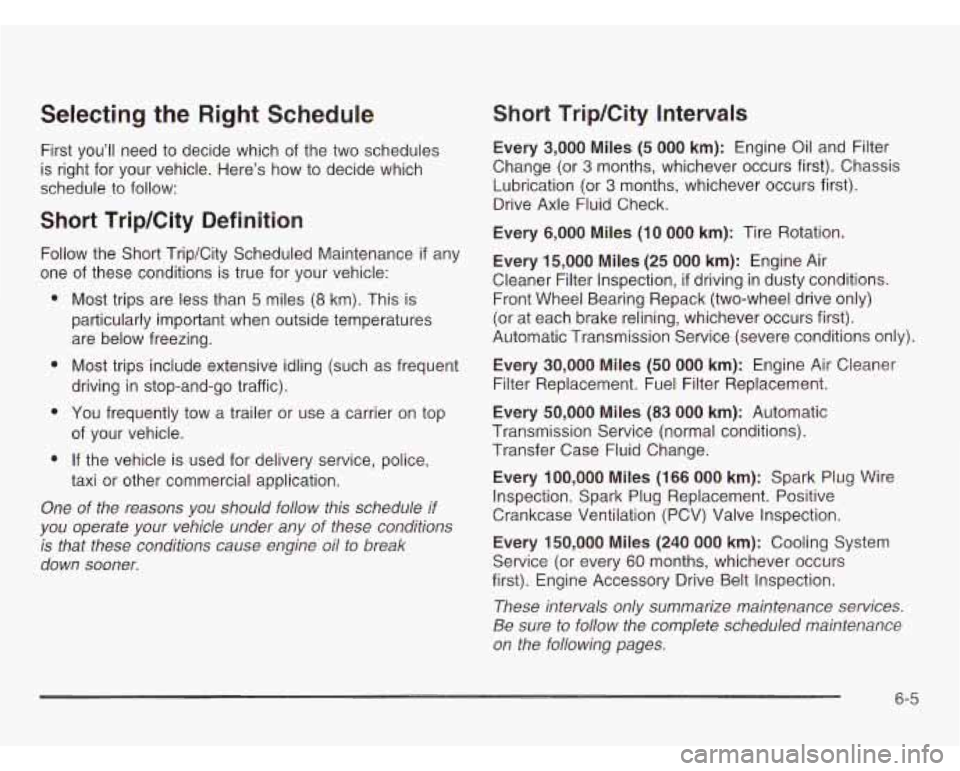
Selecting the Right Schedule
First you’ll need to decide which of the two schedules
is right for your vehicle. Here’s how to decide which
schedule to follow:
Short Trip/City Definition
Follow the Short Trip/City Scheduled Maintenance if any
one of these conditions is true for your vehicle:
e
e
e
e
Most trips are less than 5 miles (8 km). This is
particularly important when outside temperatures
are below freezing.
Most trips include extensive idling (such as frequent
driving in stop-and-go traffic).
You frequently tow a trailer or use a carrier on top
of your vehicle.
If the vehicle is used for delivery service, police,
taxi or other commercial application.
One of the reasons you should follow this schedule if
you operate your vehicle under any of these conditions
is that these conditions cause engine oil to break
down sooner.
Short Trip/City Intervals
Every 3,000 Miles (5 000 km): Engine Oil and Filter
Change (or
3 months, whichever occurs first). Chassis
Lubrication (or
3 months, whichever occurs first).
Drive Axle Fluid Check.
Every 6,000 Miles (IO 000 km): Tire Rotation.
Every 15,000 Miles (25 000 km): Engine Air
Cleaner Filter Inspection,
if driving in dusty conditions.
Front Wheel Bearing Repack (two-wheel drive only)
(or at each brake relining, whichever occurs first).
Automatic Transmission Service (severe conditions only).
Every 30,000 Miles (50 000 km): Engine Air Cleaner
Filter Replacement. Fuel Filter Replacement.
Every 50,000 Miles (83 000 km): Automatic
Transmission Service (normal conditions).
Transfer Case Fluid Change.
Every 100,000 Miles (166 000 km): Spark Plug Wire
Inspection. Spark Plug Replacement. Positive
Crankcase Ventilation (PCV) Valve Inspection.
Every 150,000 Miles (240 000 km): Cooling System
Service (or every
60 months, whichever occurs
first). Engine Accessory Drive Belt Inspection.
These intervals only summarize maintenance services.
Be sure to follow the complete scheduled maintenance
on the following pages.
6-5
Page 325 of 386
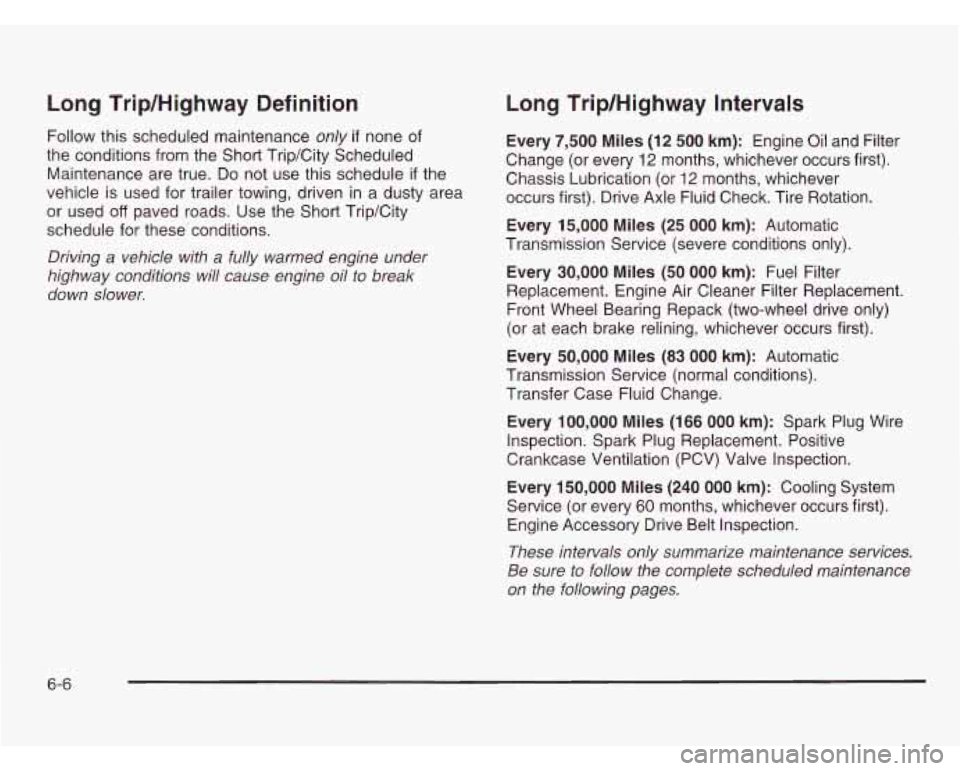
Long Trip/Highway Definition
Follow this scheduled maintenance only if none of
the conditions from the Short Trip/City Scheduled
Maintenance are true. Do not use this schedule
if the
vehicle is used for trailer towing, driven in a dusty area
or used
off paved roads. Use the Short Trip/City
schedule for these conditions.
Driving a vehicle with a fully warmed engine under
highway conditions will cause engine oil
to break
down slower.
Long Trip/Highway Intervals
Every 7,500 Miles (12 500 km): Engine Oil and Filter
Change (or every
12 months, whichever occurs first).
Chassis Lubrication (or
12 months, whichever
occurs first). Drive Axle Fluid Check. Tire Rotation.
Every 15,000 Miles (25 000 km): Automatic
Transmission Service (severe conditions only).
Every 30,000 Miles (50 000 km): Fuel Filter
Replacement. Engine Air Cleaner Filter Replacement.
Front Wheel Bearing Repack (two-wheel drive only)
(or at each brake relining, whichever occurs first).
Every 50,000 Miles (83 000 km): Automatic
Transmission Service (normal conditions).
Transfer Case Fluid Change.
Every 100,000 Miles (166 000 km): Spark Plug Wire
Inspection. Spark Plug Replacement. Positive
Crankcase Ventilation (PCV) Valve Inspection.
Every 150,000 Miles (240 000 km): Cooling System
Service (or every
60 months, whichever occurs first).
Engine Accessory Drive Belt Inspection.
These intervals only summarize maintenance services.
Be sure to follow the complete scheduled maintenance
on the following pages.
6-6
Page 326 of 386
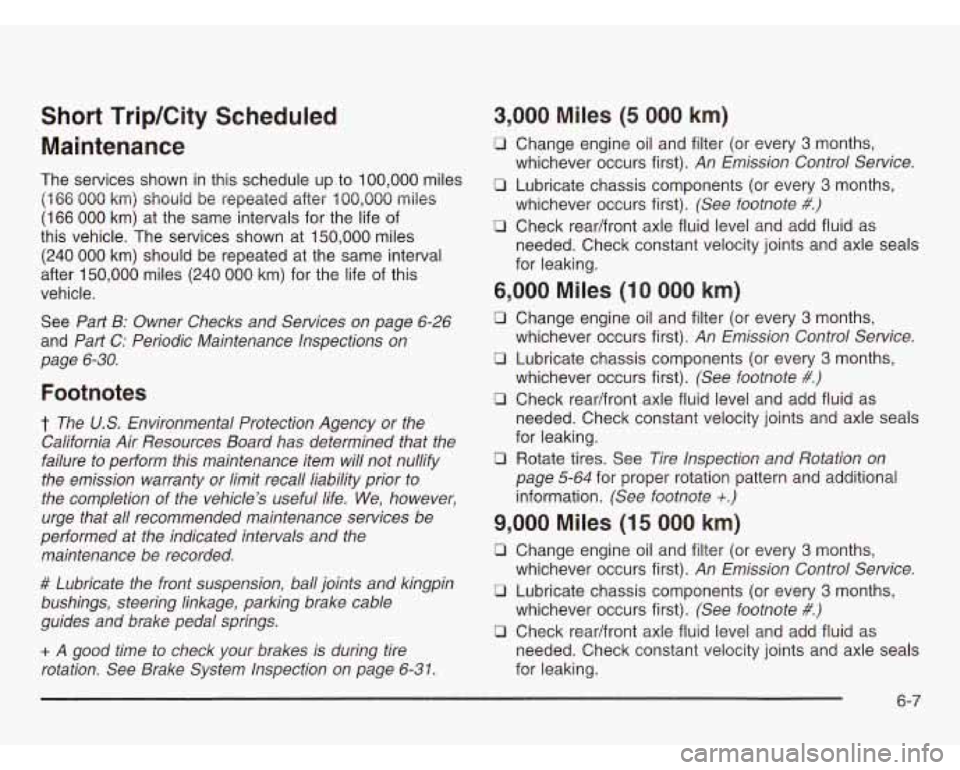
Short Trip/City Scheduled Maintenance
The services shown in this schedule up to 100,000 miles
(166 000 km) should be repeated after IQ0,OOQ miles
(166 000 km) at the same intervals for the life of
this vehicle. The services shown at
150,000 miles
(240
000 km) should be repeated at the same interval
after
150,000 miles (240 000 km) for the life of this
vehicle.
See
Part B: Owner Checks and Services on page 6-26
and Part C: Periodic Maintenance Inspections on
page 6-30.
Footnotes
t The U.S. Environmental Protection Agency or the
California Air Resources Board has determined that the
failure to perform this maintenance item will not nullify
the emission warranty or limit recall liability prior to
the completion of the vehicle’s useful life. We, however,
urge that all recommended maintenance services be
performed at the indicated intervals and the
maintenance be recorded.
# Lubricate the front suspension, ball joints and kingpin
bushings, steering linkage, parking brake cable
guides and brake pedal springs.
+ A good time to check your brakes is during tire
rotation. See Brake System Inspection
on page 6-3 1.
3,000 Miles (5 000 km)
0 Change engine oil and filter (or every 3 months,
0 Lubricate chassis components (or every 3 months,
0 Check readfront axle fluid level and add fluid as
whichever
occurs first).
An Emission Control Service.
whichever occurs first). (See footnote #.)
needed. Check constant velocity joints and axle seals
for leaking.
6,000 Miles (IO 000 km)
0
0
0
0
Change engine oil and filter (or every 3 months,
whichever occurs first).
An Emission Control Service.
Lubricate chassis components (or every 3 months,
whichever occurs first).
(See footnote #.)
Check readfront axle fluid level and add fluid as
needed. Check constant velocity joints and axle seals
for leaking.
Rotate tires. See
Tire Inspection and Rotation on
page 5-64
for proper rotation pattern and additional
information.
(See footnote +.)
9,000 Miles (15 000 km)
0 Change engine oil and filter (or every 3 months,
0 Lubricate chassis components (or every 3 months,
0 Check readfront axle fluid level and add fluid as
whichever
occurs first).
An Emission Control Service.
whichever occurs first). (See footnote #.)
needed. Check constant velocity joints and axle seals
for leaking.
6-7
Page 337 of 386
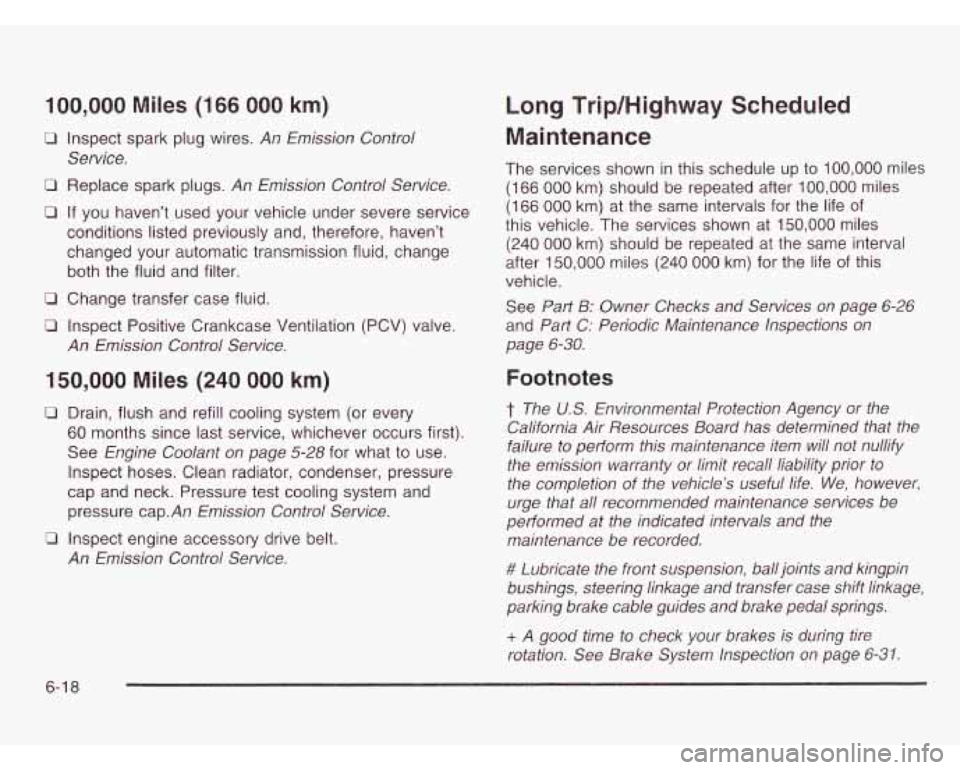
100,000 Miles (166 000 km)
0 Inspect spark plug wires. An Emission Control
Service.
0 Replace spark plugs. An Emission Control Service.
0 If you haven’t used your vehicle under severe service
conditions listed previously and, therefore, haven’t
changed your automatic transmission fluid, change
both the fluid and filter.
0 Change transfer case fluid.
Cl Inspect Positive Crankcase Ventilation (PCV) valve.
An Emission Control Service.
150,000 Miles (240 000 km)
0 Drain, flush and refill cooling system (or every
60 months since last service, whichever occurs first).
See
Engine Coolant on page 5-28 for what to use.
Inspect hoses. Clean radiator, condenser, pressure
cap and neck. Pressure test cooling system and
pressure cap.An
Emission Control Service.
An Emission Control Service.
Cl Inspect engine accessory drive belt.
Long Trip/Highway Scheduled
Maintenance
The services shown in this schedule up to 100,000 miles
(166 000 km) should be repeated after 100,000 miles
(166 000 km) at the same intervals for the life of
this vehicle. The services shown at
150,000 miles
(240 000 km) should be repeated at the same interval
after
150,000 miles (240 000 km) for the life of this
vehicle.
See
Part 5: Owner Checks and Services on page 6-26
and Part C: Periodic Maintenance Inspections on
page 6-30.
Footnotes
t The U.S. Environmental Protection Agency or the
California Air Resources Board has determined that the
failure to perform this maintenance item will not nullify the emission warranty or limit recall liability prior to
the completion of the vehicle’s useful life. We, however,
urge that all recommended maintenance services be
performed at the indicated intervals and the
maintenance be recorded.
# Lubricate the front suspension, ball joints and kingpin
bushings, steering linkage and transfer case shift linkage,
parking brake cable guides and brake pedal springs.
+ A good time to check your brakes is during tire
rotation. See Brake System Inspection
on page 6-31.
6-1 8
Page 353 of 386
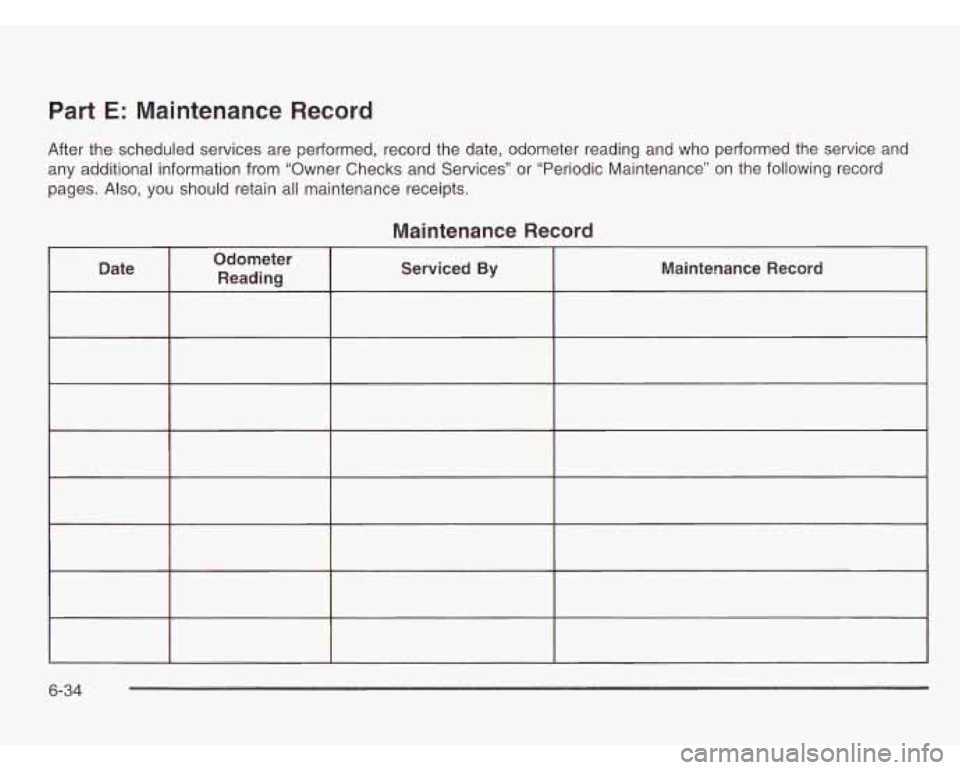
Part E: Maintenance Record
After the scheduled services are performed, record the date, odometer reading and who performed the service and
any additional information from “Owner Checks and Services”
or “Periodic Maintenance” on the following record
pages. Also, you should retain all maintenance receipts.
Maintenance Record
6-34
Page 359 of 386
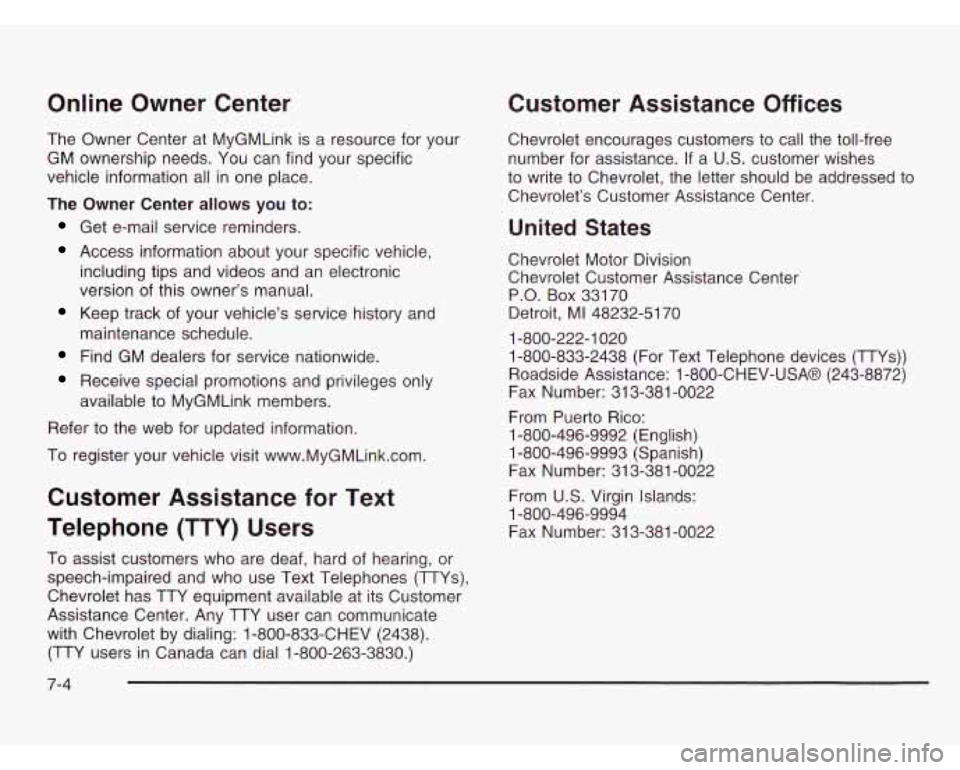
Online Owner Center
The Owner Center at MyGMLink is a resource for your
GM ownership needs. You can find your specific
vehicle information all in one place.
The Owner Center allows you to:
Get e-mail service reminders.
Access information about your specific vehicle.
including tips and videos and an electronic
version of this owner’s manual.
Keep track of your vehicle’s service history and
Find GM dealers for service nationwide.
maintenance
schedule.
Receive special promotions and privileges only
available to MyGMLink members.
Refer to the web for updated information.
To register your vehicle visit www.MyGMLink.com.
Customer Assistance for Text
Telephone (TTY) Users
To assist customers who are deaf, hard of hearing, or
speech-impaired and who use Text Telephones
(TTYs),
Chevrolet has TTY equipment available at its Customer
Assistance Center. Any TTY user can communicate
with Chevrolet by dialing: 1 -800-833-CHEV (2438).
(TTY users in Canada can dial 1-800-263-3830.)
Customer Assistance Off ices
Chevrolet encourages customers to call the toll-free
number for assistance. If a U.S. customer wishes
to write to Chevrolet, the letter should be addressed to
Chevrolet’s Customer Assistance Center.
United States
Chevrolet Motor Division
Chevrolet Customer Assistance Center
P.O. Box 33170
Detroit, MI 48232-51
70
1-800-222-1 020
1-800-833-2438 (For Text Telephone devices (TTYs))
Roadside Assistance: 1 -800-CHEV-USA@ (243-8872)
Fax Number: 31 3-381 -0022
From Puerto Rico:
1-800-496-9992 (English)
1-800-496-9993 (Spanish)
Fax Number: 31 3-381 -0022
From
US. Virgin Islands:
Fax Number: 31 3-381 -0022
1-800-496-9994
7-4
Page 363 of 386
Courtesy Transportation
Chevrolet has always exemplified quality and value
in its offering of motor vehicles. To enhance your
ownership experience, we and our participating dealers
are proud to offer Courtesy Transportation, a customer
support program for new vehicles.
The Courtesy Transportation program is offered to
retail purchaseAease customers in conjunction with
the Bumper-to-Bumper coverage provided by the
New Vehicle Limited Warranty. Several transportation
options are available when warranty repairs are
required. This will reduce your inconvenience during
warranty repairs.
Plan Ahead When Possible
When your vehicle requires warranty service, you
should contact your dealer and request an appointment.
By scheduling a service appointment and advising
your service consultant of your transportation needs,
your dealer can help minimize your inconvenience.
If your vehicle cannot be scheduled into the service
department immediately, keep driving it until it can be
scheduled for service, unless, of course, the problem
is safety-related. If it is, please call your dealership,
let them know this, and ask for instructions.
If the dealer requests that you simply drop the vehicle
off for service, you are urged to do
so as early in
the work day as possible to allow for same day repair.
7-e
Page 364 of 386
Transportation Options
Warranty service can generally be completed while
you wait. However,
if you are unable to wait Chevrolet
helps minimize your inconvenience by providing several
transportation options. Depending on the circumstances,
your dealer can offer you one of the following:
Shuttle Service
Participating dealers can provide you with shuttle
service to get you to your destination with minimal
interruption of your daily schedule. This includes a
one way shuttle ride to a destination up to
10 miles
from the dealership.
Public Transportation or Fuel
Reimbursement
If your vehicle requires overnight warranty repairs,
reimbursement up to
$30 per day (five day maximum)
may be available for the use of public transportation
such as taxi or bus. In addition, should you arrange
transportation through a friend or relative,
reimbursement for reasonable fuel expenses up to
$10 per day (five day maximum) may be available.
Claim amounts should reflect actual costs and be
supported by original receipts.
Courtesy Rental Vehicle
When your vehicle is unavailable due to overnight
warranty repairs, your dealer may arrange to provide
you with a courtesy rental vehicle or reimburse you
for a rentai vehicle you obtained, at actuai cost, up to
a maximum of
$30.00 per day supported by receipts.
This requires that you sign and complete a rental
agreement and meet state, local and rental vehicle
provider requirements. Requirements vary and
may include minimum age requirements, insurance
coverage, credit card, etc. You are responsible for
fuel usage charges and may also be responsible
for taxes, levies, usage fees, excessive mileage or
rental usage beyond the completion of the repair.
Generally it is not possible to provide a like-vehicle as
a courtesy rental.
7-9