brakes CHEVROLET ASTRO 2003 Owner's Manual
[x] Cancel search | Manufacturer: CHEVROLET, Model Year: 2003, Model line: ASTRO, Model: CHEVROLET ASTRO 2003Pages: 386, PDF Size: 17.31 MB
Page 214 of 386
Driving On Grades Parking on Hills
Reduce speed and shift to a lower gear before you start
down a long or steep downgrade.
If you don’t shift
down, you might have to use your brakes
so much that
they would get hot and no longer work well.
You can tow in DRIVE (D). You may want to shift the
transmission to THIRD
(3) or, if necessary, a lower gear
selection
if the transmission shifts too often (e.g., under
heavy loads and/or hilly conditions).
When towing at high altitude on steep uphill grades,
consider the following: Engine coolant will boil at a lower
temperature than at normal altitudes.
If you turn your
engine
off immediately after towing at high altitude
on steep uphill grades, your vehicle may show signs
similar to engine overheating.
To avoid this, let the
engine run while parked (preferably on level ground)
with the automatic transmission in PARK
(P) for a
few minutes before turning the engine
off. If you do get
the overheat warning, see
Engine Overheating on
page
5-3 1.
You really shoul tot park your vehicle, ith a
trailer attached, on a hill.
If something goes
wrong, your rig could start to move. People
can be injured, and both your vehicle and the
trailer can be damaged.
But if you ever have to park your rig on a hill, here’s
how to do it:
1. Apply your regular brakes, but don’t shift into
2. Have someone place chocks under the trailer
3. When the wheel chocks are in place, release the
4. Reapply the regular brakes. Then apply your PARK (P) yet.
wheels. regular brakes until the chocks absorb the load.
parking brake, and shift to PARK (P).
5. Release the regular brakes.
4-39
Page 215 of 386
When You Are Ready to Leave After
Parking on a Hill
1. Apply your regular brakes and hold the pedal down
while you:
start your engine,
shift into a gear, and
release the parking brake.
2. Let up on the brake pedal.
3. Drive slowly until the trailer is clear of the chocks.
4. Stop and have someone pick up and store the
chocks.
Maintenance When Trailer Towing
Your vehicle will need service more often when you’re
pulling a trailer. See the Maintenance Schedule for more
on this. Things that are especially important in trailer
operation are automatic transmission fluid (don’t overfill),
engine oil, axle lubricant, belt, cooling system and
brake system. Each
of these is covered in this manual,
and the Index will help you find them quickly.
If you’re
trailering, it’s a good idea to review these sections
before you start your trip.
Check periodically to see that all hitch nuts and bolts
are tight.
4-40
Page 218 of 386
Section 5 Service and Appearance Care
Service .......................................................... -5-3
Doing Your Own Service Work
......................... 5-3
Adding Equipment to the Outside of
Your Vehicle
.............................................. 5-4
Fuel ................................................................ 5.5
Gasoline Octane ........................................... -5-5
Gasoline Specifications .................................... 5.5
California Fuel ............................................. -56
Additives
....................................................... 5.6
Fuels in Foreign Countries
............................... 5.7
Filling Your Tank
............................................ 5-8
Filling a Portable Fuel Container
..................... 5-10
Checking Things Under the Hood .................... 5-1 1
Hood Release .............................................. 5.11
Engine Compartment Overview
...................... 5.14
Engine Oil
................................................... 5.15
Engine Cover ................. .... ........ 5.20
Engine Air Cleaner/Filter
................. ........ 5.24
Automatic Transmission Fluid
...................... 5.25
Engine Coolant ............................................. 5.28
Radiator Pressure Cap
.................................. 5.30
Engine Overheating
....................................... 5.31
Cooling System
............................................ 5.33
Engine Fan Noise
......................................... 5.39
Power Steering Fluid
..................................... 5.40
Windshield Washer Fluid
................................ 5.41 Brakes
........................................................ 5.42
Battery
........................................................ 5-46
Jump Starting
............................................... 5-47
All-Wheel Drive .............................................. 5-52
Rear Axle ....................................................... 5-53
Front Axle ...................................................... 5-54
Bulb Replacement .......................................... 5-55
Halogen Bulbs .............................. ..... 5-55
Headlamps .................................. ..... 5-55
Front Turn Signal Lamps ............................... 5-59
Replacement Bulbs
....................................... 5-61
Windshield Wiper Blade Replacement .............. 5-62
Tires .............................................................. 5.63
Inflation
- Tire Pressure ................................ 5-64
Tire Inspection and Rotation
........................... 5-64
When It
Is Time for New Tires ....................... 5-66
Buying New Tires
......................................... 5-66
Uniform Tire Quality Grading
.......................... 5-67
Wheel Alignment and Tire Balance
.................. 5-69
Wheel Replacement
...................................... 5-69
Tire Chains
.................................................. 5-70
If a Tire Goes Flat ........................................ 5.70
Changing a Flat Tire ..................................... 5.71
Compact Spare Tire ...................................... 5-82
Taillamps
.................................................... 5-60
5- 1
Page 259 of 386
Brakes
Brake Fluid
DOT3
. . . . . . . ..... . . . . . . . . ... .
. . . . . . . .
. ... . . . .
..
. . . . . . . . . . . , . , . . .
There are only two reasons why the brake fluid level
in the reservoir might go down. The first
is that the brake
fluid goes down to an acceptable level during normal
brake lining wear. When new linings are put in, the fluid
level goes back up. The other reason
is that fluid is
leaking out of the brake system.
If it is, you should have
your brake system fixed, since a leak means that
sooner or later your brakes won’t work well, or won’t
work at all.
So, it isn’t a good idea to “top off your brake fluid.
Adding brake fluid won’t correct a leak.
If you add fluid
when your linings are worn, then you’ll have too much
fluid when you get new brake linings. You should add
(or remove) brake fluid, as necessary, only when work is
done on the brake hydraulic system.
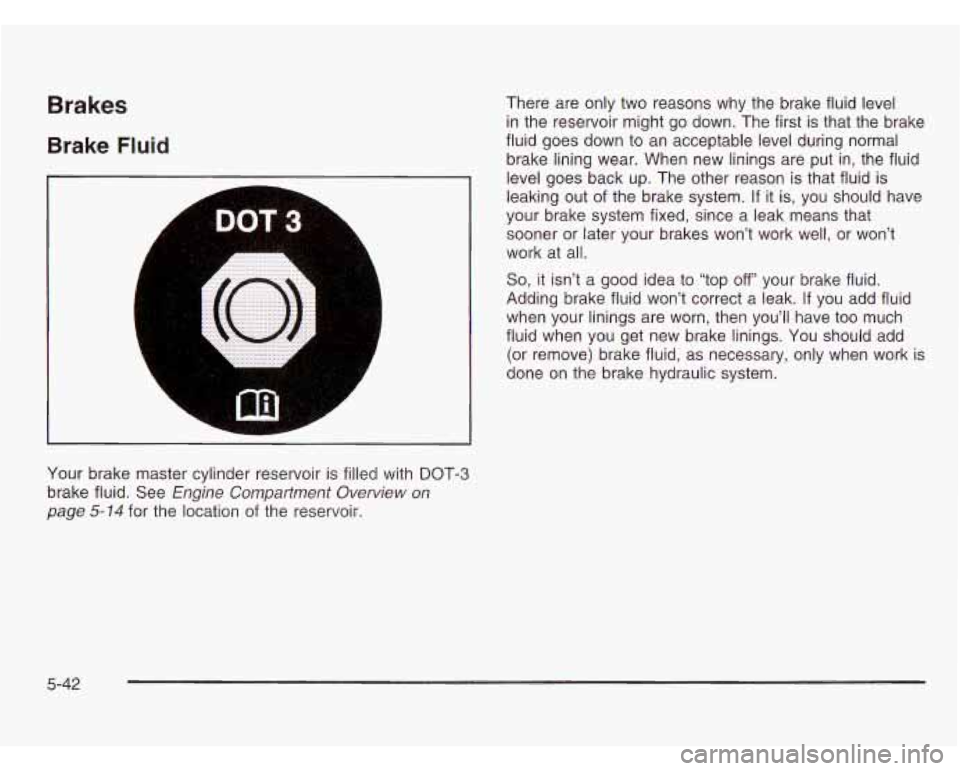
Your brake master cylinder reservoir is filled with DOT-3
brake fluid. See
Engine Compadment Overview on
page 5-14 for the location of the reservoir.
5-42
Page 261 of 386
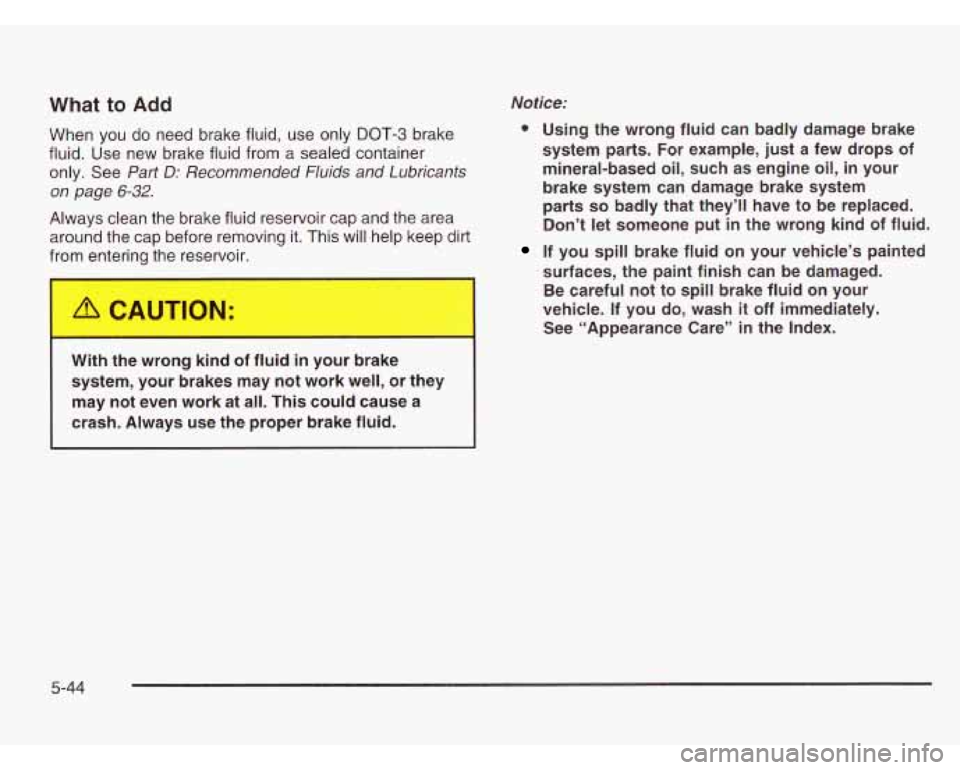
Notice:
0 Using the wrong fluid can badly damage brake
system parts. For example, just a few drops
of
mineral-based oil, such as engine oil, in your
brake system can damage brake system
parts
so badly that they’ll have to be replaced.
Don’t let someone put in the wrong kind of fluid.
If you spill brake fluid on your vehicle’s painted
surfaces, the paint finish can be damaged.
Be careful not to spill brake fluid on your
vehicle. If you do, wash
it off immediately.
See “Appearance Care”
in the Index.
What to Add
When you do need brake fluid, use only DOT-3 brake
fluid. Use new brake fluid from a sealed container
only. See
Part D: Recommended Fluids and Lubricants
on page 6-32.
Always clean the brake fluid reservoir cap and the area
around the cap before removing it. This will help keep dirt
from enterinn the reservoir.
I
With the VI .-.. =I kir.- of flui, .n your b.,.re
system, your brakes may not work well, or they
may not even work at all. This could cause a
crash. Always use the proper brake fluid.
5-44
Page 262 of 386
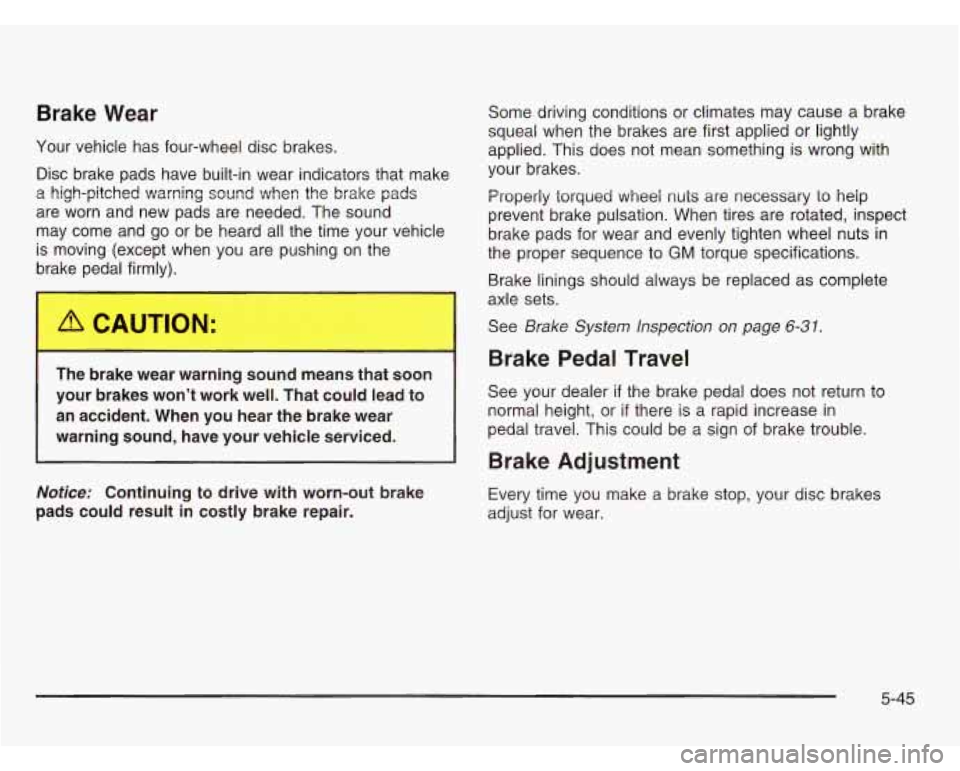
Brake Wear
Your vehicle has four-wheel disc brakes,
Disc brake pads have built-in wear indicators that make
a high-pitched warning sound when the brake
pads
are worn and new pads are needed. The sound
may come and go or be heard all the time your vehicle
is moving (except when you are pushing on the
brake pedal firmly).
The brake wear warning sound means that soon
your brakes won’t work well. That could lead to
an accident. When
you hear the brake wear
Notice: Continuing to drive with worn-out brake
pads could result in costly brake repair.
Some driving conditions or climates may cause a brake
squeal when the brakes are first applied or lightly
applied. This does not mean something is wrong with
your brakes.
Properly torqued wheei nuts are necessary to heip
prevent brake pulsation. When tires are rotated, inspect
brake pads for wear and evenly tighten wheel nuts in
the proper sequence to
GM torque specifications.
Brake linings should always be replaced as complete
axle sets.
See
Brake System Inspection on page 6-31.
Brake Pedal Travel
See your dealer if the brake pedal does not return to
normal height, or if there is a rapid increase in
pedal travel. This could be a sign of brake trouble.
Brake Adjustment
Every time you make a brake stop, your disc brakes
adjust for wear.
5-45
Page 263 of 386
Replacing Brake System Parts
Te braking system on a vehicle is complex. Its many parts
have to be of top quality and work well together
if the
vehicle is to have really good braking. Your vehicle was
designed and tested with top-quality
GM brake parts.
When you replace parts of your braking system -for
example, when your brake linings wear down and you
need new ones put
in - be sure you get new approved
GM replacement parts. If you don’t, your brakes may no
longer work properly.
For example,
if someone puts in brake linings that are
wrong for your vehicle, the balance between your front
and rear brakes can change -for the worse. The braking
performance you’ve come to expect can change
in many
other ways
if someone puts in the wrong replacement
brake parts.
Battery
Your new vehicle comes with a maintenance free
ACDelco@ battery. When it’s time for a new battery,
get one that has the replacement number shown on the
original battery’s label. We recommend an ACDelco@
battery. See
Engine Compartment Overview on
page 5-74 for battery location.
Warnings Battery posts, terminals and related
accessories contain lead and lead compounds,
chemicals known to the State
of California to cause
cancer and reproductive harm. Wash hands after
handling.
5-46
Page 311 of 386
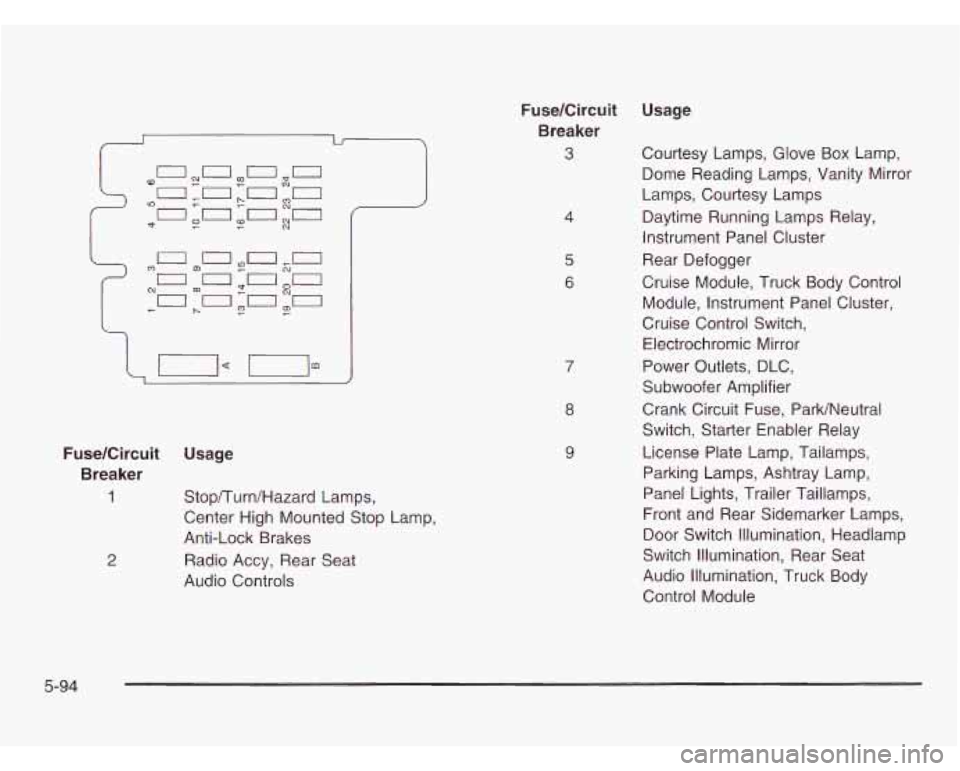
FuseKircuit Usage
Breaker
1
2
Stop/Turn/Hazard Lamps,
Center High Mounted Stop Lamp,
Anti-Lock Brakes
Radio Accy, Rear Seat
Audio Controls
FuseKircuit
Breaker
3
4
5
6
8
9
Usage
Courtesy Lamps, Glove Box Lamp,
Dome Reading Lamps, Vanity Mirror
Lamps, Courtesy Lamps
Daytime Running Lamps Relay,
Instrument Panel Cluster
Rear Defogger
Cruise Module, Truck Body Control Module, Instrument Panel Cluster,
Cruise Control Switch,
Electrochromic Mirror
Power Outlets, DLC,
Subwoofer Amplifier
Crank Circuit Fuse, ParWNeutral
Switch, Starter Enabler Relay
License Plate Lamp, Tailamps,
Parking Lamps, Ashtray Lamp,
Panel Lights, Trailer Taillamps,
Front and Rear Sidemarker Lamps,
Door Switch Illumination, Headlamp
Switch Illumination, Rear Seat
Audio Illumination, Truck Body
Control Module
5-94
Page 326 of 386
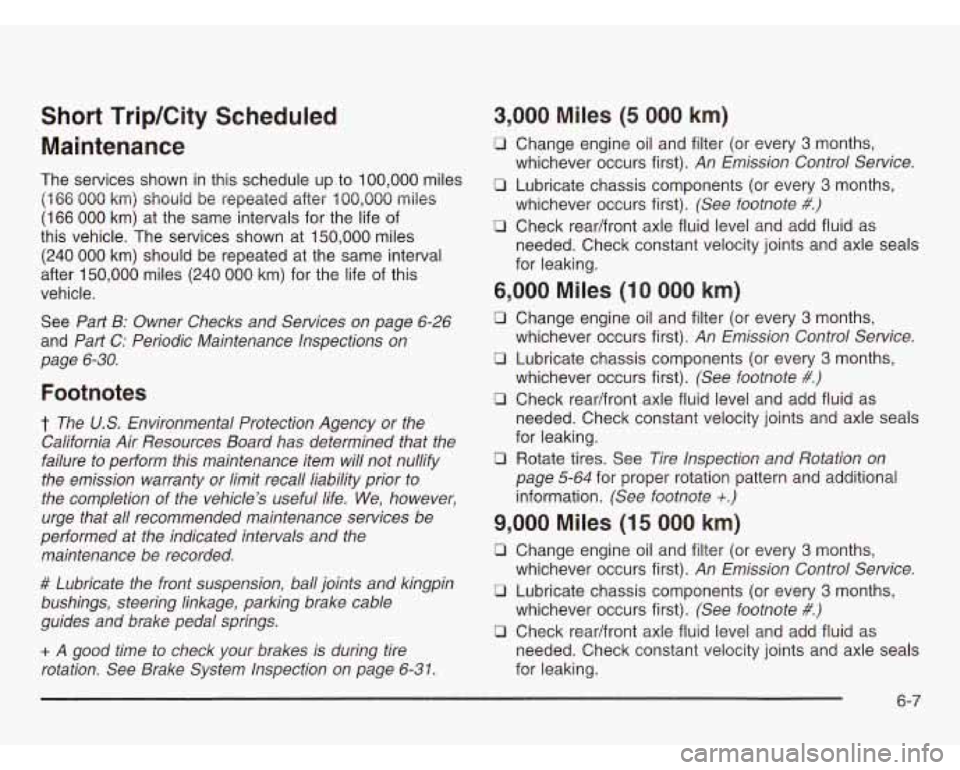
Short Trip/City Scheduled Maintenance
The services shown in this schedule up to 100,000 miles
(166 000 km) should be repeated after IQ0,OOQ miles
(166 000 km) at the same intervals for the life of
this vehicle. The services shown at
150,000 miles
(240
000 km) should be repeated at the same interval
after
150,000 miles (240 000 km) for the life of this
vehicle.
See
Part B: Owner Checks and Services on page 6-26
and Part C: Periodic Maintenance Inspections on
page 6-30.
Footnotes
t The U.S. Environmental Protection Agency or the
California Air Resources Board has determined that the
failure to perform this maintenance item will not nullify
the emission warranty or limit recall liability prior to
the completion of the vehicle’s useful life. We, however,
urge that all recommended maintenance services be
performed at the indicated intervals and the
maintenance be recorded.
# Lubricate the front suspension, ball joints and kingpin
bushings, steering linkage, parking brake cable
guides and brake pedal springs.
+ A good time to check your brakes is during tire
rotation. See Brake System Inspection
on page 6-3 1.
3,000 Miles (5 000 km)
0 Change engine oil and filter (or every 3 months,
0 Lubricate chassis components (or every 3 months,
0 Check readfront axle fluid level and add fluid as
whichever
occurs first).
An Emission Control Service.
whichever occurs first). (See footnote #.)
needed. Check constant velocity joints and axle seals
for leaking.
6,000 Miles (IO 000 km)
0
0
0
0
Change engine oil and filter (or every 3 months,
whichever occurs first).
An Emission Control Service.
Lubricate chassis components (or every 3 months,
whichever occurs first).
(See footnote #.)
Check readfront axle fluid level and add fluid as
needed. Check constant velocity joints and axle seals
for leaking.
Rotate tires. See
Tire Inspection and Rotation on
page 5-64
for proper rotation pattern and additional
information.
(See footnote +.)
9,000 Miles (15 000 km)
0 Change engine oil and filter (or every 3 months,
0 Lubricate chassis components (or every 3 months,
0 Check readfront axle fluid level and add fluid as
whichever
occurs first).
An Emission Control Service.
whichever occurs first). (See footnote #.)
needed. Check constant velocity joints and axle seals
for leaking.
6-7
Page 337 of 386
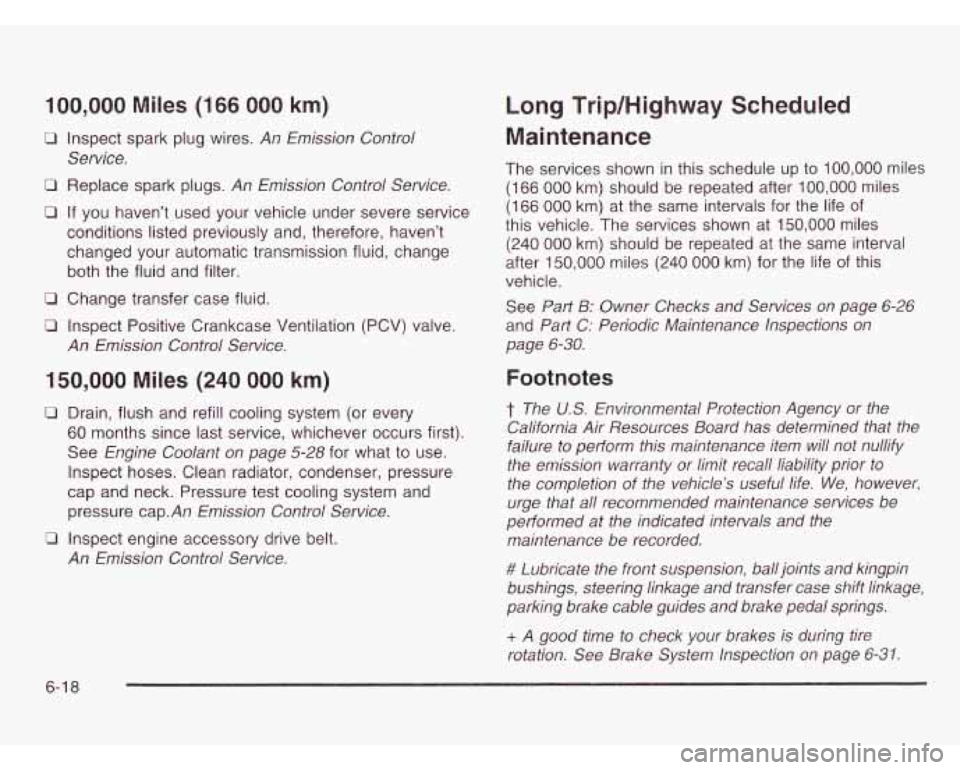
100,000 Miles (166 000 km)
0 Inspect spark plug wires. An Emission Control
Service.
0 Replace spark plugs. An Emission Control Service.
0 If you haven’t used your vehicle under severe service
conditions listed previously and, therefore, haven’t
changed your automatic transmission fluid, change
both the fluid and filter.
0 Change transfer case fluid.
Cl Inspect Positive Crankcase Ventilation (PCV) valve.
An Emission Control Service.
150,000 Miles (240 000 km)
0 Drain, flush and refill cooling system (or every
60 months since last service, whichever occurs first).
See
Engine Coolant on page 5-28 for what to use.
Inspect hoses. Clean radiator, condenser, pressure
cap and neck. Pressure test cooling system and
pressure cap.An
Emission Control Service.
An Emission Control Service.
Cl Inspect engine accessory drive belt.
Long Trip/Highway Scheduled
Maintenance
The services shown in this schedule up to 100,000 miles
(166 000 km) should be repeated after 100,000 miles
(166 000 km) at the same intervals for the life of
this vehicle. The services shown at
150,000 miles
(240 000 km) should be repeated at the same interval
after
150,000 miles (240 000 km) for the life of this
vehicle.
See
Part 5: Owner Checks and Services on page 6-26
and Part C: Periodic Maintenance Inspections on
page 6-30.
Footnotes
t The U.S. Environmental Protection Agency or the
California Air Resources Board has determined that the
failure to perform this maintenance item will not nullify the emission warranty or limit recall liability prior to
the completion of the vehicle’s useful life. We, however,
urge that all recommended maintenance services be
performed at the indicated intervals and the
maintenance be recorded.
# Lubricate the front suspension, ball joints and kingpin
bushings, steering linkage and transfer case shift linkage,
parking brake cable guides and brake pedal springs.
+ A good time to check your brakes is during tire
rotation. See Brake System Inspection
on page 6-31.
6-1 8