washer fluid CHEVROLET ASTRO 2003 Owners Manual
[x] Cancel search | Manufacturer: CHEVROLET, Model Year: 2003, Model line: ASTRO, Model: CHEVROLET ASTRO 2003Pages: 386, PDF Size: 17.31 MB
Page 133 of 386
Windshield Wipers For fewer wipes choose a setting closer to LOW.
Use this setting for light rain and snow.
- -
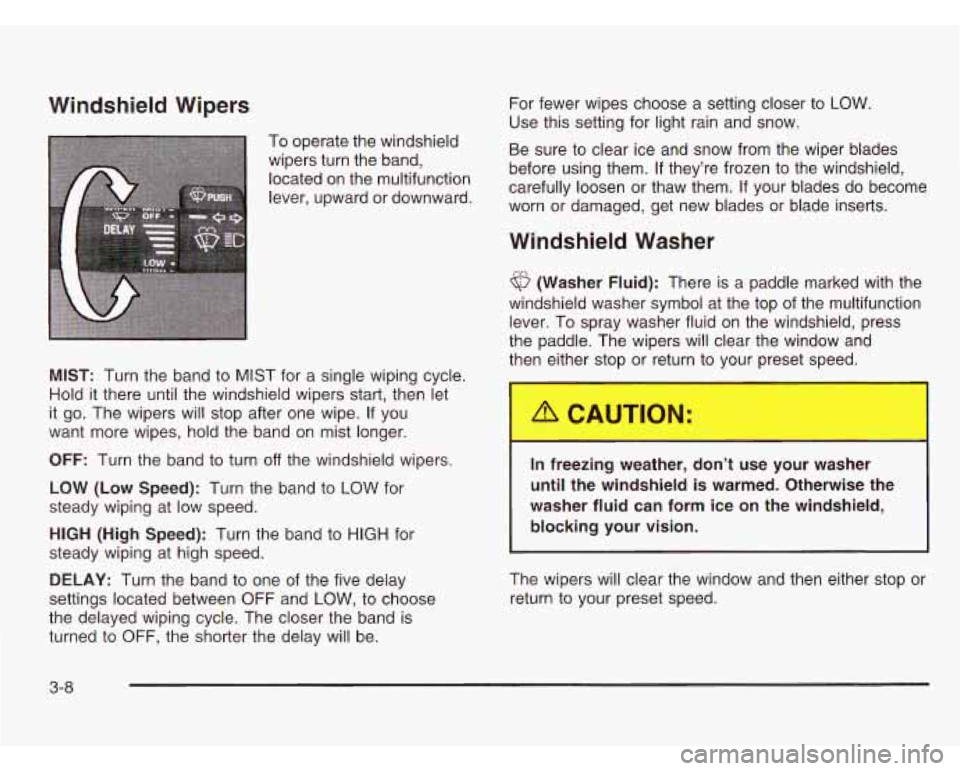
To operate the windshield
wipers turn the band,
located On the multifunction carefully loosen or thaw them. If your blades do become
lever’ Or worn or damaged, get new blades or blade inserts. Be
sure to clear ice and snow from the wiper blades
before using them.
If they’re frozen to the windshield,
Windshield Washer
6 (Washer Fluid): There is a paddle marked with the
windshield washer symbol at the top of the multifunction
lever. To spray washer fluid on the windshield, press
the paddle. The wipers will clear the window and
then either stop or return to vour preset speed.
MIST: Turn the band to MIST for a single wiping cycle.
Hold
it there until the windshield wipers start, then let
it go. The wipers will stop after one wipe. If you
want more wipes, hold the band on mist longer.
OFF: Turn the band to turn off the windshield wipers.
LOW (Low Speed): Turn the band to LOW for
steady wiping at low speed.
HIGH (High Speed): Turn the band to HIGH for
steady wiping at high speed.
DELAY: Turn the band to one of the five delay
settings located between OFF and
LOW, to choose
the delayed wiping cycle. The closer the band is
turned to OFF, the shorter the delay will be.
In freezing weather, don’t u- - your washer
until the windshield is warmed. Otherwise the
washer fluid can form ice on the windshield,
blocking your vision.
The wipers will clear the window and then either stop or
return to your preset speed.
3-8
Page 134 of 386
Rear Window WasherNViper For delay wiping, slide the switch up to the center
position next to the word DELAY on the rear wiper
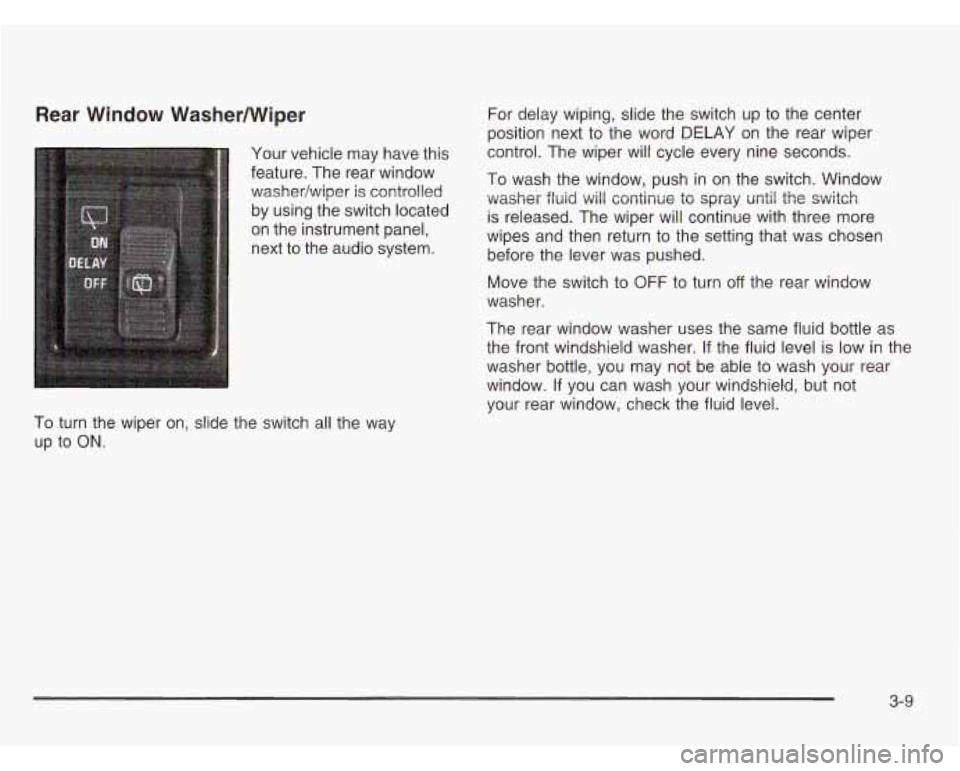
Your vehicle may have this control. The wiper will cycle every nine seconds.
feature. The rear window
To wash the window, push in on the switch. Window
washer'wiper
is controHed washer fluid will continue to spray until the switch
by using
the switch located is released. The wiper will continue with three more
on the instrument panel, wipes and then return to the setting that was chosen
next to the audio system.
before the lever was pushed.
Move the switch to
OFF to turn off the rear window
washer.
The rear window washer uses the same fluid bottle as
the front windshield washer. If the fluid level
is low in the
washer bottle, you may not be able to wash your rear
window.
If you can wash your windshield, but not
your rear window, check the fluid level.
To turn the wiper on, slide the switch all the way
up to
ON.
3-9
Page 191 of 386
Driving in Rain and on Wet Roads And, if your tires don’t have much tread left, you’ll get
even less traction. It’s always wise to go slower and
be cautious
if rain starts to fall while you are driving.
The surface may get wet suddenly when your reflexes
are tuned for driving on dry pavement.
The heavier the rain, the harder it is to see. Even
if your
windshield wiper blades are in good shape, a heavy rain
can make it harder to see road signs and traffic signals,
pavement markings, the edge of the road and even
people walking.
It’s wise to keep your wiping equipment in good shape
and keep your windshield washer tank filled with
washer fluid. Replace your windshield wiper inserts
when they show signs of streaking or missing areas
on the windshield, or when strips of rubber start
to separate from the inserts.
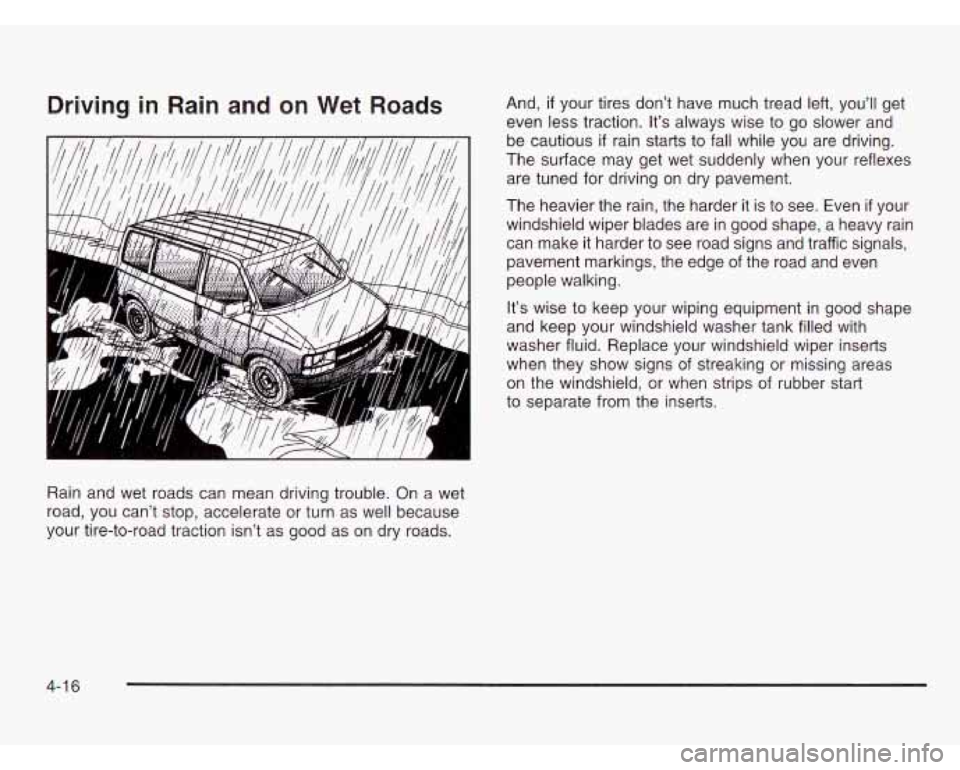
Rain and wet roads can mean driving trouble. On a wet
road, you can’t stop, accelerate or turn as well because
your tire-to-road traction isn’t as good
as on dry roads.
4-1 6
Page 196 of 386
The exit ramp can be curved, sometimes quite sharply.
The exit speed is usually posted.
Reduce your speed according to your speedometer, not
to your sense of motion. After driving for any distance
at higher speeds, you
may tend to think you are
going slower than you actually are.
Before Leaving on a Long Trip
Make sure you’re ready. Try to be well rested. If you
must start when you’re not fresh
- such as after a day’s
work
- don’t plan to make too many miles that first
part of the journey. Wear comfortable clothing and shoes
you can easily drive in.
Is your vehicle ready for a long trip? If you keep it
serviced and maintained, it’s ready to go.
If it needs
service, have it done before starting out. Of course,
you’ll find experienced and able service experts
in dealerships all across North America. They’ll be
ready and willing to help
if you need it. Here
are some things you can check before a trip:
e
e
e
Windshield Washer Fluid: Is the reservior full?
Are
all windows clean inside and outside?
Wiper Blades: Are they in good shape?
Fuel, Engine Oil, Other Fluids: Have you checked
all levels?
Lamps: Are they all working? Are the lenses clean?
Tires: They are vitally important to a safe,
trouble-free trip.
Is the tread good enough for
long-distance driving? Are the tires all inflated
to the recommended pressure?
Weather Forecasts: What’s the weather outlook
along your route? Should you delay your trip a
short time to avoid a major storm system?
Maps: Do you have up-to-date maps?
4-2 1
Page 199 of 386
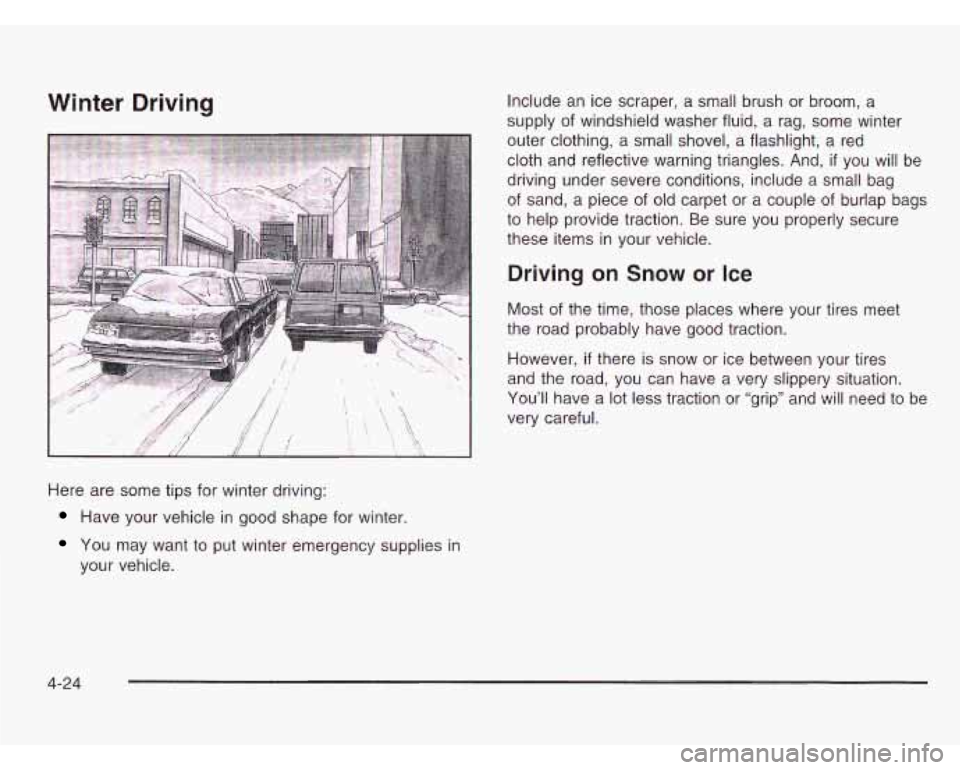
Winter Driving
Here are some tips for winter driving:
Have your vehicle in good shape for winter.
You may want to put winter emergency supplies in
your vehicle. Include
an ice scraper, a small brush or broom, a
supply of windshield washer fluid, a rag, some winter
outer clothing, a small shovel, a flashlight, a red
cloth and reflective warning triangles. And,
if you will be
driving under severe conditions, include a small bag
of sand, a piece of old carpet or a couple of burlap bags
to help provide traction. Be sure you properly secure
these items
in your vehicle.
Driving on Snow or Ice
Most of the time, those places where your tires meet
the road probably have good traction.
However,
if there is snow or ice between your tires
and the road, you can have a very slippery situation.
You’ll have a lot less traction or “grip” and will need to be
very careful.
4-24
Page 218 of 386
Section 5 Service and Appearance Care
Service .......................................................... -5-3
Doing Your Own Service Work
......................... 5-3
Adding Equipment to the Outside of
Your Vehicle
.............................................. 5-4
Fuel ................................................................ 5.5
Gasoline Octane ........................................... -5-5
Gasoline Specifications .................................... 5.5
California Fuel ............................................. -56
Additives
....................................................... 5.6
Fuels in Foreign Countries
............................... 5.7
Filling Your Tank
............................................ 5-8
Filling a Portable Fuel Container
..................... 5-10
Checking Things Under the Hood .................... 5-1 1
Hood Release .............................................. 5.11
Engine Compartment Overview
...................... 5.14
Engine Oil
................................................... 5.15
Engine Cover ................. .... ........ 5.20
Engine Air Cleaner/Filter
................. ........ 5.24
Automatic Transmission Fluid
...................... 5.25
Engine Coolant ............................................. 5.28
Radiator Pressure Cap
.................................. 5.30
Engine Overheating
....................................... 5.31
Cooling System
............................................ 5.33
Engine Fan Noise
......................................... 5.39
Power Steering Fluid
..................................... 5.40
Windshield Washer Fluid
................................ 5.41 Brakes
........................................................ 5.42
Battery
........................................................ 5-46
Jump Starting
............................................... 5-47
All-Wheel Drive .............................................. 5-52
Rear Axle ....................................................... 5-53
Front Axle ...................................................... 5-54
Bulb Replacement .......................................... 5-55
Halogen Bulbs .............................. ..... 5-55
Headlamps .................................. ..... 5-55
Front Turn Signal Lamps ............................... 5-59
Replacement Bulbs
....................................... 5-61
Windshield Wiper Blade Replacement .............. 5-62
Tires .............................................................. 5.63
Inflation
- Tire Pressure ................................ 5-64
Tire Inspection and Rotation
........................... 5-64
When It
Is Time for New Tires ....................... 5-66
Buying New Tires
......................................... 5-66
Uniform Tire Quality Grading
.......................... 5-67
Wheel Alignment and Tire Balance
.................. 5-69
Wheel Replacement
...................................... 5-69
Tire Chains
.................................................. 5-70
If a Tire Goes Flat ........................................ 5.70
Changing a Flat Tire ..................................... 5.71
Compact Spare Tire ...................................... 5-82
Taillamps
.................................................... 5-60
5- 1
Page 228 of 386
Checking Things Under
the Hood
Hood Release
Things that burn can get on hot engine parts
and start
a fire. These include liquids like fuel,
oil, coolant, brake fluid, windshield washer and
other fluids, and plastic or rubber. You or
others could be burned. Be careful not to drop
or spill things that
will burn onto a hot engine.
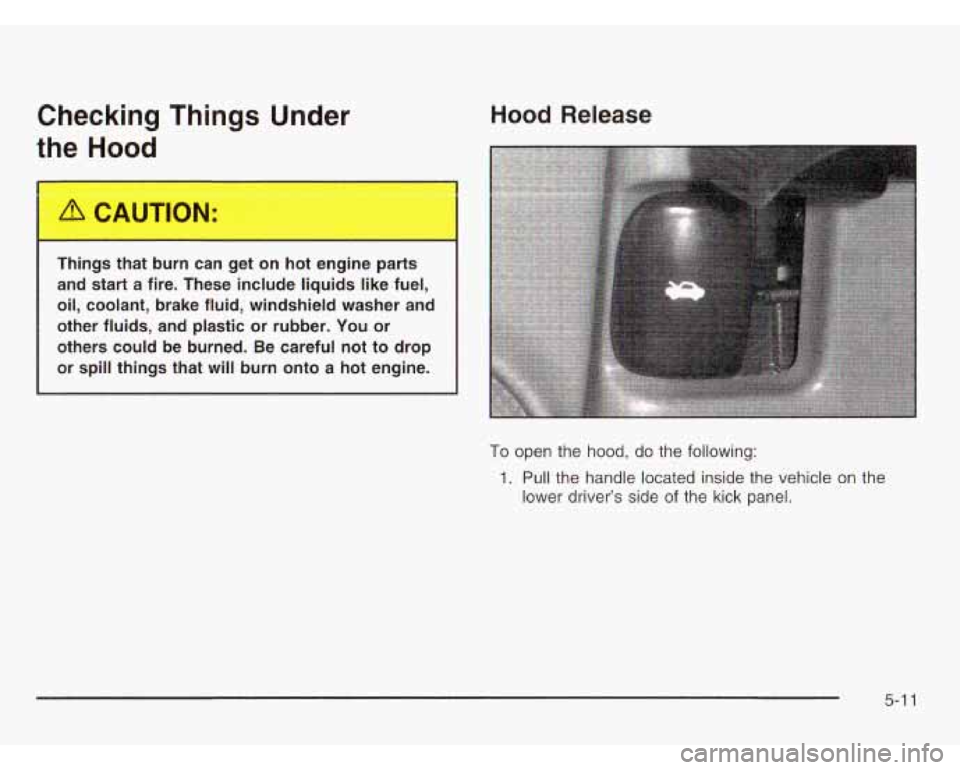
To open the hood, do the following:
1. Pull the handle located inside the vehicle on the
lower driver’s side of the kick panel.
5-1 1
Page 232 of 386
A. Windshield Washer Fluid
B. Engine Coolant
C. Engine
Oil Dipstick
D. Transmission Dipstick
E. Engine Air Cleaner/Filter
F. Engine Oil Fill
G. Brake Master Cylinder Reservoir
H. Power Steering Fluid Reservoir
I. Battery
Engine Oil
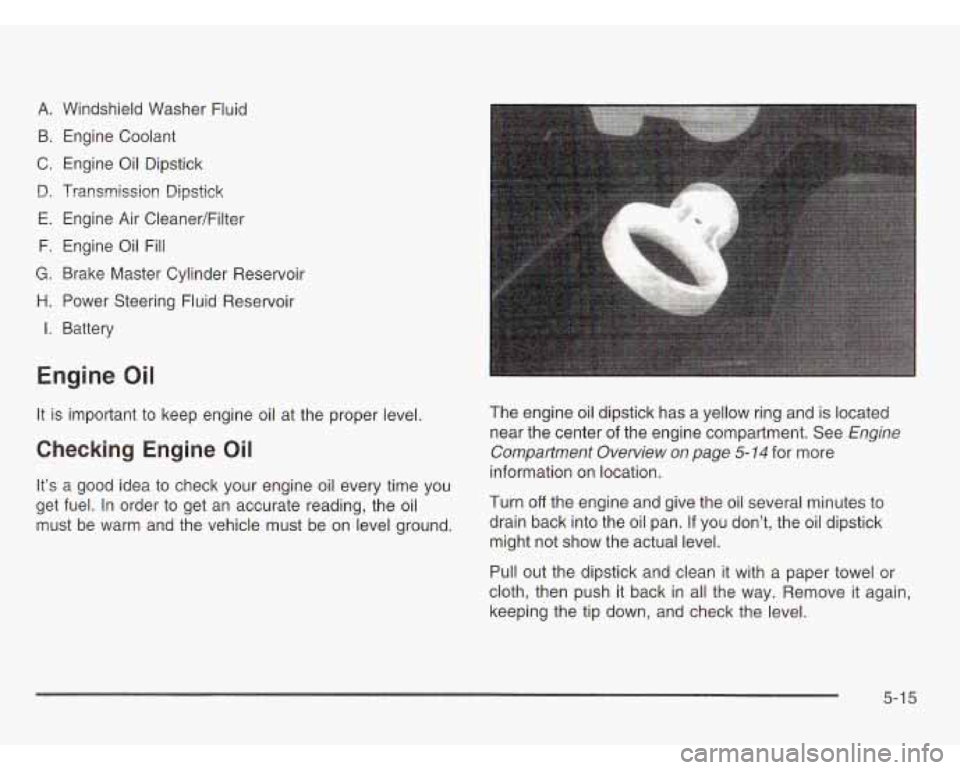
It is important to keep engine oil at the proper level. The engine oil dipstick has a yellow ring and is located
near the center of the engine compartment. See
Engine
information on location.
Checking Engine Oil Compartment Overview on page 5- 14 for more
It’s a good idea to check your engine oil every time
you
get fuel. In order to get an accurate reading, the oil Turn off the engine and give the oil several minutes to
must be warm and the vehicle must be on level ground. drain back into the
Oil pan. If YOU don’t, the oil dipstick
might not show the actual level.
Pull out the dipstick and clean it with a paper towel or
cloth, then push it back in all the way. Remove it again,
keeping the tip down, and check the level.
5-1 5
Page 258 of 386
Windshield Washer Fluid
What to Use
When you need windshield washer fluid, be sure to read
the manufacturer’s instructions before use. If you will
be operating your vehicle in an area where the
temperature may fall below freezing, use a fluid that
has sufficient protection against freezing.
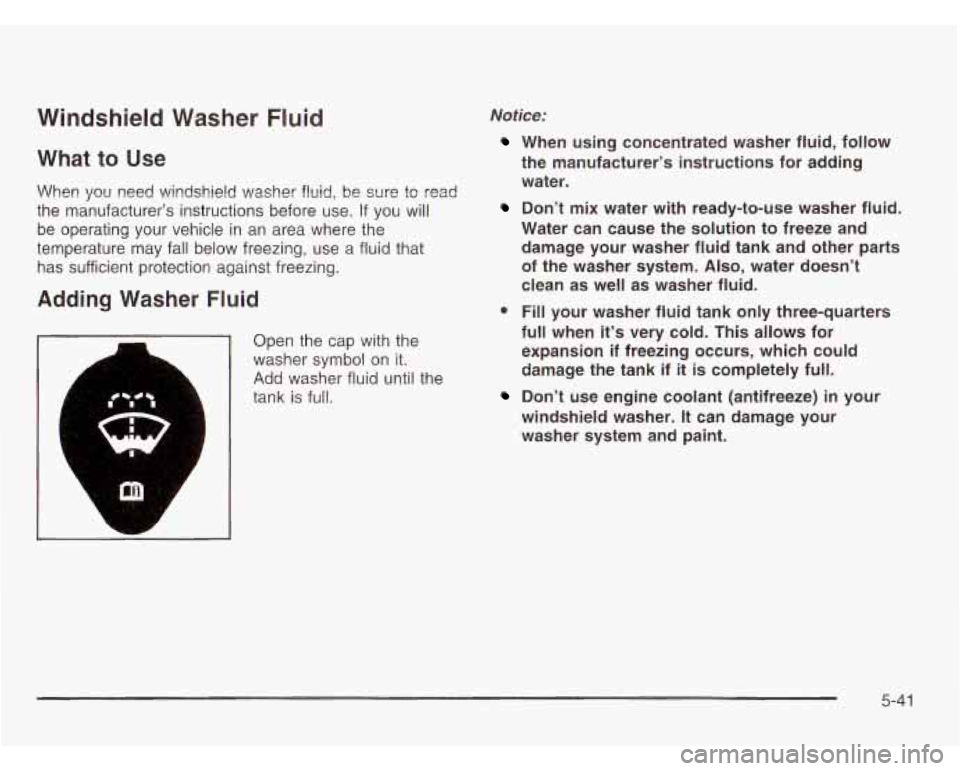
Adding Washer Fluid
Open the cap with the
washer symbol on it.
Add washer fluid until the
tank is full.
Notice:
When using concentrated washer fluid, follow
the manufacturer’s instructions for adding water.
Don’t mix water with ready-to-use washer fluid.
Water can cause the solution to freeze and
damage your washer fluid tank and other parts
of the washer system.
Also, water doesn’t
clean as well as washer fluid.
0 Fill your washer fluid tank only three-quarters
full when
it’s very cold. This allows for
expansion
if freezing occurs, which could
damage the tank if
it is completely full.
Don’t use engine coolant (antifreeze) in your
windshield washer.
It can damage your
washer system and paint.
5-41
Page 345 of 386
Part B: Owner Checks and Services
Listed in this part are owner checks and services
which should be performed at the intervals specified to
help ensure the safety, dependability and emission
control performance of your vehicle.
Be sure any necessary repairs are completed at once.
Whenever any fluids or lubricants are added to your
vehicle, make sure they are the proper ones, as shown
in Part D.
At Each Fuel Fill
It is important for you or a service station attendant to
perform these underhood checks at each fuel fill.
Engine Oil Level Check
Check the engine oil level and add the proper oil
if necessary. See Engine Oil on page 5-15 for
further details.
Engine Coolant Level Check
Check the engine coolant level and add DEX-COOL@
coolant mixture
if necessary. See Engine Coolant
on page
5-28 for further details.
Windshield Washer Fluid Level Check
Check the windshield washer fluid level in the windshield
washer tank and add the proper fluid
if necessary.
See
Windshield Washer Fluid on page 5-41 for
further details.
At Least Once a Month
Tire Inflation Check
Make sure tires are inflated to the correct pressures.
Don’t forget to check your spare tire. See
Tires on
page
5-63 for further details.
At Least Twice a Year
Restraint System Check
Make sure the safety belt reminder light and all your belts,
buckles, latch plates, retractors and anchorages are
working properly. Look for any other loose or damaged
safety belt system parts. If you see anything that might
keep a safety belt system from doing its job, have it
repaired. Have any torn or frayed safety belts replaced.
Also look for any opened or broken air bag coverings,
and have them repaired or replaced. (The air bag
system does not need regular maintenance.)
6-26