engine overheat CHEVROLET ASTRO 2004 User Guide
[x] Cancel search | Manufacturer: CHEVROLET, Model Year: 2004, Model line: ASTRO, Model: CHEVROLET ASTRO 2004Pages: 382, PDF Size: 2.73 MB
Page 240 of 382
What to Use
Use a mixture of one-halfclean, drinkable waterand
one-half DEX-COOLžcoolant which won't damage
aluminum parts. If you use this coolant mixture,
you don't need to add anything else.
{CAUTION:
Adding only plain water to your cooling
system can be dangerous. Plain water, or
some other liquid such as alcohol, can boil
before the proper coolant mixture will. Your
vehicle's coolant warning system is set for the
proper coolant mixture. With plain water or the
wrong mixture, your engine could get too hot
but you would not get the overheat warning.
Your engine could catch ®re and you or others
could be burned. Use a 50/50 mixture of clean,
drinkable water and the proper coolant.
Notice:If you use an improper coolant mixture,
your engine could overheat and be badly damaged.
The repair cost would not be covered by your
warranty. Too much water in the mixture can freeze
and crack the engine, radiator, heater core and
other parts.If you have to add coolant more than four times a year,
have your dealer check your cooling system.
Notice:If you use the proper coolant, you do not
have to add extra inhibitors or additives which claim
to improve the system. These can be harmful.
Checking Coolant
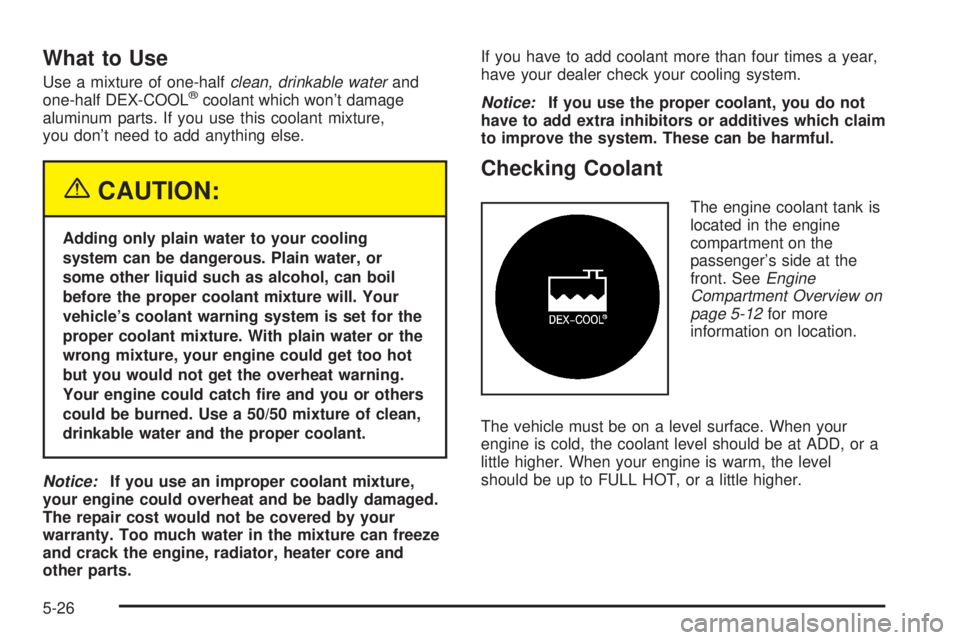
The engine coolant tank is
located in the engine
compartment on the
passenger's side at the
front. See
Engine
Compartment Overview on
page 5-12
for more
information on location.
The vehicle must be on a level surface. When your
engine is cold, the coolant level should be at ADD, or a
little higher. When your engine is warm, the level
should be up to FULL HOT, or a little higher.
5-26
Page 242 of 382
Engine Overheating
You will ®nd an engine coolant temperature gage on
your vehicle's instrument panel. SeeEngine Coolant
Temperature Gage on page 3-30.
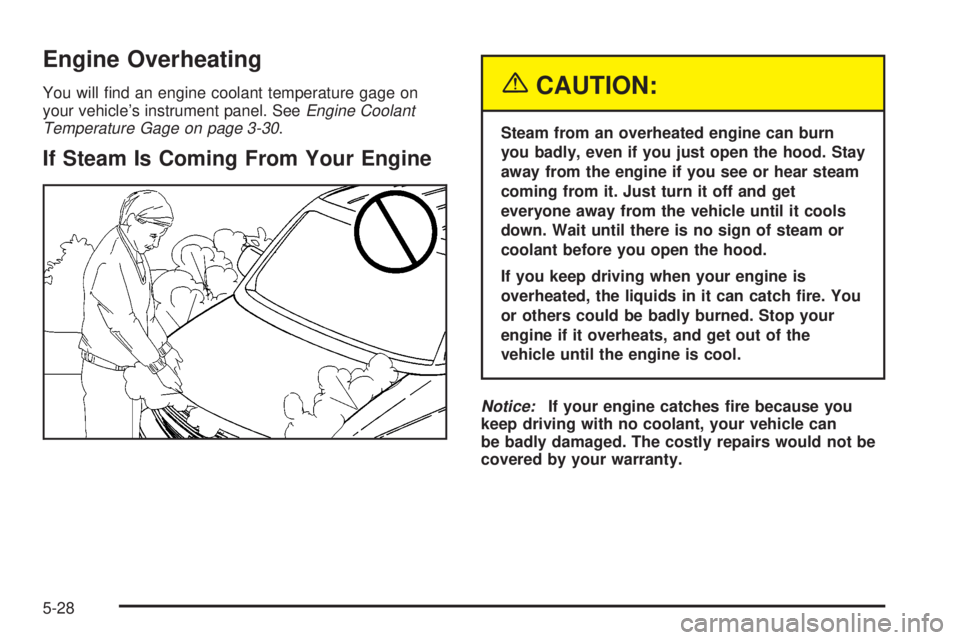
If Steam Is Coming From Your Engine
{CAUTION:
Steam from an overheated engine can burn
you badly, even if you just open the hood. Stay
away from the engine if you see or hear steam
coming from it. Just turn it off and get
everyone away from the vehicle until it cools
down. Wait until there is no sign of steam or
coolant before you open the hood.
If you keep driving when your engine is
overheated, the liquids in it can catch ®re. You
or others could be badly burned. Stop your
engine if it overheats, and get out of the
vehicle until the engine is cool.
Notice:If your engine catches ®re because you
keep driving with no coolant, your vehicle can
be badly damaged. The costly repairs would not be
covered by your warranty.
5-28
Page 243 of 382
If No Steam Is Coming From Your
Engine
If you get an engine overheat warning but see or hear
no steam, the problem may not be too serious.
Sometimes the engine can get a little too hot when you:
·Climb a long hill on a hot day.
·Stop after high-speed driving.
·Idle for long periods in traffic.
·Tow a trailer. See²Driving on Gradesº inTowing a
Trailer on page 4-35
.
If you get the overheat warning with no sign of steam,
try this for a minute or so:
1. In heavy traffic, let the engine idle in NEUTRAL (N)
while stopped. If it is safe to do so, pull off the road,
shift to PARK (P) or NEUTRAL (N) and let the
engine idle.
2. Turn on your heater to full hot at the highest fan
speed and open the window as necessary.If you no longer have the overheat warning, you can
drive. Just to be safe, drive slower for about 10 minutes.
If the warning doesn't come back on, you can drive
normally.
If the warning continues and you have not stopped, pull
over, stop, and park your vehicle right away.
If there's still no sign of steam, you can push down the
accelerator until the engine speed is about twice as
fast as normal idle speed for at least three minutes while
you're parked. If you still have the warning,
turn off the
engine and get everyone out of the vehicleuntil it
cools down.
You may decide not to lift the hood but to get service
help right away.
5-29
Page 246 of 382
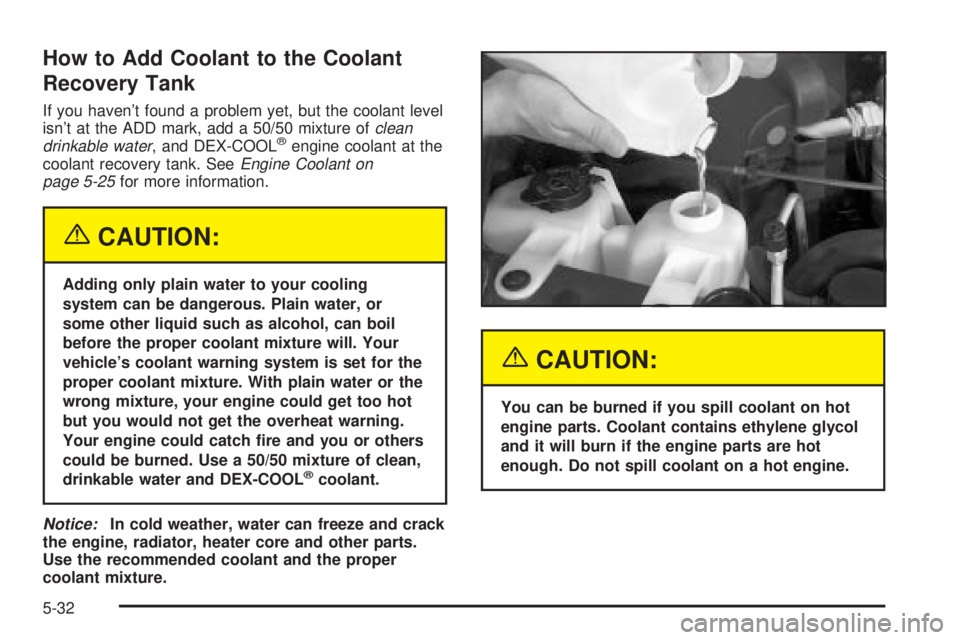
How to Add Coolant to the Coolant
Recovery Tank
If you haven't found a problem yet, but the coolant level
isn't at the ADD mark, add a 50/50 mixture ofclean
drinkable water, and DEX-COOLžengine coolant at the
coolant recovery tank. SeeEngine Coolant on
page 5-25for more information.
{CAUTION:
Adding only plain water to your cooling
system can be dangerous. Plain water, or
some other liquid such as alcohol, can boil
before the proper coolant mixture will. Your
vehicle's coolant warning system is set for the
proper coolant mixture. With plain water or the
wrong mixture, your engine could get too hot
but you would not get the overheat warning.
Your engine could catch ®re and you or others
could be burned. Use a 50/50 mixture of clean,
drinkable water and DEX-COOL
žcoolant.
Notice:In cold weather, water can freeze and crack
the engine, radiator, heater core and other parts.
Use the recommended coolant and the proper
coolant mixture.
{CAUTION:
You can be burned if you spill coolant on hot
engine parts. Coolant contains ethylene glycol
and it will burn if the engine parts are hot
enough. Do not spill coolant on a hot engine.
5-32
Page 310 of 382
Headlamp Wiring
The headlamp wiring is protected by a circuit breaker in
the lamp switch. An electrical overload will cause the
lamps to ¯icker on and off, or in some cases to remain
off. If this happens, have your headlamp wiring
checked right away.
Windshield Wiper Fuses
The windshield wiper motor is protected by a circuit
breaker and a fuse. If the motor overheats due to heavy
snow, etc., the wiper will stop until the motor cools.
Although the circuit is protected from electrical overload,
overload due to heavy snow, etc., may cause wiper
linkage damage. Always clear ice and heavy snow from
the windshield before using the windshield wipers. If
the overload is caused by some electrical problem and
not snow, etc., be sure to get it ®xed.
Power Windows and Other Power
Options
Circuit breakers in the fuse panel protect the power
windows and other power accessories. When the current
load is too heavy, the circuit breaker opens and
closes, protecting the circuit until the problem is ®xed or
goes away.
Fuses and Circuit Breakers
The wiring circuits in your vehicle are protected from
short circuits by a combination of fuses, circuit breakers
and fusible thermal links. This greatly reduces the
chance of ®res caused by electrical problems.
Look at the silver-colored band inside the fuse. If the
band is broken or melted, replace the fuse. Be sure you
replace a bad fuse with a new one of the identical
size and rating.
Spare fuses and a fuse puller are located in the
underhood fuse block. You can remove fuses with the
fuse puller. Remember to replace any of the spare fuses
you use, so you will have some if you ever need them
again.
If you ever have a problem on the road and don't have
a spare fuse, you can borrow one that has the same
amperage. Just pick some feature of your vehicle
that you can get along without ± like the radio or
cigarette lighter ± and use its fuse, if it is the correct
amperage. Replace it as soon as you can.
There are two fuse blocks in your vehicle: one is inside
the vehicle and one is in the engine compartment.
5-96
Page 371 of 382
Driver
Position, Safety Belt.....................................1-18
Driver Information System................................2-38
Driving
At Night.....................................................4-14
City...........................................................4-19
Defensive..................................................... 4-2
Drunken....................................................... 4-3
Freeway.....................................................4-20
Hill and Mountain Roads..............................4-22
In Rain and on Wet Roads...........................4-16
Winter........................................................4-24
Driving On Grades..........................................4-42
Driving on Snow or Ice....................................4-25
Driving Through Deep Standing Water...............4-18
Driving Through Flowing Water.........................4-18
Driving with a Trailer.......................................4-41
E
Electrical System
Add-On Equipment......................................5-95
Fuses and Circuit Breakers...........................5-96
Headlamp Wiring.........................................5-96
Power Windows and Other Power Options......5-96
Windshield Wiper Fuses...............................5-96
Emissions Inspection and Maintenance
Programs...................................................3-33Engine
Air Cleaner/Filter.........................................5-21
Battery.......................................................5-42
Check and Service Engine Soon Light............3-30
Coolant......................................................5-25
Coolant Heater............................................2-20
Coolant Temperature Gage...........................3-30
Cooling System Inspection............................6-28
Cover........................................................5-17
Drive Belt Routing......................................5-105
Engine Compartment Overview......................5-12
Exhaust.....................................................2-28
Fan Noise..................................................5-36
Oil .............................................................5-13
Overheating................................................5-28
Starting......................................................2-19
Engine Coolant Level Check.............................6-24
Engine Oil Additives........................................5-16
Engine Oil Level Check...................................6-24
Entry Lighting.................................................3-15
Erasing HomeLinkžButtons..............................2-33
Event Data Records (EDR)................................ 7-9
Except Cargo Vans.................................1-38, 1-47
Exit Lighting...................................................3-15
Express-Down Window....................................2-15
Extender, Safety Belt.......................................1-34
Exterior Lamps...............................................3-12
5