seats CHEVROLET ASTRO 2005 Owner's Manual
[x] Cancel search | Manufacturer: CHEVROLET, Model Year: 2005, Model line: ASTRO, Model: CHEVROLET ASTRO 2005Pages: 376, PDF Size: 2.45 MB
Page 60 of 376
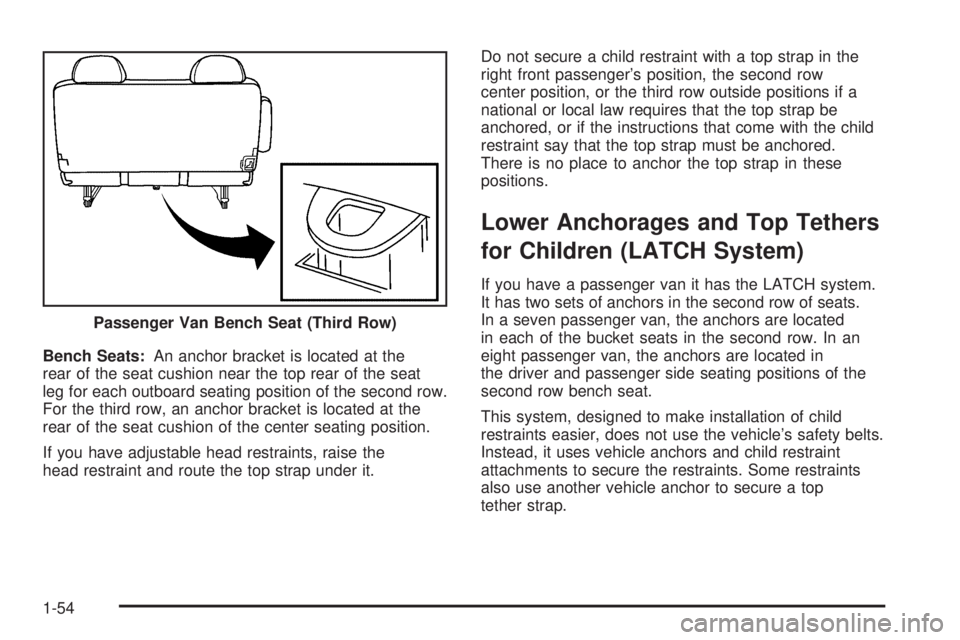
Bench Seats:An anchor bracket is located at the
rear of the seat cushion near the top rear of the seat
leg for each outboard seating position of the second row.
For the third row, an anchor bracket is located at the
rear of the seat cushion of the center seating position.
If you have adjustable head restraints, raise the
head restraint and route the top strap under it.Do not secure a child restraint with a top strap in the
right front passenger’s position, the second row
center position, or the third row outside positions if a
national or local law requires that the top strap be
anchored, or if the instructions that come with the child
restraint say that the top strap must be anchored.
There is no place to anchor the top strap in these
positions.
Lower Anchorages and Top Tethers
for Children (LATCH System)
If you have a passenger van it has the LATCH system.
It has two sets of anchors in the second row of seats.
In a seven passenger van, the anchors are located
in each of the bucket seats in the second row. In an
eight passenger van, the anchors are located in
the driver and passenger side seating positions of the
second row bench seat.
This system, designed to make installation of child
restraints easier, does not use the vehicle’s safety belts.
Instead, it uses vehicle anchors and child restraint
attachments to secure the restraints. Some restraints
also use another vehicle anchor to secure a top
tether strap. Passenger Van Bench Seat (Third Row)
1-54
Page 66 of 376
Securing a Child Restraint in the
Right Front Seat Position
If your child restraint is equipped with the LATCH
system, seeLower Anchorages and Top Tethers for
Children (LATCH System) on page 1-54.
If your vehicle is a passenger van, there is no top strap
anchor in the right front passenger’s position. Do not
secure a child seat in this position if a national or local
law requires that the top strap be anchored, or if the
instructions that come with the child restraint say that the
top strap must be anchored. SeeTop Strap on
page 1-50if the child restraint has one.
Your vehicle has a front passenger airbag.Neverput a
rear facing child restraint in this seat. Here is why:
{CAUTION:
A child in a rear-facing child restraint can
be seriously injured or killed if the front
passenger’s airbag inates. This is because
the back of the rear-facing child restraint
would be very close to the inating airbag.
CAUTION: (Continued)
CAUTION: (Continued)
If your vehicle is a passenger van, always
secure a rear-facing child restraint in a rear
seat. If your vehicle is a cargo van, do not use
a rear-facing child restraint in this vehicle.
If you need to secure a forward-facing child
restraint in the right front seat, always move
the passenger seat as far back as it will go.
A rear seat is a safer place to secure a forward-facing
child restraint.
If you need to secure a forward-facing child restraint in
the right front seat, you will be using the lap-shoulder
belt to secure the child restraint in this position. Be sure
to follow the instructions that came with the child
restraint. Secure the child in the child restraint when
and as the instructions say.
1. Because your vehicle has a right front passenger
airbag, always move the seat as far back as it will
go before securing a forward-facing child restraint.
SeeManual Seats on page 1-3.
2. Put the child restraint on the seat.
1-60
Page 137 of 376
Notice:Using a razor blade or sharp object to
clear the inside rear window may damage the rear
window defogger. Repairs would not be covered
by your warranty. Do not clear the inside of the rear
window with sharp objects.
Outlet Adjustment
Move the thumbwheel in the center of the outlets up or
down to change the direction of airow.
Operation Tips
Clear away any ice, snow or leaves from the air
inlets at the base of the windshield that may
block the ow of air into your vehicle.
Use of non-GM approved hood deectors may
adversely affect the performance of the system.
Keep the path under the front seats clear of objects
to help circulate the air inside of your vehicle more
effectively.
Rear Heating System
Your vehicle may have a rear heating system that
allows you to adjust the amount of air owing into the
rear of the vehicle, from the front seating area. This
feature works with the main climate control system in
your vehicle.
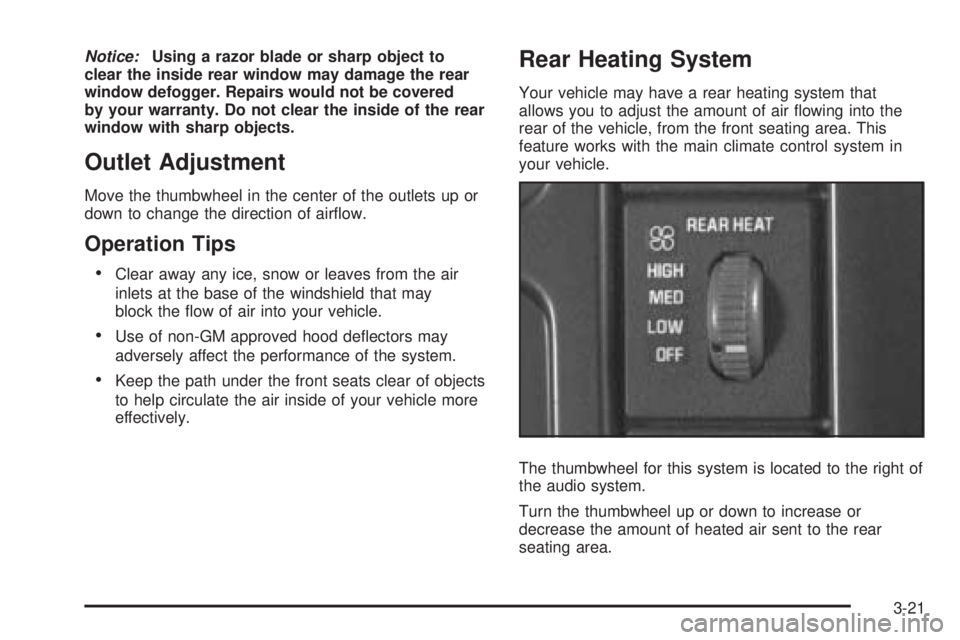
The thumbwheel for this system is located to the right of
the audio system.
Turn the thumbwheel up or down to increase or
decrease the amount of heated air sent to the rear
seating area.
3-21
Page 139 of 376
To increase or decrease the temperature for the entire
vehicle, use the center knob located on the main
climate control panel.
The air conditioning system on the main climate control
panel must be turned on to direct cooled air to the
rear of the vehicle. If it is not on, then the temperature
in the rear of the vehicle will remain at cabin
temperature.
Be sure to keep the area under the front seats clear of
any objects so that the air inside of your vehicle can
circulate effectively.
For information on how to use the main climate control
system, seeClimate Control System on page 3-19.
For information on ventilation, seeOutlet Adjustment
on page 3-21.
Warning Lights, Gages, and
Indicators
This part describes the warning lights and gages that
may be on your vehicle. The pictures will help you
locate them.Warning lights and gages can signal that something is
wrong before it becomes serious enough to cause
an expensive repair or replacement. Paying attention
to your warning lights and gages could also save you or
others from injury.
Warning lights come on when there may be or is a
problem with one of your vehicle’s functions. As you
will see in the details on the next few pages, some
warning lights come on briey when you start the engine
just to let you know they’re working. If you are familiar
with this section, you should not be alarmed when
this happens.
Gages can indicate when there may be or is a problem
with one of your vehicle’s functions. Often gages
and warning lights work together to let you know when
there’s a problem with your vehicle.
When one of the warning lights comes on and stays on
when you are driving, or when one of the gages shows
there may be a problem, check the section that tells
you what to do about it. Please follow this manual’s
advice. Waiting to do repairs can be costly – and even
dangerous. So please get to know your warning lights
and gages. They’re a big help.
3-23
Page 199 of 376
Notice:Overloading your vehicle may cause
damage. Repairs would not be covered by your
warranty. Do not overload your vehicle.
If you put things inside of your vehicle — like suitcases,
tools, packages, or anything else — they will go as
fast as the vehicle goes. If you have to stop or
turn quickly, or if there is a crash, they’ll keep going.
{CAUTION:
Things you put inside your vehicle can strike
and injure people in a sudden stop or turn,
or in a crash.
Put things in the cargo area of your
vehicle. Try to spread the weight evenly.
Never stack heavier things, like suitcases,
inside the vehicle so that some of them
are above the tops of the seats.
Do not leave an unsecured child restraint
in your vehicle.
When you carry something inside the
vehicle, secure it whenever you can.
Do not leave a seat folded down unless
you need to.
Trailering Package
There is a load rating which includes the weight of the
vehicle and the trailer it tows. This rating is called
the Gross Combination Weight Rating (GCWR).
When you weigh your trailer, be sure to include the
weight of everything you put in it. And, remember
to gure the weight of the people inside the vehicle
as part of your load.
Add-On Equipment
When you carry removable items, you may need to
put a limit on how many people you carry inside your
vehicle. Be sure to weigh your vehicle before you
buy and install the new equipment.
Towing
Towing Your Vehicle
Consult your dealer or a professional towing service if
you need to have your disabled vehicle towed. See
Roadside Assistance Program on page 7-6.
If you want to tow your vehicle behind another vehicle
for recreational purposes (such as behind a motorhome),
see “Recreational Vehicle Towing” following.
4-33
Page 229 of 376
Engine Cover
Removing the Engine Cover
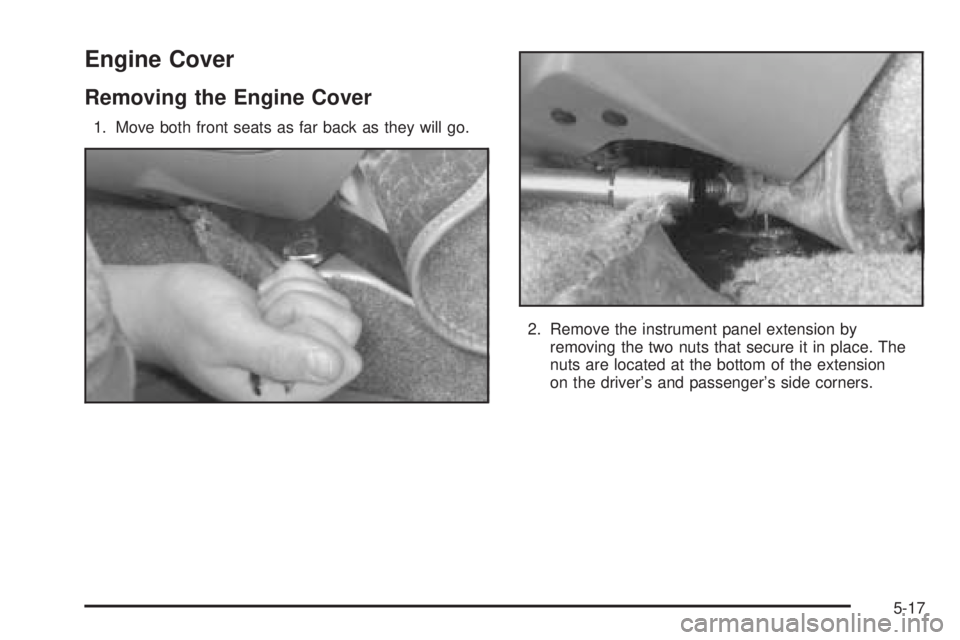
1. Move both front seats as far back as they will go.
2. Remove the instrument panel extension by
removing the two nuts that secure it in place. The
nuts are located at the bottom of the extension
on the driver’s and passenger’s side corners.
5-17
Page 273 of 376
Tire Size
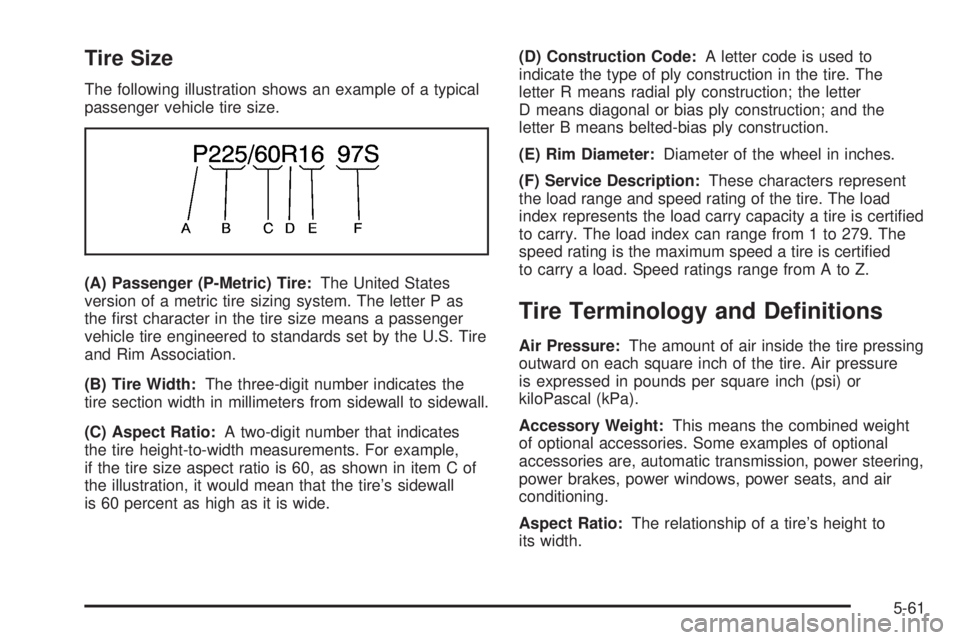
The following illustration shows an example of a typical
passenger vehicle tire size.
(A) Passenger (P-Metric) Tire:The United States
version of a metric tire sizing system. The letter P as
the rst character in the tire size means a passenger
vehicle tire engineered to standards set by the U.S. Tire
and Rim Association.
(B) Tire Width:The three-digit number indicates the
tire section width in millimeters from sidewall to sidewall.
(C) Aspect Ratio:A two-digit number that indicates
the tire height-to-width measurements. For example,
if the tire size aspect ratio is 60, as shown in item C of
the illustration, it would mean that the tire’s sidewall
is 60 percent as high as it is wide.(D) Construction Code:A letter code is used to
indicate the type of ply construction in the tire. The
letter R means radial ply construction; the letter
D means diagonal or bias ply construction; and the
letter B means belted-bias ply construction.
(E) Rim Diameter:Diameter of the wheel in inches.
(F) Service Description:These characters represent
the load range and speed rating of the tire. The load
index represents the load carry capacity a tire is certied
to carry. The load index can range from 1 to 279. The
speed rating is the maximum speed a tire is certied
to carry a load. Speed ratings range from A to Z.
Tire Terminology and Denitions
Air Pressure:The amount of air inside the tire pressing
outward on each square inch of the tire. Air pressure
is expressed in pounds per square inch (psi) or
kiloPascal (kPa).
Accessory Weight:This means the combined weight
of optional accessories. Some examples of optional
accessories are, automatic transmission, power steering,
power brakes, power windows, power seats, and air
conditioning.
Aspect Ratio:The relationship of a tire’s height to
its width.
5-61
Page 310 of 376
Fuse/Circuit
BreakerUsage
17 Front Wipers, Front Washer Pump
18VCM-Ign 3, VCM-Brake, Cruise
Stepper Motor Signal, ATC Module
19Instrument Panel Radio: ATC
(Main Feed), 2000 Series (Standby)
20PRNDL/Odometer, Shift A and
Shift B Solenoids, 3–2 Downshift
Solenoid, Instrument Panel Cluster,
VCM Module
21 Power Adjust Mirrors
22 Not Used
23 Rear Wiper, Rear Washer Pump
24 Not Used
Circuit
BreakersUsage
APower Door Lock Relay,
6–Way Power Seats
B Power Windows
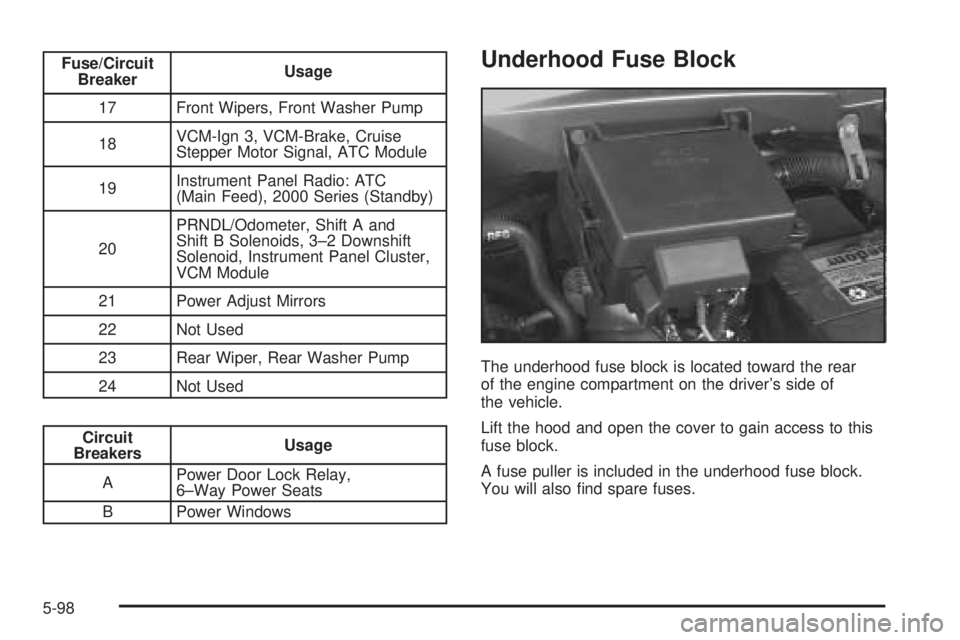
Underhood Fuse Block
The underhood fuse block is located toward the rear
of the engine compartment on the driver’s side of
the vehicle.
Lift the hood and open the cover to gain access to this
fuse block.
A fuse puller is included in the underhood fuse block.
You will also nd spare fuses.
5-98
Page 364 of 376
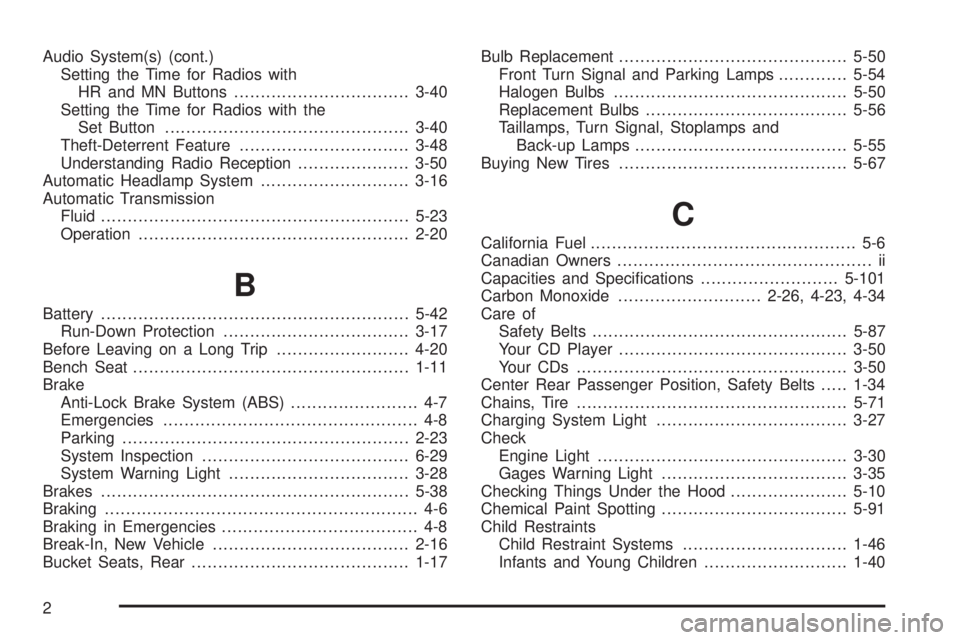
Audio System(s) (cont.)
Setting the Time for Radios with
HR and MN Buttons.................................3-40
Setting the Time for Radios with the
Set Button..............................................3-40
Theft-Deterrent Feature................................3-48
Understanding Radio Reception.....................3-50
Automatic Headlamp System............................3-16
Automatic Transmission
Fluid..........................................................5-23
Operation...................................................2-20
B
Battery..........................................................5-42
Run-Down Protection...................................3-17
Before Leaving on a Long Trip.........................4-20
Bench Seat....................................................1-11
Brake
Anti-Lock Brake System (ABS)........................ 4-7
Emergencies................................................ 4-8
Parking......................................................2-23
System Inspection.......................................6-29
System Warning Light..................................3-28
Brakes..........................................................5-38
Braking........................................................... 4-6
Braking in Emergencies..................................... 4-8
Break-In, New Vehicle.....................................2-16
Bucket Seats, Rear.........................................1-17Bulb Replacement...........................................5-50
Front Turn Signal and Parking Lamps.............5-54
Halogen Bulbs............................................5-50
Replacement Bulbs......................................5-56
Taillamps, Turn Signal, Stoplamps and
Back-up Lamps........................................5-55
Buying New Tires...........................................5-67
C
California Fuel.................................................. 5-6
Canadian Owners................................................ ii
Capacities and Specications..........................5-101
Carbon Monoxide...........................2-26, 4-23, 4-34
Care of
Safety Belts................................................5-87
Your CD Player...........................................3-50
Your CDs ...................................................3-50
Center Rear Passenger Position, Safety Belts.....1-34
Chains, Tire...................................................5-71
Charging System Light....................................3-27
Check
Engine Light...............................................3-30
Gages Warning Light...................................3-35
Checking Things Under the Hood......................5-10
Chemical Paint Spotting...................................5-91
Child Restraints
Child Restraint Systems...............................1-46
Infants and Young Children...........................1-40
2
Page 370 of 376
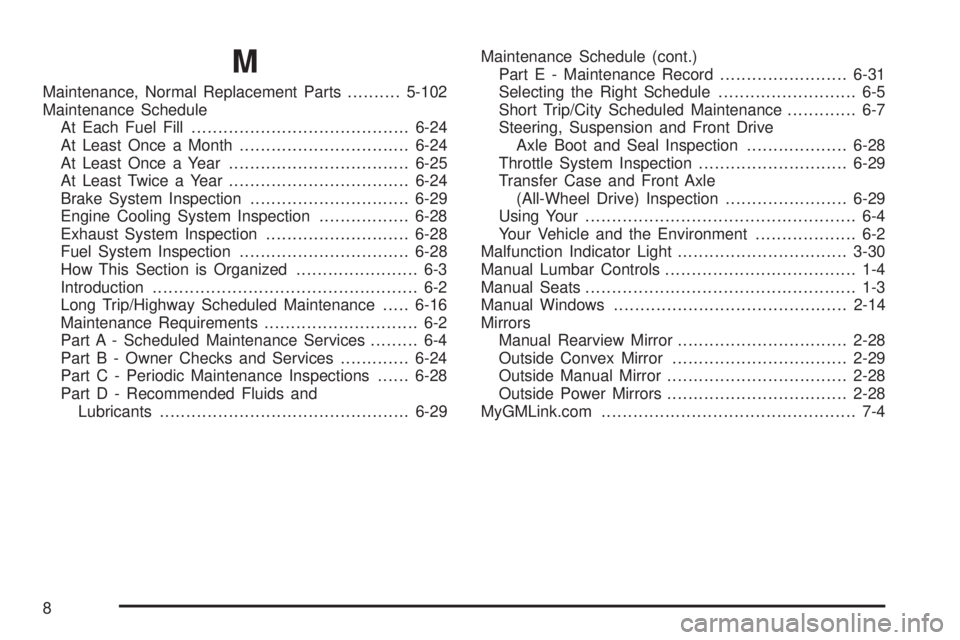
M
Maintenance, Normal Replacement Parts..........5-102
Maintenance Schedule
At Each Fuel Fill.........................................6-24
At Least Once a Month................................6-24
At Least Once a Year..................................6-25
At Least Twice a Year..................................6-24
Brake System Inspection..............................6-29
Engine Cooling System Inspection.................6-28
Exhaust System Inspection...........................6-28
Fuel System Inspection................................6-28
How This Section is Organized....................... 6-3
Introduction.................................................. 6-2
Long Trip/Highway Scheduled Maintenance.....6-16
Maintenance Requirements............................. 6-2
Part A - Scheduled Maintenance Services......... 6-4
Part B - Owner Checks and Services.............6-24
Part C - Periodic Maintenance Inspections......6-28
Part D - Recommended Fluids and
Lubricants...............................................6-29Maintenance Schedule (cont.)
Part E - Maintenance Record........................6-31
Selecting the Right Schedule.......................... 6-5
Short Trip/City Scheduled Maintenance............. 6-7
Steering, Suspension and Front Drive
Axle Boot and Seal Inspection...................6-28
Throttle System Inspection............................6-29
Transfer Case and Front Axle
(All-Wheel Drive) Inspection.......................6-29
Using Your................................................... 6-4
Your Vehicle and the Environment................... 6-2
Malfunction Indicator Light................................3-30
Manual Lumbar Controls.................................... 1-4
Manual Seats................................................... 1-3
Manual Windows............................................2-14
Mirrors
Manual Rearview Mirror................................2-28
Outside Convex Mirror.................................2-29
Outside Manual Mirror..................................2-28
Outside Power Mirrors..................................2-28
MyGMLink.com................................................ 7-4
8