air condition CHEVROLET ASTRO CARGO VAN 1995 2.G User Guide
[x] Cancel search | Manufacturer: CHEVROLET, Model Year: 1995, Model line: ASTRO CARGO VAN, Model: CHEVROLET ASTRO CARGO VAN 1995 2.GPages: 342, PDF Size: 17.57 MB
Page 192 of 342
Downloaded from www.Manualslib.com manuals search engine 7. By this time the coolant level inside the radiator filler neck may be
lower.
If the level is lower, add more of the proper mix through the
filler neck until the level reaches the base
of the filler neck.
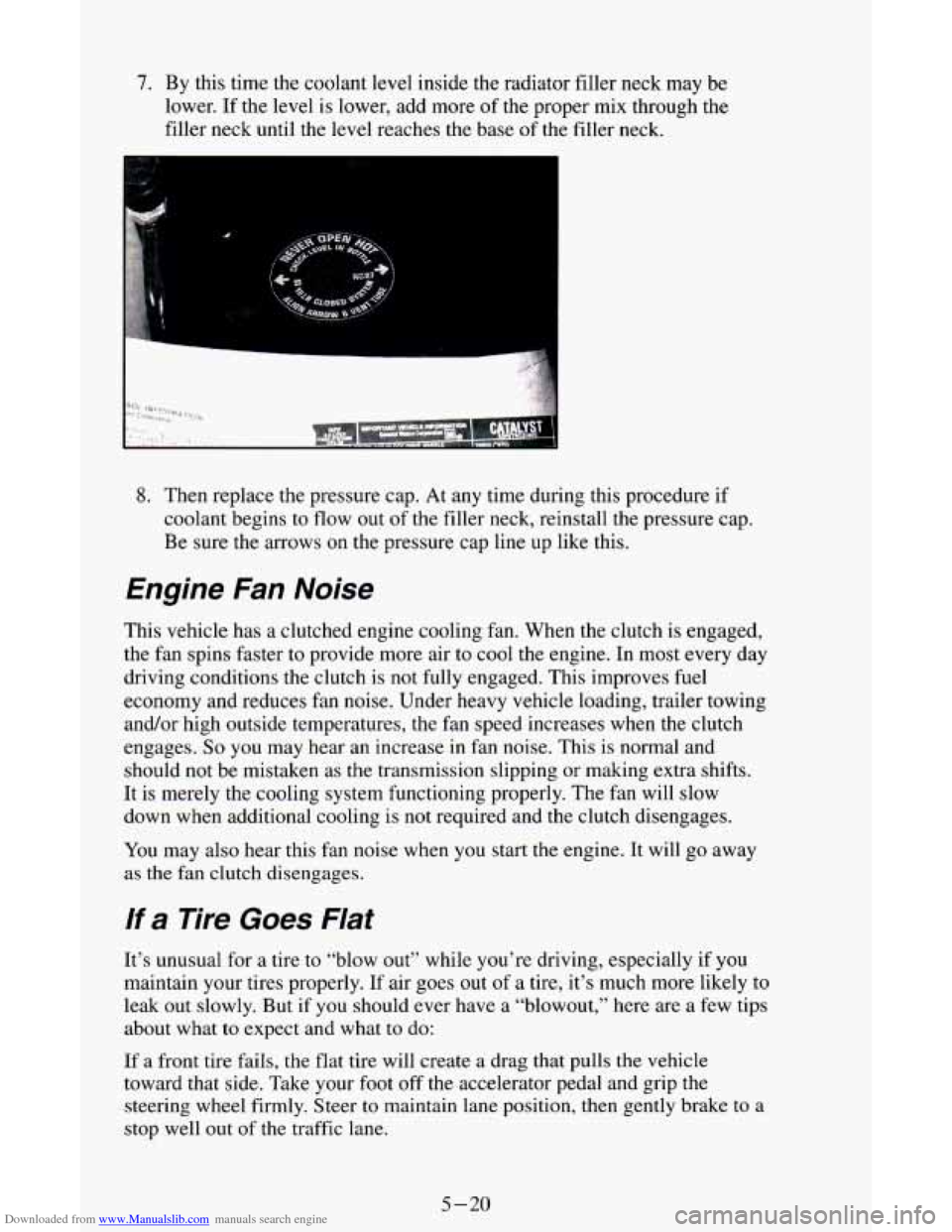
8. Then replace the pressure cap. At any time during this procedure if
coolant begins to flow out of the filler neck, reinstall the pressure cap.
Be sure the arrows on the pressure cap line
up like this.
Engine Fan Noise
This vehicle has a clutched engine cooling fan. When the clutch is engaged,
the fan spins faster to provide more air to cool the engine. In most every day
driving conditions the clutch is not fully engaged. This improves fuel
economy and reduces fan noise. Under heavy vehicle loading, trailer towing
and/or high outside temperatures, the fan speed increases when the clutch
engages.
So you may hear an increase in fan noise. This is normal and
should not be mistaken
as the transmission slipping or making extra sh
It is merely the cooling system functioning properly. The fan will slow
down when additional cooling is not required and the clutch disengage .ifts.
S.
You may
also hear this fan noise when you start the engine. It will go away
as the fan clutch disengages.
If a Tire Goes Flat
It’s unusual for a tire to “blow out” while you’re driving, especially if you
maintain your tires properly.
If air goes out of a tire, it’s much more likely to
leak out slowly. But if you should ever have a “blowout,” here are a few tips
about what
to expect and what to do:
If
a front tire fails, the flat tire will create a drag that pulls the vehicle
toward that side. Take your foot off the accelerator pedal and grip the
steering wheel firmly. Steer
to maintain lane position, then gently brake to a
stop well out of the traffic lane.
5-20
Page 232 of 342
Downloaded from www.Manualslib.com manuals search engine NOTICE:
If you use an improper coolant mix, your engine could overheat
and be badly damaged. The repair cost wouldn’t be covered by
your warranty.
Too much water in the mix can freeze and crack
the engine, radiator, heater core and other parts.
Some conditions, such as air trapped in the cooling system, can affect the
coolant level in the radiator. Check the coolant level when the engine is cold
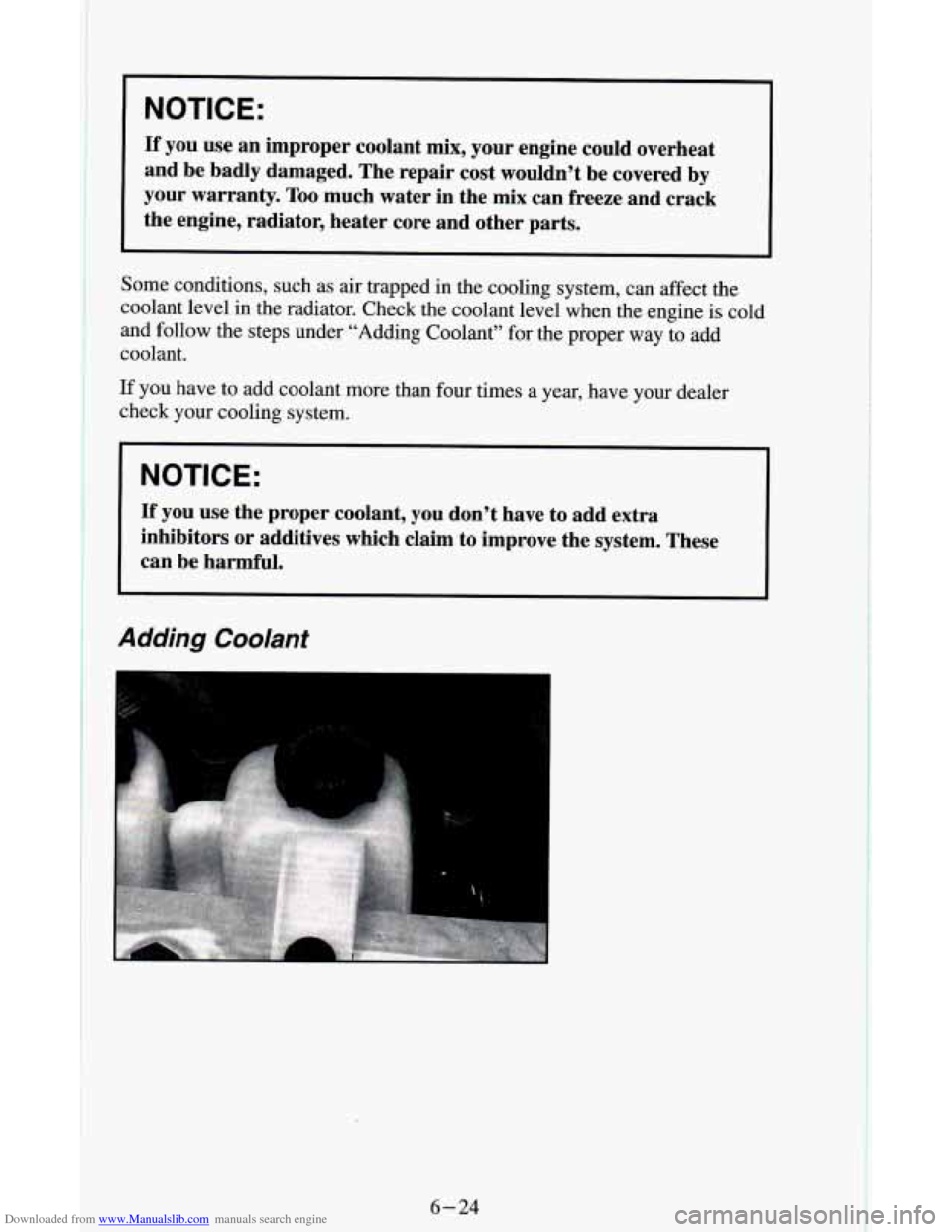
and follow the steps under “Adding Coolant” for the proper way to add
coolant.
If you have to add coolant more than four times a year, have your dealer
check your cooling system.
NOTICE:
If YOU use the proper coolant, you don’t have to add extra
inhibitors or additives which claim to improve the system. These
can be harmful.
Adding Coolant
6-24
Page 239 of 342
Downloaded from www.Manualslib.com manuals search engine Brake Wear
Your vehicle has front disc brakes and rear drum brakes.
Disc brake pads have built-in wear indicators that make
a high-pitched
warning sound when the brake pads are worn and new pads are needed. The
sound may come and go or be heard all the time your vehicle is moving
(except when you are pushing
on the brake pedal firmly).
NOTICE:
Continuing to drive with worn-out brake pads could result in
costly brake repair.
Some driving conditions or climates may cause a brake squeal when the
brakes are first applied or lightly applied. This does not mean something is
wrong with your brakes.
Your rear drum brakes don’t have wear indicators, but
if you ever hear a
rear brake rubbing noise, have the rear brake linings inspected. Also,
the
rear brake drums should be removed and inspected each time the tires are
removed for rotation or changing. When you have the front brakes replaced,
have
the rear brakes inspected, too.
Brake linings should always be replaced
as complete axle sets.
Brake Pedal Travel
See your dealer if the brake pedal does not return to normal height, or if
there is a rapid increase in pedal travel. This could be a sign of brake
trouble.
Brake Adjustment
Every time you make a brake stop, your disc brakes adjust for wear.
If your brake pedal goes down Farther than normal, your rear drum brakes
may need adjustment. Adjust them by backing
up and firmly applying the
brakes a few times.
6-3 1
Page 241 of 342
Downloaded from www.Manualslib.com manuals search engine For more information on vehicle storage, contact your dealer’s service
department, or write to:
Adistra Corporation
17 1 Hamilton Street
Plymouth, MI
48 170
In Canada, write to:
General Motors of Canada, Limited
Customer Services Department
Oshawa, Ontario
Ll J 5Z6
Fluid Leak Check
After the vehicle has been parked for awhile, inspect the surface beneath the
vehicle for water, oil,
fuel or other fluids. Water dripping from the air
conditioning system is normal. If you notice fuel leaks or fumes, the causes
should be found and corrected at once.
Bulb Replacement
Before replacing any bulbs, make sure all lights are off and the vehicle is
not running.
Sealed Beam Headlamps
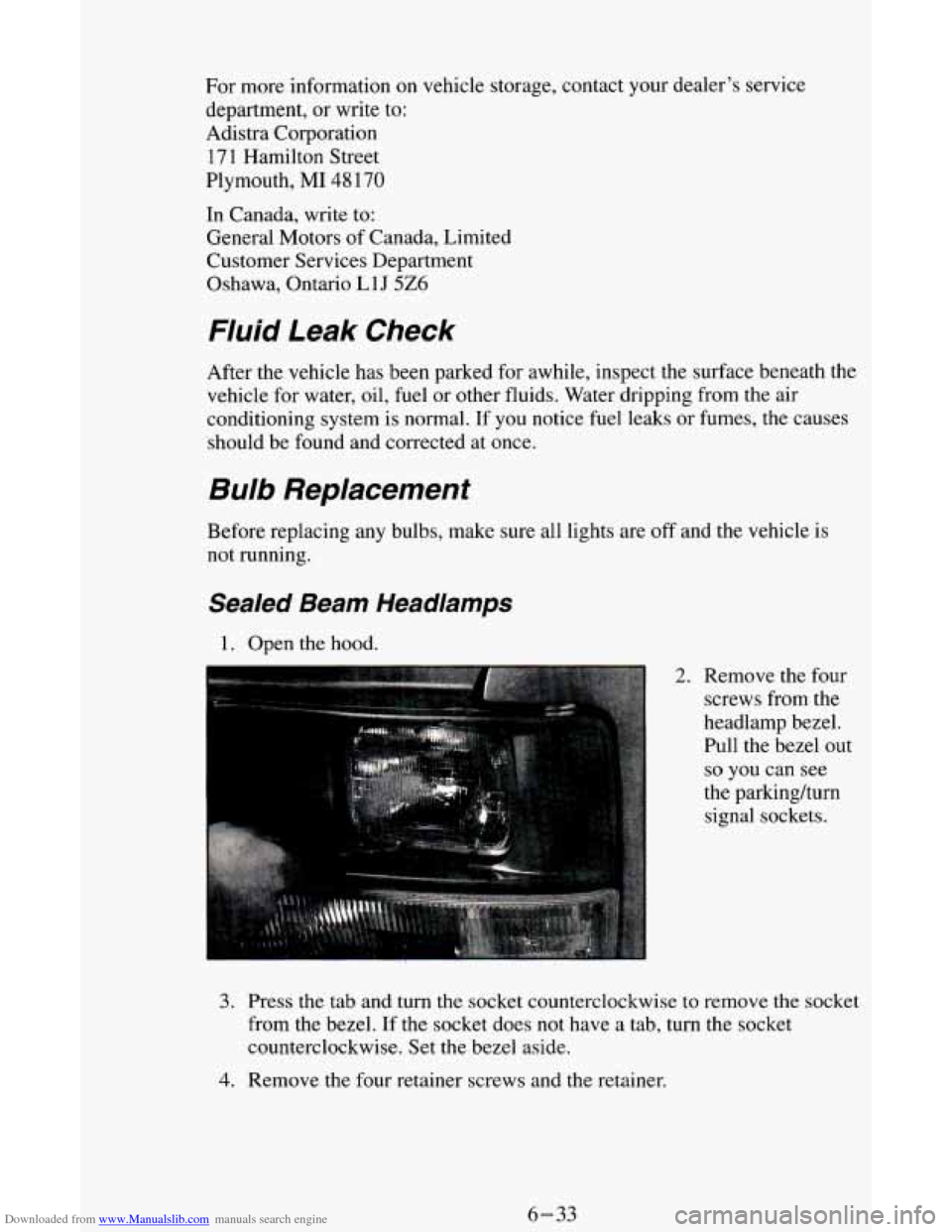
1. Open the hood.
2. Remove the four
screws from the
headlamp bezel.
Pull the bezel out
so you can see
the parkingkurn
signal sockets.
3. Press the tab and turn the socket counterclockwise to remove the socket
from the bezel. If the socket does
not have a tab, turn the socket
counterclockwise. Set the bezel aside.
4. Remove the four retainer screws and the retainer.
6-33
Page 248 of 342
Downloaded from www.Manualslib.com manuals search engine Air Conditioning
Every now and then have your dealership check your air conditioning
system
to be sure it has not lost any cooling ability. If you think the system
is not working properly, have your dealership check it out as soon as
possible.
The air conditioning will not work when the temperature
is below 40°F
(4°C).
Lock Cylinders
To be sure your locks operate properly, they must be lubricated.
Refer
to the Maintenance Schedule to determine how often to lubricate them
and what type
of lubricant to use.
You should not use penetrating oils because they could wash out the factory
installed lubricant and cause the lock to bind. De-icers which contain
alcohol could also wash away the lubricant,
so be sure to lubricate the lock
after using a de-icer of this type.
Exhaust System
To help prevent damage to your exhaust system, do not continue to drive
your vehicle if you notice:
0 Engine misfiring
Loss of performance
Exhaust system components hanging lower than normal.
Loud exhaust system noises.
Other unusual operating conditions
Have your engine and exhaust system serviced regularly.
Three-way Catalytic Converter
Your vehicle’s three-way catalytic converter is designed to reduce the
pollutants in your vehicle’s exhaust. Use only unleaded fuel in your vehicle.
If you use leaded fuel, you could damage your three-way catalytic converter
and other engine components.
Engine Control Module System
This system has an oxygen (02) sensor that helps keep your engine’s
air-fuel mixture at a proper level. Use only unleaded fuel in your vehicle. If
you
use leaded fuel, you could damage your oxygen (02) sensor and affect
your vehicle’s emissions.
6-40
Page 254 of 342
Downloaded from www.Manualslib.com manuals search engine sudden tire failure. The grade C corresponds to a level of performance
which all passenger car tires must meet under the Federal Motor Vehicle
Safety Standard
No. 109. Grades B and A represent higher levels of
performance on the laboratory test wheel than the minimum required by
law.
Warning:
The temperature grade for this tire is established for a tire that is
properly inflated and not overloaded. Excessive speed, underinflation, or
excessive loading, either separately or in combination, can cause heat
buildup and possible tire failure.
These grades are molded on the sidewalls of passenger car tires.
While the tires available as standard or optional equipment
on General
Motors vehicles may vary with respect to these grades, all such tires meet
General Motors performance standards and have been approved for use on
General Motors vehicles. All passenger type
(P Metric) tires must conform
to Federal safety requirements in addition
to these grades.
Wheel Alignment and Tire Balance
The wheels on your vehicle were aligned and balanced carefully at the
factory
to give you the longest tire life and best overall performance.
In most cases, you will
not need to have your wheels aligned again.
However, if
you notice unusual tire wear or your vehicle pulling one way or
the other, the alignment may need to be reset.
If you notice your vehicle
vibrating when driving on a smooth road, your wheels may need
to be
rebalanced.
Wheel Replacement
Replace any wheel that is bent, cracked, or badly rusted or corroded. If
wheel nuts keep coming loose, the wheel, wheel bolts, and wheel nuts
should be replaced. If the wheel leaks air, replace it (except some aluminum
wheels, which can sometimes be repaired). See your GM dealer if any of
these conditions exist.
Your dealer will know the kind
of wheel you need.
Each new wheel should have the same load carrying capacity, diameter,
width, offset, and
be mounted the same way as the one it replaces.
6-46
Page 263 of 342
Downloaded from www.Manualslib.com manuals search engine Finish Damage
Any stone chips, fractures or deep scratches in the finish should be repaired
right away. Bare metal will corrode quickly and may develop
into a major
repair expense.
Minor chips and scratches can be repaired with touch-up materials available
from your dealer or other service outlets. Larger areas
of finish damage can
be corrected in your dealer’s body and paint shop.
Underbody Maintenance
Chemicals used for ice and snow removal and dust control can collect on
the underbody. If these are not removed, accelerated corrosion (rust) can
occur
on the underbody parts such as fuel lines, frame, floor pan, and
exhaust system even though they have corrosion protection.
At least every spring,
flush these materials from the underbody with plain
water. Clean any areas where mud and other debris
can collect. Dirt packed
in closed areas of the frame should be loosened before being flushed. Your
dealer or an underbody vehicle washing system can do this for
you.
Chemical Paint Spotting
Some weather and atmospheric conditions can create a chemical fallout.
Airborne pollutants can fall upon and attack painted surfaces
on your
vehicle. This damage can take two forms: blotchy, ringlet-shaped
discolorations, and small irregular dark
spots etched into the paint surface.
Although
no defect in the paint job causes this, GM will repair, at no charge
to the owner, the surfaces of new vehicles damaged by this fallout condition
within
12 months or 12,000 miles (20 000 km) of purchase, whichever
comes first.
6-55
Page 275 of 342
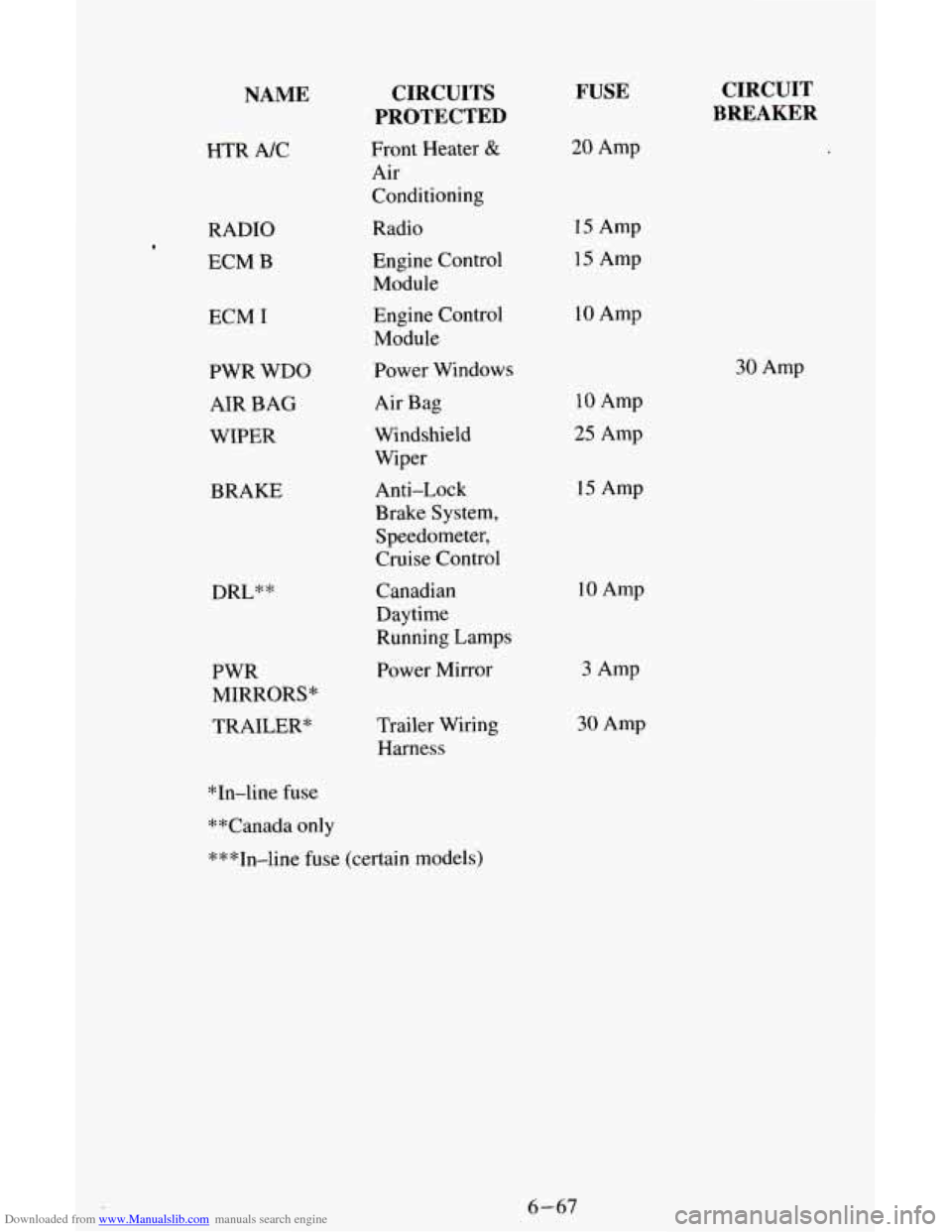
Downloaded from www.Manualslib.com manuals search engine NAME
HTR A/C
RADIO
ECM B
ECM I
PWR WDO
AIR BAG
WIPER
BRAKE
DRL** PWR
MIRRORS*
TRAILER*
CIRCUITS
PROTECTED
Front Heater &
Air
Conditioning
Radio
Engine Control
Module
Engine Control Module
Power
Windows
Air Bag
Windshield Wiper
Anti-Lock
Brake System,
Speedometer,
Cruise Control
Canadian Daytime
Running Lamps
rower Mirror
Trailer Wiring
Harness
FUSE
20 Amp
15 Amp
15 Amp
10 Amp
CIRCUIT
BREAKER
30 Amp
10 Amp
25 Amp
15 Amp
10 Amp
3 Amp
30 Amp
*In-line fuse
**Canada
only
***In-line fuse (certain models)
6-67
Page 276 of 342
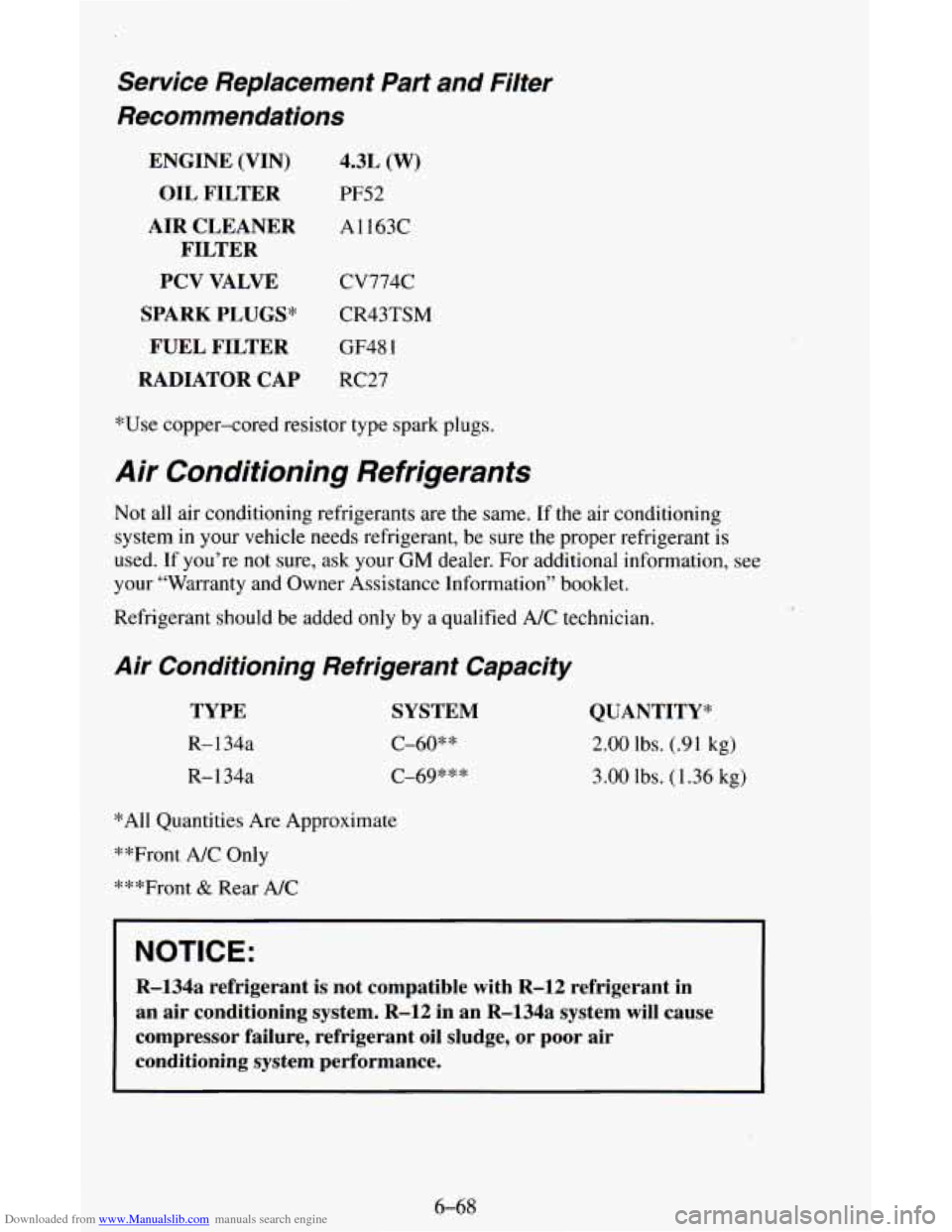
Downloaded from www.Manualslib.com manuals search engine Service Replacement Part and Filter
Recommendations
ENGINE (VIN)
OIL FILTER
AIR CLEANER FILTER
PCV VALVE
SPARK PLUGS* FUEL FILTER
RADIATOR CAP 4.3L (W)
PF52
A1163C
cv774c
CR43TSM
GF48
1
RC27
*Use copper-cored resistor type spark plugs.
Air Conditioning Refrigerants
Not all air conditioning refrigerants are the same. If the air conditioning
system in your vehicle needs refrigerant, be sure
the proper refrigerant is
used. If you’re not
sure, ask your GM dealer. For additional information, see
your “Warranty and Owner Assistance Information” booklet.
Refrigerant should be added only by a qualified
A/C technician.
Air Conditioning Refrigerant Capacity
TYPE
R-l34a
R-134a
SYSTEM
C-60* *
C-69***
QUANTITY*
2.00 lbs. (.91 kg)
3.00 lbs. (1.36 kg)
*All Quantities
Are Approximate
**Front A/C Only
***Front
& Rear A/C
NOTICE:
R-134a refrigerant is not compatible with R-12 refrigerant in
an air conditioning system. R-12 in an R-134a system
will cause
compressor failure, refrigerant oil sludge, or poor air
conditioning system performance.
6-68
Page 277 of 342
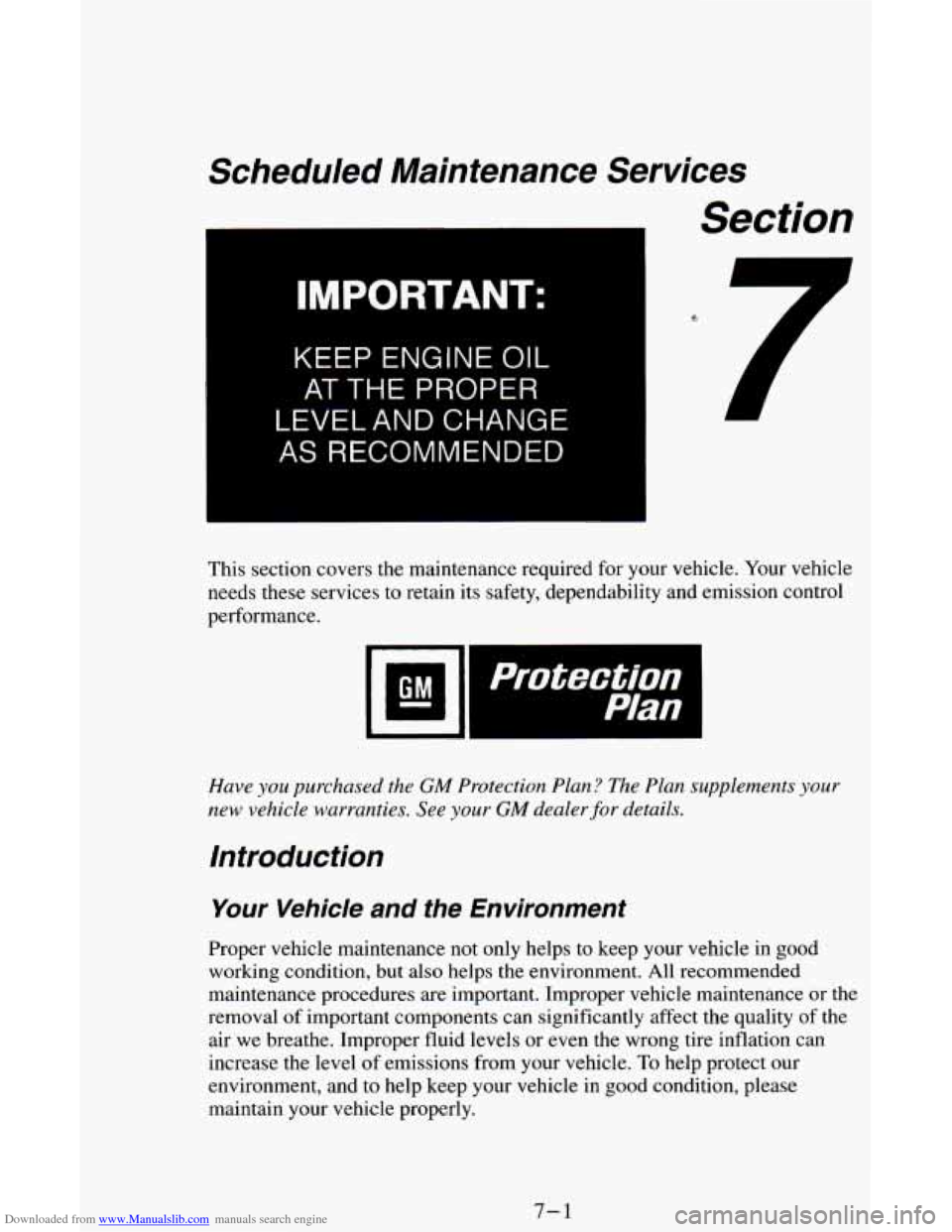
Downloaded from www.Manualslib.com manuals search engine Scheduled Maintenance Services
IMPORTANT:
KEEP ENGINE OIL
AT THE PROPER
LEVEL AND CHANGE
AS RECOMMENDED
Section
This section covers the maintenance required for your vehicle. Your vehicle
needs these services to retain its safety, dependability and emission control
performance.
Protection I
Have you purchased the GM Protection Plan? The Plan supplements your
new vehicle warranties. See your GM dealer for details.
Introduction
Your Vehicle and the Environment
Proper vehicle maintenance not only helps to keep your vehicle in good
working condition, but also helps the environment.
All recommended
maintenance procedures are important. Improper vehicle maintenance or the
removal of important components can significantly affect the quality of the
air we breathe. Improper fluid levels or even the wrong tire inflation can
increase the level
of emissions from your vehicle. To help protect our
environment, and
to help keep your vehicle in good condition, please
maintain your vehicle properly.
7-1