Oil CHEVROLET ASTRO CARGO VAN 1995 2.G Owner's Manual
[x] Cancel search | Manufacturer: CHEVROLET, Model Year: 1995, Model line: ASTRO CARGO VAN, Model: CHEVROLET ASTRO CARGO VAN 1995 2.GPages: 342, PDF Size: 17.57 MB
Page 248 of 342
Downloaded from www.Manualslib.com manuals search engine Air Conditioning
Every now and then have your dealership check your air conditioning
system
to be sure it has not lost any cooling ability. If you think the system
is not working properly, have your dealership check it out as soon as
possible.
The air conditioning will not work when the temperature
is below 40°F
(4°C).
Lock Cylinders
To be sure your locks operate properly, they must be lubricated.
Refer
to the Maintenance Schedule to determine how often to lubricate them
and what type
of lubricant to use.
You should not use penetrating oils because they could wash out the factory
installed lubricant and cause the lock to bind. De-icers which contain
alcohol could also wash away the lubricant,
so be sure to lubricate the lock
after using a de-icer of this type.
Exhaust System
To help prevent damage to your exhaust system, do not continue to drive
your vehicle if you notice:
0 Engine misfiring
Loss of performance
Exhaust system components hanging lower than normal.
Loud exhaust system noises.
Other unusual operating conditions
Have your engine and exhaust system serviced regularly.
Three-way Catalytic Converter
Your vehicle’s three-way catalytic converter is designed to reduce the
pollutants in your vehicle’s exhaust. Use only unleaded fuel in your vehicle.
If you use leaded fuel, you could damage your three-way catalytic converter
and other engine components.
Engine Control Module System
This system has an oxygen (02) sensor that helps keep your engine’s
air-fuel mixture at a proper level. Use only unleaded fuel in your vehicle. If
you
use leaded fuel, you could damage your oxygen (02) sensor and affect
your vehicle’s emissions.
6-40
Page 258 of 342
Downloaded from www.Manualslib.com manuals search engine Rinse the section with a clean, wet sponge.
Wipe off what’s left with a slightly damp paper towel or cloth.
Then dry it immediately with a blow dryer or a heat lamp.
NOTICE:
Be careful. A blow dryer may scorch the fabric.
Wipe with a clean cloth.
Using Solvent-Type Cleaner on Fabric
First, see if you have to use solvent-type cleaner at all. Some spots and
stains will clean off better
with just water and mild soap.
If you need to
use a solvent:
Gently scrape excess soil from the trim material with a clean, dull knife or
scraper. Use
very little cleaner, light pressure and clean cloths (preferably
cheesecloth). Cleaning should start at the outside
of the stain, “feathering”
toward the center. Keep changing
to a clean section of the cloth.
blow dryer to help prevent a cleaning ring. (See the previous NOTICE.)
0 When you clean a stain from fabric, immediately dry the area with a
Fabric Protection
Your vehicle has upholstery that has been treated with Scotchgard” Fabric
Protector,
a 3M product. Scotchgard“ protects fabrics by repelling oil and
water, which are the carriers of most stains. Even with this protection, you
still need to clean your upholstery often to keep it looking new.
Further information on cleaning is available by calling 1-800-433-3296
(in
Minnesota, 1-800-642-6 167).
Special Cleaning Problems
Greasy or Oily Stains
Stains caused by grease, oil, butter, margarine, shoe polish, coffee with
cream, chewing gum, cosmetic creams, vegetable oils, wax crayon, tar and
asphalt can be removed as follows:
Carefully scrape off excess stain.
Follow the solvent-type instructions described earlier.
Shoe polish, wax crayon, tar and asphalt will stain if left on a vehicle
seat fabric. They should be removed as soon
as possible. Be careful,
because the cleaner will dissolve them and may cause them to spread.
4-50
Page 259 of 342
Downloaded from www.Manualslib.com manuals search engine Non-Greasy Stains
Stains caused by catsup, coffee (black), egg, fruit, fruit juice, milk, soft
drinks, wine, vomit, urine and blood can be removed as follows:
0
0
0
0
Carefully scrape off excess stain, then sponge the soiled area with cool
water.
If a stain remains, follow the foam-type instructions described earlier.
If an odor lingers after cleaning vomit or urine, treat the area with a
watedbaking soda solution:
1 teaspoon (5 ml) of baking soda to 1 cup
(250 ml) of lukewarm water.
If needed, clean lightly
with solvent-type cleaner.
Combination Stains
Stains caused by candy, ice cream, mayonnaise, chili sauce and unknown
stains can be removed as follows:
Carefully scrape off excess stain, then clean with cool water and allow
to dry.
0 If a stain remains, clean it with solvent-type cleaner.
Cleaning Vinyl
Use warm water and a clean cloth.
0 Rub with a clean, damp cloth to remove dirt. You may have to do it
more than once.
Things like tar, asphalt and shoe polish will stain if you don’t get them
off quickly. Use
a clean cloth and a solvent-type vinyl cleaner.
Cleaning the Top of the Instrument Panel
Use only mild soap and water to clean the top surfaces of the instrument
panel. Sprays containing silicones or waxes may cause annoying reflections
in the windshield and even make it difficult to see through the windshield
under certain conditions.
6-5 1
Page 261 of 342
Downloaded from www.Manualslib.com manuals search engine Cleaning the Outside of Your Vehicle
The paint finish on your vehicle provides beauty, depth of color, gloss
retention and durability.
Washing Your Vehicle
The best way to preserve your vehicle’s finish is to keep it clean by washing
it often with lukewarm or cold water.
Don’t wash your vehicle in the direct rays of
the sun. Don’t use strong soaps
or chemical detergents. Use liquid hand, dish or car washing (mild
detergent) soaps. Don’t use cleaning agents that are petroleum based, or that
contain acid or abrasives. All cleaning agents should be flushed promptly
and not allowed to dry on the surface,
or they could stain. Dry the finish
with a soft, clean chamois or a 100% cotton towel to avoid surface scratches
and water spotting.
High pressure vehicle washes may cause water
t0 eater your vehicle.
Finish Care
Occasional waxing or mild polishing of your vehicle by hand may be
necessary to remove residue from the paint finish.
You can get GM
approved cleaning products from your dealer. (See “Appearance Care and
Materials’’ in the Index.)
Your vehicle has a “basecoatjclearcoat” paint finish. The clearcoat gives
more depth and gloss to the colored basecoat. Always use waxes and
polishes that are non-abrasive and made for
a basecoat/clearcoat paint
finish.
NOTICE:
Machine compounding or aggressive polishing on a
basecoatklearcoat paint finish may dull the finish or leave swirl
marks.
Foreign materials such as calcium chloride and other salts, ice melting
agents, road oil and tar, tree sap, bird droppings, chemicals from industrial
chimneys, etc. can damage your vehicle’s finish if
they remain on painted
surfaces. Wash the vehicle as soon as possible. If necessary, use
non-abrasive cleaners that are marked safe for painted surfaces to remove
foreign matter.
Exterior painted surfaces are subject to aging, weather and chemical fallout
that can take their toll over a period
of years. You can help to keep the paint
finish looking new by keeping your vehicle garaged or covered whenever
possible.
6-53
Page 264 of 342
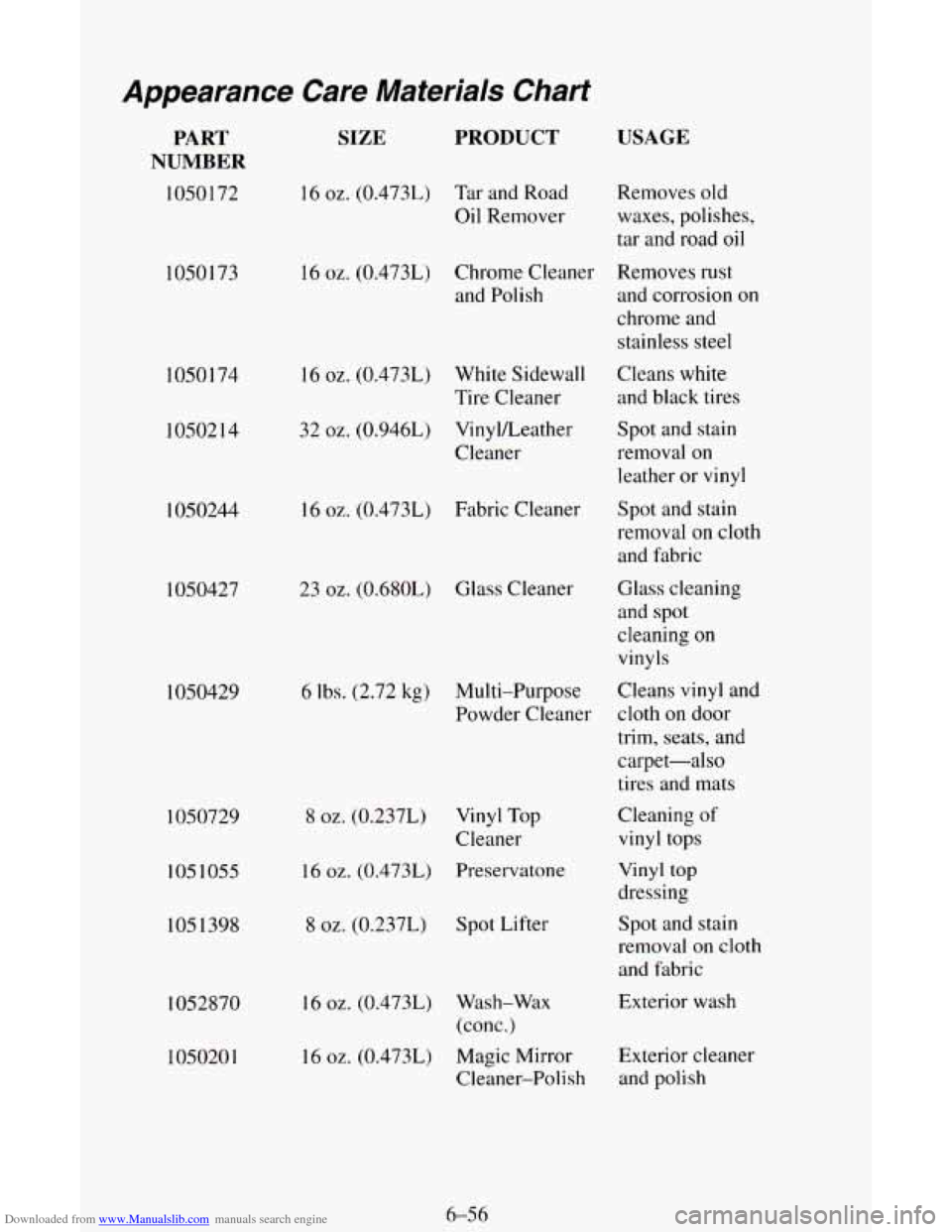
Downloaded from www.Manualslib.com manuals search engine Appearance Care Materials Chart
PART
NUMBER
1050 172
1050173
1050174
1050214 I050244
1050427
1050429
1050729
1051055
1051398 1052870
105020
1
SIZE PRODUCT
16 oz. (0.473L) Tar and Road
Oil Remover
16 oz. (0.473L) White Sidewall
32
oz. (0,9461) VinyVLeather
Tire
Cleaner
Cleaner
USAGE
Removes old
waxes, polishes,
tar and road oil
16 oz. (0.473L) Chrome Cleaner Removes rust
and Polish and corrosion
on
chrome and
stainless steel
Cleans white
and black tires
Spot and stain
removal
on
leather or vinyl
16 oz. (0.473L) Fabric Cleaner
23 oz. (0.680L) Glass Cleaner
8 oz. (0.237L) Vinyl Top
Cleaner
16 oz. (0.4731) Preservatone
8 oz. (0.237L) Spot
Lifter Spot
and stain
removal on cloth
and fabric
Glass cleaning
and spot
cleaning on
vinyls
6 lbs. (2.72
kg) Multi-Purpose Cleans vinyl and
Powder Cleaner cloth
on door
trim,
seats, and
carpet-also
tires and mats
Cleaning
of
vinyl tops
Vinyl top
dressing
Spot and stain
removal on cloth
and fabric
16 oz. (0.473L) Wash-Wax
16
oz. (0.473L) Magic Mirror (conc.)
Cleaner-Polish Exterior
wash
Exterior cleaner
and polish
6-56
Page 276 of 342
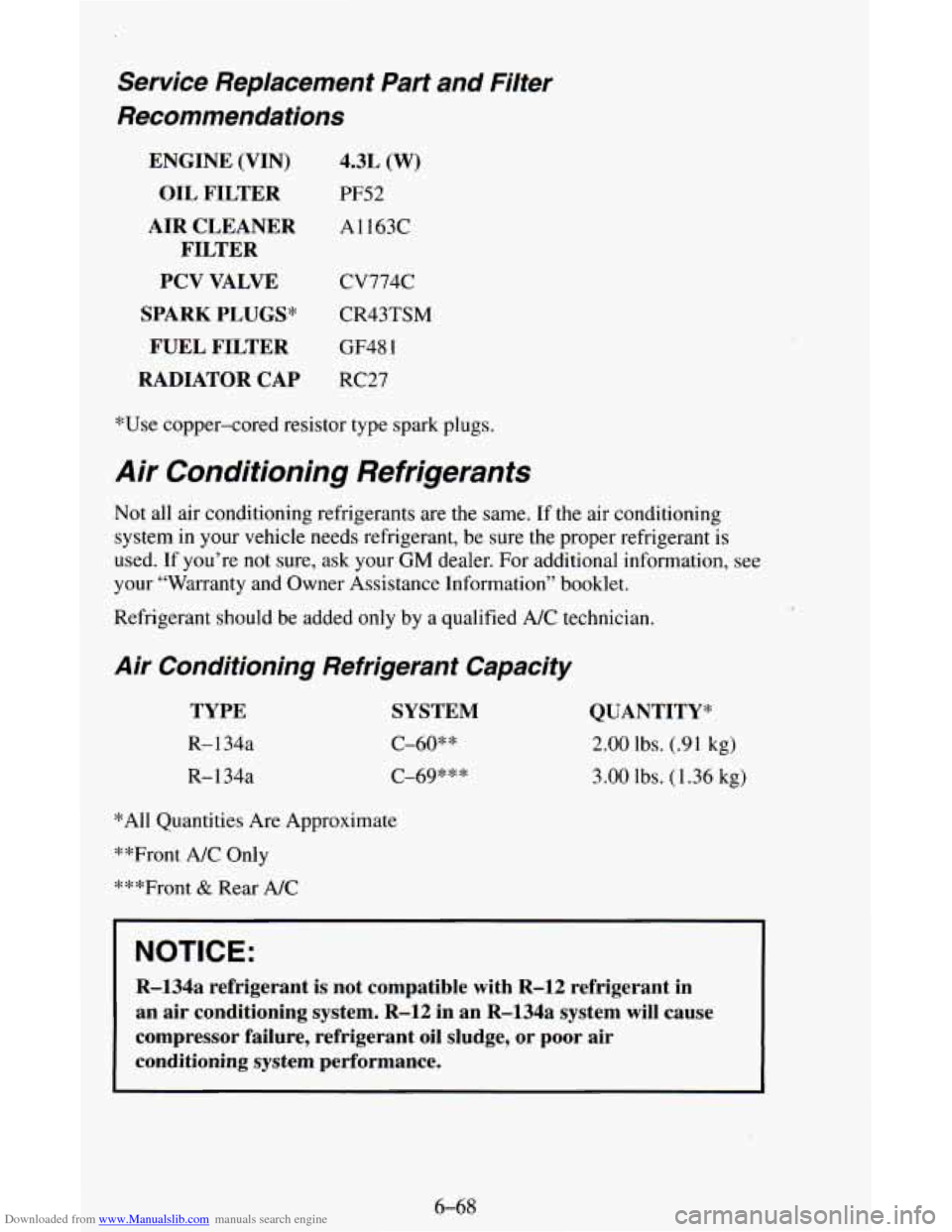
Downloaded from www.Manualslib.com manuals search engine Service Replacement Part and Filter
Recommendations
ENGINE (VIN)
OIL FILTER
AIR CLEANER FILTER
PCV VALVE
SPARK PLUGS* FUEL FILTER
RADIATOR CAP 4.3L (W)
PF52
A1163C
cv774c
CR43TSM
GF48
1
RC27
*Use copper-cored resistor type spark plugs.
Air Conditioning Refrigerants
Not all air conditioning refrigerants are the same. If the air conditioning
system in your vehicle needs refrigerant, be sure
the proper refrigerant is
used. If you’re not
sure, ask your GM dealer. For additional information, see
your “Warranty and Owner Assistance Information” booklet.
Refrigerant should be added only by a qualified
A/C technician.
Air Conditioning Refrigerant Capacity
TYPE
R-l34a
R-134a
SYSTEM
C-60* *
C-69***
QUANTITY*
2.00 lbs. (.91 kg)
3.00 lbs. (1.36 kg)
*All Quantities
Are Approximate
**Front A/C Only
***Front
& Rear A/C
NOTICE:
R-134a refrigerant is not compatible with R-12 refrigerant in
an air conditioning system. R-12 in an R-134a system
will cause
compressor failure, refrigerant oil sludge, or poor air
conditioning system performance.
6-68
Page 277 of 342
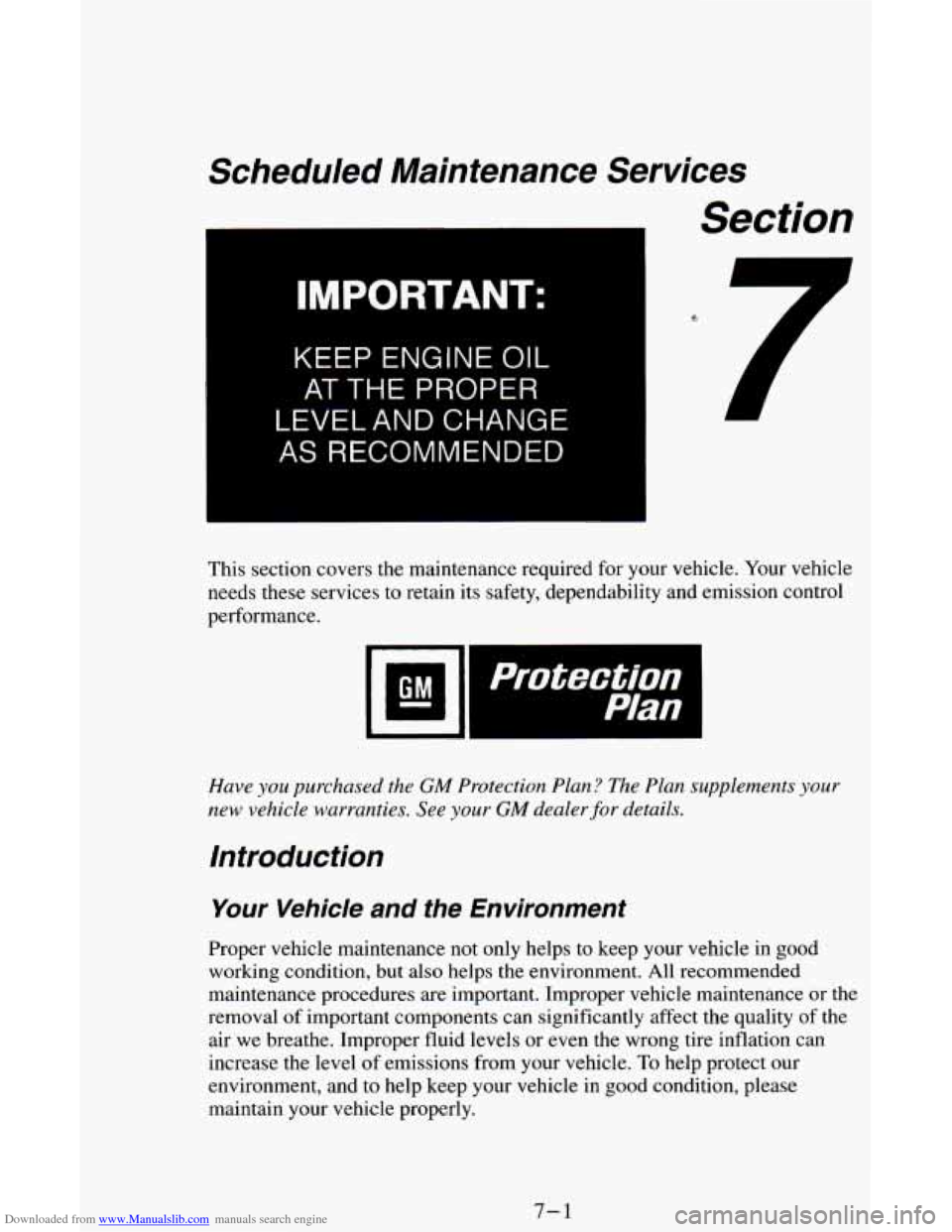
Downloaded from www.Manualslib.com manuals search engine Scheduled Maintenance Services
IMPORTANT:
KEEP ENGINE OIL
AT THE PROPER
LEVEL AND CHANGE
AS RECOMMENDED
Section
This section covers the maintenance required for your vehicle. Your vehicle
needs these services to retain its safety, dependability and emission control
performance.
Protection I
Have you purchased the GM Protection Plan? The Plan supplements your
new vehicle warranties. See your GM dealer for details.
Introduction
Your Vehicle and the Environment
Proper vehicle maintenance not only helps to keep your vehicle in good
working condition, but also helps the environment.
All recommended
maintenance procedures are important. Improper vehicle maintenance or the
removal of important components can significantly affect the quality of the
air we breathe. Improper fluid levels or even the wrong tire inflation can
increase the level
of emissions from your vehicle. To help protect our
environment, and
to help keep your vehicle in good condition, please
maintain your vehicle properly.
7-1
Page 280 of 342
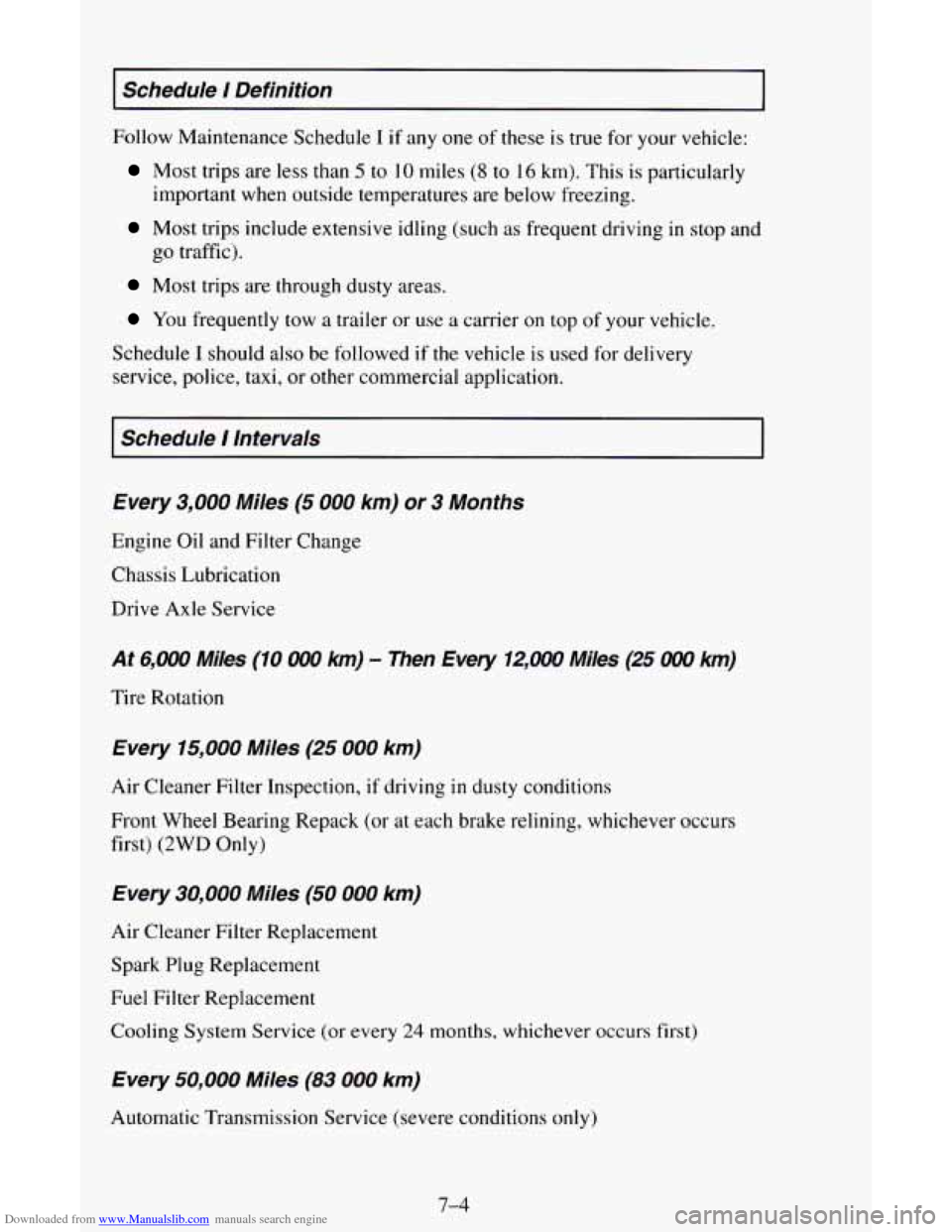
Downloaded from www.Manualslib.com manuals search engine I Schedule I Definition I
Follow Maintenance Schedule I if any one of these is true for your vehicle:
Most trips are less than 5 to 10 miles (8 to 16 km). This is particularly
important when outside temperatures are below freezing.
Most trips include extensive idling (such as frequent driving in stop and
Most trips are through dusty areas.
go traffic).
You frequently tow a trailer or use a carrier on top of your vehicle.
Schedule
I should also be followed if the vehicle is used for delivery
service, police, taxi,
or other commercial application.
I Schedule I Intervals I
Every 3,000 Miles (5 000 km) or 3 Months
Engine Oil and Filter Change
Chassis Lubrication
Drive Axle Service
At 6,000 Miles (10 OOO km) - Then Every 12,000 Miles (25 OOO km)
Tire Rotation
Every 15,000 Miles (25 000 km)
Air Cleaner Filter Inspection, if driving in dusty conditions
Front Wheel Bearing Repack
(or at each brake relining, whichever occurs
first)
(2WD Only)
Every 30,000 Miles (50 000 km)
Air Cleaner Filter Replacement
Spark Plug Replacement
Fuel Filter Replacement
Cooling System Service (or every
24 months, whichever occurs first)
Every 50,000 Miles (83 000 km)
Automatic Transmission Service (severe conditions only)
7-4
Page 281 of 342
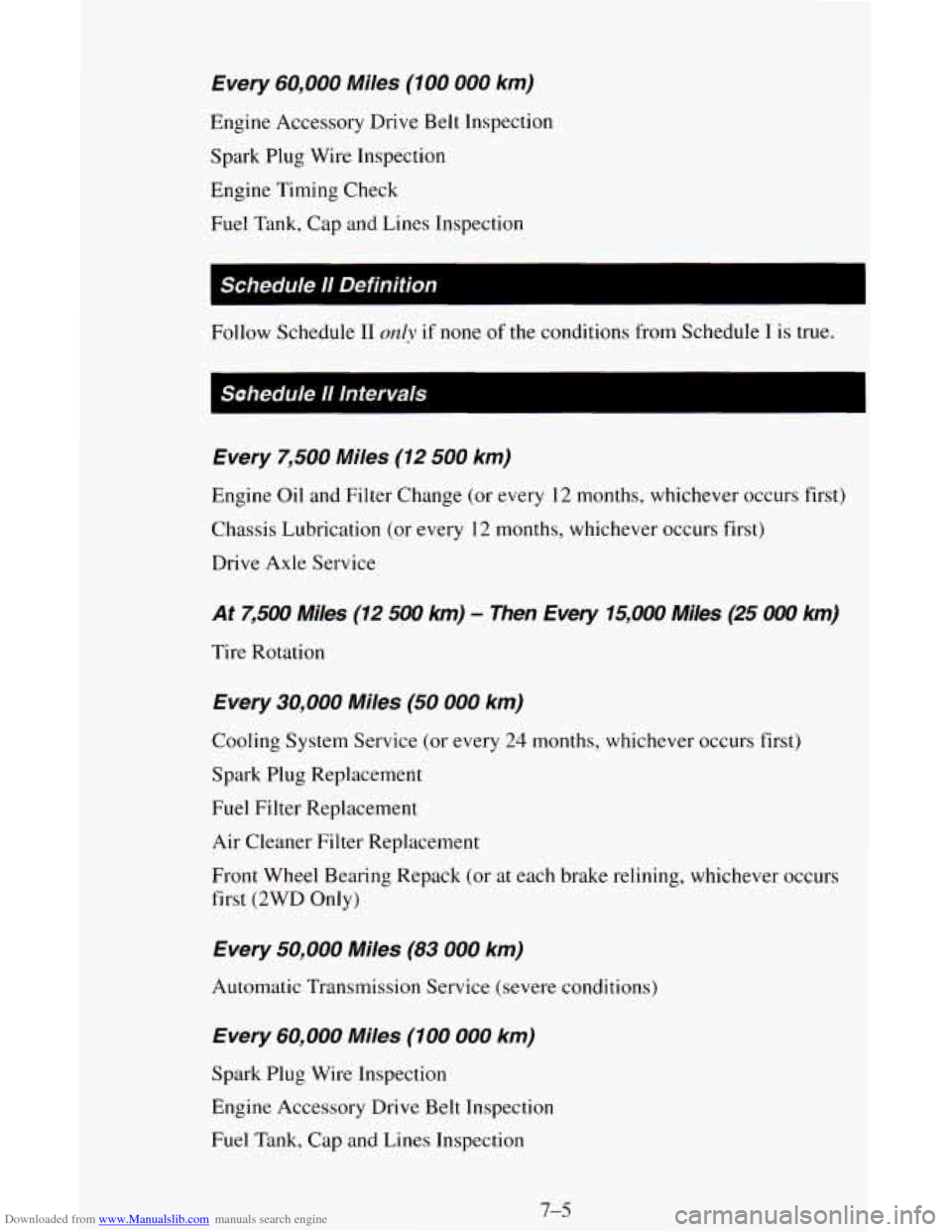
Downloaded from www.Manualslib.com manuals search engine Every 60,000 Miles (100 000 km)
Engine Accessory Drive Belt Inspection
Spark Plug Wire Inspection
Engine Timing Check
Fuel Tank. CaD and Lines Inspection
Schedule 11 Definition I
Follow Schedule I1 only if none of the conditions from Schedule I is true.
Sohedule I1 Intervals
Every
7,500 Miles (12 500 km)
Engine Oil and Filter Change (or every 12 months, whichever occurs first)
Chassis Lubrication (or every 12 months, whichever occurs first)
Drive Axle Service
At 7,500 Miles (12 500 km) - Then Every 15,000 Miles (25 000 km)
Tire Rotation
Every 30,000 Miles (50 000 km)
Cooling System Service (or every 24 months, whichever occurs first)
Spark Plug Replacement
Fuel Filter Replacement
Air Cleaner Filter Replacement
Front Wheel Bearing Repack (or at each brake relining, whichever occurs
first
(2WD Only)
Every 50,000 Miles (83 000 km)
Automatic Transmission Service (severe conditions)
Every 60,000 Miles (100 000 km)
Spark Plug Wire Inspection
Engine Accessory Drive Belt Inspection
Fuel Tank, Cap and Lines Inspection
7-5
Page 282 of 342
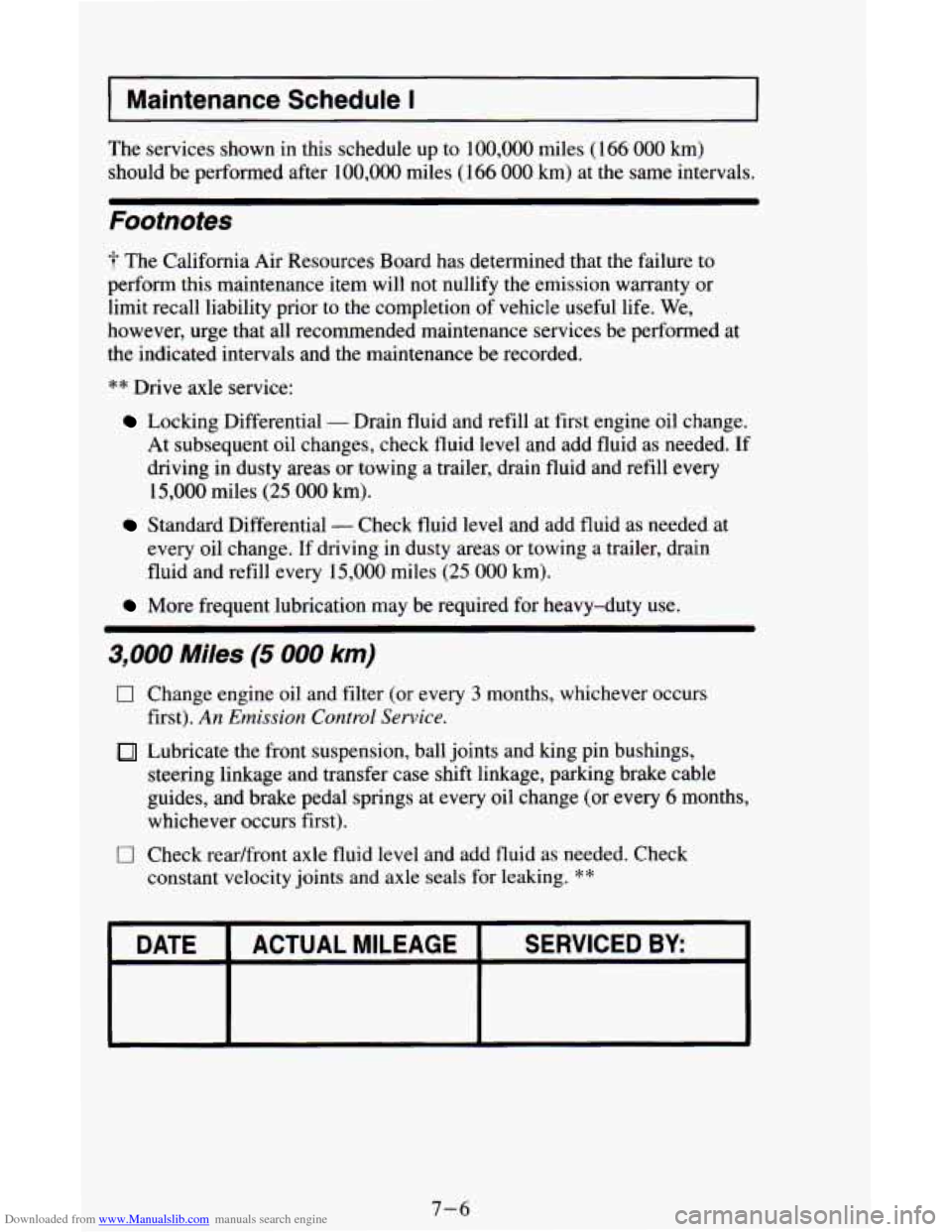
Downloaded from www.Manualslib.com manuals search engine I Maintenance Schedule I
The services shown in this schedule up to 100,000 miles ( 166 000 km)
should be performed after 100,000 miles (166
000 km) at the same intervals.
Footnotes
f The California Air Resources Board has determined that the failure to
perform this maintenance item will not nullify the emission warranty or
limit recall liability prior to the completion of vehicle useful life. We,
however, urge that all recommended maintenance services be performed at
the indicated intervals and the maintenance be recorded.
** Drive axle service:
Locking Differential - Drain fluid and refill at first engine oil change.
At subsequent oil changes, check fluid level and add fluid as needed. If
driving in dusty areas or towing a trailer, drain fluid and refill every
15,000 miles (25 000 km).
Standard Differential - Check fluid level and add fluid as needed at
every oil change. If driving in dusty areas or towing a trailer, drain
fluid and refill every 15,000 miles
(25 000 km).
More frequent lubrication may be required for heavy-duty use.
3,000 Miles (5 000 km)
0 Change engine oil and filter (or every 3 months, whichever occurs
first).
An Emission Control Service.
Lubricate the front suspension, ball joints and king pin bushings,
steering linkage and transfer case shift linkage, parking brake cable
guides, and brake pedal springs at every oil change (or every
6 months,
whichever occurs first).
0 Check readfront axle fluid level and add fluid as needed. Check
constant velocity joints and axle seals
for leaking. **
I DATE I ACTUALMILEAGE I T~RVICED BY
7-6