transmission oil CHEVROLET ASTRO CARGO VAN 1995 2.G Owners Manual
[x] Cancel search | Manufacturer: CHEVROLET, Model Year: 1995, Model line: ASTRO CARGO VAN, Model: CHEVROLET ASTRO CARGO VAN 1995 2.GPages: 342, PDF Size: 17.57 MB
Page 72 of 342
Downloaded from www.Manualslib.com manuals search engine How long should you keep the coolant heater plugged in? The answer
depends
on the weather, the kind of oil you have, and some other things.
Instead
of trying to list everything here, we ask that you contact your GM
dealer in the area where you’ll be parking your vehicle. The dealer can give
you the best advice for that particular area.
Automatic Transmission
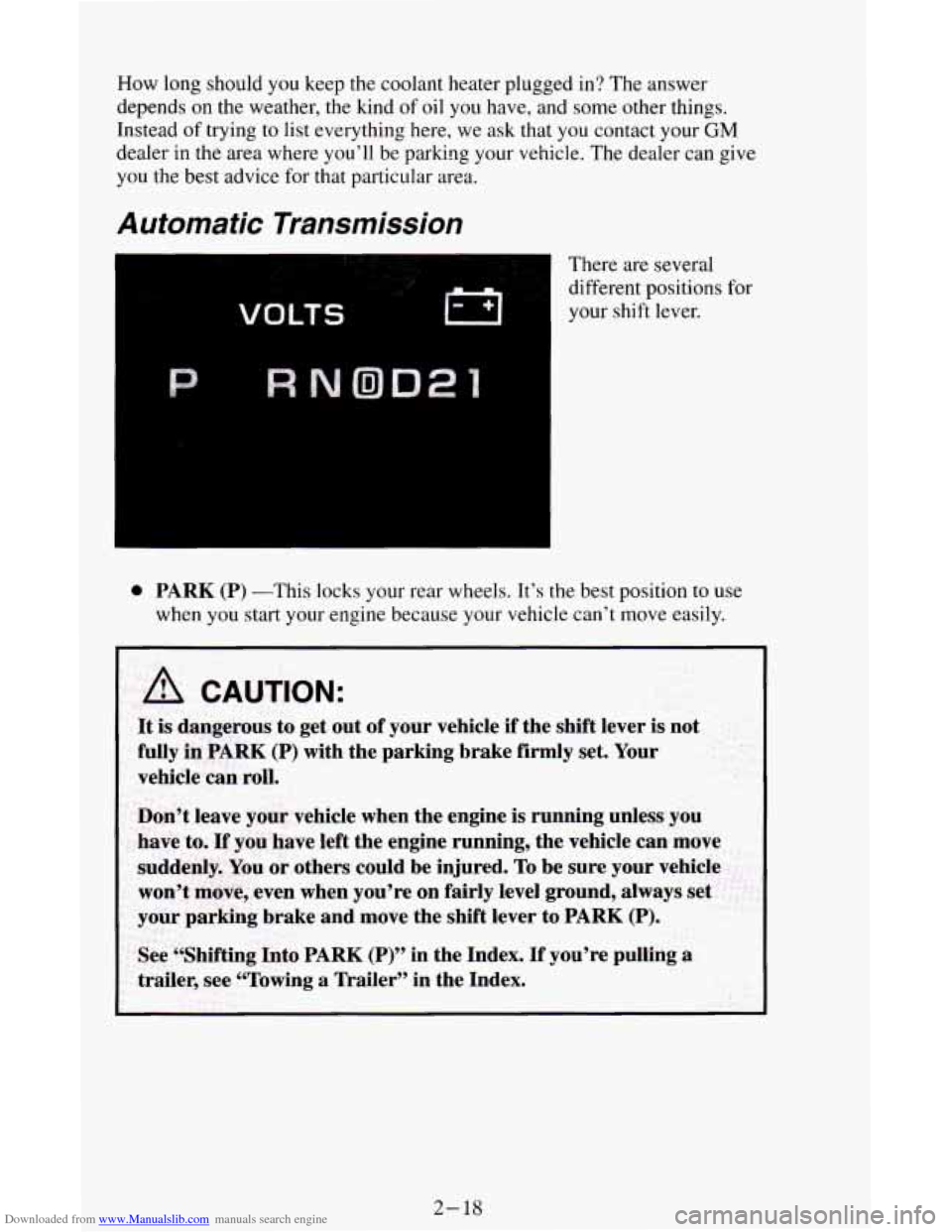
There are several
different positions for
your shift lever.
0 PARK (P) -This locks your rear wheels. It’s the best position to use
when you start your engine because your vehicle can’t move easily.
A CAUTION:
It is dangerous to get out of your vehicle if the shift lever is not I
fully in PARK (P) with the parking brake firmly set. Your
vehicle can roll.
Don’t leave your vehicle when the engine is running unless you
have to.
If you have left the engine running, the vehicle can move
suddenly.
You or others could be injured. To be sure your vehicle
won’t move, even when you’re on fairly level ground, always set
your parking brake and move the shift lever to PARK
(P). I
See “Shifting Into PARK (P)” in the Index. If you’re pulling a
trailer,
see “Towing a Trailer” in the Index.
2- 18
Page 170 of 342
Downloaded from www.Manualslib.com manuals search engine Driving On Grades
Reduce speed and shift to a lower gear before you start down a long or steep
downgrade. If
you don’t shift down, you might have to use your brakes so
much that they would get hot and no longer work well.
On a long uphill grade, shift down and reduce your speed to around
45 mph
(70 km/h) to reduce the possibility of engine and transmission overheating.
When towing at high altitude
on steep uphill grades, consider the following:
Engine coolant will boil at
a lower temperature than at normal altitudes. If
you turn your engine off immediately after towing at high altitude on steep
uphill grades, your vehicle may show signs similar to engine overheating.
To avoid this, let the engine run while parked (preferably on level ground)
with the automatic transmission
in PARK (P) for a few minutes before
turning the engine off. If you do get the overheat warning, see “Engine
Overheating”
in the Index.
Parking on Hills
You really should not park your vehicle, with a trailer attached, on a hill. If
something goes wrong, your rig could start to move. People can be injured,
and both your vehicle and the trailer can be damaged.
But if
you ever have to park your rig on a hill, here’s how to do it:
1. Apply your regular brakes, but don’t shift into PARK (P) yet. Turn your
wheels into the curb when facing downhill and away from the curb
when facing uphill.
2. Have someone place chocks under the trailer wheels.
3. When the wheel chocks are in place, release the regular brakes until the
chocks absorb the load.
4. Reapply the regular brakes, Then apply your parking brake, and shift to
5. Release the regular brakes.
PARK (P).
When You Are Ready to Leave After Parking on a Hill
1. Apply your regular brakes and hold the pedal down while you:
Start your engine;
Shift into a gear; and
0 Release the parking brake.
2. Let up on the brake pedal.
3. Drive slowly until the trailer is clear of the chocks.
4. Stop and have someone pick up and store the chocks.
4-32
Page 171 of 342
Downloaded from www.Manualslib.com manuals search engine Maintenance When Trailer Towing
Your vehicle will need service more often when you’re pulling a trailer. See
the Maintenance Schedule for more
on this. Things that are especially
important in trailer operation are automatic transmission fluid (don’t
overfill), engine oil, axle lubricant, belt, cooling system, and brake
adjustment. Each of these is covered in this manual, and the Index will help
you find them quickly. If you’re trailering, it’s a good idea to review these
sections before you start your trip.
Check periodically to see that all hitch nuts and bolts are tight.
Trailer Lighting Systems Wiring
See “Trailer Wiring Harness” in the Index.
4-33
Page 226 of 342
Downloaded from www.Manualslib.com manuals search engine NOTICE:
If the air cleaner is off, a backfire can cause a damaging engine
fire. And, dirt can easily get into your engine, which will damage
it. Always have the air cleaner in place when you’re driving.
Automatic Transmission Fluid
When to Check and Change
A good time to check your automatic transmission fluid level is when the
engine oil
is changed. Refer to the Maintenance Schedule to determine
when
to change your fluid. See “Scheduled Maintenance Services” in the
Index.
How to Check
Because this operation can be a little difficult, you may choose to have this
done at your
GM dealer Service Department.
If you do it yourself, be sure to follow all the instructions here, or you could
get a false reading
on the dipstick.
NOTICE:
Too much or too little fluid can damage your transmission. Too
much can mean that some of the fluid could come out and fall on
hot engine parts or exhaust system parts, starting
a fire. Be sure
to get an accurate reading if you check your transmission fluid.
Wait at least
30 minutes before checking the transmission fluid level if you
have been driving:
When outside temperatures are above 90°F (32” C).
0 At high speed for quite a while.
0 In heavy traffic - especially in hot weather.
While pulling a trailer.
To get the right reading, the fluid should be at normal operating
temperature, which is 180°F to
200°F (82°C to 93°C).
6- 18
Page 280 of 342
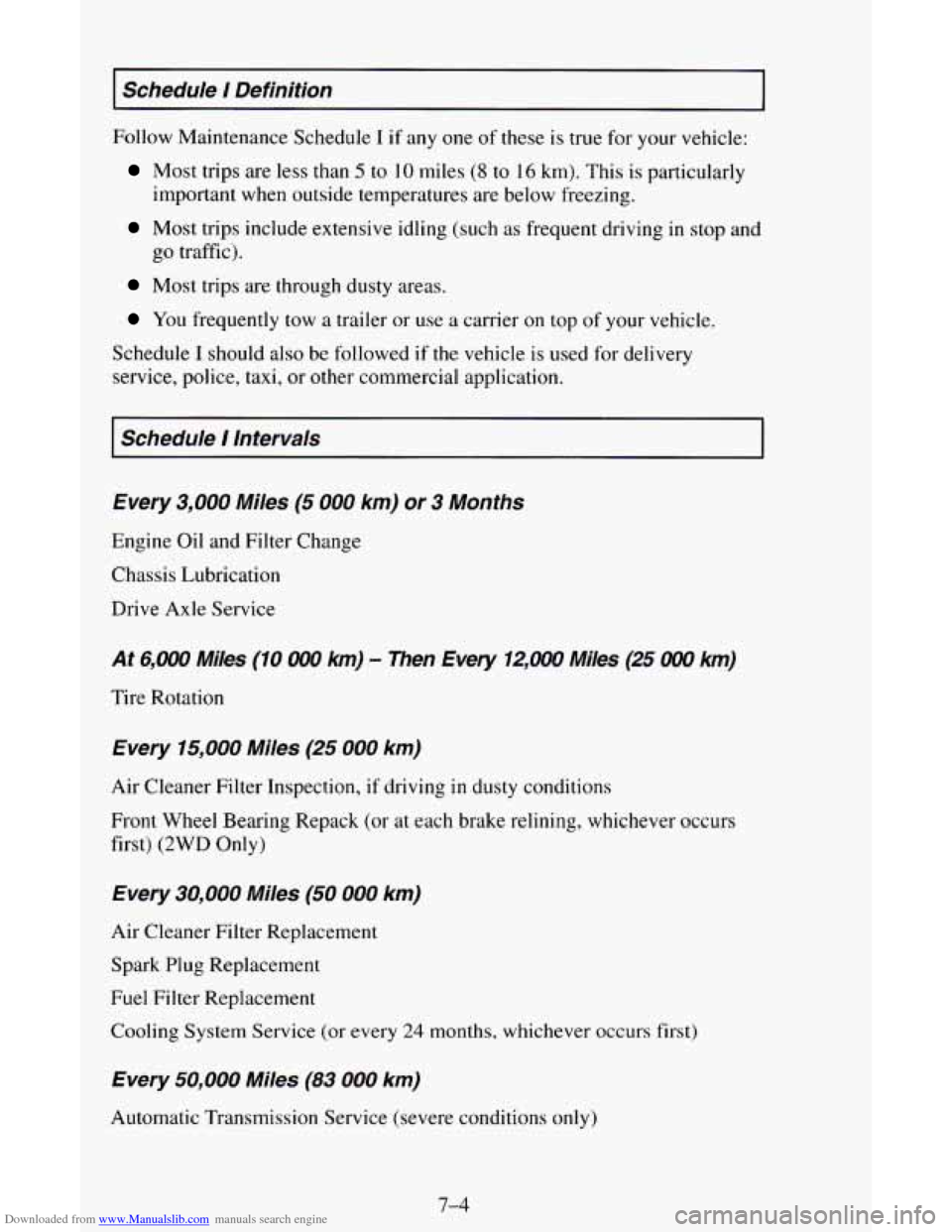
Downloaded from www.Manualslib.com manuals search engine I Schedule I Definition I
Follow Maintenance Schedule I if any one of these is true for your vehicle:
Most trips are less than 5 to 10 miles (8 to 16 km). This is particularly
important when outside temperatures are below freezing.
Most trips include extensive idling (such as frequent driving in stop and
Most trips are through dusty areas.
go traffic).
You frequently tow a trailer or use a carrier on top of your vehicle.
Schedule
I should also be followed if the vehicle is used for delivery
service, police, taxi,
or other commercial application.
I Schedule I Intervals I
Every 3,000 Miles (5 000 km) or 3 Months
Engine Oil and Filter Change
Chassis Lubrication
Drive Axle Service
At 6,000 Miles (10 OOO km) - Then Every 12,000 Miles (25 OOO km)
Tire Rotation
Every 15,000 Miles (25 000 km)
Air Cleaner Filter Inspection, if driving in dusty conditions
Front Wheel Bearing Repack
(or at each brake relining, whichever occurs
first)
(2WD Only)
Every 30,000 Miles (50 000 km)
Air Cleaner Filter Replacement
Spark Plug Replacement
Fuel Filter Replacement
Cooling System Service (or every
24 months, whichever occurs first)
Every 50,000 Miles (83 000 km)
Automatic Transmission Service (severe conditions only)
7-4
Page 281 of 342
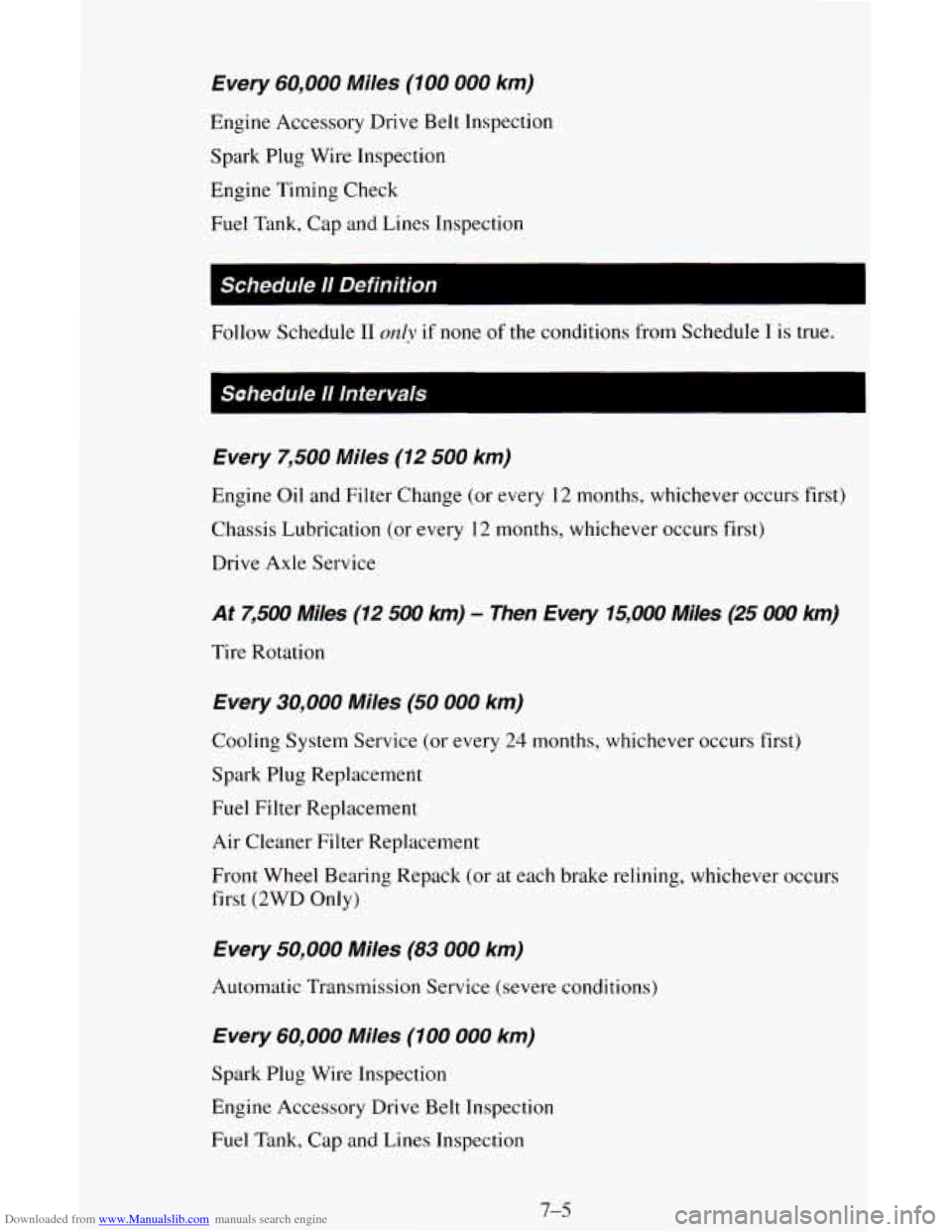
Downloaded from www.Manualslib.com manuals search engine Every 60,000 Miles (100 000 km)
Engine Accessory Drive Belt Inspection
Spark Plug Wire Inspection
Engine Timing Check
Fuel Tank. CaD and Lines Inspection
Schedule 11 Definition I
Follow Schedule I1 only if none of the conditions from Schedule I is true.
Sohedule I1 Intervals
Every
7,500 Miles (12 500 km)
Engine Oil and Filter Change (or every 12 months, whichever occurs first)
Chassis Lubrication (or every 12 months, whichever occurs first)
Drive Axle Service
At 7,500 Miles (12 500 km) - Then Every 15,000 Miles (25 000 km)
Tire Rotation
Every 30,000 Miles (50 000 km)
Cooling System Service (or every 24 months, whichever occurs first)
Spark Plug Replacement
Fuel Filter Replacement
Air Cleaner Filter Replacement
Front Wheel Bearing Repack (or at each brake relining, whichever occurs
first
(2WD Only)
Every 50,000 Miles (83 000 km)
Automatic Transmission Service (severe conditions)
Every 60,000 Miles (100 000 km)
Spark Plug Wire Inspection
Engine Accessory Drive Belt Inspection
Fuel Tank, Cap and Lines Inspection
7-5
Page 291 of 342
Downloaded from www.Manualslib.com manuals search engine I Maintenance Schedule I I
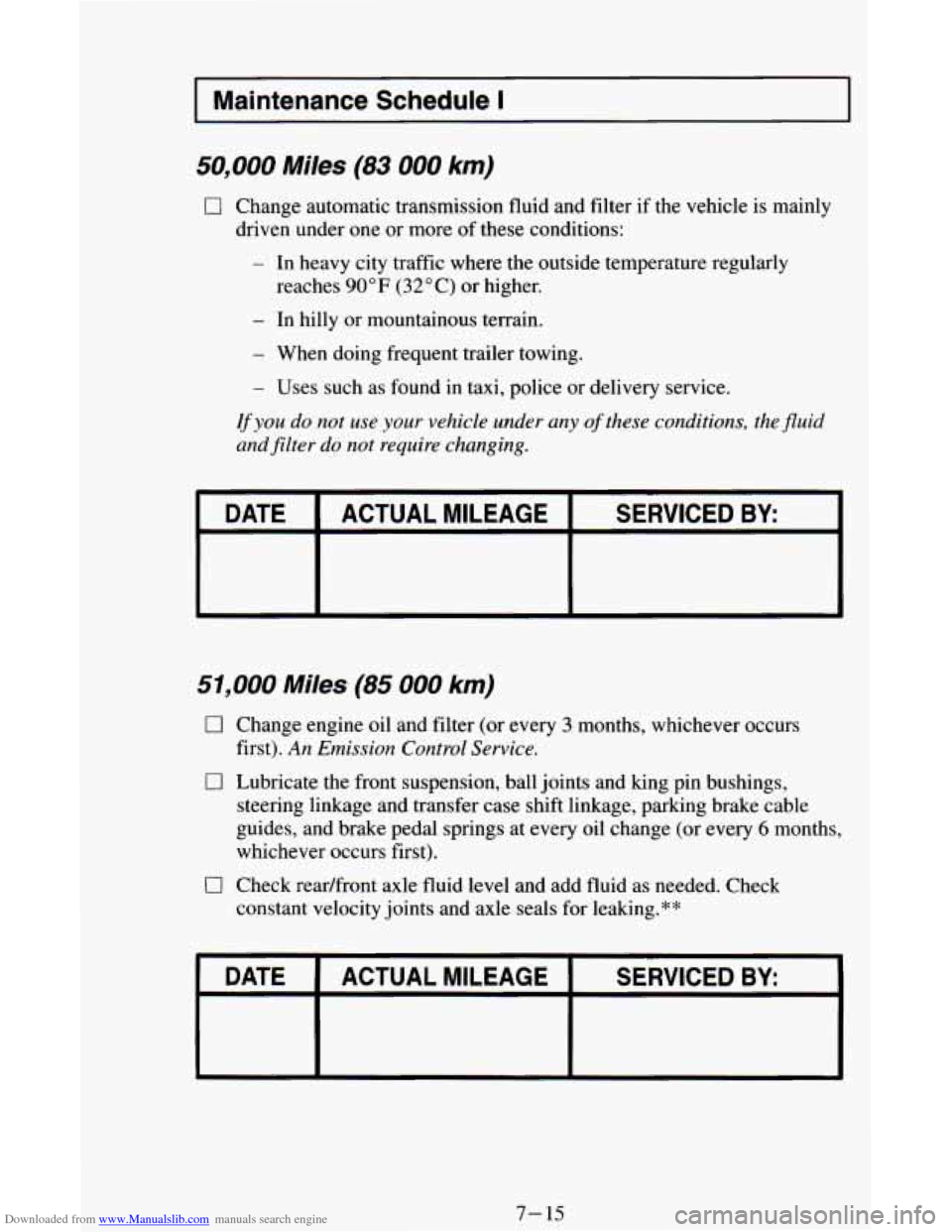
50,000 Miles (83 000 km)
0 Change automatic transmission fluid and filter if the vehicle is mainly
driven under one or more of these conditions:
- In heavy city traffic where the outside temperature regularly
reaches
90°F (32°C) or higher.
- In hilly or mountainous terrain.
- When doing frequent trailer towing.
- Uses such as found in taxi, police or delivery service.
If you do not use your vehicle under any of these conditions, the fluid
and filter do not require changing.
DATE
SERVICED BY: ACTUAL MILEAGE
51,000 Miles (85 000 km)
0
0
0
Change engine oil and filter (or every 3 months, whichever occurs
first).
An Emission Control Service.
Lubricate the front suspension, ball joints and king pin bushings,
steering linkage and transfer case shift linkage, parking brake cable
guides, and brake pedal springs at every oil change (or every
6 months,
whichever occurs first).
Check readfront axle fluid level and add fluid as needed. Check
constant velocity joints and axle seals for leaking.**
DATE ACTUAL MILEAGE SERVICED BY:
7- 15
Page 306 of 342
Downloaded from www.Manualslib.com manuals search engine Maintenance Schedule II I
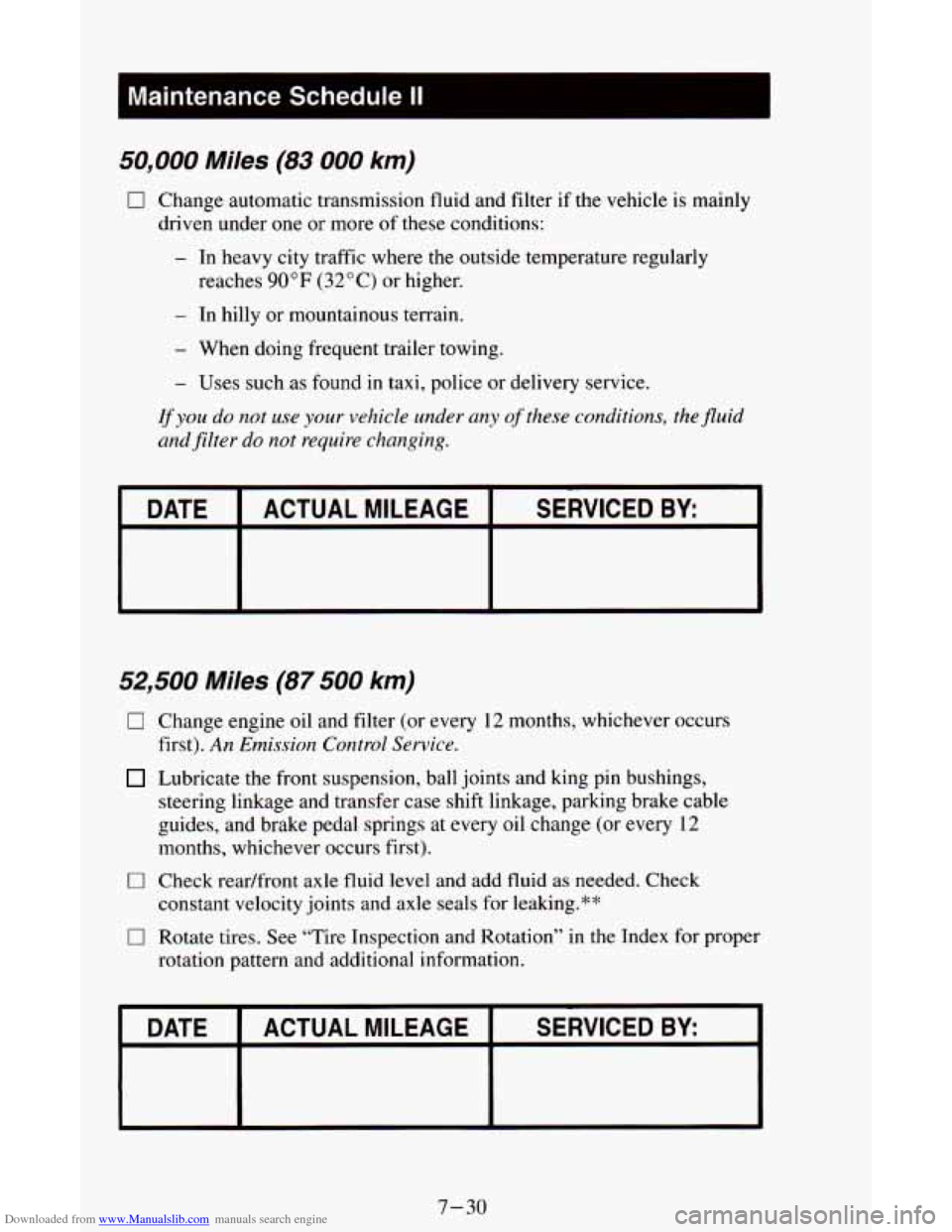
50,000 Miles (83 000 km)
0 Change automatic transmission fluid and filter if the vehicle is mainly
driven under one or more of these conditions:
- In heavy city traffic where the outside temperature regularly
reaches
90°F (32°C) or higher.
- In hilly or mountainous terrain.
- When doing frequent trailer towing.
- Uses such as found in taxi, police or delivery service.
If you do not use your vehicle under any of these conditions, the fluid
and
filter do not require changing.
DATE SERVICED BY ACTUAL MILEAGE
52,500 Miles (87 500 km)
0
0
0
Change
engine oil and filter (or every 12 months, whichever occurs
first).
An Emission Control Service.
Lubricate the front suspension, ball joints and king pin bushings,
steering linkage and transfer case shift linkage, parking brake cable
guides, and brake pedal springs at every oil change (or every
12
months, whichever occurs first).
Check readfront axle fluid level and add
fluid as needed. Check
constant velocity joints and axle seals for leaking.**
Rotate tires. See “Tire Inspection and Rotation”
in the Index for proper
rotation pattern and additional information.
DATE SERVICED BY: ACTUAL MILEAGE
7-30
Page 311 of 342
Downloaded from www.Manualslib.com manuals search engine I Maintenance Schedule II I
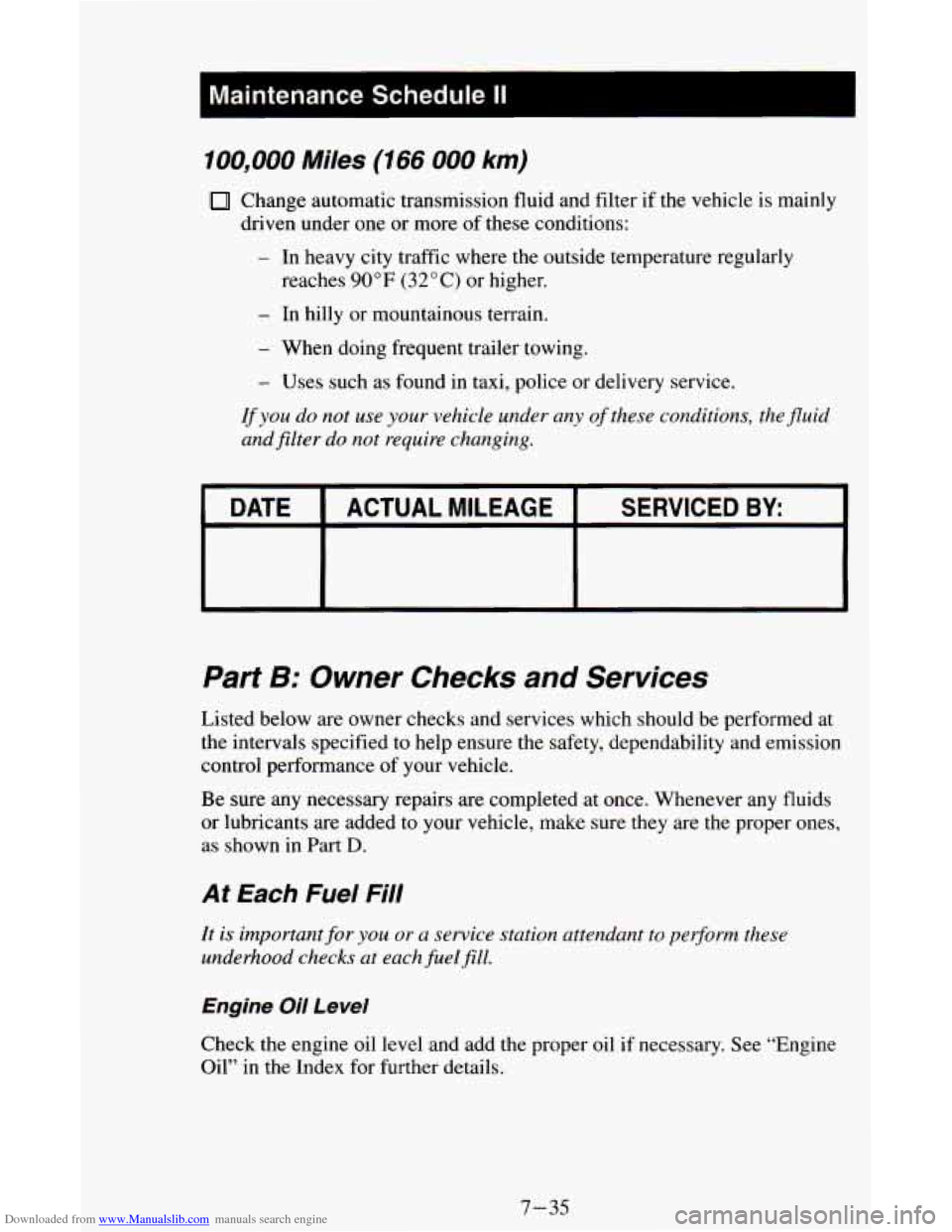
100,000 Miles (166 000 km)
Change automatic transmission fluid and filter if the vehicle is mainly
- In heavy city traffic where the outside temperature regularly
reaches
90°F (32°C) or higher.
- In hilly or mountainous terrain.
- When doing frequent trailer towing.
- Uses such as found in taxi, police or delivery service.
driven
under one
or more of these conditions:
If you do not use your vehicle under any of these conditions, the fluid
and filter do not require changing.
DATE
SERVICED BY: ACTUAL MILEAGE
Part 9: vwner Checks and Services
Listed below are owner checks and services which should be performed at
the intervals specified to help ensure the safety, dependability and emission
control performance
of your vehicle.
Be sure any necessary repairs are completed at once. Whenever any fluids
or lubricants are added to your vehicle, make sure they are the proper ones,
as shown
in Part D.
At Each Fuel Fill
It is important for you or a service station attendant to pegorm these
underhood checks at each fuel
fill.
Engine Oil Level
Check the engine oil level and add the proper oil if necessary. See “Engine
Oil” in the Index for further details.
7-35
Page 316 of 342
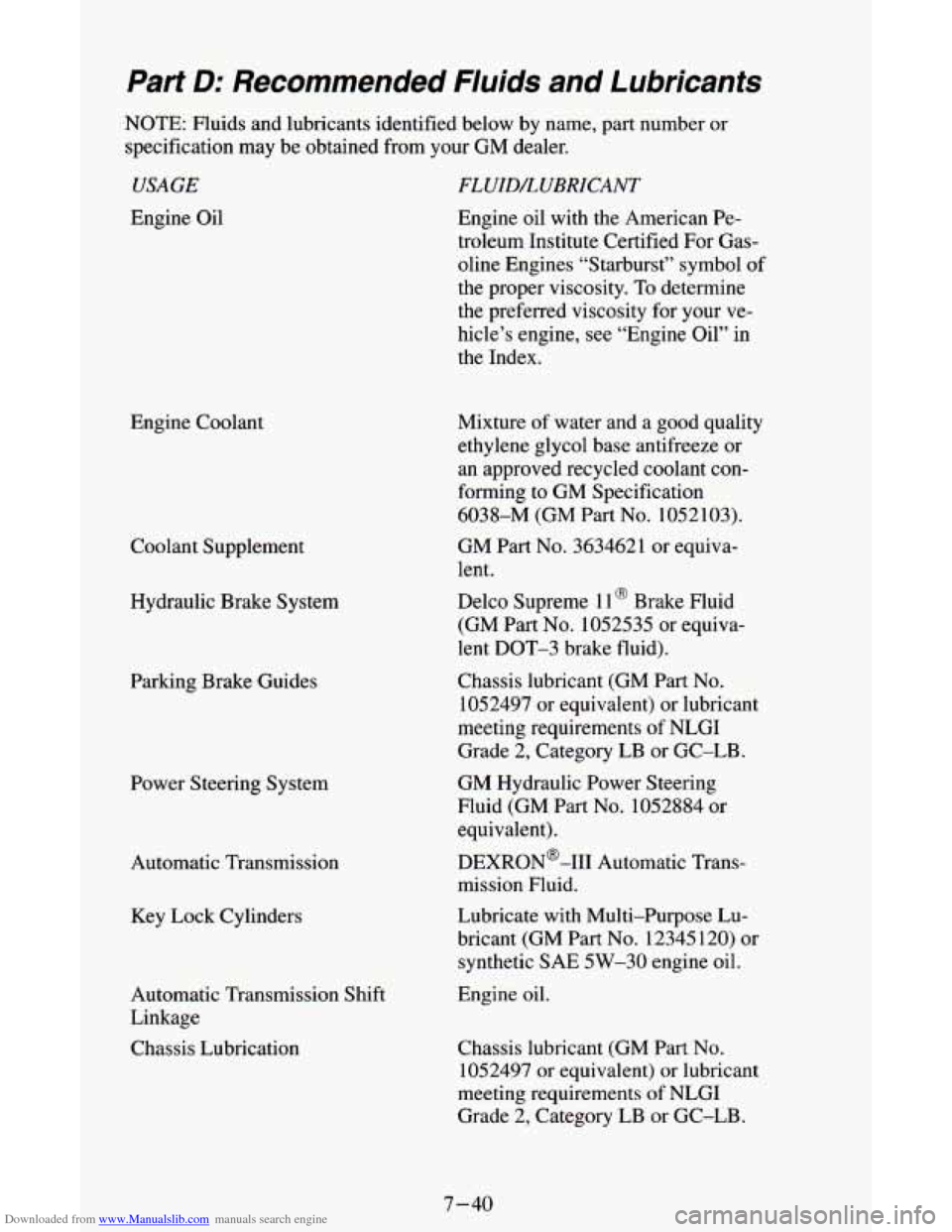
Downloaded from www.Manualslib.com manuals search engine NOTE: Fluids and lubricants identified below by name, part number or
specification may be obtained from your GM dealer.
USAGE
Engine Oil
Engine Coolant Coolant Supplement
Hydraulic Brake System
Parking Brake Guides
Power Steering System
Automatic Transmission Key Lock Cylinders
Automatic Transmission Shift
Linkage
Chassis Lubrication
FLUID/LUBRICANT
Engine oil with the American Pe-
troleum Institute Certified For Gas-
oline Engines “Starburst” symbol
of
the proper viscosity. To determine
the preferred viscosity for your ve-
hicle’s engine, see “Engine Oil” in
the Index.
Mixture of water and a good quality
ethylene glycol base antifreeze or
an approved recycled coolant con-
forming to GM Specification
GM Part No. 3634621 or equiva-
lent. 6038-M (GM Part
NO. 1052103).
Delco Supreme
11 @ Brake Fluid
(GM Part
No. 1052535 or equiva-
lent DOT-3 brake fluid).
Chassis lubricant (GM Part No.
1052497 or equivalent) or lubricant
meeting requirements
of NLGI
Grade
2, Category LB or GC-LB.
GM Hydraulic Power Steering
Fluid (GM Part
No. 1052884 or
equivalent).
DEXRON@-I11 Automatic Trans-
mission Fluid.
Lubricate
with Multi-Purpose Lu-
bricant (GM Part
No. 12345 120) or
synthetic SAE
5W-30 engine oil.
Engine oil.
Chassis lubricant
(GM Part No.
1052497 or equivalent) or lubricant
meeting requirements of NLGI
Grade 2, Category LB
or GC-LB.
7-40