stop CHEVROLET ASTRO CARGO VAN 2003 2.G Owners Manual
[x] Cancel search | Manufacturer: CHEVROLET, Model Year: 2003, Model line: ASTRO CARGO VAN, Model: CHEVROLET ASTRO CARGO VAN 2003 2.GPages: 382, PDF Size: 2.63 MB
Page 12 of 382

Seatback Latches
The seatback lever is
located on the right rear of
your seat. If your vehicle
has the non-touring
bench seatback, pull up on
the latch release lever
while pulling the seatback
toward the rear of the
vehicle.After the latch has been released, push the seatback
toward the front of the vehicle until it locks into place.
To raise the seatback, unlock the seatback latch
by pushing up on the lever while pushing down on the
upper edge of the seatback. Move the seatback into the
upright position. Make sure the seatback is locked
when it is back in the upright position.
{CAUTION:
If the seatback isn't locked, it could move
forward in a sudden stop or crash. That could
cause injury to the person sitting there. Always
press rearward on the seatback to be sure it
is locked.
1-6
Page 15 of 382

Replacing the Rear Seats
1. Lower the seat into position. Make sure the front
retainers are hooked onto the anchor pins.2. Pull the seat down to latch the rear retainers. Make
sure the seat is locked in by pulling up and down
on the seat.
{CAUTION:
A seat that isn't locked into place properly can
move around in a collision or sudden stop.
People in the vehicle could be injured. Be sure
to lock the seat into place properly when
installing it.
1-9
Page 21 of 382

Put someone on it. Get it up to speed. Then stop the vehicle. The rider
doesn't stop.
1-15
Page 22 of 382

The person keeps going until stopped by something. In
a real vehicle, it could be the windshield...or the instrument panel...
1-16
Page 23 of 382

or the safety belts!
With safety belts, you slow down as the vehicle does.
You get more time to stop. You stop over more distance,
and your strongest bones take the forces. That's why
safety belts make such good sense.
Questions and Answers About
Safety Belts
Q:Won't I be trapped in the vehicle after an
accident if I'm wearing a safety belt?
A:Youcouldbe ± whether you're wearing a safety
belt or not. But you can unbuckle a safety belt,
even if you're upside down. And your chance
of being conscious during and after an accident,
so you
canunbuckle and get out, ismuchgreater if
you are belted.
Q:If my vehicle has air bags, why should I have to
wear safety belts?
A:Air bags are in many vehicles today and will be in
most of them in the future. But they are
supplemental systems only; so they work
with
safety belts ± not instead of them. Every air bag
system ever offered for sale has required the use of
safety belts. Even if you're in a vehicle that has air
bags, you still have to buckle up to get the most
protection. That's true not only in frontal collisions,
but especially in side and other collisions.
1-17
Page 25 of 382
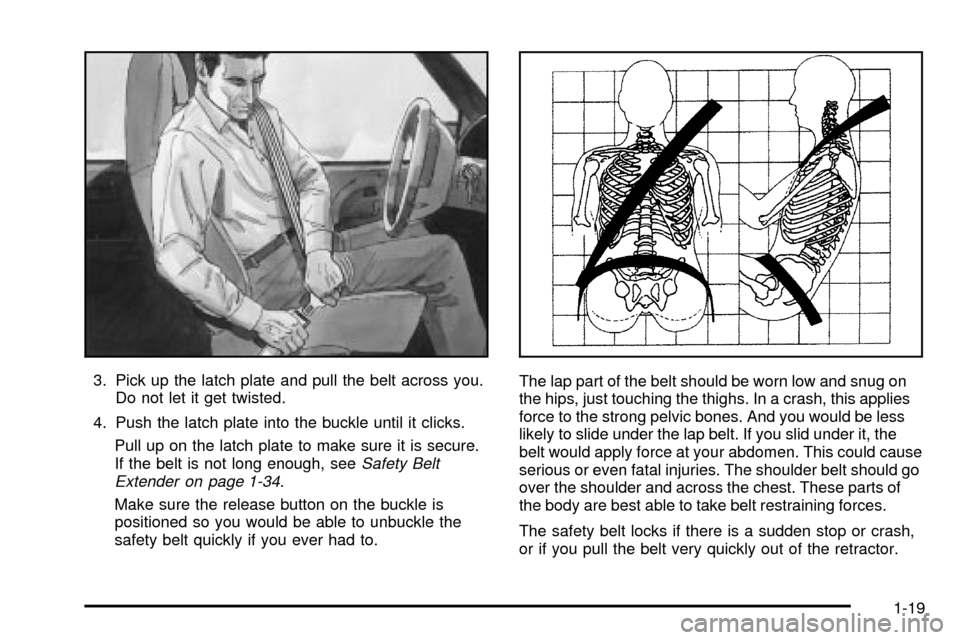
3. Pick up the latch plate and pull the belt across you.
Do not let it get twisted.
4. Push the latch plate into the buckle until it clicks.
Pull up on the latch plate to make sure it is secure.
If the belt is not long enough, see
Safety Belt
Extender on page 1-34.
Make sure the release button on the buckle is
positioned so you would be able to unbuckle the
safety belt quickly if you ever had to.The lap part of the belt should be worn low and snug on
the hips, just touching the thighs. In a crash, this applies
force to the strong pelvic bones. And you would be less
likely to slide under the lap belt. If you slid under it, the
belt would apply force at your abdomen. This could cause
serious or even fatal injuries. The shoulder belt should go
over the shoulder and across the chest. These parts of
the body are best able to take belt restraining forces.
The safety belt locks if there is a sudden stop or crash,
or if you pull the belt very quickly out of the retractor.
1-19
Page 36 of 382

If the belt stops before it reaches the buckle, tilt the
latch plate and keep pulling until you can buckle
it. Pull up on the latch plate to make sure it is
secure.
If the belt is not long enough, see
Safety Belt
Extender on page 1-34.
Make sure the release button on the buckle is
positioned so that you would be able to unbuckle
the safety belt quickly if you ever had to.3. To make the lap part tight, pull down on the buckle
end of the belt as you pull up on the shoulder part.
1-30
Page 37 of 382
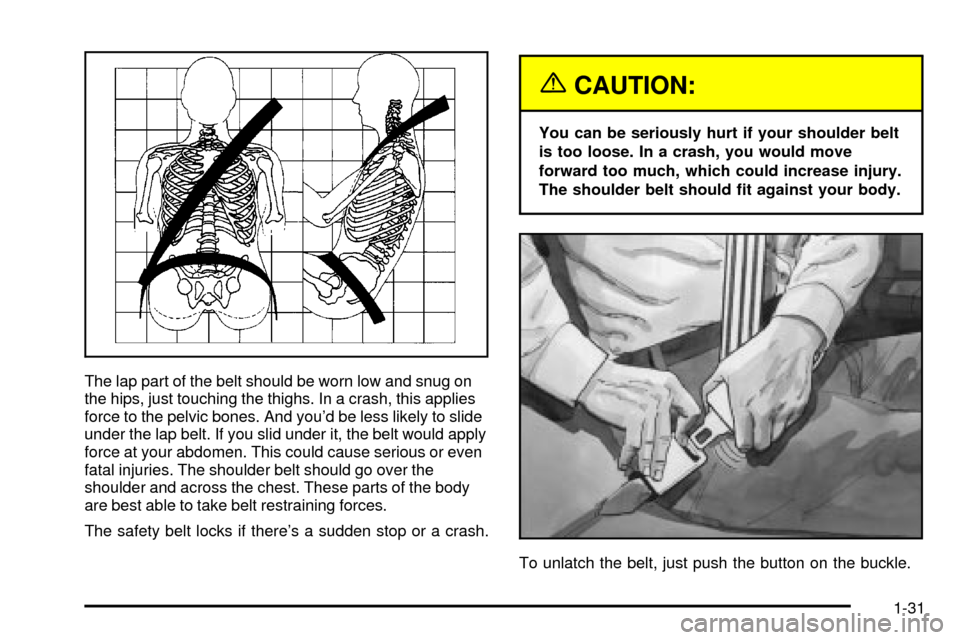
The lap part of the belt should be worn low and snug on
the hips, just touching the thighs. In a crash, this applies
force to the pelvic bones. And you'd be less likely to slide
under the lap belt. If you slid under it, the belt would apply
force at your abdomen. This could cause serious or even
fatal injuries. The shoulder belt should go over the
shoulder and across the chest. These parts of the body
are best able to take belt restraining forces.
The safety belt locks if there's a sudden stop or a crash.
{CAUTION:
You can be seriously hurt if your shoulder belt
is too loose. In a crash, you would move
forward too much, which could increase injury.
The shoulder belt should ®t against your body.
To unlatch the belt, just push the button on the buckle.
1-31
Page 53 of 382

Where to Put the Restraint
Except Cargo Vans
Accident statistics show that children are safer if they
are restrained in the rear rather than the front seat.
General Motors, therefore, recommends that child
restraints be secured in a rear seat including an infant
riding in a rear-facing infant seat, a child riding in a
forward-facing child seat and an older child riding in a
booster seat.
Neverput a rear-facing child restraint
in the front passenger seat. Here's why:
{CAUTION:
A child in a rear-facing child restraint can be
seriously injured or killed if the right front
passenger's air bag in¯ates. This is because
the back of the rear-facing child restraint
would be very close to the in¯ating air bag.
Always secure a rear-facing child restraint in a
rear seat.
CAUTION: (Continued)
CAUTION: (Continued)
You may secure a forward-facing child
restraint in the right front seat, but before you
do, always move the front passenger seat as
far back as it will go. It's better to secure the
child restraint in a rear seat.
Wherever you install it, be sure to secure the child
restraint properly.
Keep in mind that an unsecured child restraint can
move around in a collision or sudden stop and injure
people in the vehicle. Be sure to properly secure
any child restraint in your vehicle ± even when no
child is in it.
1-47
Page 54 of 382

Cargo Vans
The child restraint must be secured properly in the
passenger seat.Neverput a rear-facing child restraint in
this vehicle. Here's why:
{CAUTION:
A child in a rear-facing child restraint can be
seriously injured or killed if the passenger's air
bag in¯ates. This is because the back of the
rear-facing child restraint would be very close
to the in¯ating air bag. Do not use a
rear-facing child restraint in this vehicle.
If a forward-facing child restraint is suitable for
your child, always move the front passenger
seat as far back as it will go.
Keep in mind that an unsecured child restraint can
move around in a collision or sudden stop and injure
people in the vehicle. Be sure to properly secure
any child restraint in your vehicle ± even when no
child is in it.
Top Strap
Some child restraints have a top strap, or ªtop tether.º It
can help restrain the child restraint during a collision.
For it to work, a top strap must be properly anchored to
the vehicle. Some top strap-equipped child restraints are
designed for use with or without the top strap being
anchored. Others require the top strap always to be
anchored. Be sure to read and follow the instructions for
your child restraint. If yours requires that the top strap be
anchored, don't use the restraint unless it is anchored
properly.
If the child restraint does not have a top strap, one can
be obtained, in kit form, for many child restraints.
Ask the child restraint manufacturer whether or not a kit
is available.
1-48