warning CHEVROLET ASTRO PASSENGER 1993 1.G User Guide
[x] Cancel search | Manufacturer: CHEVROLET, Model Year: 1993, Model line: ASTRO PASSENGER, Model: CHEVROLET ASTRO PASSENGER 1993 1.GPages: 345, PDF Size: 19 MB
Page 120 of 345
Downloaded from www.Manualslib.com manuals search engine Featurns & Controls
Voltmeter
Standard Cluster Digital Cluster
r
LT S M
I
i
f
r
I
'i I I
I
I I I
PO652
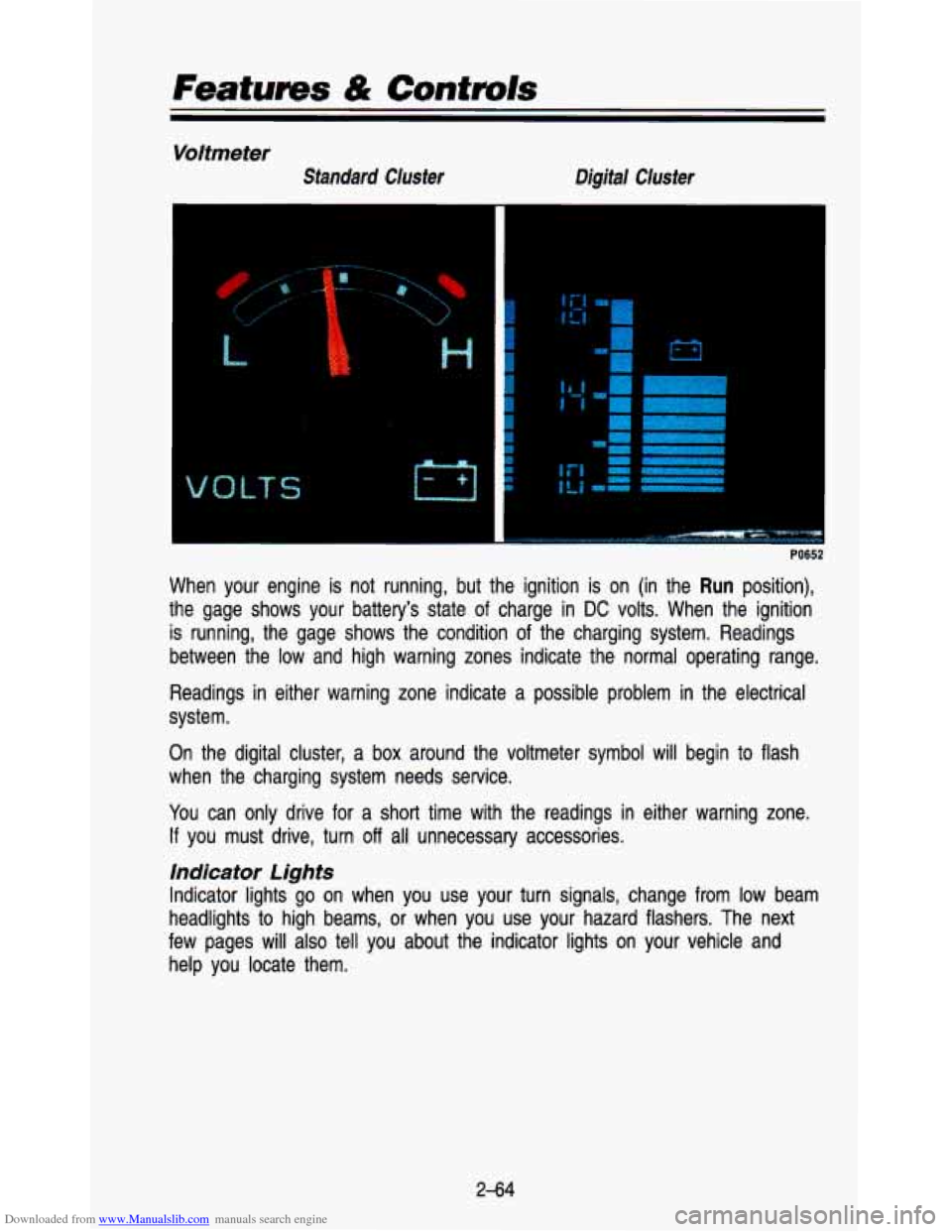
When your engine is not running, but the ignition is on (in \
the Run position),
the gage shows your battery's state
of charge in DC volts. When the ignition
is running, the gage shows the condition of the charging syste\
m. Readings
between the low and high warning zones indicate the normal ope\
rating range.
Readings in either warning zone indicate a possible problem in the electric\
al
system.
On the digital cluster,
a box around the voltmeter symbol will begin to flash
when the charging system needs service.
You can only drive for a
short time with the readings in either warning zone.
If you must drive, turn off all unnecessary accessories.
indicator Lights
Indicator lights go on when you use your turn signals, change \
from low beam
headlights to high beams,
or when you use your hazard flashers. The next
few pages
will also tell you about the indicator lights on your vehicle and
help you locate them.
2-64
Page 156 of 345
Downloaded from www.Manualslib.com manuals search engine Your Driving and fhe Road
-. . *p .. . f@@&
:.&+. -: ., -.. + c.=- .A; _.
Road Signs
p., :*. - - L.._ .. . ,. r-- . ;I;; - ,’ ’ -I’ - ,
5- ,i ..
The road signs you see everywhere ad Yoded by color, shape and symbols.
It’s a
good idea to know these codes so that you can quickly grasp the basic
meaning or intent of the sign even before you have a chance to read it.
Color of Road Signs
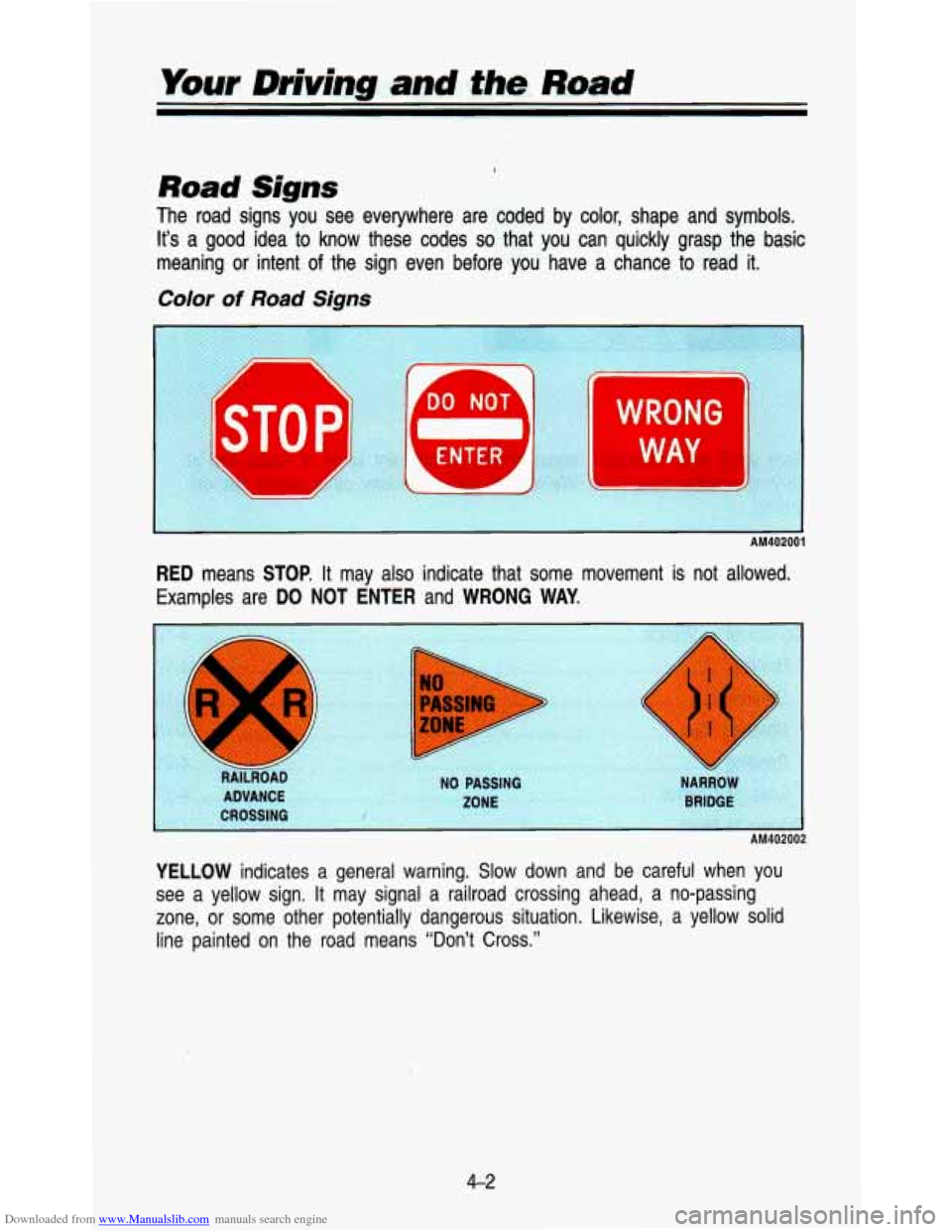
RED means STOP. It may also indicate that some movement is not allowed.
Examples are
DO NOT ENTER and WRONG WAY.
YELLOW indicates a general warning. Slow down and be careful when you
see a yellow sign.
It may signal a railroad crossing ahead, a no-passing
zone,
or some other potentially dangerous situation. Likewise, a yellow solid
line painted on the road means “Don’t Cross.”
4-2
Page 158 of 345
Downloaded from www.Manualslib.com manuals search engine Your Driving and the Road
SWIMMING
AM402006
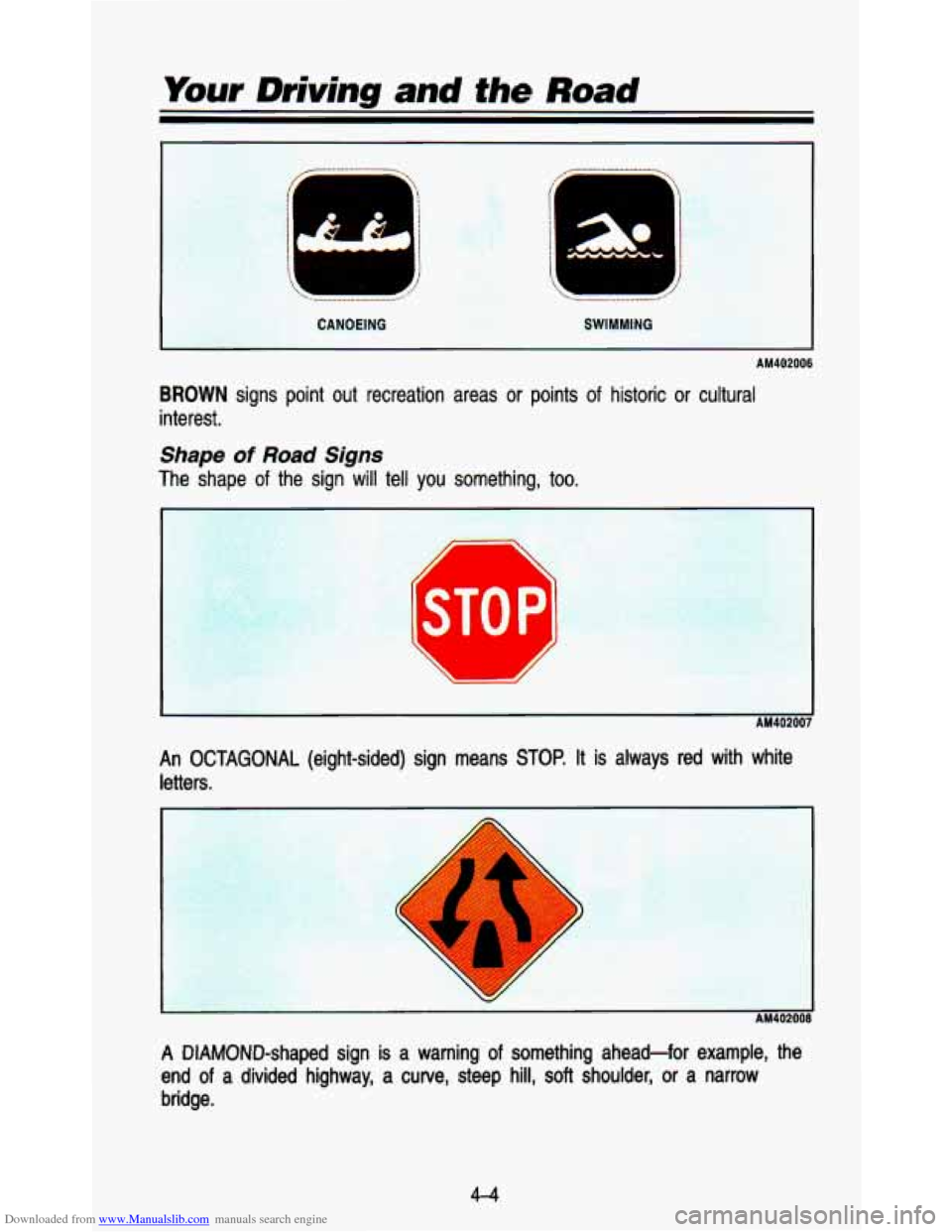
BROWN signs point out recreation areas or points of historic or cultural
interest.
Shape of Road Signs
The shape of the sign will tell you something, too.
An OCTI AL (eight-sided) sign means STOP. It is always red with white
letters. - -
A
A DIAMOND-shaped sign is a warning of something ahead-for example,\
the
end
of a divided highway, a curve, steep hill, soft shoulder, or a narrow
bridge.
4-4
Page 162 of 345
Downloaded from www.Manualslib.com manuals search engine Your Driving and the Road
Turn and lane change signals: Always signal when you plan to turn or
change lanes.
If necessary, you can use hand signals out the window: Left arm \
straight out
for a left turn, down for slow or about-to-stop, and up for \
a right turn.
Slowing down: If time allows, tap the brake pedal once or twice in advance
of slowing or stopping. This warns the driver behind you.
Disabled: Your four-way flashers signal that your vehicle is disabled or is a\
hazard. See “Hazard Warning Flashers” in the Index.
Traffic Officer
The traffic police officer is also a source of important information. The officer’s
signals govern, no matter what the traffic lights or other sig\
ns say.
The next part discusses some of the road conditions you may encounter.
Defensive Driving
The best advice anyone can give about driving is: Drive defens\
ively.
Please start with a very important safety device in your vehic\
le: Buckle up.
(See “Safety Belts in the Index.”)
Defensive driving really means “be ready for anything.’’\
On city streets, rural
roads, or freeways, it means “always expect the unexpected.”
Assume that pedestrians or other drivers are going to be carel\
ess and make mistakes. Anticipate what they might
do. Be ready for their mistakes.
Expect children
to dash out from behind parked cars, often followed by other
children. Expect occupants in parked cars
to open doors into traffic. Watch for
movement in parked cars-someone may be about
to open a door.
Expect other drivers
to run stop signs when you are on a through street. Be
ready to brake if necessary as you go through intersections. You may not
have to use the brake, but
if you do, you will be ready.
If you’re driving through a shopping center parking lot where t\
here are
well-marked lanes, directional arrows, and designated parking are\
as, expect
some drivers to ignore all these markings and dash straight to\
ward one part
of the lot.
Pedestrians can be careless. Watch for them. In general, you m\
ust give way
to pedestrians even
if you know you have the right of way.
Rear-end collisions are about the most preventable of accidents. Yet they are
common. Allow enough following distance.
It’s the best defensive driving
4-0
Page 170 of 345
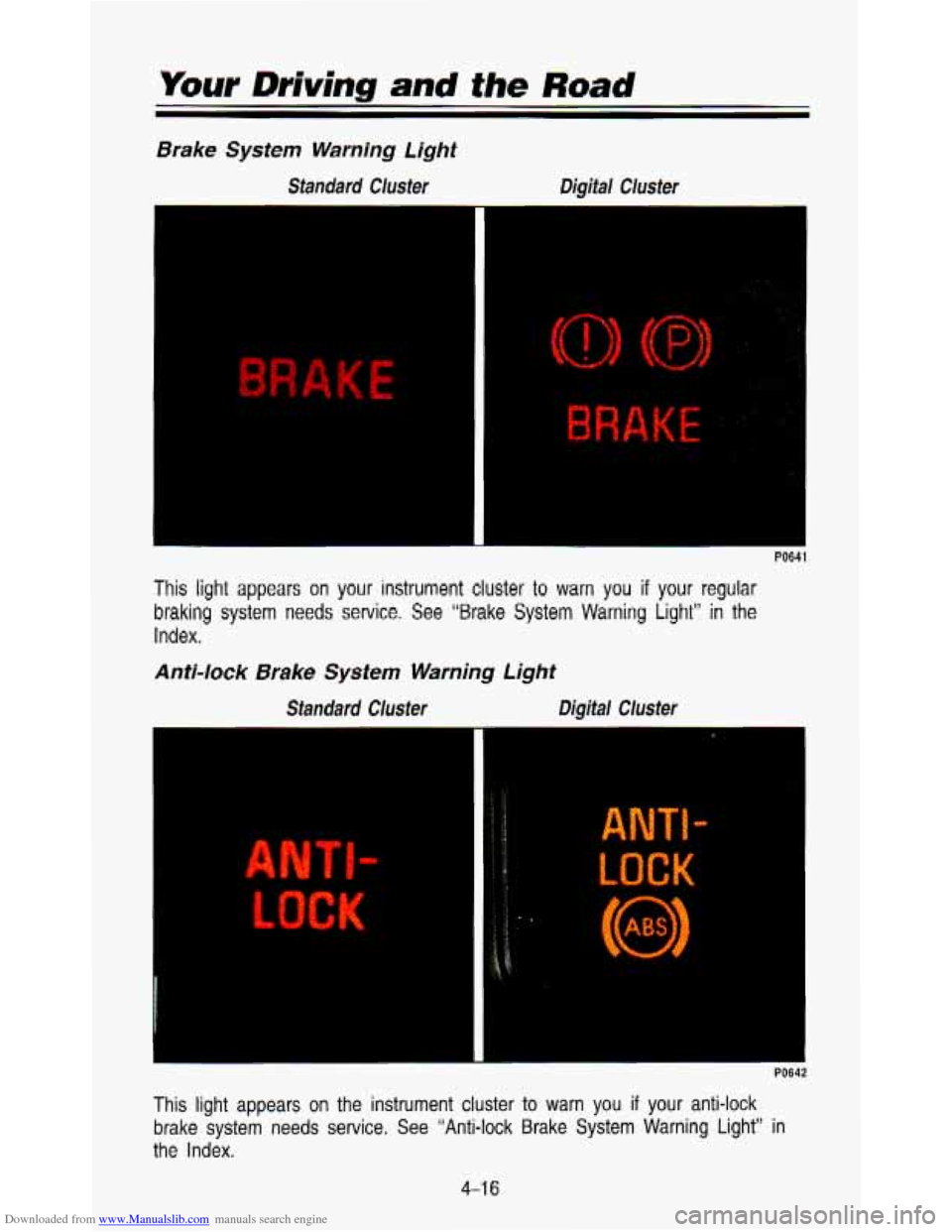
Downloaded from www.Manualslib.com manuals search engine Brake System Warning Light
Standard Cluster Digital Cluster
PO641
This light appears on your instrument cluster to warn you if your regular
braking system needs service. See “Brake System Warning Light” in the
Index.
Anti-lock Brake System Warning Light
Standard CIusfer Digital Cluster
This light appears on the instrument cluster to warn you if your anti-lock
brake system needs service. See “Anti-lock Brake System Warning Light” in
the Index.
4-1 6
Page 171 of 345

Downloaded from www.Manualslib.com manuals search engine Disc Brake Wear Indicators
Your vehicle has front disc brakes and rear drum brakes. Disc brake\
pads
have built-in wear indicators that make a high-pitched warning sound when
the brake pads are worn and new pads are needed. The sound m\
ay come and go or be heard all the time your vehicle is moving (except when you are
pushing on the brake pedal firmly).
I CAUTION
A The brake wear warning sound means that sooner or later your
4 brakes won’t work well. That could lead to an accident. When you
hear the brake wear warning sound, have your vehicle serviced. \
I
NCTICE
Some driving conditions or climates may cause a brake squeal when the
brakes are first applied or lightly applied. This does not mean something is
wrong with your brakes.
Rear Drum Brakes
Your rear drum brakes don’t have the wear indicators, but if you ever hear a
rear brake rubbing noise, have the rear brake linings inspected\
. Also, the rear
brake drums should be removed and inspected each time the tires are
removed for rotation or changing. When
have the rear brakes inspected, too.
Brake linings should always be replaced
Brake Pedal Travel
See your dealer if the brake pedal does
there
is a rapid increase in pedal travel.
trouble.
Brake Adjustment
Every time you make a brake stop, your you have
the front brakes replaced,
as complete axle sets.
not return to normal height, or
if
This could be a sign of brake
disc brakes adjust for wear.
If your
brake pedal goes down farther than normal, your rear drum brak\
es may need
adjustment. Adjust them by backing up and firmly applying the brakes a few
times.
4-1 7
Page 177 of 345
Downloaded from www.Manualslib.com manuals search engine these conditions. It is important to slow down on slippery surfaces because
stopping distance will be longer and vehicle control more limited.
While driving on a surface with reduced traction, try your best to avoid
sudden steering, acceleration, or braking (including engine brak\
ing by shifting
to a lower gear). Any sudden changes could cause the tires to s\
lide. You
may not realize the surface is slippery until your vehicle is skidding. Learn to
recognize warning clues-such as enough water, ice or packed sno\
w on the
road to make a “mirrored sutface”-and slow down when you have any\
doubt.
Remember: Any anti-lock braking system
(ABS) helps avoid only the braking
skid. Steer the way you want to go.
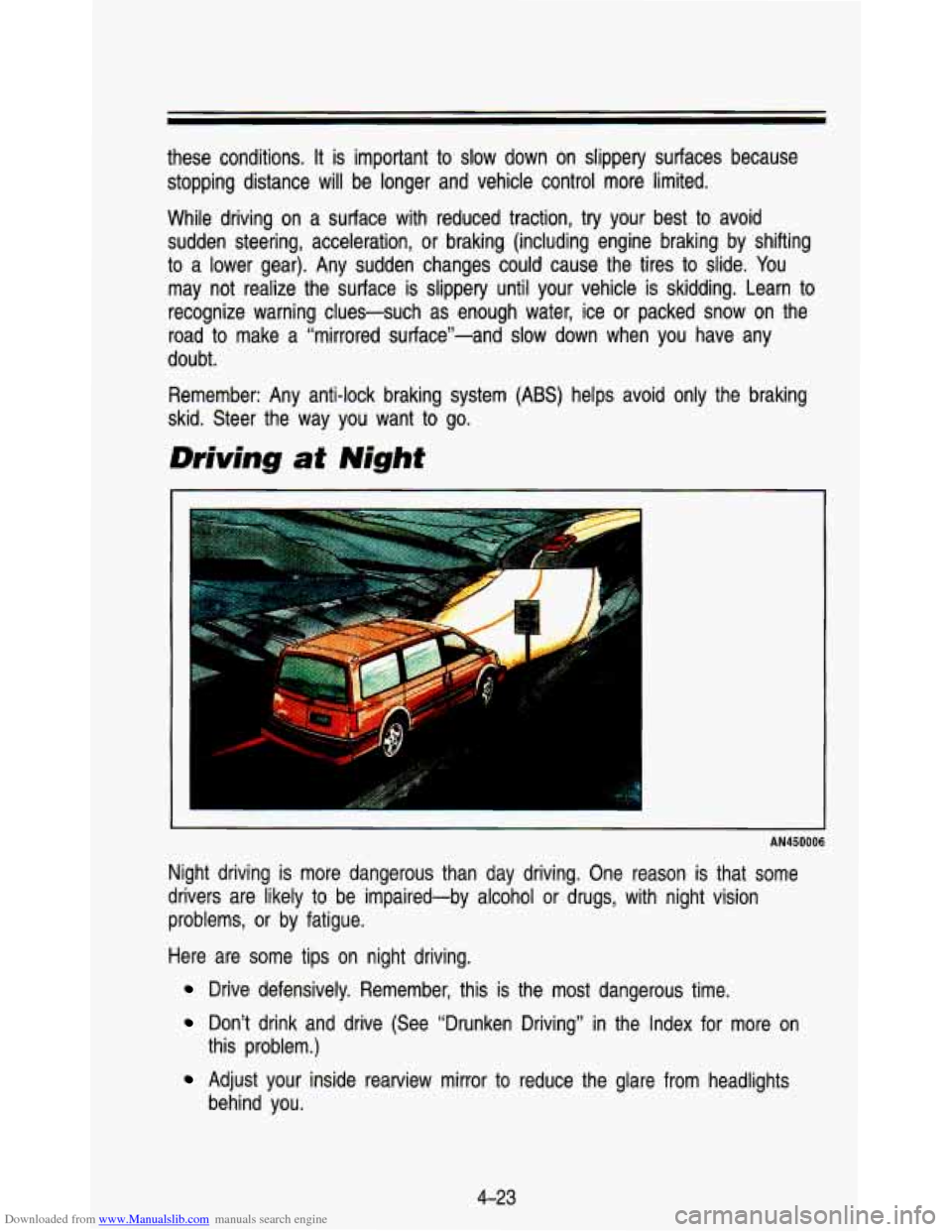
Driving at Night
AN450006
Night driving is more dangerous than day driving. One reason is that some
drivers are likely to be impaired-by alcohol or drugs, with night vision
problems, or by fatigue.
Here are some tips on night driving.
Drive defensively. Remember, this is the most dangerous time.
Don’t drink and drive (See “Drunken Driving” in the Index for more on
Adjust your inside rearview mirror to reduce the glare from he\
adlights
this problem.)
behind you.
4-23
Page 183 of 345
Downloaded from www.Manualslib.com manuals search engine that you can see only a few feet (meters) ahead. It may come suddenly to
an otherwise clear road. And it can be a major hazard.
When you drive into a fog patch, your visibility will be ieduced quickly. The
biggest dangers are striking the vehicle ahead
or being struck by the one
behind. Try
to “read” the fog density down the road. If the vehicle ahead
starts
to become less clear or, at night, if the taillights are harder to see, the
fog is probably thickening. Slow down to give traffic behind y\
ou a chance
to
slow down. Everybody then has a better chance to avoid hitting the vehicle
ahead.
A patch of dense fog may extend only for a few feet (meters) or for miles
(kilometers); you can’t really tell while you’re in
it. You can only treat the
situation with extreme care.
One common fog condition-sometimes called mist
or ground fog-can
happen in weather that seems perfect, especially at night
or in the early
morning in valley and low, marshy areas. You can be suddenly enveloped in
thick, wet haze that may even coat your windshield. You can often spot these
fog patches
or mist layers with your headlights. But sometimes they can be
waiting for you as you come over a hill
or dip into a shallow valley. Start
your windshield wipers and washer,
to help clear accumulated road dirt. Slow
down carefully.
Tips on Driving in Fog
If you get caught in fog, turn your headlights on low beam, even\
in daytime.
You’ll see-and be seen-better. Use your fog lights
if your vehicle has them.
Don’t use your high beams. The light will bounce
off the water droplets that
make up fog and reflect back at you.
Use your defogger. In high humidity, even a light buildup of moisture on the
inside
of the glass will cut down on your already limited visibility. Ru\
n your
windshield wipers and washer occasionally. Moisture can build up\
on the outside glass, and what seems to be fog may actually be moist\
ure on the
outside of your windshield.
Treat dense fog as an emergency.
Try to find a place to pull off the road. Of
course you want
to respect another’s property, but you might need to put
something between you and moving vehicles-space, trees, telephone poles,
a private driveway, anything that removes you from other traffi\
c.
If visibility is near zero and you must stop but are unsure whether you are
away from the road, turn your lights on, start your hazard warning flashers,
and sound your horn at intervals
or when you hear approaching traffic.
4-29
Page 184 of 345
Downloaded from www.Manualslib.com manuals search engine Your Driving and the Road
Pass other vehicles in fog only if you can see far enough ahead to pass
safely. Even then, be prepared to delay your pass
if you suspect the fog is
worse up ahead.
If other vehicles try to pass you, make it easy for them.
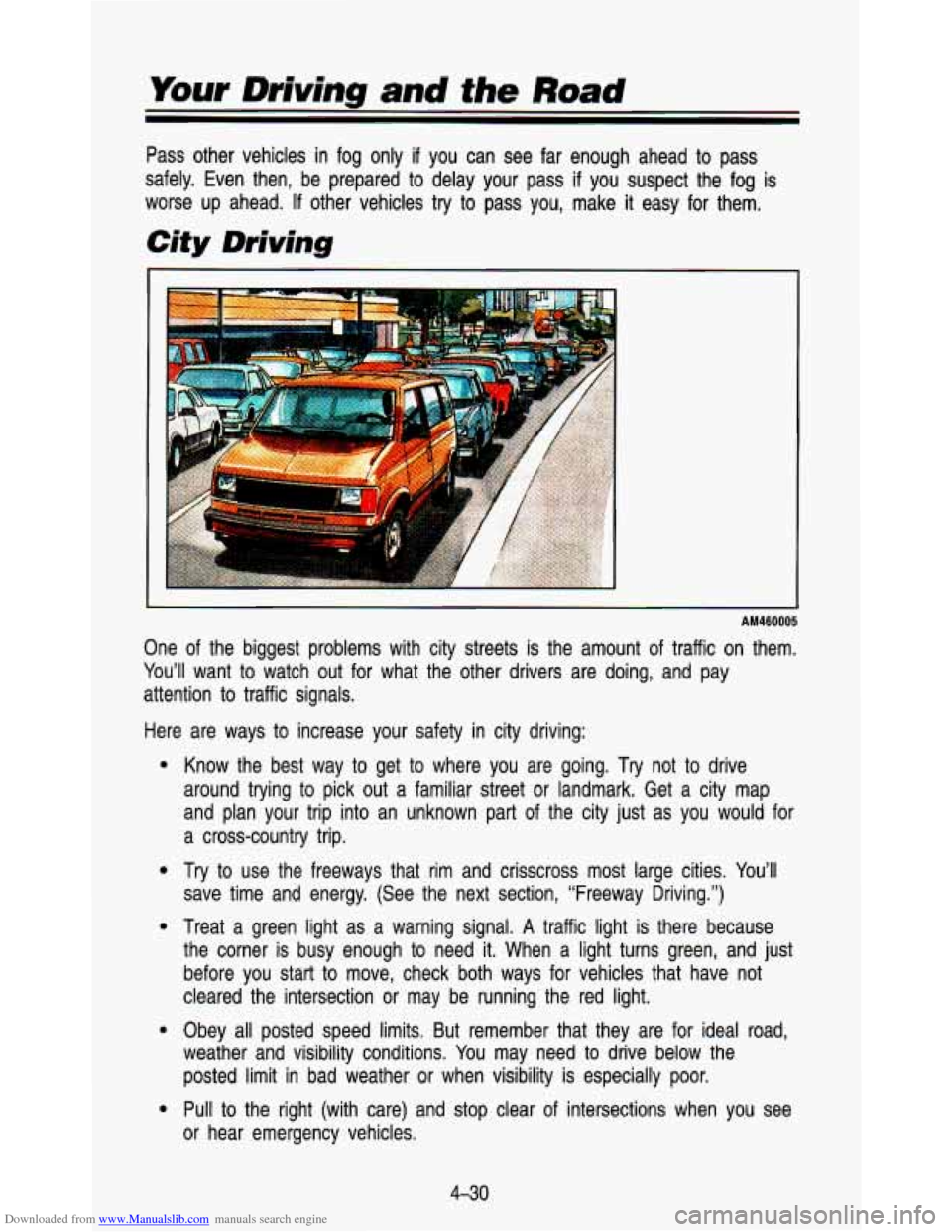
City Driving
AM460005
One of the biggest problems with city streets is the amount of traffic on them.
You’ll want to watch out for what the other drivers are doing, and pay
attention to traffic signals.
Here are ways to increase your safety in city driving:
e
e
e
e
Know the best way to get to where you are going. Try not to drive
around trying to pick out a familiar street or landmark. Get \
a city map
and plan your trip into an unknown part of the city just as you would for
a cross-county trip.
Try to use the freeways that rim and crisscross most large cities. You’ll
save time and energy. (See the next section, “Freeway Drivi\
ng.”)
Treat a green light as a warning signal.
A traffic light is there because
the corner is busy enough to need
it. When a light turns green, and just
before you start to move, check both ways for vehicles that have not
cleared the intersection or may be running the red light.
Obey all posted speed limits. But remember that they are for ideal road,
weather and visibility conditions. You may need to drive below the
posted limit in bad weather
or when visibility is especially poor.
Pull to the right (with care) and stop clear of intersections when y\
ou see
or hear emergency vehicles.
430
Page 186 of 345

Downloaded from www.Manualslib.com manuals search engine Your Driving and the Road
Driving on the Freeway
Once you are on the freeway, adjust your speed to the posted \
limit or to the
prevailing rate
if it’s slower. Stay in the right lane unless you want to pass. If
you are on a two-lane freeway, treat the right lane as the s\
low lane and the
left lane as the passing lane.
If you are on a three-lane freeway, treat the right lane as the \
slower-speed
through lane, the middle lane as the higher-speed through lane,\
and the left lane as the passing lane.
Before changing lanes, check your rearview mirrors. Then use yo\
ur turn
signal. Just before you leave the lane, glance quickly over yo\
ur shoulder to make sure there isn’t another vehicle in your “blind” \
spot.
If you are moving from an outside to a center lane on a freeway\
having
more than two lanes, make sure another vehicle isn’t about \
to move into the
same spot. Look at the vehicles
two lanes over and watch for telltale signs:
turn signals flashing, an increase in speed, or moving toward \
the edge of the
lane. Be prepared to delay your move.
Once you are moving on the freeway, make certain you allow a \
reasonable
following distance. Expect to move slightly slower at night.
Leaving the Freeway
When you want to leave the freeway, move to the proper lane \
well in
advance. Dashing across lanes at the last minute is dangerous. \
If you miss
your exit do not, under any circumstances, stop and back up. \
Drive on to the
next exit.
At each exit point is a deceleration lane. Ideally
it should be long enough for
you to enter
it at freeway speed (after signaling, of course) and then do yo\
ur
braking before moving onto the exit ramp. Unfortunately, not al\
l deceleration
lanes are long enough-some are too short for all the braking. \
Decide when
to start braking.
If you must brake on the through lane, and if there is traffic
close behind you, you can allow a little extra time and flash\
your brake lights
(in addition to your turn signal) as extra warning that you \
are about
to slow
down and exit.
The exit ramp can be curved, sometimes quite sharply. The exit\
speed is usually posted. Reduce your speed according to your speedometer,\
not to
your sense of motion. After driving for any distance at higher\
speeds, you may tend
to think you are going slower than you actually are. For example,\
40 mph (65 km/h) might seem like only 20 mph (30 kmk). Obviously, this
could lead to serious trouble on
a ramp designed for 20 mph (30 kmlh)!
4-32