check engine light CHEVROLET ASTRO PASSENGER 1994 1.G User Guide
[x] Cancel search | Manufacturer: CHEVROLET, Model Year: 1994, Model line: ASTRO PASSENGER, Model: CHEVROLET ASTRO PASSENGER 1994 1.GPages: 340, PDF Size: 16.86 MB
Page 167 of 340
Downloaded from www.Manualslib.com manuals search engine Night Vision
No one can see as well at night as in the daytime. But as we get older these
differences increase.
A 50-year-old driver may require at least twice as
much light to see the same thing at night as a 20-year-old.
What you do in
the daytime can also affect your night vision. For example,
if you spend the day in bright sunshine you are wise to wear sunglasses.
Your eyes will have less trouble adjusting to night. But if you’re driving,
don’t wear sunglasses at night. They may cut down on glare from
headlights, but they also make a lot of things invisible.
You can be temporarily blinded by approaching lights. It can take a second
or two, or even several seconds, for your eyes to readjust to the dark. When
you are faced with severe glare (as from a driver who doesn’t lowe\
r the high
beams, or a vehicle with misaimed headlights), slow down a little. Avoid
staring directly into the approaching lights.
Keep your windshield and all the glass on your vehicle clean
- inside and
out. Glare at night is made much worse by dirt on the glass. Even the inside
of the glass can build up a film caused by dust. Dirty glass makes lights
dazzle and flash more than clean glass would, making the pupils of y\
our
eyes contract repeatedly.
Remember that your headlights light up far less
of a roadway when you are
in a turn or curve. Keep your eyes moving; that way, it’s easier to pick out
dimly lighted objects. Just as your headlights should be checke\
d regularly
for proper aim,
so should your eyes be examined regularly. Some drivers
suffer from night blindness
- the inability to see in dim light - and aren’t
even aware of
it.
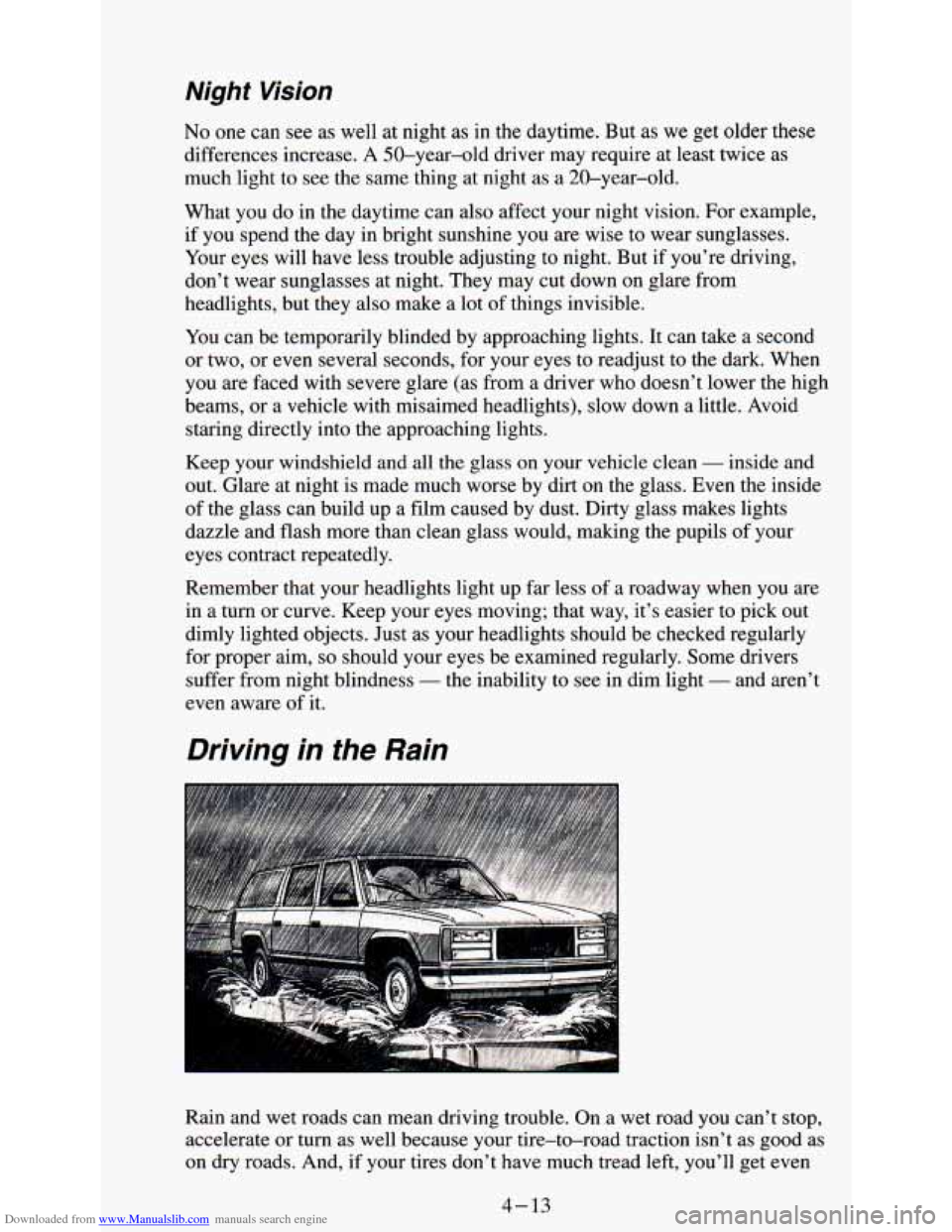
Driving in the Rain
Rain and wet roads can mean driving trouble. On a wet road you can’t stop,
accelerate or turn as well because your tire-to-road traction isn’t as goo\
d as
on dry roads. And, if your tires don’t have much tread left, you’ll get even
4-13
Page 170 of 340
Downloaded from www.Manualslib.com manuals search engine Here are ways to increase your safety in city driving:
Know the best way to get to where you are going. Get a city map and
plan your trip into an unknown part of the city just as you would for a
cross-country trip.
Try to use the freeways that rim and crisscross most large cities. You’ll
save time and energy. (See the next section, “Freeway Driving.”)
Treat a green light as a warning signal. A traffic light is there because
the corner is busy enough to need it. When a light turns green, and just
before you start
to move, check both ways for vehicles that have not
cleared the intersection or may be running the red light.
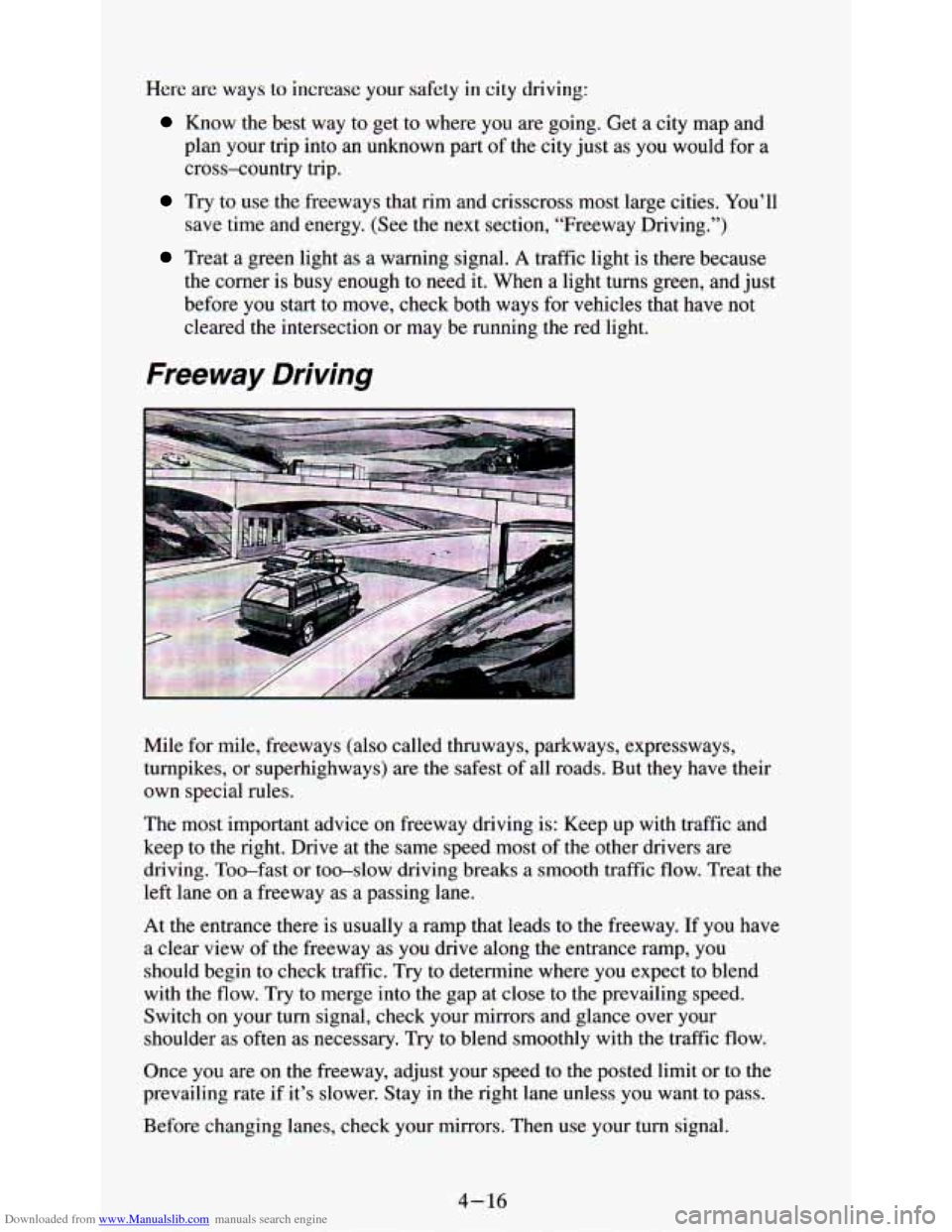
Freeway Driving
Mile for mile, freeways (also called thruways, parkways, expressways,
turnpikes, or superhighways) are the safest of all roads. But they have their
own special rules.
The most important advice on freeway driving is: Keep up with traffic and
keep to the right. Drive at the same speed most of the other drivers are
driving. Too-fast or too-slow driving breaks a smooth traffic flow. Treat the
left lane on a freeway as a passing lane.
At the entrance there is usually a ramp that leads to the freeway. If you have
a clear view of the freeway as you drive along the entrance ramp, you
should begin
to check traffic. Try to determine where you expect to blend
with the flow. Try to merge into the gap at close to the prevailing speed.
Switch on your turn signal, check your mirrors and glance over your
shoulder as often as necessary.
Try to blend smoothly with the traffic flow.
Once you are on the freeway, adjust your speed to the posted limit
or to the
prevailing rate if it’s slower. Stay
in the right lane unless you want to pass.
Before changing lanes, check your mirrors. Then use your turn signal.
4-16
Page 171 of 340
Downloaded from www.Manualslib.com manuals search engine Just before you leave the lane, glance quickly over your shoulder to make
sure there isn’t another vehicle in your “blind” spot.
Once you are moving on
the freeway, make certain you allow a reasonable
following distance. Expect to move slightly slower
at night.
When you want
to leave the freeway, move to the proper lane well in
advance. If you miss your exit do not, under any circumstances, stop and
back up. Drive on to the next exit.
The exit ramp can be curved, sometimes quite sharply.
The exit speed is usually posted.
Reduce your speed according to your speedometer, not to your sense of
motion. After driving for any distance at higher speeds, you may tend to
think you are going slower than you actually are.
Before Leaving on a Long Trip
Make sure you’re ready. Try to be well rested. If you must start when you’re
not fresh
- such as after a day’s work - don’t plan to make too many
miles that first part of the journey. Wear comfortable clothing and shoes you
can easily drive in.
Is your vehicle ready for a long trip? If you keep
it serviced and maintained,
it’s ready to go. If
it needs service, have it done before starting out. Of course,
you’ll find experienced and able service experts in
GM dealerships all across
North America. They’ll be ready and willing to help
if you need it.
Here are some things you can check before a trip:
0
0
0
0
0
0
0
Windshield Washer Fluid: Is the reservoir full? Are all windows clean
inside and outside?
Wiper Blades: Are they in good shape?
Fuel, Engine Oil, Other Fluids: Have you checked all levels?
Lights: Are they all working? Are the lenses clean?
Tires: They are vitally important to a safe, trouble-free trip. Is the tread
good enough for long-distance driving? Are the tires all inflated to the
recommended pressure?
Weather Forecasts: What’s the weather outlook along your route?
Should you delay your trip a short time to avoid a major storm system?
Maps: Do you have up-to-date maps?
4- 17
Page 181 of 340
Downloaded from www.Manualslib.com manuals search engine 0 Will the trailer parts take 3,000 psi (20 650 kPa) of pressure? If not, the
trailer brake system must not be used with your vehicle.
If everything checks out this far, then make the brake fluid tap at the
port
on the master cylinder that sends fluid to the rear brakes. But don’t
use copper tubing for this.
If you do, it will bend and finally break off.
Use steel brake tubing.
Driving with a Trailer
Towing a trailer requires a certain amount of experience. Before setting out
for the open road, you’ll want to get to know your rig. Acquaint yourself
with the feel
of handling and braking with the added weight of the trailer.
And always keep in mind that the vehicle you are driving is now a good
deal longer and not nearly
so responsive as your vehicle is by itself.
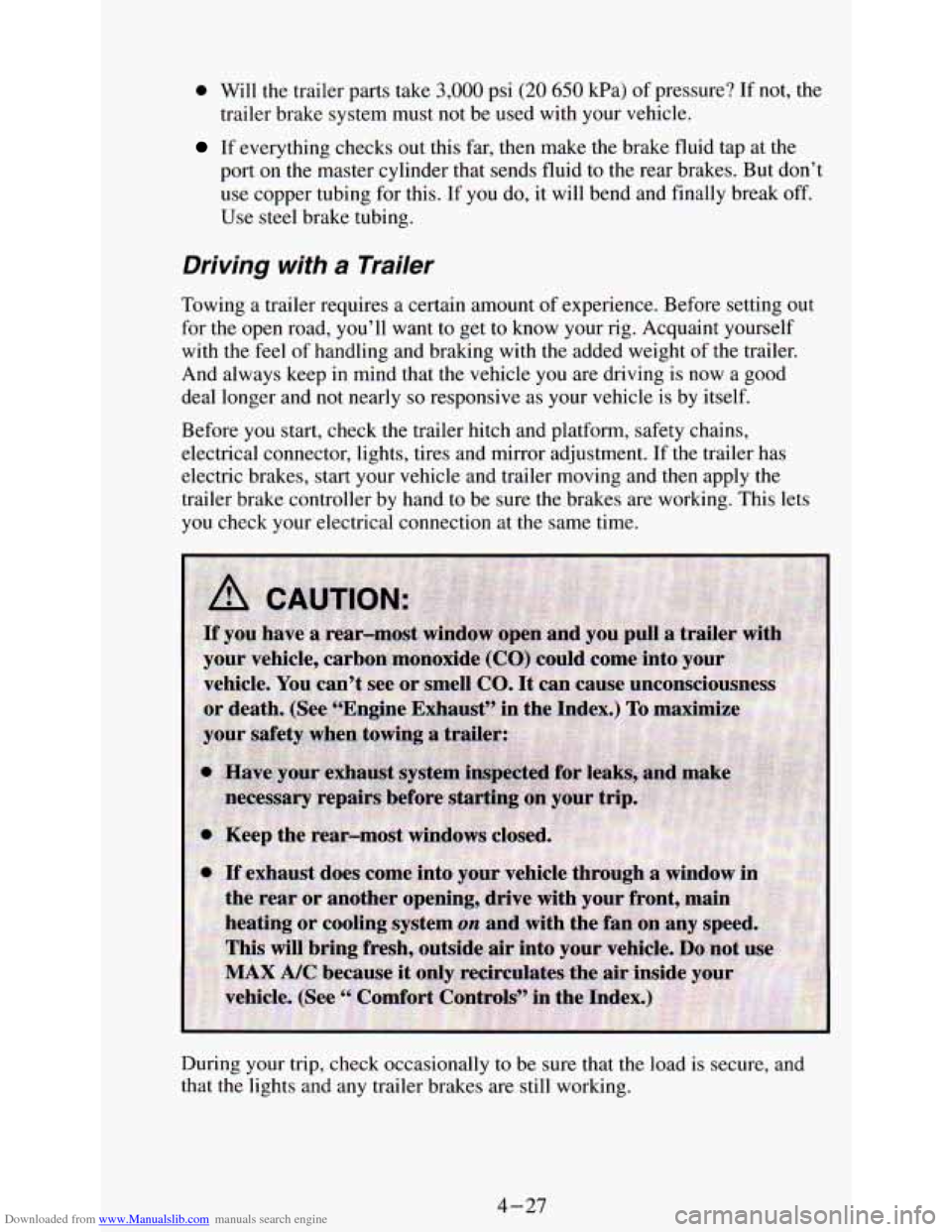
Before you start, check the trailer hitch and platform, safety chains,
electrical connector, lights, tires and mirror adjustment. If the trailer has
electric brakes, start your vehicle and trailer moving and then apply t\
he
trailer brake controller by hand to be sure the brakes are working. This lets
you check your electrical connection at the same time.
During your trip, check occasionally to be sure that the load is secure, and
that the lights and any trailer brakes are still working.
4-27
Page 182 of 340
Downloaded from www.Manualslib.com manuals search engine Following Distance
Stay at least twice as far behind the vehicle ahead as you would when
driving your vehicle without a trailer. This can help you avoid situations that
require heavy braking and sudden turns.
Passing
You’ll need more passing distance up ahead when you’re towing a trailer.
And, because you’re a good deal longer, you’ll need to go much farther
beyond the passed vehicle before you can return to your lane. \
Backing Up
Hold the bottom of the steering wheel with one hand. Then, to move the
trailer to the left, just move that hand to the left.
To move the trailer to the
right, move your hand to the right. Always back up slowly and, if possible,
have someone guide you.
Making Turns
When you’re turning with a trailer, make wider turns than normal. Do this
so your trailer won’t strike soft shoulders, curbs, road signs, trees, or other
objects. Avoid jerky or sudden maneuvers. Signal well
in advance.
Turn Signals When Towing a Trailer
When you tow a trailer, your vehicle has to have a different turn signal
flasher and extra wiring. The green arrows on your instrument panel will
flash whenever you signal a turn or lane change. Properly hooked up, the
trailer lights will also flash, telling other drivers you’re about to turn,
change lanes or stop.
When towing a trailer, the green arrows on your instrument panel will flash
for turns even
if the bulbs on the trailer are burned out. Thus, you may think
drivers behind you are seeing your signal when they are not. It’s important
to check occasionally to be sure the trailer bulbs are still working.
Driving On Grades
Reduce speed and shift to a lower gear before you start down a long or
steep downgrade. If you don’t shift down, you might have to use your
brakes
so much that they would get hot and no longer work well.
On a long uphill grade, shift down and reduce your speed to around
45 mph
(70 km/h) to reduce the possibility of engine and transmission overheating.
4-28
Page 183 of 340
Downloaded from www.Manualslib.com manuals search engine Parking on Hills
You really should not park your vehicle, with a trailer attached, on a hill. If
something goes wrong, your rig could start to move. People can be injured.
and both your vehicle and the trailer can be damaged.
But if you ever have to park your rig on a hill, here’s how to do it:
1. Apply your regular brakes, but don’t shift into “P” (Park) yet.
2. Have someone place chocks under the trailer wheels.
3. When the wheel chocks are in place, release the regular brakes until the
chocks absorb the load.
4. Reapply the regular brakes. Then apply your parking brake, and shift to
5. Release the regular brakes.
“P” (Park).
When You Are Ready to Leave After Parking on a Hill
1. Apply your regular brakes and hold the pedal down while you:
Start your engine;
Shift into a gear; and
Release the parking brake.
2. Let up on the brake pedal.
3. Drive slowly until the trailer is clear of the chocks.
4. Stop and have someone pick up and store the chocks.
Maintenance When Trailer Towing
Your vehicle will need service more often when you’re pulling a trailer. See
the Maintenance Schedule for more on this. Thin.gs that are especially
important in trailer operation are automatic transmission fluid (don’t
overfill), engine oil, axle lubricant, belt, cooling system, and brake
adjustment. Each of these
is covered in this manual, and the Index will help
you find them quickly. If you’re trailering, it’s a good idea to review these
sections before you start your trip.
Check periodically
to see that all hitch nuts and bolts are tight.
Trailer Light Wiring
See “Trailer Wiring Harness” in the Index.
4-29
Page 254 of 340
Downloaded from www.Manualslib.com manuals search engine For more information on vehicle storage, contact your dealer’s service
department,
or write to:
Adistra Corporation
17 1 Hamilton Street
Plymouth, MI
48 170
In Canada, write to:
General Motors of Canada, Limited
Customer Services Department
Oshawa, Ontario
L1 J 5Z6
Fluid Leak Check
After the vehicle has been parked for awhile, inspect the surface beneath the
vehicle for water, oil, fuel or other fluids. Water dripping from the air
conditioning system
is normal. If you notice fuel leaks or fumes, the causes
should be found and corrected at once.
Bulb Replacement
Before replacing any bulbs, make sure all lights are off and the vehicle is
not running.
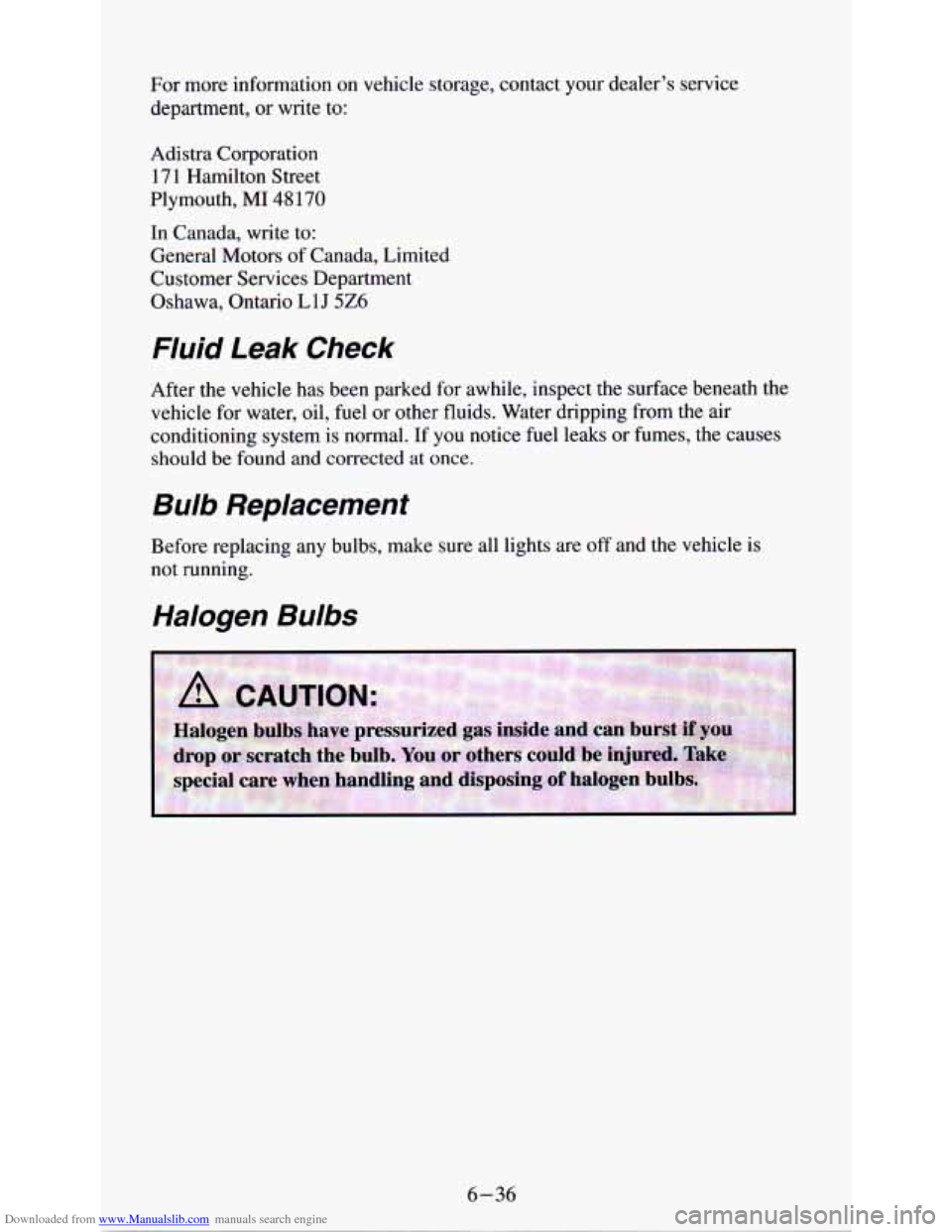
Halogen Bulbs
1_
6-36
Page 284 of 340
Downloaded from www.Manualslib.com manuals search engine Fuses and Circuit Breakers
The wiring circuits in your vehicle are protected from short circuits by a
combination of fuses, circuit breakers, and fusible thermal
links in the
wiring itself. This greatly reduces the chance of fires caused by electrical
problems. See “Fuses and Circuit Breakers”
in the Index for more
information.
Headlights
The headlight wiring is protected by a circuit breaker in the light switch. An
electrical overload will cause the lights
to go on and off, or in some cases to
remain off. If this happens, have your headlight wiring checked right away.
Windshield Wipers
The windshield wiper motor is protected by a circuit breaker and a fuse. If
the motor overheats
due to heavy snow, etc., the wiper will stop until the
motor cools. If the overload is caused
by some electrical problem and not
snow, etc., be sure to get it fixed.
Power Windows and Other Power Options
Circuit breakers in the fuse panel protect the power windows and other
power accessories. When the current load is too heavy, the circuit breaker
opens and closes, protecting the circuit until the problem is fixed or goes
away.
Trailer Wiring Harness
The optional seven-wire trailer wiring harness is protected by an in-line
fuse
in the battery feed wire. This fuse is near the junction block. See
“Trailer Wiring Harness”
in the Index.
6-66
Page 320 of 340
Downloaded from www.Manualslib.com manuals search engine Bulletins cover various subjects. Some pertain to the proper use and care of
your vehicle. Some describe costly repairs. Others describe inexpensive
repairs which, if done
on time with the latest parts, may avoid future costly
repairs. Some bulletins tell a technician how to repair a new or unexpected
condition. Others describe a quicker way to fix your vehicle. They can help
a technician service your vehicle better.
Most bulletins apply to conditions affecting a small number
of cars or
trucks. Your Chevrolet dealer or a qualified technician may have
to
determine if a specific bulletin applies to your vehicle.
You can subscribe
to all Chevrolet’s bulletins by calling Helm, Inc. at
1-800-7824356. This way you’ll get them as they become available.
Individual PSP’s
If you don’t want to buy all the PSP’s issued by Chevrolet for all car or
truck models in the model year,
you can buy individual PSP’s, such as those
which may pertain to a particular model.
To do this, you will first need to
see our index of PSP’s. It provides a variety of information. Here’s what
you’ll find in the index and how you can get one:
What You’// Find in the Index:
A list of PSP’s published by Chevrolet in a model year (1990 or later).
PSP’s covering all models
of Chevrolet cars or light trucks (less than
10,000 pounds (4 536 kg) GVWR) are listed in the same index.
Ordering information so you can buy the specific PSP’s you may want.
Price information for the PSP’s you may want to buy.
How You Can Get an Index:
Indexes are published periodically. Most of the PSP’s which could
potentially apply
to the most recent Chevrolet models will be listed in the
most recent publication for that model year. This means you may want to
wait until
the end of the model year before ordering an index, if you are
interested in buying PSP’s pertaining
to a current model year car or truck.
Some PSP’s pertaining
to a particular model year vehicle may be published
in later years, and these would be listed in the later year’s index. When you
order an index for a model year that is not over yet, we’ll send
you the most
recently published issue. Check the ordering
form for indexes for earlier
model years.
Cut
out the ordering form, fill it out, and mail it in. We will then see to it
that an index is mailed
to you. There is no charge for indexes for the
1989-1 994 model years.
8-8
Page 328 of 340
Downloaded from www.Manualslib.com manuals search engine Exhaust System ................................................. 6-43
F
FanNoise ...................................................... 5-18
Filter Replacement Chart
.......................................... 6-74
Finish
Care
........................................................ 6-59
Damage
..................................................... 6-61
Automatic Transmission
........................................ 6-20
Brake
....................................................... 6-32
Capacities
................................................... 6-69
CoolantRecovery
............................................. 5-14
FrontAxle
................................................... 6-25
Leak Check
.................................................. 6-36
Powersteering
............................................... 6-30
Radiator
..................................................... 5-15
Rear Axle
................................................... 6-24
RecommendedFluids
.......................................... 7-13
Transfercase
................................................ 6-24
Windshield Washer
............................................ 6-31
FogLamps
..................................................... 2-42
Four-wheel Anti-lock
............................................. 4-7
Frontseats
...................................................... 1-2
Fuel
........................................................... 6-3
FillingYourTank
.............................................. 6-5
Foreign Countries
.............................................. 6-5
Gage
....................................................... 2-61
Gasolines for Cleaner Air
........................................ 6-4
Tankcapacity ................................................ 6-69
Fuses and Circuit Breakers
........................................ 6-72
FuseBlock
.................................................. 6-67
Headlights
................................................... 6-66
Power Windows and Other Power Options
......................... 6-66
Trailer Wiring Harness
......................................... 6-66
Windshield Wipers
....................... .............. 6-66
Fluid
G
Gages ......................................................... 2-61
Coolant Temperature Gage
...................................... 2-63
FuelGage
................................................... 2-61
Odometer
................................................... 2-53
Oil Pressure Gage
............................................. 2-62
Speedometer
................................................. 2-53
Trip Odometer
................................................ 2-53
Voltmeter
.................................................... 2-64
Gasolines for Cleaner Air
.......................................... 6-4
Hatch Release Switch ............................................. 2-28
HalogenBulbs
........................................ ....... 6-36