automatic transmission CHEVROLET ASTRO PASSENGER 1994 1.G Owners Manual
[x] Cancel search | Manufacturer: CHEVROLET, Model Year: 1994, Model line: ASTRO PASSENGER, Model: CHEVROLET ASTRO PASSENGER 1994 1.GPages: 340, PDF Size: 16.86 MB
Page 61 of 340
Downloaded from www.Manualslib.com manuals search engine Features & Controls
Section
A
..
Here you can learn about the many standard and optional features on your
vehicle. and information on starting. shifting. and braking
. Also explained
are the instrument panel and
the warning systems that tell you if everything
is working properly- and what to
do if you have a problem .
For explanation of vehicle symbols. refer to “Vehicle Symbols” in the
Introduction
.
Keys ................................. .................. 2-3
Your Doors and How They Work
..................... ....... 2-5
DoorLocks
................................................ 2-8
Theft
..............................................
New Vehicle “Break-In” ................. .......
. . 2-11
. . 2-12
Ignition Switch
....... ....... .......................... 2-13
Starting Your Engine
....................................... 2-14
FuelRegulator
......................................... 2-15
Driving Through Deep Standing Water
... ............... 2-15
Automatic Transmission
.................................... 2-17
Engine
Block Heater
................................... 2-16
.. ..< .. Locking Rear Axle ...................... .... 2-20
ParkingBrake
............................................ 2-20
Shifting Into
“P’ (Park) ....... .......................... 2-21
Shifting Out of “P” (Park)
................................... 2-22
Parking Over Things That Burn
............................... 2-23
EngineExhaust
.....................................
Running Your Engine While You’re Parked .............
.... 2-24
. . 2-24
2-1
Page 77 of 340
Downloaded from www.Manualslib.com manuals search engine How long should you keep the coolant heater plugged in? The answer
depends on the weather, the kind
of oil you have, and some other things.
Instead of trying to list everything here, we ask that you contact a
GM
dealer in the area where you’ll be parking your vehicle. The dealer can give
you the best advice for
that particular area.
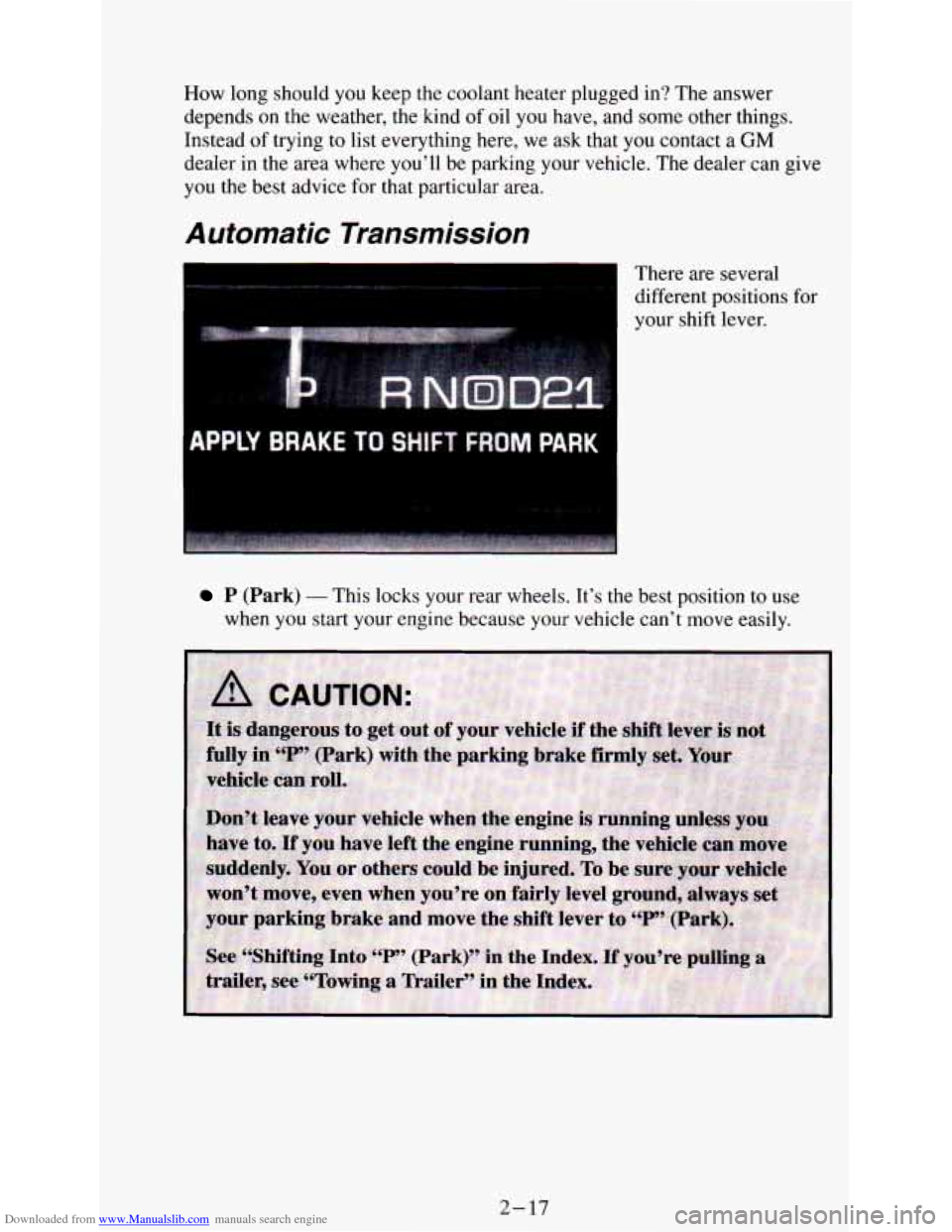
Automatic Transmission
There are several
different positions for
your shift lever.
P (Park) - This locks your rear wheels. It’s the best position to use
when you start your engine because your vehicle can’t move easily.
2- 17
Page 82 of 340
Downloaded from www.Manualslib.com manuals search engine Leaving Your Vehide With the Engine Running
If you have to leave your vehicle with the engine running, be sure your
vehicle is in “P” (Park) and your parking brake is firmly set before you
leave it. After you’ve moved the shift lever into the
“P” (Park) position,
hold the regular brake pedal down. Then, see if you can move the shift lever
away from
“F’” (Park) without first pulling it toward you. If you can, it
means that the shift lever wasn’t fully locked into
“P” (Park).
Shifting Out of “P” (Park)
Your vehicle has a brake-transmission shift interlock. You have to fully
apply your regular brake before you can shift from “P” (Park) when the
ignition is in the
RUN position. See “Automatic Transmission” in the Index.
If you cannot shift out of
“P” (Park), ease pressure on the shift lever - push
the shift lever all the way into
“P” (Park) as you maintain brake application.
Then move the shift lever into the gear you want.
If you ever hold the brake pedal down but still can’t shift out of “P” (Park),
try this:
1. Turn the key to OFF.
2. Apply and hold the brake until the end of Step 4.
3. Shift to “N’ (Neutral).
4. Start the vehicle and then shift to the drive gear you want.
5. Have the vehicle fixed as soon as you can.
2-22
Page 183 of 340
Downloaded from www.Manualslib.com manuals search engine Parking on Hills
You really should not park your vehicle, with a trailer attached, on a hill. If
something goes wrong, your rig could start to move. People can be injured.
and both your vehicle and the trailer can be damaged.
But if you ever have to park your rig on a hill, here’s how to do it:
1. Apply your regular brakes, but don’t shift into “P” (Park) yet.
2. Have someone place chocks under the trailer wheels.
3. When the wheel chocks are in place, release the regular brakes until the
chocks absorb the load.
4. Reapply the regular brakes. Then apply your parking brake, and shift to
5. Release the regular brakes.
“P” (Park).
When You Are Ready to Leave After Parking on a Hill
1. Apply your regular brakes and hold the pedal down while you:
Start your engine;
Shift into a gear; and
Release the parking brake.
2. Let up on the brake pedal.
3. Drive slowly until the trailer is clear of the chocks.
4. Stop and have someone pick up and store the chocks.
Maintenance When Trailer Towing
Your vehicle will need service more often when you’re pulling a trailer. See
the Maintenance Schedule for more on this. Thin.gs that are especially
important in trailer operation are automatic transmission fluid (don’t
overfill), engine oil, axle lubricant, belt, cooling system, and brake
adjustment. Each of these
is covered in this manual, and the Index will help
you find them quickly. If you’re trailering, it’s a good idea to review these
sections before you start your trip.
Check periodically
to see that all hitch nuts and bolts are tight.
Trailer Light Wiring
See “Trailer Wiring Harness” in the Index.
4-29
Page 188 of 340
Downloaded from www.Manualslib.com manuals search engine 2. Get the vehicles close enough so the jumper cables can reach, but be
sure the vehicles aren’t touching each other. If they are, it could cause a
ground connection you don’t want. You wouldn’t be able to start your
vehicle, and the bad grounding could damage the electrical systems.
You could be injured if the vehicles roll. Set the parking brake firmly
on each vehicle. Put an automatic transmission
in “P” (Park) or a
manual transmission in
“N’ (Neutral). If you have a four-wheel-drive
vehicle with a manual transfer case shift lever, be sure the transfer case
is not in
“N’ (Neutral).
needed, and radios. This will avoid sparks and help save both batteries.
And it could save your radio!
3. Turn off the ignition on both vehicles. Turn off all lights that aren’t
NOTICE:
If you leave your radio on, it could be badly damaged. The
repairs wouldn’t be covered by your warranty.
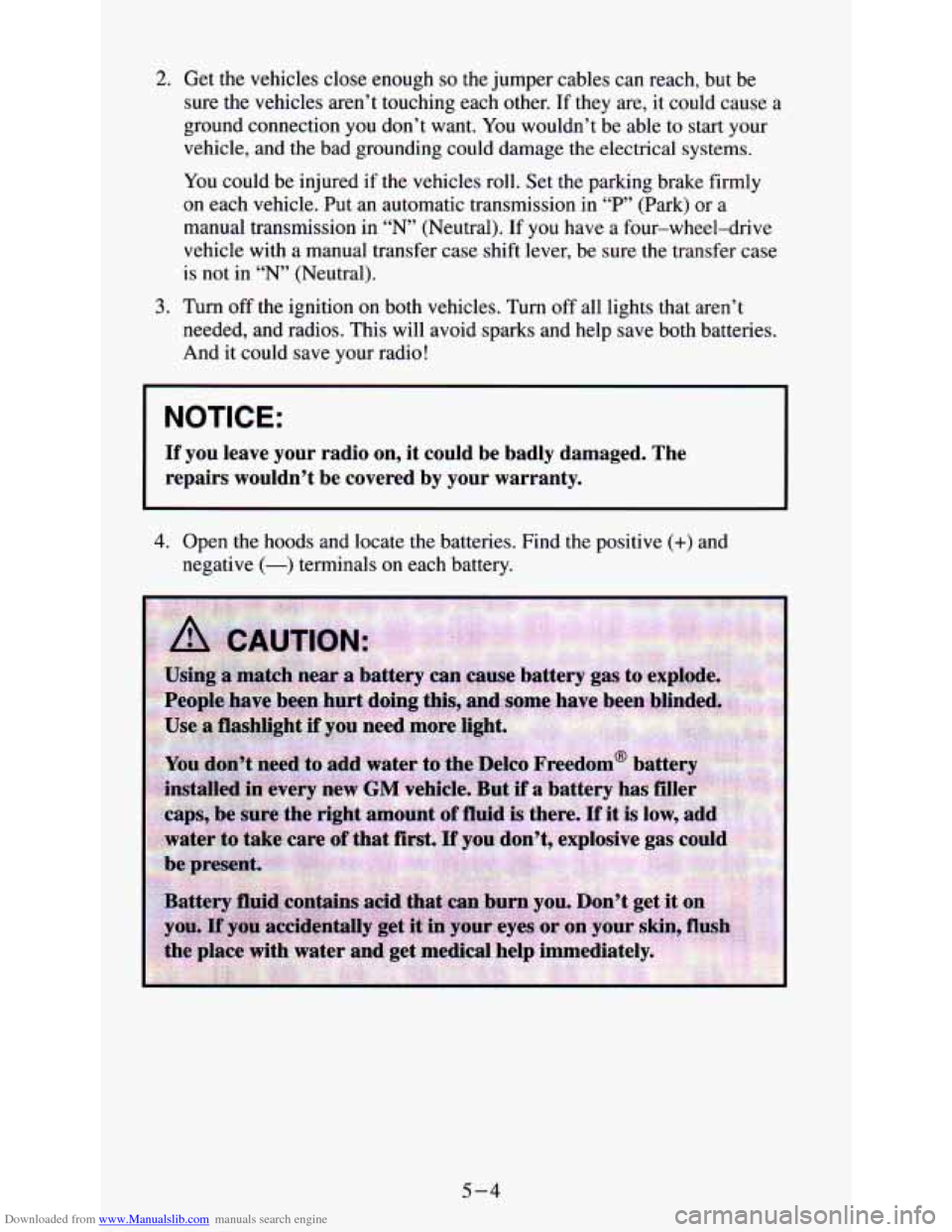
4. Open the hoods and locate the batteries. Find the positive (+) and
negative
(-) terminals on each battery.
5-4
Page 219 of 340
Downloaded from www.Manualslib.com manuals search engine Service & Appearance Care
...
Section
Here you will find information about the care of your vehicle . This part
begins with service and fuel information. and then it shows how to check
important fluid and lubricant levels
. There is also technical information
about your vehicle. and a section devoted to its appearance care
.
Service ................................................... 6-2
Fuel
..................................................... 6-3
Checking Things Under the Hood
.............................. 6-7
Hood Release
........................................... 6-7
Engineoil
.............................................. 6-9
Enginecover
.......................................... 6-15
Air Cleaner
............................................ 6-19
Automatic Transmission Fluid ............................. 6-20
RearAxle
............................................. 6-24
All-WheelDrive
........................................ 6-24
Transfercase
.......................................... 6-24
FrontAxle
............................................. 6-25
Engine Coolant
....................................... 6-26
Windshield Washer Fluid
................................. 6-31
Brake Master Cylinder
................................... 6-32
Replacing Brake System Parts
.................... ........ 6-35
Battery
.................................................. 6-35
Vehiclestorage
......................................... 6-35
FluidLeakCheck
.......................................... 6-36
Bulb Replacement
......................................... 6-36
Other Maintenance Items
.................................... 6-41
Tires
.................................................... 6-47
Appearancecare
.......................................... 6-54
Vehicle Identification Number
................................ 6-63
Service Parts Identification Label
..................... .... 6-65
Capacities and Specification Charts
................ . . 6-68
Fuses and Circuit Breakers ........... 6-72
Power Steering Fluid .................................. 6-30
Loading Your Vehicle
.... .............................. 6-44
6-1
Page 238 of 340
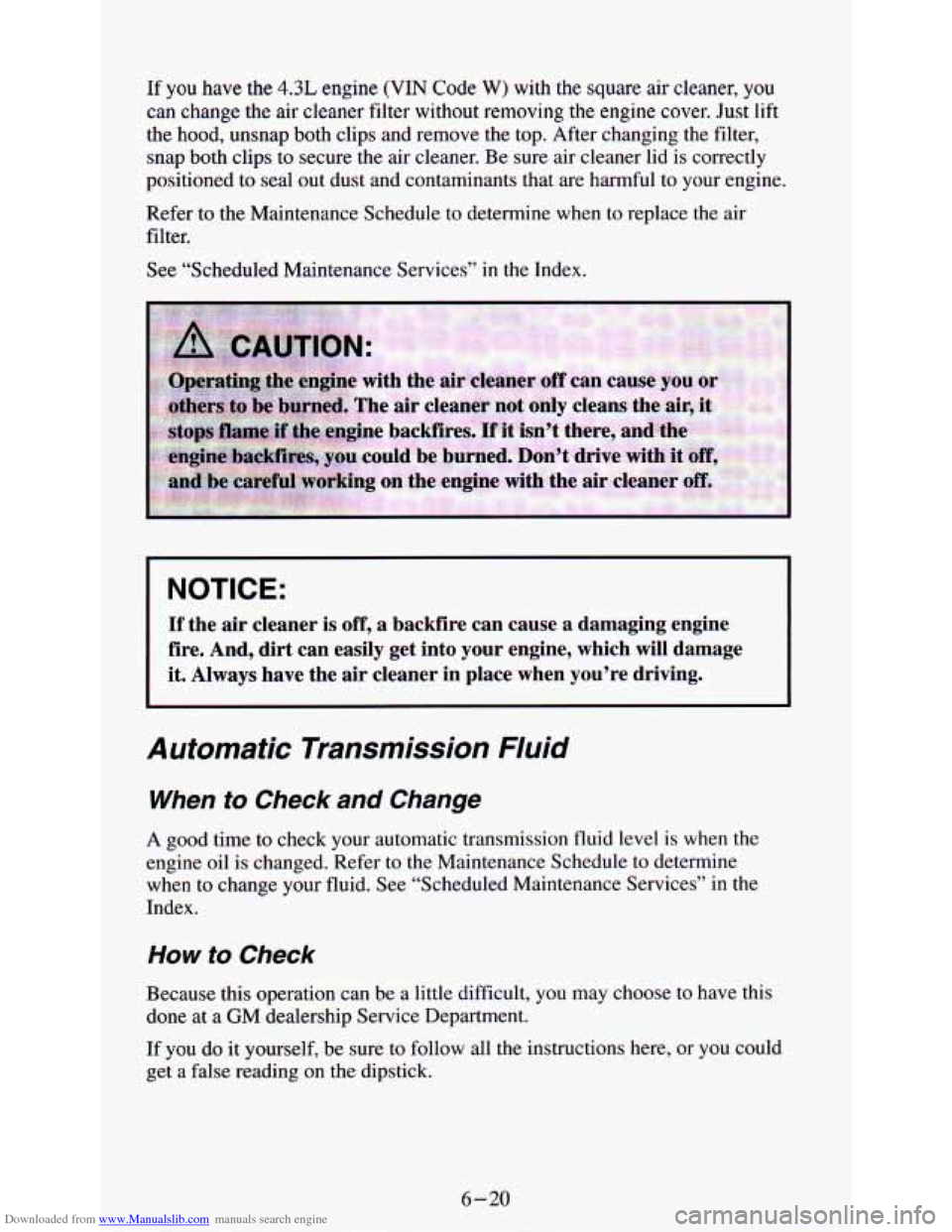
Downloaded from www.Manualslib.com manuals search engine If you have the 4.3L engine (VIN Code W) with the square air cleaner, you
can change the air cleaner filter without removing the engine cover. Just lift
the hood, unsnap both clips and remove
the top. After changing the filter,
snap both clips to secure
the air cleaner. Be sure air cleaner lid is correctly
positioned to seal out dust and contaminants that are harmful
to your engine.
Refer to the Maintenance Schedule to determine when to replace the air
filter.
See “Scheduled Maintenance Services”
in the Index.
NOTICE:
If the air cleaner is off, a backfire can cause a damaging engine
fire. And, dirt can easily get into your engine, which
will damage
it. Always have the air cleaner in place when you’re drivin\
g.
Automatic Transmission Fluid
When to Check and Change
A good time to check your automatic transmission fluid level is when the
engine oil is changed. Refer to the Maintenance Schedule to determine
when to change your fluid. See “Scheduled Maintenance Services” in the
Index.
How to Check
Because this operation can be a little difficult, you may choose to have this
done at a GM dealership Service Department.
If you do it yourself, be sure to follow all the instructions here,
or you could
get a false reading on the dipstick.
6-20
Page 241 of 340
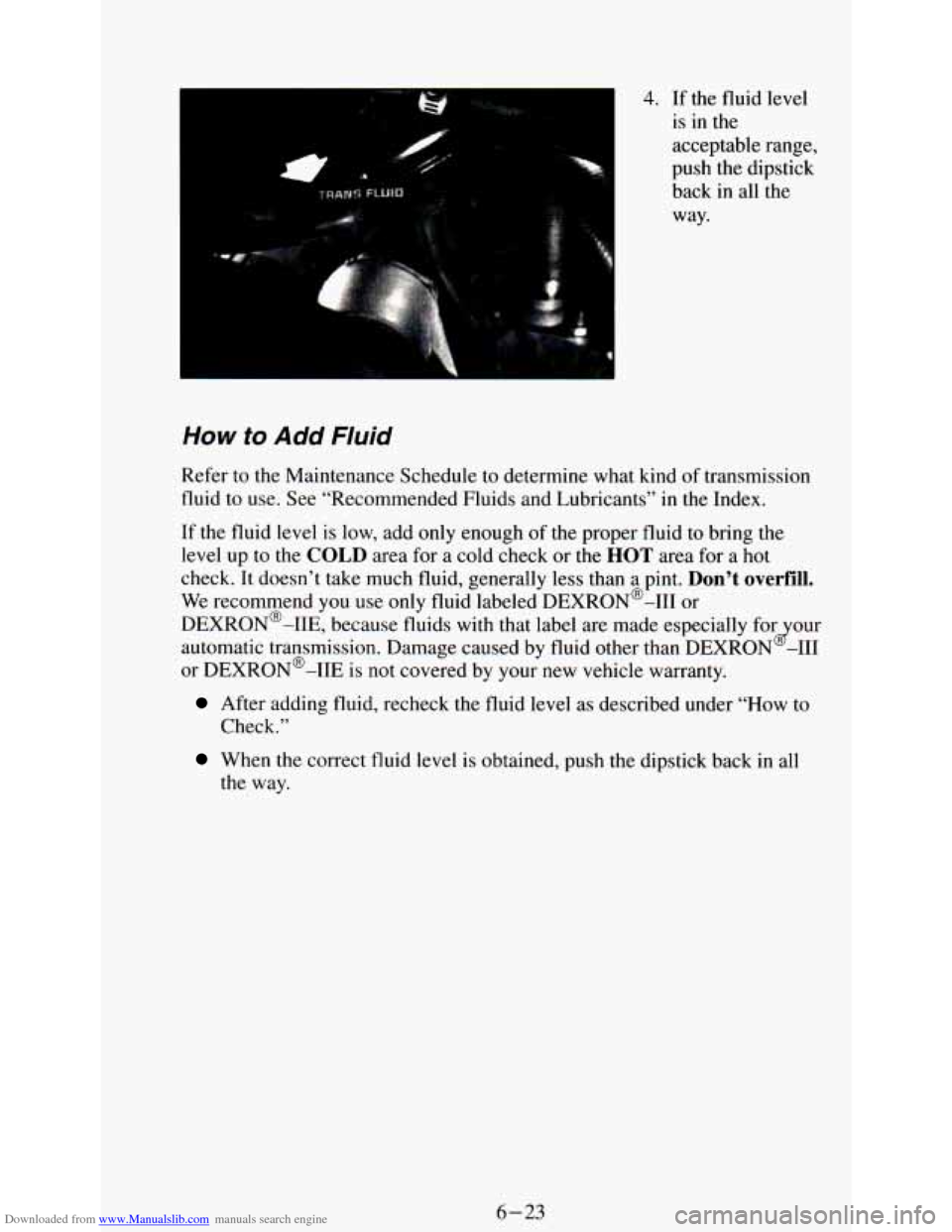
Downloaded from www.Manualslib.com manuals search engine 4. If the fluid level
is in the
acceptable range,
push the dipstick
back in all the
way.
How to Add Fluid
Refer to the Maintenance Schedule to determine what kind of transmission
fluid to use. See “Recommended Fluids and Lubricants”
in the Index.
If the fluid level
is low, add only enough of the proper fluid to bring the
level up to the
COLD area for a cold check or the HOT area for a hot
check. It doesn’t take much fluid, generally less than
a pint. Don’t overfill.
We recommend you use only fluid labeled DEXRON@-I11 or
DEXRON@-IIE, because fluids with that label are made especially for our
automatic transmission. Damage caused by fluid other than DEXRON
-111
or DEXRON@-IIE is not covered by your new vehicle warranty.
d
After adding fluid, recheck the fluid level as described under “How to
Check.”
When the correct fluid level is obtained, push the dipstick back in all
the way.
6-23
Page 302 of 340
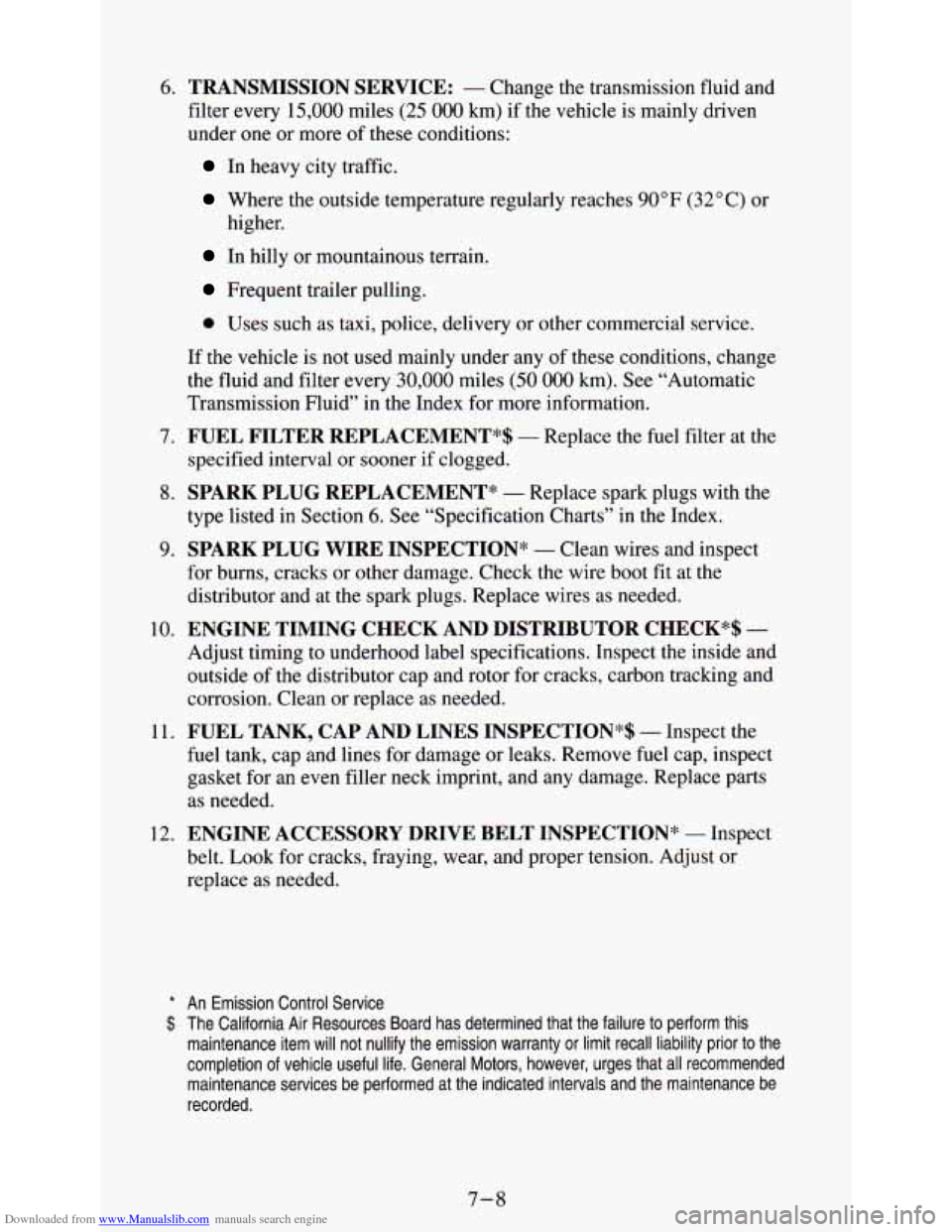
Downloaded from www.Manualslib.com manuals search engine 6. TRANSMISSION SERVICE: - Change the transmission fluid and
filter every
15,000 miles (25 000 km) if the vehicle is mainly driven
under
one or more of these conditions:
In heavy city traffic.
Where the outside temperature regularly reaches 90 “F (32” C) or
In hilly or mountainous terrain.
higher.
Frequent trailer pulling.
0 Uses
such as taxi, police, delivery or other commercial service.
If the vehicle
is not used mainly under any of these conditions, change
the fluid and filter every
30,000 miles (50 000 km). See “Automatic
Transmission Fluid” in the Index for more information.
7. FUEL FILTER REPLACEMENT*$ - Replace the fuel filter at the
specified interval or sooner if clogged.
8. SPARK PLUG REPLACEMENT* - Replace spark plugs with the
type listed in Section
6. See “Specification Charts” in the Index.
9. SPARK PLUG WIRE INSPECTION* - Clean wires and inspect
for bums, cracks or other damage. Check the wire boot fit at the
distributor and at the spark plugs. Replace wires as needed.
Adjust timing to underhood label specifications. Inspect the inside and
outside
of the distributor cap and rotor for cracks, carbon tracking and
corrosion. Clean or replace as needed.
10. ENGINE TIMING CHECK AND DISTRIBUTOR CHECK*$ -
11. FUEL TANK, CAP AND LINES INSPECTION*$ - Inspect the
fuel tank, cap and lines for damage or leaks. Remove fuel cap, inspect
gasket for an even filler neck imprint, and any damage. Replace parts
as needed.
12. ENGINE ACCESSORY DRIVE BELT INSPECTION* - Inspect
belt.
Look for cracks, fraying, wear, and proper tension. Adjust or
replace as needed.
* An Emission Control Service
$ The California Air Resources Board has determined that the failure to perform \
this
maintenance item will not nullify the emission warranty or limit recall liability prior to the
completion of vehicle useful life. General Motors, however, urges that all re\
commended
maintenance services be performed at the indicated intervals and\
the maintenance be
recorded.
7-8
Page 307 of 340
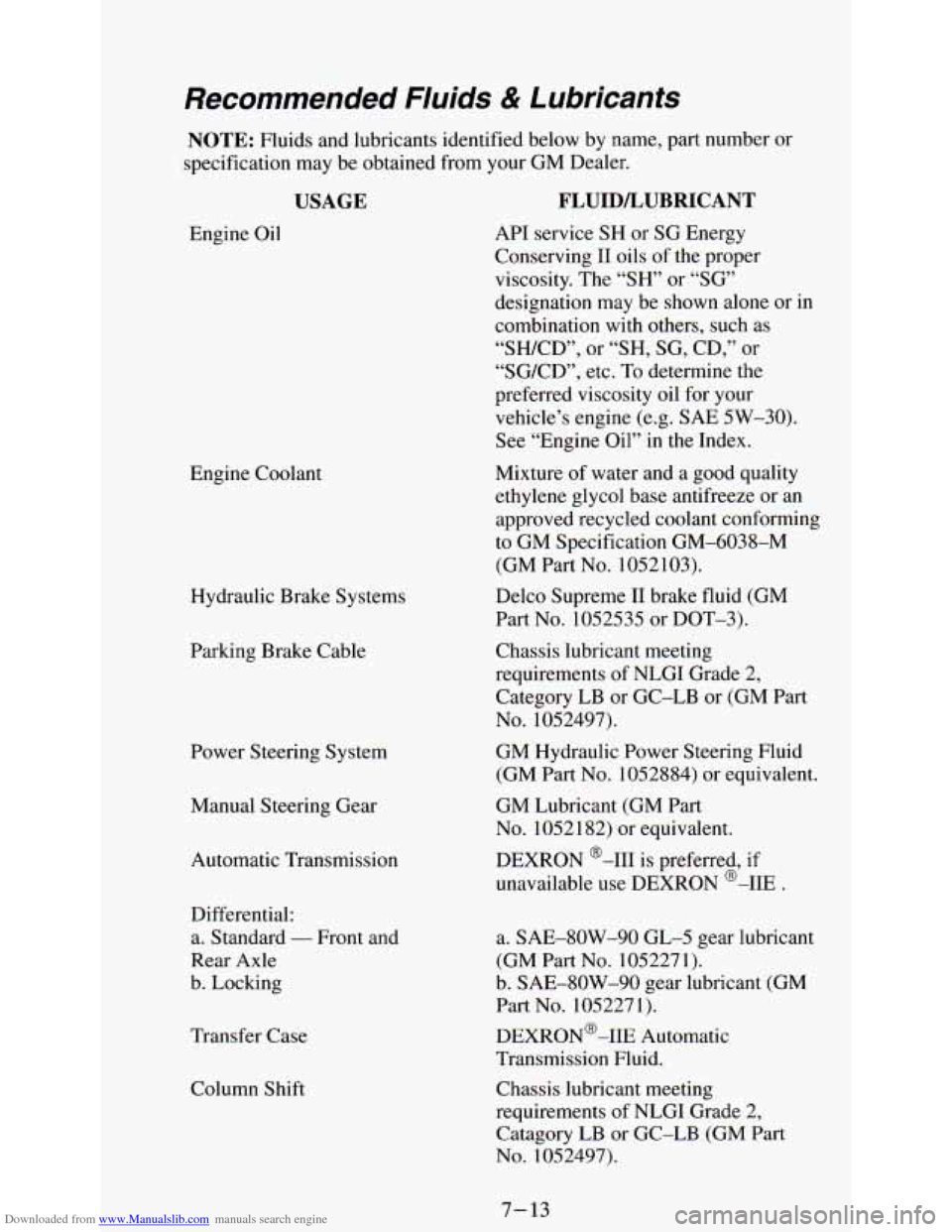
Downloaded from www.Manualslib.com manuals search engine Recommended Fluids & Lubricants
NOTE: Fluids and lubricants identified below by name, part number or
specification may be obtained from your GM Dealer.
USAGE
Engine Oil
Engine Coolant Hydraulic Brake Systems
Parking Brake Cable
Power Steering System
Manual Steering Gear
Automatic Transmission
Differential: a. Standard
- Front and
Rear Axle
b. Locking
Transfer Case Column Shift
FLUIDLUBRICANT
API service SH or SG Energy
Conserving I1 oils
of the proper
viscosity. The “SH” or
“SG’
designation may be shown alone or in
combination with others, such as
“SWCD”, or
“SH, SG, CD,” or
“SGKD”, etc. To determine the
preferred viscosity oil for your
vehicle’s engine (e.g. SAE 5W-30).
See “Engine Oil”
in the Index.
Mixture of water and a good quality
ethylene glycol base antifreeze or an
approved recycled coolant conforming
to GM Specification GM-6038-M
(GM Part No. 1052103).
Delco Supreme I1 brake fluid
(GM
Part No. 1052535 or DOT-3).
Chassis lubricant meeting
requirements of NLGI Grade 2,
Category LB or GC-LB or (GM Part
No. 1052497).
GM Hydraulic Power Steering Fluid
(GM Part No. 1052884) or equivalent.
GM Lubricant (GM Part
No. 10521 82) or equivalent.
DEXRON @-I11
is preferred, if
unavailable use DEXRON @-IIE .
a. SAE-80W-90 GL-5 gear lubricant
(GM Part
No. 105227 1).
b. SAE-80W-90 gear lubricant (GM
Part
No. 1052271).
DEXRON@-IIE Automatic
Transmission Fluid.
Chassis lubricant meeting
requirements of NLGI Grade 2,
Catagory LB or GC-LB
(GM Part
No. 1052497).
7- 13