wheel CHEVROLET AVALANCHE 2002 1.G Workshop Manual
[x] Cancel search | Manufacturer: CHEVROLET, Model Year: 2002, Model line: AVALANCHE, Model: CHEVROLET AVALANCHE 2002 1.GPages: 437, PDF Size: 3.28 MB
Page 259 of 437
4-48
Four-Wheel-Drive Vehicles
Use the following procedure to correctly tow your
vehicle on all four wheels:
1. Firmly set the parking brake.
2. Shift the transmission to PARK (P).
3. Securely attach the vehicle being towed to the
tow vehicle.
CAUTION:
Shifting a four-wheel-drive vehicle's transfer
case into NEUTRAL can cause your vehicle to
roll even if the transmission is in Park (P). You or
others could be injured. Make sure the parking
brake is firmly set before you shift the transfer
case to NEUTRAL. See ªTransfer Caseºin the
Index for more information.
4. Shift the transfer case to NEUTRAL (N).
See ªFour
-Wheel-Driveº in the Index for the
proper procedure to select the neutral position for
your vehicle.
5. Release the parking brake only after the vehicle
being towed is firmly attached to the towing vehicle.
6. When the vehicle is properly attached to the tow
vehicle and is ready to be towed, turn the ignition to
OFF. To prevent the battery from draining, remove
the IGN 0 fuse from the instrument panel fuse block.
See ªFusesº in the Index for more information about
removing the IGN 0 fuse.
Page 260 of 437

4-49 Dolly Towing
(Two-Wheel Drive Vehicle Only)
Tw o-Wheel Drive OnlyTw o
-Wheel-Drive Vehicles
Tw o
-wheel-drive, vehicles, should not be towed with
the rear wheels on the ground. Two
-wheel-drive
transmissions have no provisions for internal lubrication
while being towed. To properly tow these vehicles, they
should be placed on a platform trailer with all four
wheels off the ground.
In rare cases when it's unavoidable that a two
-wheel
drive vehicle is to be towed with the rear wheels on the
ground, the propeller shaft axle yoke orientation should
be marked and the propeller shaft removed following the
applicable service manual removal/installation procedure.
Dust or dirt can enter the back of the transmission
through the opening created by removing the propeller
shaft if proper protection is not provided. Also, check
the transmission fluid level before driving the truck.
When the vehicle is properly attached to the tow vehicle
and is ready to be towed, turn the ignition to LOCK.
Clamp the steering wheel in a straight
-ahead position
with a clamping device designed for towing.
Page 261 of 437
4-50
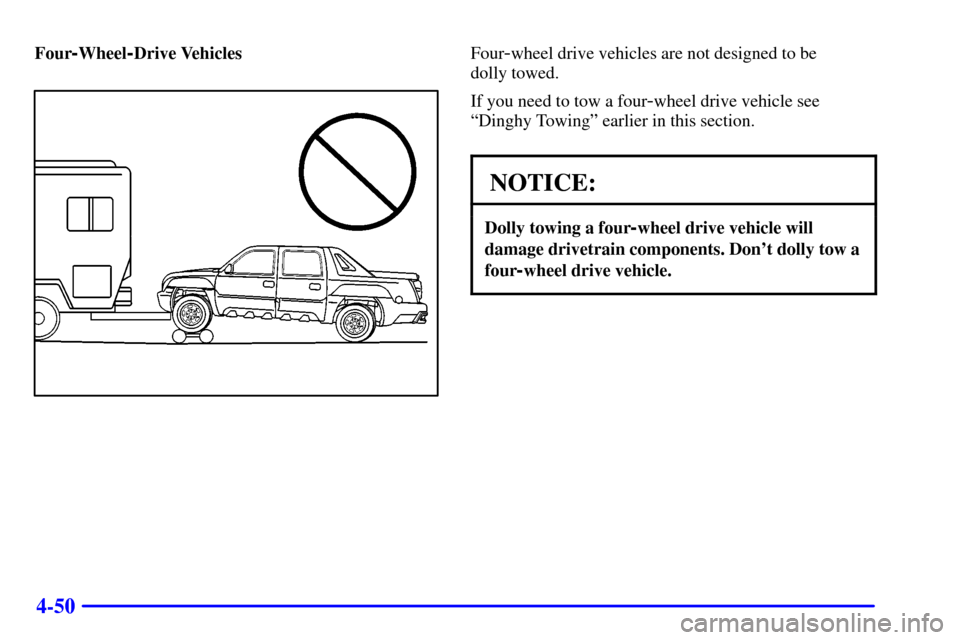
Four-Wheel-Drive VehiclesFour-wheel drive vehicles are not designed to be
dolly towed.
If you need to tow a four
-wheel drive vehicle see
ªDinghy Towingº earlier in this section.
NOTICE:
Dolly towing a four-wheel drive vehicle will
damage drivetrain components. Don't dolly tow a
four
-wheel drive vehicle.
Page 266 of 437

4-55
Q:What is front axle reserve capacity, and how
do I calculate it?
A:Front axle reserve capacity is the difference
between your front GAWR and the front axle
weight of your truck with full fuel and passengers.
Basically, it's the amount of weight you can add to
your front axle before reaching your front GAWR.
The front axle reserve capacity for your vehicle
can be found in the lower right corner of the
tire/certification label.In order to calculate the amount of weight any front
accessory, such as a snow plow, is adding to the
front axle, use the following formula:
(W x (A + W.B.))/W.B.= Weight the accessory is
adding to the front axle.
Where:
W=Weight of added accessory
A=Distance that the accessory is in front of the
front axle
W.B.=Vehicle Wheelbase
Page 267 of 437
4-56
For example, adding a 700 lb. (318 kg) snow plow
actually adds more than 700 lb. (318 kg) to the
front axle. Using the formula, if the snow plow is
4 ft. (122 cm) in front of the front axle and the
wheel base is 10 ft. (305 cm), then:
W=700 lb. (318 kg)
A=4 ft. (122 cm)
W.B.=10 ft. (305 cm)
(W x (A + W.B.))/W.B.= (700 x (4 + 10))/10 =
980 lb. (445 kg)
So, if your truck's front axle reserve capacity is
more than 980 lb. (445 kg), you could add this
snow plow without exceeding the front GAWR.
Q:What if I want to add heavier equipment to
my vehicle?
A:You can add heavier equipment on the front of the
vehicle if you compensate for it by carrying fewer
passengers, less cargo, or by positioning cargo
more towards the rear. This has the effect of
reducing the load on the front. However, the front
GAWR, rear GAWR and the GVWR must never
be exceeded.
CAUTION:
On some vehicles equipped with certain front
mounted equipment, such as a snow plow, it may
be possible to load the front axle to the front
GAWR but not have enough weight on the rear
axle to have proper braking performance.
If your brakes can't work properly, you could
have a crash. To help your brakes work properly
when a snow plow is installed, always follow
the snow plow manufacturer or installer's
recommendation for rear ballast to ensure a
proper front and rear weight distribution ratio,
even though the actual front weight may be less
than the front GAWR, and the total vehicle weight
is less than the GVWR. Maintaining a proper
front and rear weight distribution ratio is
necessary to provide proper braking performance.
Page 272 of 437

4-61 Weight of the Trailer
How heavy can a trailer safely be?
It depends on how you plan to use your rig.
For example, speed, altitude, road grades, outside
temperature and how much your vehicle is used to
pull a trailer are all important. And, it can also depend
on any special equipment that you have on your vehicle.
Use one of the following charts to determine how much
your vehicle can weigh, based upon your vehicle model
and options.
Maximum trailer weight is calculated assuming the
driver and one passenger are in the tow vehicle and it
has all the required trailering equipment. The weight of
additional optional equipment, passengers and cargo in
the tow vehicle must be subtracted from the maximum
trailer weight.Above the 5,000 lbs. (2 268 kg) trailer rating, the
handling/trailering suspension is required on C-1500
models and the handling/trailering or off
-road
suspension is required on K
-1500 models.
NOTICE:
Your vehicle was not designed to be used with
a fifth
-wheel hitch device. Using such a device
could result in damage to the vehicle.
These damages would not be covered by your
vehicle's warranty.
Page 278 of 437
4-67 Following Distance
Stay at least twice as far behind the vehicle ahead as
you would when driving your vehicle without a trailer.
This can help you avoid situations that require heavy
braking and sudden turns.
Passing
You'll need more passing distance up ahead when
you're towing a trailer. And, because you're a good
deal longer, you'll need to go much farther beyond
the passed vehicle before you can return to your lane.
Backing Up
Hold the bottom of the steering wheel with one hand.
Then, to move the trailer to the left, just move that
hand to the left. To move the trailer to the right, move
your hand to the right. Always back up slowly and,
if possible, have someone guide you.
Making Turns
NOTICE:
Making very sharp turns while trailering
could cause the trailer to come in contact with
the vehicle. Your vehicle could be damaged.
Avoid making very sharp turns while trailering.
When you're turning with a trailer, make wider turns than
normal. Do this so your trailer won't strike soft shoulders,
curbs, road signs, trees or other objects. Avoid jerky or
sudden maneuvers. Signal well in advance.
Page 280 of 437
4-69 Parking on Hills
CAUTION:
You really should not park your vehicle, with a
trailer attached, on a hill. If something goes
wrong, your rig could start to move. People can
be injured, and both your vehicle and the trailer
can be damaged.
But if you ever have to park your rig on a hill, here's
how to do it:
1. Apply your regular brakes, but don't shift into
PARK (P) yet.
2. Have someone place chocks under the trailer wheels.
3. When the wheel chocks are in place, release the
regular brakes until the chocks absorb the load.
4. Reapply the regular brakes. Then apply your parking
brake and shift into PARK (P).5. If you have a four
-wheel-drive vehicle, be sure the
transfer case is in a drive gear and not in NEUTRAL (N).
6. Release the regular brakes.
CAUTION:
It can be dangerous to get out of your vehicle if
the shift lever is not fully in PARK (P) with the
parking brake firmly set. Your vehicle can roll.
If you have left the engine running, the vehicle
can move suddenly. You or others could be
injured. To be sure your vehicle won't move,
even when you're on fairly level ground, use
the steps that follow.
Always put the shift lever fully in PARK (P) with
the parking brake firmly set.
If the transfer case on four-wheel drive vehicles
is in NEUTRAL, your vehicle will be free to roll,
even if your shift lever is in PARK (P). So, be
sure the transfer case is in a drive gear
-- not
in NEUTRAL.
Page 288 of 437
5-4
2. Get the vehicles close enough so the jumper cables
can reach, but be sure the vehicles aren't touching
each other. If they are, it could cause a ground
connection you don't want. You wouldn't be able
to start your vehicle, and the bad grounding could
damage the electrical systems.
To avoid the possibility of the vehicles rolling, set
the parking brake firmly on both vehicles involved
in the jump start procedure. Put an automatic
transmission in PARK (P) or a manual transmission
in NEUTRAL before setting the parking brake.
If you have a four
-wheel-drive vehicle, be sure
the transfer case is not in NEUTRAL (N).
NOTICE:
If you leave your radio on, it could be badly
damaged. The repairs wouldn't be covered by
your warranty.
3. Turn off the ignition on both vehicles. Unplug
unnecessary accessories plugged into the cigarette
lighter or in the accessory power outlets. Turn off the
radio and all lamps that aren't needed. This will
avoid sparks and help save both batteries. And it
could save your radio!
4. Open the hoods and locate the positive (+) and
negative (
-) terminal locations of the other vehicle.
Your vehicle has a remote positive (+) jump starting
terminal and a remote negative (
-) jump starting
terminal. You should always use these remote
terminals instead of the terminals on the battery.
The remote positive (+) terminal is located under
a red plastic cover near the engine accessory drive
bracket. To access the remote positive (+) terminal,
open the red plastic cover.
The remote negative (
-) terminal is located on the
engine accessory drive bracket and is marked ªGND.º
See ªEngine Compartment Overviewº in the Index
for more information on location.
Page 304 of 437
5-20
If a Tire Goes Flat
It's unusual for a tire to ªblow outº while you're driving,
especially if you maintain your tires properly. If air goes
out of a tire, it's much more likely to leak out slowly.
But if you should ever have a ªblowout,º here are
a few tips about what to expect and what to do:
If a front tire fails, the flat tire will create a drag that
pulls the vehicle toward that side. Take your foot off
the accelerator pedal and grip the steering wheel firmly.
Steer to maintain lane position, and then gently brake
to a stop well out of the traffic lane.
A rear blowout, particularly on a curve, acts much like
a skid and may require the same correction you'd use
in a skid. In any rear blowout, remove your foot from
the accelerator pedal. Get the vehicle under control by
steering the way you want the vehicle to go. It may be
very bumpy and noisy, but you can still steer. Gently
brake to a stop
-- well off the road if possible.
If a tire goes flat, the next part shows how to use your
jacking equipment to change a flat tire safely.
Changing a Flat Tire
If a tire goes flat, avoid further tire and wheel damage
by driving slowly to a level place. Turn on your hazard
warning flashers.
CAUTION:
Changing a tire can cause an injury. The vehicle
can slip off the jack and roll over you or other
people. You and they could be badly injured.
Find a level place to change your tire. To help
prevent the vehicle from moving:
1. Set the parking brake firmly.
2. Put the shift lever in PARK (P).
3. If you have a four
-wheel-drive vehicle,
be sure the transfer case is in a drive
gear
-- not in NEUTRAL.
4. Turn off the engine.
5. Put the wheel blocks at the front and
rear of the tire farthest away from the
one being changed. That would be the
tire on the other side of the vehicle, at
the opposite end.