headlamp CHEVROLET AVALANCHE 2003 1.G Owner's Manual
[x] Cancel search | Manufacturer: CHEVROLET, Model Year: 2003, Model line: AVALANCHE, Model: CHEVROLET AVALANCHE 2003 1.GPages: 492, PDF Size: 3.53 MB
Page 298 of 492
Hydroplaning
Hydroplaning is dangerous. So much water can build up
under your tires that they can actually ride on the
water. This can happen if the road is wet enough and
you're going fast enough. When your vehicle is
hydroplaning, it has little or no contact with the road.
Hydroplaning doesn't happen often. But it can if
your tires do not have much tread or if the pressure in
one or more is low. It can happen if a lot of water is
standing on the road. If you can see re¯ections
from trees, telephone poles or other vehicles, and
raindrops ªdimpleº the water's surface, there could be
hydroplaning.
Hydroplaning usually happens at higher speeds. There
just isn't a hard and fast rule about hydroplaning.
The best advice is to slow down when it is raining.
Driving Through Deep Standing Water
Notice:If you drive too quickly through deep
puddles or standing water, water can come in
through your engine's air intake and badly damage
your engine. Never drive through water that is
slightly lower than the underbody of your vehicle. If
you can't avoid deep puddles or standing water,
drive through them very slowly.
Driving Through Flowing Water
{CAUTION:
Flowing or rushing water creates strong forces.
If you try to drive through ¯owing water, as you
might at a low water crossing, your vehicle can
be carried away. As little as six inches of
¯owing water can carry away a smaller vehicle.
If this happens, you and other vehicle
occupants could drown. Don't ignore police
warning signs, and otherwise be very cautious
about trying to drive through ¯owing water.
Some Other Rainy Weather Tips
·Turn on your low-beam headlamps ± not just your
parking lamps ± to help make you more visible to
others.
·Besides slowing down, allow some extra following
distance. And be especially careful when you
pass another vehicle. Allow yourself more clear
room ahead, and be prepared to have your
view restricted by road spray.
·Have good tires with proper tread depth. SeeTires
on page 5-61
.
4-35
Page 308 of 492
{CAUTION:
Snow can trap exhaust gases under your
vehicle. This can cause deadly CO (carbon
monoxide) gas to get inside. CO could
overcome you and kill you. You can't see it or
smell it, so you might not know it is in your
vehicle. Clear away snow from around the
base of your vehicle, especially any that is
blocking your exhaust pipe. And check around
again from time to time to be sure snow
doesn't collect there.
Open a window just a little on the side of the
vehicle that's away from the wind. This will
help keep CO out.
Run your engine only as long as you must. This saves
fuel. When you run the engine, make it go a little
faster than just idle. That is, push the accelerator
slightly. This uses less fuel for the heat that you get and
it keeps the battery charged. You will need a
well-charged battery to restart the vehicle, and possibly
for signaling later on with your headlamps. Let the
heater run for a while.Then, shut the engine off and close the window almost
all the way to preserve the heat. Start the engine
again and repeat this only when you feel really
uncomfortable from the cold. But do it as little as
possible. Preserve the fuel as long as you can. To help
keep warm, you can get out of the vehicle and do
some fairly vigorous exercises every half hour or so until
help comes.
If You Are Stuck: In Sand, Mud, Ice
or Snow
In order to free your vehicle when it is stuck, you will
need to spin the wheels, but you don't want to spin your
wheels too fast. The method known as ªrockingº can
help you get out when you're stuck, but you must
use caution.
4-45
Page 334 of 492

Service............................................................5-3
Doing Your Own Service Work.........................5-4
Adding Equipment to the Outside of Your
Vehicle......................................................5-4
Fuel................................................................5-5
Gasoline Octane............................................5-5
Gasoline Speci®cations....................................5-5
California Fuel...............................................5-6
Additives.......................................................5-6
Fuels in Foreign Countries...............................5-7
Filling Your Tank............................................5-7
Filling a Portable Fuel Container.......................5-9
Checking Things Under the Hood....................5-10
Hood Release..............................................5-10
Engine Compartment Overview.......................5-12
Engine Oil...................................................5-15
Engine Air Cleaner/Filter................................5-20
Automatic Transmission Fluid.........................5-22
Engine Coolant.............................................5-24
Coolant Surge Tank Pressure Cap..................5-27
Engine Overheating.......................................5-27
Cooling System............................................5-30
Engine Fan Noise.........................................5-36Power Steering Fluid.....................................5-36
Windshield Washer Fluid................................5-38
Brakes........................................................5-39
Battery........................................................5-42
Jump Starting...............................................5-43
Rear Axle.......................................................5-49
Four-Wheel Drive............................................5-50
Front Axle......................................................5-51
Bulb Replacement..........................................5-52
Halogen Bulbs..............................................5-52
Headlamps..................................................5-52
Front Turn Signal, Sidemarker and Parking
Lamps.....................................................5-55
Front Turn Signal, Sidemarker and Daytime
Running Lamps.........................................5-56
Daytime Running Lamps................................5-58
Center High-Mounted Stoplamp (CHMSL).........5-58
Taillamps.....................................................5-58
Replacement Bulbs.......................................5-59
Windshield Wiper Blade Replacement..............5-60
Section 5 Service and Appearance Care
5-1
Page 385 of 492
Bulb Replacement
SeeReplacement Bulbs on page 5-59for the proper
type of bulbs to use.
For any bulb changing procedure not listed in this
section, contact your dealer.
Halogen Bulbs
{CAUTION:
Halogen bulbs have pressurized gas inside
and can burst if you drop or scratch the bulb.
You or others could be injured. Be sure to read
and follow the instructions on the bulb
package.
Headlamps
Vehicles with Gray Body-Side Cladding
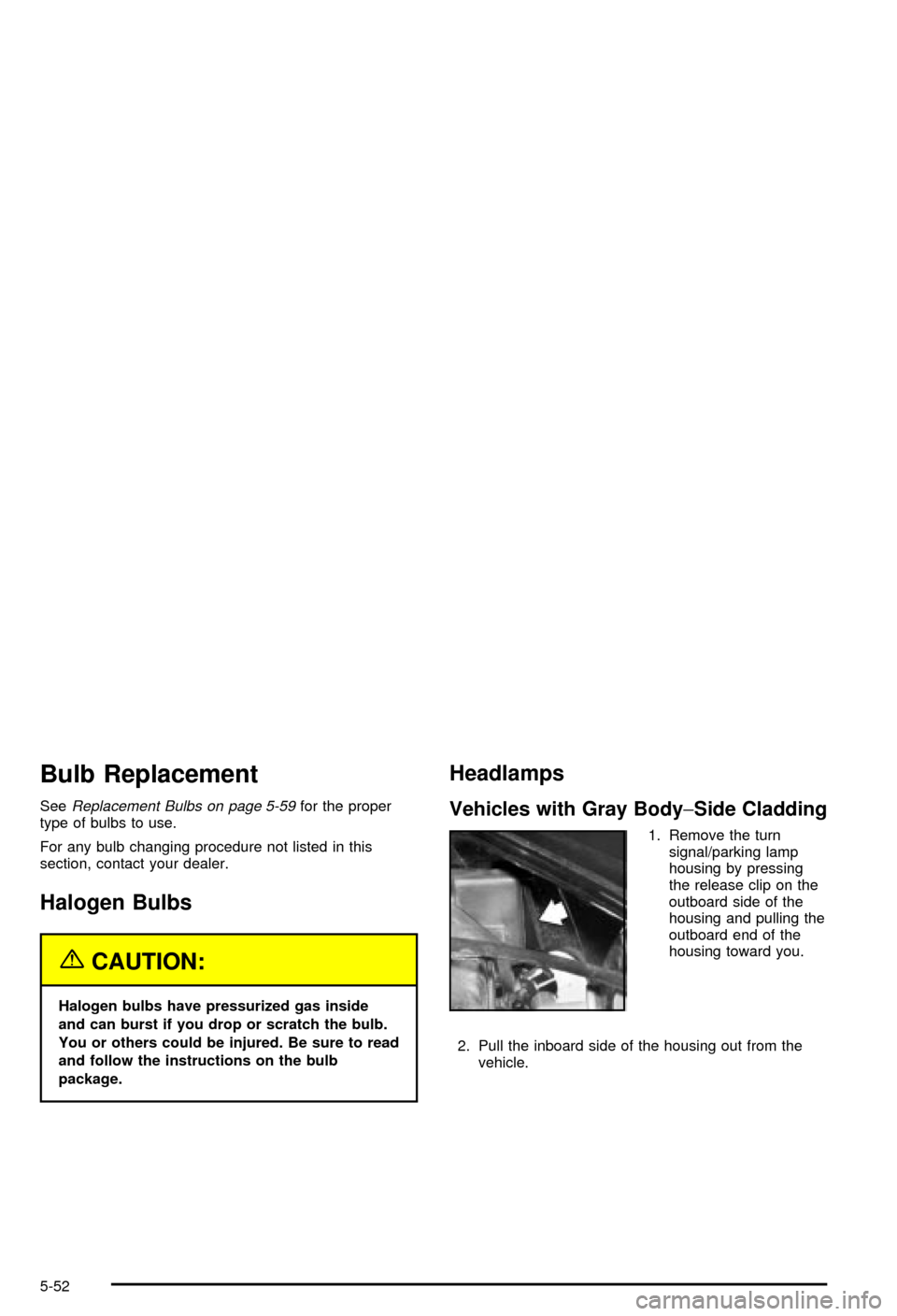
1. Remove the turn
signal/parking lamp
housing by pressing
the release clip on the
outboard side of the
housing and pulling the
outboard end of the
housing toward you.
2. Pull the inboard side of the housing out from the
vehicle.
5-52
Page 386 of 492
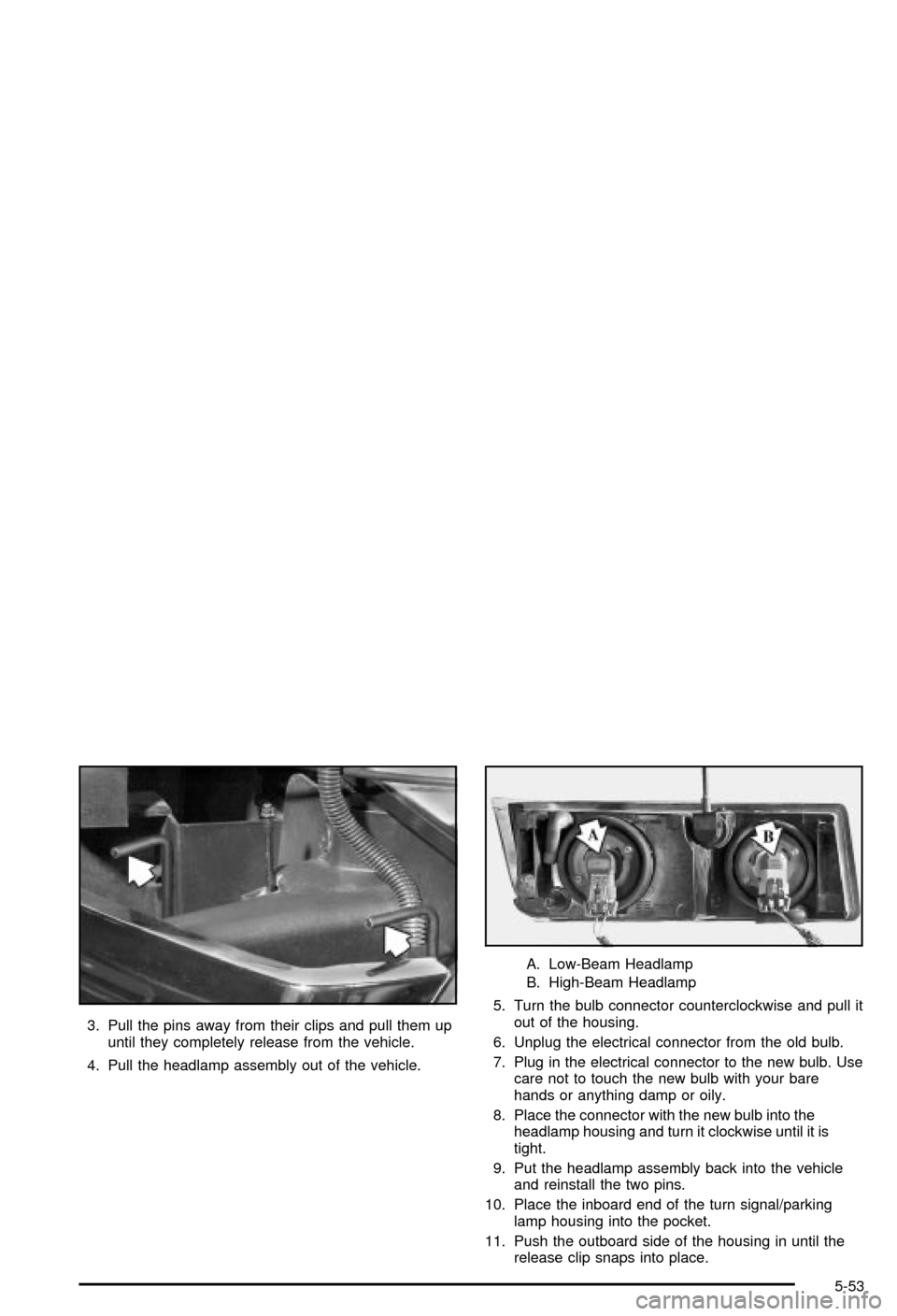
3. Pull the pins away from their clips and pull them up
until they completely release from the vehicle.
4. Pull the headlamp assembly out of the vehicle.A. Low-Beam Headlamp
B. High-Beam Headlamp
5. Turn the bulb connector counterclockwise and pull it
out of the housing.
6. Unplug the electrical connector from the old bulb.
7. Plug in the electrical connector to the new bulb. Use
care not to touch the new bulb with your bare
hands or anything damp or oily.
8. Place the connector with the new bulb into the
headlamp housing and turn it clockwise until it is
tight.
9. Put the headlamp assembly back into the vehicle
and reinstall the two pins.
10. Place the inboard end of the turn signal/parking
lamp housing into the pocket.
11. Push the outboard side of the housing in until the
release clip snaps into place.
5-53
Page 387 of 492
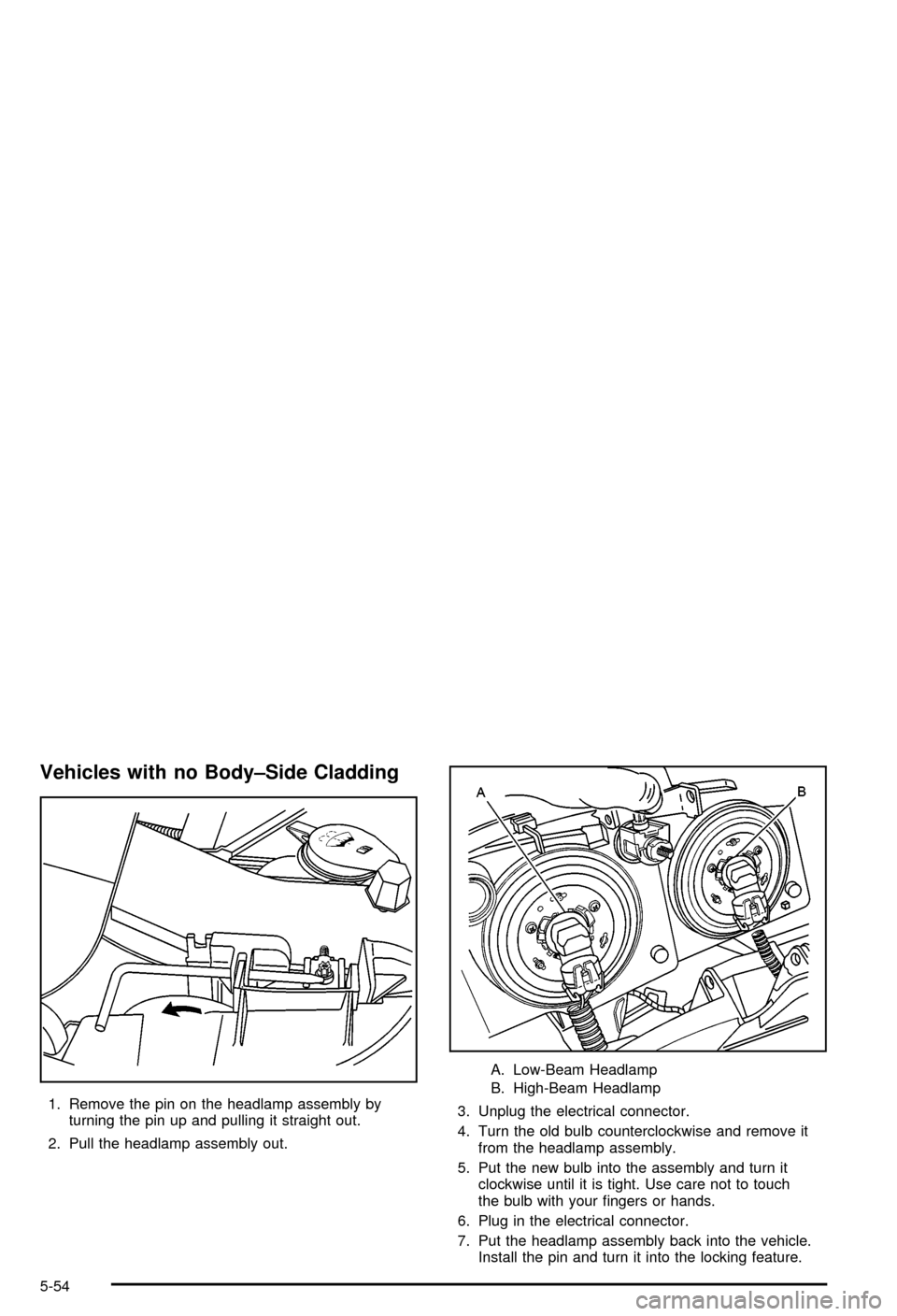
Vehicles with no Body±Side Cladding
1. Remove the pin on the headlamp assembly by
turning the pin up and pulling it straight out.
2. Pull the headlamp assembly out.A. Low-Beam Headlamp
B. High-Beam Headlamp
3. Unplug the electrical connector.
4. Turn the old bulb counterclockwise and remove it
from the headlamp assembly.
5. Put the new bulb into the assembly and turn it
clockwise until it is tight. Use care not to touch
the bulb with your ®ngers or hands.
6. Plug in the electrical connector.
7. Put the headlamp assembly back into the vehicle.
Install the pin and turn it into the locking feature.
5-54
Page 389 of 492
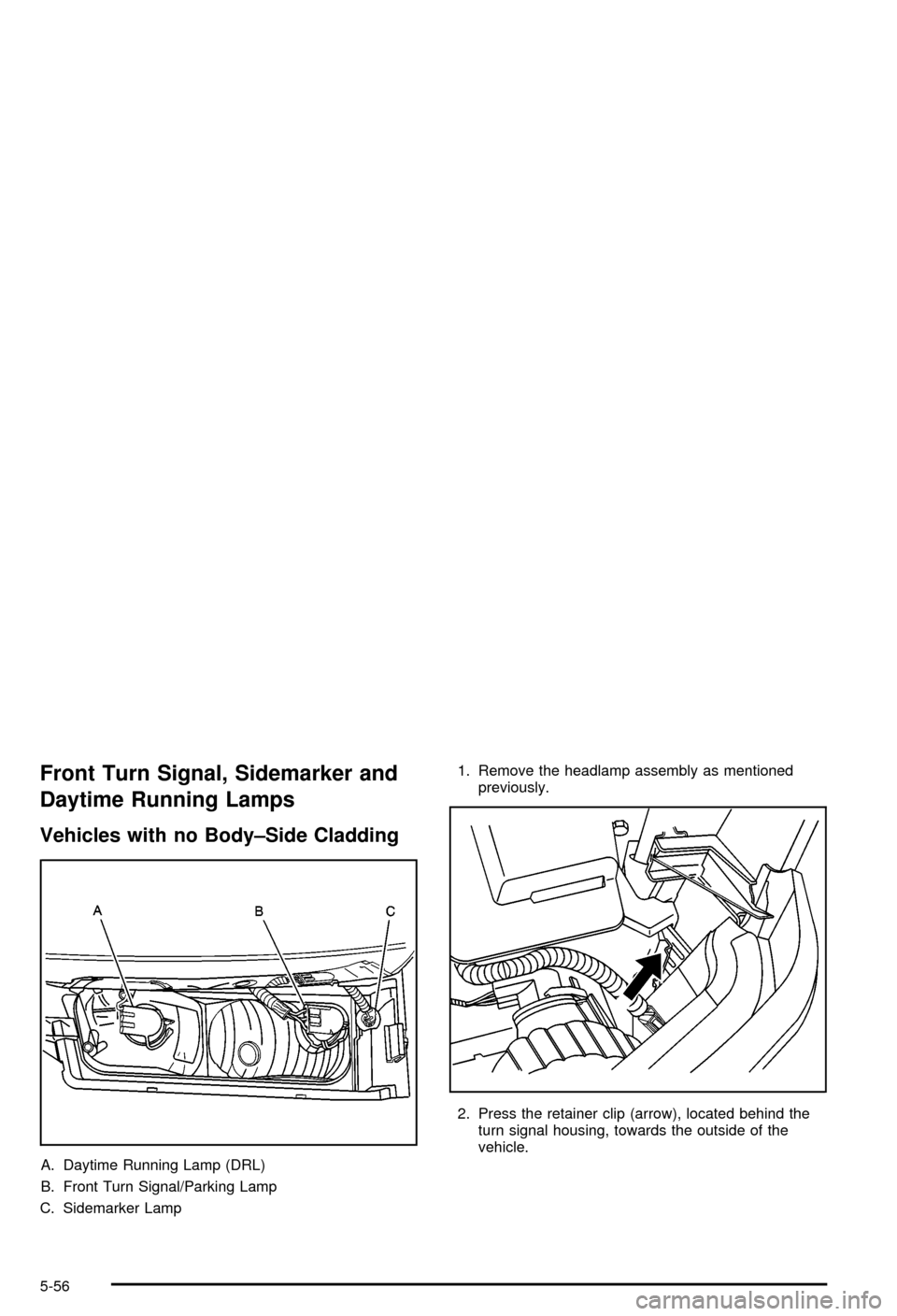
Front Turn Signal, Sidemarker and
Daytime Running Lamps
Vehicles with no Body±Side Cladding
A. Daytime Running Lamp (DRL)
B. Front Turn Signal/Parking Lamp
C. Sidemarker Lamp1. Remove the headlamp assembly as mentioned
previously.
2. Press the retainer clip (arrow), located behind the
turn signal housing, towards the outside of the
vehicle.
5-56
Page 390 of 492
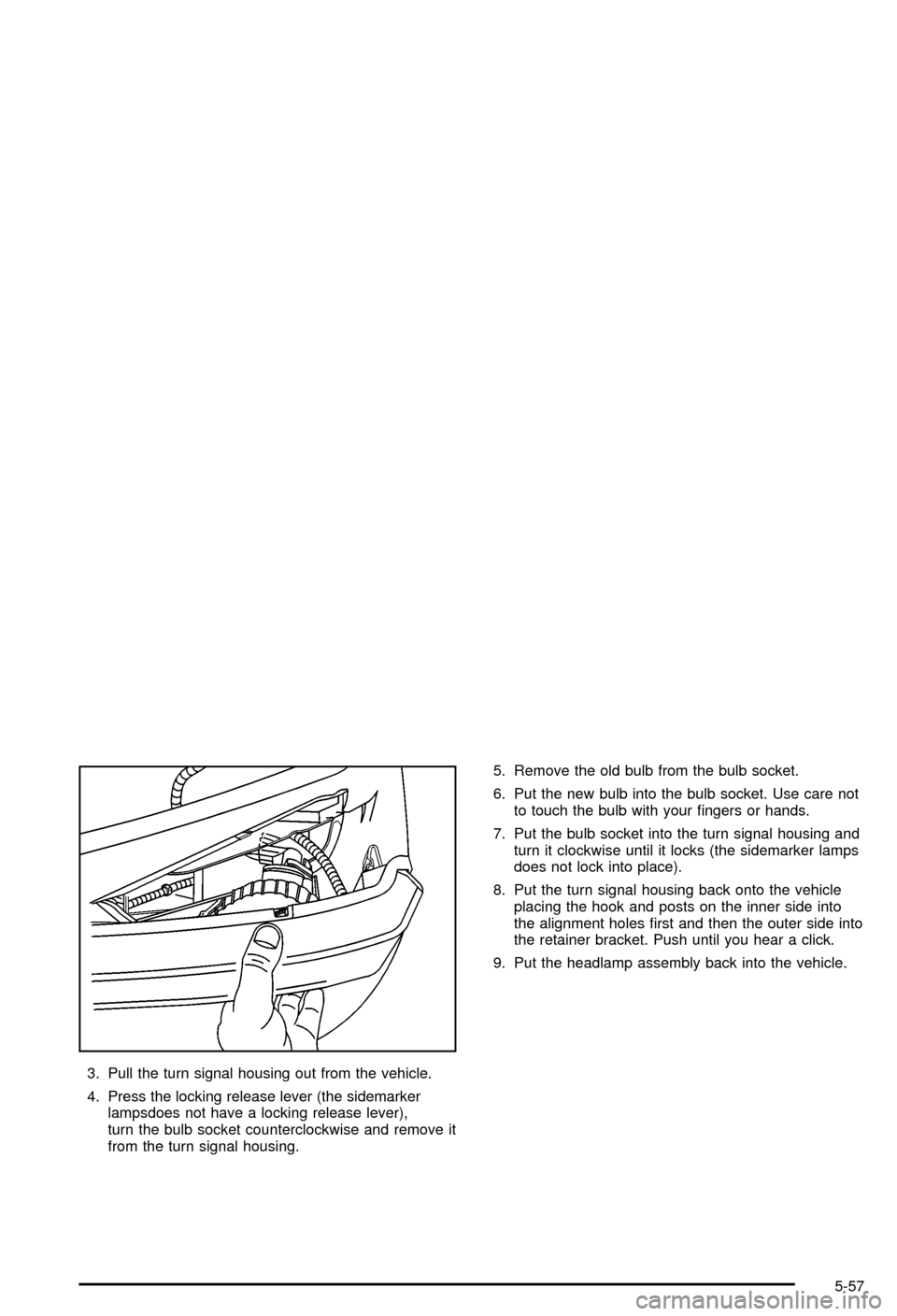
3. Pull the turn signal housing out from the vehicle.
4. Press the locking release lever (the sidemarker
lampsdoes not have a locking release lever),
turn the bulb socket counterclockwise and remove it
from the turn signal housing.5. Remove the old bulb from the bulb socket.
6. Put the new bulb into the bulb socket. Use care not
to touch the bulb with your ®ngers or hands.
7. Put the bulb socket into the turn signal housing and
turn it clockwise until it locks (the sidemarker lamps
does not lock into place).
8. Put the turn signal housing back onto the vehicle
placing the hook and posts on the inner side into
the alignment holes ®rst and then the outer side into
the retainer bracket. Push until you hear a click.
9. Put the headlamp assembly back into the vehicle.
5-57
Page 392 of 492
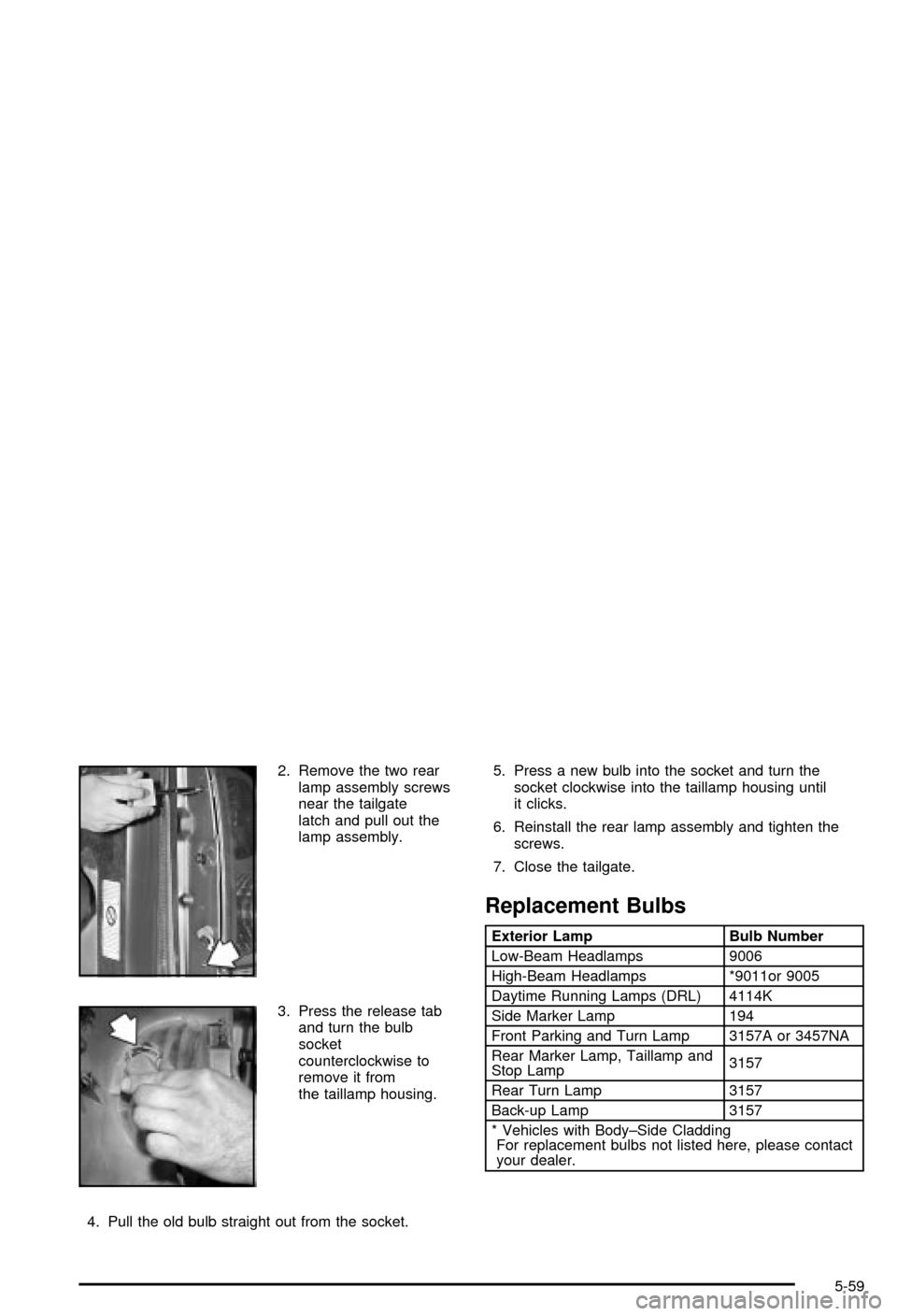
2. Remove the two rear
lamp assembly screws
near the tailgate
latch and pull out the
lamp assembly.
3. Press the release tab
and turn the bulb
socket
counterclockwise to
remove it from
the taillamp housing.
4. Pull the old bulb straight out from the socket.5. Press a new bulb into the socket and turn the
socket clockwise into the taillamp housing until
it clicks.
6. Reinstall the rear lamp assembly and tighten the
screws.
7. Close the tailgate.
Replacement Bulbs
Exterior Lamp Bulb Number
Low-Beam Headlamps 9006
High-Beam Headlamps *9011or 9005
Daytime Running Lamps (DRL) 4114K
Side Marker Lamp 194
Front Parking and Turn Lamp 3157A or 3457NA
Rear Marker Lamp, Taillamp and
Stop Lamp3157
Rear Turn Lamp 3157
Back-up Lamp 3157
* Vehicles with Body±Side Cladding
For replacement bulbs not listed here, please contact
your dealer.
5-59
Page 401 of 492
Notice:The wrong wheel can also cause problems
with bearing life, brake cooling, speedometer or
odometer calibration, headlamp aim, bumper height,
vehicle ground clearance and tire or tire chain
clearance to the body and chassis.
See
Changing a Flat Tire on page 5-70for more
information.
Used Replacement Wheels
{CAUTION:
Putting a used wheel on your vehicle is
dangerous. You can't know how it's been used
or how far it's been driven. It could fail
suddenly and cause a crash. If you have to
replace a wheel, use a new GM original
equipment wheel.
Tire Chains
{CAUTION:
If your vehicle is a 1500 Series, don't use tire
chains. They can damage your vehicle because
there's not enough clearance. Tire chains used
on a vehicle without the proper amount of
clearance can cause damage to the brakes,
suspension or other vehicle parts. The area
damaged by the tire chains could cause you to
lose control of your vehicle and you or others
may be injured in a crash.
Use another type of traction device only if its
manufacturer recommends it for use on your
vehicle and tire size combination and road
conditions. Follow that manufacturer's
instructions. To help avoid damage to your
vehicle, drive slowly, readjust or remove the
device if it's contacting your vehicle, and don't
spin your wheels.
If you do ®nd traction devices that will ®t,
install them on the rear tires.
5-68