change wheel CHEVROLET AVALANCHE 2004 1.G User Guide
[x] Cancel search | Manufacturer: CHEVROLET, Model Year: 2004, Model line: AVALANCHE, Model: CHEVROLET AVALANCHE 2004 1.GPages: 548, PDF Size: 3.49 MB
Page 339 of 548
{CAUTION:
Shifting the transfer case to NEUTRAL can
cause your vehicle to roll even if the
transmission is in PARK (P). You or someone
else could be seriously injured. Be sure to set
the parking brake before placing the transfer
case in NEUTRAL. SeeParking Brake on
page 2-42.
6. Shift the transfer case to NEUTRAL (N). See
Four-Wheel Drive on page 2-38for the proper
procedure to select the neutral position for your
vehicle.
7. Release the parking brake only after the vehicle
being towed is rmly attached to the towing
vehicle.
8. Turn the ignition off and lock the steering column.
Loading Your Vehicle
It is very important to know how much weight your
vehicle can carry. This weight is called the vehicle
capacity weight and includes the weight of all occupants,
cargo and all nonfactory-installed options. Two labels
on your vehicle show how much weight it may properly
carry, the Tire and Loading Information label and the
Certication/Tire label.
{CAUTION:
Do not load your vehicle any heavier than the
GVWR, or either the maximum front or rear
GAWR. If you do, parts on your vehicle can
break, and it can change the way your vehicle
handles. These could cause you to lose
control and crash. Also, overloading can
shorten the life of your vehicle.
4-55
Page 345 of 548
{CAUTION:
Do not load your vehicle any heavier than the
GVWR, or either the maximum front or rear
GAWR. If you do, parts on your vehicle can
break, and it can change the way your vehicle
handles. These could cause you to lose
control and crash. Also, overloading can
shorten the life of your vehicle.
Your warranty does not cover parts or components that
fail because of overloading.
This will help you decide how much cargo and installed
equipment your truck can carry.
Using heavier suspension components to get added
durability might not change your weight ratings. Ask your
dealer to help you load your vehicle the right way.
If you put things inside your vehicle – like suitcases,
tools, packages, or anything else – they go as fast
as the vehicle goes. If you have to stop or turn quickly,
or if there is a crash, they’ll keep going.
{CAUTION:
Things you put inside your vehicle can strike
and injure people in a sudden stop or turn, or
in a crash.
Put things in the cargo area of your
vehicle. Try to spread the weight evenly.
Never stack heavier things, like suitcases,
inside the vehicle so that some of them
are above the tops of the seats.
Do not leave an unsecured child restraint
in your vehicle.
When you carry something inside the
vehicle, secure it whenever you can.
Do not leave a seat folded down unless
you need to.
There’s also important loading information for off-road
driving in this manual. See “Loading Your Vehicle
for Off-Road Driving” underOff-Road Driving with Your
Four-Wheel-Drive Vehicle on page 4-20.
4-61
Page 422 of 548
Four-Wheel Drive
Transfer Case
It is not necessary to regularly check transfer case uid
unless you suspect there is a leak or you hear an
unusual noise. A uid loss could indicate a problem.
Have it inspected and repaired.
Refer to the Maintenance Schedule to determine how
often to change the lubricant. SeeScheduled
Maintenance on page 6-4.
How to Check Lubricant
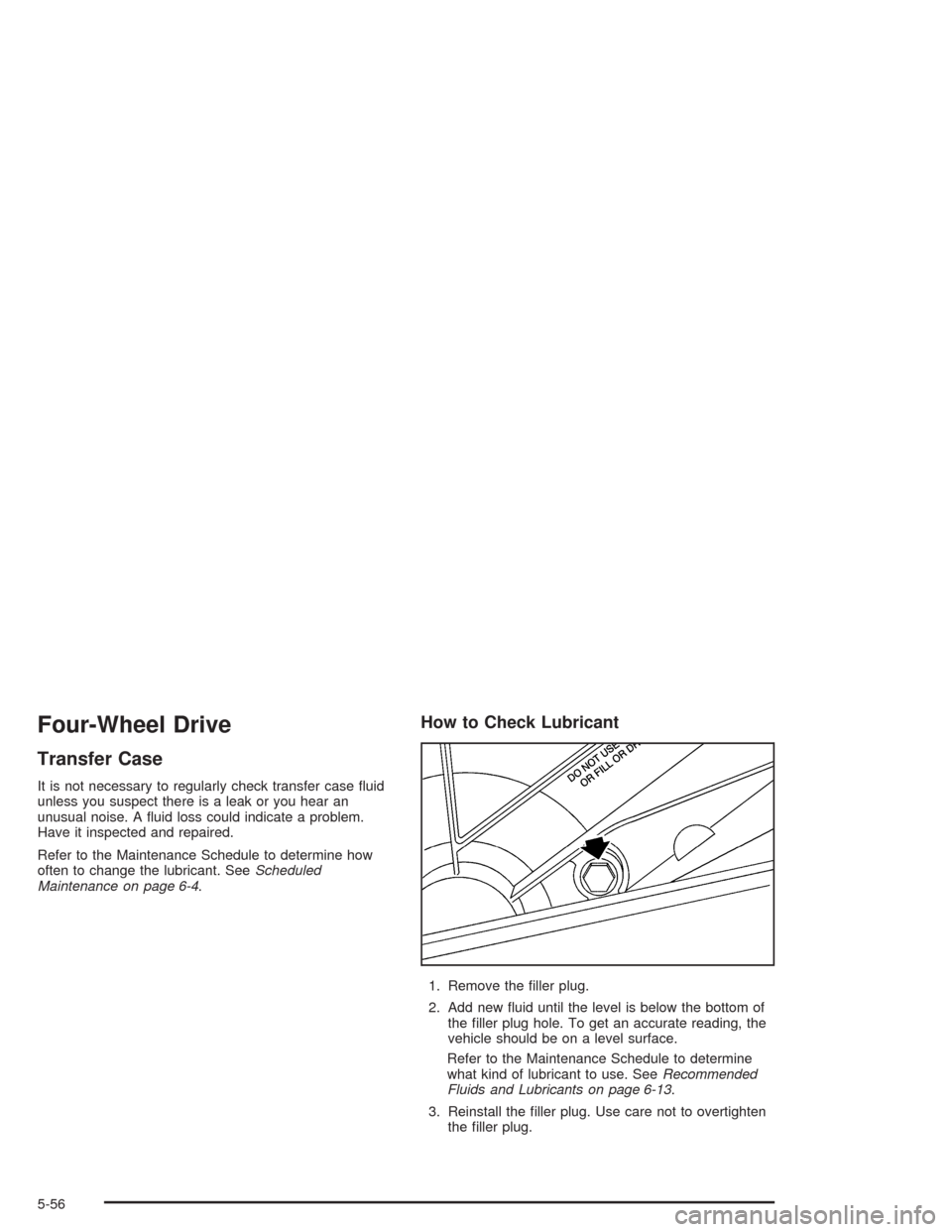
1. Remove the ller plug.
2. Add new uid until the level is below the bottom of
the ller plug hole. To get an accurate reading, the
vehicle should be on a level surface.
Refer to the Maintenance Schedule to determine
what kind of lubricant to use. SeeRecommended
Fluids and Lubricants on page 6-13.
3. Reinstall the ller plug. Use care not to overtighten
the ller plug.
5-56
Page 448 of 548
If your vehicle has the Tire Pressure Monitor (TPM)
system, the sensors will need to be reset after a
tire rotation is performed. See “TPM Sensor
Identication Codes” underTire Pressure Monitor
System on page 5-77.
{CAUTION:
Rust or dirt on a wheel, or on the parts to
which it is fastened, can make wheel nuts
become loose after a time. The wheel could
come off and cause an accident. When you
change a wheel, remove any rust or dirt from
places where the wheel attaches to the vehicle.
In an emergency, you can use a cloth or a
paper towel to do this; but be sure to use a
scraper or wire brush later, if you need to, to
get all the rust or dirt off. See “Changing a Flat
Tire” in the Index.
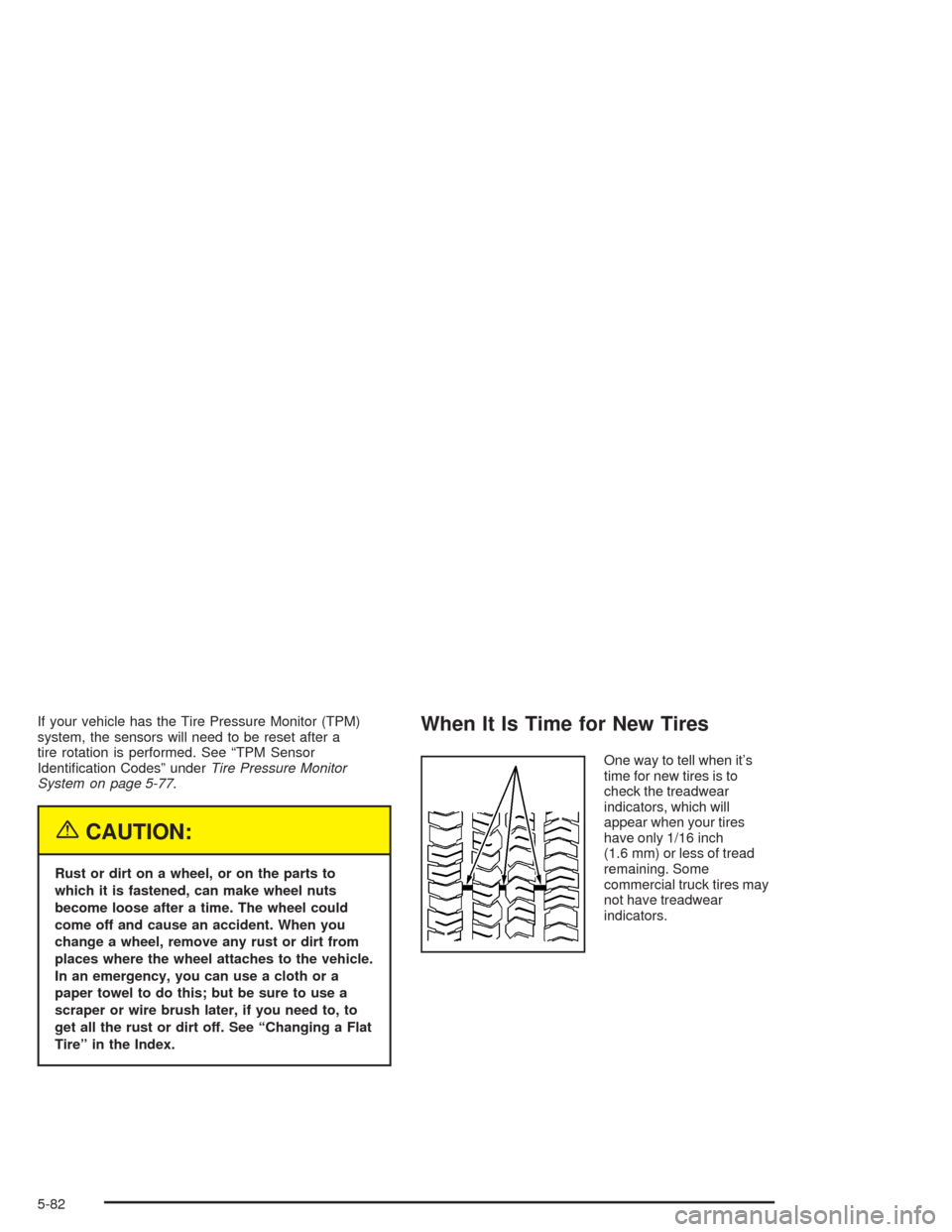
When It Is Time for New Tires
One way to tell when it’s
time for new tires is to
check the treadwear
indicators, which will
appear when your tires
have only 1/16 inch
(1.6 mm) or less of tread
remaining. Some
commercial truck tires may
not have treadwear
indicators.
5-82
Page 455 of 548
If a Tire Goes Flat
It’s unusual for a tire to “blowout” while you’re driving,
especially if you maintain your tires properly. If air goes
out of a tire, it’s much more likely to leak out slowly.
But if you should ever have a “blowout,” here are a few
tips about what to expect and what to do:
If a front tire fails, the at tire will create a drag that
pulls the vehicle toward that side. Take your foot off the
accelerator pedal and grip the steering wheel rmly.
Steer to maintain lane position, and then gently brake to
a stop well out of the traffic lane.
A rear blowout, particularly on a curve, acts much like a
skid and may require the same correction you’d use
in a skid. In any rear blowout, remove your foot from the
accelerator pedal. Get the vehicle under control by
steering the way you want the vehicle to go. It may be
very bumpy and noisy, but you can still steer. Gently
brake to a stop, well off the road if possible.{CAUTION:
Lifting a vehicle and getting under it to do
maintenance or repairs is dangerous without
the appropriate safety equipment and training.
The jack provided with your vehicle is
designed only for changing a at tire. If it is
used for anything else, you or others could be
badly injured or killed if the vehicle slips off
the jack. Use the jack provided with your
vehicle only for changing a at tire.
If a tire goes at, the next part shows how to use your
jacking equipment to change a at tire safely.
5-89
Page 456 of 548
Changing a Flat Tire
If a tire goes at, avoid further tire and wheel damage
by driving slowly to a level place. Turn on your
hazard warning ashers.{CAUTION:
Changing a tire can be dangerous. The vehicle
can slip off the jack and roll over or fall on you
or other people. You and they could be badly
injured or even killed. Find a level place to
change your tire. To help prevent the vehicle
from moving:
1. Set the parking brake rmly.
2. Put the shift lever in PARK (P).
3. If you have a four-wheel-drive vehicle, be
sure the transfer case is in a drive
gear – not in NEUTRAL.
4. Turn off the engine and do not restart
while the vehicle is raised.
5. Do not allow passengers to remain in the
vehicle.
6. Put the wheel blocks at the front and rear
of the tire farthest away from the one
being changed. That would be the tire on
the other side, at the opposite end of the
vehicle.
5-90
Page 457 of 548
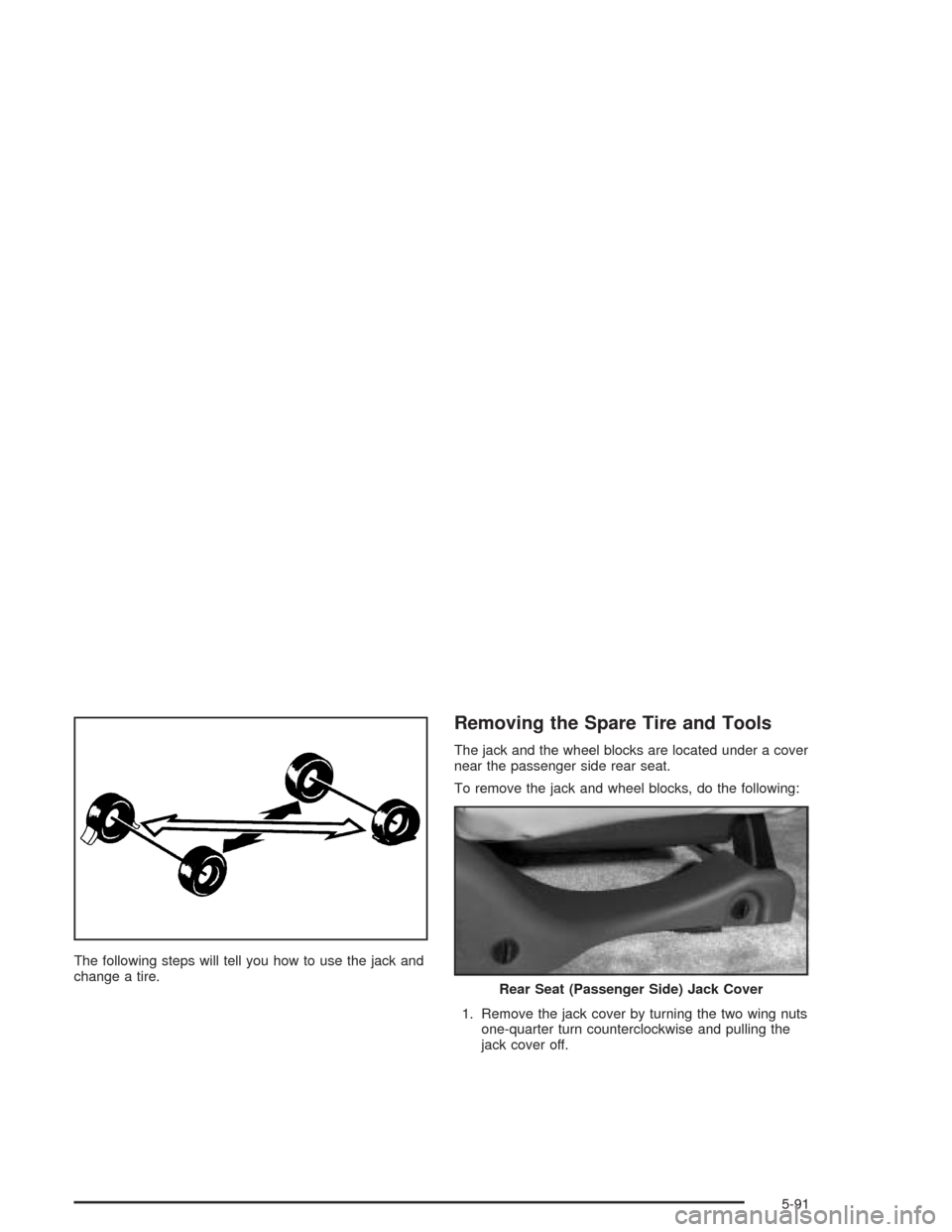
The following steps will tell you how to use the jack and
change a tire.
Removing the Spare Tire and Tools
The jack and the wheel blocks are located under a cover
near the passenger side rear seat.
To remove the jack and wheel blocks, do the following:
1. Remove the jack cover by turning the two wing nuts
one-quarter turn counterclockwise and pulling the
jack cover off.
Rear Seat (Passenger Side) Jack Cover
5-91
Page 459 of 548
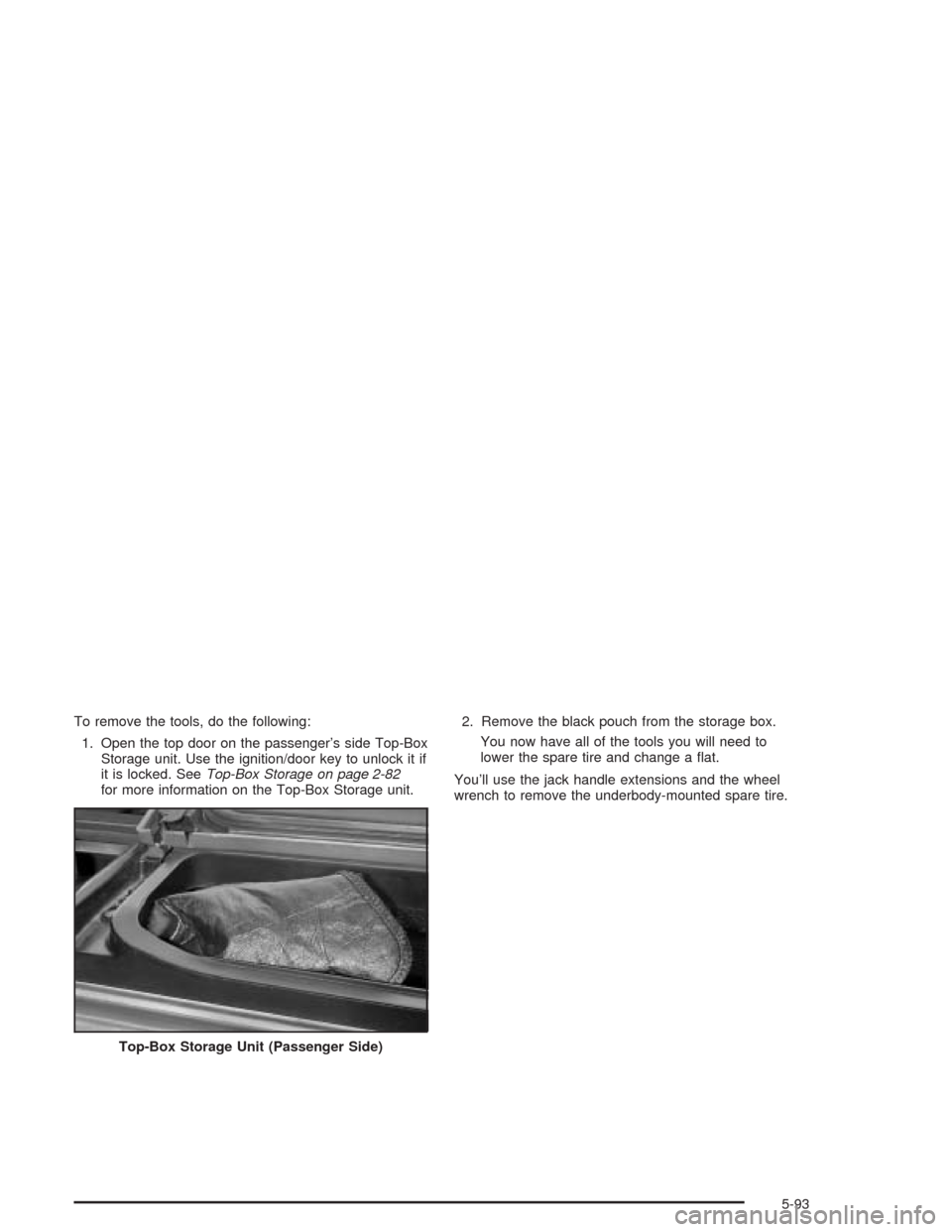
To remove the tools, do the following:
1. Open the top door on the passenger’s side Top-Box
Storage unit. Use the ignition/door key to unlock it if
it is locked. SeeTop-Box Storage on page 2-82
for more information on the Top-Box Storage unit.2. Remove the black pouch from the storage box.
You now have all of the tools you will need to
lower the spare tire and change a at.
You’ll use the jack handle extensions and the wheel
wrench to remove the underbody-mounted spare tire.
Top-Box Storage Unit (Passenger Side)
5-93
Page 465 of 548
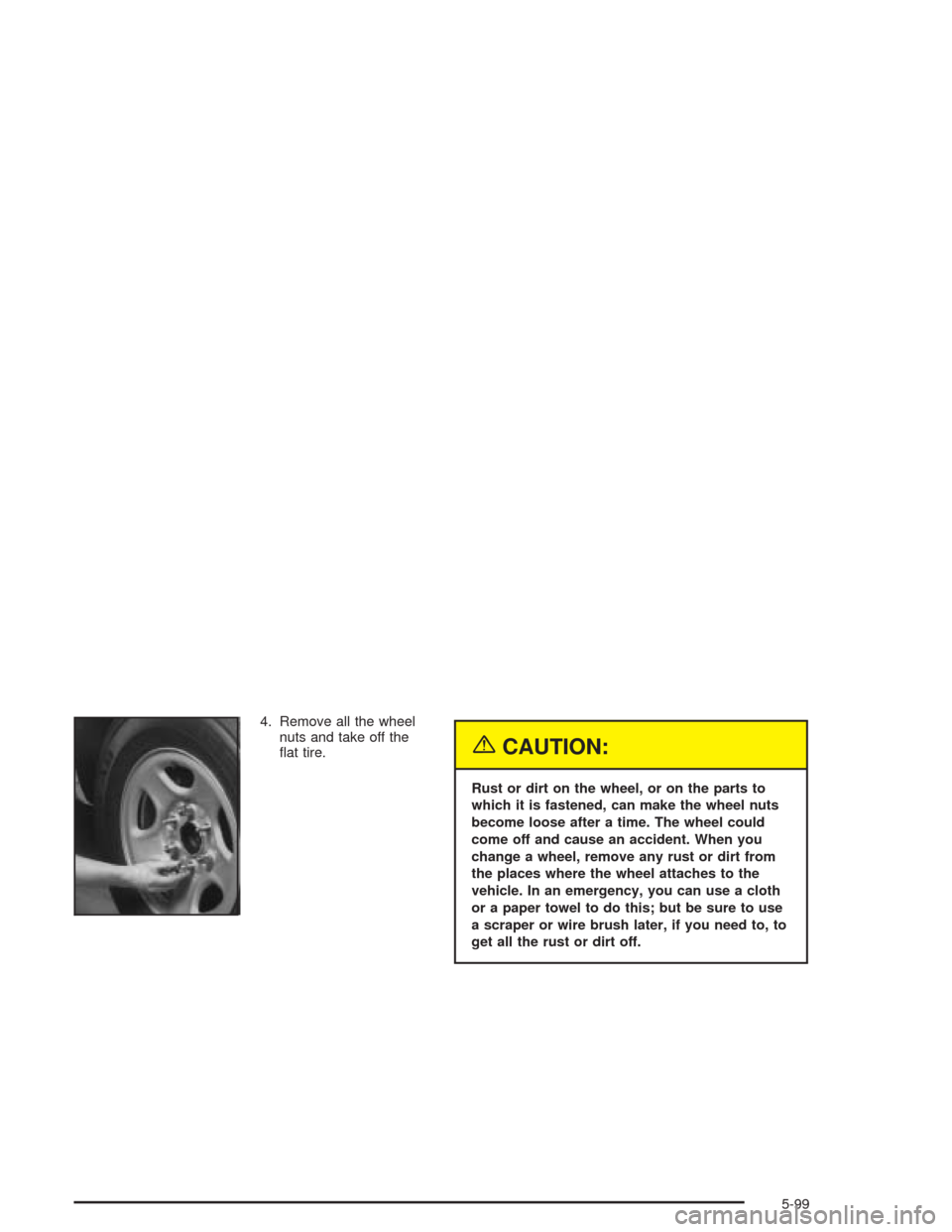
4. Remove all the wheel
nuts and take off the
at tire.
{CAUTION:
Rust or dirt on the wheel, or on the parts to
which it is fastened, can make the wheel nuts
become loose after a time. The wheel could
come off and cause an accident. When you
change a wheel, remove any rust or dirt from
the places where the wheel attaches to the
vehicle. In an emergency, you can use a cloth
or a paper towel to do this; but be sure to use
a scraper or wire brush later, if you need to, to
get all the rust or dirt off.
5-99
Page 547 of 548
Transmission
Fluid, Automatic...........................................5-23
Temperature Gage.......................................3-45
TRANSMISSION HOT.....................................3-68
Transmission Operation, Automatic....................2-34
Transmission, Transaxle, Transfer Case Unit
Repair Manual............................................7-13
Transportation Options...................................... 7-9
Traveling to Remote Areas...............................4-22
Trip Information Button....................................3-54
Truck-Camper Loading Information....................4-67
Turn and Lane Change Signals.......................... 3-8
TURN SIGNAL ON.........................................3-67
Turn Signal/Multifunction Lever........................... 3-8
Turn Signals When Towing a Trailer..................4-77
U
Underhood Fuse Block...................................5-123
Understanding Radio Reception.......................3-115
Uniform Tire Quality Grading............................5-85
United States – Customer Assistance.................. 7-5
Used Replacement Wheels..............................5-87
Using Cleaner on Fabric................................5-112
Using HomeLink
®...........................................2-64
Using Song List Mode.....................................3-97
Using the Recovery Hooks...............................4-50
V
Vehicle
Control........................................................ 4-6
Damage Warnings........................................... iv
Loading......................................................4-55
Symbols......................................................... iv
Vehicle Data Collection and Event Data
Recorders..................................................7-10
Vehicle Identication
Number (VIN)............................................5-119
Service Parts Identication Label..................5-119
Vehicle Personalization
Memory Seat..............................................2-90
Vehicle Storage..............................................5-47
Vehicles with Body-Side Cladding..............5-58, 5-62
Vehicles with Gray Body-Side Cladding..............5-65
Vehicles without Body-Side Cladding.........5-60, 5-63
Ventilation Adjustment......................................3-32
Video Screen................................................3-103
Visors...........................................................2-26
Voltmeter Gage..............................................3-41
17