ECO mode CHEVROLET AVALANCHE 2005 1.G Owner's Guide
[x] Cancel search | Manufacturer: CHEVROLET, Model Year: 2005, Model line: AVALANCHE, Model: CHEVROLET AVALANCHE 2005 1.GPages: 496, PDF Size: 3.25 MB
Page 327 of 496
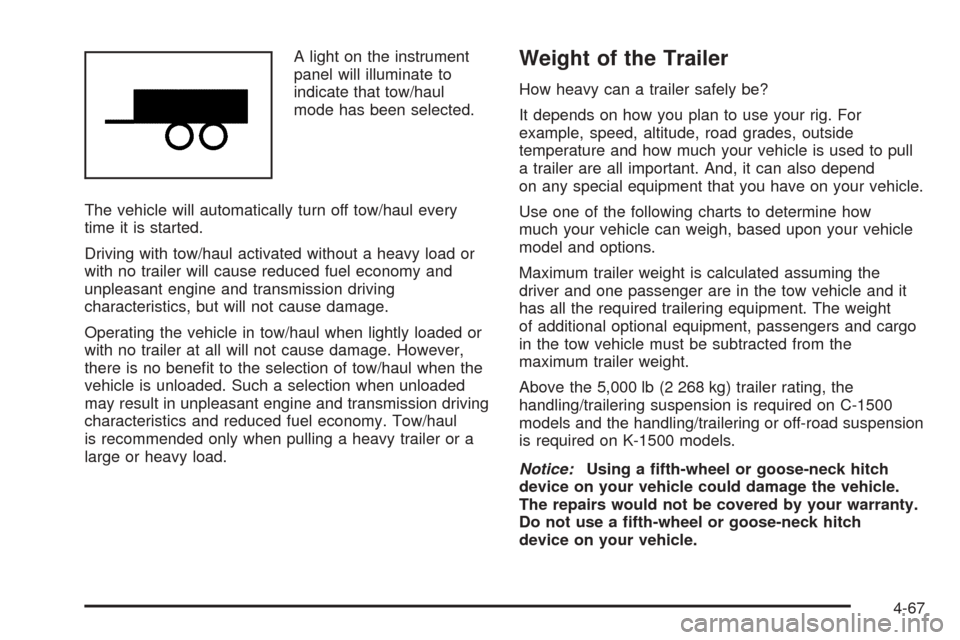
A light on the instrument
panel will illuminate to
indicate that tow/haul
mode has been selected.
The vehicle will automatically turn off tow/haul every
time it is started.
Driving with tow/haul activated without a heavy load or
with no trailer will cause reduced fuel economy and
unpleasant engine and transmission driving
characteristics, but will not cause damage.
Operating the vehicle in tow/haul when lightly loaded or
with no trailer at all will not cause damage. However,
there is no benet to the selection of tow/haul when the
vehicle is unloaded. Such a selection when unloaded
may result in unpleasant engine and transmission driving
characteristics and reduced fuel economy. Tow/haul
is recommended only when pulling a heavy trailer or a
large or heavy load.Weight of the Trailer
How heavy can a trailer safely be?
It depends on how you plan to use your rig. For
example, speed, altitude, road grades, outside
temperature and how much your vehicle is used to pull
a trailer are all important. And, it can also depend
on any special equipment that you have on your vehicle.
Use one of the following charts to determine how
much your vehicle can weigh, based upon your vehicle
model and options.
Maximum trailer weight is calculated assuming the
driver and one passenger are in the tow vehicle and it
has all the required trailering equipment. The weight
of additional optional equipment, passengers and cargo
in the tow vehicle must be subtracted from the
maximum trailer weight.
Above the 5,000 lb (2 268 kg) trailer rating, the
handling/trailering suspension is required on C-1500
models and the handling/trailering or off-road suspension
is required on K-1500 models.
Notice:Using a fth-wheel or goose-neck hitch
device on your vehicle could damage the vehicle.
The repairs would not be covered by your warranty.
Do not use a fth-wheel or goose-neck hitch
device on your vehicle.
4-67
Page 476 of 496
We will provide the following services during the
Bumper-to-Bumper warranty period, at no expense
to you:
Fuel Delivery:Delivery of enough fuel
($5 maximum) for the customer to get to the
nearest service station.
Lock-out Service (identication required):
Replacement keys or locksmith service will be
covered at no charge if you are unable to gain entry
into your vehicle. Delivery of the replacement key will
be covered within 10 miles (16 km).
Emergency Tow:Tow to the nearest dealership for
warranty service or in the event of a vehicle-disabling
accident. Assistance provided when the vehicle is
mired in sand, mud, or snow.
Flat Tire Change:Installation of a spare tire will be
covered at no charge. The customer is responsible
for the repair or replacement of the tire if not covered
by a warrantable failure.
Jump Start:No-start occurrences which require a
battery jump start will be covered at no charge.
Dealer Locator ServiceIn many instances, mechanical failures are covered
under Chevrolet’s Bumper-to-Bumper warranty.
However, when other services are utilized, our Roadside
Assistance Representatives will explain any payment
obligations you might incur.
For prompt and efficient assistance when calling, please
provide the following to the Roadside Assistance
Representative:
Your name, home address, and home telephone
number.
Telephone number of your location.
Location of the vehicle.
Model, year, color, and license plate number.
Mileage, Vehicle Identication Number (VIN), and
delivery date of the vehicle.
Description of the problem.
While we hope you never have the occasion to use our
service, it is added security while traveling for you
and your family. Remember, we are only a phone
call away. Chevrolet Roadside Assistance:
1-800-CHEV-USA (1-800-243-8872), text
telephone (TTY) users, call 1-888-889-2438.
Chevrolet reserves the right to limit services or
reimbursement to an owner or driver when, in Chevrolet’s
judgement, the claims become excessive in frequency or
type of occurrence.
7-6
Page 479 of 496
Courtesy Transportation is available only at participating
dealers and all program options, such as shuttle
service, may not be available at every dealer. Please
contact your dealer for specic information about
availability. All Courtesy Transportation arrangements
will be administered by appropriate dealer personnel.
Canadian Vehicles:For warranty repairs during
the Complete Vehicle Coverage period of the General
Motors of Canada New Vehicle Limited Warranty,
alternative transportation may be available under the
Courtesy Transportation Program. Please consult
your dealer for details.
General Motors reserves the right to unilaterally modify,
change or discontinue Courtesy Transportation at
any time and to resolve all questions of claim eligibility
pursuant to the terms and conditions described
herein at its sole discretion.Vehicle Data Collection and Event
Data Recorders
Your vehicle, like other modern motor vehicles, has a
number of sophisticated computer systems that monitor
and control several aspects of the vehicle’s performance.
Your vehicle uses on-board vehicle computers to monitor
emission control components to optimize fuel economy,
to monitor conditions for airbag deployment and, if so
equipped, to provide anti-lock braking and to help the
driver control the vehicle in difficult driving situations.
Some information may be stored during regular
operations to facilitate repair of detected malfunctions;
other information is stored only in a crash event by
computer systems, such as those commonly called event
data recorders (EDR).
In a crash event, computer systems, such as the Airbag
Sensing and Diagnostic Module (SDM) in your vehicle
may record information about the condition of the vehicle
and how it was operated, such as data related to engine
speed, brake application, throttle position, vehicle speed,
safety belt usage, airbag readiness, airbag performance,
and the severity of a collision. If your vehicle is equipped
with StabiliTrak
®, steering performance, including yaw
rate, steering wheel angle, and lateral acceleration, is
also recorded. This information has been used to improve
vehicle crash performance and may be used to improve
crash performance of future vehicles and driving safety.
7-9
Page 487 of 496
E
Electrical System...........................................5-103
Center Instrument Panel Fuse Block.............5-106
Fuses and Circuit Breakers.........................5-104
Instrument Panel Fuse Block.......................5-104
Power Windows and Other Power Options....5-104
Underhood Fuse Block...............................5-107
Windshield Wiper Fuses.............................5-104
Engine
Air Cleaner/Filter.........................................5-20
Battery.......................................................5-41
Check and Service Engine Soon Light............3-40
Coolant......................................................5-25
Coolant Heater............................................2-30
Coolant Temperature Gage...........................3-38
Engine Compartment Overview......................5-12
Exhaust.....................................................2-42
Fan Noise..................................................5-35
Oil .............................................................5-15
Oil Life System...........................................5-18
Overheated Protection Operating Mode...........5-30
Overheating................................................5-28
Starting......................................................2-28
Entry/Exit Lighting...........................................3-18
Event Data Recorders (EDR)............................. 7-9
Extender, Safety Belt.......................................1-28
Exterior Cargo Lamps......................................3-17
Exterior Lamps...............................................3-14
F
Filter
Engine Air Cleaner......................................5-20
Finish Damage.............................................5-101
Fixed Mast Antenna.......................................3-104
Flash-to-Pass................................................... 3-9
Flat Tire........................................................5-74
Flat Tire, Changing.........................................5-75
Flat Tire, Storing.............................................5-91
Fluid
Automatic Transmission................................5-22
Power Steering...........................................5-36
Windshield Washer......................................5-36
Fog Lamps....................................................3-16
Four-Wheel Drive....................................2-34, 5-48
Front Armrest Storage Area..............................2-57
Front Axle......................................................5-49
Fuel............................................................... 5-5
Additives...................................................... 5-6
California Fuel.............................................. 5-5
E-85 (85% Ethanol)....................................... 5-6
Filling a Portable Fuel Container..................... 5-9
Filling Your Tank........................................... 5-8
Fuels in Foreign Countries.............................. 5-7
Gage.........................................................3-44
Gasoline Octane........................................... 5-5
Gasoline Specications.................................. 5-5
Low Warning Light.......................................3-45
5
Page 490 of 496
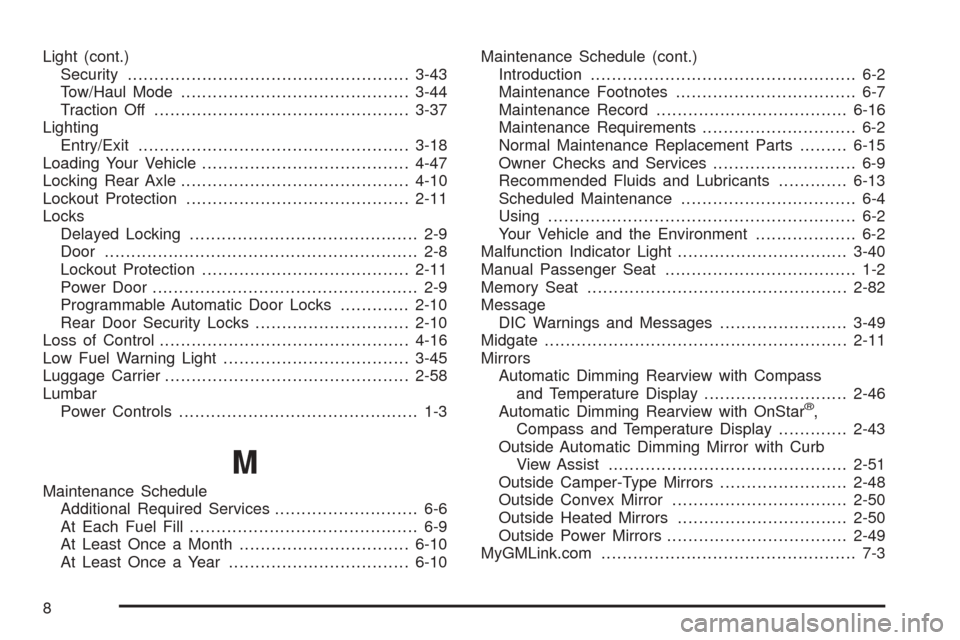
Light (cont.)
Security.....................................................3-43
Tow/Haul Mode...........................................3-44
Traction Off................................................3-37
Lighting
Entry/Exit...................................................3-18
Loading Your Vehicle.......................................4-47
Locking Rear Axle...........................................4-10
Lockout Protection..........................................2-11
Locks
Delayed Locking........................................... 2-9
Door........................................................... 2-8
Lockout Protection.......................................2-11
Power Door.................................................. 2-9
Programmable Automatic Door Locks.............2-10
Rear Door Security Locks.............................2-10
Loss of Control...............................................4-16
Low Fuel Warning Light...................................3-45
Luggage Carrier..............................................2-58
Lumbar
Power Controls............................................. 1-3
M
Maintenance Schedule
Additional Required Services........................... 6-6
At Each Fuel Fill........................................... 6-9
At Least Once a Month................................6-10
At Least Once a Year..................................6-10Maintenance Schedule (cont.)
Introduction.................................................. 6-2
Maintenance Footnotes.................................. 6-7
Maintenance Record....................................6-16
Maintenance Requirements............................. 6-2
Normal Maintenance Replacement Parts.........6-15
Owner Checks and Services........................... 6-9
Recommended Fluids and Lubricants.............6-13
Scheduled Maintenance................................. 6-4
Using.......................................................... 6-2
Your Vehicle and the Environment................... 6-2
Malfunction Indicator Light................................3-40
Manual Passenger Seat.................................... 1-2
Memory Seat.................................................2-82
Message
DIC Warnings and Messages........................3-49
Midgate.........................................................2-11
Mirrors
Automatic Dimming Rearview with Compass
and Temperature Display...........................2-46
Automatic Dimming Rearview with OnStar
®,
Compass and Temperature Display.............2-43
Outside Automatic Dimming Mirror with Curb
View Assist.............................................2-51
Outside Camper-Type Mirrors........................2-48
Outside Convex Mirror.................................2-50
Outside Heated Mirrors................................2-50
Outside Power Mirrors..................................2-49
MyGMLink.com................................................ 7-3
8
Page 491 of 496
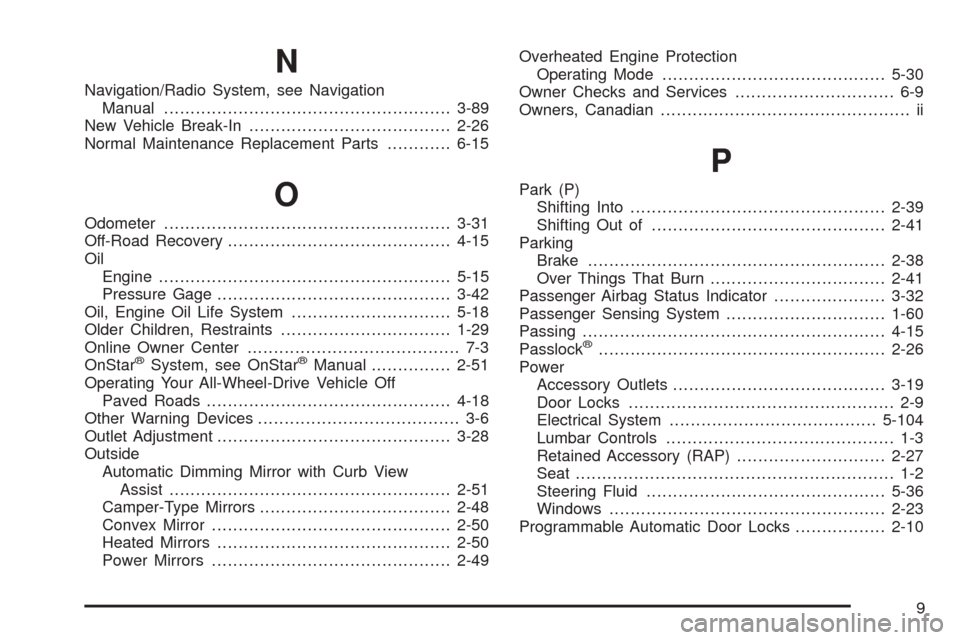
N
Navigation/Radio System, see Navigation
Manual......................................................3-89
New Vehicle Break-In......................................2-26
Normal Maintenance Replacement Parts............6-15
O
Odometer......................................................3-31
Off-Road Recovery..........................................4-15
Oil
Engine.......................................................5-15
Pressure Gage............................................3-42
Oil, Engine Oil Life System..............................5-18
Older Children, Restraints................................1-29
Online Owner Center........................................ 7-3
OnStar
®System, see OnStar®Manual...............2-51
Operating Your All-Wheel-Drive Vehicle Off
Paved Roads..............................................4-18
Other Warning Devices...................................... 3-6
Outlet Adjustment............................................3-28
Outside
Automatic Dimming Mirror with Curb View
Assist.....................................................2-51
Camper-Type Mirrors....................................2-48
Convex Mirror.............................................2-50
Heated Mirrors............................................2-50
Power Mirrors.............................................2-49Overheated Engine Protection
Operating Mode..........................................5-30
Owner Checks and Services.............................. 6-9
Owners, Canadian............................................... ii
P
Park (P)
Shifting Into................................................2-39
Shifting Out of............................................2-41
Parking
Brake........................................................2-38
Over Things That Burn.................................2-41
Passenger Airbag Status Indicator.....................3-32
Passenger Sensing System..............................1-60
Passing.........................................................4-15
Passlock
®......................................................2-26
Power
Accessory Outlets........................................3-19
Door Locks.................................................. 2-9
Electrical System.......................................5-104
Lumbar Controls........................................... 1-3
Retained Accessory (RAP)............................2-27
Seat............................................................ 1-2
Steering Fluid.............................................5-36
Windows....................................................2-23
Programmable Automatic Door Locks.................2-10
9
Page 495 of 496
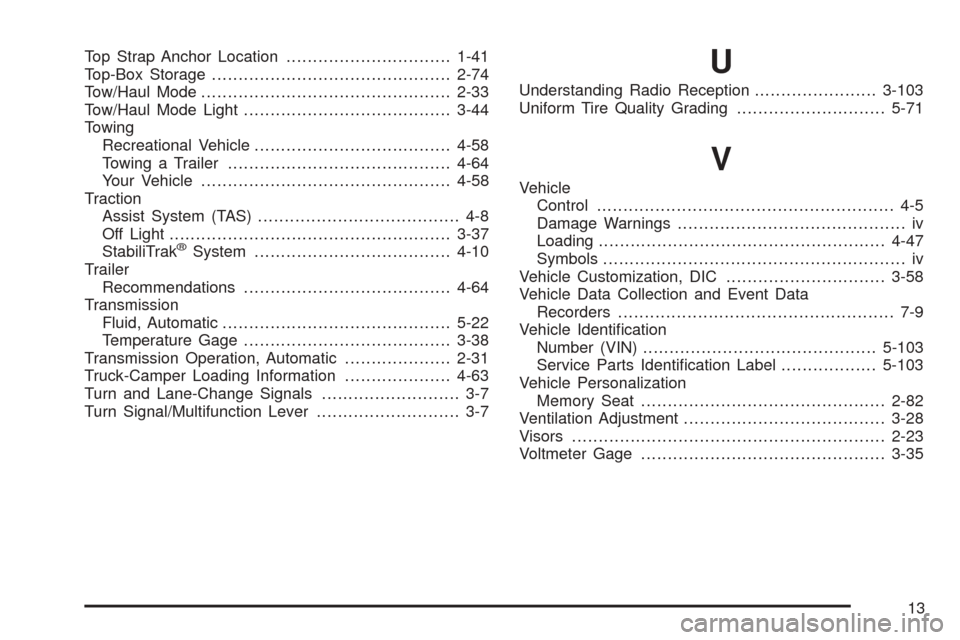
Top Strap Anchor Location...............................1-41
Top-Box Storage.............................................2-74
Tow/Haul Mode...............................................2-33
Tow/Haul Mode Light.......................................3-44
Towing
Recreational Vehicle.....................................4-58
Towing a Trailer..........................................4-64
Your Vehicle...............................................4-58
Traction
Assist System (TAS)...................................... 4-8
Off Light.....................................................3-37
StabiliTrak
®System.....................................4-10
Trailer
Recommendations.......................................4-64
Transmission
Fluid, Automatic...........................................5-22
Temperature Gage.......................................3-38
Transmission Operation, Automatic....................2-31
Truck-Camper Loading Information....................4-63
Turn and Lane-Change Signals.......................... 3-7
Turn Signal/Multifunction Lever........................... 3-7
U
Understanding Radio Reception.......................3-103
Uniform Tire Quality Grading............................5-71
V
Vehicle
Control........................................................ 4-5
Damage Warnings........................................... iv
Loading......................................................4-47
Symbols......................................................... iv
Vehicle Customization, DIC..............................3-58
Vehicle Data Collection and Event Data
Recorders.................................................... 7-9
Vehicle Identication
Number (VIN)............................................5-103
Service Parts Identication Label..................5-103
Vehicle Personalization
Memory Seat..............................................2-82
Ventilation Adjustment......................................3-28
Visors...........................................................2-23
Voltmeter Gage..............................................3-35
13