towing CHEVROLET AVALANCHE 2005 1.G Owner's Guide
[x] Cancel search | Manufacturer: CHEVROLET, Model Year: 2005, Model line: AVALANCHE, Model: CHEVROLET AVALANCHE 2005 1.GPages: 496, PDF Size: 3.25 MB
Page 373 of 496
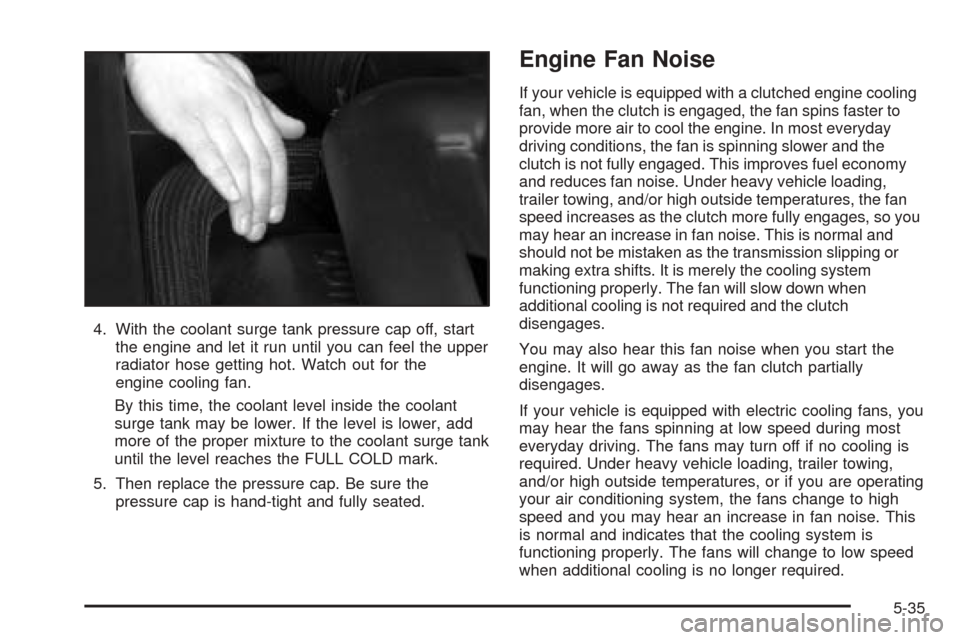
4. With the coolant surge tank pressure cap off, start
the engine and let it run until you can feel the upper
radiator hose getting hot. Watch out for the
engine cooling fan.
By this time, the coolant level inside the coolant
surge tank may be lower. If the level is lower, add
more of the proper mixture to the coolant surge tank
until the level reaches the FULL COLD mark.
5. Then replace the pressure cap. Be sure the
pressure cap is hand-tight and fully seated.
Engine Fan Noise
If your vehicle is equipped with a clutched engine cooling
fan, when the clutch is engaged, the fan spins faster to
provide more air to cool the engine. In most everyday
driving conditions, the fan is spinning slower and the
clutch is not fully engaged. This improves fuel economy
and reduces fan noise. Under heavy vehicle loading,
trailer towing, and/or high outside temperatures, the fan
speed increases as the clutch more fully engages, so you
may hear an increase in fan noise. This is normal and
should not be mistaken as the transmission slipping or
making extra shifts. It is merely the cooling system
functioning properly. The fan will slow down when
additional cooling is not required and the clutch
disengages.
You may also hear this fan noise when you start the
engine. It will go away as the fan clutch partially
disengages.
If your vehicle is equipped with electric cooling fans, you
may hear the fans spinning at low speed during most
everyday driving. The fans may turn off if no cooling is
required. Under heavy vehicle loading, trailer towing,
and/or high outside temperatures, or if you are operating
your air conditioning system, the fans change to high
speed and you may hear an increase in fan noise. This
is normal and indicates that the cooling system is
functioning properly. The fans will change to low speed
when additional cooling is no longer required.
5-35
Page 460 of 496
(b)Visually inspect front and rear suspension and
steering system for damaged, loose, or missing parts,
signs of wear or lack of lubrication. Inspect power
steering lines and hoses for proper hook-up, binding,
leaks, cracks, chang, etc. Visually check constant
velocity joints, rubber boots, and axle seals for leaks.
(c)Visually inspect hoses and have them replaced
if they are cracked, swollen, or deteriorated. Inspect all
pipes, ttings, and clamps; replace with genuine GM
parts as needed. To help ensure proper operation,
a pressure test of the cooling system and pressure cap
and cleaning the outside of the radiator and air
conditioning condenser is recommended at least once a
year.
(d)Visually inspect wiper blades for wear or cracking.
Replace wiper blades that appear worn or damaged
or that streak or miss areas of the windshield.
(e)Make sure the safety belt reminder light and all your
belts, buckles, latch plates, retractors, and anchorages
are working properly. Look for any other loose or
damaged safety belt system parts. If you see anything
that might keep a safety belt system from doing its
job, have it repaired. Have any torn or frayed safety belts
replaced. Also look for any opened or broken airbag
coverings, and have them repaired or replaced.
The airbag system does not need regular maintenance.(f)Lubricate all key lock cylinders, hood latch assembly,
secondary latch, pivots, spring anchor, release pawl,
midgate hinges, side storage box door hinges, tailgate
hinges, tailgate linkage, outer tailgate handle pivot
points, latch bolt, fuel door hinge, locks, and folding seat
hardware. More frequent lubrication may be required
when exposed to a corrosive environment. Applying
silicone grease on weatherstrips with a clean cloth will
make them last longer, seal better, and not stick or
squeak.
(g)Check vent hose at transfer case for kinks and
proper installation.
(h)Change automatic transmission uid and lter if the
vehicle is mainly driven under one or more of these
conditions:
In heavy city traffic where the outside temperature
regularly reaches 90°F (32°C) or higher.
In hilly or mountainous terrain.
When doing frequent trailer towing.
Uses such as found in taxi, police, or delivery
service.
(i)Drain, ush, and rell cooling system. This service
can be complex; you should have your dealer perform
this service. See Engine Coolant on page 5-25 for
what to use. Inspect hoses. Clean radiator, condenser,
pressure cap, and ller neck. Pressure test the
cooling system and pressure cap.
6-8
Page 492 of 496
Q
Questions and Answers About Safety Belts.........1-13
R
Radios..........................................................3-64
Care of Your CD and DVD Player................3-104
Care of Your CDs and DVDs.......................3-104
Navigation/Radio System, see Navigation
Manual...................................................3-89
Radio with CD............................................3-65
Radio with Six-Disc CD................................3-76
Rear Seat Audio........................................3-101
Setting the Time..........................................3-65
Theft-Deterrent..........................................3-102
Understanding Reception............................3-103
Reading Lamps..............................................3-18
Rear Axle......................................................5-47
Locking......................................................4-10
Rear Door Security Locks................................2-10
Rear Safety Belt Comfort Guides......................1-26
Rear Seat Audio (RSA)..................................3-101
Rear Seat Entertainment System.......................3-90
Rear Seat Operation......................................... 1-7
Rear Seat Passengers, Safety Belts..................1-23
Rear Storage Area..........................................2-59Rearview Mirror, Automatic Dimming with
Compass and Temperature Display................2-46
Rearview Mirror, Automatic Dimming with
OnStar
®, Compass and Temperature Display . . . 2-43
Reclining Seatbacks.......................................... 1-5
Recommended Fluids and Lubricants.................6-13
Recovery Hooks.............................................4-46
Recreational Vehicle Towing.............................4-58
Remote Keyless Entry System............................ 2-4
Remote Keyless Entry System, Operation............ 2-5
Removing the Flat Tire and Installing
the Spare Tire.............................................5-80
Removing the Spare Tire and Tools...................5-76
Replacement Bulbs.........................................5-58
Reporting Safety Defects
Canadian Government..................................7-11
General Motors...........................................7-11
United States Government............................7-10
Restraint System Check
Checking the Restraint Systems....................1-65
Replacing Restraint System Parts
After a Crash..........................................1-66
Retained Accessory Power (RAP)......................2-27
Right Front Passenger Position, Safety Belts......1-22
Roadside
Assistance Program....................................... 7-5
Rocking Your Vehicle to Get it Out....................4-46
Running the Engine While Parked.....................2-42
10
Page 495 of 496
Top Strap Anchor Location...............................1-41
Top-Box Storage.............................................2-74
Tow/Haul Mode...............................................2-33
Tow/Haul Mode Light.......................................3-44
Towing
Recreational Vehicle.....................................4-58
Towing a Trailer..........................................4-64
Your Vehicle...............................................4-58
Traction
Assist System (TAS)...................................... 4-8
Off Light.....................................................3-37
StabiliTrak
®System.....................................4-10
Trailer
Recommendations.......................................4-64
Transmission
Fluid, Automatic...........................................5-22
Temperature Gage.......................................3-38
Transmission Operation, Automatic....................2-31
Truck-Camper Loading Information....................4-63
Turn and Lane-Change Signals.......................... 3-7
Turn Signal/Multifunction Lever........................... 3-7
U
Understanding Radio Reception.......................3-103
Uniform Tire Quality Grading............................5-71
V
Vehicle
Control........................................................ 4-5
Damage Warnings........................................... iv
Loading......................................................4-47
Symbols......................................................... iv
Vehicle Customization, DIC..............................3-58
Vehicle Data Collection and Event Data
Recorders.................................................... 7-9
Vehicle Identication
Number (VIN)............................................5-103
Service Parts Identication Label..................5-103
Vehicle Personalization
Memory Seat..............................................2-82
Ventilation Adjustment......................................3-28
Visors...........................................................2-23
Voltmeter Gage..............................................3-35
13