overheating CHEVROLET AVALANCHE 2006 1.G User Guide
[x] Cancel search | Manufacturer: CHEVROLET, Model Year: 2006, Model line: AVALANCHE, Model: CHEVROLET AVALANCHE 2006 1.GPages: 532, PDF Size: 3.3 MB
Page 390 of 532
Coolant Surge Tank Pressure Cap
Notice:If the pressure cap is not tightly installed,
coolant loss and possible engine damage may
occur. Be sure the cap is properly and tightly
secured.
The coolant surge tank pressure cap must be fully
installed on the coolant surge tank. SeeEngine
Compartment Overview on page 5-14for more
information on location.
Engine Overheating
You will nd a coolant temperature gage on your
vehicle’s instrument panel. SeeEngine Coolant
Temperature Gage on page 3-41.
In addition, you will nd an ENGINE COOLANT HOT,
ENGINE OVERHEATED and a REDUCED ENGINE
POWER message in the Driver Information Center (DIC)
on the instrument panel. SeeDIC Warnings and
Messages on page 3-53.
If Steam Is Coming From Your Engine
{CAUTION:
Steam from an overheated engine can burn
you badly, even if you just open the hood. Stay
away from the engine if you see or hear steam
coming from it. Just turn it off and get
everyone away from the vehicle until it cools
down. Wait until there is no sign of steam or
coolant before you open the hood.
If you keep driving when your engine is
overheated, the liquids in it can catch re. You
or others could be badly burned. Stop your
engine if it overheats, and get out of the
vehicle until the engine is cool.
SeeOverheated Engine Protection Operating
Mode on page 5-32for information on driving
to a safe place in an emergency.
5-30
Page 393 of 532
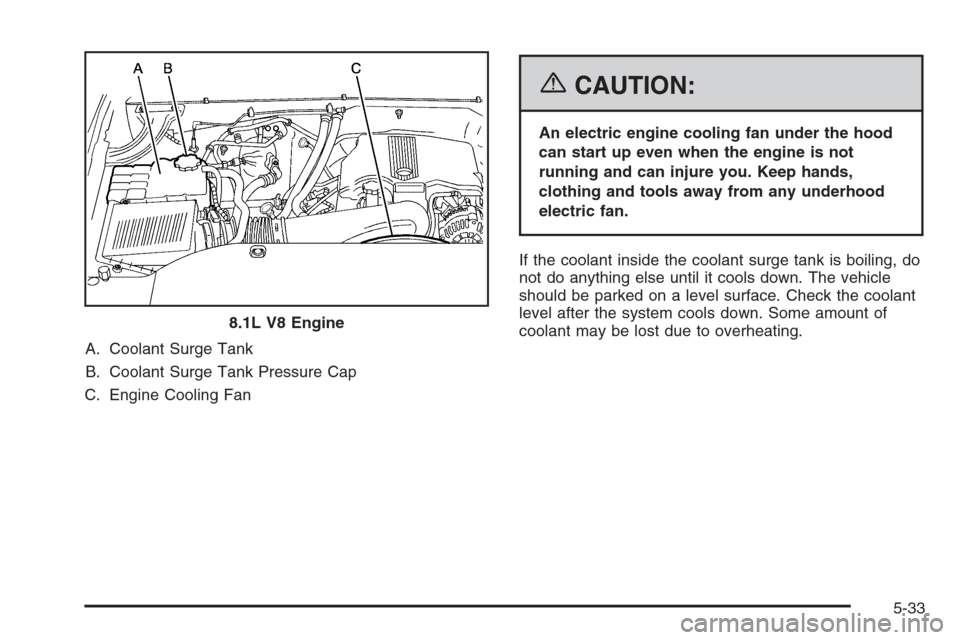
A. Coolant Surge Tank
B. Coolant Surge Tank Pressure Cap
C. Engine Cooling Fan
{CAUTION:
An electric engine cooling fan under the hood
can start up even when the engine is not
running and can injure you. Keep hands,
clothing and tools away from any underhood
electric fan.
If the coolant inside the coolant surge tank is boiling, do
not do anything else until it cools down. The vehicle
should be parked on a level surface. Check the coolant
level after the system cools down. Some amount of
coolant may be lost due to overheating. 8.1L V8 Engine
5-33
Page 424 of 532
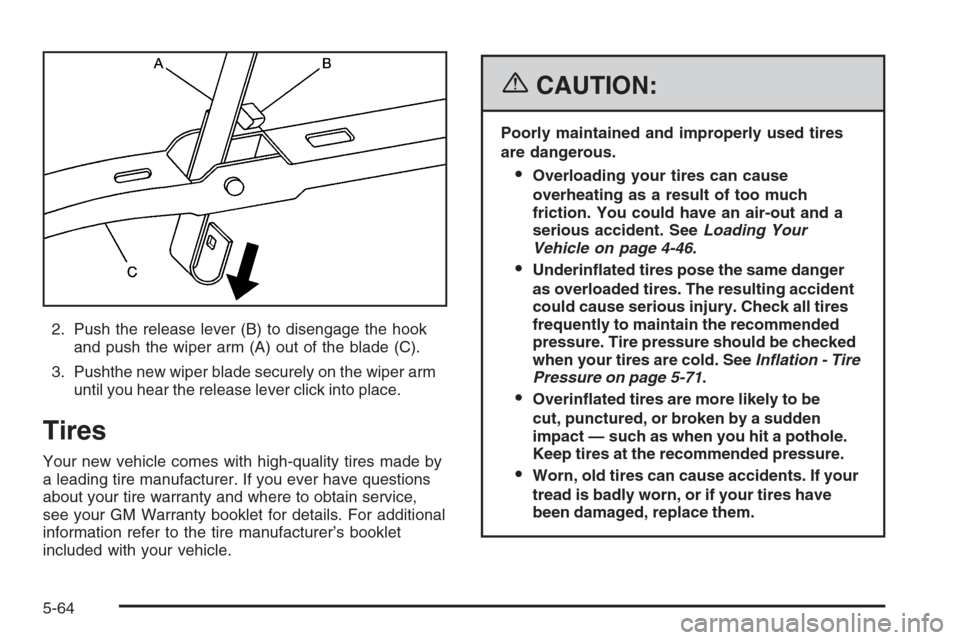
2. Push the release lever (B) to disengage the hook
and push the wiper arm (A) out of the blade (C).
3. Pushthe new wiper blade securely on the wiper arm
until you hear the release lever click into place.
Tires
Your new vehicle comes with high-quality tires made by
a leading tire manufacturer. If you ever have questions
about your tire warranty and where to obtain service,
see your GM Warranty booklet for details. For additional
information refer to the tire manufacturer’s booklet
included with your vehicle.
{CAUTION:
Poorly maintained and improperly used tires
are dangerous.
Overloading your tires can cause
overheating as a result of too much
friction. You could have an air-out and a
serious accident. SeeLoading Your
Vehicle on page 4-46.
Underinated tires pose the same danger
as overloaded tires. The resulting accident
could cause serious injury. Check all tires
frequently to maintain the recommended
pressure. Tire pressure should be checked
when your tires are cold. SeeInflation - Tire
Pressure on page 5-71.
Overinated tires are more likely to be
cut, punctured, or broken by a sudden
impact — such as when you hit a pothole.
Keep tires at the recommended pressure.
Worn, old tires can cause accidents. If your
tread is badly worn, or if your tires have
been damaged, replace them.
5-64
Page 523 of 532
E
Electrical System...........................................5-113
Center Instrument Panel Fuse Block.............5-116
Fuses and Circuit Breakers.........................5-113
Instrument Panel Fuse Block.......................5-114
Power Windows and Other Power Options....5-113
Underhood Fuse Block...............................5-117
Windshield Wiper Fuses.............................5-113
Engine
Air Cleaner/Filter.........................................5-23
Battery.......................................................5-44
Check and Service Engine Soon Light............3-43
Coolant......................................................5-28
Coolant Heater............................................2-31
Coolant Temperature Gage...........................3-41
Drive Belt Routing.......................................6-15
Engine Compartment Overview......................5-14
Exhaust.....................................................2-44
Fan Noise..................................................5-38
Oil .............................................................5-18
Oil Life System...........................................5-21
Overheated Protection Operating Mode...........5-32
Overheating................................................5-30
Starting......................................................2-29
Entry/Exit Lighting...........................................3-20
Event Data Recorders (EDR)............................. 7-9
Extender, Safety Belt.......................................1-28Exterior Cargo Lamps......................................3-19
Exterior Lamps...............................................3-14
F
Filter
Engine Air Cleaner......................................5-23
Finish Damage.............................................5-110
Fixed Mast Antenna.......................................3-114
Flashers, Hazard Warning.................................. 3-6
Flash-to-Pass................................................... 3-9
Flat Tire........................................................5-84
Flat Tire, Changing.........................................5-84
Flat Tire, Storing...........................................5-100
Fluid
Automatic Transmission................................5-25
Power Steering...........................................5-39
Windshield Washer......................................5-40
Fog Lamps ....................................................3-17
Four-Wheel Drive....................................2-35, 5-52
Front Armrest Storage Area..............................2-64
Front Axle......................................................5-53
Fuel............................................................... 5-5
Additives...................................................... 5-6
California Fuel.............................................. 5-6
E85 (85% Ethanol)........................................ 5-7
Filling a Portable Fuel Container....................5-11
Filling Your Tank........................................... 5-9
Fuels in Foreign Countries.............................. 5-8
5