automatic transmission CHEVROLET AVALANCHE 2007 2.G User Guide
[x] Cancel search | Manufacturer: CHEVROLET, Model Year: 2007, Model line: AVALANCHE, Model: CHEVROLET AVALANCHE 2007 2.GPages: 618, PDF Size: 3.25 MB
Page 416 of 618
Tow/haul is designed to be most effective when
the vehicle and trailer combined weight is at least
75 percent of the vehicle’s Gross Combination
Weight Rating (GCWR). See “Weight of the
Trailer” later in this section.
Press the button at the end of the shift lever to
enable/disable the tow/haul mode.
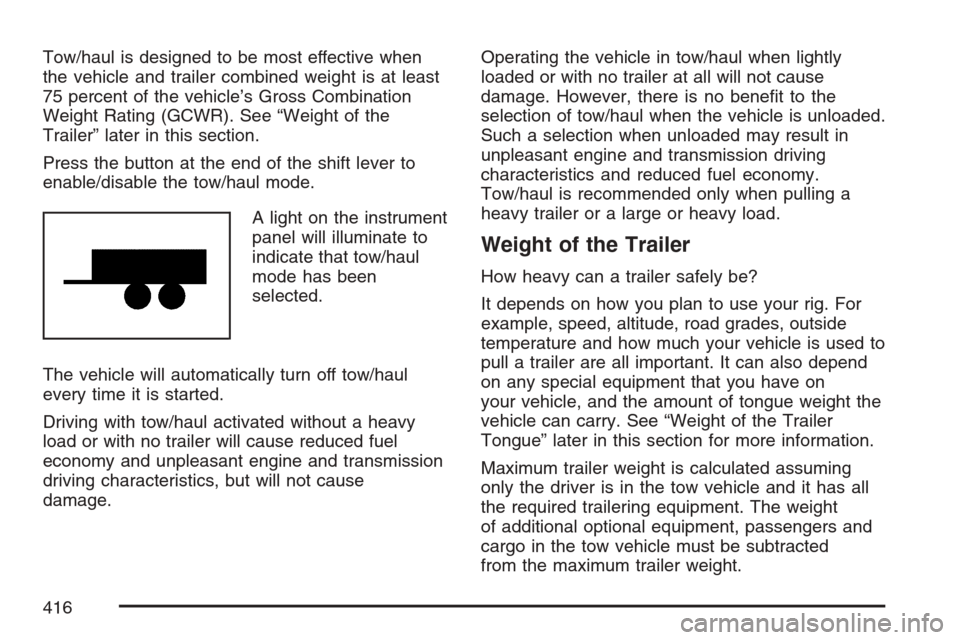
A light on the instrument
panel will illuminate to
indicate that tow/haul
mode has been
selected.
The vehicle will automatically turn off tow/haul
every time it is started.
Driving with tow/haul activated without a heavy
load or with no trailer will cause reduced fuel
economy and unpleasant engine and transmission
driving characteristics, but will not cause
damage.Operating the vehicle in tow/haul when lightly
loaded or with no trailer at all will not cause
damage. However, there is no benet to the
selection of tow/haul when the vehicle is unloaded.
Such a selection when unloaded may result in
unpleasant engine and transmission driving
characteristics and reduced fuel economy.
Tow/haul is recommended only when pulling a
heavy trailer or a large or heavy load.
Weight of the Trailer
How heavy can a trailer safely be?
It depends on how you plan to use your rig. For
example, speed, altitude, road grades, outside
temperature and how much your vehicle is used to
pull a trailer are all important. It can also depend
on any special equipment that you have on
your vehicle, and the amount of tongue weight the
vehicle can carry. See “Weight of the Trailer
Tongue” later in this section for more information.
Maximum trailer weight is calculated assuming
only the driver is in the tow vehicle and it has all
the required trailering equipment. The weight
of additional optional equipment, passengers and
cargo in the tow vehicle must be subtracted
from the maximum trailer weight.
416
Page 424 of 618
Driving On Grades
Reduce speed and shift to a lower gearbefore
you start down a long or steep downgrade. If you
don’t shift down, you might have to use your
brakes so much that they would get hot and no
longer work well.
You can tow in DRIVE (D). You may want to shift
the transmission to THIRD (3) or, if necessary,
a lower gear selection if the transmission shifts too
often (e.g., under heavy loads and/or hilly
conditions).
You may also want to activate the tow/haul mode
if the transmission shifts too often. See “Tow/Haul
Mode” earlier in this section.
When towing at high altitude on steep uphill
grades, consider the following: Engine coolant
at higher altitudes will boil at a lower temperature
than at or near sea level. If you turn your
engine off immediately after towing at high
altitude on steep uphill grades, your vehicle
may show signs similar to engine overheating.To avoid this, let the engine run while parked
(preferably on level ground) with the automatic
transmission in PARK (P) for a few minutes before
turning the engine off. If you do get the overheat
warning, seeEngine Overheating on page 460.
Parking on Hills
{CAUTION:
You really should not park your
vehicle, with a trailer attached, on a hill.
If something goes wrong, your rig could
start to move. People can be injured,
and both your vehicle and the trailer
can be damaged.
But if you ever have to park your rig on a hill,
here’s how to do it:
1. Apply your regular brakes, but don’t shift into
PARK (P) yet.
2. Have someone place chocks under the trailer
wheels.
424
Page 426 of 618
When You Are Ready to Leave After
Parking on a Hill
1. Apply your regular brakes and hold the pedal
down while you:
start your engine,
shift into a gear, and
release the parking brake.
2. Let up on the brake pedal.
3. Drive slowly until the trailer is clear of the
chocks.
4. Stop and have someone pick up and store
the chocks.
Maintenance When Trailer Towing
Your vehicle will need service more often when
you’re pulling a trailer. See the Maintenance
Schedule for more on this. Things that are
especially important in trailer operation are
automatic transmission uid (don’t overll), engine
oil, axle lubricant, belts, cooling system and
brake system. Each of these is covered in this
manual, and the Index will help you nd them
quickly. If you’re trailering, it’s a good idea
to review these sections before you start your trip.
Check periodically to see that all hitch nuts and
bolts are tight.
426
Page 429 of 618
Service........................................................ 432
Accessories and Modications................... 433
California Proposition 65 Warning.............. 433
Doing Your Own Service Work.................. 434
Adding Equipment to the Outside
of Your Vehicle...................................... 435
Fuel............................................................. 435
Gasoline Octane........................................ 436
Gasoline Specications.............................. 436
California Fuel........................................... 436
Additives................................................... 437
Fuel E85 (85% Ethanol)............................ 438
Fuels in Foreign Countries........................ 439
Filling the Tank......................................... 440
Filling a Portable Fuel Container............... 442
Checking Things Under the Hood.............. 442
Hood Release........................................... 443
Engine Compartment Overview.................. 444
Engine Oil................................................. 446
Engine Oil Life System.............................. 449Engine Air Cleaner/Filter............................ 451
Automatic Transmission Fluid.................... 454
Engine Coolant.......................................... 457
Coolant Surge Tank Pressure Cap............ 460
Engine Overheating................................... 460
Overheated Engine Protection
Operating Mode..................................... 463
Cooling System......................................... 464
Engine Fan Noise..................................... 469
Power Steering Fluid ................................. 469
Windshield Washer Fluid........................... 470
Brakes...................................................... 472
Battery...................................................... 475
Jump Starting............................................ 476
Rear Axle.................................................... 482
Four-Wheel Drive........................................ 483
Front Axle................................................... 484
Headlamp Aiming........................................ 485
Section 5 Service and Appearance Care
429
Page 445 of 618
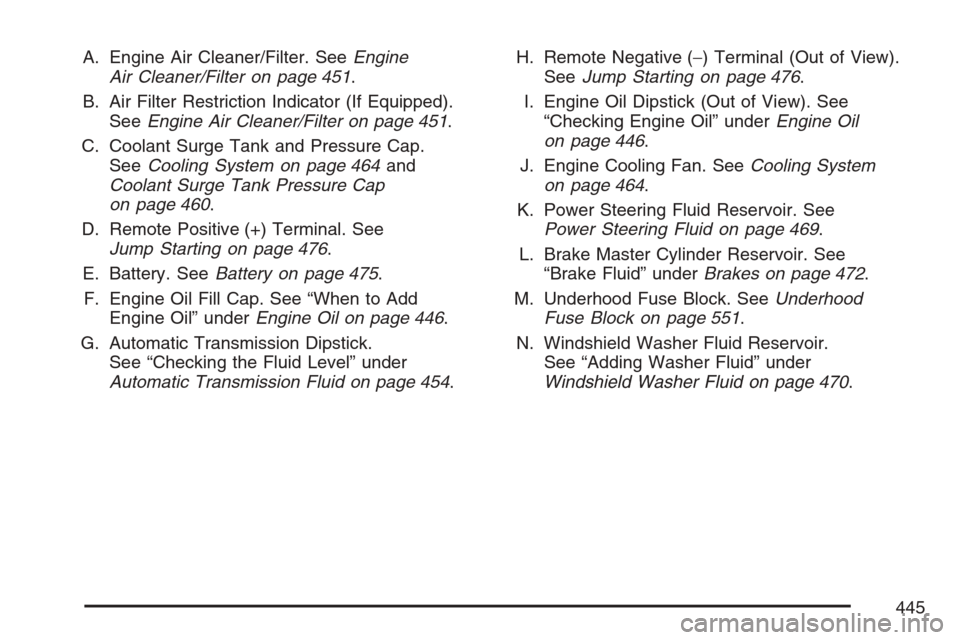
A. Engine Air Cleaner/Filter. SeeEngine
Air Cleaner/Filter on page 451.
B. Air Filter Restriction Indicator (If Equipped).
SeeEngine Air Cleaner/Filter on page 451.
C. Coolant Surge Tank and Pressure Cap.
SeeCooling System on page 464and
Coolant Surge Tank Pressure Cap
on page 460.
D. Remote Positive (+) Terminal. See
Jump Starting on page 476.
E. Battery. SeeBattery on page 475.
F. Engine Oil Fill Cap. See “When to Add
Engine Oil” underEngine Oil on page 446.
G. Automatic Transmission Dipstick.
See “Checking the Fluid Level” under
Automatic Transmission Fluid on page 454.H. Remote Negative (−) Terminal (Out of View).
SeeJump Starting on page 476.
I. Engine Oil Dipstick (Out of View). See
“Checking Engine Oil” underEngine Oil
on page 446.
J. Engine Cooling Fan. SeeCooling System
on page 464.
K. Power Steering Fluid Reservoir. See
Power Steering Fluid on page 469.
L. Brake Master Cylinder Reservoir. See
“Brake Fluid” underBrakes on page 472.
M. Underhood Fuse Block. SeeUnderhood
Fuse Block on page 551.
N. Windshield Washer Fluid Reservoir.
See “Adding Washer Fluid” under
Windshield Washer Fluid on page 470.
445
Page 454 of 618
Automatic Transmission Fluid
When to Check and Change Automatic
Transmission Fluid
A good time to check your automatic transmission
uid level is when the engine oil is changed.
Change the uid and lter at the intervals listed in
Additional Required Services on page 566, and
be sure to use the transmission uid listed in
Recommended Fluids and Lubricants on page 574.
How to Check Automatic
Transmission Fluid
Because this operation can be a little difficult, you
may choose to have this done at the dealership
service department.
If you do it yourself, be sure to follow all the
instructions here, or you could get a false
reading on the dipstick.Notice:Too much or too little uid can
damage your transmission. Too much can
mean that some of the uid could come out
and fall on hot engine parts or exhaust system
parts, starting a re. Too little uid could
cause the transmission to overheat. Be sure to
get an accurate reading if you check your
transmission uid.
Wait at least 30 minutes before checking the
transmission uid level if you have been driving:
When outside temperatures are above
90°F (32°C).
At high speed for quite a while.
In heavy traffic — especially in hot weather.
While pulling a trailer.
To get the right reading, the uid should be
at normal operating temperature, which is
180°F to 200°F (82°C to 93°C).
454
Page 457 of 618
Consistency of Readings
Always check the uid level at least twice using
the procedure described previously. Consistency
(repeatable readings) is important to maintaining
proper uid level. If readings are still inconsistent,
contact your dealer.
How to Add Automatic
Transmission Fluid
Refer to the Maintenance Schedule to determine
what kind of transmission uid to use. See
Recommended Fluids and Lubricants on page 574.
Using a funnel, add uid down the transmission
dipstick tube only after checking the transmission
uid while it is hot. A cold check is used only
as a reference. If the uid level is low, add only
enough of the proper uid to bring the level up to
the HOT area for a hot check. It does not take
much uid, generally less than one pint (0.5 L).
Do not overll.Notice:Use of the incorrect automatic
transmission uid may damage your vehicle,
and the damages may not be covered by
your warranty. Always use the automatic
transmission uid listed inRecommended
Fluids and Lubricants on page 574.
After adding uid, recheck the uid level as
described under “How to Check Automatic
Transmission Fluid,” earlier in this section.
When the correct uid level is obtained, push
the dipstick back in all the way; then ip the
handle down to lock the dipstick in place.
Engine Coolant
If your vehicle has the DURAMAX®Diesel engine,
see the DURAMAX®Diesel manual for more
information.
The cooling system in your vehicle is lled with
DEX-COOL
®engine coolant. This coolant is
designed to remain in your vehicle for ve years or
150,000 miles (240 000 km), whichever occurs rst,
if you add only DEX-COOL
®extended life coolant.
457
Page 477 of 618
2. Get the vehicles close enough so the jumper
cables can reach, but be sure the vehicles are
not touching each other. If they are, it could
cause a ground connection you do not
want. You would not be able to start your
vehicle, and the bad grounding could damage
the electrical systems.
To avoid the possibility of the vehicles rolling,
set the parking brake rmly on both vehicles
involved in the jump start procedure. Put
the automatic transmission in PARK (P) or a
manual transmission in NEUTRAL before
setting the parking brake. If you have a
four-wheel-drive vehicle, be sure the transfer
case is in a drive gear, not in NEUTRAL.
Notice:If you leave your radio or other
accessories on during the jump starting
procedure, they could be damaged.
The repairs would not be covered by
your warranty. Always turn off your radio
and other accessories when jump starting
your vehicle.3. Turn off the ignition on both vehicles.
Unplug unnecessary accessories plugged
into the cigarette lighter or the accessory
power outlets. Turn off the radio and all the
lamps that are not needed. This will avoid
sparks and help save both batteries.
And it could save the radio!
4. Open the hood on the other vehicle and locate
the positive (+) and negative (−) terminal
locations on that vehicle.
Your vehicle has a remote positive (+) jump
starting terminal and a remote negative (−)
jump starting terminal. You should always use
these remote terminals instead of the terminals
on the battery.
The remote positive (+) terminal, if equipped, is
located under a red plastic cover at the positive
battery post. To uncover the remote positive (+)
terminal, open the red plastic cover.
477
Page 497 of 618
(F) Service Description:The service description
indicates the load range and speed rating of a
tire. The load index can range from 1 to 279.
Speed ratings range from A to Z.
Tire Terminology and Denitions
Air Pressure:The amount of air inside the tire
pressing outward on each square inch of the
tire. Air pressure is expressed in pounds
per square inch (psi) or kilopascal (kPa).
Accessory Weight:This means the combined
weight of optional accessories. Some examples
of optional accessories are, automatic
transmission/transaxle, power steering, power
brakes, power windows, power seats, and
air conditioning.
Aspect Ratio:The relationship of a tire’s height
to its width.
Belt:A rubber coated layer of cords that is
located between the plies and the tread. Cords
may be made from steel or other reinforcing
materials.Bead:The tire bead contains steel wires wrapped
by steel cords that hold the tire onto the rim.
Bias Ply Tire:A pneumatic tire in which the plies
are laid at alternate angles less than 90 degrees
to the centerline of the tread.
Cold Tire Pressure:The amount of air pressure
in a tire, measured in pounds per square inch
(psi) or kilopascals (kPa) before a tire has built up
heat from driving. SeeInation - Tire Pressure
on page 500.
Curb Weight:This means the weight of a motor
vehicle with standard and optional equipment
including the maximum capacity of fuel, oil, and
coolant, but without passengers and cargo.
DOT Markings:A code molded into the sidewall
of a tire signifying that the tire is in compliance
with the U.S. Department of Transportation (DOT)
motor vehicle safety standards. The DOT code
includes the Tire Identication Number (TIN),
an alphanumeric designator which can also identify
the tire manufacturer, production plant, brand,
and date of production.
497
Page 553 of 618

Fuses Usage
1 Not Used
2Electronic Stability Suspension
Control, Automatic Level Control
Exhaust
3 Left Trailer Stop/Turn Lamp
4 Engine Controls
5Engine Control Module,
Throttle Control
6 Right Trailer Stop/Turn Lamp
7 Front Washer
8 Oxygen Sensors
9 Anti-lock Brakes System 2
10 Trailer Back-up Lamps
11 Driver’s Side Low-Beam Headlamp
12 Engine Control Module (Battery)
13Fuel Injectors, Ignition Coils
(Right Side)
14Transmission Control Module
(Battery)Fuses Usage
15 Vehicle Back-up Lamps
16Passenger’s Side Low-Beam
Headlamp
17 Air Conditioning Compressor
18 Oxygen Sensors
19 Transmission Controls (Ignition)
20 Fuel Pump
21 Not Used
22 Rear Washer
23Fuel Injectors, Ignition Coils
(Left Side)
24 Trailer Park Lamps
25 Driver’s Side Park Lamps
26 Passenger’s Side Park Lamps
27 Fog Lamps
28 Horn
29Passenger’s Side High-Beam
Headlamp
553