instrument panel CHEVROLET AVALANCHE 2007 2.G Owner's Manual
[x] Cancel search | Manufacturer: CHEVROLET, Model Year: 2007, Model line: AVALANCHE, Model: CHEVROLET AVALANCHE 2007 2.GPages: 618, PDF Size: 3.25 MB
Page 208 of 618
Turn and Lane-Change Signals
The turn signal has two upward (for right) and
two downward (for left) positions. These positions
allow you to signal a turn or a lane change.
To signal a turn, move the lever all the way up or
down. When the turn is nished, the lever will
return automatically.
To signal a lane change, raise or lower the
lever for less than one second until the arrow
starts to ash. This will cause the turn signals
to automatically ash three times. It will ash
six times if the tow-haul mode is active. Holding
the turn signal lever for more than one second will
cause the turn signals to ash until you release
the lever. The lever will return by itself when
it is released.
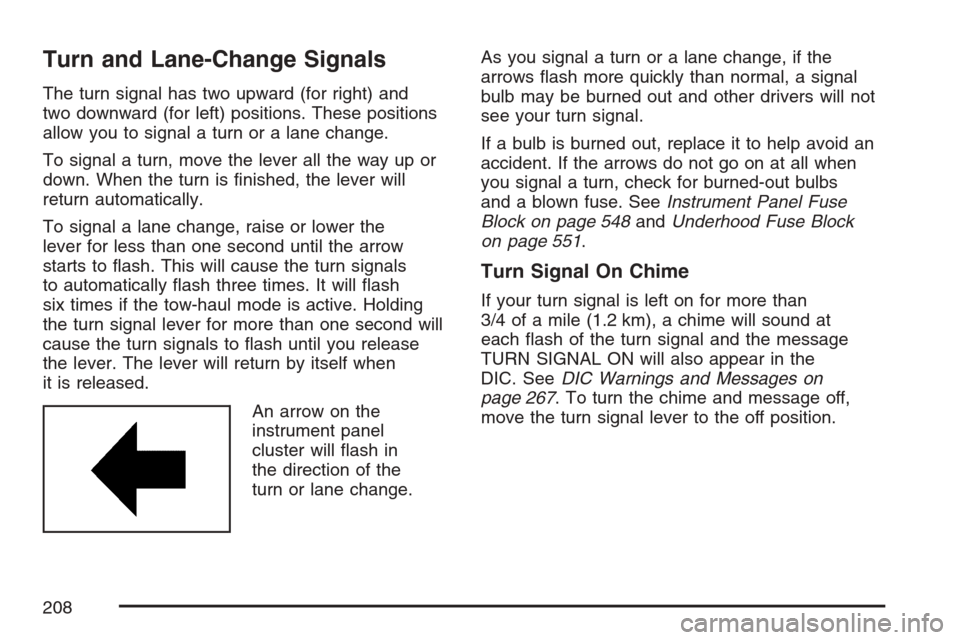
An arrow on the
instrument panel
cluster will ash in
the direction of the
turn or lane change.As you signal a turn or a lane change, if the
arrows ash more quickly than normal, a signal
bulb may be burned out and other drivers will not
see your turn signal.
If a bulb is burned out, replace it to help avoid an
accident. If the arrows do not go on at all when
you signal a turn, check for burned-out bulbs
and a blown fuse. SeeInstrument Panel Fuse
Block on page 548andUnderhood Fuse Block
on page 551.
Turn Signal On Chime
If your turn signal is left on for more than
3/4 of a mile (1.2 km), a chime will sound at
each ash of the turn signal and the message
TURN SIGNAL ON will also appear in the
DIC. SeeDIC Warnings and Messages on
page 267. To turn the chime and message off,
move the turn signal lever to the off position.
208
Page 209 of 618
Headlamp High/Low-Beam Changer
53(Headlamp High/Low Beam Changer):
To change the headlamps from low to high beam,
push the lever toward the instrument panel.
To return to low-beam headlamps, pull the
multifunction lever toward you. Then release it.
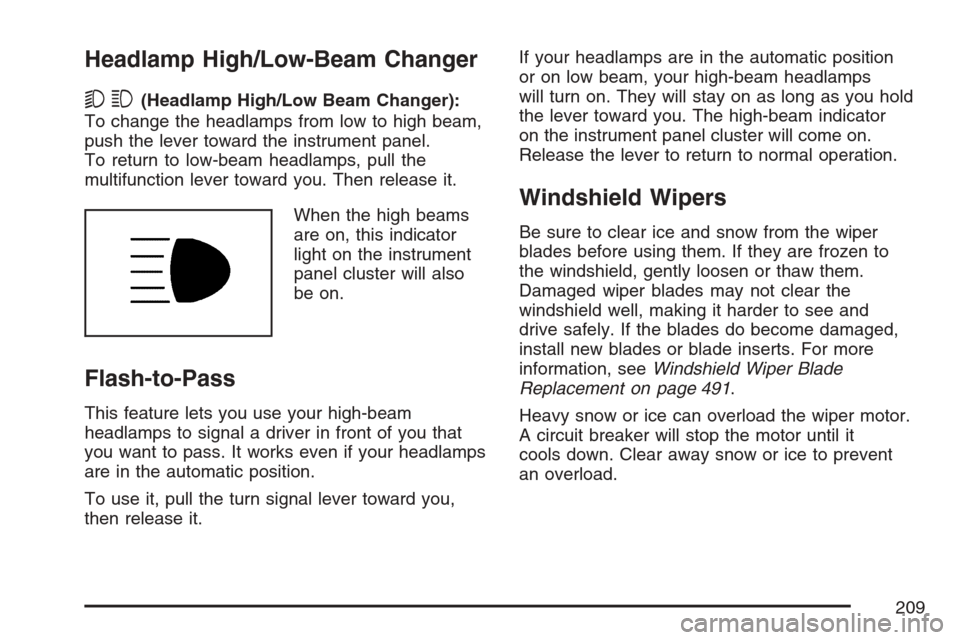
When the high beams
are on, this indicator
light on the instrument
panel cluster will also
be on.
Flash-to-Pass
This feature lets you use your high-beam
headlamps to signal a driver in front of you that
you want to pass. It works even if your headlamps
are in the automatic position.
To use it, pull the turn signal lever toward you,
then release it.If your headlamps are in the automatic position
or on low beam, your high-beam headlamps
will turn on. They will stay on as long as you hold
the lever toward you. The high-beam indicator
on the instrument panel cluster will come on.
Release the lever to return to normal operation.
Windshield Wipers
Be sure to clear ice and snow from the wiper
blades before using them. If they are frozen to
the windshield, gently loosen or thaw them.
Damaged wiper blades may not clear the
windshield well, making it harder to see and
drive safely. If the blades do become damaged,
install new blades or blade inserts. For more
information, seeWindshield Wiper Blade
Replacement on page 491.
Heavy snow or ice can overload the wiper motor.
A circuit breaker will stop the motor until it
cools down. Clear away snow or ice to prevent
an overload.
209
Page 213 of 618
SET−(Set/Coast):Press this button to set the
speed or make the vehicle decelerate.
[(Cancel):Press this button to cancel cruise
control without erasing the set speed from memory.
Setting Cruise Control
Cruise control will not work if your parking brake is
set, or if the master cylinder brake uid level is low.
The cruise control light on the instrument panel
cluster will come on after the cruise control
has been set to the desired speed.
{CAUTION:
If you leave your cruise control on when
you are not using cruise, you might hit a
button and go into cruise when you do not
want to. You could be startled and even
lose control. Keep the cruise control switch
off until you want to use cruise control.
1. Press the cruise control On/Off button.
2. Get up to the desired speed.3. Press the SET−button located on the steering
wheel and release it.
4. Take your foot off the accelerator.
Resuming a Set Speed
Suppose you set your cruise control at a
desired speed and then you apply the brake.
This shuts off the cruise control. But you do
not need to reset it.
Once you are driving about 25 mph (40 km/h) or
more, press the +RES button on your steering
wheel. The vehicle will go back to the previous
set speed and stay there.
Increasing Speed While Using
Cruise Control
To increase the cruise speed while using
cruise control:
Press and hold the +RES button on the steering
wheel until you reach your new desired speed,
then release it.
To increase vehicle speed in small increments,
press the +RES button. Each time you do this,
you will go about 1 mph (1.6 km/h) faster.
213
Page 215 of 618
Exterior Lamps
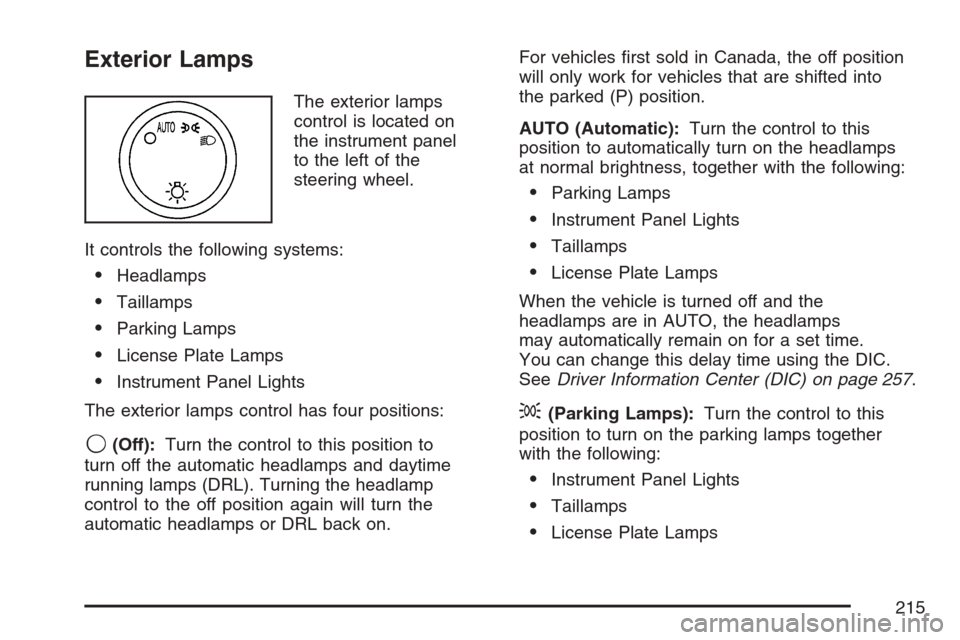
The exterior lamps
control is located on
the instrument panel
to the left of the
steering wheel.
It controls the following systems:
Headlamps
Taillamps
Parking Lamps
License Plate Lamps
Instrument Panel Lights
The exterior lamps control has four positions:
9(Off):Turn the control to this position to
turn off the automatic headlamps and daytime
running lamps (DRL). Turning the headlamp
control to the off position again will turn the
automatic headlamps or DRL back on.For vehicles rst sold in Canada, the off position
will only work for vehicles that are shifted into
the parked (P) position.
AUTO (Automatic):Turn the control to this
position to automatically turn on the headlamps
at normal brightness, together with the following:
Parking Lamps
Instrument Panel Lights
Taillamps
License Plate Lamps
When the vehicle is turned off and the
headlamps are in AUTO, the headlamps
may automatically remain on for a set time.
You can change this delay time using the DIC.
SeeDriver Information Center (DIC) on page 257.
;(Parking Lamps):Turn the control to this
position to turn on the parking lamps together
with the following:
Instrument Panel Lights
Taillamps
License Plate Lamps
215
Page 216 of 618
2(Headlamps):Turn the control to this
position to turn on the headlamps together
with the following lamps listed below.
When the headlamps are turned on while the
vehicle is on, the headlamps will turn off
automatically 10 minutes after the ignition is
turned off. When the headlamps are turned
on while the vehicle is off, the headlamps will
continue to stay on. Turn the control to the
off position to turn the headlamps off or the
battery will be drained.
A warning chime will sound if you open the
driver’s door when the ignition switch is off
and the headlamps are on.
Parking Lamps
Instrument Panel Lights
Taillamps
License Plate Lamps
You can switch your headlamps from low to high
beam by pushing the turn signal/multifunction
lever toward the instrument panel.
Headlamps on Reminder
If a door is open, a reminder chime will sound
when your headlamps or parking lamps are
manually turned on and your key is out of the
ignition. To turn off the chime, turn the headlamp
switch to off or AUTO and then back on, or
close and re-open the door. In the AUTO mode,
the headlamps turn off once the ignition is in
LOCK or may remain on until the headlamp delay
ends (if enabled in the DIC). See “Exit Lighting”
underDIC Vehicle Customization (With DIC
Buttons) on page 278.
Daytime Running Lamps (DRL)
Daytime Running Lamps (DRL) can make it easier
for others to see the front of your vehicle during
the day. DRL can be helpful in many different
driving conditions, but they can be especially
helpful in the short periods after dawn and before
sunset. Fully functional daytime running lamps
are required on all vehicles rst sold in Canada.
216
Page 217 of 618

The DRL system will come on when the following
conditions are met:
The ignition is on.
The exterior lamps control is in AUTO.
The transmission is not in PARK (P).
The light sensor determines it is daytime.
When the DRL are on, only your DRL lamps will
be on. The taillamps, sidemarker, and other lamps
will not be on. The instrument panel will not be
lit up either.
When it begins to get dark, the automatic
headlamp system will switch from DRL to the
headlamps.
To turn off the DRL lamps, turn the exterior lamps
control to the OFF position and then release.
For vehicles rst sold in Canada, the transaxle
must be in the PARK (P) position, before the
DRL lamps can be turned off.
As with any vehicle, you should turn on the
regular headlamp system when you need it.
Automatic Headlamp System
When it is dark enough outside and the headlamp
switch is in AUTO, your automatic headlamp
system will turn on your headlamps at the normal
brightness along with other lamps such as the
taillamps, sidemarker, parking lamps, roof marker
lamps, and the instrument panel lights. The
radio lights will also be dim.
To turn off the automatic headlamp system,
turn the exterior lamps switch to the off position
and then release. For vehicles rst sold in Canada,
the transaxle must be in the PARK (P) position,
before the automatic headlamp system can
be turned off.
Your vehicle has a light sensor located on the
top of the instrument panel. Be sure it is not
covered, or the system will be on whenever the
ignition is on.
The system may also turn on your headlamps
when driving through a parking garage, heavy
overcast weather, or a tunnel. This is normal.
217
Page 218 of 618

There is a delay in the transition between
the daytime and nighttime operation of the
Daytime Running Lamps (DRL) and the
automatic headlamp systems so that driving
under bridges or bright overhead street lights
does not affect the system. The DRL and
automatic headlamp system will only be affected
when the light sensor sees a change in lighting
lasting longer than the delay.
If you start your vehicle in a dark garage,
the automatic headlamp system will come
on immediately. Once you leave the garage,
it will take approximately one minute for the
automatic headlamp system to change to DRL
if it is light outside. During that delay, your
instrument panel cluster may not be as bright
as usual. Make sure your instrument panel
brightness control is in the full bright position.
SeeInstrument Panel Brightness on page 219.Fog Lamps
If your vehicle has fog lamps you can use them
for better vision in foggy or misty conditions.
Your parking lamps and/or low-beam headlamps
must be on for your fog lamps to work.
The fog lamp button is located on the left side of
your instrument panel.
-(Fog Lamps):Press the button to turn the
fog lamps on. An indicator light will glow near
the button when the fog lamps are on. Press the
button again to turn them off.
Remember, fog lamps alone will not give off as
much light as your headlamps. Never use your
fog lamps in the dark without turning on the
headlamps.
218
Page 219 of 618
The fog lamps will go off whenever your high-beam
headlamps come on. When the high beams go
off, the fog lamps will come on again.
The fog lamps will be cancelled after the ignition is
turned off. If you still want to use the fog lamps
after you restart the vehicle, you will need to press
the fog lamp button again.
Some localities have laws that require the
headlamps to be on along with the fog lamps.
Exterior Cargo Lamps
You can use the cargo lamp if you need more
light in the cargo area of your vehicle or in
the top-box storage units. Some vehicles will only
have a cargo lamp in the driver side top box.
The cargo lamps come on by turning on the
interior dome lamps.
Instrument Panel Brightness
The knob for this feature is located next to the
exterior lamps control.
D(Instrument Panel Lights):Turn the knob
clockwise or counterclockwise to brighten or
dim the instrument panel lights and the radio
display. This will only work if the headlamps or
parking lamps are on.
To turn on the dome lamps, with the vehicle doors
closed, turn the knob all the way to the right.
219
Page 226 of 618
Accessory Power Outlet(s)
Your vehicle may have two accessory power
outlets located on the instrument panel.
Your vehicle may also have an outlet on the back
of the center console above the cupholder door.
Notice:Adding any electrical equipment to
your vehicle may damage it or keep other
components from working as they should. The
repairs would not be covered by your warranty.
Do not use equipment exceeding maximum
amperage rating of 20 amperes. Check with
your dealer before adding electrical equipment.
Certain power accessory plugs may not be
compatible to the accessory power outlets and
could result in blown vehicle or adapter fuses.
If you experience a problem, see your dealer
for additional information on the accessory
power plugs.
Notice:Improper use of the power outlet can
cause damage not covered by your warranty.
Do not hang any type of accessory or accessory
bracket from the plug because the power outlets
are designed for accessory power plugs only.
Ashtray(s) and Cigarette Lighter
If your vehicle has this feature it is located in the
center console or on the instrument panel. Pull up
on the ashtray door to open it if it is in the console or
pull the door open it if it is on the instrument panel.
Notice:If you put papers, pins, or other
ammable items in the ashtray, hot cigarettes
or other smoking materials could ignite them
and possibly damage your vehicle. Never put
ammable items in the ashtray.
To remove the ashtray, pull it out from the console
or from the slide out door. To reinstall the ashtray,
slide it back to the original position.
To use the cigarette lighter, if the vehicle has one,
push it in all the way, and let go. When it is ready
for use, it will pop back out by itself.
Do not use the lighter to plug in accessory devices.
Use the power outlets provided.
Notice:Holding a cigarette lighter in while it is
heating does not let the lighter back away from
the heating element when it is hot. Damage from
overheating can occur to the lighter or heating
element, or a fuse could be blown. Do not hold
a cigarette lighter in while it is heating.
226
Page 227 of 618
Climate Controls
Dual Climate Control System
With this system you can control the heating,
cooling, defrost, defog and ventilation of
your vehicle.
Manual Operation
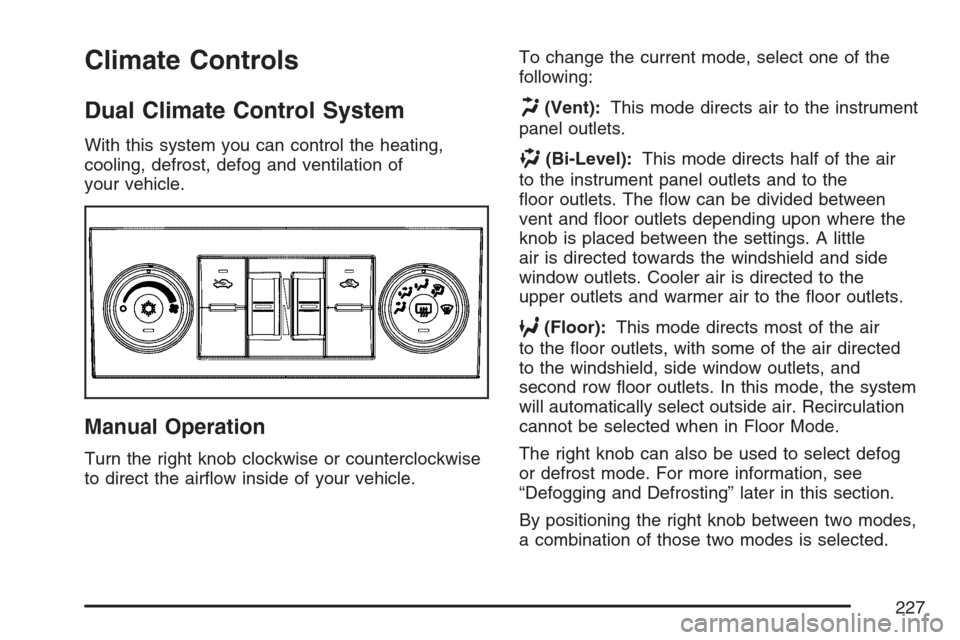
Turn the right knob clockwise or counterclockwise
to direct the airow inside of your vehicle.To change the current mode, select one of the
following:
H(Vent):This mode directs air to the instrument
panel outlets.
)(Bi-Level):This mode directs half of the air
to the instrument panel outlets and to the
oor outlets. The ow can be divided between
vent and oor outlets depending upon where the
knob is placed between the settings. A little
air is directed towards the windshield and side
window outlets. Cooler air is directed to the
upper outlets and warmer air to the oor outlets.
6(Floor):This mode directs most of the air
to the oor outlets, with some of the air directed
to the windshield, side window outlets, and
second row oor outlets. In this mode, the system
will automatically select outside air. Recirculation
cannot be selected when in Floor Mode.
The right knob can also be used to select defog
or defrost mode. For more information, see
“Defogging and Defrosting” later in this section.
By positioning the right knob between two modes,
a combination of those two modes is selected.
227