brake light CHEVROLET AVALANCHE 2007 2.G Owner's Guide
[x] Cancel search | Manufacturer: CHEVROLET, Model Year: 2007, Model line: AVALANCHE, Model: CHEVROLET AVALANCHE 2007 2.GPages: 618, PDF Size: 3.25 MB
Page 477 of 618
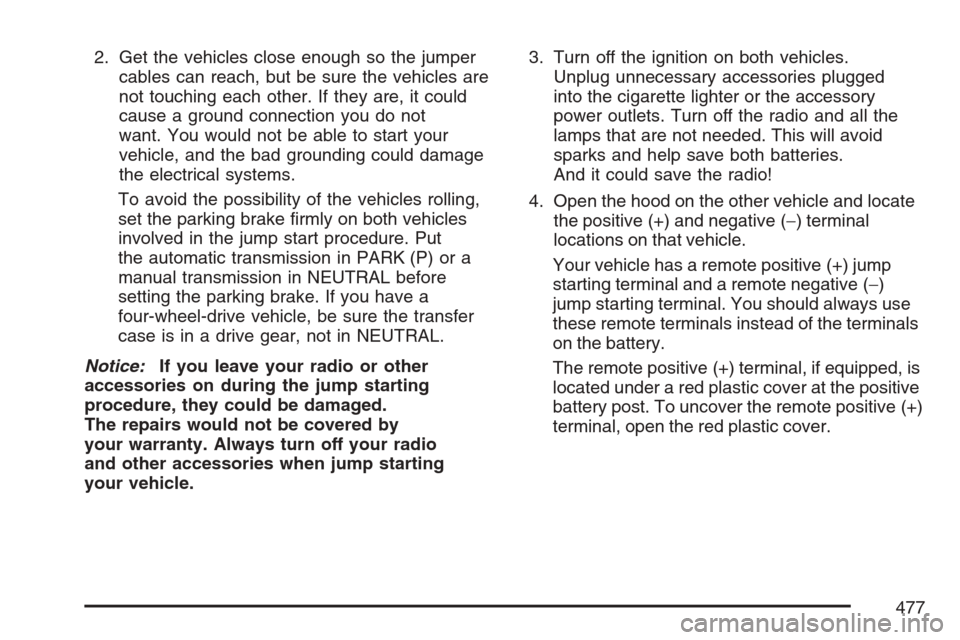
2. Get the vehicles close enough so the jumper
cables can reach, but be sure the vehicles are
not touching each other. If they are, it could
cause a ground connection you do not
want. You would not be able to start your
vehicle, and the bad grounding could damage
the electrical systems.
To avoid the possibility of the vehicles rolling,
set the parking brake rmly on both vehicles
involved in the jump start procedure. Put
the automatic transmission in PARK (P) or a
manual transmission in NEUTRAL before
setting the parking brake. If you have a
four-wheel-drive vehicle, be sure the transfer
case is in a drive gear, not in NEUTRAL.
Notice:If you leave your radio or other
accessories on during the jump starting
procedure, they could be damaged.
The repairs would not be covered by
your warranty. Always turn off your radio
and other accessories when jump starting
your vehicle.3. Turn off the ignition on both vehicles.
Unplug unnecessary accessories plugged
into the cigarette lighter or the accessory
power outlets. Turn off the radio and all the
lamps that are not needed. This will avoid
sparks and help save both batteries.
And it could save the radio!
4. Open the hood on the other vehicle and locate
the positive (+) and negative (−) terminal
locations on that vehicle.
Your vehicle has a remote positive (+) jump
starting terminal and a remote negative (−)
jump starting terminal. You should always use
these remote terminals instead of the terminals
on the battery.
The remote positive (+) terminal, if equipped, is
located under a red plastic cover at the positive
battery post. To uncover the remote positive (+)
terminal, open the red plastic cover.
477
Page 568 of 618
Maintenance Footnotes
†The U.S. Environmental Protection Agency or the
California Air Resources Board has determined that
the failure to perform this maintenance item will not
nullify the emission warranty or limit recall liability
prior to the completion of the vehicle’s useful life.
We, however, urge that all recommended
maintenance services be performed at the indicated
intervals and the maintenance be recorded.
#Lubricate the front suspension, steering linkage,
transmission shift linkage, and parking brake
cable guides. Control arm ball joints are
maintenance-free.
(a)Visually inspect brake lines and hoses for
proper hook-up, binding, leaks, cracks, chang,
etc. Inspect disc brake pads for wear and rotors
for surface condition. Inspect other brake
parts, including calipers, parking brake, etc.
(b)Visually inspect front and rear suspension and
steering system for damaged, loose, or missing
parts, signs of wear or lack of lubrication. Inspect
power steering lines and hoses for proper
hook-up, binding, leaks, cracks, chang, etc.
Visually check constant velocity joints, rubber
boots, and axle seals for leaks.(c)Visually inspect hoses and have them replaced
if they are cracked, swollen, or deteriorated.
Inspect all pipes, ttings, and clamps; replace with
genuine GM parts as needed. To help ensure
proper operation, a pressure test of the cooling
system and pressure cap and cleaning the outside
of the radiator and air conditioning condenser is
recommended at least once a year.
(d)Visually inspect wiper blades for wear or
cracking. Replace wiper blades that appear worn
or damaged or that streak or miss areas of
the windshield.
(e)Make sure the safety belt reminder light and all
your belts, buckles, latch plates, retractors, and
anchorages are working properly. Look for
any other loose or damaged safety belt system
parts. If you see anything that might keep a safety
belt system from doing its job, have it repaired.
Have any torn or frayed safety belts replaced. Also
look for any opened or broken airbag coverings,
and have them repaired or replaced. The
airbag system does not need regular maintenance.
568
Page 603 of 618
A
Accessories and Modications..................... 433
Accessory Power Outlet(s).......................... 226
Adding Equipment to Your
Airbag-Equipped Vehicle............................ 87
Additives, Fuel............................................ 437
Add-On Electrical Equipment....................... 547
Adjustable Throttle and Brake Pedal............ 126
Air Cleaner/Filter, Engine............................. 451
Air Conditioning..................................227, 230
Airbag
Passenger Status Indicator....................... 243
Readiness Light....................................... 242
Airbag Sensing and Diagnostic
Module (SDM).......................................... 594
Airbag System............................................... 72
Adding Equipment to Your
Airbag-Equipped Vehicle......................... 87
How Does an Airbag Restrain?.................. 79
Passenger Sensing System....................... 81
Servicing Your Airbag-Equipped Vehicle..... 86
What Makes an Airbag Inate?.................. 79
What Will You See After an
Airbag Inates?...................................... 80
When Should an Airbag Inate?................. 77
Where Are the Airbags?............................. 75Antenna, Fixed Mast................................... 349
Antenna, XM™ Satellite Radio
Antenna System....................................... 349
Anti-Lock Brake System (ABS).................... 357
Anti-Lock Brake, System Warning Light....... 248
Appearance Care
Aluminum or Chrome-Plated Wheels........ 542
Care of Safety Belts................................ 540
Chemical Paint Spotting........................... 544
Cleaning Exterior Lamps/Lenses.............. 541
Cleaning the Inside of Your Vehicle.......... 537
Fabric/Carpet........................................... 538
Finish Care.............................................. 541
Finish Damage......................................... 544
Instrument Panel, Vinyl, and
Other Plastic Surfaces.......................... 540
Leather.................................................... 539
Sheet Metal Damage............................... 544
Tires........................................................ 543
Underbody Maintenance........................... 544
Vehicle Care/Appearance Materials.......... 545
Washing Your Vehicle .............................. 541
Weatherstrips........................................... 540
Windshield and Wiper Blades................... 542
Ashtray(s).................................................... 226
603
Page 604 of 618
Audio System(s).......................................... 286
Audio Steering Wheel Controls................. 347
Care of Your CD and DVD Player............ 349
Care of Your CDs and DVDs................... 349
Fixed Mast Antenna................................. 349
Navigation/Radio System,
see Navigation Manual......................... 334
Radio with CD......................................... 291
Radio with CD and DVD.......................... 301
Rear Seat Audio (RSA)............................ 345
Setting the Time.....................288, 289, 290
Theft-Deterrent Feature............................ 347
Understanding Radio Reception............... 348
XM™ Satellite Radio Antenna System...... 349
Automatic Headlamp System....................... 217
Automatic Transmission
Fluid........................................................ 454
Operation................................................. 128
BBattery........................................................ 475
Electric Power Management..................... 220
Run-Down Protection............................... 221
Before Leaving on a Long Trip.................... 392
Brake
Anti-Lock Brake System (ABS)................. 357
Emergencies............................................ 359Brake (cont.)
Parking.................................................... 138
System Warning Light.............................. 246
Brake Pedal, Throttle................................... 126
Brakes........................................................ 472
Braking....................................................... 356
Braking in Emergencies............................... 359
Break-In, New Vehicle................................. 122
Bulb Replacement....................................... 488
Halogen Bulbs......................................... 488
Headlamp Aiming..................................... 485
License Plate Lamps................................ 490
Replacement Bulbs.................................. 490
Taillamps, Turn Signal, Sidemarker,
Stoplamps, and Back-Up Lamps........... 488
Buying New Tires........................................ 508
C
Calibration..........................................145, 148
California Fuel............................................. 436
California Proposition 65 Warning................ 433
Canadian Owners........................................... 3
Capacities and Specications...................... 556
Carbon Monoxide......................105, 115, 143,
396, 414
604
Page 610 of 618
L
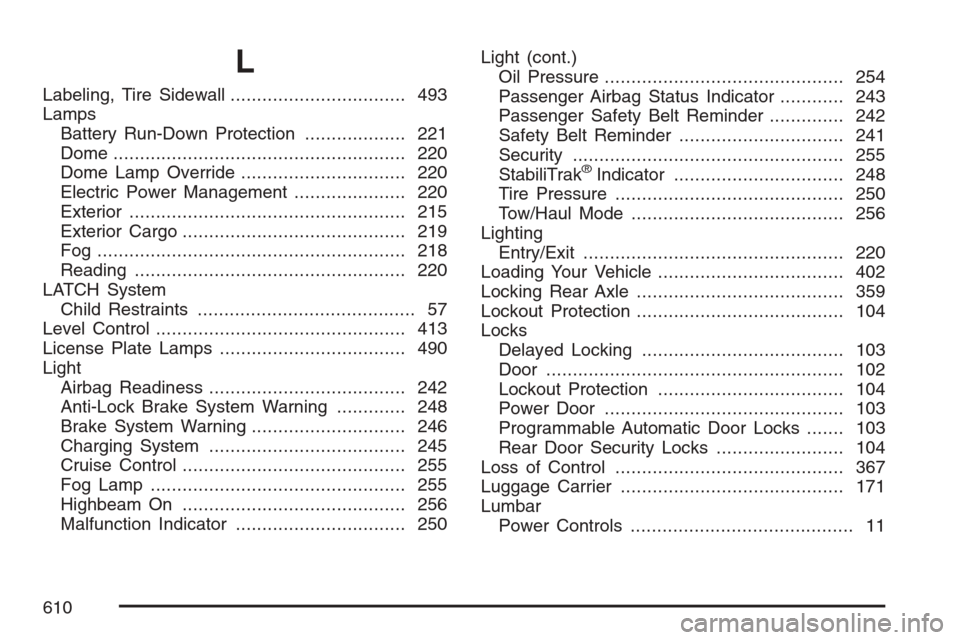
Labeling, Tire Sidewall................................. 493
Lamps
Battery Run-Down Protection................... 221
Dome....................................................... 220
Dome Lamp Override............................... 220
Electric Power Management..................... 220
Exterior.................................................... 215
Exterior Cargo.......................................... 219
Fog .......................................................... 218
Reading................................................... 220
LATCH System
Child Restraints......................................... 57
Level Control............................................... 413
License Plate Lamps................................... 490
Light
Airbag Readiness..................................... 242
Anti-Lock Brake System Warning............. 248
Brake System Warning............................. 246
Charging System..................................... 245
Cruise Control.......................................... 255
Fog Lamp................................................ 255
Highbeam On.......................................... 256
Malfunction Indicator................................ 250Light (cont.)
Oil Pressure............................................. 254
Passenger Airbag Status Indicator............ 243
Passenger Safety Belt Reminder.............. 242
Safety Belt Reminder............................... 241
Security................................................... 255
StabiliTrak
®Indicator................................ 248
Tire Pressure........................................... 250
Tow/Haul Mode........................................ 256
Lighting
Entry/Exit................................................. 220
Loading Your Vehicle................................... 402
Locking Rear Axle....................................... 359
Lockout Protection....................................... 104
Locks
Delayed Locking...................................... 103
Door........................................................ 102
Lockout Protection................................... 104
Power Door............................................. 103
Programmable Automatic Door Locks....... 103
Rear Door Security Locks........................ 104
Loss of Control........................................... 367
Luggage Carrier.......................................... 171
Lumbar
Power Controls.......................................... 11
610
Page 612 of 618
O
Odometer.................................................... 241
Odometer, Trip............................................ 241
Off-Road Driving.......................................... 368
Off-Road Recovery...................................... 365
Oil
Engine..................................................... 446
Pressure Gage......................................... 253
Pressure Light.......................................... 254
Oil, Engine Oil Life System......................... 449
Older Children, Restraints............................. 45
Online Owner Center................................... 585
OnStar
®System, see OnStar®Manual........ 156
Operation, Universal Home
Remote System..............................161, 166
Other Warning Devices................................ 206
Outlet Adjustment........................................ 238
Outlet(s), Accessory Power.......................... 226
Outside
Power Foldaway Mirrors........................... 153
Power Mirrors.......................................... 152
Overheated Engine Protection
Operating Mode....................................... 463
Owner Checks and Services....................... 570
Owners, Canadian.......................................... 3
P
Paint, Damage............................................ 544
Park Aid...................................................... 222
Park (P)
Shifting Into............................................. 139
Shifting Out of......................................... 141
Parking
Assist....................................................... 222
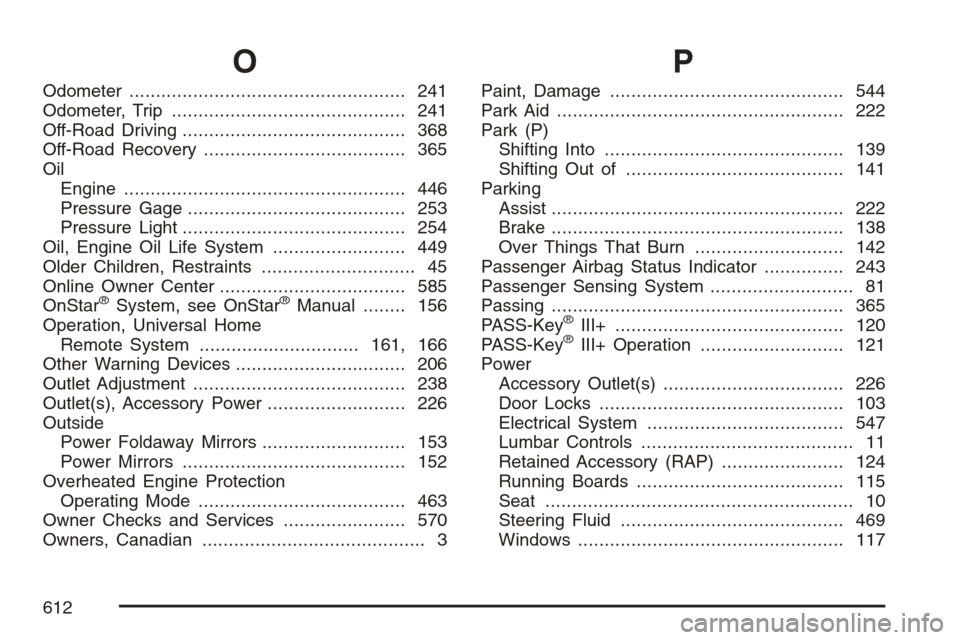
Brake....................................................... 138
Over Things That Burn............................ 142
Passenger Airbag Status Indicator............... 243
Passenger Sensing System........................... 81
Passing....................................................... 365
PASS-Key
®III+........................................... 120
PASS-Key®III+ Operation........................... 121
Power
Accessory Outlet(s).................................. 226
Door Locks.............................................. 103
Electrical System..................................... 547
Lumbar Controls........................................ 11
Retained Accessory (RAP)....................... 124
Running Boards....................................... 115
Seat.......................................................... 10
Steering Fluid.......................................... 469
Windows.................................................. 117
612