ABS CHEVROLET AVALANCHE 2008 2.G User Guide
[x] Cancel search | Manufacturer: CHEVROLET, Model Year: 2008, Model line: AVALANCHE, Model: CHEVROLET AVALANCHE 2008 2.GPages: 528, PDF Size: 3.05 MB
Page 346 of 528
{CAUTION:
Shifting the transfer case to NEUTRAL
can cause your vehicle to roll even if the
transmission is in PARK (P). You or someone
else could be seriously injured. Be sure to set
the parking brake before placing the transfer
case in NEUTRAL. SeeParking Brake on
page 2-44.
6. Shift the transfer case to NEUTRAL (N). See
Four-Wheel Drive on page 2-39for the proper
procedure to select the neutral position for your
vehicle.
7. Release the parking brake only after the vehicle
being towed is rmly attached to the tow vehicle.
If the tow vehicle will not be started or driven for
six weeks or more, remove the battery cable
from the negative terminal (post) of the battery to
prevent your battery from draining while towing.
Level Control
The self-adjusting rear suspension may come as part of
the premium smooth ride suspension package.
This type of level control will provide a leveled riding
position as well as improved handling under a variety of
passenger and loading conditions. A hydraulic pump
inside each rear shock absorber raises the rear of the
vehicle to the proper height, based on inputs from the
road surface, while the vehicle is being driven. It take
approximately 2 miles (3.2 km) of driving for the leveling
to complete, depending on the road surface conditions.
If the loaded vehicle is not moved for approximately
12 hours, the leveling system may bleed down to a lower
height. This can be especially apparent if a trailer is
left attached to a parked vehicle for long periods of time.
The vehicle must be driven to re-level the vehicle.
If a weight-distributing hitch is being used, the vehicle
should be driven approximately 2 miles (3.2 km) with the
trailer prior to adjusting the hitch.
4-46
Page 357 of 528
Parking on Hills
{CAUTION:
You really should not park your vehicle, with a
trailer attached, on a hill. If something goes
wrong, your rig could start to move. People
can be injured, and both your vehicle and the
trailer can be damaged.
But if you ever have to park your rig on a hill, here’s
how to do it:
1. Apply your regular brakes, but don’t shift into
PARK (P) yet.
2. Have someone place chocks under the trailer
wheels.
3. When the wheel chocks are in place, release the
regular brakes until the chocks absorb the load.
4. Reapply the regular brakes. Then apply your
parking brake and shift into PARK (P).
5. If you have a four-wheel-drive vehicle, be sure
the transfer case is in a drive gear and not in
NEUTRAL (N).
6. Release the regular brakes.
{CAUTION:
It can be dangerous to get out of your vehicle
if the shift lever is not fully in PARK (P) with the
parking brake rmly set. Your vehicle can roll.
If you have left the engine running, the vehicle
can move suddenly. You or others could be
injured. To be sure your vehicle will not move,
even when you are on fairly level ground, use
the steps that follow.
Always put the shift lever fully in PARK (P) with
the parking brake rmly set.
If the transfer case on four-wheel-drive vehicles
is in NEUTRAL, your vehicle will be free to roll,
even if your shift lever is in PARK (P). So, be
sure the transfer case is in a drive gear — not in
NEUTRAL.
4-57
Page 460 of 528
Do not clean your vehicle using:
A knife or any other sharp object to remove a soil
from any interior surface.
A stiff brush. It can cause damage to your vehicle’s
interior surfaces.
Heavy pressure or aggressive rubbing with a
cleaning cloth. Use of heavy pressure can damage
your interior and does not improve the effectiveness
of soil removal.
Laundry detergents or dishwashing soaps with
degreasers can leave residue that streaks and
attracts dirt. For liquid cleaners, about 20 drops
per gallon (3.78 L) of water is a good guide.
Use only mild, neutral-pH soaps.
Too much cleaner that saturates the upholstery.
Organic solvents such as naptha, alcohol, etc. that
can damage your vehicle’s interior.
Fabric/Carpet
Use a vacuum cleaner with a soft brush attachment
frequently to remove dust and loose dirt. A canister
vacuum with a beater bar in the nozzle may only
be used on oor carpet and carpeted oor mats.
For any soil, always try to remove it rst with plain
water or club soda. Before cleaning, gently remove as
much of the soil as possible using one of the following
techniques:
For liquids: gently blot the remaining soil with a
paper towel. Allow the soil to absorb into the
paper towel until no more can be removed.
For solid dry soils: remove as much as possible
and then vacuum.
To clean:
1. Saturate a lint-free, clean white cloth with water or
club soda.
2. Wring the cloth to remove excess moisture.
3. Start on the outside edge of the soil and gently rub
toward the center. Continue cleaning, using a clean
area of the cloth each time it becomes soiled.
4. Continue to gently rub the soiled area until the
cleaning cloth remains clean.
5. If the soil is not completely removed, use a mild
soap solution and repeat the cleaning process
that was used with plain water.
5-100
Page 515 of 528
A
Accessories and Modications............................ 5-3
Accessory Power Outlets.................................3-20
Adding Equipment to Your Airbag-Equipped
Vehicle.......................................................1-74
Additives, Fuel................................................. 5-6
Add-On Electrical Equipment...........................5-108
Adjustable Throttle and Brake Pedal..................2-33
Air Cleaner/Filter, Engine.................................5-20
Air Conditioning......................................3-21, 3-24
Airbag
Passenger Status Indicator...........................3-36
Readiness Light..........................................3-35
Airbag System................................................1-60
Adding Equipment to Your Airbag-Equipped
Vehicle...................................................1-74
How Does an Airbag Restrain?......................1-67
Passenger Sensing System...........................1-69
Servicing Your Airbag-Equipped Vehicle..........1-74
What Makes an Airbag Inate?......................1-67
What Will You See After an Airbag Inates?....1-68
When Should an Airbag Inate?....................1-65
Where Are the Airbags?...............................1-63
Antenna, Fixed Mast......................................3-120
Antenna, XM™ Satellite Radio Antenna
System.....................................................3-120
Antilock Brake System (ABS)............................. 4-4
Anti-lock Brake, System Warning Light...............3-41Appearance Care
Aluminum or Chrome-Plated Wheels.............5-104
Care of Safety Belts...................................5-102
Chemical Paint Spotting..............................5-106
Cleaning Exterior Lamps/Lenses..................5-103
Fabric/Carpet............................................5-100
Finish Care...............................................5-103
Finish Damage..........................................5-105
Instrument Panel, Vinyl, and Other
Plastic Surfaces.....................................5-101
Interior Cleaning..........................................5-99
Leather....................................................5-101
Sheet Metal Damage..................................5-105
Tires........................................................5-105
Underbody Maintenance.............................5-105
Vehicle Care/Appearance Materials...............5-106
Washing Your Vehicle.................................5-102
Weatherstrips............................................5-102
Windshield and Wiper Blades......................5-104
Appointments, Scheduling Service....................... 7-9
Ashtray.........................................................3-20
Audio System.................................................3-75
Audio Steering Wheel Controls....................3-118
Fixed Mast Antenna...................................3-120
Navigation/Radio System,
see Navigation Manual............................3-107
Radio Reception........................................3-119
Rear Seat Audio (RSA)...............................3-116
Setting the Clock.........................................3-76
1
Page 521 of 528
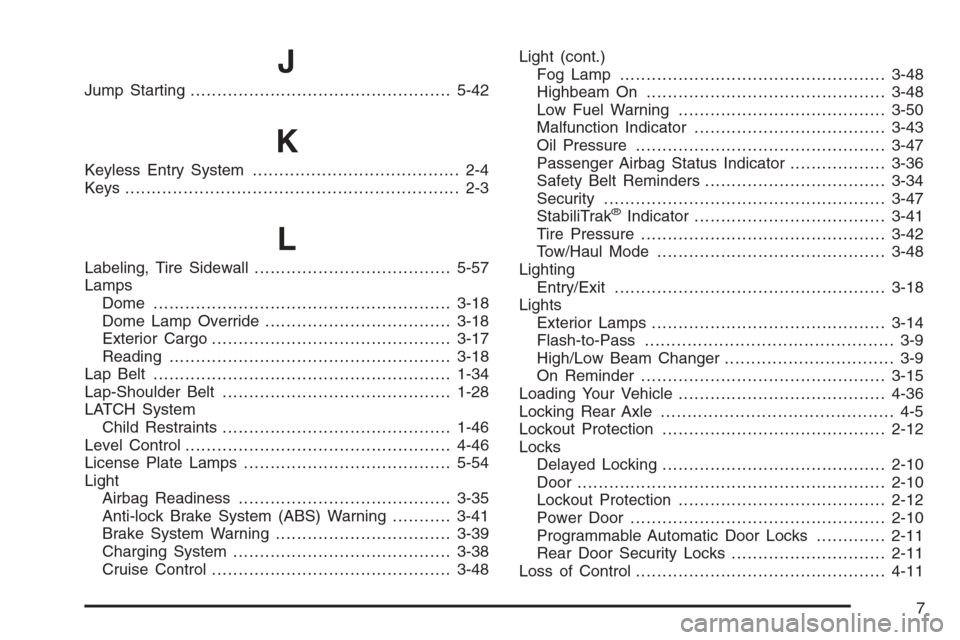
J
Jump Starting.................................................5-42
K
Keyless Entry System....................................... 2-4
Keys............................................................... 2-3
L
Labeling, Tire Sidewall.....................................5-57
Lamps
Dome ........................................................3-18
Dome Lamp Override...................................3-18
Exterior Cargo.............................................3-17
Reading.....................................................3-18
Lap Belt........................................................1-34
Lap-Shoulder Belt...........................................1-28
LATCH System
Child Restraints...........................................1-46
Level Control..................................................4-46
License Plate Lamps.......................................5-54
Light
Airbag Readiness........................................3-35
Anti-lock Brake System (ABS) Warning...........3-41
Brake System Warning.................................3-39
Charging System.........................................3-38
Cruise Control.............................................3-48Light (cont.)
Fog Lamp ..................................................3-48
Highbeam On.............................................3-48
Low Fuel Warning.......................................3-50
Malfunction Indicator....................................3-43
Oil Pressure...............................................3-47
Passenger Airbag Status Indicator..................3-36
Safety Belt Reminders..................................3-34
Security.....................................................3-47
StabiliTrak
®Indicator....................................3-41
Tire Pressure..............................................3-42
Tow/Haul Mode...........................................3-48
Lighting
Entry/Exit...................................................3-18
Lights
Exterior Lamps............................................3-14
Flash-to-Pass............................................... 3-9
High/Low Beam Changer................................ 3-9
On Reminder..............................................3-15
Loading Your Vehicle.......................................4-36
Locking Rear Axle............................................ 4-5
Lockout Protection..........................................2-12
Locks
Delayed Locking..........................................2-10
Door ..........................................................2-10
Lockout Protection.......................................2-12
Power Door ................................................2-10
Programmable Automatic Door Locks.............2-11
Rear Door Security Locks.............................2-11
Loss of Control...............................................4-11
7