ECU CHEVROLET AVALANCHE 2009 2.G Owner's Manual
[x] Cancel search | Manufacturer: CHEVROLET, Model Year: 2009, Model line: AVALANCHE, Model: CHEVROLET AVALANCHE 2009 2.GPages: 550, PDF Size: 3.06 MB
Page 77 of 550
The passenger sensing system works with sensors that
are part of the right front passenger seat and safety
belt. The sensors are designed to detect the presence
of a properly-seated occupant and determine if the
right front passenger frontal airbag should be enabled
(may inate) or not.
According to accident statistics, children are safer when
properly secured in a rear seat in the correct child
restraint for their weight and size.
We recommend that children be secured in a rear seat,
including: an infant or a child riding in a rear-facing
child restraint; a child riding in a forward-facing child
seat; an older child riding in a booster seat; and children,
who are large enough, using safety belts.
A label on the sun visor says, “Never put a rear-facing
child seat in the front.” This is because the risk to
the rear-facing child is so great, if the airbag deploys.
{CAUTION:
A child in a rear-facing child restraint can be
seriously injured or killed if the right front
passenger airbag inates. This is because the
back of the rear-facing child restraint would be
CAUTION: (Continued)
CAUTION: (Continued)
very close to the inating airbag. A child in a
forward-facing child restraint can be seriously
injured or killed if the right front passenger airbag
inates and the passenger seat is in a forward
position.
Even if the passenger sensing system has turned
off the right front passenger frontal airbag, no
system is fail-safe. No one can guarantee that an
airbag will not deploy under some unusual
circumstance, even though the airbag is turned off.
Secure rear-facing child restraints in a rear seat,
even if the airbag is off. If you secure a
forward-facing child restraint in the right front seat,
always move the front passenger seat as far back
as it will go. It is better to secure the child restraint
in a rear seat.
The passenger sensing system is designed to turn off
the right front passenger frontal airbag if:
The right front passenger seat is unoccupied.
The system determines an infant is present in a
child restraint.
1-71
Page 79 of 550
If the On Indicator is Lit for a Child
Restraint
If a child restraint has been installed and the on
indicator is lit:
1. Turn the vehicle off.
2. Remove the child restraint from the vehicle.
3. Remove any additional items from the seat such as
blankets, cushions, seat covers, seat heaters, or
seat massagers.
4. Reinstall the child restraint following the directions
provided by the child restraint manufacturer and
refer toSecuring a Child Restraint in the Right Front
Seat Position on page 1-59.5. If, after reinstalling the child restraint and restarting
the vehicle, the on indicator is still lit, turn the
vehicle off. Then slightly recline the vehicle seatback
and adjust the seat cushion, if adjustable, to
make sure that the vehicle seatback is not pushing
the child restraint into the seat cushion.
Also make sure the child restraint is not trapped
under the vehicle head restraint. If this happens,
adjust the head restraint. SeeHead Restraints
on page 1-2.
6. Restart the vehicle.
The passenger sensing system may or may not
turn off the airbag for a child in a child restraint
depending upon the child’s seating posture
and body build. It is better to secure the child
restraint in a rear seat.
1-73
Page 83 of 550
Adding Equipment to Your
Airbag-Equipped Vehicle
Q:Is there anything I might add to or change
about the vehicle that could keep the airbags
from working properly?
A:Yes. If you add things that change the vehicle’s
frame, bumper system, height, front end or side
sheet metal, they may keep the airbag system from
working properly. Changing or moving any parts
of the front seats, safety belts, the airbag sensing
and diagnostic module, steering wheel, instrument
panel, roof-rail airbag modules, ceiling headliner
or pillar garnish trim, overhead console, front
sensors, side impact sensors, rollover sensor
module, or airbag wiring can affect the operation of
the airbag system.
In addition, the vehicle has a passenger sensing
system for the right front passenger position, which
includes sensors that are part of the passenger
seat. The passenger sensing system may not
operate properly if the original seat trim is replaced
with non-GM covers, upholstery or trim, or with
GM covers, upholstery or trim designed for a
different vehicle. Any object, such as an aftermarket
seat heater or a comfort enhancing pad or device,installed under or on top of the seat fabric, could
also interfere with the operation of the passenger
sensing system. This could either prevent
proper deployment of the passenger airbag(s) or
prevent the passenger sensing system from
properly turning off the passenger airbag(s). See
Passenger Sensing System on page 1-70.
If you have any questions, call Customer
Assistance. The phone numbers and addresses for
Customer Assistance are in Step Two of the
Customer Satisfaction Procedure in this manual.
SeeCustomer Satisfaction Procedure on page 7-2.
If the vehicle has rollover roof-rail airbags, see
Different Size Tires and Wheels on page 5-73for
additional important information.
Q:Because I have a disability, I have to get my
vehicle modied. How can I nd out whether
this will affect my airbag system?
A:If you have questions, call Customer Assistance.
The phone numbers and addresses for Customer
Assistance are in Step Two of the Customer
Satisfaction Procedure in this manual. See
Customer Satisfaction Procedure on page 7-2.
In addition, your dealer/retailer and the service manual
have information about the location of the airbag
sensors, sensing and diagnostic module and airbag
wiring.
1-77
Page 87 of 550
Keys...............................................................2-3
Remote Keyless Entry (RKE) System................2-4
Remote Keyless Entry (RKE) System
Operation...................................................2-5
Remote Vehicle Start......................................2-7
Doors and Locks............................................2-10
Door Locks..................................................2-10
Power Door Locks........................................2-10
Delayed Locking...........................................2-11
Programmable Automatic Door Locks..............2-11
Rear Door Security Locks..............................2-12
Lockout Protection........................................2-13
Midgate
®.....................................................2-13
Tailgate.......................................................2-23
Power Assist Steps.......................................2-24
Windows........................................................2-25
Power Windows............................................2-26
Sun Visors...................................................2-27
Theft-Deterrent Systems..................................2-28
Content Theft-Deterrent.................................2-28
PASS-Key
®III+ Electronic Immobilizer.............2-30
PASS-Key®III+ Electronic Immobilizer
Operation.................................................2-30Starting and Operating Your Vehicle................2-32
New Vehicle Break-In....................................2-32
Ignition Positions..........................................2-32
Retained Accessory Power (RAP)...................2-34
Starting the Engine.......................................2-34
Adjustable Throttle and Brake Pedal................2-35
Engine Coolant Heater..................................2-36
Active Fuel Management™.............................2-37
Automatic Transmission Operation...................2-37
Tow/Haul Mode............................................2-41
Four-Wheel Drive..........................................2-43
Parking Brake..............................................2-48
Shifting Into Park..........................................2-50
Shifting Out of Park......................................2-52
Parking Over Things That Burn.......................2-52
Engine Exhaust............................................2-53
Running the Vehicle While Parked..................2-54
Mirrors...........................................................2-55
Manual Rearview Mirror.................................2-55
Automatic Dimming Rearview Mirror................2-55
Outside Power Mirrors...................................2-56
Outside Power Foldaway Mirrors.....................2-56
Park Tilt Mirrors............................................2-57
Outside Convex Mirror...................................2-57
Outside Heated Mirrors..................................2-58
Section 2 Features and Controls
2-1
Page 98 of 550
Rear Door Security Locks
Your vehicle has rear door security locks. These
prevent passengers from opening the rear doors from
the inside.
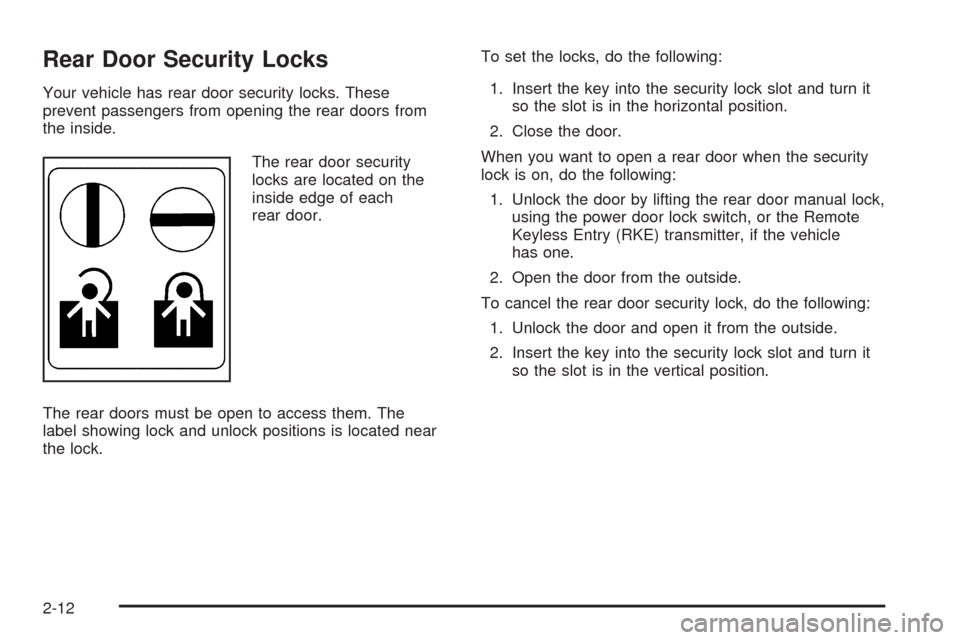
The rear door security
locks are located on the
inside edge of each
rear door.
The rear doors must be open to access them. The
label showing lock and unlock positions is located near
the lock.To set the locks, do the following:
1. Insert the key into the security lock slot and turn it
so the slot is in the horizontal position.
2. Close the door.
When you want to open a rear door when the security
lock is on, do the following:
1. Unlock the door by lifting the rear door manual lock,
using the power door lock switch, or the Remote
Keyless Entry (RKE) transmitter, if the vehicle
has one.
2. Open the door from the outside.
To cancel the rear door security lock, do the following:
1. Unlock the door and open it from the outside.
2. Insert the key into the security lock slot and turn it
so the slot is in the vertical position.
2-12
Page 101 of 550
Rear Glass Removal and Storage
{CAUTION:
If the removable rear glass is not stored properly,
it could be thrown about the vehicle in a crash or
sudden maneuver. People in the vehicle could be
injured. Whenever you store the rear glass in the
vehicle, always be sure that it is stored securely in
the Midgate
®storage pocket.
Do not remove the rear glass when the rear defroster is
on. If you remove the rear glass with the rear defroster
on, you may see a discharge spark coming from
the latch area.To remove the rear glass do the following:
1. Fold the rear seats. SeeRear Seat Operation on
page 1-13for more information. The front seats
may have to be moved forward slightly to allow the
rear seats to fold completely.
Although the rear glass can be removed without
folding the rear seats, you will not be able to access
the rear glass storage pocket. Be sure to fold the
seats before removing the rear glass.
2-15
Page 104 of 550
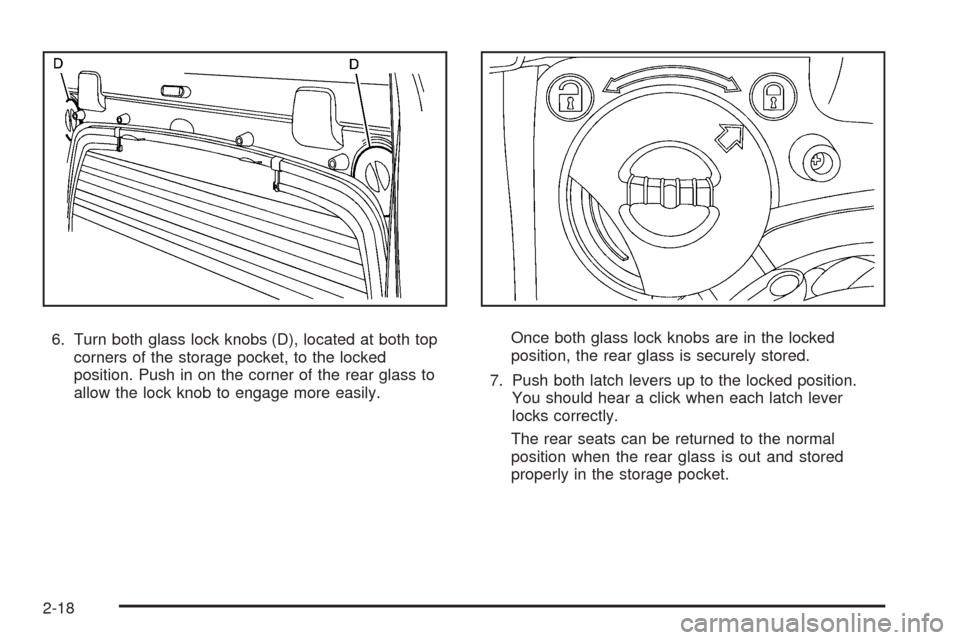
6. Turn both glass lock knobs (D), located at both top
corners of the storage pocket, to the locked
position. Push in on the corner of the rear glass to
allow the lock knob to engage more easily.Once both glass lock knobs are in the locked
position, the rear glass is securely stored.
7. Push both latch levers up to the locked position.
You should hear a click when each latch lever
locks correctly.
The rear seats can be returned to the normal
position when the rear glass is out and stored
properly in the storage pocket.
2-18
Page 107 of 550
To lower the Midgate®, do the following:
1. Fold the rear seats. The front seats might have to
be moved forward slightly to allow the rear seats to
fold. SeeRear Seat Operation on page 1-13for
more information.
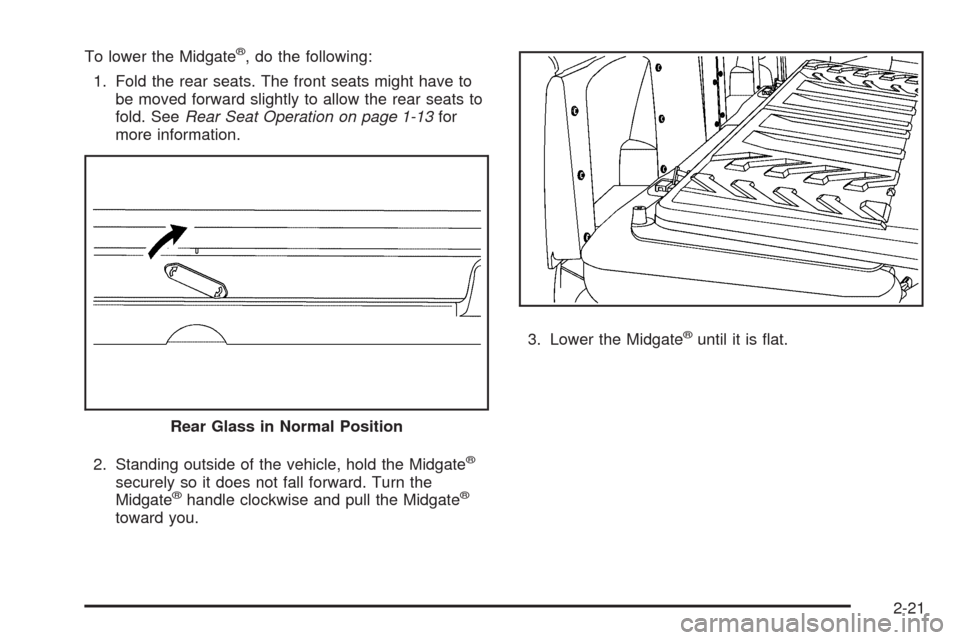
2. Standing outside of the vehicle, hold the Midgate
®
securely so it does not fall forward. Turn the
Midgate®handle clockwise and pull the Midgate®
toward you.3. Lower the Midgate
®until it is at.
Rear Glass in Normal Position
2-21
Page 109 of 550
Raising the Midgate®
To return the Midgate®to its normal position, raise the
Midgate®up with a rm swinging motion until it
latches into place securely. This will help to ensure that
the Midgate
®closes with enough force to engage
the latches.
If the rear glass is removed and you would like to put it
back, do so using the instructions given previously.
Tailgate
{CAUTION:
It is extremely dangerous to ride on the tailgate,
even when the vehicle is operated at low speeds.
People riding on the tailgate can easily lose their
balance and fall in response to vehicle maneuvers.
Falling from a moving vehicle may result in serious
injuries or death. Do not allow people to ride on
the tailgate. Be sure everyone in your vehicle is in
a seat and using a safety belt properly.Use the Remote Keyless Entry (RKE) transmitter or
power door lock switch to lock and unlock the tailgate.
Open the tailgate by lifting up on its handle while pulling
the tailgate toward you.
To shut the tailgate, push it rmly upward until it
latches. Push and pull on the tailgate to be sure it is
latched securely.
Tailgate Removal
The tailgate is not to be removed. This may cause
damage to electrical connector resulting in loss
of lock/unlock and rear vision camera function.
2-23
Page 114 of 550
Theft-Deterrent Systems
Vehicle theft is big business, especially in some cities.
This vehicle has theft-deterrent features, however,
they do not make it impossible to steal.
Content Theft-Deterrent
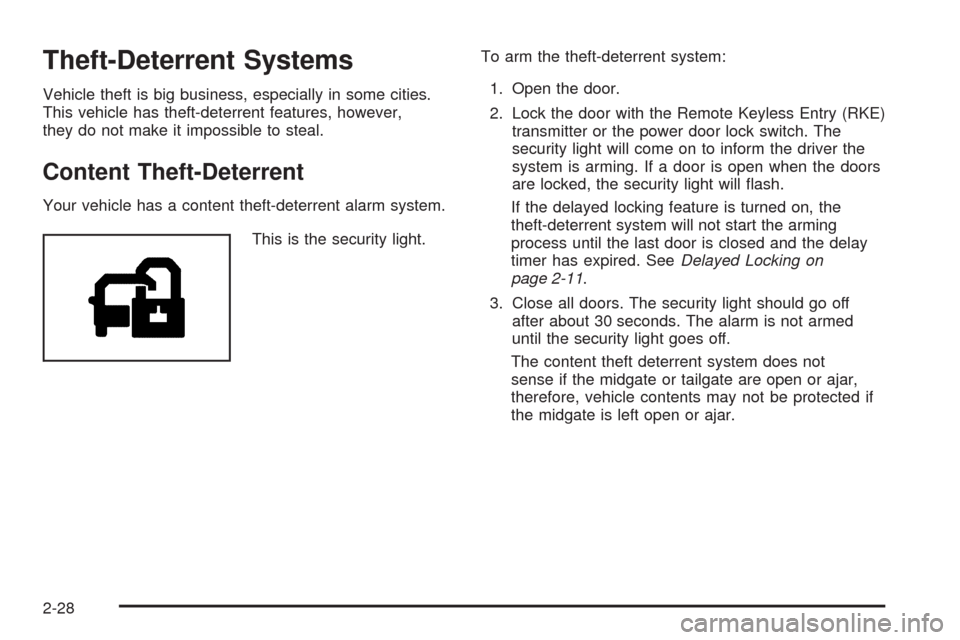
Your vehicle has a content theft-deterrent alarm system.
This is the security light.To arm the theft-deterrent system:
1. Open the door.
2. Lock the door with the Remote Keyless Entry (RKE)
transmitter or the power door lock switch. The
security light will come on to inform the driver the
system is arming. If a door is open when the doors
are locked, the security light will ash.
If the delayed locking feature is turned on, the
theft-deterrent system will not start the arming
process until the last door is closed and the delay
timer has expired. SeeDelayed Locking on
page 2-11.
3. Close all doors. The security light should go off
after about 30 seconds. The alarm is not armed
until the security light goes off.
The content theft deterrent system does not
sense if the midgate or tailgate are open or ajar,
therefore, vehicle contents may not be protected if
the midgate is left open or ajar.
2-28