air condition CHEVROLET AVALANCHE 2011 2.G Service Manual
[x] Cancel search | Manufacturer: CHEVROLET, Model Year: 2011, Model line: AVALANCHE, Model: CHEVROLET AVALANCHE 2011 2.GPages: 528, PDF Size: 7.65 MB
Page 415 of 528
Black plate (43,1)Chevrolet Avalanche Owner Manual - 2011
Vehicle Care 10-43
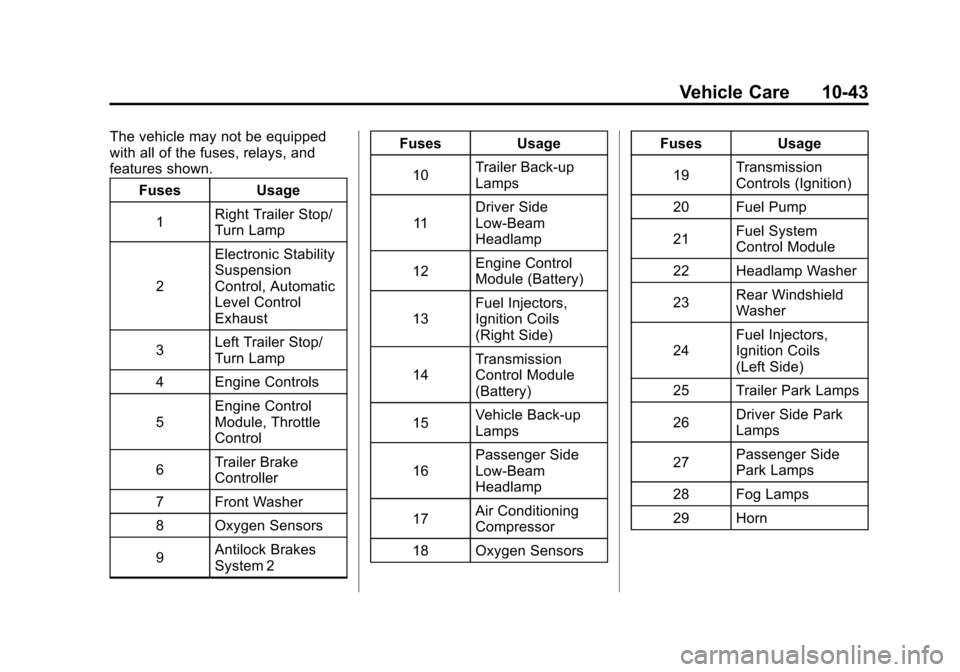
The vehicle may not be equipped
with all of the fuses, relays, and
features shown.Fuses Usage
1 Right Trailer Stop/
Turn Lamp
2 Electronic Stability
Suspension
Control, Automatic
Level Control
Exhaust
3 Left Trailer Stop/
Turn Lamp
4 Engine Controls
5 Engine Control
Module, Throttle
Control
6 Trailer Brake
Controller
7 Front Washer
8 Oxygen Sensors
9 Antilock Brakes
System 2 Fuses Usage
10 Trailer Back-up
Lamps
11 Driver Side
Low-Beam
Headlamp
12 Engine Control
Module (Battery)
13 Fuel Injectors,
Ignition Coils
(Right Side)
14 Transmission
Control Module
(Battery)
15 Vehicle Back-up
Lamps
16 Passenger Side
Low-Beam
Headlamp
17 Air Conditioning
Compressor
18 Oxygen Sensors Fuses Usage
19 Transmission
Controls (Ignition)
20 Fuel Pump
21 Fuel System
Control Module
22 Headlamp Washer
23 Rear Windshield
Washer
24 Fuel Injectors,
Ignition Coils
(Left Side)
25 Trailer Park Lamps
26 Driver Side Park
Lamps
27 Passenger Side
Park Lamps
28 Fog Lamps
29 Horn
Page 417 of 528
Black plate (45,1)Chevrolet Avalanche Owner Manual - 2011
Vehicle Care 10-45
J-CaseFuses Usage
57 Cooling Fan 1
58 Automatic Level
Control
Compressor
59 Heavy Duty
Antilock Brake
System
60 Cooling Fan 2
61 Antilock Brake
System 1
62 Starter
63 Stud 2
(Trailer Brakes)
64 Left Bussed
Electrical Center 1 J-Case
Fuses Usage
65 Electric Running
Boards
66 Heated Windshield
Washer System
67 Transfer Case
68 Stud 1
(Trailer Connector
Battery Power)
69 Mid-Bussed
Electrical Center 1
70 Climate Control
Blower
71 Power Liftgate
Module
72 Left Bussed
Electrical Center 2 Relays Usage
FAN HI Cooling Fan High
Speed
FAN LO Cooling Fan Low
Speed
FAN CNTRL Cooling Fan
Control
HDLP
LO/HID Low-Beam
Headlamp
FOG LAMP Front Fog Lamps
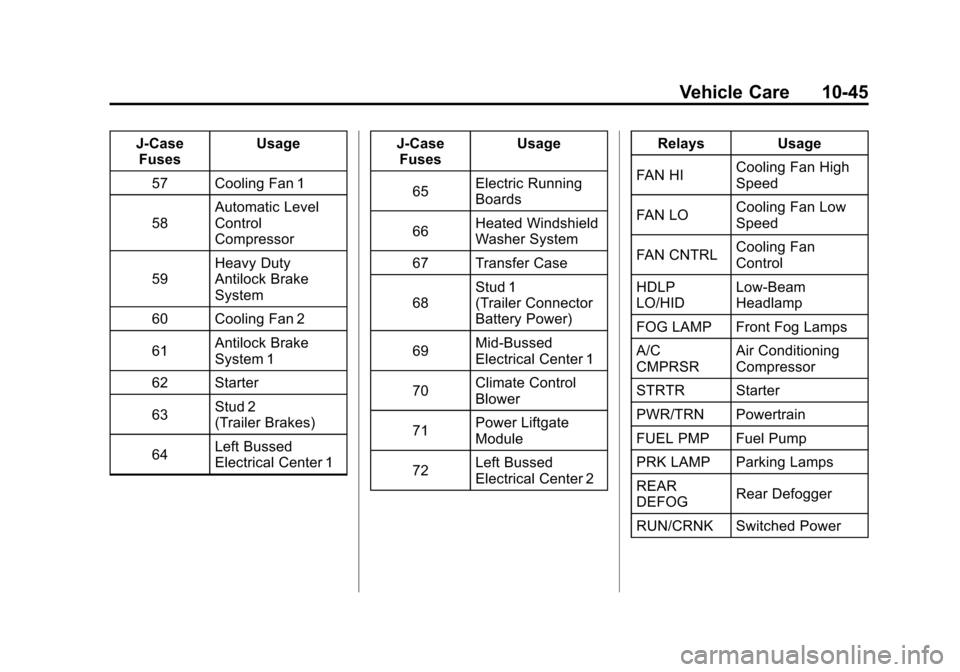
A/C
CMPRSR Air Conditioning
Compressor
STRTR Starter
PWR/TRN Powertrain
FUEL PMP Fuel Pump
PRK LAMP Parking Lamps
REAR
DEFOG Rear Defogger
RUN/CRNK Switched Power
Page 427 of 528

Black plate (55,1)Chevrolet Avalanche Owner Manual - 2011
Vehicle Care 10-55
Tire Terminology and
Definitions
Air Pressure:The amount of
air inside the tire pressing
outward on each square inch of
the tire. Air pressure is
expressed in psi (pounds per
square inch) or kPa (kilopascal).
Accessory Weight
:This
means the combined weight
of optional accessories.
Some examples of optional
accessories are, automatic
transmission, power steering,
power brakes, power windows,
power seats, and air
conditioning.
Aspect Ratio
:The relationship
of a tire's height to its width.
Belt
:A rubber coated layer of
cords that is located between
the plies and the tread. Cords
may be made from steel or other
reinforcing materials. Bead
:The tire bead contains
steel wires wrapped by steel
cords that hold the tire onto
the rim.
Bias Ply Tire
:A pneumatic tire
in which the plies are laid at
alternate angles less than
90 degrees to the centerline of
the tread.
Cold Tire Pressure
:The
amount of air pressure in a tire,
measured in kPa (kilopascal)
or psi (pounds per square inch)
before a tire has built up heat
from driving. See Tire Pressure
on page 10‑58.
Curb Weight
:The weight of a
motor vehicle with standard and
optional equipment including the
maximum capacity of fuel, oil,
and coolant, but without
passengers and cargo. DOT Markings
:A code molded
into the sidewall of a tire
signifying that the tire is in
compliance with the U.S.
Department of Transportation
(DOT) motor vehicle safety
standards. The DOT code
includes the Tire Identification
Number (TIN), an alphanumeric
designator which can also
identify the tire manufacturer,
production plant, brand, and
date of production.
GVWR
:Gross Vehicle Weight
Rating. See Vehicle Load Limits
on page 9‑24.
GAWR FRT
:Gross Axle Weight
Rating for the front axle. See
Vehicle Load Limits on
page 9‑24.
GAWR RR
:Gross Axle Weight
Rating for the rear axle. See
Vehicle Load Limits on
page 9‑24.
Page 433 of 528
Black plate (61,1)Chevrolet Avalanche Owner Manual - 2011
Vehicle Care 10-61
Tire Pressure Monitor
Operation
This vehicle may have a Tire
Pressure Monitor System (TPMS).
The TPMS is designed to warn the
driver when a low tire pressure
condition exists. TPMS sensors are
mounted onto each tire and wheel
assembly, excluding the spare tire
and wheel assembly. The TPMS
sensors monitor the air pressure in
the vehicle's tires and transmit the
tire pressure readings to a receiver
located in the vehicle.
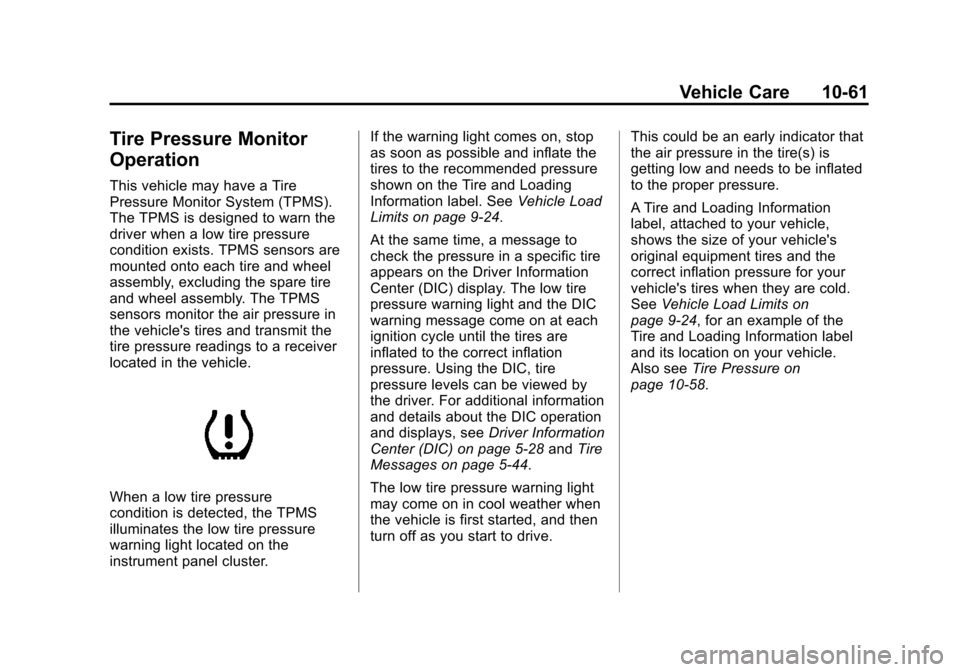
When a low tire pressure
condition is detected, the TPMS
illuminates the low tire pressure
warning light located on the
instrument panel cluster.If the warning light comes on, stop
as soon as possible and inflate the
tires to the recommended pressure
shown on the Tire and Loading
Information label. See
Vehicle Load
Limits on page 9‑24.
At the same time, a message to
check the pressure in a specific tire
appears on the Driver Information
Center (DIC) display. The low tire
pressure warning light and the DIC
warning message come on at each
ignition cycle until the tires are
inflated to the correct inflation
pressure. Using the DIC, tire
pressure levels can be viewed by
the driver. For additional information
and details about the DIC operation
and displays, see Driver Information
Center (DIC) on page 5‑28 andTire
Messages on page 5‑44.
The low tire pressure warning light
may come on in cool weather when
the vehicle is first started, and then
turn off as you start to drive. This could be an early indicator that
the air pressure in the tire(s) is
getting low and needs to be inflated
to the proper pressure.
A Tire and Loading Information
label, attached to your vehicle,
shows the size of your vehicle's
original equipment tires and the
correct inflation pressure for your
vehicle's tires when they are cold.
See
Vehicle Load Limits on
page 9‑24, for an example of the
Tire and Loading Information label
and its location on your vehicle.
Also see Tire Pressure on
page 10‑58.
Page 435 of 528
Black plate (63,1)Chevrolet Avalanche Owner Manual - 2011
Vehicle Care 10-63
.Operating electronic devices or
being near facilities using radio
wave frequencies similar to the
TPMS could cause the TPMS
sensors to malfunction.
If the TPMS is not functioning it
cannot detect or signal a low tire
condition. See your dealer for
service if the TPMS malfunction
light and DIC message come on
and stay on.
TPMS Sensor Matching
Process
Each TPMS sensor has a unique
identification code. Any time you
rotate your vehicle's tires or replace
one or more of the TPMS sensors,
the identification codes will need to
be matched to the new tire/wheel
position. The sensors are matched
to the tire/wheel positions in the
following order: driver side front tire,
passenger side front tire, passenger
side rear tire, and driver side rear
tire using a TPMS diagnostic tool.
See your dealer for service. The TPMS sensors can also be
matched to each tire/wheel position
by increasing or decreasing the
tire's air pressure. If increasing the
tire's air pressure, do not exceed
the maximum inflation pressure
indicated on the tire's sidewall.
To decrease air pressure out of a
tire you can use the pointed end of
the valve cap, a pencil-style air
pressure gauge, or a key.
You have two minutes to match
the first tire/wheel position, and
five minutes overall to match all
four tire/wheel positions. If it takes
longer than two minutes to match
the first tire and wheel, or more than
five minutes to match all four tire
and wheel positions, the matching
process stops and you need to
start over.
The TPMS sensor matching process
is outlined below:
1. Set the parking brake.
2. Turn the ignition switch to
ON/RUN with the engine off. 3. Press the Remote Keyless
Entry (RKE) transmitter's lock
and unlock buttons at the
same time for approximately
five seconds. The horn sounds
twice to signal the receiver is in
relearn mode and the TIRE
LEARNING ACTIVE message
displays on the DIC screen.
4. Start with the driver side front tire.
5. Remove the valve cap from the valve cap stem. Activate the
TPMS sensor by increasing or
decreasing the tire's air pressure
for five seconds, or until a horn
chirp sounds. The horn chirp,
which may take up to
30 seconds to sound, confirms
that the sensor identification
code has been matched to this
tire and wheel position.
6. Proceed to the passenger side front tire, and repeat the
procedure in Step 5.
Page 443 of 528
Black plate (71,1)Chevrolet Avalanche Owner Manual - 2011
Vehicle Care 10-71
Wheel Replacement
Replace any wheel that is bent,
cracked, or badly rusted or
corroded. If wheel nuts keep coming
loose, the wheel, wheel bolts, and
wheel nuts should be replaced.
If the wheel leaks air, replace it,
except some aluminum wheels,
which can sometimes be repaired.
See your dealer if any of these
conditions exist.
Your dealer will know the kind of
wheel you need.
Each new wheel should have the
same load-carrying capacity,
diameter, width, offset, and be
mounted the same way as the one it
replaces.If you need to replace any of the
wheels, wheel bolts, wheel nuts,
or Tire Pressure Monitor System
(TPMS) sensors, replace them only
with new GM original equipment
parts. This way, you will be sure to
have the right wheel, wheel bolts,
wheel nuts, and TPMS sensors for
the vehicle.
{WARNING
Using the wrong replacement
wheels, wheel bolts, or wheel
nuts on your vehicle can be
dangerous. It could affect the
braking and handling of your
vehicle, make your tires lose air
and make you lose control. You
could have a collision in which
you or others could be injured.
Always use the correct wheel,
wheel bolts, and wheel nuts for
replacement.Notice:
The wrong wheel can
also cause problems with bearing
life, brake cooling, speedometer
or odometer calibration,
headlamp aim, bumper height,
vehicle ground clearance, and tire
or tire chain clearance to the
body and chassis.
See If a Tire Goes Flat on
page 10‑73 for more information.
Used Replacement Wheels
{WARNING
Putting a used wheel on the
vehicle is dangerous. You cannot
know how it has been used or
how far it has been driven.
It could fail suddenly and cause a
crash. If you have to replace a
wheel, use a new GM original
equipment wheel.
Page 472 of 528
Black plate (100,1)Chevrolet Avalanche Owner Manual - 2011
10-100 Vehicle Care
Protecting Exterior Bright Metal
Parts
Bright metal parts should be
cleaned regularly to keep their
luster. Washing with water is all that
is usually needed. However, chrome
polish may be used on chrome or
stainless steel trim, if necessary.
Use special care with aluminum
trim. To avoid damaging protective
trim, never use auto or chrome
polish, steam or caustic soap to
clean aluminum. A coating of
wax, rubbed to high polish, is
recommended for all bright metal
parts.
Windshield and Wiper Blades
Clean the outside of the windshield
with glass cleaner.
Clean the rubber blades using a lint
free cloth or paper towel soaked
with windshield washer fluid or a
mild detergent. Wash the windshield
thoroughly when cleaning the
blades. Bugs, road grime, sap
and a buildup of vehicle wash/waxtreatments may cause wiper
streaking. Replace the wiper blades
if they are worn or damaged.
Wipers can be damaged by:
.Extreme dusty conditions
.Sand and salt
.Heat and sun
.Snow and ice, without proper
removal
Aluminum or Chrome-Plated
Wheels and Trim
The vehicle may have either
aluminum or chrome-plated wheels.
Keep the wheels clean using a soft
clean cloth with mild soap and
water. Rinse with clean water. After
rinsing thoroughly, dry with a soft
clean towel. A wax may then be
applied.
Notice:
Chrome wheels and other
chrome trim may be damaged if
the vehicle is not washed after
driving on roads that have been
sprayed with magnesium, calcium or sodium chloride. These
chlorides are used on roads for
conditions such as ice and dust.
Always wash the vehicle's
chrome with soap and water
after exposure.
Notice:
Using strong soaps,
chemicals, abrasive polishes,
cleaners, brushes, or cleaners
that contain acid on aluminum or
chrome-plated wheels, could
damage the surface of the
wheel(s). The repairs would not
be covered by the vehicle
warranty. Use only approved
cleaners on aluminum or
chrome-plated wheels.
The surface of these wheels is
similar to the painted surface of the
vehicle. Do not use strong soaps,
chemicals, abrasive polishes,
abrasive cleaners, cleaners with
acid, or abrasive cleaning brushes
on them because they could
damage the surface. Do not use
chrome polish on aluminum wheels.
Page 474 of 528
Black plate (102,1)Chevrolet Avalanche Owner Manual - 2011
10-102 Vehicle Care
At least every spring, flush these
materials from the underbody with
plain water. Clean any areas where
mud and debris can collect. Dirt
packed in close areas of the frame
should be loosened before being
flushed. Your dealer or an
underbody car washing system can
do this.
Underbody Maintenance
Chemicals used for ice and snow
removal and dust control can collect
on the underbody. If these are not
removed, corrosion and rust can
develop on the underbody parts
such as fuel lines, frame, floor pan,
and exhaust system even though
they have corrosion protection.At least every spring, flush these
materials from the underbody with
plain water. Clean any areas where
mud and debris can collect. Dirt
packed in close areas of the frame
should be loosened before being
flushed. Your dealer or an
underbody car washing system
can do this.
Chemical Paint Spotting
Some weather and atmospheric
conditions can create a chemical
fallout. Airborne pollutants can fall
upon and attack painted surfaces on
the vehicle. This damage can take
two forms: blotchy, ring-shaped
discolorations, and small, irregular
dark spots etched into the paint
surface.
Although no defect in the paint job
causes this, we will repair, at no
charge to the owner, the surfaces of
new vehicles damaged by this
fallout condition within 12 months or
20 000 km (12,000 miles) of
purchase, whichever occurs first.
Interior Care
The vehicle's interior will continue to
look its best if it is cleaned often.
Dust and dirt can accumulate on the
upholstery and cause damage to
the carpet, fabric, leather, and
plastic surfaces. Stains should be
removed quickly as extreme heat
could cause them to set rapidly.
Lighter colored interiors may
require more frequent cleaning.
Newspapers and garments that can
transfer color to home furnishings
can also transfer color to the
vehicle's interior.
Remove dust from small buttons
and knobs with a small brush with
soft bristles.
Your dealer has products for
cleaning the vehicle's interior. When
cleaning the vehicle's interior, only
use cleaners specifically designed
for the surfaces that are being
cleaned. Permanent damage can
result from using cleaners on
surfaces for which they were
not intended.
Page 479 of 528
Black plate (1,1)Chevrolet Avalanche Owner Manual - 2011
Service and Maintenance 11-1
Service and
Maintenance
General Information
General Information . . . . . . . . . . 11-1
Scheduled Maintenance
Scheduled Maintenance . . . . . 11-2
Recommended Fluids,
Lubricants, and Parts
Recommended Fluids andLubricants . . . . . . . . . . . . . . . . . . 11-6
Maintenance Replacement Parts . . . . . . . . . . . . . . . . . . . . . . . 11-8
Maintenance Records
Maintenance Records . . . . . . . . 11-9
General Information
Notice: Maintenance intervals,
checks, inspections,
recommended fluids, and
lubricants are necessary to keep
this vehicle in good working
condition. Damage caused by
failure to follow scheduled
maintenance might not be
covered by the vehicle warranty.
As the vehicle owner, you are
responsible for the scheduled
maintenance in this section. We
recommend having your dealer
perform these services. Proper
vehicle maintenance helps to keep
the vehicle in good working
condition, improves fuel economy,
and reduces vehicle emissions for
better air quality.
Because of all the different ways
people use vehicles, maintenance
needs vary. The vehicle might need
more frequent checks and services. Please read the information under
Scheduled Maintenance. To keep
the vehicle in good condition, see
your dealer.
The maintenance schedule is for
vehicles that:
.Carry passengers and cargo
within recommended limits on
the Tire and Loading Information
label. See
Vehicle Load Limits
on page 9‑24.
.Are driven on reasonable road
surfaces within legal driving
limits.
.Are driven off-road in the
recommended manner. See
Off-Road Driving on page 9‑7.
.Use the recommended fuel.
See Recommended Fuel on
page 9‑68.
Page 483 of 528
Black plate (5,1)Chevrolet Avalanche Owner Manual - 2011
Service and Maintenance 11-5
Check to be sure vent hose is
unobstructed, clear, and free of
debris. During any maintenance,
if a power washer is used to
clean mud and dirt from the
underbody, care should be taken
to not directly spray the transfer
case output seals. High pressure
water can overcome the seals
and contaminate the transfer
case fluid. Contaminated fluid
will decrease the life of the
transfer case and should
be replaced.
.Evaporative control system
inspection. Check all fuel and
vapor lines and hoses for proper
hook‐up, routing, and condition.
Check that the purge valve,
if the vehicle has one, works
properly. Replace as needed.
An Emission Control Service.
The U.S. Environmental
Protection Agency or the
California Air Resources Board
has determined that the failure
to perform this maintenance item
will not nullify the emissionwarranty or limit recall liability
prior to the completion of the
vehicle's useful life. We,
however, urge that all
recommended maintenance
services be performed at the
indicated intervals and the
maintenance be recorded.
First Engine Oil Change After
Every 160 000 km/100,000 Miles
.Automatic transmission fluid
change (normal service). See
Automatic Transmission Fluid on
page 10‑12.
.Four‐wheel drive only: Transfer
case fluid change (normal
service). Check vent hose at
transfer case for kinks and
proper installation. Check to be
sure vent hose is unobstructed,
clear, and free of debris. During
any maintenance, if a power
washer is used to clean mud
and dirt from the underbody,
care should be taken to not
directly spray the transfer case
output seals. High pressure water can
overcome the seals and
contaminate the transfer case
fluid. Contaminated fluid will
decrease the life of the transfer
case and should be replaced.
.Spark plug replacement and
spark plug wires inspection.
An Emission Control Service.
First Engine Oil Change After
Every 240 000 km/150,000 Miles
.Engine cooling system drain,
flush, and refill (or every
five years, whichever occurs
first). See Engine Coolant on
page 10‑19. An Emission
Control Service.
.Engine drive belts inspection
for fraying, excessive cracks,
or obvious damage (or every
10 years, whichever occurs
first). Replace, if needed.