ignition CHEVROLET AVEO 2002 Service Service Manual
[x] Cancel search | Manufacturer: CHEVROLET, Model Year: 2002, Model line: AVEO, Model: CHEVROLET AVEO 2002Pages: 5127, PDF Size: 41.82 MB
Page 1614 of 5127
If you drive regularly in steep country, or if you are
planning to visit there, here are some tips that can make
your trips safer and more enjoyable.
•Keep your vehicle in good shape. Check all fluid
levels and also the brakes, tires, cooling system
and transaxle. These parts can work hard on
mountain roads.
•Know how to go down hills. The most important
thing to know is this: let your engine do some of
the slowing down. Shift to a lower gear when you
go down a steep or long hill.
{CAUTION:
If you do not shift down, your brakes could get
so hot that they would not work well. You would
then have poor braking or even none going
down a hill. You could crash. Shift down to let
your engine assist your brakes on a steep
downhill slope.
{CAUTION:
Coasting downhill in NEUTRAL (N) or with the
ignition off is dangerous. Your brakes will have
to do all the work of slowing down. They could
get so hot that they would not work well. You
would then have poor braking or even none
going down a hill. You could crash. Always
have your engine running and your vehicle in
gear when you go downhill.
•Know how to go uphill. Drive in the highest gear
possible.
•Stay in your own lane when driving on two-lane
roads in hills or mountains. Do not swing wide
or cut across the center of the road. Drive at speeds
that let you stay in your own lane.
•As you go over the top of a hill, be alert. There could
be something in your lane, like a stalled car or an
accident.
•You may see highway signs on mountains that warn
of special problems. Examples are long grades,
passing or no-passing zones, a falling rocks area or
winding roads. Be alert to these and take appropriate
action.
4-23
Page 1622 of 5127
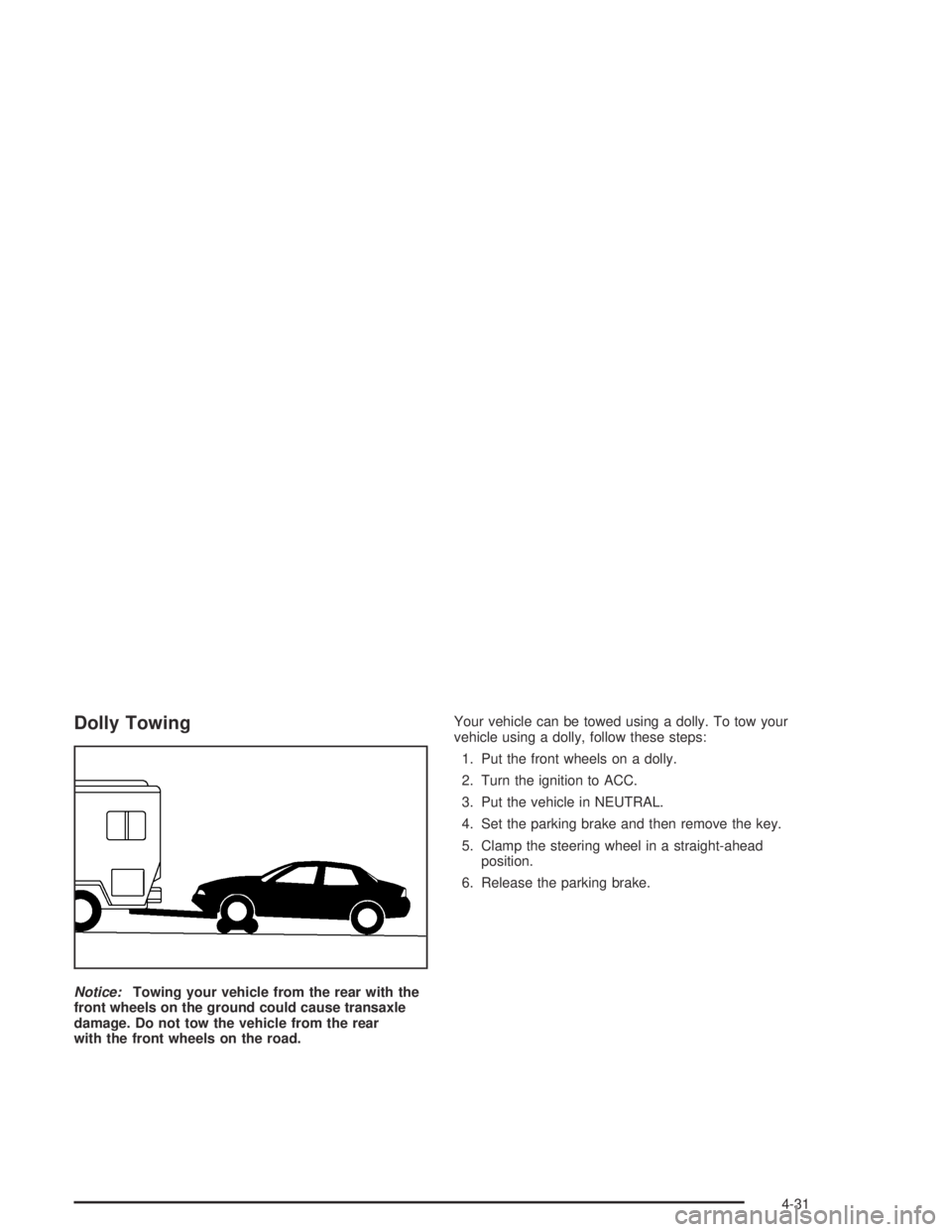
Dolly Towing
Notice:Towing your vehicle from the rear with the
front wheels on the ground could cause transaxle
damage. Do not tow the vehicle from the rear
with the front wheels on the road.Your vehicle can be towed using a dolly. To tow your
vehicle using a dolly, follow these steps:
1. Put the front wheels on a dolly.
2. Turn the ignition to ACC.
3. Put the vehicle in NEUTRAL.
4. Set the parking brake and then remove the key.
5. Clamp the steering wheel in a straight-ahead
position.
6. Release the parking brake.
4-31
Page 1670 of 5127
3. Turn off the ignition on both vehicles. Unplug
unnecessary accessories plugged into the cigarette
lighter or in the accessory power outlet. Turn off
the radio and all lamps that are not needed. This will
avoid sparks and help save both batteries. And it
could save your radio!
4. Open the hoods and locate the batteries. Find the
positive (+) and negative (−) terminal locations on
each vehicle. Your vehicle’s positive (+) terminal
is located under a red tethered cap on the battery.
SeeEngine Compartment Overview on page 5-14
for more information on location.
Flip the cap up to access the positive (+) terminal.
{CAUTION:
An electric fan can start up even when the
engine is not running and can injure you.
Keep hands, clothing and tools away from
any underhood electric fan.
{CAUTION:
Using a match near a battery can cause battery
gas to explode. People have been hurt doing
this, and some have been blinded. Use a
ashlight if you need more light.
Be sure the battery has enough water. You do
not need to add water to the battery installed
in your new vehicle. But if a battery has ller
caps, be sure the right amount of uid is there.
If it is low, add water to take care of that rst.
If you don’t, explosive gas could be present.
Battery uid contains acid that can burn you.
Do not get it on you. If you accidentally get it
in your eyes or on your skin, ush the place
with water and get medical help immediately.
5-41
Page 1716 of 5127
Fuses Usage
DIS,
INJECTORDirect Ignition System, Injector
ABS, ENG
FUSEAntilock Brake System, Engine Fuse
AIRBAG Air Bag
HVAC
BLOWERHVAC Blower
BLANK Not Used
BLANK Not Used
BLANK Not Used
BLANK Not Used
BLANK Not Used
BLANK Not Used
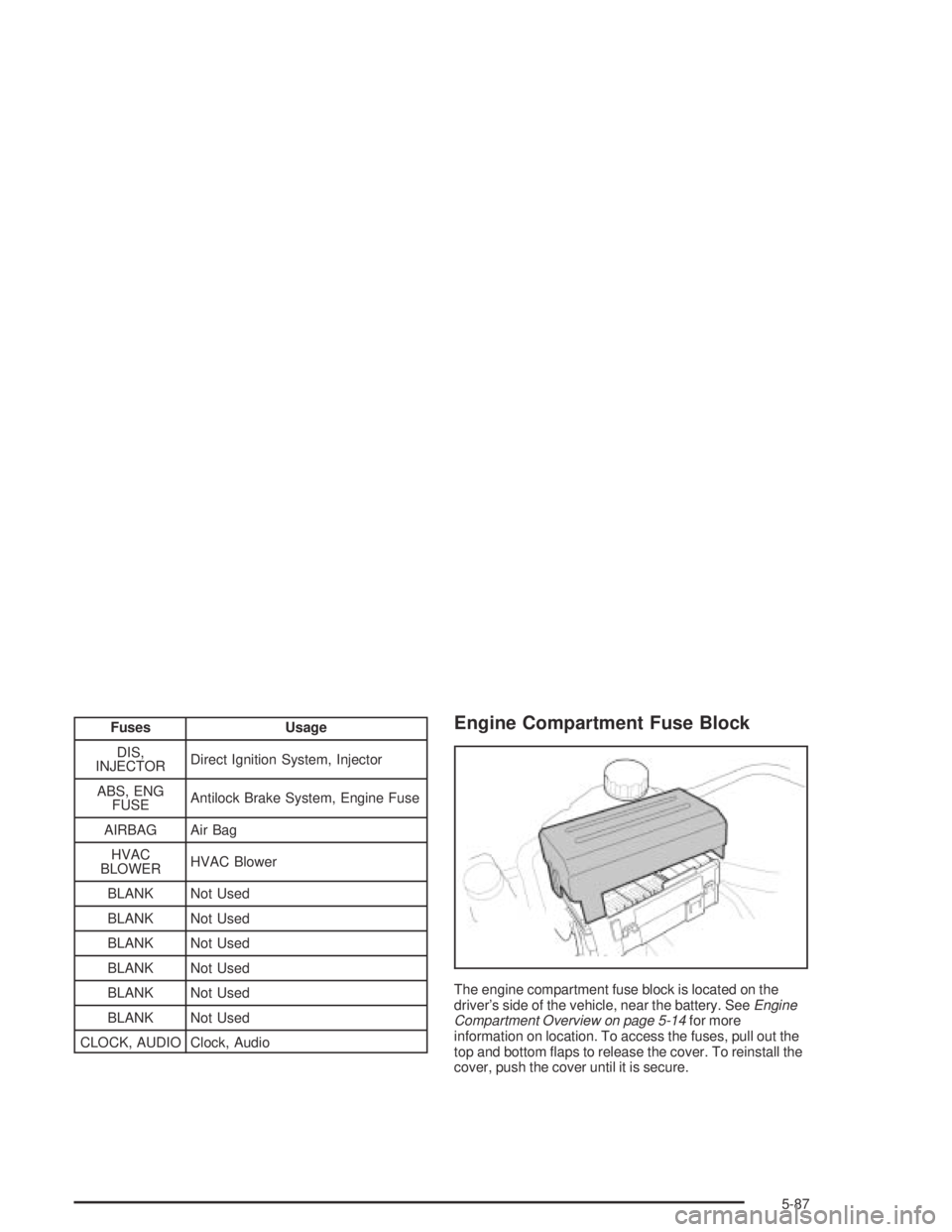
CLOCK, AUDIO Clock, AudioEngine Compartment Fuse Block
The engine compartment fuse block is located on the
driver’s side of the vehicle, near the battery. SeeEngine
Compartment Overview on page 5-14for more
information on location. To access the fuses, pull out the
top and bottom flaps to release the cover. To reinstall the
cover, push the cover until it is secure.
5-87
Page 1718 of 5127

Fuses Usage
H/L HI RH Head Lamp High Right Side
BLANK Not Used
H/L HI LH Head Lamp High Left Side
BLANK Not Used
H/L LOW RH Head Lamp Low Right Side
ILL RHParking Lamp Right Side,
Illumination Circuit
H/L LOW LH Head Lamp Low Left Side
ILL LHParking Lamp Left Side, License
Plate Lamp
ROOM LAMP Room Lamp
BLANK Not Used
DEFOG Defogger
SUN ROOF Sunroof
ILL LAMP Illumination RelayFuses Usage
HORN Horn
HEAD LAMP Headlamp
FUEL PUMP Fuel Pump
A/C COMP Air Conditioning Compressor
FRT FOG Front Fog Lamp
BLOWER Blower
ABS Antilock Brake System
IP F/BOX Instrument Panel Fuse Box
RAD’ FAN Radiator Fan
IGN 2 Ignition 2
IGN 1 Ignition 1
POWER
WINDOWPower Windows
FUSE SPARE Spare Fuse
5-89
Page 1743 of 5127

Automatic Transaxle Shift Lock Control
System Check
{CAUTION:
When you are doing this inspection, the vehicle
could move suddenly. If the vehicle moves, you
or others could be injured.
1. Before you start, be sure you have enough room
around the vehicle. It should be parked on a level
surface.
2. Firmly apply the parking brake. SeeParking Brake
on page 2-28if necessary.
Be ready to apply the regular brake immediately if
the vehicle begins to move.
3. With the engine off, turn the key to the RUN position,
but do not start the engine. Without applying the
regular brake, try to move the shift lever out of
PARK (P) with normal effort. If the shift lever moves
out of PARK (P), your vehicle needs service.
Ignition Transaxle Lock Check
While parked, and with the parking brake set, try to turn
the ignition key to LOCK in each shift lever position.
•With an automatic transaxle, the key should turn to
LOCK only when the shift lever is in PARK (P).
•With a manual transaxle, the key should turn to
LOCK only when you press the key release
button.
On all vehicles, the key should come out only in LOCK.
Turn the steering wheel to the left and to the right. It
should only lock when turned to the right.
6-22
Page 1770 of 5127

I
If No Steam Is Coming From Your Engine..........5-27
If Steam Is Coming From Your Engine...............5-26
If the Light Is Flashing.....................................3-30
If the Light Is On Steady.................................3-30
If You Are Caught in a Blizzard.........................4-26
If You Are Stuck in Sand, Mud, Ice or Snow.......4-28
Ignition Positions.............................................2-19
Ignition Transaxle Lock Check..........................6-22
Immobilizer....................................................2-17
Immobilizer Operation......................................2-17
Infants and Young Children, Restraints...............1-30
Inflation - Tire Pressure...................................5-59
Inspection
Brake System.............................................6-25
Engine Cooling System................................6-25
Exhaust System..........................................6-24
Fuel System...............................................6-25
Part C - Periodic Maintenance.......................6-24
Steering, Suspension and Front Drive Axle
Boot and Seal.........................................6-24
Throttle System...........................................6-25
Instrument Panel
Cluster.......................................................3-18
Overview..................................................... 3-2
Instrument Panel Brightness.............................3-10
Instrument Panel Fuse Block............................5-85
Interior Lamps................................................3-10
J
Jump Starting.................................................5-40
K
Key Lock Cylinders Service..............................6-21
Keyless Entry System....................................... 2-4
Keys............................................................... 2-2
L
Lamps
Exterior........................................................ 3-8
Fog Lamps.................................................5-48
Interior.......................................................3-10
Lamps On Reminder......................................... 3-8
Lap-Shoulder Belt...................................1-15, 1-23
LATCH System
Child Restraints...........................................1-41
Securing a Child Restraint Designed for
the LATCH System...................................1-44
Leaving Your Vehicle.......................................2-10
Leaving Your Vehicle With the
Engine Running..........................................2-29
Liftgate..........................................................2-12
7
Page 1835 of 5127
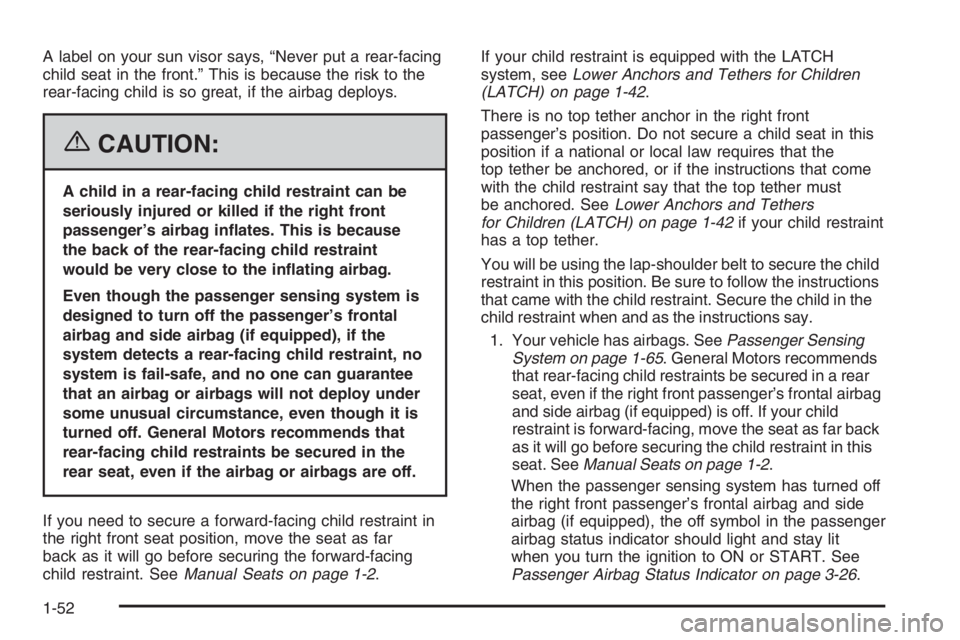
A label on your sun visor says, “Never put a rear-facing
child seat in the front.” This is because the risk to the
rear-facing child is so great, if the airbag deploys.
{CAUTION:
A child in a rear-facing child restraint can be
seriously injured or killed if the right front
passenger’s airbag inates. This is because
the back of the rear-facing child restraint
would be very close to the inating airbag.
Even though the passenger sensing system is
designed to turn off the passenger’s frontal
airbag and side airbag (if equipped), if the
system detects a rear-facing child restraint, no
system is fail-safe, and no one can guarantee
that an airbag or airbags will not deploy under
some unusual circumstance, even though it is
turned off. General Motors recommends that
rear-facing child restraints be secured in the
rear seat, even if the airbag or airbags are off.
If you need to secure a forward-facing child restraint in
the right front seat position, move the seat as far
back as it will go before securing the forward-facing
child restraint. SeeManual Seats on page 1-2.If your child restraint is equipped with the LATCH
system, seeLower Anchors and Tethers for Children
(LATCH) on page 1-42.
There is no top tether anchor in the right front
passenger’s position. Do not secure a child seat in this
position if a national or local law requires that the
top tether be anchored, or if the instructions that come
with the child restraint say that the top tether must
be anchored. SeeLower Anchors and Tethers
for Children (LATCH) on page 1-42if your child restraint
has a top tether.
You will be using the lap-shoulder belt to secure the child
restraint in this position. Be sure to follow the instructions
that came with the child restraint. Secure the child in the
child restraint when and as the instructions say.
1. Your vehicle has airbags. SeePassenger Sensing
System on page 1-65. General Motors recommends
that rear-facing child restraints be secured in a rear
seat, even if the right front passenger’s frontal airbag
and side airbag (if equipped) is off. If your child
restraint is forward-facing, move the seat as far back
as it will go before securing the child restraint in this
seat. SeeManual Seats on page 1-2.
When the passenger sensing system has turned off
the right front passenger’s frontal airbag and side
airbag (if equipped), the off symbol in the passenger
airbag status indicator should light and stay lit
when you turn the ignition to ON or START. See
Passenger Airbag Status Indicator on page 3-26.
1-52
Page 1848 of 5127
In many crashes severe enough to inflate an airbag,
windshields are broken by vehicle deformation.
Additional windshield breakage may also occur from the
right front passenger airbag.
•Airbags are designed to inflate only once. After an
airbag inflates, you will need some new parts for
your airbag system. If you do not get them,
the airbag system will not be there to help protect
you in another crash. A new system will include
airbag modules and possibly other parts. The
service manual for your vehicle covers the need to
replace other parts.
•Your vehicle is equipped with a crash sensing and
diagnostic module which records information after
a crash. SeeVehicle Data Collection and Event
Data Recorders on page 7-10.
•Let only qualified technicians work on your airbag
system. Improper service can mean that an
airbag system will not work properly. See your
dealer for service.
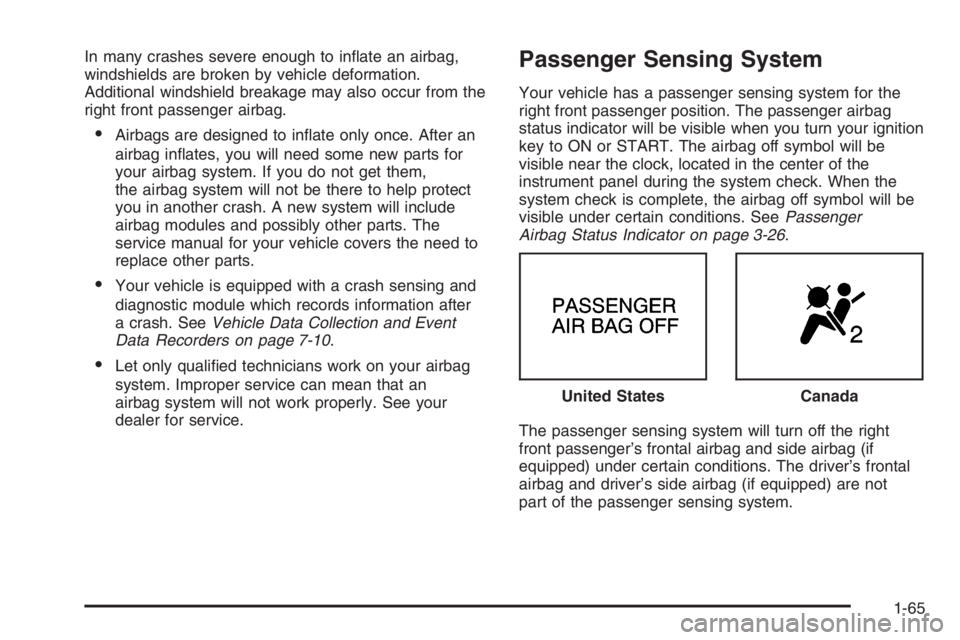
Passenger Sensing System
Your vehicle has a passenger sensing system for the
right front passenger position. The passenger airbag
status indicator will be visible when you turn your ignition
key to ON or START. The airbag off symbol will be
visible near the clock, located in the center of the
instrument panel during the system check. When the
system check is complete, the airbag off symbol will be
visible under certain conditions. SeePassenger
Airbag Status Indicator on page 3-26.
The passenger sensing system will turn off the right
front passenger’s frontal airbag and side airbag (if
equipped) under certain conditions. The driver’s frontal
airbag and driver’s side airbag (if equipped) are not
part of the passenger sensing system.United States
Canada
1-65
Page 1852 of 5127
{CAUTION:
If the airbag readiness light in the instrument
panel cluster ever comes on and stays on, it
means that something may be wrong with the
airbag system. If this ever happens, have the
vehicle serviced promptly, because an
adult-size person sitting in the right front
passenger’s seat may not have the protection
of the frontal airbag and side airbag (if
equipped). SeeAirbag Readiness Light on
page 3-32for more on this, including important
safety information.
A thick layer of additional material such as a blanket,
or aftermarket equipment such as seat covers, seat
heaters and seat massagers can affect how well
the passenger sensing system operates. Remove any
additional material from the seat cushion before
reinstalling or securing the child restraint or small
occupant. You may want to consider not using seat
covers or other aftermarket equipment if your vehicle
has the passenger sensing system. SeeAdding
Equipment to Your Airbag-Equipped Vehicle on
page 1-70for more information about modifications
that can affect how the system operates.
Servicing Your Airbag-Equipped
Vehicle
Airbags affect how your vehicle should be serviced.
There are parts of the airbag system in several places
around your vehicle. You do not want the system to
inflate while someone is working on your vehicle.
Your dealer and the service manual have information
about servicing your vehicle and the airbag system.
To purchase a service manual, seeService Publications
Ordering Information on page 7-15.
{CAUTION:
For up to 10 seconds after the ignition key is
turned off and the battery is disconnected, an
airbag can still inate during improper service.
You can be injured if you are close to an
airbag when it inates. Avoid yellow
connectors. They are probably part of the
airbag system. Be sure to follow proper
service procedures, and make sure the person
performing work for you is qualied to do so.
The airbag system does not need regular maintenance.
1-69