brakes CHEVROLET AVEO 2002 Service Workshop Manual
[x] Cancel search | Manufacturer: CHEVROLET, Model Year: 2002, Model line: AVEO, Model: CHEVROLET AVEO 2002Pages: 5127, PDF Size: 41.82 MB
Page 2053 of 5127
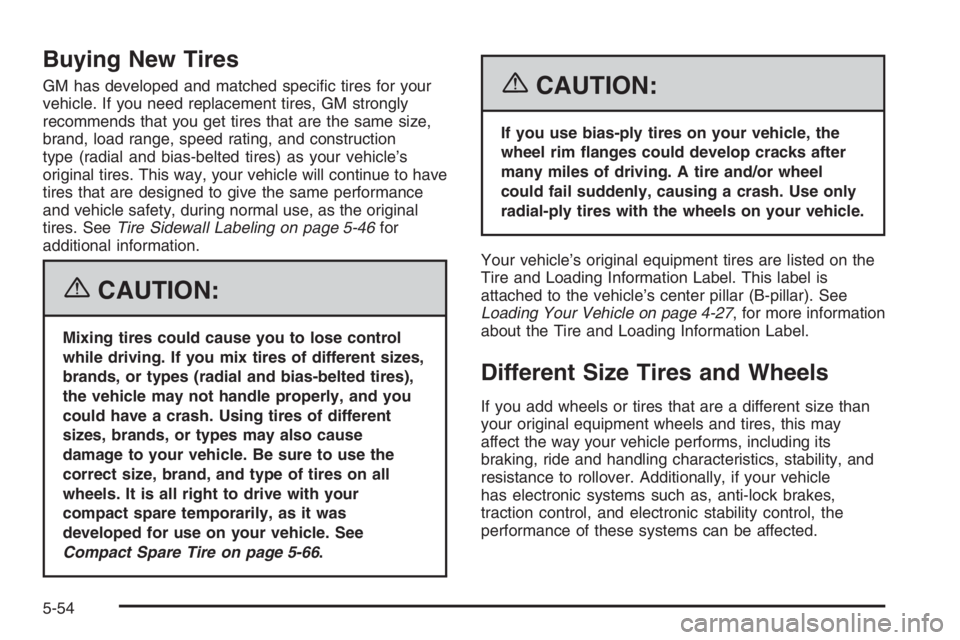
Buying New Tires
GM has developed and matched specific tires for your
vehicle. If you need replacement tires, GM strongly
recommends that you get tires that are the same size,
brand, load range, speed rating, and construction
type (radial and bias-belted tires) as your vehicle’s
original tires. This way, your vehicle will continue to have
tires that are designed to give the same performance
and vehicle safety, during normal use, as the original
tires. SeeTire Sidewall Labeling on page 5-46for
additional information.
{CAUTION:
Mixing tires could cause you to lose control
while driving. If you mix tires of different sizes,
brands, or types (radial and bias-belted tires),
the vehicle may not handle properly, and you
could have a crash. Using tires of different
sizes, brands, or types may also cause
damage to your vehicle. Be sure to use the
correct size, brand, and type of tires on all
wheels. It is all right to drive with your
compact spare temporarily, as it was
developed for use on your vehicle. See
Compact Spare Tire on page 5-66.
{CAUTION:
If you use bias-ply tires on your vehicle, the
wheel rim anges could develop cracks after
many miles of driving. A tire and/or wheel
could fail suddenly, causing a crash. Use only
radial-ply tires with the wheels on your vehicle.
Your vehicle’s original equipment tires are listed on the
Tire and Loading Information Label. This label is
attached to the vehicle’s center pillar (B-pillar). See
Loading Your Vehicle on page 4-27, for more information
about the Tire and Loading Information Label.
Different Size Tires and Wheels
If you add wheels or tires that are a different size than
your original equipment wheels and tires, this may
affect the way your vehicle performs, including its
braking, ride and handling characteristics, stability, and
resistance to rollover. Additionally, if your vehicle
has electronic systems such as, anti-lock brakes,
traction control, and electronic stability control, the
performance of these systems can be affected.
5-54
Page 2088 of 5127

Footnotes
† The U.S. Environmental Protection Agency or the
California Air Resources Board has determined that the
failure to perform this maintenance item will not nullify
the emission warranty or limit recall liability prior to
the completion of the vehicle’s useful life. We, however,
urge that all recommended maintenance services be
performed at the indicated intervals and the
maintenance be recorded.
+ A good time to check your brakes is during tire
rotation. See Brake System Inspection on page 6-24 .
3,000 Miles (5 000 km)
❑Change engine oil and filter (or every 3 months,
whichever occurs first). An Emission Control Service.
6,000 Miles (10 000 km)
❑Change engine oil and filter (or every 3 months,
whichever occurs first). An Emission Control Service.
❑ Rotate tires. See Tire Inspection and Rotation
on page 5-52 for proper rotation pattern and
additional information. (See footnote +.)
9,000 Miles (15 000 km)
❑Change engine oil and filter (or every 3 months,
whichever occurs first). An Emission Control Service.
12,000 Miles (20 000 km)
❑Change engine oil and filter (or every 3 months,
whichever occurs first). An Emission Control Service.
❑ Rotate tires. See Tire Inspection and Rotation
on page 5-52 for proper rotation pattern and
additional information. (See footnote +.)
15,000 Miles (25 000 km)
❑Change engine oil and filter (or every 3 months,
whichever occurs first). An Emission Control Service.
❑ Replace passenger compartment air filter. If you drive
regularly under dusty conditions, the filter may
require replacement more often.
❑ Inspect engine air cleaner filter. If necessary, replace
the filter. If vehicle is driven in dusty/dirty conditions,
inspect filter at every engine oil change. See
Engine Air Cleaner/Filter on page 5-17 for more
information.
❑ Inspect drive belt(s).
6-7
Page 2094 of 5127

❑ Inspect EVAP canister, vapor lines, and EVAP vent
solenoid valve. An Emission Control Service.
(See footnote †.)
❑ Inspect PCV system. An Emission Control Service.
(See footnote †.)
❑ Change brake/clutch fluid (or every 24 months,
whichever occurs first).
93,000 Miles (155 000 km)
❑ Change engine oil and filter (or every 3 months,
whichever occurs first). An Emission Control Service.
96,000 Miles (160 000 km)
❑Change engine oil and filter (or every 3 months,
whichever occurs first). An Emission Control Service.
❑ Rotate tires. See Tire Inspection and Rotation
on page 5-52 for proper rotation pattern and
additional information. (See footnote +.)
99,000 Miles (165 000 km)
❑Change engine oil and filter (or every 3 months,
whichever occurs first). An Emission Control Service.
Long Trip/Highway Scheduled
Maintenance
The services shown in this schedule up to 100,000 miles
(166 000 km) should be repeated after 100,000 miles
(166 000 km) at the same intervals for the life of
this vehicle.
See Part B: Owner Checks and Services on page 6-18
and Part C: Periodic Maintenance Inspections on
page 6-23 .
Footnotes
†The U.S. Environmental Protection Agency or the
California Air Resources Board has determined that the
failure to perform this maintenance item will not nullify
the emission warranty or limit recall liability prior to
the completion of the vehicle’s useful life. We, however,
urge that all recommended maintenance services be
performed at the indicated intervals and the
maintenance be recorded.
+ A good time to check your brakes is during tire
rotation. See Brake System Inspection on page 6-24 .
6-13
Page 2105 of 5127
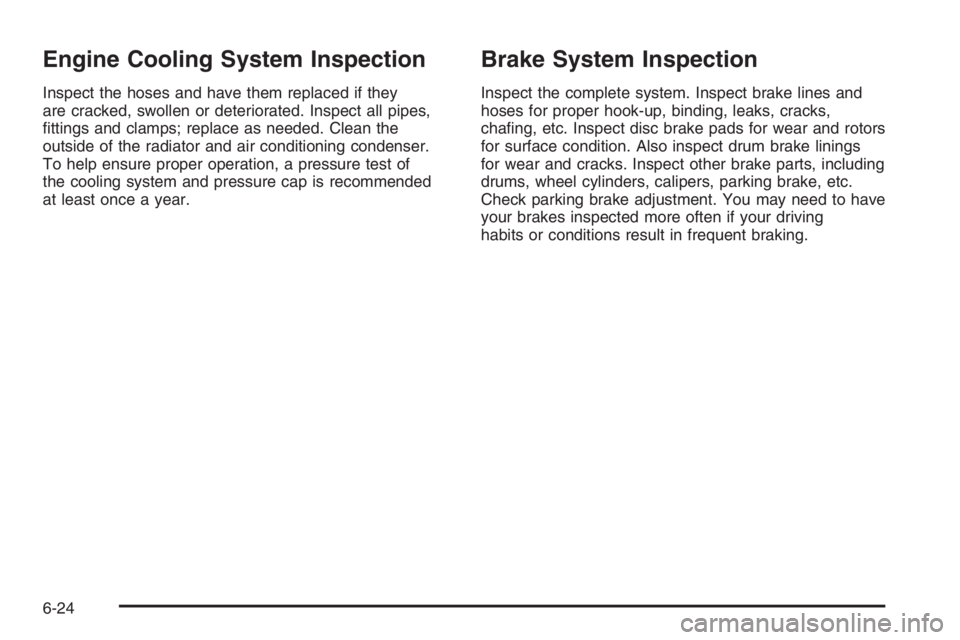
Engine Cooling System Inspection
Inspect the hoses and have them replaced if they
are cracked, swollen or deteriorated. Inspect all pipes,
fittings and clamps; replace as needed. Clean the
outside of the radiator and air conditioning condenser.
To help ensure proper operation, a pressure test of
the cooling system and pressure cap is recommended
at least once a year.
Brake System Inspection
Inspect the complete system. Inspect brake lines and
hoses for proper hook-up, binding, leaks, cracks,
chafing, etc. Inspect disc brake pads for wear and rotors
for surface condition. Also inspect drum brake linings
for wear and cracks. Inspect other brake parts, including
drums, wheel cylinders, calipers, parking brake, etc.
Check parking brake adjustment. You may need to have
your brakes inspected more often if your driving
habits or conditions result in frequent braking.
6-24
Page 2126 of 5127

Reporting Safety Defects to
General Motors
In addition to notifying NHTSA (or Transport Canada) in
a situation like this, we certainly hope you will notify
General Motors. Please call the Chevrolet Customer
Assistance Center at 1-800-222-1020, or write:
Chevrolet Motor Division
Chevrolet Customer Assistance Center
P.O. Box 33170
Detroit, MI 48232-5170
In Canada, please call us at 1-800-263-3777 (English)
or 1-800-263-7854 (French). Or, write:
General Motors of Canada Limited
Customer Communication Centre, 163-005
1908 Colonel Sam Drive
Oshawa, Ontario L1H 8P7
Service Publications Ordering
Information
Service Manuals
Service Manuals have the diagnosis and repair
information on engines, transmission, axle suspension,
brakes, electrical, steering, body, etc.
Transmission, Transaxle, Transfer
Case Unit Repair Manual
This manual provides information on unit repair service
procedures, adjustments, and specifications for GM
transmissions, transaxles, and transfer cases.
Service Bulletins
Service Bulletins give technical service information
needed to knowledgeably service General Motors cars
and trucks. Each bulletin contains instructions to
assist in the diagnosis and service of your vehicle.
In Canada, information pertaining to Product Service
Bulletins can be obtained by contacting your General
Motors dealer or by calling 1-800-GM-DRIVE
(1-800-463-7483).
7-15
Page 2129 of 5127
Automatic Transaxle
Fluid..........................................................5-19
Operation...................................................2-21
B
Battery..........................................................5-35
Before Leaving on a Long Trip.........................4-19
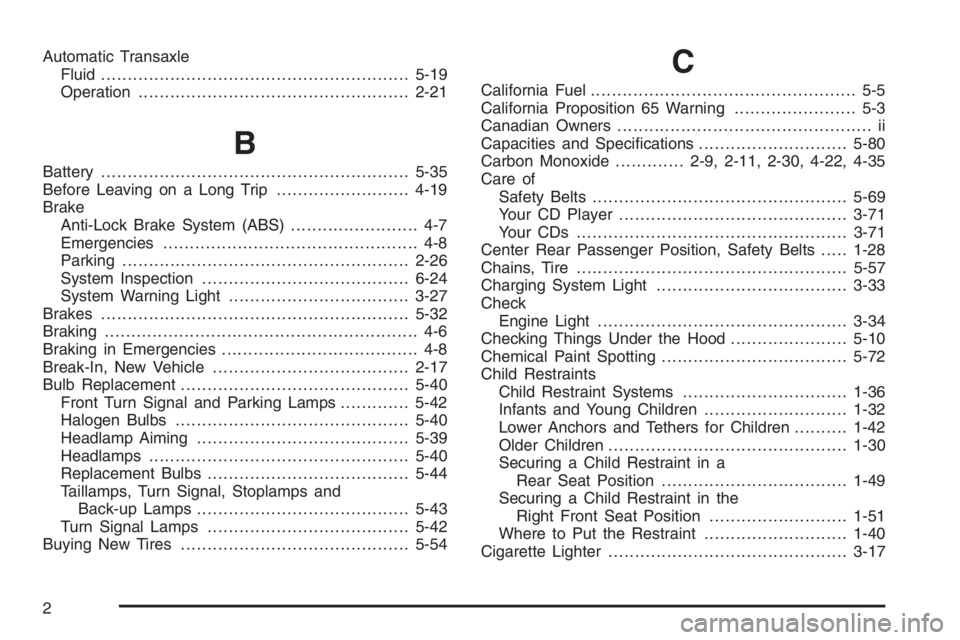
Brake
Anti-Lock Brake System (ABS)........................ 4-7
Emergencies................................................ 4-8
Parking......................................................2-26
System Inspection.......................................6-24
System Warning Light..................................3-27
Brakes..........................................................5-32
Braking........................................................... 4-6
Braking in Emergencies..................................... 4-8
Break-In, New Vehicle.....................................2-17
Bulb Replacement...........................................5-40
Front Turn Signal and Parking Lamps.............5-42
Halogen Bulbs............................................5-40
Headlamp Aiming........................................5-39
Headlamps.................................................5-40
Replacement Bulbs......................................5-44
Taillamps, Turn Signal, Stoplamps and
Back-up Lamps........................................5-43
Turn Signal Lamps......................................5-42
Buying New Tires...........................................5-54
C
California Fuel.................................................. 5-5
California Proposition 65 Warning....................... 5-3
Canadian Owners................................................ ii
Capacities and Specifications............................5-80
Carbon Monoxide.............2-9, 2-11, 2-30, 4-22, 4-35
Care of
Safety Belts................................................5-69
Your CD Player...........................................3-71
Your CDs ...................................................3-71
Center Rear Passenger Position, Safety Belts.....1-28
Chains, Tire...................................................5-57
Charging System Light....................................3-33
Check
Engine Light...............................................3-34
Checking Things Under the Hood......................5-10
Chemical Paint Spotting...................................5-72
Child Restraints
Child Restraint Systems...............................1-36
Infants and Young Children...........................1-32
Lower Anchors and Tethers for Children..........1-42
Older Children.............................................1-30
Securing a Child Restraint in a
Rear Seat Position...................................1-49
Securing a Child Restraint in the
Right Front Seat Position..........................1-51
Where to Put the Restraint...........................1-40
Cigarette Lighter.............................................3-17
2
Page 3015 of 5127

A. Front Planetary Gear
B. Rear Planetary Gear
Reverse Gear
1. The input shaft rotates clockwise.
The reverse clutch (C3) operates. Connect the input shaft to the rear planetary sun gear.
2. The planetary long pinion rotates itself counterclockwise.
3. The 1st and reverse brake (3) operates. Lock rotates the planetary carrier.
4. The ring gear rotates counterclockwise.
5. The counter drive gear rotates counterclockwise for the ring gear and one.
6. The counter driven gear rotates clockwise.
7. The differential gear drive pinion rotates clockwise for the counter driven gear and one.
8. The differential gear rotates counterclockwise.
Engine Brake
The driving force is connected to the input shaft directory without the 1-way clutch. Therefore the engine brake
operates.
TRANSMISSION GENERAL DESCRIPTION
The new automatic transmission AISIN (81-40LE) is an electronically controlled 4-speed automatic
transmission with lock-up mechanism.
The transmission is mainly composed of the torque converter with lock up clutch, newly developed 4-speed
planetary gear unit, the hydraulic control system and the electric control system.
Hydraulic Control System
Based on the hydraulic pressure created by the oil pump, the TCM sends signals to the solenoid and the
hydraulic control system governs the hydraulic pressure acting on the torque converter, planetary gear, clutches,
and brakes in accordance with the vehicle driving conditions.
Function of Components
NOTE: Lack of basic knowledge of this powertrain when performing diagnostic
procedures could result in incorrect diagnostic performance or damage to
powertrain components. Do not attempt to diagnose a powertrain problem
without this basic knowledge.
2006 Chevrolet Aveo
2006 TRANSMISSION Automatic Transaxle - Aisin (81-40LE) - Introduction (2 Of 2) - Aveo
Microsoft
Thursday, July 16, 2009 1:17:33 PMPage 466 © 2005 Mitchell Repair Information Company, LLC.
Page 3017 of 5127

Operations of Clutches and Brakes
Fig. 449: Operations Of Clutches And Brakes
Courtesy of GENERAL MOTORS CORP.
Operations of Clutches and Brakes
counterclockwise.
21st and Reverse BrakePrevents the planetary carrier from turning
either clockwise or counterclockwise.
8No. 1 One-Way ClutchWhen 4 is operating, this clutch prevents rear
sun gear from turning counterclockwise.
1No. 2 One-Way ClutchPrevents the planetary carrier from turning
counterclockwise.
Planetary Gear
These gears change the route through which
driving force is transmitted, in accordance
with the operation of each clutch and brake, in
order to increase or reduce the input and
output speed.
2006 Chevrolet Aveo
2006 TRANSMISSION Automatic Transaxle - Aisin (81-40LE) - Introduction (2 Of 2) - Aveo
Microsoft
Thursday, July 16, 2009 1:17:34 PMPage 468 © 2005 Mitchell Repair Information Company, LLC.