hood release CHEVROLET AVEO 2004 1.G Owners Manual
[x] Cancel search | Manufacturer: CHEVROLET, Model Year: 2004, Model line: AVEO, Model: CHEVROLET AVEO 2004 1.GPages: 334, PDF Size: 2.35 MB
Page 107 of 334
The main components of your instrument panel are the
following:
A. Air Outlet. SeeOutlet Adjustment on page 3-15.
B. Instrument Panel Cluster. SeeInstrument Panel
Cluster on page 3-18.
C. Digital Clock and Secondary Information Center.
SeeClock on page 3-25andSecondary Information
Center (SIC) on page 3-24.
D. Hazard Warning Flashers Button. SeeHazard
Warning Flashers on page 3-3.
E. Instrument Panel Brightness Control. See
“Instrument Panel Brightness” underInterior Lamps
on page 3-10.
F. Hood Release. SeeHood Release on page 5-11.
G. Horn. SeeHorn on page 3-4.
H. Audio System. SeeAudio System(s) on page 3-34.
I. Cupholder. SeeCupholder(s) on page 2-36.
J. Ashtray. SeeAshtrays and Cigarette Lighter on
page 3-12.
K. Cigarette Lighter. SeeAshtrays and Cigarette
Lighter on page 3-12.
L. Climate Control System. SeeClimate Control
System on page 3-12.
M. Glove Box. SeeGlove Box on page 2-36.Hazard Warning Flashers
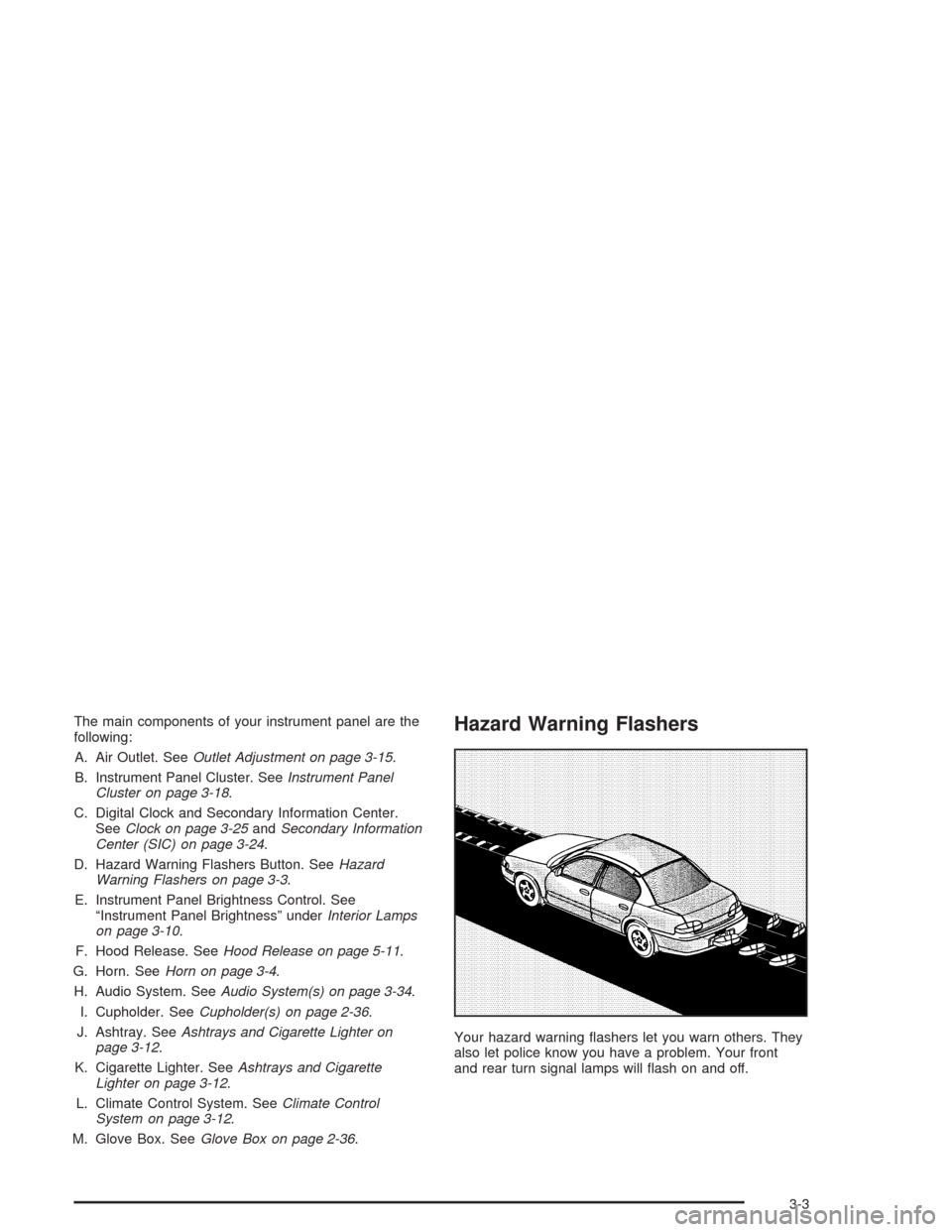
Your hazard warning flashers let you warn others. They
also let police know you have a problem. Your front
and rear turn signal lamps will flash on and off.
3-3
Page 187 of 334
Service............................................................5-3
Doing Your Own Service Work.........................5-4
Adding Equipment to the Outside of Your
Vehicle......................................................5-4
Fuel................................................................5-5
Gasoline Octane............................................5-5
Gasoline Specifications....................................5-5
California Fuel...............................................5-6
Additives.......................................................5-6
Fuels in Foreign Countries...............................5-7
Filling Your Tank............................................5-8
Filling a Portable Fuel Container.....................5-10
Checking Things Under the Hood....................5-11
Hood Release..............................................5-11
Engine Compartment Overview.......................5-14
Engine Oil...................................................5-15
Engine Air Cleaner/Filter................................5-20
Automatic Transaxle Fluid..............................5-21
Manual Transaxle Fluid..................................5-21
Hydraulic Clutch...........................................5-22
Engine Coolant.............................................5-23Coolant Surge Tank Pressure Cap..................5-25
Engine Overheating.......................................5-25
Cooling System............................................5-28
Power Steering Fluid.....................................5-34
Windshield Washer Fluid................................5-35
Brakes........................................................5-36
Battery........................................................5-39
Jump Starting...............................................5-40
Headlamp Aiming...........................................5-45
Bulb Replacement..........................................5-45
Halogen Bulbs..............................................5-45
Headlamps..................................................5-46
Front Turn Signal and Parking Lamps................5-46
Turn Signal Lamps (Side)..............................5-47
Fog Lamps..................................................5-48
Sidemarker Lamps (Front)..............................5-48
Sidemarker Lamps (Rear)..............................5-49
Taillamps, Turn Signal, Stoplamps and
Back-up Lamps.........................................5-49
Windshield Wiper Blade Replacement..............5-50
Section 5 Service and Appearance Care
5-1
Page 197 of 334
Checking Things Under
the Hood
{CAUTION:
An electric fan under the hood can start up
and injure you even when the engine is not
running. Keep hands, clothing and tools away
from any underhood electric fan.
{CAUTION:
Things that burn can get on hot engine parts
and start a re. These include liquids like fuel,
oil, coolant, brake uid, windshield washer
and other uids, and plastic or rubber. You or
others could be burned. Be careful not to drop
or spill things that will burn onto a hot engine.
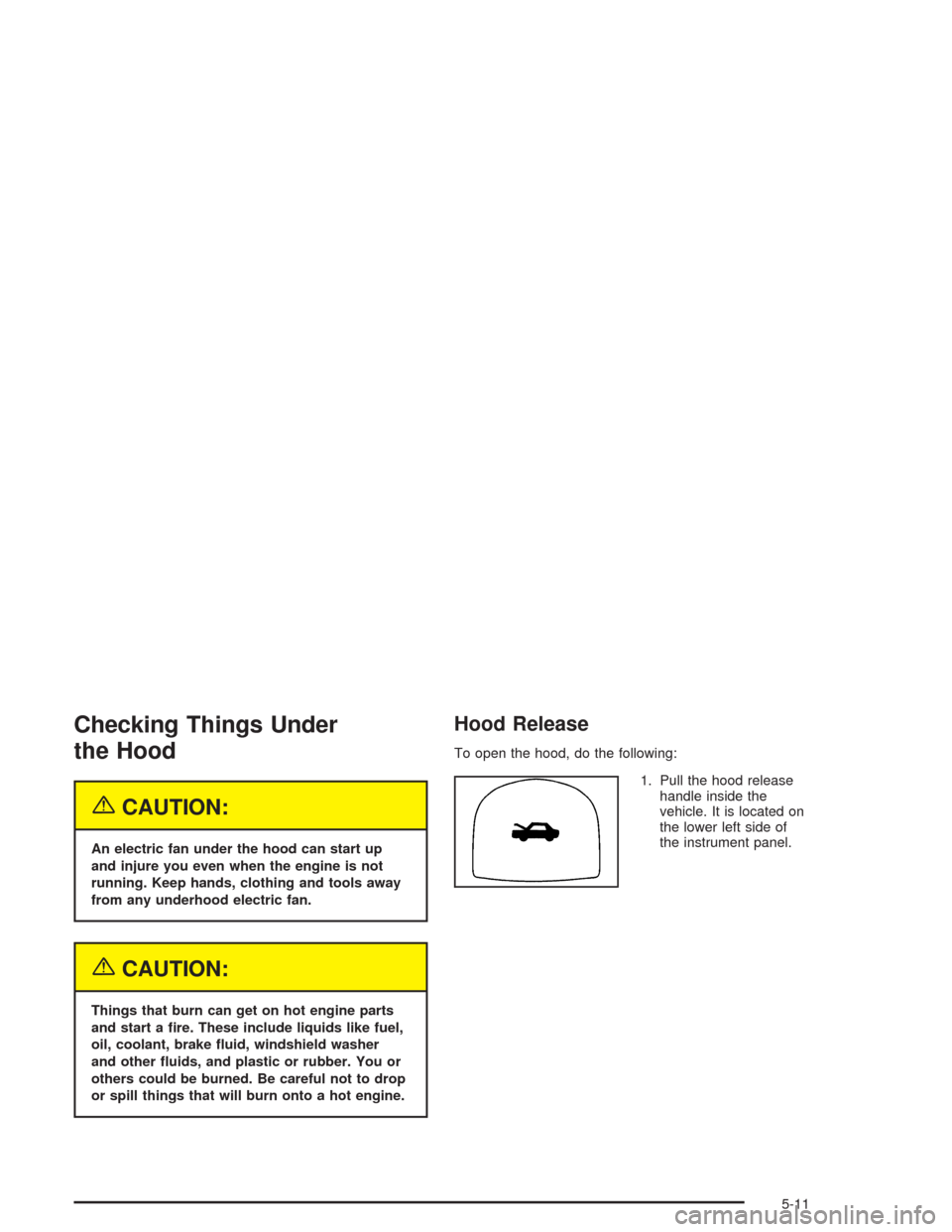
Hood Release
To open the hood, do the following:
1. Pull the hood release
handle inside the
vehicle. It is located on
the lower left side of
the instrument panel.
5-11
Page 198 of 334
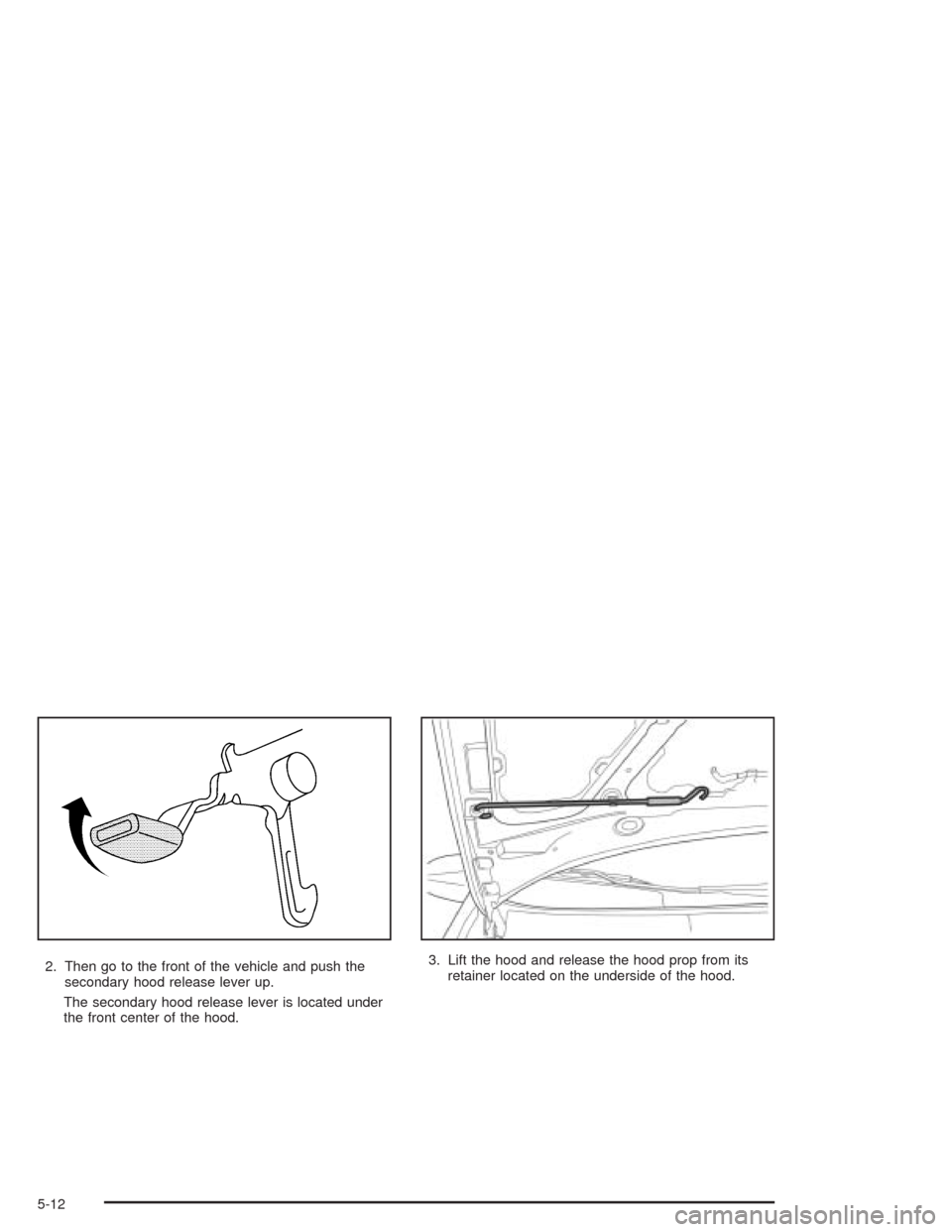
2. Then go to the front of the vehicle and push the
secondary hood release lever up.
The secondary hood release lever is located under
the front center of the hood.3. Lift the hood and release the hood prop from its
retainer located on the underside of the hood.
5-12
Page 199 of 334
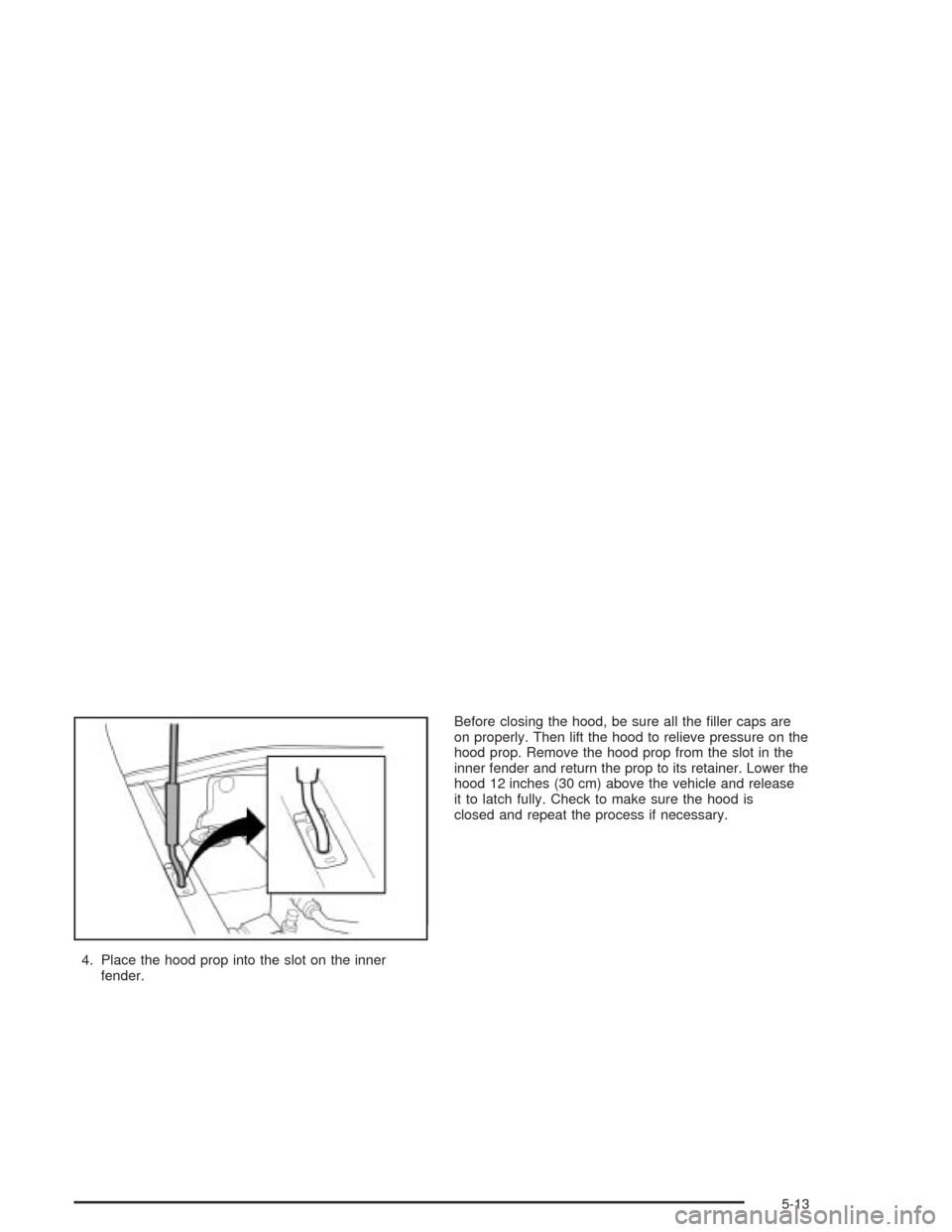
4. Place the hood prop into the slot on the inner
fender.Before closing the hood, be sure all the filler caps are
on properly. Then lift the hood to relieve pressure on the
hood prop. Remove the hood prop from the slot in the
inner fender and return the prop to its retainer. Lower the
hood 12 inches (30 cm) above the vehicle and release
it to latch fully. Check to make sure the hood is
closed and repeat the process if necessary.
5-13
Page 232 of 334
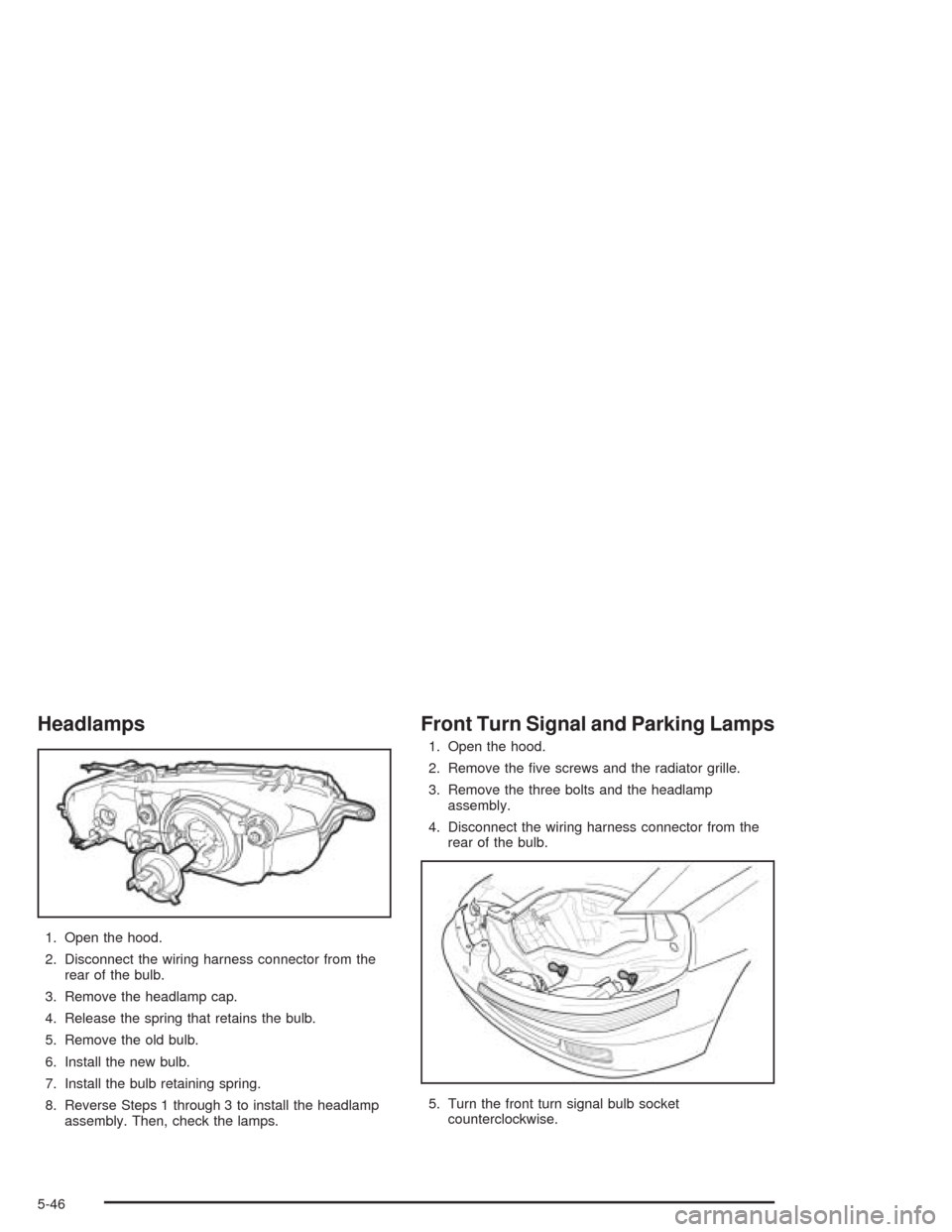
Headlamps
1. Open the hood.
2. Disconnect the wiring harness connector from the
rear of the bulb.
3. Remove the headlamp cap.
4. Release the spring that retains the bulb.
5. Remove the old bulb.
6. Install the new bulb.
7. Install the bulb retaining spring.
8. Reverse Steps 1 through 3 to install the headlamp
assembly. Then, check the lamps.
Front Turn Signal and Parking Lamps
1. Open the hood.
2. Remove the five screws and the radiator grille.
3. Remove the three bolts and the headlamp
assembly.
4. Disconnect the wiring harness connector from the
rear of the bulb.
5. Turn the front turn signal bulb socket
counterclockwise.
5-46
Page 299 of 334
At Least Once a Year
Key Lock Cylinders Service
Lubricate the key lock cylinders with the lubricant
specified in Part D.
Body Lubrication Service
Lubricate all hood latch assemblies, secondary latch,
pivots, spring anchor, release pawl, hood and body
door hinges, rear compartment and any folding seat
hardware. Part D tells you what to use. More frequent
lubrication may be required when exposed to a corrosive
environment.
Starter Switch Check
{CAUTION:
When you are doing this inspection, the vehicle
could move suddenly. If the vehicle moves,
you or others could be injured.
1. Before you start, be sure you have enough room
around the vehicle.
2. Firmly apply both the parking brake and the regular
brake. SeeParking Brake on page 2-28if necessary.
Do not use the accelerator pedal, and be ready to
turn off the engine immediately if it starts.
3. On automatic transaxle vehicles, try to start the
engine in each gear. The starter should work only in
PARK (P) or NEUTRAL (N). If the starter works in
any other position, your vehicle needs service.
On manual transaxle vehicles, put the shift lever
in NEUTRAL (N), push the clutch down halfway and
try to start the engine. The starter should work only
when the clutch is pushed down all the way to the
floor. If the starter works when the clutch is not
pushed all the way down, your vehicle needs service.
6-21
Page 305 of 334
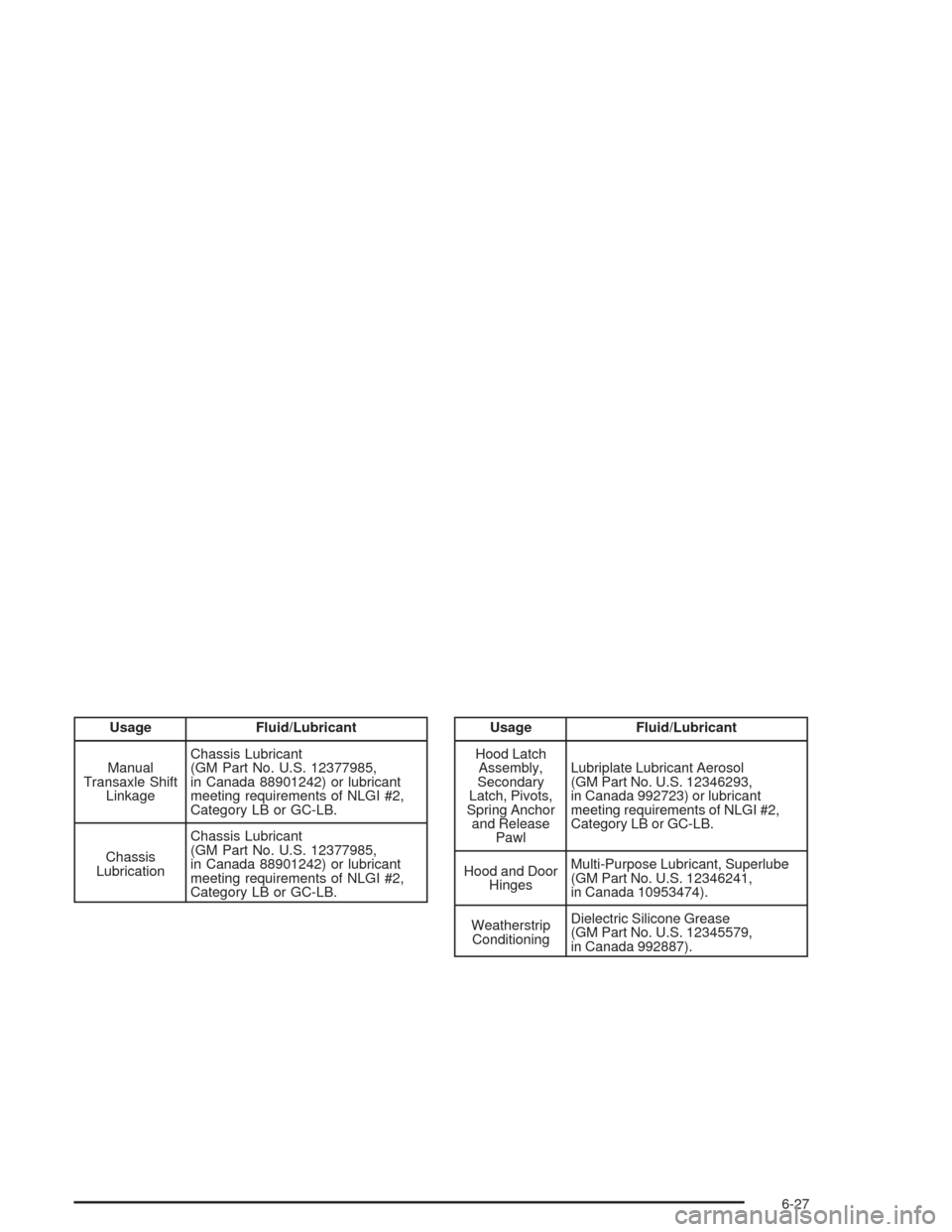
Usage Fluid/Lubricant
Manual
Transaxle Shift
LinkageChassis Lubricant
(GM Part No. U.S. 12377985,
in Canada 88901242) or lubricant
meeting requirements of NLGI #2,
Category LB or GC-LB.
Chassis
LubricationChassis Lubricant
(GM Part No. U.S. 12377985,
in Canada 88901242) or lubricant
meeting requirements of NLGI #2,
Category LB or GC-LB.Usage Fluid/Lubricant
Hood Latch
Assembly,
Secondary
Latch, Pivots,
Spring Anchor
and Release
PawlLubriplate Lubricant Aerosol
(GM Part No. U.S. 12346293,
in Canada 992723) or lubricant
meeting requirements of NLGI #2,
Category LB or GC-LB.
Hood and Door
HingesMulti-Purpose Lubricant, Superlube
(GM Part No. U.S. 12346241,
in Canada 10953474).
Weatherstrip
ConditioningDielectric Silicone Grease
(GM Part No. U.S. 12345579,
in Canada 992887).
6-27
Page 326 of 334
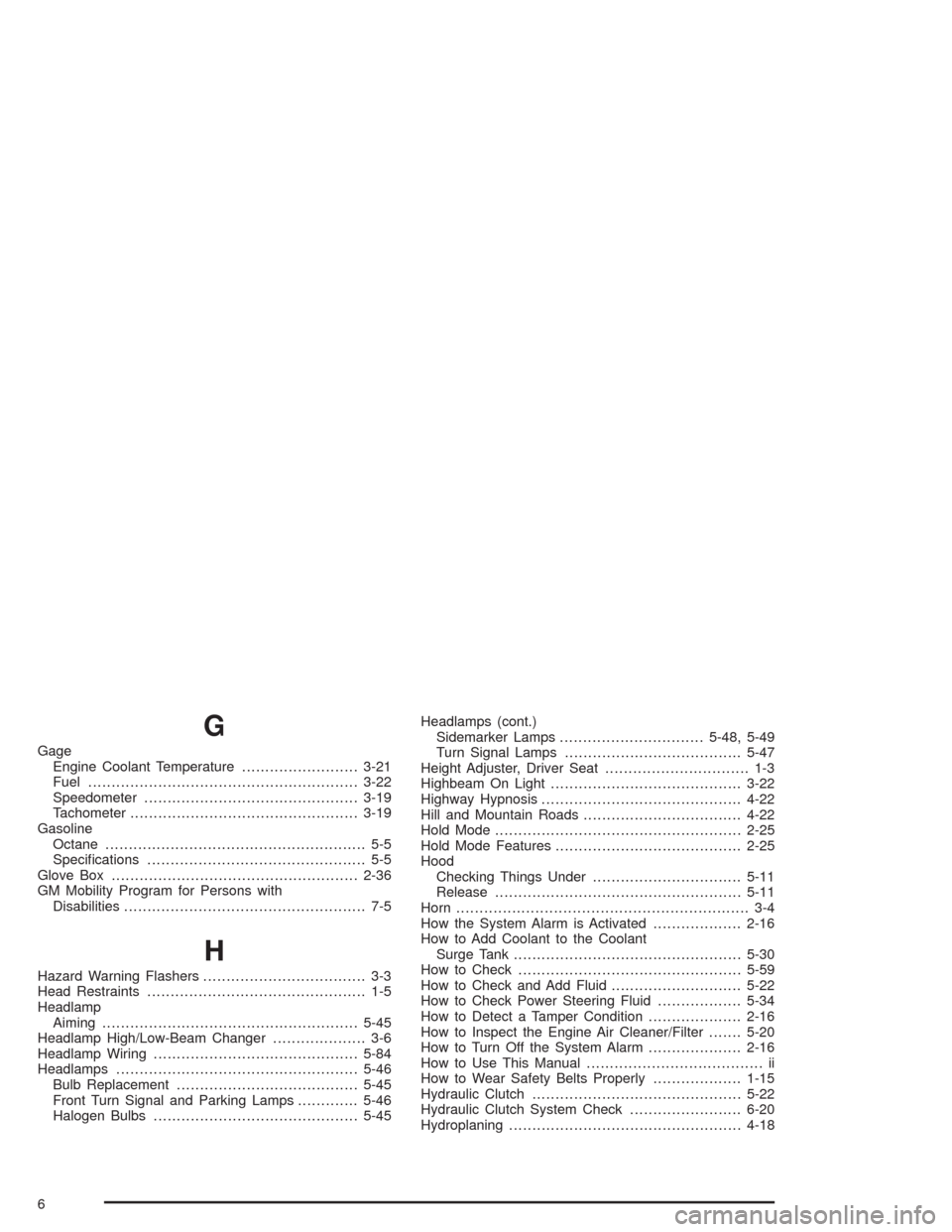
G
Gage
Engine Coolant Temperature.........................3-21
Fuel..........................................................3-22
Speedometer..............................................3-19
Tachometer.................................................3-19
Gasoline
Octane........................................................ 5-5
Specifications............................................... 5-5
Glove Box.....................................................2-36
GM Mobility Program for Persons with
Disabilities.................................................... 7-5
H
Hazard Warning Flashers................................... 3-3
Head Restraints............................................... 1-5
Headlamp
Aiming.......................................................5-45
Headlamp High/Low-Beam Changer.................... 3-6
Headlamp Wiring............................................5-84
Headlamps....................................................5-46
Bulb Replacement.......................................5-45
Front Turn Signal and Parking Lamps.............5-46
Halogen Bulbs............................................5-45Headlamps (cont.)
Sidemarker Lamps...............................5-48, 5-49
Turn Signal Lamps......................................5-47
Height Adjuster, Driver Seat............................... 1-3
Highbeam On Light.........................................3-22
Highway Hypnosis...........................................4-22
Hill and Mountain Roads..................................4-22
Hold Mode.....................................................2-25
Hold Mode Features........................................2-25
Hood
Checking Things Under................................5-11
Release.....................................................5-11
Horn............................................................... 3-4
How the System Alarm is Activated...................2-16
How to Add Coolant to the Coolant
Surge Tank.................................................5-30
How to Check................................................5-59
How to Check and Add Fluid............................5-22
How to Check Power Steering Fluid..................5-34
How to Detect a Tamper Condition....................2-16
How to Inspect the Engine Air Cleaner/Filter.......5-20
How to Turn Off the System Alarm....................2-16
How to Use This Manual...................................... ii
How to Wear Safety Belts Properly...................1-15
Hydraulic Clutch.............................................5-22
Hydraulic Clutch System Check........................6-20
Hydroplaning..................................................4-18
6