ECU CHEVROLET AVEO 2005 1.G Owner's Guide
[x] Cancel search | Manufacturer: CHEVROLET, Model Year: 2005, Model line: AVEO, Model: CHEVROLET AVEO 2005 1.GPages: 316, PDF Size: 2.12 MB
Page 175 of 316
{CAUTION:
Do not load your vehicle any heavier than the
Gross Vehicle Weight Rating (GVWR), or either
the maximum front or rear Gross Axle Weight
Rating (GAWR). If you do, parts on your
vehicle can break, and it can change the way
your vehicle handles. These could cause you
to lose control and crash. Also, overloading
can shorten the life of your vehicle.
Notice:Overloading your vehicle may cause
damage. Repairs would not be covered by your
warranty. Do not overload your vehicle.
If you put things inside your vehicle — like suitcases,
tools, packages, or anything else — they will go as
fast as the vehicle goes. If you have to stop or
turn quickly, or if there is a crash, they will keep going.
{CAUTION:
Things you put inside your vehicle can strike
and injure people in a sudden stop or turn, or
in a crash.
Put things in the cargo area of your
vehicle. Try to spread the weight evenly.
Never stack heavier things, like suitcases,
inside the vehicle so that some of them
are above the tops of the seats.
Do not leave an unsecured child restraint
in your vehicle.
When you carry something inside the
vehicle, secure it whenever you can.
Do not leave a seat folded down unless
you need to.
4-33
Page 202 of 316
Adding Coolant
If the level falls below the MIN (B) mark, add the proper
coolant mixtureat the surge tank,but only when the
engine is cool. If the surge tank is empty, a special
fill procedure is necessary. SeeCooling System
on page 5-26for instructions on “How to Add Coolant
to the Coolant Surge Tank.”
{CAUTION:
You can be burned if you spill coolant on hot
engine parts. Coolant contains ethylene glycol,
and it will burn if the engine parts are hot
enough. Do not spill coolant on a hot engine.
When replacing the pressure cap, make sure it is
hand-tight.
Coolant Surge Tank Pressure Cap
Notice:If the pressure cap is not tightly installed,
coolant loss and possible engine damage may
occur. Be sure the cap is properly and tightly
secured.
Engine Overheating
You will find a coolant temperature gage on your
vehicle’s instrument panel cluster. SeeEngine Coolant
Temperature Gage on page 3-23.
If Steam Is Coming From Your Engine
{CAUTION:
Steam from an overheated engine can burn
you badly, even if you just open the hood.
Stay away from the engine if you see or hear
steam coming from it. Just turn it off and get
everyone away from the vehicle until it cools
down. Wait until there is no sign of steam or
coolant before you open the hood.
If you keep driving when your engine is
overheated, the liquids in it can catch re.
You or others could be badly burned. Stop
your engine if it overheats, and get out of
the vehicle until the engine is cool.
5-24
Page 223 of 316
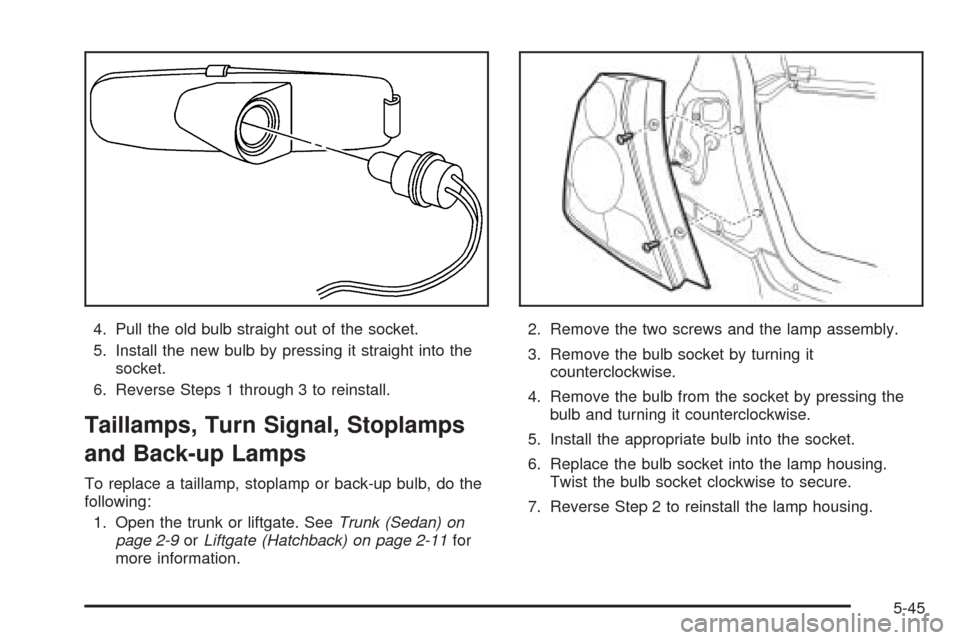
4. Pull the old bulb straight out of the socket.
5. Install the new bulb by pressing it straight into the
socket.
6. Reverse Steps 1 through 3 to reinstall.
Taillamps, Turn Signal, Stoplamps
and Back-up Lamps
To replace a taillamp, stoplamp or back-up bulb, do the
following:
1. Open the trunk or liftgate. SeeTrunk (Sedan) on
page 2-9orLiftgate (Hatchback) on page 2-11for
more information.2. Remove the two screws and the lamp assembly.
3. Remove the bulb socket by turning it
counterclockwise.
4. Remove the bulb from the socket by pressing the
bulb and turning it counterclockwise.
5. Install the appropriate bulb into the socket.
6. Replace the bulb socket into the lamp housing.
Twist the bulb socket clockwise to secure.
7. Reverse Step 2 to reinstall the lamp housing.
5-45
Page 237 of 316
{CAUTION:
Using the wrong replacement wheels, wheel
bolts or wheel nuts on your vehicle can be
dangerous. It could affect the braking and
handling of your vehicle, make your tires lose
air and make you lose control. You could have
a collision in which you or others could be
injured. Always use the correct wheel, wheel
bolts and wheel nuts for replacement.
Notice:The wrong wheel can also cause problems
with bearing life, brake cooling, speedometer or
odometer calibration, headlamp aim, bumper height,
vehicle ground clearance and tire or tire chain
clearance to the body and chassis.
SeeChanging a Flat Tire on page 5-60for more
information.
Used Replacement Wheels
{CAUTION:
Putting a used wheel on your vehicle is
dangerous. You can’t know how it’s been
used or how far it’s been driven. It could fail
suddenly and cause a crash. If you have to
replace a wheel, use a new GM original
equipment wheel.
Tire Chains
Notice:Use tire chains only where legal and only
when you must. Use only SAE Class “S” type chains
that are the proper size for your tires. Install them
on the front tires and tighten them as tightly as
possible with the ends securely fastened. Drive
slowly and follow the chain manufacturer’s
instructions. If you can hear the chains contacting
your vehicle, stop and retighten them. If the contact
continues, slow down until it stops. Driving too
fast or spinning the wheels with chains on will
damage your vehicle.
5-59
Page 245 of 316
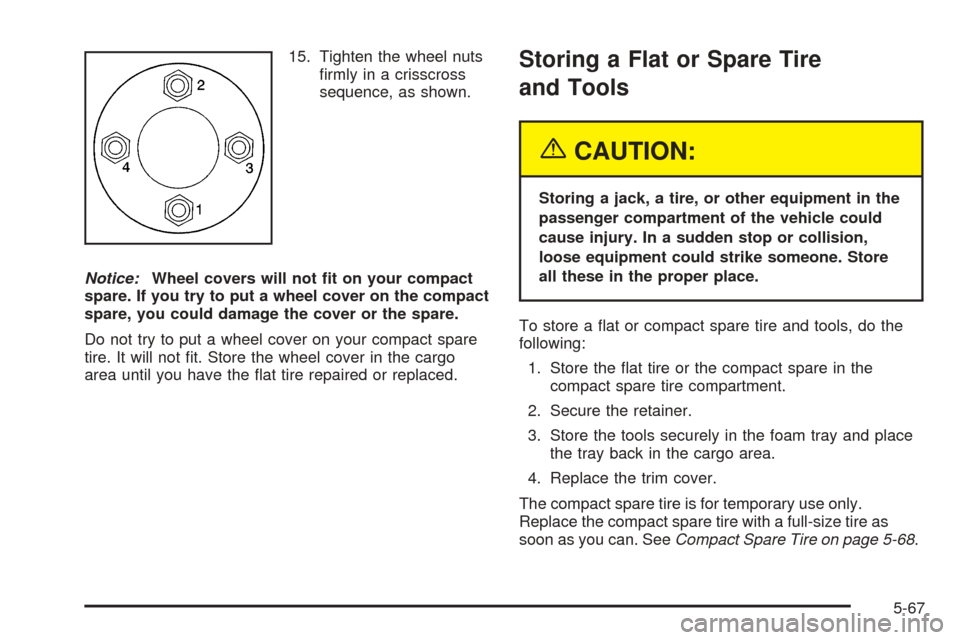
15. Tighten the wheel nuts
firmly in a crisscross
sequence, as shown.
Notice:Wheel covers will not t on your compact
spare. If you try to put a wheel cover on the compact
spare, you could damage the cover or the spare.
Do not try to put a wheel cover on your compact spare
tire. It will not fit. Store the wheel cover in the cargo
area until you have the flat tire repaired or replaced.Storing a Flat or Spare Tire
and Tools
{CAUTION:
Storing a jack, a tire, or other equipment in the
passenger compartment of the vehicle could
cause injury. In a sudden stop or collision,
loose equipment could strike someone. Store
all these in the proper place.
To store a flat or compact spare tire and tools, do the
following:
1. Store the flat tire or the compact spare in the
compact spare tire compartment.
2. Secure the retainer.
3. Store the tools securely in the foam tray and place
the tray back in the cargo area.
4. Replace the trim cover.
The compact spare tire is for temporary use only.
Replace the compact spare tire with a full-size tire as
soon as you can. SeeCompact Spare Tire on page 5-68.
5-67
Page 256 of 316
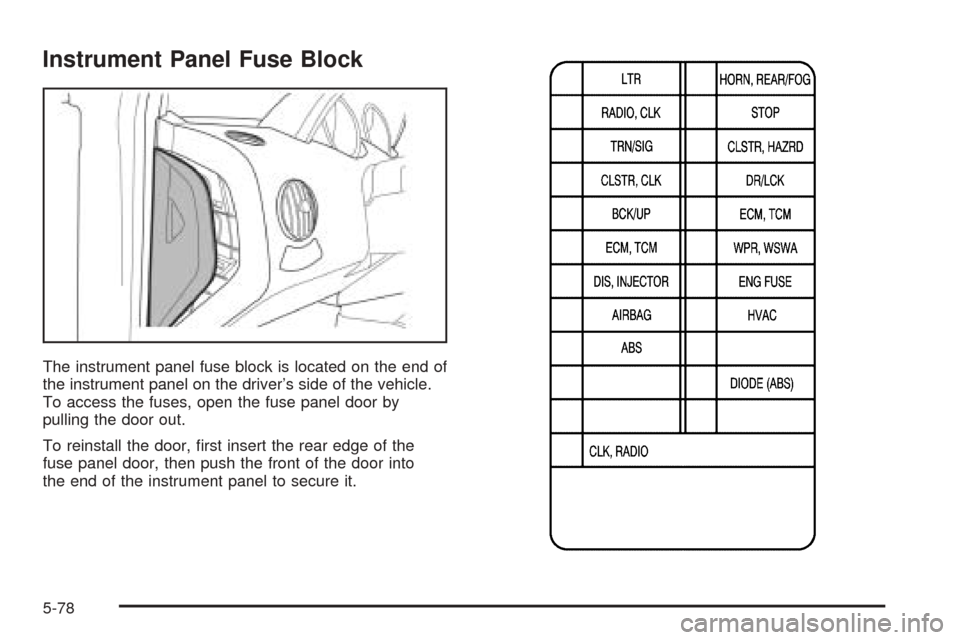
Instrument Panel Fuse Block
The instrument panel fuse block is located on the end of
the instrument panel on the driver’s side of the vehicle.
To access the fuses, open the fuse panel door by
pulling the door out.
To reinstall the door, first insert the rear edge of the
fuse panel door, then push the front of the door into
the end of the instrument panel to secure it.
5-78
Page 257 of 316
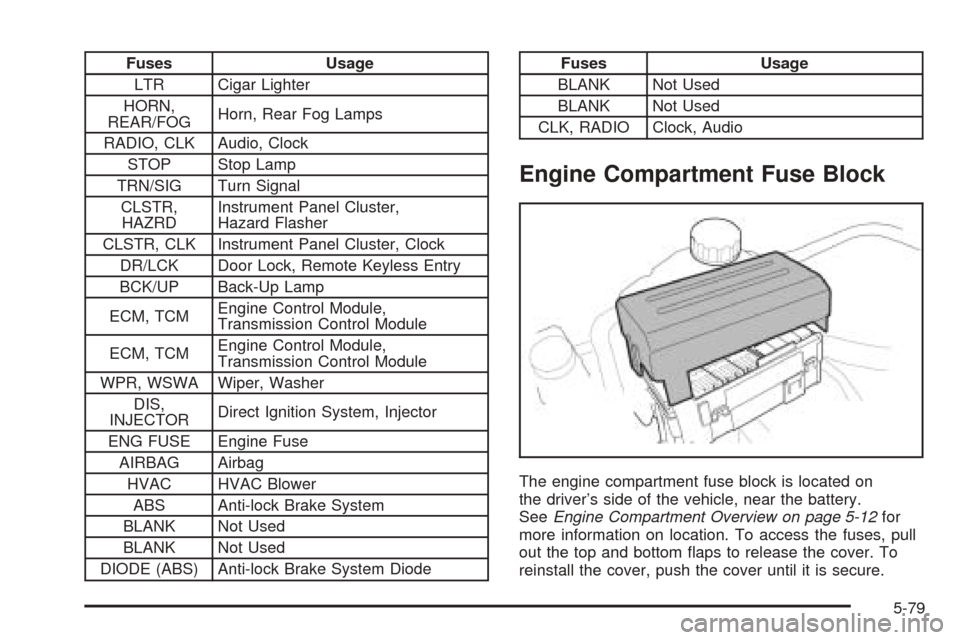
Fuses Usage
LTR Cigar Lighter
HORN,
REAR/FOGHorn, Rear Fog Lamps
RADIO, CLK Audio, Clock
STOP Stop Lamp
TRN/SIG Turn Signal
CLSTR,
HAZRDInstrument Panel Cluster,
Hazard Flasher
CLSTR, CLK Instrument Panel Cluster, Clock
DR/LCK Door Lock, Remote Keyless Entry
BCK/UP Back-Up Lamp
ECM, TCMEngine Control Module,
Transmission Control Module
ECM, TCMEngine Control Module,
Transmission Control Module
WPR, WSWA Wiper, Washer
DIS,
INJECTORDirect Ignition System, Injector
ENG FUSE Engine Fuse
AIRBAG Airbag
HVAC HVAC Blower
ABS Anti-lock Brake System
BLANK Not Used
BLANK Not Used
DIODE (ABS) Anti-lock Brake System DiodeFuses Usage
BLANK Not Used
BLANK Not Used
CLK, RADIO Clock, Audio
Engine Compartment Fuse Block
The engine compartment fuse block is located on
the driver’s side of the vehicle, near the battery.
SeeEngine Compartment Overview on page 5-12for
more information on location. To access the fuses, pull
out the top and bottom flaps to release the cover. To
reinstall the cover, push the cover until it is secure.
5-79
Page 298 of 316
We will provide the following services during
the Bumper-to-Bumper warranty period, at no
expense to you:
•Fuel Delivery:Delivery of enough fuel
($5 maximum) for the customer to get to the
nearest service station.
•Lock-out Service (identication required):
Replacement keys or locksmith service will
be covered at no charge if you are unable to gain
entry into your vehicle. Delivery of the replacement
key will be covered within 10 miles (16 km).
•Emergency Tow:Tow to the nearest dealership
for warranty service or in the event of a
vehicle-disabling accident. Assistance provided
when the vehicle is mired in sand, mud, or snow.
•Flat Tire Change:Installation of a spare tire will be
covered at no charge. The customer is responsible
for the repair or replacement of the tire if not
covered by a warrantable failure.
•Jump Start:No-start occurrences which require a
battery jump start will be covered at no charge.
•Dealer Locator Service
In many instances, mechanical failures are covered
under Chevrolet’s Bumper-to-Bumper warranty.
However, when other services are utilized, our Roadside
Assistance Representatives will explain any payment
obligations you might incur.For prompt and efficient assistance when calling, please
provide the following to the Roadside Assistance
Representative:
•Your name, home address, and home
telephone number.
•Telephone number of your location.
•Location of the vehicle.
•Model, year, color, and license plate number.
•Mileage, Vehicle Identification Number (VIN),
and delivery date of the vehicle.
•Description of the problem.
While we hope you never have the occasion to use our
service, it is added security while traveling for you and
your family. Remember, we are only a phone call away.
Chevrolet Roadside Assistance: 1-800-CHEV-USA
(1-800-243-8872), text telephone (TTY) users, call
1-888-889-2438.
Chevrolet reserves the right to limit services or
reimbursement to an owner or driver when, in
Chevrolet’s judgement, the claims become excessive
in frequency or type of occurrence.
Roadside Assistance is not part of or included in the
coverage provided by the New Vehicle Limited Warranty.
Chevrolet reserves the right to make any changes or
discontinue the Roadside Assistance program at
any time without notification.
7-6
Page 306 of 316
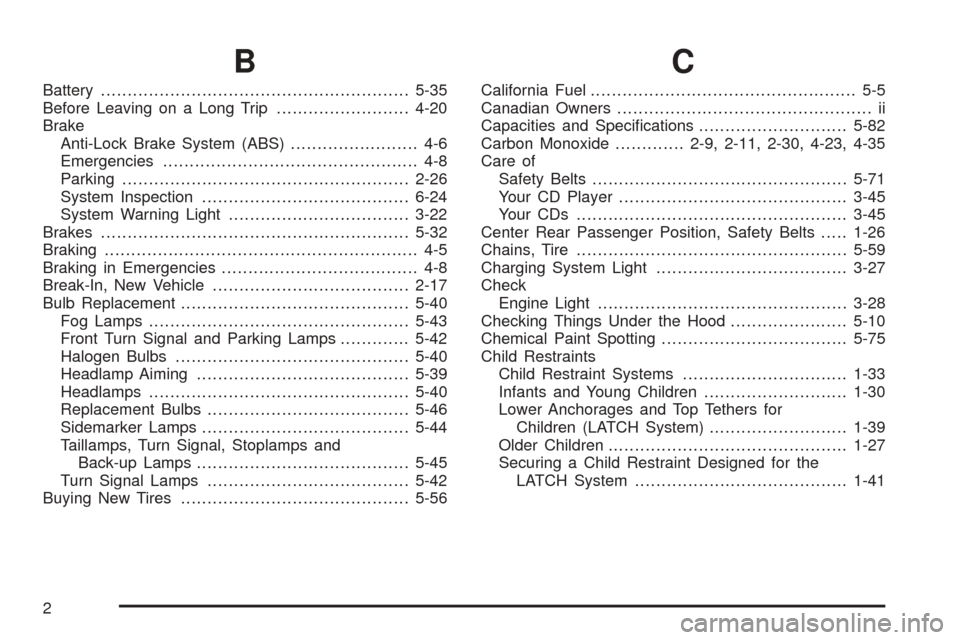
B
Battery..........................................................5-35
Before Leaving on a Long Trip.........................4-20
Brake
Anti-Lock Brake System (ABS)........................ 4-6
Emergencies................................................ 4-8
Parking......................................................2-26
System Inspection.......................................6-24
System Warning Light..................................3-22
Brakes..........................................................5-32
Braking........................................................... 4-5
Braking in Emergencies..................................... 4-8
Break-In, New Vehicle.....................................2-17
Bulb Replacement...........................................5-40
Fog Lamps.................................................5-43
Front Turn Signal and Parking Lamps.............5-42
Halogen Bulbs............................................5-40
Headlamp Aiming........................................5-39
Headlamps.................................................5-40
Replacement Bulbs......................................5-46
Sidemarker Lamps.......................................5-44
Taillamps, Turn Signal, Stoplamps and
Back-up Lamps........................................5-45
Turn Signal Lamps......................................5-42
Buying New Tires...........................................5-56
C
California Fuel.................................................. 5-5
Canadian Owners................................................ ii
Capacities and Specifications............................5-82
Carbon Monoxide.............2-9, 2-11, 2-30, 4-23, 4-35
Care of
Safety Belts................................................5-71
Your CD Player...........................................3-45
Your CDs ...................................................3-45
Center Rear Passenger Position, Safety Belts.....1-26
Chains, Tire...................................................5-59
Charging System Light....................................3-27
Check
Engine Light...............................................3-28
Checking Things Under the Hood......................5-10
Chemical Paint Spotting...................................5-75
Child Restraints
Child Restraint Systems...............................1-33
Infants and Young Children...........................1-30
Lower Anchorages and Top Tethers for
Children (LATCH System)..........................1-39
Older Children.............................................1-27
Securing a Child Restraint Designed for the
LATCH System........................................1-41
2
Page 307 of 316
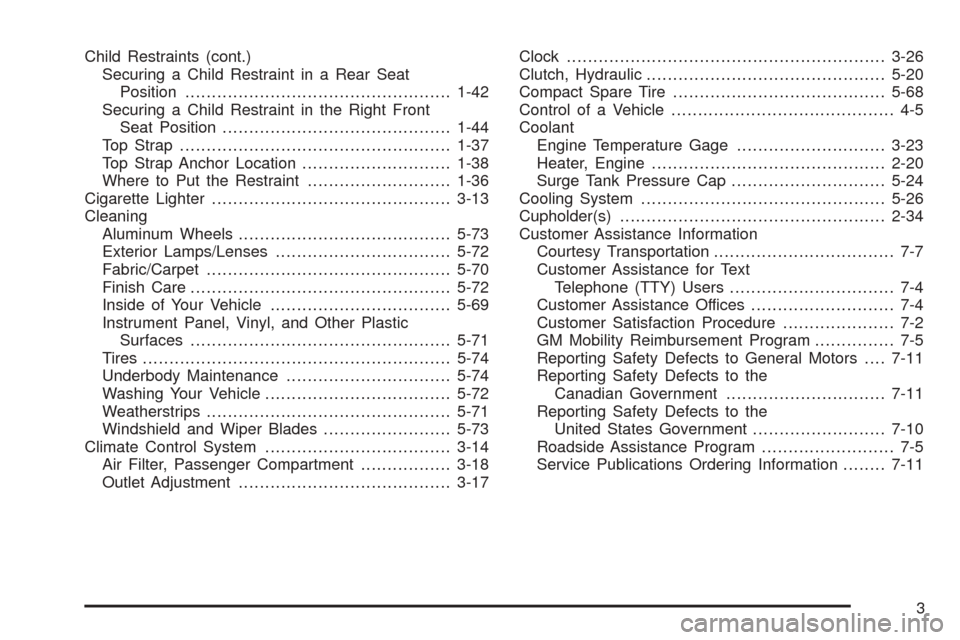
Child Restraints (cont.)
Securing a Child Restraint in a Rear Seat
Position..................................................1-42
Securing a Child Restraint in the Right Front
Seat Position...........................................1-44
Top Strap...................................................1-37
Top Strap Anchor Location............................1-38
Where to Put the Restraint...........................1-36
Cigarette Lighter.............................................3-13
Cleaning
Aluminum Wheels........................................5-73
Exterior Lamps/Lenses.................................5-72
Fabric/Carpet..............................................5-70
Finish Care.................................................5-72
Inside of Your Vehicle..................................5-69
Instrument Panel, Vinyl, and Other Plastic
Surfaces.................................................5-71
Tires..........................................................5-74
Underbody Maintenance...............................5-74
Washing Your Vehicle...................................5-72
Weatherstrips..............................................5-71
Windshield and Wiper Blades........................5-73
Climate Control System...................................3-14
Air Filter, Passenger Compartment.................3-18
Outlet Adjustment........................................3-17Clock............................................................3-26
Clutch, Hydraulic.............................................5-20
Compact Spare Tire........................................5-68
Control of a Vehicle.......................................... 4-5
Coolant
Engine Temperature Gage............................3-23
Heater, Engine............................................2-20
Surge Tank Pressure Cap.............................5-24
Cooling System..............................................5-26
Cupholder(s)..................................................2-34
Customer Assistance Information
Courtesy Transportation.................................. 7-7
Customer Assistance for Text
Telephone (TTY) Users............................... 7-4
Customer Assistance Offices........................... 7-4
Customer Satisfaction Procedure..................... 7-2
GM Mobility Reimbursement Program............... 7-5
Reporting Safety Defects to General Motors....7-11
Reporting Safety Defects to the
Canadian Government..............................7-11
Reporting Safety Defects to the
United States Government.........................7-10
Roadside Assistance Program......................... 7-5
Service Publications Ordering Information........7-11
3