seats CHEVROLET AVEO 2007 1.G User Guide
[x] Cancel search | Manufacturer: CHEVROLET, Model Year: 2007, Model line: AVEO, Model: CHEVROLET AVEO 2007 1.GPages: 436, PDF Size: 2.52 MB
Page 26 of 436
Driver Position
Lap-Shoulder Belt
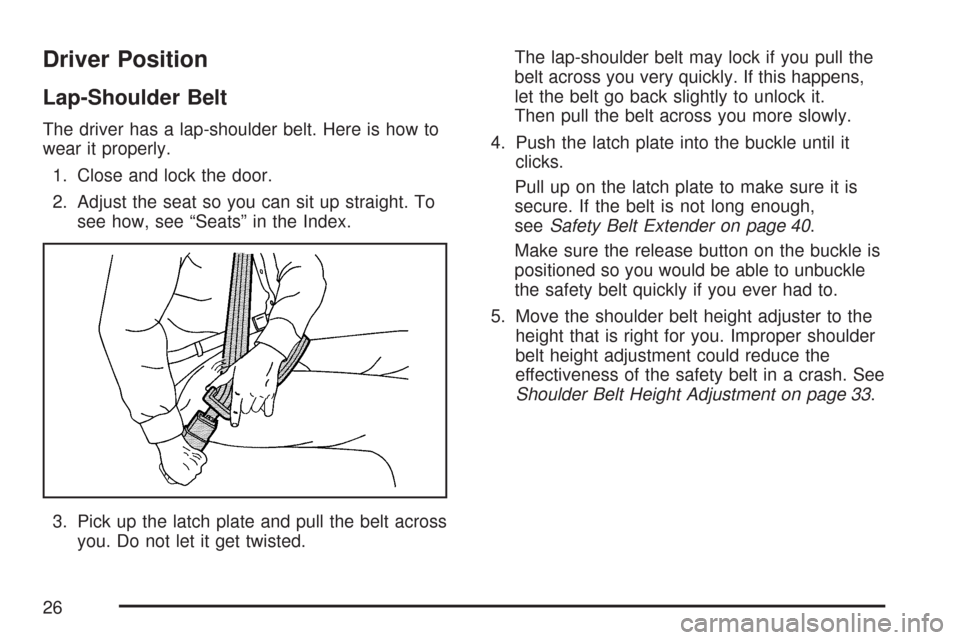
The driver has a lap-shoulder belt. Here is how to
wear it properly.
1. Close and lock the door.
2. Adjust the seat so you can sit up straight. To
see how, see “Seats” in the Index.
3. Pick up the latch plate and pull the belt across
you. Do not let it get twisted.The lap-shoulder belt may lock if you pull the
belt across you very quickly. If this happens,
let the belt go back slightly to unlock it.
Then pull the belt across you more slowly.
4. Push the latch plate into the buckle until it
clicks.
Pull up on the latch plate to make sure it is
secure. If the belt is not long enough,
seeSafety Belt Extender on page 40.
Make sure the release button on the buckle is
positioned so you would be able to unbuckle
the safety belt quickly if you ever had to.
5. Move the shoulder belt height adjuster to the
height that is right for you. Improper shoulder
belt height adjustment could reduce the
effectiveness of the safety belt in a crash. See
Shoulder Belt Height Adjustment on page 33.
26
Page 40 of 436
Safety Belt Pretensioners
Your vehicle has safety belt pretensioners for the
driver and right front passenger. Although you
cannot see them, they are part of the safety belt
assembly. They help tighten the safety belts during
the early stages of a moderate to severe frontal
or near frontal crash if the threshold conditions for
pretensioner activation are met.
Pretensioners work only once. If they activate in a
crash, you will need to get new ones, and
probably other new parts for your safety belt
system. SeeReplacing Restraint System Parts
After a Crash on page 85.
Safety Belt Extender
If the vehicle’s safety belt will fasten around you,
you should use it.
But if a safety belt is not long enough, your
dealer/retailer will order you an extender. When
you go in to order it, take the heaviest coat you will
wear, so the extender will be long enough for
you. To help avoid personal injury, do not
let someone else use it, and use it only for the
seat it is made to fit. The extender has been
designed for adults. Never use it for securing child
seats. To wear it, attach it to the regular safety
belt. For more information, see the instruction
sheet that comes with the extender.
40
Page 41 of 436
Child Restraints
Older Children
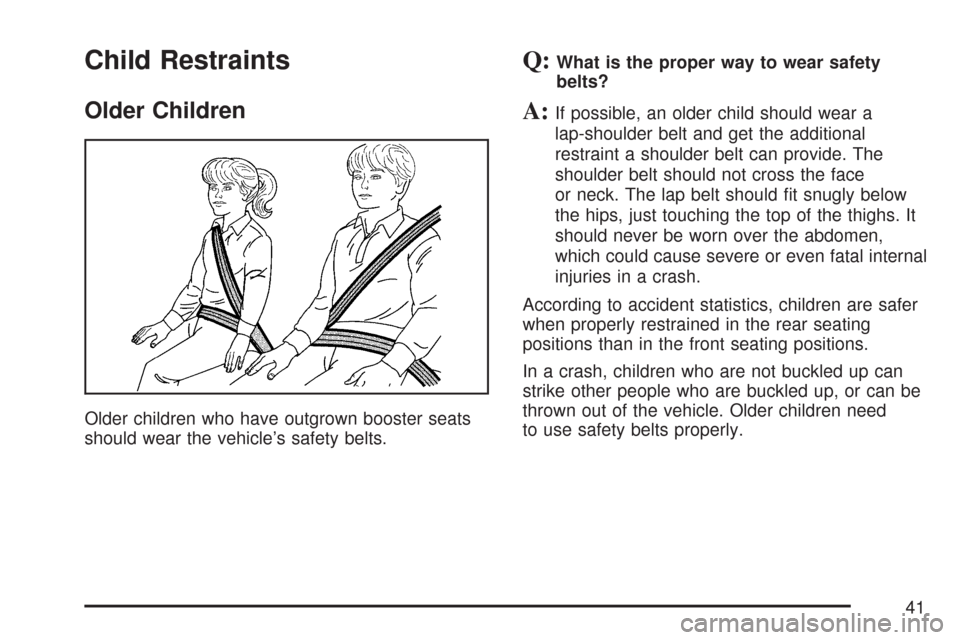
Older children who have outgrown booster seats
should wear the vehicle’s safety belts.
Q:What is the proper way to wear safety
belts?
A:If possible, an older child should wear a
lap-shoulder belt and get the additional
restraint a shoulder belt can provide. The
shoulder belt should not cross the face
or neck. The lap belt should fit snugly below
the hips, just touching the top of the thighs. It
should never be worn over the abdomen,
which could cause severe or even fatal internal
injuries in a crash.
According to accident statistics, children are safer
when properly restrained in the rear seating
positions than in the front seating positions.
In a crash, children who are not buckled up can
strike other people who are buckled up, or can be
thrown out of the vehicle. Older children need
to use safety belts properly.
41
Page 49 of 436
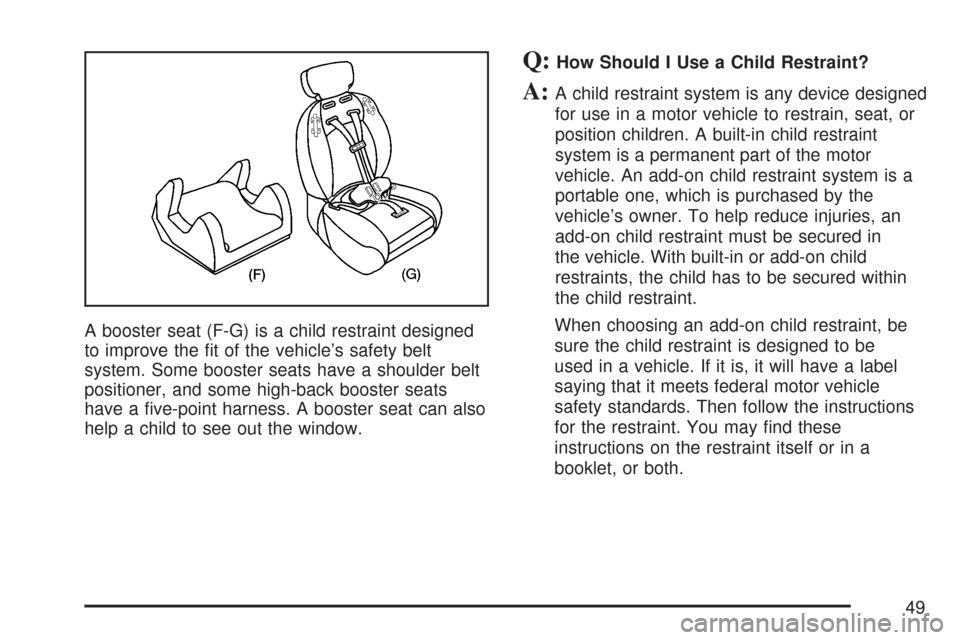
A booster seat (F-G) is a child restraint designed
to improve the fit of the vehicle’s safety belt
system. Some booster seats have a shoulder belt
positioner, and some high-back booster seats
have a five-point harness. A booster seat can also
help a child to see out the window.
Q:How Should I Use a Child Restraint?
A:A child restraint system is any device designed
for use in a motor vehicle to restrain, seat, or
position children. A built-in child restraint
system is a permanent part of the motor
vehicle. An add-on child restraint system is a
portable one, which is purchased by the
vehicle’s owner. To help reduce injuries, an
add-on child restraint must be secured in
the vehicle. With built-in or add-on child
restraints, the child has to be secured within
the child restraint.
When choosing an add-on child restraint, be
sure the child restraint is designed to be
used in a vehicle. If it is, it will have a label
saying that it meets federal motor vehicle
safety standards. Then follow the instructions
for the restraint. You may find these
instructions on the restraint itself or in a
booklet, or both.
49
Page 50 of 436
Securing an Add-on Child Restraint in
the Vehicle
{CAUTION:
A child can be seriously injured or killed
in a crash if the child restraint is not
properly secured in the vehicle. Make sure
the child restraint is properly installed in
the vehicle using the vehicle’s safety belt
or LATCH system, following the
instructions that came with that restraint,
and also the instructions in this manual.To help reduce the chance of injury, the child
restraint must be secured in the vehicle. Child
restraint systems must be secured in vehicle seats
by lap belts or the lap belt portion of a lap-shoulder
belt, or by the LATCH system. SeeLower
Anchors and Tethers for Children (LATCH) on
page 53for more information. A child can
be endangered in a crash if the child restraint is
not properly secured in the vehicle.
When securing an add-on child restraint, refer to
the instructions that come with the restraint which
may be on the restraint itself or in a booklet, or both,
and to this manual. The child restraint instructions
are important, so if they are not available, obtain a
replacement copy from the manufacturer.
Keep in mind that an unsecured child restraint can
move around in a collision or sudden stop and
injure people in the vehicle. Be sure to properly
secure any child restraint in your vehicle — even
when no child is in it.
50
Page 65 of 436
If you need to secure a forward-facing child
restraint in the right front seat position, move the
seat as far back as it will go before securing
the forward-facing child restraint. SeeManual
Seats on page 8.
If your child restraint is equipped with the LATCH
system, seeLower Anchors and Tethers for
Children (LATCH) on page 53.
There is no top tether anchor in the right front
passenger’s position. Do not secure a child seat in
this position if a national or local law requires that
the top tether be anchored, or if the instructions that
come with the child restraint say that the top tether
must be anchored. SeeLower Anchors and Tethers
for Children (LATCH) on page 53if your child
restraint has a top tether.You will be using the lap-shoulder belt to secure
the child restraint in this position. Be sure to follow
the instructions that came with the child restraint.
Secure the child in the child restraint when and as
the instructions say.
1. Your vehicle has airbags. SeePassenger
Sensing System on page 77. General
Motors recommends that rear-facing child
restraints be secured in a rear seat, even if the
right front passenger’s frontal airbag and
side airbag (if equipped) is off. If your child
restraint is forward-facing, move the seat
as far back as it will go before securing the
child restraint in this seat. SeeManual
Seats on page 8.
When the passenger sensing system has
turned off the right front passenger’s frontal
airbag and side airbag (if equipped), the
off symbol in the passenger airbag status
indicator should light and stay lit when you turn
the ignition to ON or START. SeePassenger
Airbag Status Indicator (Sedan) on page 161.
2. Put the child restraint on the seat.
65
Page 83 of 436
Adding Equipment to Your
Airbag-Equipped Vehicle
Q:Is there anything I might add to the
exterior of the vehicle that could keep the
airbags from working properly?
A:Yes. If you add things that change your
vehicle’s frame, bumper system, height,
front end or side sheet metal, they may keep
the airbag system from working properly.
Also, the airbag system may not work properly
if you relocate any of the airbag sensors. If
you have any questions about this, you should
contact Customer Assistance before you
modify your vehicle. The phone numbers and
addresses for Customer Assistance are in
Step Two of the Customer Satisfaction
Procedure in this manual. SeeCustomer
Satisfaction Procedure on page 402.
Q:Because I have a disability, I have to get
my vehicle modied. How can I nd out
whether this will affect my airbag system?
A:Changing or moving any parts of the
front seats, safety belts, the airbag sensing
and diagnostic module, steering wheel,
instrument panel, or airbag wiring can affect
the operation of the airbag system. If you have
questions, call Customer Assistance. The
phone numbers and addresses for Customer
Assistance are in Step Two of the Customer
Satisfaction Procedure in this manual.
SeeCustomer Satisfaction Procedure on
page 402.
Your dealer/retailer and the service manual have
information about the location of the airbag
sensors, sensing and diagnostic module and
airbag wiring.
83
Page 112 of 436
Automatic Transaxle Operation
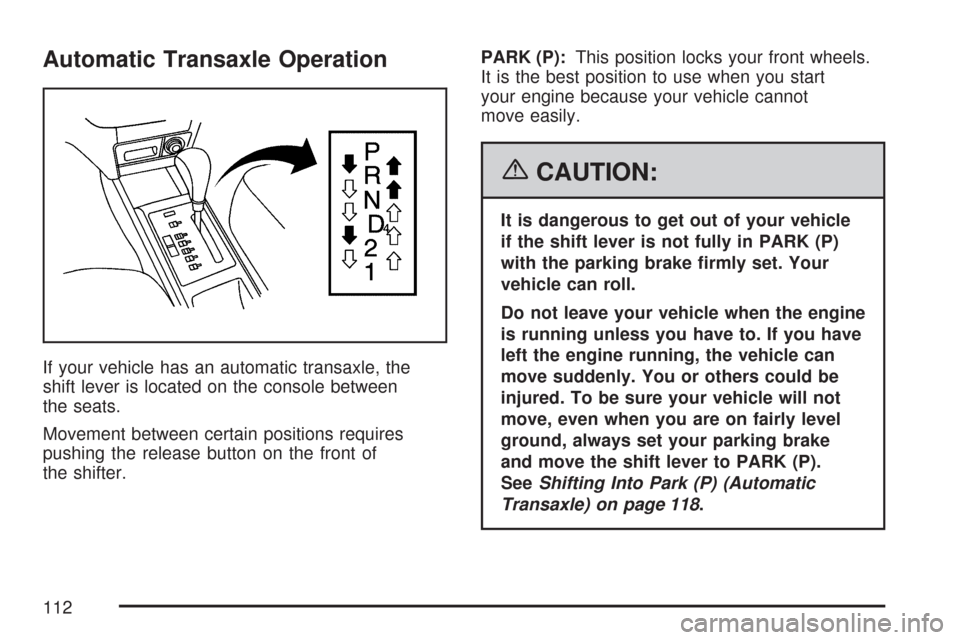
If your vehicle has an automatic transaxle, the
shift lever is located on the console between
the seats.
Movement between certain positions requires
pushing the release button on the front of
the shifter.PARK (P):This position locks your front wheels.
It is the best position to use when you start
your engine because your vehicle cannot
move easily.
{CAUTION:
It is dangerous to get out of your vehicle
if the shift lever is not fully in PARK (P)
with the parking brake rmly set. Your
vehicle can roll.
Do not leave your vehicle when the engine
is running unless you have to. If you have
left the engine running, the vehicle can
move suddenly. You or others could be
injured. To be sure your vehicle will not
move, even when you are on fairly level
ground, always set your parking brake
and move the shift lever to PARK (P).
SeeShifting Into Park (P) (Automatic
Transaxle) on page 118.
112
Page 117 of 436
Notice:Shifting to REVERSE (R) while your
vehicle is moving forward could damage
the transaxle. The repairs would not be
covered by your warranty. Shift to
REVERSE (R) only after your vehicle is
stopped.
Also, use REVERSE (R), along with the parking
brake, for parking your vehicle.
Shift Speeds
{CAUTION:
If you skip a gear when you downshift,
you could lose control of your vehicle.
You could injure yourself or others. Do
not shift down more than one gear at a
time when you downshift.
Parking Brake
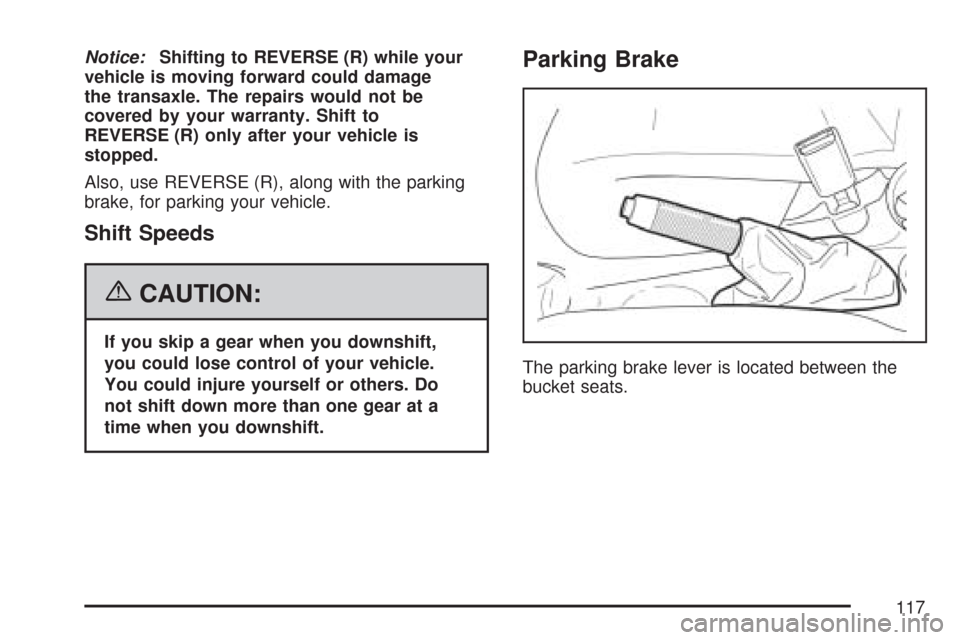
The parking brake lever is located between the
bucket seats.
117
Page 151 of 436
To change the current mode, select one of the
following from the right knob:
Y(Vent):This mode directs air to the instrument
panel outlets.
\(Bi-Level):This mode directs about half of the
air to the instrument panel outlets, and then
directs the remaining air to the floor outlets.
[(Floor):This mode directs most of the air to
the floor outlets. Some of the air will also be
directed to the rear outlets. Be sure to keep the
area under the front seats clear to allow the flow of
air to the rear compartment.
The right knob can also be used to select the
defog and defrost modes. Information on defogging
and defrosting can be found later in this section.
?(Recirculation):This mode keeps outside air
from coming into the vehicle. It can be used to
prevent outside air and odors from entering your
vehicle or to help heat or cool the air inside
your vehicle more quickly.
If your vehicle has a recirculation button (uplevel
model), press the button to turn the recirculation
mode on. When the button is pressed, an indicatorlight in the button will come on. Press the button
again to return to outside air mode.
If your vehicle has a lever (base model), move the
lever to choose the recirculation mode.
Using the recirculation mode for extended periods
may cause your windows to fog. If this happens,
select the defrost mode.
:(Outside Air):This mode brings outside air
into the vehicle.
If your vehicle has a recirculation button (uplevel
model), press the button until the recirculation
mode is turned off. Your vehicle will then return to
outside air mode.
If your vehicle has a lever (base model), move the
lever to choose the outside air mode.
A/C (Air Conditioning):If your vehicle has air
conditioning, follow these steps to use the system.
Start the engine and set the fan control knob to the
desired speed. The air conditioning compressor
does not operate when the fan control knob is in the
off position. Press the A/C button to turn the air
conditioning compressor on and off. When the A/C
button is pressed, an indicator light in the button
will come on to let you know that air conditioning
is activated.
151