tow CHEVROLET AVEO 2007 1.G Owner's Guide
[x] Cancel search | Manufacturer: CHEVROLET, Model Year: 2007, Model line: AVEO, Model: CHEVROLET AVEO 2007 1.GPages: 436, PDF Size: 2.52 MB
Page 346 of 436
Dust may be removed from small buttons and
knobs using a small brush with soft bristles.
Your dealer has a product for cleaning your
vehicle’s glass. Should it become necessary, you
can also obtain a product from your dealer to
remove odors from your vehicle’s upholstery.
Do not clean your vehicle using the following
cleaners or techniques:
•Never use a knife or any other sharp object to
remove a soil from any interior surface.
•Never use a stiff brush. It can cause damage
to your vehicle’s interior surfaces.
•Never apply heavy pressure or rub
aggressively with a cleaning cloth. Use of
heavy pressure can damage your interior
and does not improve the effectiveness of
soil removal.
•Use only mild, neutral-pH soaps. Avoid laundry
detergents or dishwashing soaps with
degreasers. Using too much soap will leave a
residue that leaves streaks and attracts dirt.
For liquid cleaners, about 20 drops per
gallon (3.78 L) of water is a good guide.
•Do not heavily saturate your upholstery while
cleaning.
•Damage to your vehicle’s interior may result
from the use of many organic solvents such as
naptha, alcohol, etc.
Fabric/Carpet
Use a vacuum cleaner with a soft brush
attachment frequently to remove dust and loose
dirt. A canister vacuum with a beater bar in
the nozzle may only be used on floor carpet and
carpeted floor mats. For soils, always try to remove
them first with plain water or club soda. Before
cleaning, gently remove as much of the soil
as possible using one of the following techniques:
•For liquids: gently blot the remaining soil with a
paper towel. Allow the soil to absorb into the
paper towel until no more can be removed.
•For solid dry soils: remove as much as possible
and then vacuum.
346
Page 347 of 436
To clean, use the following instructions:
1. Saturate a lint-free, clean white cloth with
water or club soda.
2. Wring the cloth to remove excess moisture.
3. Start on the outside edge of the soil and gently
rub toward the center. Continue cleaning,
using a clean area of the cloth each time it
becomes soiled.
4. Continue to gently rub the soiled area until the
cleaning cloth remains clean.
5. If the soil is not completely removed, use a
mild soap solution and repeat the cleaning
process that was used with plain water.
If any of the soil remains, a commercial fabric
cleaner or spot lifter may be necessary. When a
commercial upholstery cleaner or spot lifter is to be
used, test a small hidden area for colorfastness
first. If the locally cleaned area gives any
impression that a ring formation may result, clean
the entire surface.
After the cleaning process has been completed, a
paper towel can be used to blot excess moisture
from the fabric or carpet.Leather
A soft cloth dampened with water may be used to
remove dust. If a more thorough cleaning is
necessary, a soft cloth dampened with a mild soap
solution can be used. Allow the leather to dry
naturally. Do not use heat to dry. Never use steam
to clean leather. Never use spot lifters or spot
removers on leather. Many commercial leather
cleaners and coatings that are sold to preserve
and protect leather may permanently change
the appearance and feel of your leather and are
not recommended. Do not use silicone or
wax-based products, or those containing organic
solvents to clean your vehicle’s interior because
they can alter the appearance by increasing
the gloss in a non-uniform manner. Never use
shoe polish on your leather.
347
Page 349 of 436
Washing Your Vehicle
The paint finish on the vehicle provides beauty,
depth of color, gloss retention, and durability.
The best way to preserve the vehicle’s finish is to
keep it clean by washing it often with lukewarm
or cold water.
Do not wash the vehicle in the direct rays of the
sun. Use a car washing soap. Do not use
strong soaps or chemical detergents. Be sure to
rinse the vehicle well, removing all soap
residue completely. Approved cleaning products
can be obtained from your dealer. SeeVehicle
Care/Appearance Materials on page 353.Donot
use cleaning agents that are petroleum based,
or that contain acid or abrasives. All cleaning
agents should be flushed promptly and not allowed
to dry on the surface, or they could stain. Dry
the finish with a soft, clean chamois or an
all-cotton towel to avoid surface scratches and
water spotting.
High pressure car washes may cause water to
enter the vehicle.
Cleaning Exterior Lamps/Lenses
Use only lukewarm or cold water, a soft cloth and
a car washing soap to clean exterior lamps
and lenses. Follow instructions underWashing
Your Vehicle on page 349.
Finish Care
Occasional waxing or mild polishing of the vehicle
by hand may be necessary to remove residue
from the paint finish. Approved cleaning products
can be obtained from your dealer. SeeVehicle
Care/Appearance Materials on page 353.
Notice:Machine compounding or aggressive
polishing on a basecoat/clearcoat paint
nish may damage it. Use only non-abrasive
waxes and polishes that are made for a
basecoat/clearcoat paint nish on your vehicle.
The vehicle has a basecoat/clearcoat paint finish.
The clearcoat gives more depth and gloss to the
colored basecoat. Always use waxes and polishes
that are non-abrasive and made for a basecoat/
clearcoat paint finish.
349
Page 350 of 436
Foreign materials such as calcium chloride and
other salts, ice melting agents, road oil and
tar, tree sap, bird droppings, chemicals from
industrial chimneys, etc., can damage the vehicle’s
finish if they remain on painted surfaces. Wash
the vehicle as soon as possible. If necessary, use
non-abrasive cleaners that are marked safe for
painted surfaces to remove foreign matter.
Exterior painted surfaces are subject to aging,
weather, and chemical fallout that can take their
toll over a period of years. To help keep the
paint finish looking new, keep the vehicle in a
garage or covered whenever possible.
Windshield and Wiper Blades
Clean the outside of the windshield with
glass cleaner.
Clean the rubber blades using a lint free cloth or
paper towel soaked with windshield washer fluid or
a mild detergent. Wash the windshield thoroughly
when you clean the blades. Bugs, road grime,
sap and a buildup of vehicle wash/wax treatments
may cause wiper streaking. Replace the wiper
blades if they are worn or damaged.Wipers can be damaged by:
•Extreme dusty conditions
•Sand and salt
•Heat and sun
•Snow and ice, without proper removal
Aluminum Wheels
Notice:If you use strong soaps, chemicals,
abrasive polishes, cleaners, brushes, or
cleaners that contain acid on aluminum or
chrome-plated wheels, you could damage the
surface of the wheel(s). The repairs would
not be covered by your warranty. Use
only approved cleaners on aluminum or
chrome-plated wheels.
Keep the wheels clean using a soft clean cloth
with mild soap and water. Rinse with clean water.
After rinsing thoroughly, dry with a soft clean
towel. A wax may then be applied.
350
Page 408 of 436
Roadside Assistance Program
In the U.S., call1-800-CHEV-USA
(1-800-243-8872).
In Canada, call1-800-268-6800.
Service is available 24 hours a day, 365 days
a year.
As the owner of a new Chevrolet vehicle, you are
automatically enrolled in the Chevrolet Roadside
Assistance program.
Who is Covered?
Roadside Assistance coverage is for the vehicle
operator, regardless of ownership. In Canada,
a person driving this vehicle without the consent of
the owner is not eligible for coverage.The following services are provided in the U.S.
during the Bumper-to-Bumper warranty period and,
in Canada, during the Base Warranty coverage
period of the New Vehicle Limited Warranty, up to
a maximum coverage of $100.
•Fuel Delivery:Delivery of enough fuel for the
vehicle to get to the nearest service station
(approximately $5 in Canada). Service
to provide diesel may be restricted. For safety
reasons, propane and other alternative
fuels will not be provided through this service.
•Lock-out Service:To ensure security, the
driver must present personal identification
before lock-out service is provided. In Canada,
the vehicle registration is also required.
Lock-out service will be covered at no charge if
you are unable to gain entry into your vehicle. A
remote unlock may be available if you have an
active OnStar
®subscription.
•Emergency Tow From a Public Roadway or
Highway:Tow to the nearest dealership for
warranty service or in the event of a
vehicle-disabling accident. Winch-out
assistance when the vehicle is mired in
sand, mud, or snow.
408
Page 411 of 436
Towing and Road Service Exclusions
Specifically excluded from Roadside Assistance
coverage are towing or services for vehicles
operated on a non-public roadway or highway,
fines, impound towing caused by a violation
of local, Municipal, State, Provincial, or Federal
law, and mounting, dismounting or changing
of snow tires, chains, or other traction devices.
Courtesy Transportation
To enhance your ownership experience, we and
our participating dealers are proud to offer
Courtesy Transportation, a customer support
program for new vehicles.
For warranty repairs during the Bumper-to-Bumper
(U.S.) or Base Warranty Coverage period
(Canada), provided by the New Vehicle Limited
Warranty, interim transportation may be available
under the Courtesy Transportation program.
Several courtesy transportation options are
available to assist in reducing your inconvenience
when warranty repairs are required.Courtesy Transportation is not a part of the New
Vehicle Limited Warranty and is available only
at participating dealers. A separate booklet entitled
“Warranty and Owner Assistance Information”
furnished with each new vehicle provides detailed
warranty coverage information.
Scheduling Service Appointments
When your vehicle requires warranty service,
contact your dealer and request an appointment.
By scheduling a service appointment and
advising your service consultant of your
transportation needs, your dealer can help
minimize your inconvenience.
If your vehicle cannot be scheduled into the
service department immediately, keep driving it
until it can be scheduled for service, unless,
of course, the problem is safety-related. If it is,
please call your dealership, let them know this, and
ask for instructions.
If the dealer requests that you simply drop the
vehicle off for service, you are urged to do so as
early in the work day as possible to allow for
the same day repair.
411
Page 417 of 436
•If your vehicle cannot be driven, know where
the towing service will be taking it. Get a
card from the tow truck operator or write down
the driver’s name, the service’s name, and
the phone number.
•Remove any valuables from your vehicle
before it is towed away. Make sure this
includes your insurance information and
registration if you keep these items in
your vehicle.
•Gather the important information you will need
from the other driver. Things like name,
address, phone number, driver’s license
number, vehicle license plate, vehicle make,
model and model year, Vehicle Identification
Number (VIN), insurance company and
policy number, and a general description of
the damage to the other vehicle.
•If possible, call your insurance company from
the scene of the accident. They will walk you
through the information they will need. If
they ask for a police report, phone or go to
the police department headquarters the
next day and you can get a copy of the report
for a nominal fee. In some states/provinces
with “no fault” insurance laws, a report may not
be necessary. This is especially true if there
are no injuries and both vehicles are driveable.
•Choose a reputable collision repair facility
for your vehicle. Whether you select a
dealer/retailer or a private collision repair
facility to fix the damage, make sure you are
comfortable with them. Remember, you
will have to feel comfortable with their work for
a long time.
•Once you have an estimate, read it carefully
and make sure you understand what work
will be performed on your vehicle. If you have
a question, ask for an explanation. Reputable
shops welcome this opportunity.
417
Page 418 of 436
Managing the Vehicle Damage
Repair Process
In the event that your vehicle requires damage
repairs, GM recommends that you take an active
role in its repair. If you have a pre-determined repair
facility of choice, take your vehicle there, or have it
towed there. Specify to the facility that any required
replacement collision parts be original equipment
parts, either new Genuine GM parts or recycled
original GM parts. Remember, recycled parts will
not be covered by your GM vehicle warranty.
Insurance pays the bill for the repair, but you must
live with the repair. Depending on your policy
limits, your insurance company may initially valuethe repair using aftermarket parts. Discuss this
with your repair professional, and insist on
Genuine GM parts. Remember if your vehicle is
leased you may be obligated to have the
vehicle repaired with Genuine GM parts, even if
your insurance coverage does not pay the full cost.
If another party’s insurance company is paying
for the repairs, you are not obligated to accept a
repair valuation based on that insurance
company’s collision policy repair limits, as you
have no contractual limits with that company. In
such cases, you can have control of the repair and
parts choices as long as cost stays within
reasonable limits.
418
Page 432 of 436
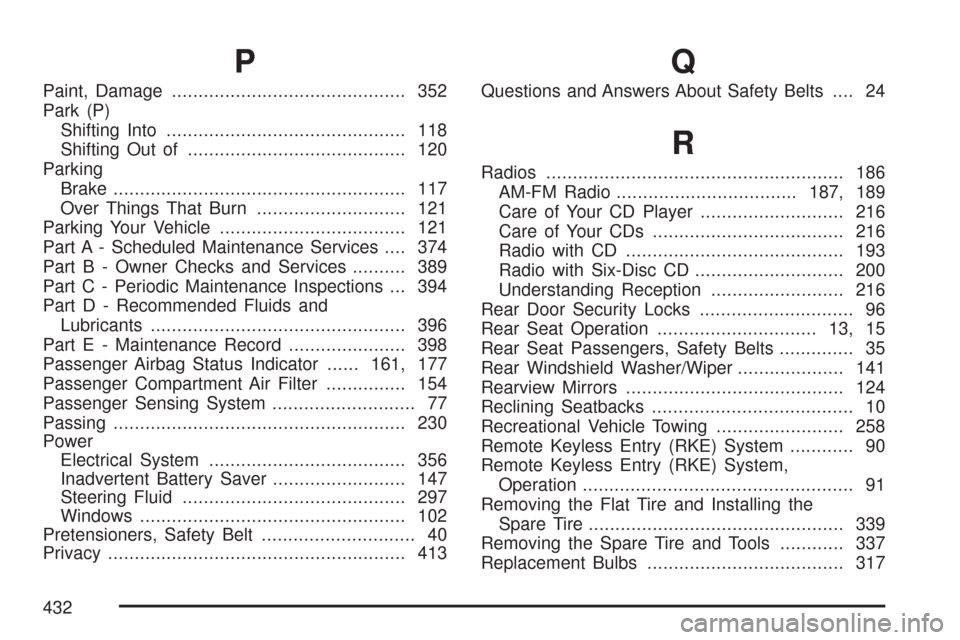
P
Paint, Damage............................................ 352
Park (P)
Shifting Into............................................. 118
Shifting Out of......................................... 120
Parking
Brake....................................................... 117
Over Things That Burn............................ 121
Parking Your Vehicle................................... 121
Part A - Scheduled Maintenance Services.... 374
Part B - Owner Checks and Services.......... 389
Part C - Periodic Maintenance Inspections ... 394
Part D - Recommended Fluids and
Lubricants................................................ 396
Part E - Maintenance Record...................... 398
Passenger Airbag Status Indicator......161, 177
Passenger Compartment Air Filter............... 154
Passenger Sensing System........................... 77
Passing....................................................... 230
Power
Electrical System..................................... 356
Inadvertent Battery Saver......................... 147
Steering Fluid.......................................... 297
Windows.................................................. 102
Pretensioners, Safety Belt............................. 40
Privacy........................................................ 413
Q
Questions and Answers About Safety Belts.... 24
R
Radios........................................................ 186
AM-FM Radio..................................187, 189
Care of Your CD Player........................... 216
Care of Your CDs.................................... 216
Radio with CD......................................... 193
Radio with Six-Disc CD............................ 200
Understanding Reception ......................... 216
Rear Door Security Locks............................. 96
Rear Seat Operation.............................. 13, 15
Rear Seat Passengers, Safety Belts.............. 35
Rear Windshield Washer/Wiper.................... 141
Rearview Mirrors......................................... 124
Reclining Seatbacks...................................... 10
Recreational Vehicle Towing........................ 258
Remote Keyless Entry (RKE) System............ 90
Remote Keyless Entry (RKE) System,
Operation................................................... 91
Removing the Flat Tire and Installing the
Spare Tire................................................ 339
Removing the Spare Tire and Tools............ 337
Replacement Bulbs..................................... 317
432
Page 435 of 436
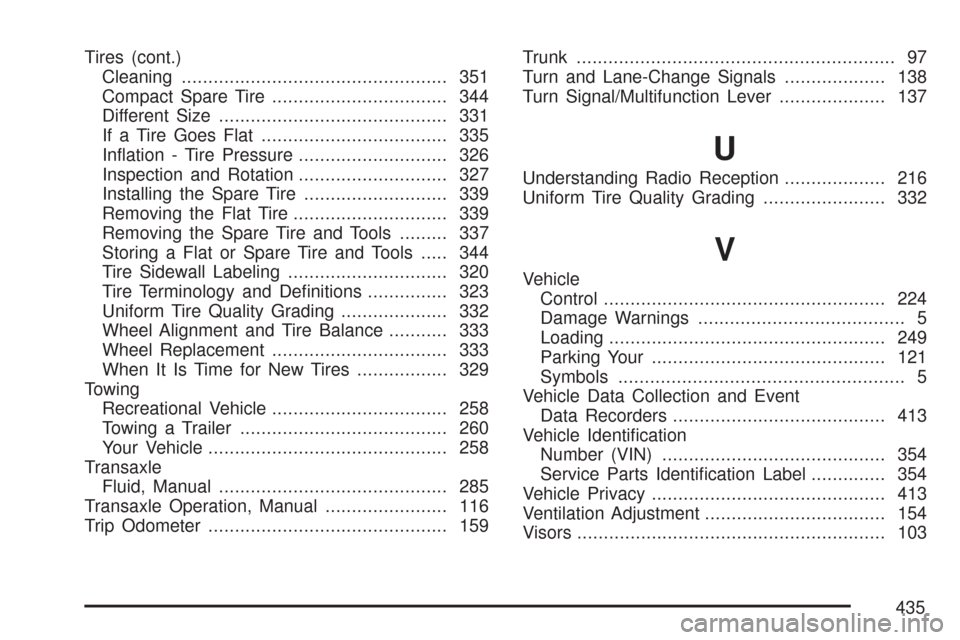
Tires (cont.)
Cleaning.................................................. 351
Compact Spare Tire................................. 344
Different Size........................................... 331
If a Tire Goes Flat................................... 335
Inflation - Tire Pressure............................ 326
Inspection and Rotation............................ 327
Installing the Spare Tire........................... 339
Removing the Flat Tire............................. 339
Removing the Spare Tire and Tools......... 337
Storing a Flat or Spare Tire and Tools..... 344
Tire Sidewall Labeling.............................. 320
Tire Terminology and Definitions............... 323
Uniform Tire Quality Grading.................... 332
Wheel Alignment and Tire Balance........... 333
Wheel Replacement................................. 333
When It Is Time for New Tires................. 329
Towing
Recreational Vehicle................................. 258
Towing a Trailer....................................... 260
Your Vehicle............................................. 258
Transaxle
Fluid, Manual........................................... 285
Transaxle Operation, Manual....................... 116
Trip Odometer............................................. 159Trunk............................................................ 97
Turn and Lane-Change Signals................... 138
Turn Signal/Multifunction Lever.................... 137
U
Understanding Radio Reception................... 216
Uniform Tire Quality Grading....................... 332
V
Vehicle
Control..................................................... 224
Damage Warnings....................................... 5
Loading.................................................... 249
Parking Your............................................ 121
Symbols...................................................... 5
Vehicle Data Collection and Event
Data Recorders........................................ 413
Vehicle Identification
Number (VIN).......................................... 354
Service Parts Identification Label.............. 354
Vehicle Privacy............................................ 413
Ventilation Adjustment.................................. 154
Visors.......................................................... 103
435