service CHEVROLET AVEO 2008 1.G Workshop Manual
[x] Cancel search | Manufacturer: CHEVROLET, Model Year: 2008, Model line: AVEO, Model: CHEVROLET AVEO 2008 1.GPages: 384, PDF Size: 6.67 MB
Page 283 of 384
TPMS Malfunction Light
The TPMS will not function properly if one or more of
the TPMS sensors are missing or inoperable. When
the system detects a malfunction, the low tire warning
light flashes for about one minute and then stays
on for the remainder of the ignition cycle. The low tire
warning light comes on at each ignition cycle until
the problem is corrected. Some of the conditions that
can cause the malfunction light to come on are:
•One of the road tires has been replaced with the
spare tire. The spare tire does not have a TPMS
sensor. The TPMS malfunction light and DIC
message should go off once you re-install the
road tire containing the TPMS sensor.
•One or more TPMS sensors are missing or
damaged. The TPMS malfunction light should go
off when the TPMS sensors are installed and
the sensor matching process is performed
successfully. See your dealer/retailer for service.
•Replacement tires or wheels do not match your
vehicle’s original equipment tires or wheels. Tires
and wheels other than those recommended for your
vehicle could prevent the TPMS from functioning
properly. SeeBuying New Tires on page 5-64.
•Operating electronic devices or being near facilities
using radio wave frequencies similar to the TPMS
could cause the TPMS sensors to malfunction.If the TPMS is not functioning it cannot detect or
signal a low tire condition. See your dealer/retailer for
service if the TPMS malfunction light and DIC message
comes on and stays on.
TPMS Sensor Identication Codes
Each TPMS sensor has a unique identification code.
Any time you replace one or more of the TPMS sensors,
or rotate the vehicle’s tires, the identification codes
need to be matched to the new tire/wheel position.
The sensors are matched, to the tire/wheel positions,
in the following order: driver side front tire, passenger
side front tire, passenger side rear tire, and driver
side rear tire using a TPMS diagnostic tool. See your
dealer/retailer for service.
Tire Inspection and Rotation
We recommend that you regularly inspect your
vehicle’s tires, including the spare tire, for signs
of wear or damage. SeeWhen It Is Time for
New Tires on page 5-63for more information.
Tires should be rotated every 5,000 to 8,000 miles
(8 000 to 13 000 km). SeePart A: Scheduled
Maintenance Services on page 6-4.
The purpose of a regular tire rotation is to achieve a
uniform wear for all tires on the vehicle. This will
ensure that your vehicle continues to perform most
like it did when the tires were new.
5-61
Page 288 of 384
Uniform Tire Quality Grading
Quality grades can be found where applicable
on the tire sidewall between tread shoulder
and maximum selection width. For example:
Treadwear 200 Traction AA Temperature A
The following information relates to the system
developed by the Unites States National Highway
Traffic Safety Administration (NHTSA), which
grades tires by treadwear, traction, and
temperature performance. This applies only to
vehicles sold in the United States. The grades are
molded on the sidewalls of most passenger car
tires. The Uniform Tire Quality Grading (UTQG)
system does not apply to deep tread, winter-type
snow tires, space-saver, or temporary use
spare tires, tires with nominal rim diameters of
10 to 12 inches (25 to 30 cm), or to some
limited-production tires.
While the tires available on General Motors
passenger cars and light trucks may vary with
respect to these grades, they must also conform
to federal safety requirements.Treadwear
The treadwear grade is a comparative rating based
on the wear rate of the tire when tested under
controlled conditions on a specified government
test course. For example, a tire graded 150 would
wear one and a half (1
1⁄2) times as well on the
government course as a tire graded 100. The
relative performance of tires depends upon the
actual conditions of their use, however, and may
depart significantly from the norm due to variations
in driving habits, service practices, and differences
in road characteristics and climate.
Traction — AA, A, B, C
The traction grades, from highest to lowest,
are AA, A, B, and C. Those grades represent
the tire’s ability to stop on wet pavement as
measured under controlled conditions on
specified government test surfaces of asphalt
and concrete. A tire marked C may have
poor traction performance.
The traction grade assigned to this tire is based
on straight-ahead braking traction tests, and does
not include acceleration, cornering, hydroplaning,
or peak traction characteristics.
5-66
Page 310 of 384
Vehicle Identication
Vehicle Identication Number (VIN)
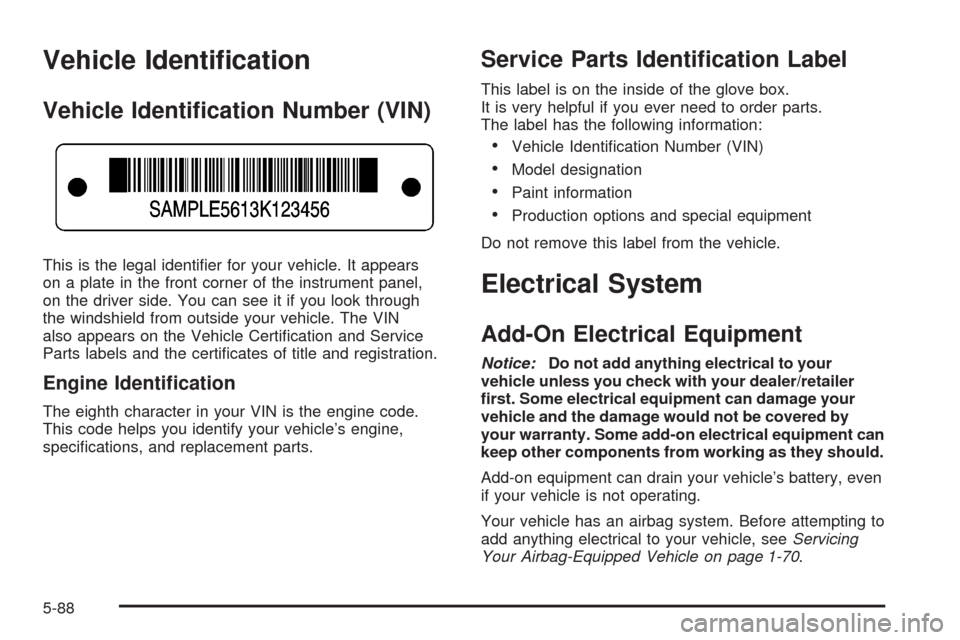
This is the legal identifier for your vehicle. It appears
on a plate in the front corner of the instrument panel,
on the driver side. You can see it if you look through
the windshield from outside your vehicle. The VIN
also appears on the Vehicle Certification and Service
Parts labels and the certificates of title and registration.
Engine Identication
The eighth character in your VIN is the engine code.
This code helps you identify your vehicle’s engine,
specifications, and replacement parts.
Service Parts Identication Label
This label is on the inside of the glove box.
It is very helpful if you ever need to order parts.
The label has the following information:
•Vehicle Identification Number (VIN)
•Model designation
•Paint information
•Production options and special equipment
Do not remove this label from the vehicle.
Electrical System
Add-On Electrical Equipment
Notice:Do not add anything electrical to your
vehicle unless you check with your dealer/retailer
rst. Some electrical equipment can damage your
vehicle and the damage would not be covered by
your warranty. Some add-on electrical equipment can
keep other components from working as they should.
Add-on equipment can drain your vehicle’s battery, even
if your vehicle is not operating.
Your vehicle has an airbag system. Before attempting to
add anything electrical to your vehicle, seeServicing
Your Airbag-Equipped Vehicle on page 1-70.
5-88
Page 325 of 384
Maintenance Schedule......................................6-2
Introduction...................................................6-2
Maintenance Requirements..............................6-2
Your Vehicle and the Environment....................6-2
How This Section is Organized.........................6-3
Part A: Scheduled Maintenance Services...........6-4
Using the Maintenance Schedule......................6-4
Selecting the Right Schedule...........................6-5
Short Trip/City Scheduled Maintenance..............6-6
Long Trip/Highway Scheduled
Maintenance.............................................6-13
Part B: Owner Checks and Services................6-18
At Each Fuel Fill..........................................6-18At Least Once a Month.................................6-18
At Least Twice a Year...................................6-18
At Least Once a Year...................................6-19
Part C: Periodic Maintenance Inspections.........6-22
Steering, Suspension and Front Drive
Axle Boot and Seal Inspection....................6-22
Exhaust System Inspection............................6-22
Fuel System Inspection..................................6-22
Engine Cooling System Inspection...................6-22
Brake System Inspection................................6-22
Part D: Recommended Fluids
and Lubricants..........................................6-23
Part E: Maintenance Record...........................6-24
Section 6 Maintenance Schedule
6-1
Page 327 of 384
How This Section is Organized
This maintenance schedule is divided into five parts:
“Part A: Scheduled Maintenance Services”explains
what to have done and how often. Some of these
services can be complex, so unless you are technically
qualified and have the necessary equipment, you
should let your dealer/retailer do these jobs.
Your dealer/retailer has trained and supported service
people that will perform the work using genuine parts.
{CAUTION:
Performing maintenance work on a vehicle
can be dangerous. In trying to do some jobs,
you can be seriously injured. Do your own
maintenance work only if you have the
required know-how and the proper tools and
equipment for the job. If you have any doubt,
have a qualied technician do the work. See
Doing Your Own Service Work on page 5-4.If you want to purchase service information, seeService
Publications Ordering Information on page 7-17.
“Part B: Owner Checks and Services”tells you what
should be checked and when. It also explains what
you can easily do to help keep your vehicle in good
condition.
“Part C: Periodic Maintenance Inspections”explains
important inspections that your dealer/retailer can
perform for you.
“Part D: Recommended Fluids and Lubricants”
lists some recommended products necessary to help
keep your vehicle properly maintained. These products,
or their equivalents, should be used whether you do
the work yourself or have it done.
“Part E: Maintenance Record”is a place for you to
record and keep track of the maintenance performed
on your vehicle. Keep your maintenance receipts.
They may be needed to qualify your vehicle for
warranty repairs.
6-3
Page 328 of 384
Part A: Scheduled Maintenance
Services
In this part are scheduled maintenance services which
are to be performed at the mileage intervals specified.
Using the Maintenance Schedule
We want to keep your vehicle in good working condition.
But we do not know exactly how you will drive it.
You might drive short distances only a few times a week.
Or you might drive long distances all the time in very
hot, dusty weather. You might use your vehicle in
making deliveries. Or you might drive it to work, to do
errands, or in many other ways.
Because of the different ways people use their vehicles,
maintenance needs vary. You might need more
frequent checks and replacements. So please read
the following and note how you drive. If you have
questions on how to keep your vehicle in good condition,
see your dealer/retailer.This part tells you the maintenance services you should
have done and when to schedule them.
When you go to your dealer/retailer for your service
needs, you will know that trained and supported service
people will perform the work using genuine parts.
The proper fluids and lubricants to use are listed in
Part D. Make sure whoever services your vehicle uses
these. All parts should be replaced and all necessary
repairs done before you or anyone else drives the
vehicle.
These schedules are for vehicles that:
•carry passengers and cargo within recommended
limits. You will find these on the Tire and Loading
Information label. SeeLoading Your Vehicle on
page 4-18.
•are driven on reasonable road surfaces within legal
driving limits.
•use the recommended fuel. SeeGasoline Octane
on page 5-5.
6-4
Page 329 of 384
Selecting the Right Schedule
First you will need to decide which of the two schedules
is right for your vehicle. Here is how to decide which
schedule to follow:
Short Trip/City Denition
Follow the Short Trip/City Scheduled Maintenance if any
one of these conditions is true for your vehicle:
•Most trips are less than 5 miles (8 km). This is
particularly important when outside temperatures
are below freezing.
•Most trips include extensive idling, such as frequent
driving in stop-and-go traffic.
•If the vehicle is used for delivery service, police,
taxi, or other commercial application.
One of the reasons you should follow this schedule if
you operate your vehicle under any of these conditions
is that these conditions cause engine oil to break
down sooner.
Short Trip/City Intervals
Every 3,000 Miles (5 000 km):Engine Oil and Filter
Change (or 3 months, whichever occurs first).
Every 6,000 Miles (10 000 km):Tire Rotation.
Every 15,000 Miles (25 000 km):Engine Air Cleaner
Filter Inspection. Passenger Compartment Air Filter
Replacement. Drive Belt(s) Inspection.
Every 30,000 Miles (50 000 km):Engine Air Cleaner
Filter Replacement. Spark Plug Replacement. EVAP
System Service. PCV System Service.
Every 37,500 Miles (60 000 km):Automatic
Transmission Fluid Change (severe service only).
Every 42,000 Miles (70 000 km):Engine Oil Pan Drain
Plug Washer Replacement.
Every 60,000 Miles (100 000 km):Spark Plug Wire
Replacement. Timing Belt Replacement. EVAP System
Solenoid Valve Replacement.
Every 90,000 Miles (150 000 km):Fuel Filter
Replacement.
Every 150,000 Miles (240 000 km):Cooling System
Service.
These intervals only summarize maintenance services.
Be sure to follow the complete scheduled maintenance
on the following pages.
6-5
Page 330 of 384
Long Trip/Highway Denition
Follow this scheduled maintenanceonlyif none of
the conditions from the Short Trip/City Scheduled
Maintenance are true. Do not use this schedule if the
vehicle is driven in a dusty area or used off paved roads.
Use the Short Trip/City schedule for these conditions.
Driving a vehicle with a fully warmed engine under
highway conditions will cause engine oil to break
down slower.
Long Trip/Highway Intervals
Every 7,500 Miles (12 500 km):Engine Oil and
Filter Change (or every 12 months, whichever occurs
first). Tire Rotation.
Every 15,000 Miles (25 000 km):Engine Air Cleaner
Filter Inspection. Passenger Compartment Air Filter
Replacement. Drive Belt(s) Inspection.
Every 30,000 Miles (50 000 km):Engine Air Cleaner
Filter Replacement. Spark Plug Replacement. EVAP
System Service. PCV System Service.
Every 37,500 Miles (60 000 km):Automatic
Transmission Fluid Change (severe service only).Every 60,000 Miles (100 000 km):Spark Plug Wire
Replacement. Timing Belt Replacement. EVAP System
Solenoid Valve Replacement.
Every 90,000 Miles (150 000 km):Fuel Filter
Replacement. Engine Oil Pan Drain Plug Washer
Replacement.
Every 150,000 Miles (240 000 km):Cooling System
Service.
These intervals only summarize maintenance services.
Be sure to follow the complete scheduled maintenance
on the following pages.Short Trip/City Scheduled
Maintenance
The services shown in this schedule up to
100,000 miles (166 000 km) should be repeated after
100,000 miles (166 000 km) at the same intervals
for the life of this vehicle. The services shown at
150,000 miles (240 000 km) should be repeated at
the same interval after 150,000 miles (240 000 km)
for the life of this vehicle.
SeePart B: Owner Checks and Services on page 6-18
andPart C: Periodic Maintenance Inspections on
page 6-22.
6-6
Page 331 of 384
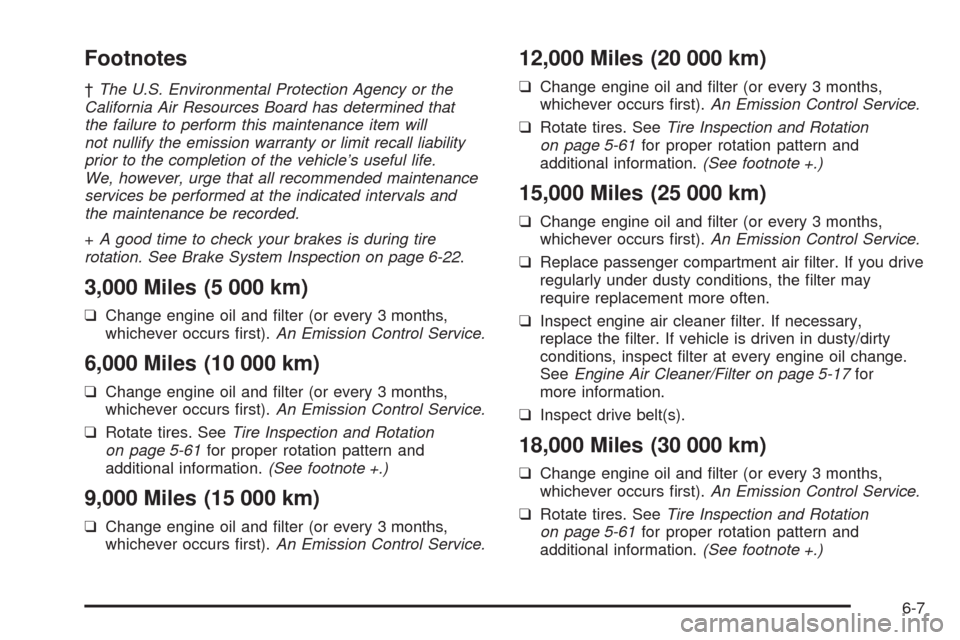
Footnotes
†The U.S. Environmental Protection Agency or the
California Air Resources Board has determined that
the failure to perform this maintenance item will
not nullify the emission warranty or limit recall liability
prior to the completion of the vehicle’s useful life.
We, however, urge that all recommended maintenance
services be performed at the indicated intervals and
the maintenance be recorded.
+A good time to check your brakes is during tire
rotation. See Brake System Inspection on page 6-22.
3,000 Miles (5 000 km)
❑Change engine oil and filter (or every 3 months,
whichever occurs first).An Emission Control Service.
6,000 Miles (10 000 km)
❑Change engine oil and filter (or every 3 months,
whichever occurs first).An Emission Control Service.
❑Rotate tires. SeeTire Inspection and Rotation
on page 5-61for proper rotation pattern and
additional information.(See footnote +.)
9,000 Miles (15 000 km)
❑Change engine oil and filter (or every 3 months,
whichever occurs first).An Emission Control Service.
12,000 Miles (20 000 km)
❑Change engine oil and filter (or every 3 months,
whichever occurs first).An Emission Control Service.
❑Rotate tires. SeeTire Inspection and Rotation
on page 5-61for proper rotation pattern and
additional information.(See footnote +.)
15,000 Miles (25 000 km)
❑Change engine oil and filter (or every 3 months,
whichever occurs first).An Emission Control Service.
❑Replace passenger compartment air filter. If you drive
regularly under dusty conditions, the filter may
require replacement more often.
❑Inspect engine air cleaner filter. If necessary,
replace the filter. If vehicle is driven in dusty/dirty
conditions, inspect filter at every engine oil change.
SeeEngine Air Cleaner/Filter on page 5-17for
more information.
❑Inspect drive belt(s).
18,000 Miles (30 000 km)
❑Change engine oil and filter (or every 3 months,
whichever occurs first).An Emission Control Service.
❑Rotate tires. SeeTire Inspection and Rotation
on page 5-61for proper rotation pattern and
additional information.(See footnote +.)
6-7
Page 332 of 384

21,000 Miles (35 000 km)
❑Change engine oil and filter (or every 3 months,
whichever occurs first).An Emission Control Service.
24,000 Miles (40 000 km)
❑Change engine oil and filter (or every 3 months,
whichever occurs first).An Emission Control Service.
❑Rotate tires. SeeTire Inspection and Rotation
on page 5-61for proper rotation pattern and
additional information.(See footnote +)
27,000 Miles (45 000 km)
❑Change engine oil and filter (or every 3 months,
whichever occurs first).An Emission Control Service.
30,000 Miles (50 000 km)
❑Change engine oil and filter (or every 3 months,
whichever occurs first).An Emission Control Service.
❑Replace passenger compartment air filter. If you
drive regularly under dusty conditions, the filter
may require replacement more often.
❑Replace engine air cleaner filter. SeeEngine Air
Cleaner/Filter on page 5-17for more information.❑Rotate tires. SeeTire Inspection and Rotation on
page 5-61for proper rotation pattern and additional
information.(See footnote +.)
❑Replace spark plugs.An Emission Control Service.
❑Inspect drive belt(s).
❑Inspect EVAP canister, vapor lines, and EVAP
vent solenoid valve.An Emission Control Service.
(See footnote †.)
❑Inspect PCV system.An Emission Control Service.
(See footnote †.)
33,000 Miles (55 000 km)
❑Change engine oil and filter (or every 3 months,
whichever occurs first).An Emission Control Service.
36,000 Miles (60 000 km)
❑Change engine oil and filter (or every 3 months,
whichever occurs first).An Emission Control Service.
❑Rotate tires. SeeTire Inspection and Rotation
on page 5-61for proper rotation pattern and
additional information.(See footnote +.)
6-8