tow CHEVROLET AVEO 2009 1.G Owner's Manual
[x] Cancel search | Manufacturer: CHEVROLET, Model Year: 2009, Model line: AVEO, Model: CHEVROLET AVEO 2009 1.GPages: 354, PDF Size: 2.07 MB
Page 204 of 354
If you put things inside your vehicle — like
suitcases, tools, packages, or anything else — they
will go as fast as the vehicle goes. If you have to
stop or turn quickly, or if there is a crash, they will
keep going.
{CAUTION:
Things you put inside your vehicle can strike
and injure people in a sudden stop or turn, or
in a crash.
Put things in the cargo area of your
vehicle. Try to spread the weight evenly.
Never stack heavier things, like suitcases,
inside the vehicle so that some of them
are above the tops of the seats.
Do not leave an unsecured child restraint
in your vehicle.
When you carry something inside the
vehicle, secure it whenever you can.
Do not leave a seat folded down unless
you need to.
Towing
Towing Your Vehicle
To avoid damage, the disabled vehicle should be towed
with all four wheels off the ground. Consult your
dealer/retailer or a professional towing service if the
disabled vehicle must be towed. SeeRoadside
Assistance Program on page 7-7.
To tow the vehicle behind another vehicle for
recreational purposes, such as behind a motorhome,
see “Recreational Vehicle Towing” following.
Recreational Vehicle Towing
Recreational vehicle towing means towing the vehicle
behind another vehicle – such as behind a motorhome.
The two most common types of recreational vehicle
towing are known as dinghy towing and dolly towing.
Dinghy towing is towing the vehicle with all four wheels
on the ground. Dolly towing is towing the vehicle
with two wheels on the ground and two wheels up on a
device known as a dolly.
4-24
Page 205 of 354
Here are some important things to consider before
recreational vehicle towing:
What is the towing capacity of the towing vehicle?
Be sure to read the tow vehicle manufacturer’s
recommendations.
What is the distance that will be travelled? Some
vehicles have restrictions on how far and how
long they can tow.
Is the proper towing equipment going to be used?
See your dealer/retailer or trailering professional
for additional advice and equipment
recommendations.
Is the vehicle ready to be towed? Just as preparing
the vehicle for a long trip, make sure the vehicle is
prepared to be towed. SeeBefore Leaving on a
Long Trip on page 4-11.
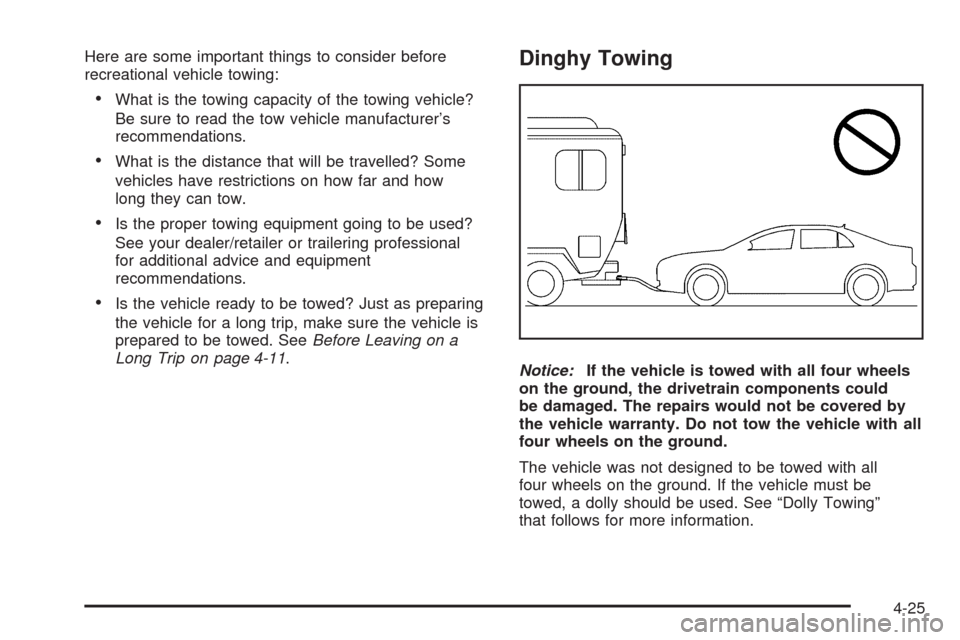
Dinghy Towing
Notice:If the vehicle is towed with all four wheels
on the ground, the drivetrain components could
be damaged. The repairs would not be covered by
the vehicle warranty. Do not tow the vehicle with all
four wheels on the ground.
The vehicle was not designed to be towed with all
four wheels on the ground. If the vehicle must be
towed, a dolly should be used. See “Dolly Towing”
that follows for more information.
4-25
Page 206 of 354
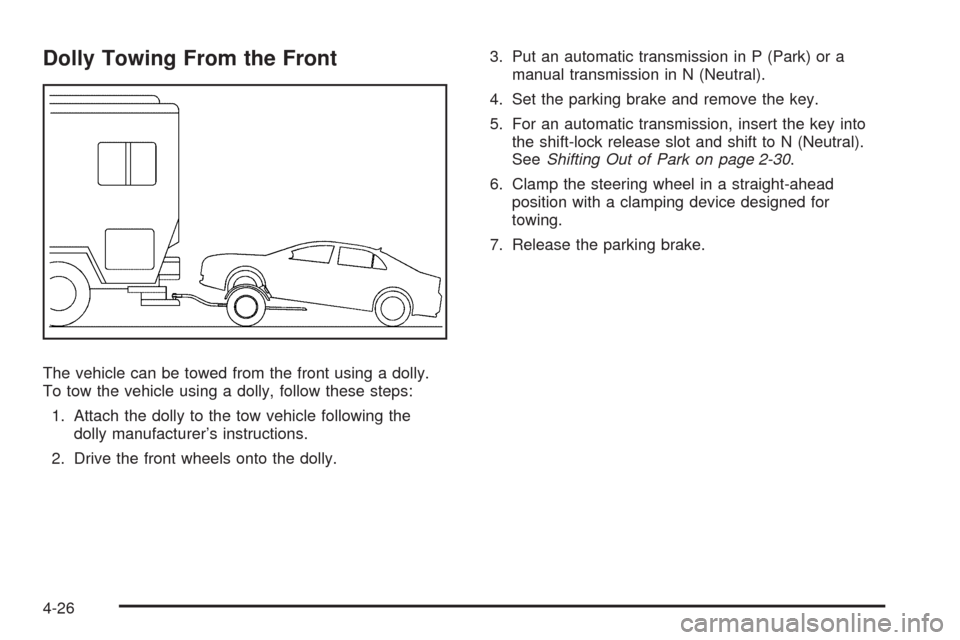
Dolly Towing From the Front
The vehicle can be towed from the front using a dolly.
To tow the vehicle using a dolly, follow these steps:
1. Attach the dolly to the tow vehicle following the
dolly manufacturer’s instructions.
2. Drive the front wheels onto the dolly.3. Put an automatic transmission in P (Park) or a
manual transmission in N (Neutral).
4. Set the parking brake and remove the key.
5. For an automatic transmission, insert the key into
the shift-lock release slot and shift to N (Neutral).
SeeShifting Out of Park on page 2-30.
6. Clamp the steering wheel in a straight-ahead
position with a clamping device designed for
towing.
7. Release the parking brake.
4-26
Page 207 of 354
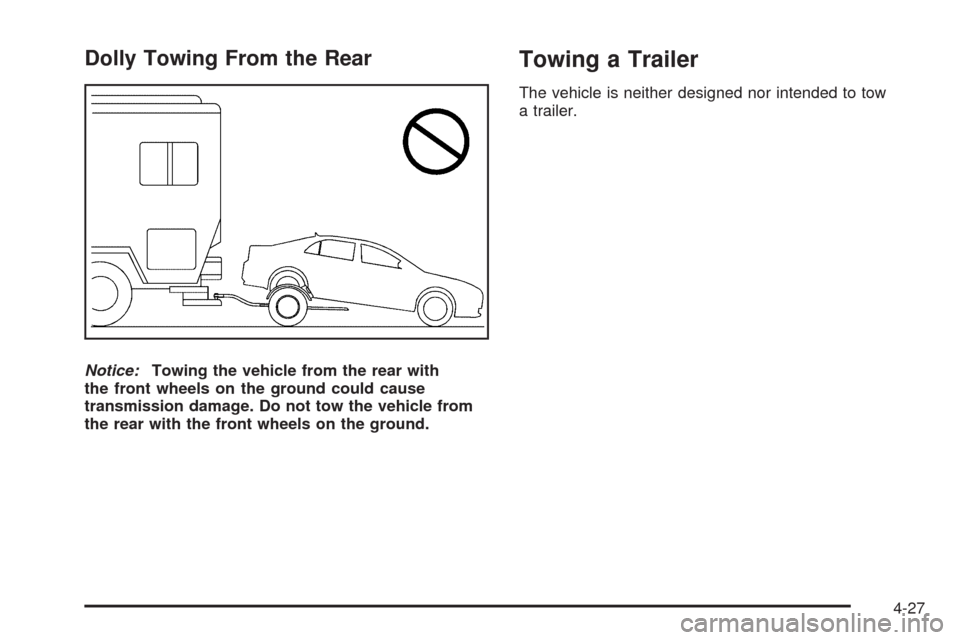
Dolly Towing From the Rear
Notice:Towing the vehicle from the rear with
the front wheels on the ground could cause
transmission damage. Do not tow the vehicle from
the rear with the front wheels on the ground.
Towing a Trailer
The vehicle is neither designed nor intended to tow
a trailer.
4-27
Page 224 of 354
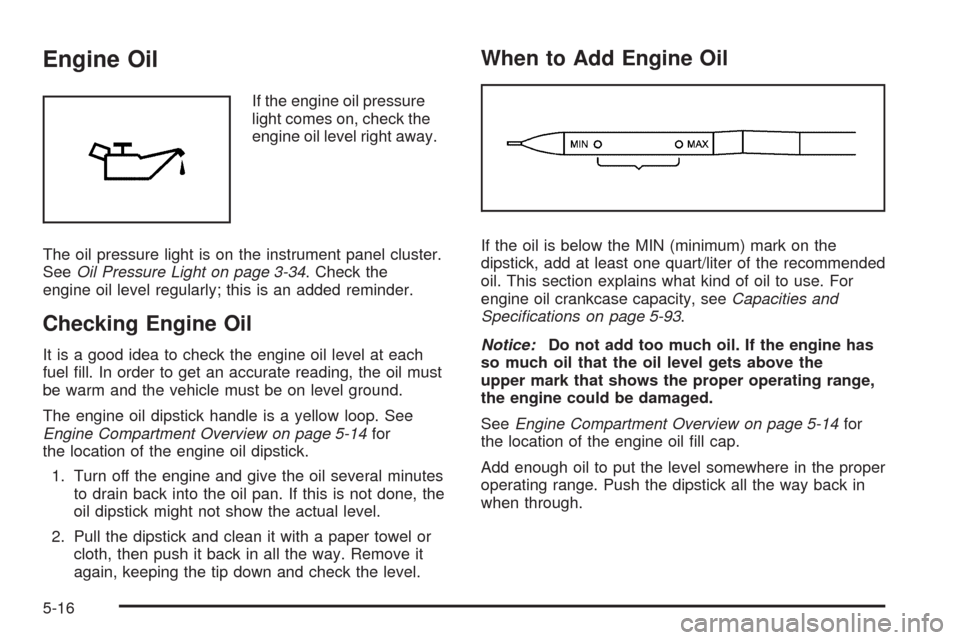
Engine Oil
If the engine oil pressure
light comes on, check the
engine oil level right away.
The oil pressure light is on the instrument panel cluster.
SeeOil Pressure Light on page 3-34. Check the
engine oil level regularly; this is an added reminder.
Checking Engine Oil
It is a good idea to check the engine oil level at each
fuel ll. In order to get an accurate reading, the oil must
be warm and the vehicle must be on level ground.
The engine oil dipstick handle is a yellow loop. See
Engine Compartment Overview on page 5-14for
the location of the engine oil dipstick.
1. Turn off the engine and give the oil several minutes
to drain back into the oil pan. If this is not done, the
oil dipstick might not show the actual level.
2. Pull the dipstick and clean it with a paper towel or
cloth, then push it back in all the way. Remove it
again, keeping the tip down and check the level.
When to Add Engine Oil
If the oil is below the MIN (minimum) mark on the
dipstick, add at least one quart/liter of the recommended
oil. This section explains what kind of oil to use. For
engine oil crankcase capacity, seeCapacities and
Specifications on page 5-93.
Notice:Do not add too much oil. If the engine has
so much oil that the oil level gets above the
upper mark that shows the proper operating range,
the engine could be damaged.
SeeEngine Compartment Overview on page 5-14for
the location of the engine oil ll cap.
Add enough oil to put the level somewhere in the proper
operating range. Push the dipstick all the way back in
when through.
5-16
Page 230 of 354
Then, without shutting off the engine, follow these steps:
1. Locate the automatic transmission dipstick which
is located toward the front of the engine
compartment, near the power steering uid
reservoir.
SeeEngine Compartment Overview on page 5-14
for more information on location.
2. Pull out the dipstick and wipe it with a clean rag or
paper towel.
3. Push the dipstick back in all the way, wait three
seconds, and then pull it back out again.
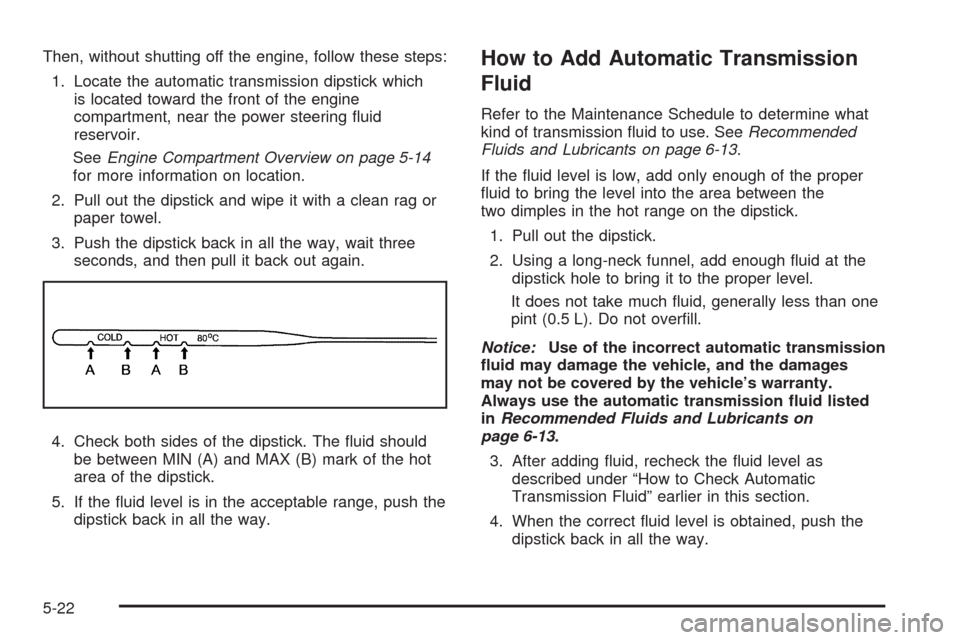
4. Check both sides of the dipstick. The uid should
be between MIN (A) and MAX (B) mark of the hot
area of the dipstick.
5. If the uid level is in the acceptable range, push the
dipstick back in all the way.How to Add Automatic Transmission
Fluid
Refer to the Maintenance Schedule to determine what
kind of transmission uid to use. SeeRecommended
Fluids and Lubricants on page 6-13.
If the uid level is low, add only enough of the proper
uid to bring the level into the area between the
two dimples in the hot range on the dipstick.
1. Pull out the dipstick.
2. Using a long-neck funnel, add enough uid at the
dipstick hole to bring it to the proper level.
It does not take much uid, generally less than one
pint (0.5 L). Do not overll.
Notice:Use of the incorrect automatic transmission
uid may damage the vehicle, and the damages
may not be covered by the vehicle’s warranty.
Always use the automatic transmission uid listed
inRecommended Fluids and Lubricants on
page 6-13.
3. After adding uid, recheck the uid level as
described under “How to Check Automatic
Transmission Fluid” earlier in this section.
4. When the correct uid level is obtained, push the
dipstick back in all the way.
5-22
Page 240 of 354
If the warning continues, pull over, stop, and park the
vehicle right away.
If there is no sign of steam, idle the engine for
three minutes while parked. If the warning is still
displayed, turn off the engine until it cools down.
Power Steering Fluid
When to Check Power Steering Fluid
The power steering uid reservoir is located toward the
front of the engine compartment on the driver’s side
of the vehicle. SeeEngine Compartment Overview on
page 5-14for reservoir location.
It is not necessary to regularly check power steering
uid unless you suspect there is a leak in the system or
you hear an unusual noise. A uid loss in this system
could indicate a problem. Have the system inspected
and repaired.
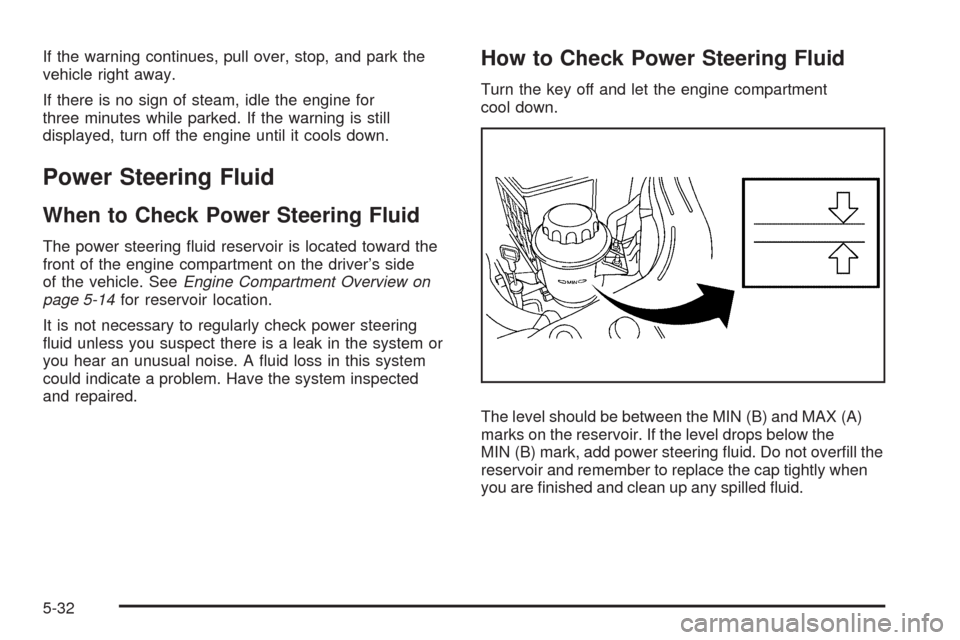
How to Check Power Steering Fluid
Turn the key off and let the engine compartment
cool down.
The level should be between the MIN (B) and MAX (A)
marks on the reservoir. If the level drops below the
MIN (B) mark, add power steering uid. Do not overll the
reservoir and remember to replace the cap tightly when
you are nished and clean up any spilled uid.
5-32
Page 257 of 354
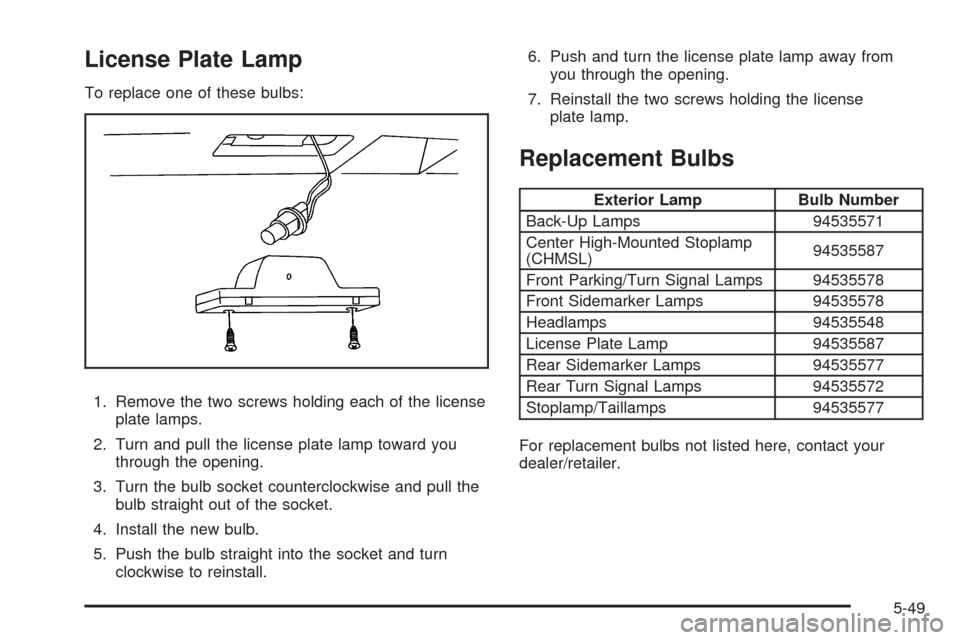
License Plate Lamp
To replace one of these bulbs:
1. Remove the two screws holding each of the license
plate lamps.
2. Turn and pull the license plate lamp toward you
through the opening.
3. Turn the bulb socket counterclockwise and pull the
bulb straight out of the socket.
4. Install the new bulb.
5. Push the bulb straight into the socket and turn
clockwise to reinstall.6. Push and turn the license plate lamp away from
you through the opening.
7. Reinstall the two screws holding the license
plate lamp.
Replacement Bulbs
Exterior Lamp Bulb Number
Back-Up Lamps 94535571
Center High-Mounted Stoplamp
(CHMSL)94535587
Front Parking/Turn Signal Lamps 94535578
Front Sidemarker Lamps 94535578
Headlamps 94535548
License Plate Lamp 94535587
Rear Sidemarker Lamps 94535577
Rear Turn Signal Lamps 94535572
Stoplamp/Taillamps 94535577
For replacement bulbs not listed here, contact your
dealer/retailer.
5-49
Page 271 of 354
After the tires have been rotated, adjust the front
and rear ination pressures as shown on the
tire and loading information label. SeeLoading the
Vehicle on page 4-16for an example of the tire
and loading information label and where it is
located on your vehicle. Make certain that all wheel
nuts are properly tightened. See “Wheel Nut
Torque” underCapacities and Specifications on
page 5-93.
{CAUTION:
Rust or dirt on a wheel, or on the parts to
which it is fastened, can make wheel nuts
become loose after time. The wheel could
come off and cause an accident. When you
change a wheel, remove any rust or dirt from
places where the wheel attaches to the
vehicle. In an emergency, you can use a
cloth or a paper towel to do this; but be sure
to use a scraper or wire brush later, if
needed, to get all the rust or dirt off. See
Changing a Flat Tire on page 5-70.
When It Is Time for New Tires
Various factors, such as maintenance, temperatures,
driving speeds, vehicle loading, and road conditions
inuence when you need new tires.
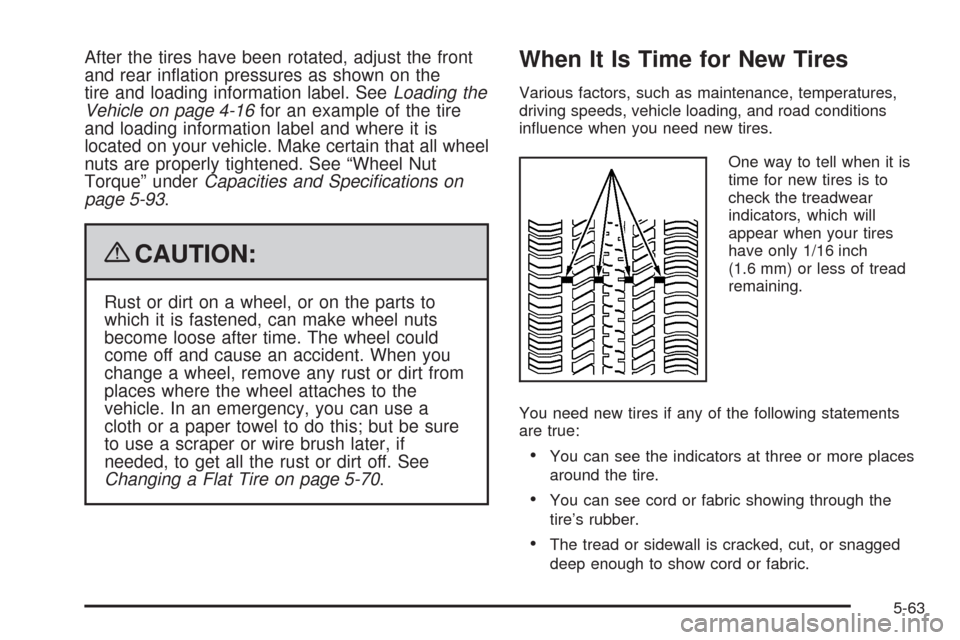
One way to tell when it is
time for new tires is to
check the treadwear
indicators, which will
appear when your tires
have only 1/16 inch
(1.6 mm) or less of tread
remaining.
You need new tires if any of the following statements
are true:
You can see the indicators at three or more places
around the tire.
You can see cord or fabric showing through the
tire’s rubber.
The tread or sidewall is cracked, cut, or snagged
deep enough to show cord or fabric.
5-63
Page 277 of 354
If a Tire Goes Flat
It is unusual for a tire to blowout while you are driving,
especially if you maintain your vehicle’s tires properly.
If air goes out of a tire, it is much more likely to leak out
slowly. But if you should ever have a blowout, here
are a few tips about what to expect and what to do:
If a front tire fails, the at tire creates a drag that pulls
the vehicle toward that side. Take your foot off the
accelerator pedal and grip the steering wheel rmly.
Steer to maintain lane position, and then gently brake to
a stop well out of the traffic lane.
A rear blowout, particularly on a curve, acts much like a
skid and may require the same correction you would
use in a skid. In any rear blowout remove your foot from
the accelerator pedal. Get the vehicle under control
by steering the way you want the vehicle to go. It may
be very bumpy and noisy, but you can still steer. Gently
brake to a stop, well off the road if possible.{CAUTION:
Lifting a vehicle and getting under it to do
maintenance or repairs is dangerous without the
appropriate safety equipment and training. If a jack
is provided with the vehicle, it is designed only for
changing a at tire. If it is used for anything else,
you or others could be badly injured or killed if the
vehicle slips off the jack. If a jack is provided with
the vehicle, only use it for changing a at tire.
If a tire goes at, the next part shows how to use the
jacking equipment to change a at tire safely.
5-69