automatic transmission CHEVROLET AVEO 2009 1.G Owners Manual
[x] Cancel search | Manufacturer: CHEVROLET, Model Year: 2009, Model line: AVEO, Model: CHEVROLET AVEO 2009 1.GPages: 354, PDF Size: 2.07 MB
Page 81 of 354
Keys...............................................................2-2
Remote Keyless Entry (RKE) System................2-3
Remote Keyless Entry (RKE) System
Operation...................................................2-4
Doors and Locks.............................................2-6
Door Locks....................................................2-6
Central Door Unlocking System........................2-7
Door Ajar Reminder........................................2-7
Rear Door Security Locks................................2-7
Trunk (Sedan)................................................2-8
Liftgate (Hatchback)......................................2-10
Windows........................................................2-12
Manual Windows..........................................2-12
Power Windows............................................2-13
Sun Visors...................................................2-14
Theft-Deterrent Systems..................................2-14
Immobilizer..................................................2-14
Immobilizer Operation....................................2-15
Content Theft-Deterrent.................................2-16
Starting and Operating Your Vehicle................2-18
New Vehicle Break-In....................................2-18
Ignition Positions..........................................2-18
Starting the Engine.......................................2-19Engine Heater..............................................2-21
Automatic Transmission Operation...................2-22
Manual Transmission Operation......................2-26
Parking Brake..............................................2-28
Shifting Into Park (Automatic Transmission)......2-29
Shifting Out of Park......................................2-30
Parking the Vehicle (Manual Transmission).......2-31
Parking Over Things That Burn.......................2-32
Engine Exhaust............................................2-32
Running the Vehicle While Parked..................2-33
Mirrors...........................................................2-34
Manual Rearview Mirror
.................................2-34
Outside Manual Mirrors..................................2-34
Outside Power Mirrors...................................2-35
Outside Convex Mirror...................................2-35
Outside Heated Mirrors..................................2-35
OnStar
®System.............................................2-36
Storage Areas................................................2-39
Glove Box...................................................2-39
Cupholders..................................................2-39
Sunglasses Storage Compartment...................2-40
Sunroof.........................................................2-40
Section 2 Features and Controls
2-1
Page 99 of 354
Notice:Using a tool to force the key to turn in the
ignition could cause damage to the switch or break
the key. Use the correct key, make sure it is all the
way in, and turn it only with your hand. If the key
cannot be turned by hand, see your dealer/retailer.
LOCK/OFF:This position locks the steering wheel,
ignition, shift lever and transmission. This is the
only position in which you can insert or remove the key.
The steering can bind with the wheels turned off
center. If this happens, move the steering wheel from
right to left while turning the key to ACC/ACCESSORY.
If this doesn’t work, then the vehicle needs service.
ACC/ACCESSORY:This position operates some of the
electrical accessories, such as the radio, but not the
climate control system.
ON/RUN:This position can be used to operate the
electrical accessories, and to display some instrument
panel cluster warning and indicator lights. The switch
stays in this position when the engine is running. If you
leave the key in the ACC/ACCESSORY or ON/RUN
position with the engine off, the battery could be drained.
You may not be able to start the vehicle if the battery
is allowed to drain for an extended period of time.
START:This is the position that starts the engine.
When the engine starts, release the key. The ignition
switch returns to ON/RUN for driving. Do not turn
the key to START if the engine is running.Starting the Engine
Automatic Transmission
Move the shift lever to P (Park) or N (Neutral).
The engine will not start in any other position.
To restart the engine when the vehicle is already
moving, use N (Neutral) only.
Notice:Do not try to shift to P (Park) if the vehicle
is moving. If you do, you could damage the
transmission. Shift to P (Park) only when the
vehicle is stopped.
Manual Transmission
The shift lever should be in N (Neutral) and the parking
brake engaged. Hold the clutch pedal to the oor
and start the engine. The vehicle will not start if the
clutch pedal is not all the way down.
2-19
Page 102 of 354
Automatic Transmission Operation
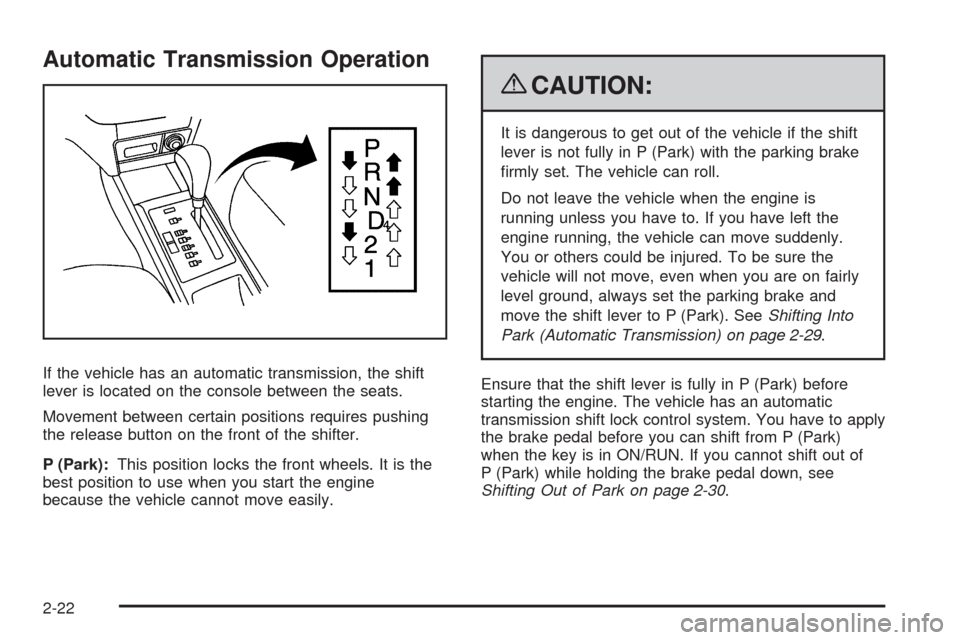
If the vehicle has an automatic transmission, the shift
lever is located on the console between the seats.
Movement between certain positions requires pushing
the release button on the front of the shifter.
P (Park):This position locks the front wheels. It is the
best position to use when you start the engine
because the vehicle cannot move easily.
{CAUTION:
It is dangerous to get out of the vehicle if the shift
lever is not fully in P (Park) with the parking brake
rmly set. The vehicle can roll.
Do not leave the vehicle when the engine is
running unless you have to. If you have left the
engine running, the vehicle can move suddenly.
You or others could be injured. To be sure the
vehicle will not move, even when you are on fairly
level ground, always set the parking brake and
move the shift lever to P (Park). SeeShifting Into
Park (Automatic Transmission) on page 2-29.
Ensure that the shift lever is fully in P (Park) before
starting the engine. The vehicle has an automatic
transmission shift lock control system. You have to apply
the brake pedal before you can shift from P (Park)
when the key is in ON/RUN. If you cannot shift out of
P (Park) while holding the brake pedal down, see
Shifting Out of Park on page 2-30.
2-22
Page 104 of 354
D4 (Automatic Overdrive):This position is for normal
driving.
When operating the vehicle in severe cold conditions,
the transmission may be prevented from shifting into
D4 gear until the transmission uid has warmed up to it’s
operational temperature.
Notice:If the vehicle seems to start up rather
slowly or not shift gears when you go faster,
and you continue to drive the vehicle that way,
you could damage the transmission. Have the
vehicle serviced right away. You can drive in
2 (Second) when you are driving less than 35 mph
(55 km/h) and D4 (Automatic Overdrive) for higher
speeds until then.
2 (Second):This position gives you more power but
lower fuel economy. You can use 2 (Second) on hills.
It can help control vehicle speed as you go down steep
mountain roads, while using the brakes off and on.
Notice:Do not drive in 2 (Second) at speeds
over 65 mph (105 km/h), or you can damage the
transmission. Use D4 (Automatic Overdrive)
as much as possible. Do not shift into 2 (Second)
unless you are going slower than 65 mph (105 km/h)
or you can damage the engine.1 (First):This position gives you even more power but
lower fuel economy than 2 (Second). You can use it
on very steep hills, or in deep snow or mud. If the shift
lever is put in 1 (First), the transmission will not shift
into rst gear until the vehicle is going slowly enough.
Notice:Spinning the tires or holding the vehicle
in one place on a hill using only the accelerator
pedal may damage the transmission. The repair will
not be covered by the vehicle warranty. If you are
stuck, do not spin the tires. When stopping on a hill,
use the brakes to hold the vehicle in place.
If there is a malfunction with the automatic transmission,
the malfunction indicator lamp (MIL) or the HOLD
indicator light will turn on or ash. SeeMalfunction
Indicator Lamp on page 3-32orHold Mode Light
on page 3-30.
Have the vehicle xed as soon as possible.
2-24
Page 105 of 354
Hold Mode
If the vehicle’s transmission has hold mode, you can
select this mode to allow the automatic transmission to
stay in a specic gear range.
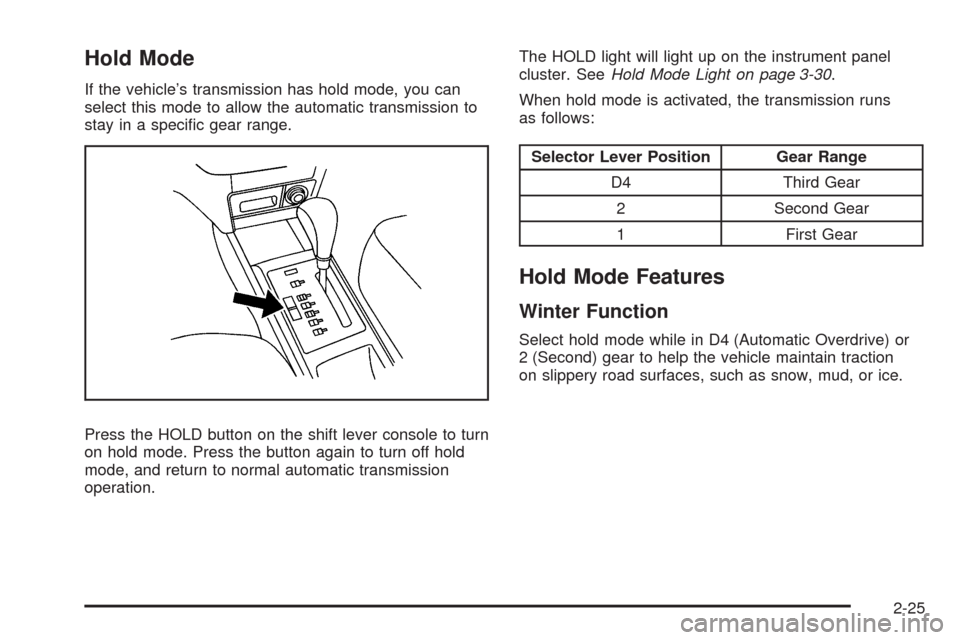
Press the HOLD button on the shift lever console to turn
on hold mode. Press the button again to turn off hold
mode, and return to normal automatic transmission
operation.The HOLD light will light up on the instrument panel
cluster. SeeHold Mode Light on page 3-30.
When hold mode is activated, the transmission runs
as follows:
Selector Lever Position Gear Range
D4 Third Gear
2 Second Gear
1 First Gear
Hold Mode Features
Winter Function
Select hold mode while in D4 (Automatic Overdrive) or
2 (Second) gear to help the vehicle maintain traction
on slippery road surfaces, such as snow, mud, or ice.
2-25
Page 109 of 354
Shifting Into Park
(Automatic Transmission)
{CAUTION:
It can be dangerous to get out of the vehicle if the
shift lever is not fully in P (Park) with the parking
brake rmly set. The vehicle can roll. If you have
left the engine running, the vehicle can move
suddenly. You or others could be injured. To be
sure the vehicle will not move, even when you are
on fairly level ground, use the steps that follow.
1. Hold the brake pedal down and set the parking
brake. SeeParking Brake on page 2-28for more
information.
2. Move the shift lever into P (Park) by pressing the
button on the shift lever and pushing the lever all
the way toward the front of the vehicle.
3. Turn the ignition key to LOCK/OFF.
4. Remove the key and take it with you. If you can
leave the vehicle with the ignition key in your
hand, the vehicle is in P (Park).
Leaving the Vehicle With the Engine
Running (Automatic Transmission)
{CAUTION:
It can be dangerous to leave the vehicle with the
engine running. The vehicle could move suddenly
if the shift lever is not fully in P (Park) with the
parking brake rmly set. And, if you leave the
vehicle with the engine running, it could overheat
and even catch re. You or others could be
injured. Do not leave the vehicle with the engine
running.
If you have to leave the vehicle with the engine running,
be sure the vehicle is in P (Park) and the parking
brake is rmly set before you leave it. After you have
moved the shift lever into P (Park), hold the brake pedal
down. Then see if you can move the shift lever away
from P (Park) without rst pushing the shift lock release
button. If you can, it means that the shift lever was
not fully locked into P (Park).
2-29
Page 110 of 354
Torque Lock (Automatic Transmission)
If you are parking on a hill and you do not shift your
transmission into P (Park) properly, the weight of
the vehicle may put too much force on the parking pawl
in the transmission. You may nd it difficult to pull the
shift lever out of P (Park). This is called “torque lock.”
To prevent torque lock, set the parking brake and
then shift into P (Park) properly before you leave the
driver seat. To nd out how, seeShifting Into Park
(Automatic Transmission) on page 2-29.
When you are ready to drive, move the shift lever out
of P (Park) before you release the parking brake.
If torque lock does occur, you may need to have
another vehicle push yours a little uphill to take
some of the pressure from the parking pawl in the
transmission, so you can pull the shift lever out
of P (Park).
Shifting Out of Park
Vehicles with an automatic transmission have a shift
interlock system. You have to apply the brake pedal
before you can shift from P (Park) when the ignition is
in the ON/RUN position. SeeAutomatic Transmission
Operation on page 2-22.
If you cannot shift out of P (Park) while holding the
brake pedal down, try this:
1. Set the parking brake.
2. Turn the ignition off and remove the key.
3. Remove the hole cover from the shift lock slot by
prying it off using a small, at object. The shift
lock release slot is located at the top of the
shift lever.
2-30
Page 113 of 354
Running the Vehicle While Parked
It is better not to park with the engine running. But if you
ever have to, here are some things to know.
{CAUTION:
Idling a vehicle in an enclosed area with poor
ventilation is dangerous. Engine exhaust may
enter the vehicle. Engine exhaust contains Carbon
Monoxide (CO) which cannot be seen or smelled.
It can cause unconsciousness and even death.
Never run the engine in an enclosed area that has
no fresh air ventilation. For more information,
seeEngine Exhaust on page 2-32.
{CAUTION:
It can be dangerous to get out of the vehicle if
the automatic transmission shift lever is not fully
in P (Park) with the parking brake rmly set.
The vehicle can roll. Do not leave the vehicle
when the engine is running unless you have to.
If you have left the engine running, the vehicle can
move suddenly. You or others could be injured.
To be sure the vehicle will not move, even when it
is on fairly level ground, always set the parking
brake and move the automatic transmission shift
lever to P (Park), or the manual transmission shift
lever to Neutral.
Follow the proper steps to be sure the vehicle will not
move. If the vehicle has an automatic transmission,
seeShifting Into Park (Automatic Transmission)
on page 2-29.
2-33
Page 133 of 354
Using Cruise Control on Hills
How well the cruise control works on hills depends upon
the vehicle speed, load, and the steepness of the
hills. When going up steep hills, you might have to step
on the accelerator pedal to maintain the vehicle’s
speed. When going downhill, you might have to brake
or shift to a lower gear to keep the vehicle’s speed
down. When the brakes are applied the cruise control
turns off.
Ending Cruise Control
There are two ways to turn off the cruise control:
Step lightly on the brake pedal, or press the clutch
pedal, if you have a manual transmission.
PressI/Oon the cruise control pad.
Erasing Speed Memory
The cruise control set speed memory is erased when
the cruise control or the ignition is turned off.
Exterior Lamps
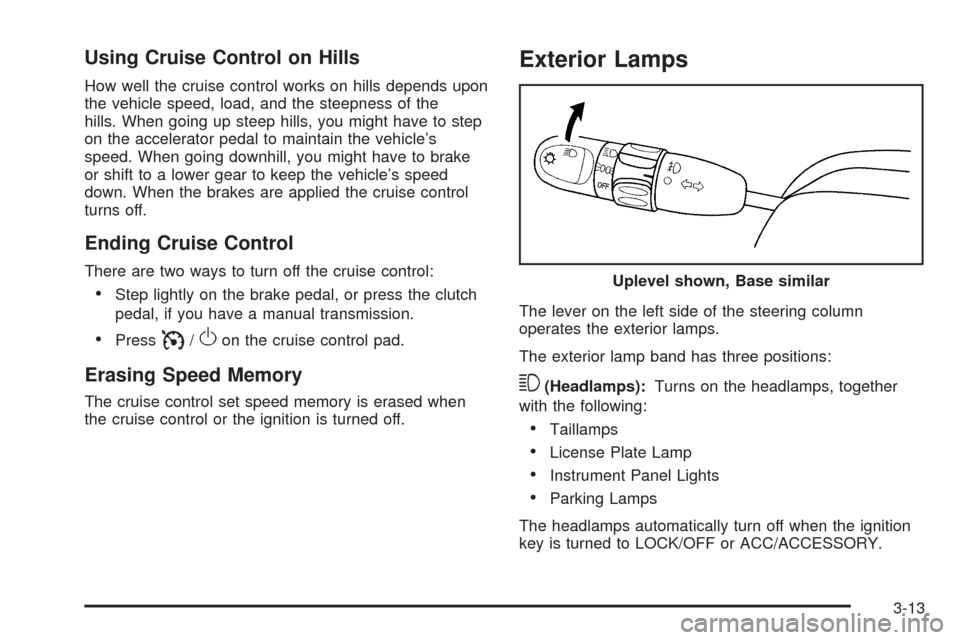
The lever on the left side of the steering column
operates the exterior lamps.
The exterior lamp band has three positions:
3(Headlamps):Turns on the headlamps, together
with the following:
Taillamps
License Plate Lamp
Instrument Panel Lights
Parking Lamps
The headlamps automatically turn off when the ignition
key is turned to LOCK/OFF or ACC/ACCESSORY.Uplevel shown, Base similar
3-13
Page 144 of 354
Instrument Panel Cluster
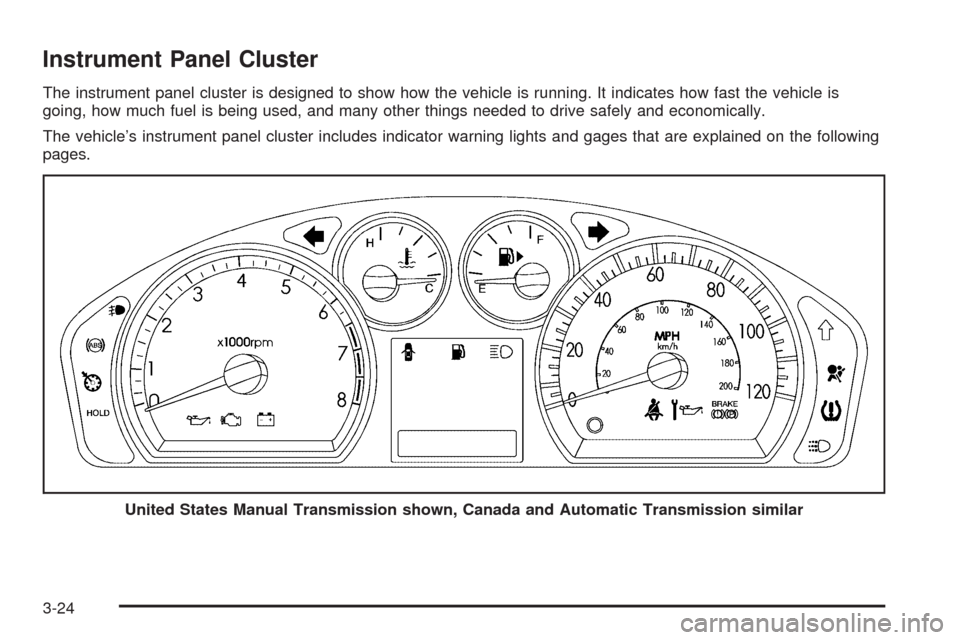
The instrument panel cluster is designed to show how the vehicle is running. It indicates how fast the vehicle is
going, how much fuel is being used, and many other things needed to drive safely and economically.
The vehicle’s instrument panel cluster includes indicator warning lights and gages that are explained on the following
pages.
United States Manual Transmission shown, Canada and Automatic Transmission similar
3-24