flat tire CHEVROLET AVEO 2011 1.G Owner's Manual
[x] Cancel search | Manufacturer: CHEVROLET, Model Year: 2011, Model line: AVEO, Model: CHEVROLET AVEO 2011 1.GPages: 328, PDF Size: 5.37 MB
Page 263 of 328
Black plate (61,1)Chevrolet Aveo Owner Manual - 2011
Vehicle Care 10-61
Used Replacement Wheels
{WARNING
Replacing a wheel with a used
one is dangerous. How it has
been used or how far it has been
driven may be unknown. It could
fail suddenly and cause a crash.
When replacing wheels, use a
new GM original equipment
wheel.
Tire Chains
Notice:Use tire chains only
where legal and only when you
must. Use only SAE Class“S”
type chains that are the proper
size for your tires. Install them on
the front tires and tighten them
as tightly as possible with the
ends securely fastened. Drive
slowly and follow the chain
manufacturer's instructions.
If you can hear the chains
contacting your vehicle, stop
and retighten them. If the
contact continues, slow down
until it stops. Driving too fast or
spinning the wheels with chains
on will damage your vehicle.
If a Tire Goes Flat
It is unusual for a tire to blowout
while you are driving, especially if
you maintain the vehicle's tires
properly. If air goes out of a tire, it is
much more likely to leak out slowly.
But if you should ever have a
blowout, here are a few tips about
what to expect and what to do:
If a front tire fails, the flat tire
creates a drag that pulls the vehicle
toward that side. Take your foot off
the accelerator pedal and grip the
steering wheel firmly. Steer to
maintain lane position, and then
gently brake to a stop, well off the
road, if possible.
Page 264 of 328
Black plate (62,1)Chevrolet Aveo Owner Manual - 2011
10-62 Vehicle Care
A rear blowout, particularly on a
curve, acts much like a skid and
may require the same correction
you would use in a skid. In any rear
blowout remove your foot from the
accelerator pedal. Get the vehicle
under control by steering the way
you want the vehicle to go. It may
be very bumpy and noisy, but you
can still steer. Gently brake to a
stop, well off the road, if possible.{WARNING
Driving on a flat tire will cause
permanent damage to the tire.
Re-inflating a tire after it has
been driven on while severely
underinflated or flat may cause a
blowout and a serious crash.
Never attempt to re-inflate a tire
that has been driven on while
severely underinflated or flat.
Have your dealer or an authorized
tire service center repair or
replace the flat tire as soon as
possible.
{WARNING
Lifting a vehicle and getting
under it to do maintenance or
repairs is dangerous without the
appropriate safety equipment and
training. If a jack is provided with
the vehicle, it is designed only for
changing a flat tire. If it is used for
anything else, you or others could
be badly injured or killed if the
vehicle slips off the jack. If a jack
is provided with the vehicle, only
use it for changing a flat tire.
If a tire goes flat, avoid further tire
and wheel damage by driving slowly
to a level place, well off the road,
if possible. Turn on the hazard
warning flashers. See Hazard
Warning Flashers on page 6‑3.
Page 265 of 328
Black plate (63,1)Chevrolet Aveo Owner Manual - 2011
Vehicle Care 10-63
{WARNING
Changing a tire can be
dangerous. The vehicle can slip
off the jack and roll over or fall on
you or other people. You and they
could be badly injured or even
killed. Find a level place to
change the tire. To help prevent
the vehicle from moving:1. Set the parking brake firmly.
2. Put an automatic transmission shift lever in
P (Park), or shift a manual
transmission to 1 (First) or
R (Reverse).
(Continued)
WARNING (Continued)
3. Turn off the engine and donot restart while the vehicle
is raised.
4. Do not allow passengers to remain in the vehicle.
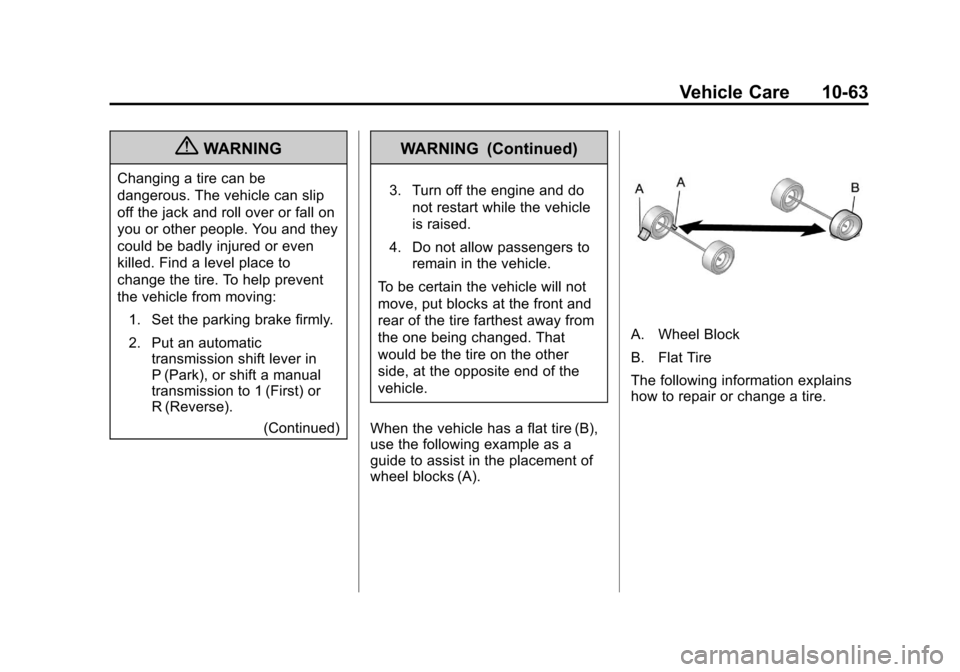
To be certain the vehicle will not
move, put blocks at the front and
rear of the tire farthest away from
the one being changed. That
would be the tire on the other
side, at the opposite end of the
vehicle.
When the vehicle has a flat tire (B),
use the following example as a
guide to assist in the placement of
wheel blocks (A).
A. Wheel Block
B. Flat Tire
The following information explains
how to repair or change a tire.
Page 267 of 328
Black plate (65,1)Chevrolet Aveo Owner Manual - 2011
Vehicle Care 10-65
Removing the Flat Tire and
Installing the Spare Tire
1. Do a safety check beforeproceeding. See If a Tire Goes
Flat on page 10‑61.
2. If your vehicle has wheel covers, turn the four plastic caps
counterclockwise by hand or by
using the wheel wrench. The
plastic nuts do not come off of
the cover.
3. Remove the wheel cover using the flat end of the jack handle.
Pry along the edge of the wheel
cover until it comes off.
Store the wheel cover in the
cargo area until you have the flat
tire repaired or replaced.
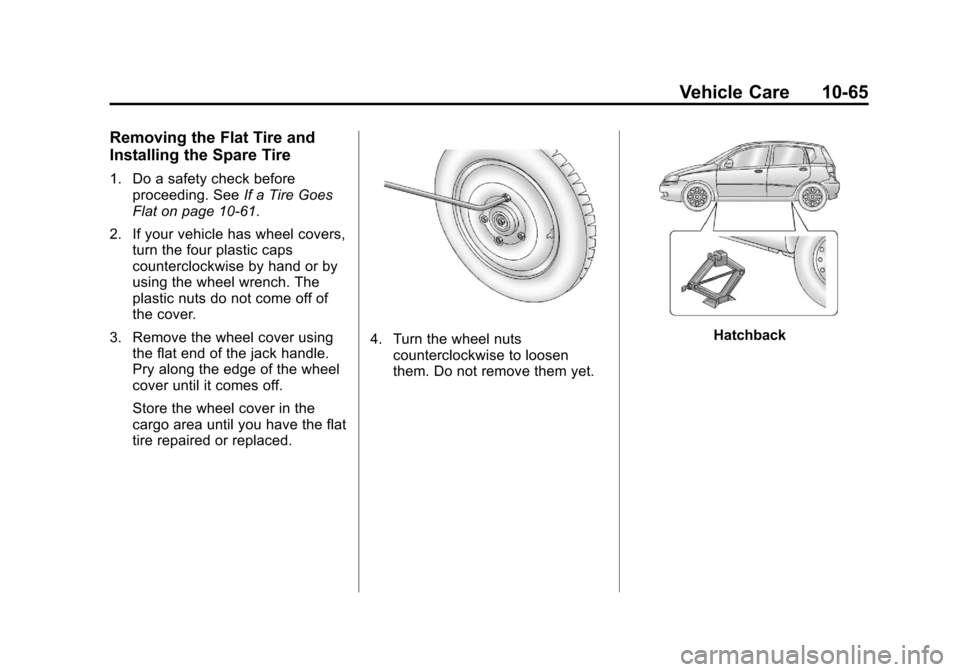
4. Turn the wheel nutscounterclockwise to loosen
them. Do not remove them yet.Hatchback
Page 268 of 328
Black plate (66,1)Chevrolet Aveo Owner Manual - 2011
10-66 Vehicle Care
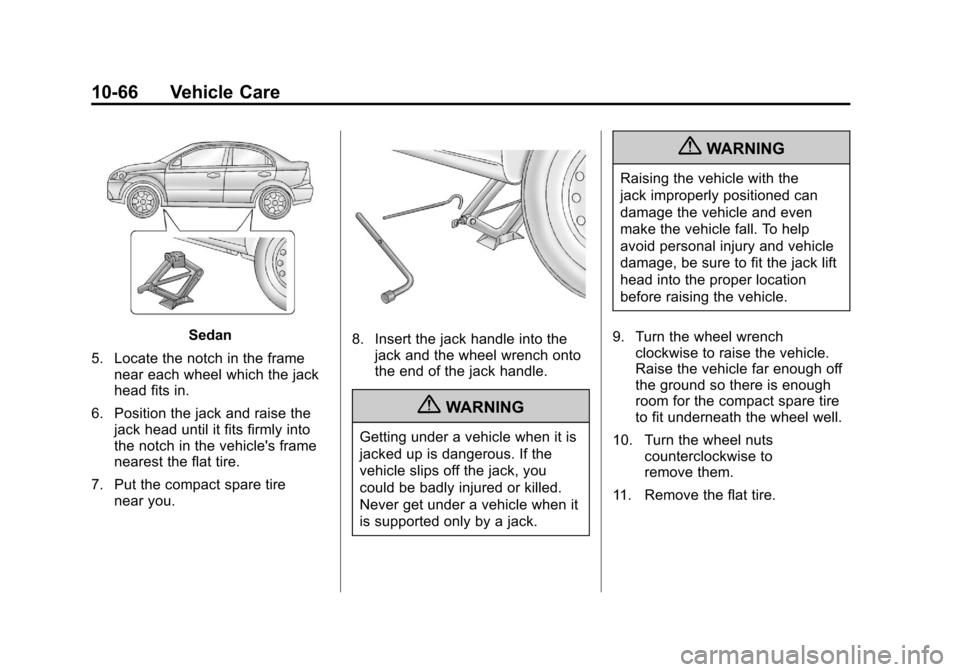
Sedan
5. Locate the notch in the frame near each wheel which the jack
head fits in.
6. Position the jack and raise the jack head until it fits firmly into
the notch in the vehicle's frame
nearest the flat tire.
7. Put the compact spare tire near you.8. Insert the jack handle into thejack and the wheel wrench onto
the end of the jack handle.
{WARNING
Getting under a vehicle when it is
jacked up is dangerous. If the
vehicle slips off the jack, you
could be badly injured or killed.
Never get under a vehicle when it
is supported only by a jack.
{WARNING
Raising the vehicle with the
jack improperly positioned can
damage the vehicle and even
make the vehicle fall. To help
avoid personal injury and vehicle
damage, be sure to fit the jack lift
head into the proper location
before raising the vehicle.
9. Turn the wheel wrench clockwise to raise the vehicle.
Raise the vehicle far enough off
the ground so there is enough
room for the compact spare tire
to fit underneath the wheel well.
10. Turn the wheel nuts counterclockwise to
remove them.
11. Remove the flat tire.
Page 269 of 328
Black plate (67,1)Chevrolet Aveo Owner Manual - 2011
Vehicle Care 10-67
{WARNING
Rust or dirt on a wheel, or on the
parts to which it is fastened, can
make wheel nuts become loose
after time. The wheel could come
off and cause an accident. When
changing a wheel, remove any
rust or dirt from places where the
wheel attaches to the vehicle. In
an emergency, use a cloth or a
paper towel to do this; but be sure
to use a scraper or wire brush
later, if needed, to get all the rust
or dirt off. SeeIf a Tire Goes Flat
on page 10‑61.
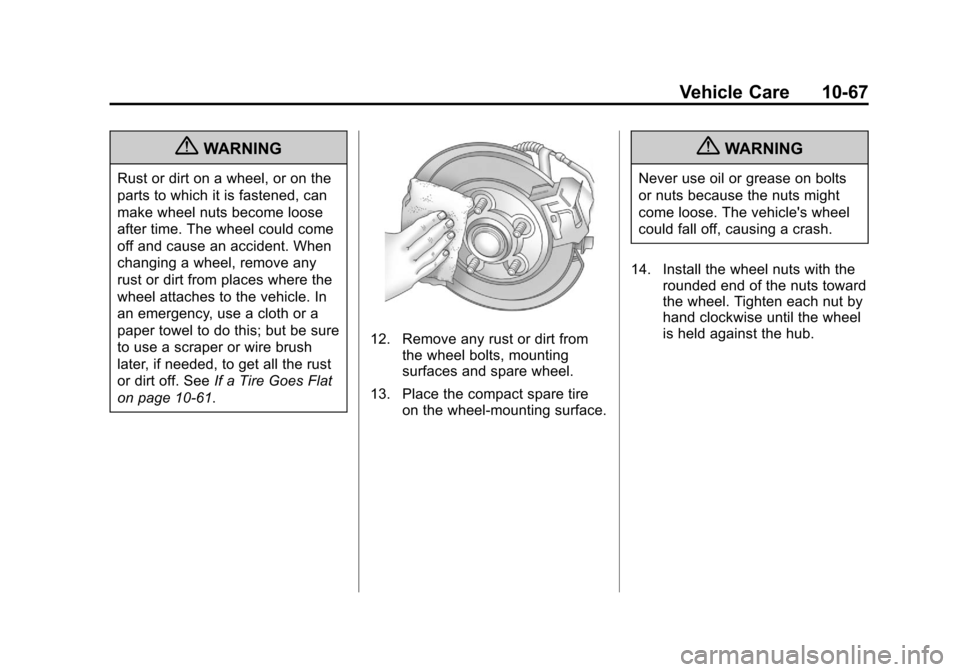
12. Remove any rust or dirt from the wheel bolts, mounting
surfaces and spare wheel.
13. Place the compact spare tire on the wheel-mounting surface.
{WARNING
Never use oil or grease on bolts
or nuts because the nuts might
come loose. The vehicle's wheel
could fall off, causing a crash.
14. Install the wheel nuts with the rounded end of the nuts toward
the wheel. Tighten each nut by
hand clockwise until the wheel
is held against the hub.
Page 270 of 328
Black plate (68,1)Chevrolet Aveo Owner Manual - 2011
10-68 Vehicle Care
15. Lower the vehicle byturning the wheel wrench
counterclockwise. Lower the
jack completely.
{WARNING
Wheel nuts that are improperly or
incorrectly tightened can cause
the wheels to become loose or
come off. The wheel nuts should
be tightened with a torque wrench
to the proper torque specification
after replacing. Follow the torque
specification supplied by the
aftermarket manufacturer when
using accessory locking wheel
nuts. See Capacities and
Specifications on page 12‑2 for
original equipment wheel nut
torque specifications.
Notice: Improperly tightened
wheel nuts can lead to brake
pulsation and rotor damage. To
avoid expensive brake repairs,
evenly tighten the wheel nuts in the proper sequence and to the
proper torque specification. See
Capacities and Specifications on
page 12‑2
for the wheel nut
torque specification.
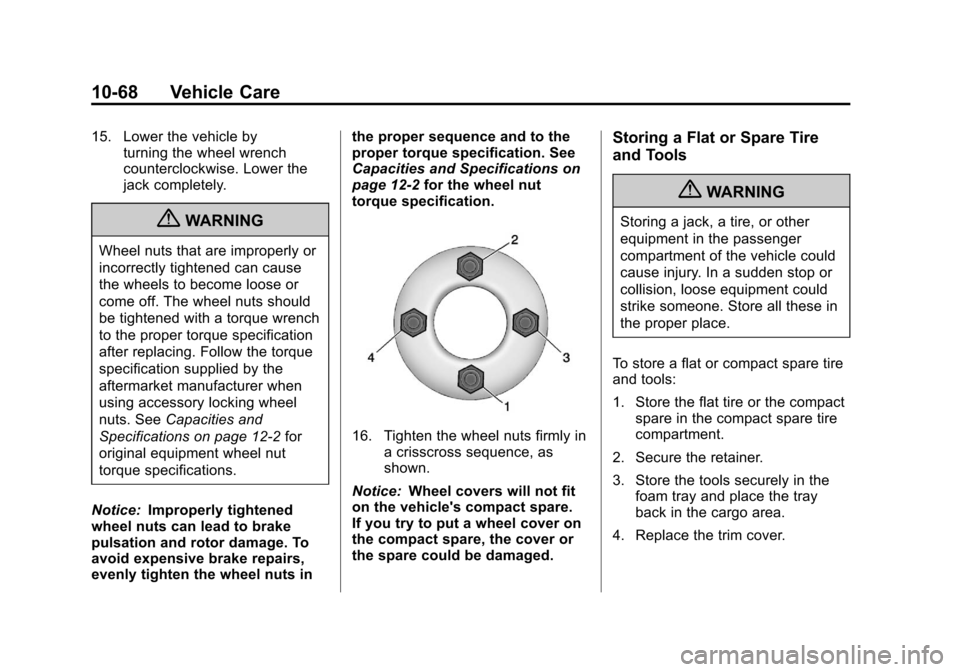
16. Tighten the wheel nuts firmly in a crisscross sequence, as
shown.
Notice: Wheel covers will not fit
on the vehicle's compact spare.
If you try to put a wheel cover on
the compact spare, the cover or
the spare could be damaged.
Storing a Flat or Spare Tire
and Tools
{WARNING
Storing a jack, a tire, or other
equipment in the passenger
compartment of the vehicle could
cause injury. In a sudden stop or
collision, loose equipment could
strike someone. Store all these in
the proper place.
To store a flat or compact spare tire
and tools:
1. Store the flat tire or the compact spare in the compact spare tire
compartment.
2. Secure the retainer.
3. Store the tools securely in the foam tray and place the tray
back in the cargo area.
4. Replace the trim cover.
Page 271 of 328
Black plate (69,1)Chevrolet Aveo Owner Manual - 2011
Vehicle Care 10-69
The compact spare tire is for
temporary use only. Replace the
compact spare tire with a full-size
tire as soon as you can. See
Compact Spare Tire on page 10‑69.
Compact Spare Tire
{WARNING
Driving with more than one
compact spare tire at a time
could result in loss of braking and
handling. This could lead to a
crash and you or others could be
injured. Use only one compact
spare tire at a time.
The compact spare tire was fully
inflated when the vehicle was new, it
can lose air after a time. Check the
inflation pressure regularly. It should
be 414 kPa (60 psi). After installing the compact spare
on your vehicle, you should stop as
soon as possible and make sure
your spare tire is correctly inflated.
The compact spare is intended
to perform well at speeds up to
80 km/h (50 mph), so you can finish
your trip and have your full-size tire
repaired or replaced where you
want. Replace your spare with a
full-size tire as soon as you can.
Notice:
When the compact
spare is installed, do not take
the vehicle through an automatic
car wash with guide rails. The
compact spare can get caught on
the rails which can damage the
tire, wheel and other parts of the
vehicle. Do not use your compact spare on
other vehicles.
Do not mix your compact spare tire
or wheel with other wheels or tires.
Keep your spare tire and its wheel
together.
Notice:
Tire chains will not fit
the compact spare. Using them
can damage the vehicle and can
damage the chains too. Do not
use tire chains on the compact
spare.
Page 289 of 328
Black plate (3,1)Chevrolet Aveo Owner Manual - 2011
Service and Maintenance 11-3
Reset the oil life system whenever
the oil is changed. SeeEngine Oil
Life System on page 10‑12.
Every Engine Oil Change
.Change engine oil and filter.
Reset oil life system. See
Engine Oil on page 10‑9 and
Engine Oil Life System on
page 10‑12. An Emission
Control Service.
.Engine coolant level check. See
Engine Coolant on page 10‑18.
.Engine cooling system
inspection. Visual inspection of
hoses, pipes, fittings, and
clamps and replacement,
if needed.
.Windshield washer fluid level
check. See Washer Fluid on
page 10‑24.
.Windshield wiper blade
inspection for wear, cracking,
or contamination and windshield
and wiper blade cleaning,
if contaminated. See Exterior
Care on page 10‑76. Worn
or damaged wiper blade
replacement. See Wiper Blade
Replacement on page 10‑30.
.Tire inflation pressures check.
See Tire Pressure on
page 10‑48.
.Tire wear inspection. See Tire
Inspection on page 10‑53.
.Rotate tires if necessary. See
Tire Rotation on page 10‑54.
.Fluids visual leak check (or
every 12 months, whichever
occurs first). A leak in any
system must be repaired and
the fluid level checked.
.Engine air cleaner filter
inspection. See Engine Air
Cleaner/Filter on page 10‑16.
.Brake system inspection
(or every 12 months, whichever
occurs first).
.Steering and suspension
inspection. Visual inspection
for damaged, loose, or missing
parts or signs of wear.
.Body hinges and latches, key
lock cylinders, and trunk lid
hinges and latches lubrication.
See Recommended Fluids and
Lubricants on page 11‑6. More
frequent lubrication may be
required when the vehicle
is exposed to a corrosive
environment. Applying silicone
grease on weatherstrips with a
clean cloth makes them last
longer, seal better, and not stick
or squeak.
.Restraint system component
check. See Safety System
Check on page 3‑23.
.Fuel system inspection for
damage or leaks.
Page 290 of 328
Black plate (4,1)Chevrolet Aveo Owner Manual - 2011
11-4 Service and Maintenance
.Exhaust system and nearby heat
shields inspection for loose or
damaged components.
.PCV system inspection.An
Emission Control Service. The
U.S. Environmental Protection
Agency or the California Air
Resources Board has
determined that the failure to
perform this maintenance item
will not nullify the emission
warranty or limit recall liability
prior to the completion of the
vehicle's useful life. We,
however, urge that all
recommended maintenance
services be performed at the
indicated intervals and the
maintenance be recorded.
.Automatic transmission fluid
level check and adding fluid,
if needed. See Automatic
Transmission Fluid on
page 10‑13.
Additional Required Services
Every 12 000 km/7,500 Miles
.Rotate tires. Tires should be
rotated every 12 000 km/
7,500 miles. See Tire Rotation
on page 10‑54.
At Each Fuel Stop
.Engine oil level check. See
Engine Oil on page 10‑9.
.Engine coolant level check. See
Engine Coolant on page 10‑18.
.Windshield washer fluid level
check. See Washer Fluid on
page 10‑24.
Once a Month
.Tire inflation pressures check.
See Tire Pressure on
page 10‑48.
.Tire wear inspection. See Tire
Inspection on page 10‑53.
.Sunroof track and seal
inspection, if equipped. See
Sunroof on page 2‑16. Once a Year
.See
Starter Switch Check on
page 10‑28.
.See Automatic Transmission
Shift Lock Control Function
Check on page 10‑28.
.See Ignition Transmission Lock
Check on page 10‑29.
.See Park Brake and P (Park)
Mechanism Check on
page 10‑29.
.Accelerator pedal check for
damage, high effort, or binding.
Replace if needed.
.Underbody flushing service.
.Hood/Decklid/Liftgate/Liftglass
Support Gas Strut Service:
Visually inspect gas strut,
if equipped, for signs of wear,
cracks, or other damage. Check
the hold open ability of the gas
strut. Contact your dealer if
service is required.