ECU CHEVROLET BLAZER 1993 User Guide
[x] Cancel search | Manufacturer: CHEVROLET, Model Year: 1993, Model line: BLAZER, Model: CHEVROLET BLAZER 1993Pages: 386, PDF Size: 20.7 MB
Page 72 of 386
Panel Doors
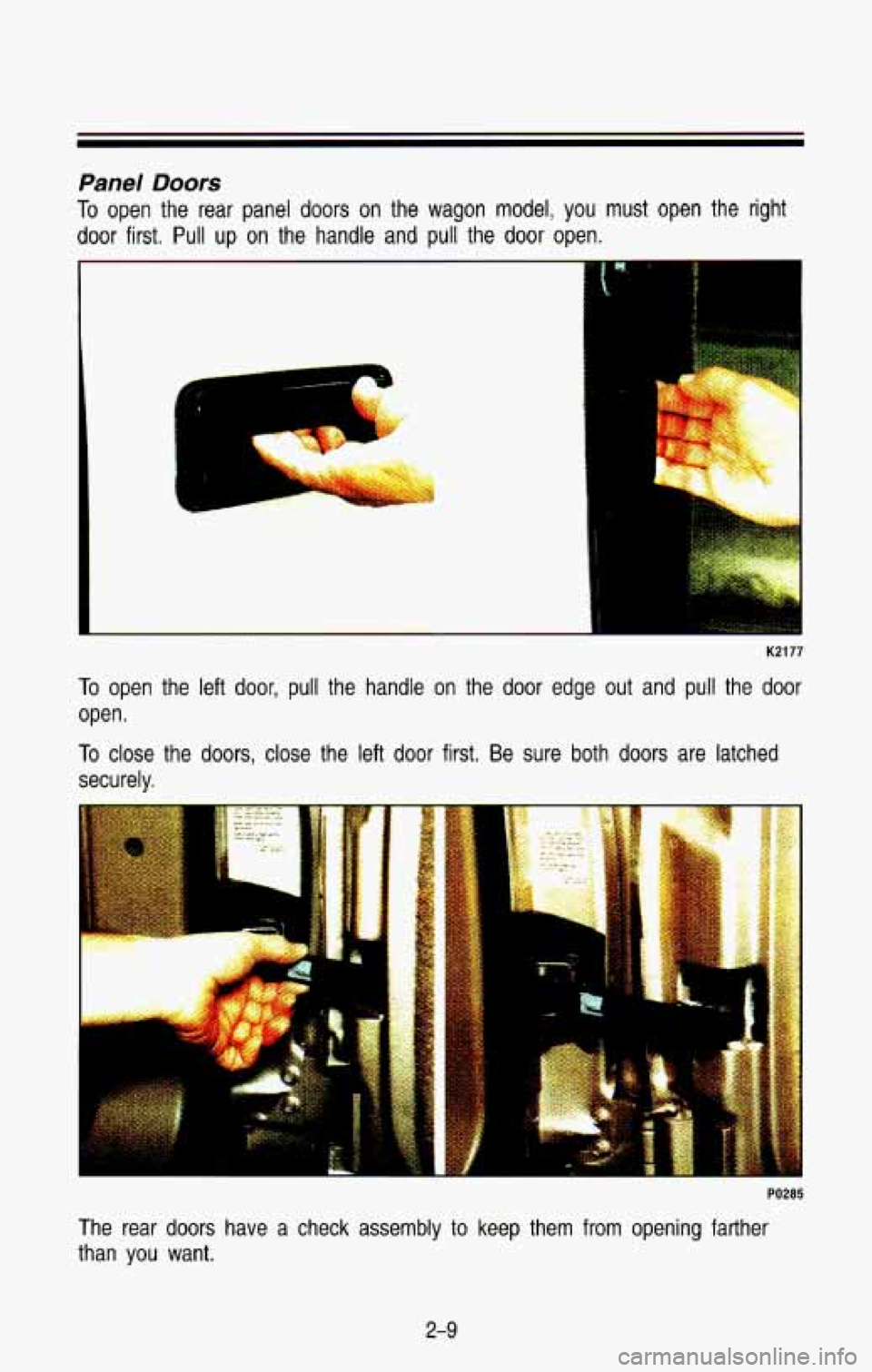
To open the rear panel doors on the wagon model, you must open the right
door first.
Pull up on the handle and pull the door open.
t" -:
g P p
K2177
To open the left door, pull the handle on the door edge out and pull the door
open.
To close me doors, close the left door first. Be sure both doors are latc\
hed
securely.
PO285
The rear doors have a check assembly to keep them from opening farther
than
you want.
2-9
Page 143 of 386
Features & Controls
You can only drive for a short time with the reading in either warning zone. If
you must drive, turn off all unnecessary accessories, and have the vehicle
serviced as soon
as possible.
Convenience Net
CAUTION
A
An improperly stored convenience net could be thrown about the
vehicle during a collision
or sudden maneuver. You or others could
be injured. When you are done using the convenience net, always
store it in its original storage pouch,
and securely reattach the pouch
on the rear side of the spare tire cover.
I
PO22
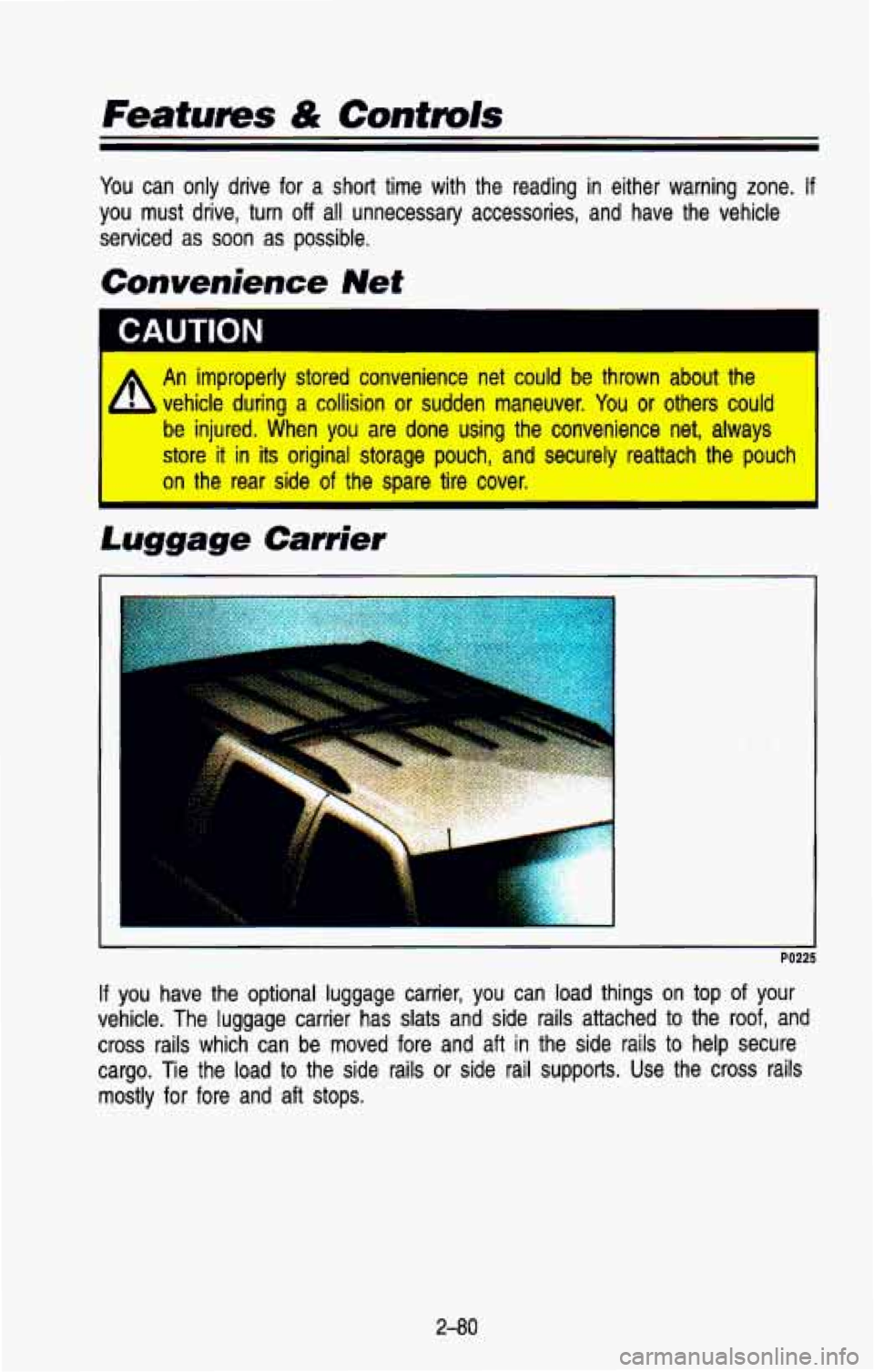
If you have the optional luggage carrier, you can load things on top of your
vehicle. The luggage carrier has slats and side rails attached \
to the roof, and
cross rails which can be moved fore and aft in the side rail\
s to help secure
cargo. Tie the load to the side rails or side rail supports. Use the cross rails
mostly for fore and aft stops.
2-80
Page 144 of 386

NOTICE
Don’t exceed the maximum vehicle capacity when loading your \
vehicle. For
more information on vehicle capacity and loading, see “Loadin\
g Your Vehicle”
in the Index.
To prevent damage or loss of cargo as you’re driving, check now and then to
make sure the luggage carrier and cargo are still securely fastened.
Be sure the cargo is properly loaded.
If small heavy objects are placed on the roof, place the load in the area
over the rear wheels (behind the rear side door on wagon mod\
els).
If
you need to, cut a piece of 3/8 inch plywood to fit inside the cross rails
and side rails to spread the load.
If plywood is used, tie it to the side
rail supports.
Tie the load to the cross rails or the side rail supports. Use the cross
rails only to keep the load from sliding.
If you need to carry long items, move the cross rails as far\
apart as
they will go. Tie the load to the cross rails and the side \
rails or side rail supports. Also tie the load to the bumpers.
Do not tie the load so tightly
that the cross rails or side rails are damaged.
After moving the cross rails, be sure to tighten all the slider screws.
To reduce wind noise, the cross rails must be installed with the \
narrow edge
toward the front of the vehicle.
Also, the front cross rail should be about 8 inches (200 mm) behind the front
anchor on Utility models.
2-8 1
Page 145 of 386

Features & Controls
mailer. Wiring Harness
K2373
The 7-wire harness is stored under your vehicle along the rear\
frame
crossmember. The harness has a
30 amp in-line fused battery feed wire and
no connector, and should be wired by a qualified electrical se\
rvice person.
Securely attach the harness to the trailer, then tape or strap\
it
to your
vehicle’s frame rail. Be sure you leave it
loose enough so the wiring won’t
bind or break when turning with the trailer, but not
so loose that it drags on
the ground.
Store the harness in its original position. Wrap the harness t\
ogether and tie it neatly
so it won’t be damaged.
2-82
Page 192 of 386

Loading Your Vehicle for Off-Road Driving
There are some important things to remember about how to load \
your
vehicle.
The heaviest things should be on the load floor and forward of your rear
axle. Put heavier items as far forward as you can.
Be sure the load is secured properly, so driving on the off-road terrain
doesn’t toss things around.
rn CAUTION
m m
Cargo on the load floor piled higher than the seatbacks can be
thrown forward during
a sudden stop. You or your passengers
could
be injured. Keep cargo below the top of the seatbacks.
Unsecured
cargo on the load floor can be tossed about when
driving over rough terrain.
You or your passengers can be struck
by flying objects. Secure the cargo properly.
Heavy loads on the roof raise the vehicle’s center
of gravity,
making
.it more likely to roll over. You can be seriously or fatally
injured
if the vehicle rolls over. Put heavy loads inside the cargo
area, not on the roof. Keep
cargo in the cargo area as far
forward and
low as possible. I
You’ll find other important information in this manual. See “Vehicle Loading”,
“Luggage Carrier” and “Tires” in the Index.
Traveling to Remote Areas
It makes sense to plan your trip, especially when going to a \
:emote area.
Know the terrain and plan your route. You are much less likely
to get bad
surprises. Get accurate maps of trails and terrain.
Try to learn of any blocked
or closed roads.
It‘s also a good idea to travel with at least one other vehicle. If something
happens to one of them, the other can help quickly.
Does your vehicle have a winch?
If so, be sure to read the winch
instructions. In a remote area,
a winch can be handy if you get stuck. But
you’ll want to know how to use it properly.
Getting Familiar with Off-Road Driving
It’s a good idea to practice in an area that’s safe and close to home befor\
e
you go into the wilderness. Off-road driving does require some \
new and
different driving skills. Here’s what
we mean.
4-25
Page 220 of 386

Winter Driving
r
AM480003
Here are some tips for winter driving.
Have your vehicle in good shape for winter. Be sure your engi\
ne coolant
mix is correct.
Snow tires can help in loose snow, but they may give you les\
s traction
on ice than regular tires.
If you do not expect to be driving in deep
snow, but may have to travel over ice, you may not want
to switch to
snow tires at all.
You may want to put winter emergency supplies in your vehicle.
Include
an ice scraper, a small brush or broom, a supply of windshield
washer fluid, a rag, some winter outer clothing, a small shovel, a flashlight, a
red cloth, and a couple of reflective warning triangles. And, if you will be
driiing under severe conditions, include a small bag of sand, a piece of
old
carpet or a couple of burlap bags to help provide traction. Be sure you
properly secure these items in your vehicle.
Driving on Snow or Ice
Most of the time, those places where your tires meet the road probably\
have
good traction.
However,
if there is snow or ice between your tires and the road, you can
have a very slippery situation. You’ll have a lot less traction or “grip” and
will
need to be very careful.
4-53
Page 228 of 386

I
If you have a rear-most window open and you pull a trailer with \
your
can’t see or smell
CO. It can cause unconsciousness or death (See
“Engine Exhaust” in the Index).
To maximize your safety when towing
a trailer:
- vehicle, carbon monoxide (CO) could come into your vehicle. You
Have the exhaust system inspected for leaks and make
Keep the rear-most windows closed.
If exhaust does come into your vehicle through a window in the
rear or another opening, drive with your front, main heating or
cooling system
on and with the fan on any speed. This will
bring fresh, outside air into your vehicle.
Do not use RECIR
because it only recirculates the air inside your vehicle. See
“Comfort Controls” in the Index.
necessary repairs before starting on your trip.
During your trip, check occasionally to be sure that the load is secure, and
that the lights and any trailer brakes are still working.
Following Distance
Stay at least twice as far behind the vehicle ahead as you would when
driving your vehicle without a trailer. This can help you avoid situations that
require heavy braking and sudden turns.
Passing
You’ll need more passing distance up ahead when you’re towing a tr\
ailer.
And, because you’re
a good deal longer, you’ll need to go much farther
beyond the passed vehicle before you can return to your lane.
Backing Up
Hold the bottom of the steering wheel with one hand. Then, to move the
trailer left, just move your hand to the left.
To move the trailer to the right,
move your hand to the right. Always back up slowly and,
if possible, have
someone guide you.
Making Turns
When you’re turning with a trailer, make wider turns than n\
ormal. Do this so
your trailer wheels won’t strike soft shoulders, curbs, road signs, trees, or
other objects. Avoid jerky or sudden maneuvers. Signal well in advance.
4-61
Page 238 of 386
Tiwing Your Vehicle
Try to have a GM dealer or a professional towing service tow your vehicle.
They can provide the right equipment and know how to tow
it without
damage.
If your vehicle has been changed since it was factory-new, by adding things
like fog lamps, aero skirting,
or special tires and wheels, these things could
be damaged during towing.
Before you
do anything, turn on the hazard warning flashers.
When you call, tell the towing service:
That your vehicle has rear-wheel drive, or that it has the four-wheel drive
option.
The make, model, and year of your vehicle.
Whether you can move the shift lever for the transmission and \
transfer
If there was an accident, what was damaged.
case,
if you have one.
CAUTION I
To help avoid
injury to you or others:
A 9 Never let passengers ride in a vehicle that is being towed.
e Never tow faster than safe or posted speeds.
e Never tow with damaged parts not fully secured.
Never get under your vehicle after it has been lifted by the tow
truck.
* Always use separate safety chains on each side when towing a
vehicle.
When your vehicle is being towed, have the ignition key off. The steering
wheel should be clamped in a straight-ahead position, with a clamping device
designed for towing service.
Do not use the vehicle’s steering column lock for
this. The transmission and transfer case,
if you have one, should be in
Neutral and the parking brake released.
If you have a two-wheel drive vehicle, don’t have your vehicle \
towed on the
rear wheels, unless you must.
If the vehicle must be towed on the rear
wheels, don’t
go more than 35 mph (56 kmlh) or farther than 50 miles (80
km) or your transmission will be damaged. If these limits must be exceeded,
then the rear drive wheels have to be supported on a dolly.
5-7
Page 250 of 386
K2135
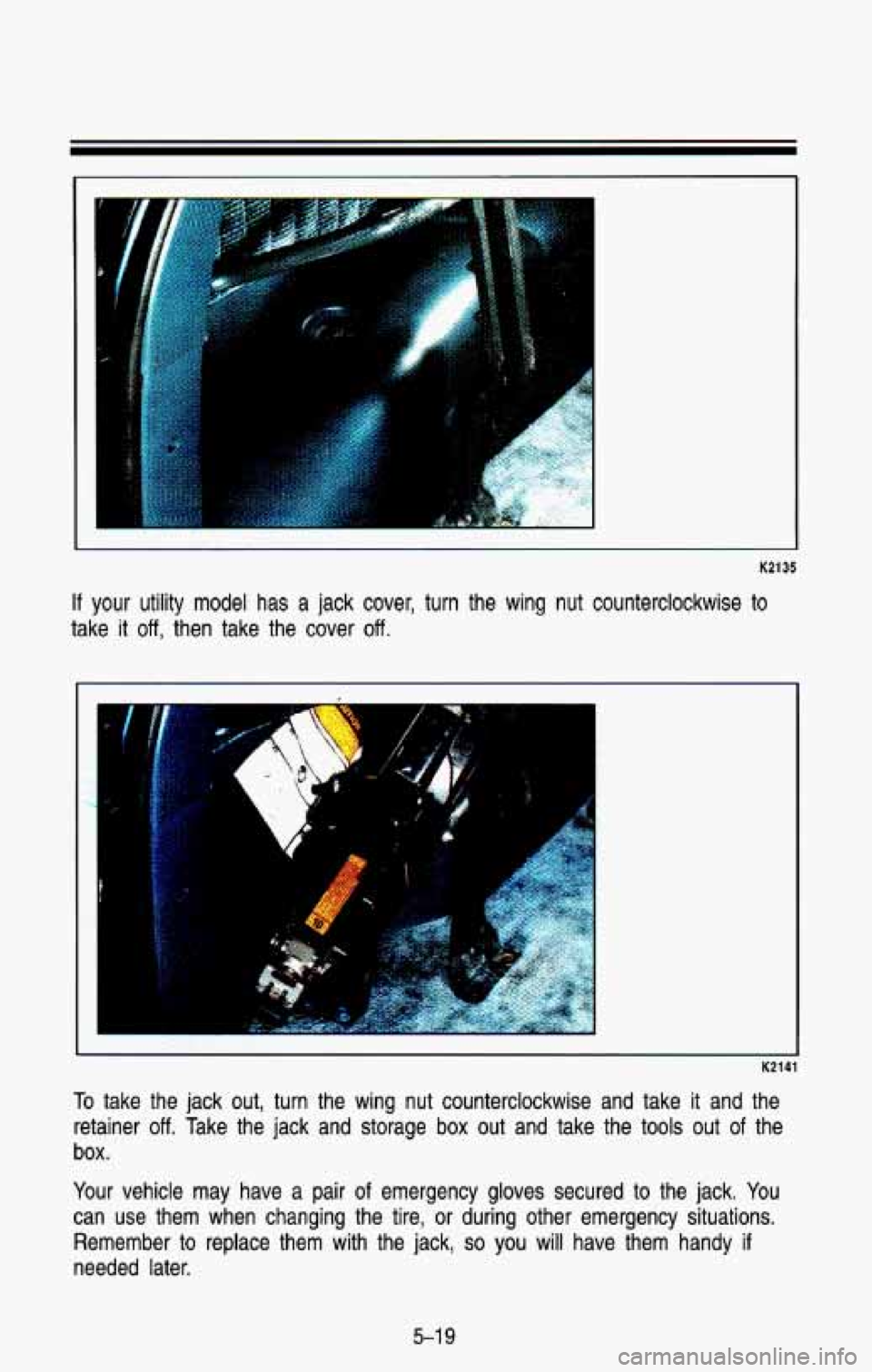
If your utility model has a jack cover, turn the wing nut counterclockwise to
take it off, then take the cover off.
". .. .
K214
To take the jack out, turn the wing nut counterclockwise and take it and the
retainer
off. Take the jack and storage box out and take the tools out of the
box.
Your vehicle may have a pair
of emergency gloves secured to the jack. You
can use them when changing the tire, or during other emergency situations.
Remember to replace them with the jack,
so you will have them handy if
needed later.
5-1 9
Page 261 of 386
Problems on the Road
Storing the Jack and Tire
Storhg the Jack
Put the tools into the storage box and close it tightly, Fit the storage box into
the bracket with the bolt through the box. Put the jack onto the
box. Be sure
the jack points in the right direction as shown for your mode\
l. Secure the
emergency gloves,
if your vehicle has them, to the jack using the provided
strap.
Slide the retainer over the bolt onto the jack and put the w\
ing nut on. Turn
the nut clockwise until it is tight against the retainer.
Replace the jack storage cover,
if your vehicle has one, by simply reversing
the removal procedure described earlier.
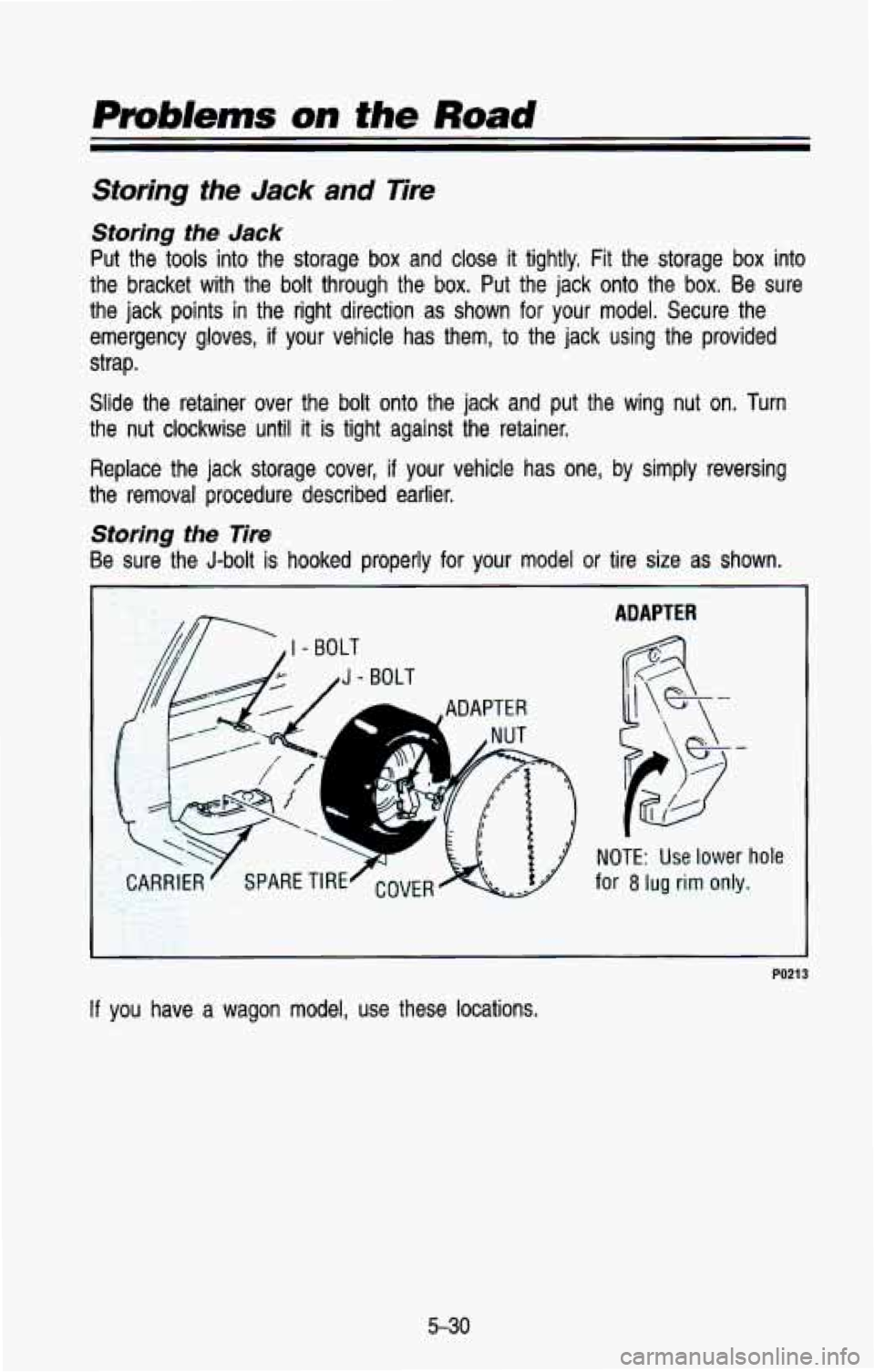
Storing the Tire
Be sure the J-bolt is hooked properly for your model or tire size as shown.
n
I - BOLT
J - BOLT
,ADAPTER
ADAPTER
NOTE: Use lower hole
for 8 lug rim only.
L
PO21 3
If you have a wagon model, use these locations.
5-30