change wheel CHEVROLET BLAZER 1993 User Guide
[x] Cancel search | Manufacturer: CHEVROLET, Model Year: 1993, Model line: BLAZER, Model: CHEVROLET BLAZER 1993Pages: 386, PDF Size: 20.7 MB
Page 194 of 386
Does the travel take you uphill or downhill? (There’s more discussion of
these subjects later.)
Will you have to stop suddenly or change direction quickly?
When you drive over obstacles
or rough terrain, keep a firm grip on the
steering wheel. Ruts, troughs, or other surface features can jerk the wheel
out of your hands
if you’re not prepared.
When you drive over bumps, rocks, or other obstacles, your wheels can leave
the ground.
If this happens, even with one or two wheels, you can’t control
the vehicle as well or at all.
Because you will
be on an unpaved surface, it’s especially important to avoid
sudden acceleration, sudden turns, or sudden braking.
In a way, off-road driving requires a different kind of alertness from driving on
paved roads and highways. There are no road signs, posted spee\
d limits or
signal lights. You have to use your
own good judgment about what is safe
and what isn’t.
I CAUTION
Drinking and driving can be very dangerous on any road. And this is
- b certainly true for off-road driving. At the very time you need special
alertness and driving skills, your reflexes, perceptions and jud\
gment
can be affected by even a small amount
of alcohol. You could have
a serious-or even fatal-accident
if you drink and drive or ride with
a driver who has been drinking. (See “Drunken Driving” in the
Index.)
Driving On Oft-Road Hills
Off-road driving often takes you up, down, or across a hill. Driving safely on
hills requires good judgment and an understanding of what your vehicle can
and can’t do. There are some hills that simply can’t be driven, no matter how
well-built the vehicle.
I CAUTION
A Many hills are simply too steep for any vehicle. If you drive up them,
62 you will stall. If you drive down them, you can’t control your speed. If
you drive across them, you will roll over. You could be seriously
injured or killed.
If you have any doubt about the steepness, don’t
drive the hill.
4-27
Page 195 of 386
Your Driving and the Road
Approaching a Hill
When you approach a hill, you need to decide if it’s one of those hills that’s
just too steep to climb, descend, or cross. Steepness can be hard to judge.
On a very small hill, for example, there may be a smooth, constant incline
with only a small change in elevation where you can easily se\
e all the way
to the top. On a large hill, the incline may get steeper as you near the top,
but you may not see this because the crest of the hill is hidden by bushes,
grass, or shrubs.
Here are some other things to consider as you approach a
hill.
e
e
e
e
e
0
Is there a constant incline, or does the hill get sharply steeper\
in
places?
Is there good traction on the hillside, or will the surface cause tire
slipping?
Is there a straight path up
or down the hill so you won’t have to make
turning maneuvers?
Are there obstructions
on the hill than can block your path (boulders,
trees, logs or ruts)?
What’s beyond the hill? Is there a cliff, an embankment, a drop-off, a
fence? Get out and walk the hill
if you don’t know. It’s the smart way to
find out.
Is the hill simply too rough? Steep hills often have ruts, gu\
llies, troughs
and exposed rocks because they are more susceptible to the eff\
ects of
erosion.
Driving Uphill
Once you decide you can safely drive up the hill, you need to take some
special steps.
e
e
e
Use a lower gear and get a firm grip on the steering wheel. \
Get a smooth start up the hill and try to maintain your speed. Don’t use
more power than you need, because you don’t want your wheel\
s to start
spinning or sliding.
Try to drive straight up the hill if at all possible. If the path twists and
turns, you might want to find another route.
4-28
Page 200 of 386
AM440002
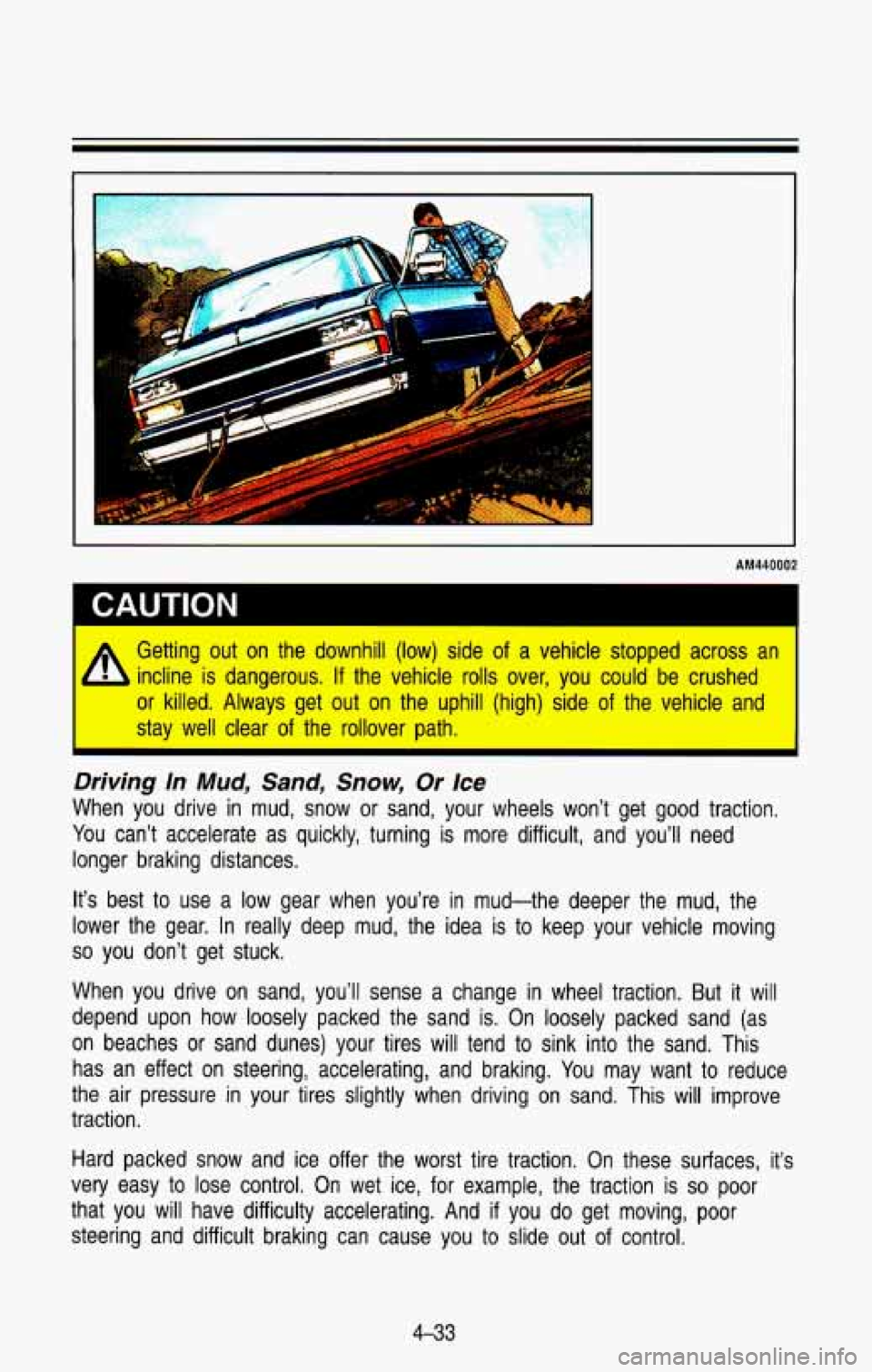
I Getting out on the downhill (low) side of a vehicle stopped across an
- , incline is dangerous. If the vehicle rolls over, you could be crushed
or killed. Always get out on the uphill (high) side of the vehicle and
stay well clear of the rollover path. F
Driving In Mud, Sand, Snow, Or Ice
When you drive in mud, snow or sand, your wheels won’t get\
good traction.
You can’t accelerate as quickly, turning is more difficult, and \
you’ll need
longer braking distances.
It’s best to use a low gear when you’re in mud-the deeper the \
mud, the
lower the gear. In really deep mud, the idea is
to keep your vehicle moving
so you don’t get stuck.
When you drive on sand, you’ll sense a change in wheel tra\
ction. But
it will
depend upon how loosely packed the sand is. On loosely packed \
sand (as
on beaches or sand dunes) your tires will tend to sink into the\
sand. This
has an effect on steering, accelerating, and braking. You may want to reduce
the air pressure
in your tires slightly when driving on sand. This will improve
traction.
Hard packed snow and ice offer the worst tire traction. On these surfaces, it’s
very easy to lose control. On wet ice, for example, the tract\
ion is
so poor
that you will have difficulty accelerating. And
if you do get moving, poor
steering and difficult braking can cause you to slide out
of control.
4-33
Page 212 of 386
Before Leaving on a Long Trip
Make sure you’re ready. Try to be well rested. If you must start when you’re
not fresh-such as after a day’s work-don’t plan to make too many miles
that first part of the journey. Wear comfortable clothing and shoes you can
easily drive in.
Is your vehicle ready for a long trip? If you keep it serviced and maintained,
it’s ready to go. If it needs service, have it done before starting out. Of
course, you’ll find experienced and able service experts
in your vehicle’s
dealerships all across North America. They’ll be ready and w\
illing to help
if
you need it.
Here are some things you can check before a trip:
e
e
On
Windshield Washer Fluid: Is the reservoir full? Are all windows clean
inside and outside?
Wiper Blades: Are they in good shape?
Fuel, Engine Oil, Other Fluids: Have you checked all levels?
Lights: Are they all working? Are the lenses clean?
Tires: They are vitally important to a safe, trouble-free trip. Is the tread
good enough for long distance driving? Are the tires all inflated to the
recommended pressure?
Weather Forecasts: What’s the weather outlook along your route?
Should you delay your trip a short time to avoid a major storm system?
Maps: Do you have up-to-date maps?
the Road
Unless you are the only driver, it is good to share the driving task with
others. Limit turns behind the wheel to about
100 miles (160 km) or two
hours at a sitting. Then, either change drivers or stop for s\
ome refreshment
like coffee, tea or soft drinks and some limbering up. But do stop and move
around. Eat lightly along the way. Heavier meals tend
to make some people
sleepy.
On two-lane highways or undivided multilane highways that do not have
controlled access, you’ll want to watch for some situations not usually found
on freeways. Examples are: stop signs and signals, shopping cen\
ters with
direct access to the highway, no passing zones and school zones, vehicles
turning left and right
off the road, pedestrians, cyclists, parked vehicles, and
even animals.
4-45
Page 229 of 386
Your Driving and the Road
Turn Signals When Towing a Trailer
When you tow a trailer, your vehicle has to have a different turn signal
flasher and extra wiring. The green arrows on your instrument \
panel will flash
whenever you signal a turn
or lane change. Properly hooked up, the trailer
lights will also flash, telling other drivers you’re about
to turn, change lanes,
or stop.
When towing a trailer, the green arrows on your instrument pan\
el will flash for
turns even
if the bulbs on the trailer are burned out. Thus, you may think \
drivers behind you are seeing your signal when they are not.
It’s important to
check occasionally to be sure the trailer bulbs are still working.
Driving on Grades
Reduce speed and shift to a lower gear before you start down a long or
steep downgrade. If you don’t shift down, you might have to use your brakes
so much that they would get hot and no longer work well.
On
a long uphill grade, shift down and reduce your speed to 45 mph (70
kmlh) or less to reduce the possibility of engine and transmission overheating.
If you have an automatic transmission, you should use D (or, as you need to,
a lower gear) when towing a trailer. Operating your vehicle in D when towing
a trailer will minimize heat buildup and extend the
life of your transmission.
Or,
if you have a manual transmission with fifth gear and you are to\
wing a
trailer, it’s better not
to use fifth gear, just drive in fourth gear (or, as you
need to, a lower gear).
Parking on Hilk
You really should not park your rig on a hill. If something goes wrong, your
rig could start
to move. People can be injured and both your vehicle and the
trailer can be damaged.
But
if you ever have to park your rig on a hill, here’s how to do it:
1. Apply your regular brakes, but don’t shift into P (Park) yet, or into gear
for a manual transmission.
2. Have someone place chocks under the trailer wheels.
3, When the wheel chocks are in place, release the regular brakes\
until the
4. Reapply the regular brakes. Then apply your parking brake, and \
then
chocks absorb the load.
shift
to P (Park), or R (Reverse) for a manual transmission.
5. If you have a four-wheel-drive vehicle, be sure the transfer case \
is in
a
drive gear-not in
N (Neutral).
4-62
Page 238 of 386
Tiwing Your Vehicle
Try to have a GM dealer or a professional towing service tow your vehicle.
They can provide the right equipment and know how to tow
it without
damage.
If your vehicle has been changed since it was factory-new, by adding things
like fog lamps, aero skirting,
or special tires and wheels, these things could
be damaged during towing.
Before you
do anything, turn on the hazard warning flashers.
When you call, tell the towing service:
That your vehicle has rear-wheel drive, or that it has the four-wheel drive
option.
The make, model, and year of your vehicle.
Whether you can move the shift lever for the transmission and \
transfer
If there was an accident, what was damaged.
case,
if you have one.
CAUTION I
To help avoid
injury to you or others:
A 9 Never let passengers ride in a vehicle that is being towed.
e Never tow faster than safe or posted speeds.
e Never tow with damaged parts not fully secured.
Never get under your vehicle after it has been lifted by the tow
truck.
* Always use separate safety chains on each side when towing a
vehicle.
When your vehicle is being towed, have the ignition key off. The steering
wheel should be clamped in a straight-ahead position, with a clamping device
designed for towing service.
Do not use the vehicle’s steering column lock for
this. The transmission and transfer case,
if you have one, should be in
Neutral and the parking brake released.
If you have a two-wheel drive vehicle, don’t have your vehicle \
towed on the
rear wheels, unless you must.
If the vehicle must be towed on the rear
wheels, don’t
go more than 35 mph (56 kmlh) or farther than 50 miles (80
km) or your transmission will be damaged. If these limits must be exceeded,
then the rear drive wheels have to be supported on a dolly.
5-7
Page 247 of 386

Engine Fan Noise
This vehicle has a clutched engine cooling fan. When the clutc\
h is engaged,
the fan spins faster
to provide more air to cool the engine. In most every day
driving conditions the clutch is not engaged. This improves fuel economy and
reduces fan noise. Under heavy vehicle loading, trailer towing \
and/or high
outside temperatures, the fan speed increases when the clutch e\
ngages.
So
you may hear an increase in fan noise. This is normal and sh\
ould not be
mistaken
as the transmission slipping or making extra shifts. It is merely the
cooling system functioning properly. The fan
will slow down when additional
cooling is not required and the clutch disengages.
You may also hear this fan noise when you start the engine. \
It will go away
as the fan clutch disengages.
If a Tire Goes Fiat
It’s unusual for a tire to “blow out” while you’re driving,\
especially if you
maintain your tires properly.
If air goes out of a tire, it’s much more likely to
leak out slowly. But if you should ever have a “blowout,” here are a few tips
about what
to expect and what to do:
If a front tire fails, the flat tire will create a drag that pulls the vehicle toward
that side. Take your foot
off the accelerator pedal and grip the steering wheel
firmly. Steer to maintain lane position, then gently brake
to a stop well out of
the traffic lane.
A rear blowout, particularly on a curve, acts much like a skid and may
require the same correction you’d use in a skid. In any rear blowout, remove
your foot from the accelerator pedal. Get the vehicle under co\
ntrol by steering
the way you want the vehicle
to go. It may be very bumpy and noisy, but
you can still steer. Gently brake to a stop, well off the road if possible.
If your tire goes flat, the next part shows how to use your jacking equipment
to change a flat tire safely.
Changing a Flat Tire
If a tire goes flat, avoid further tire and wheel damage by driving slowly to a
level place. Turn
on your hazard warning flashers.
5-1 6
Page 248 of 386
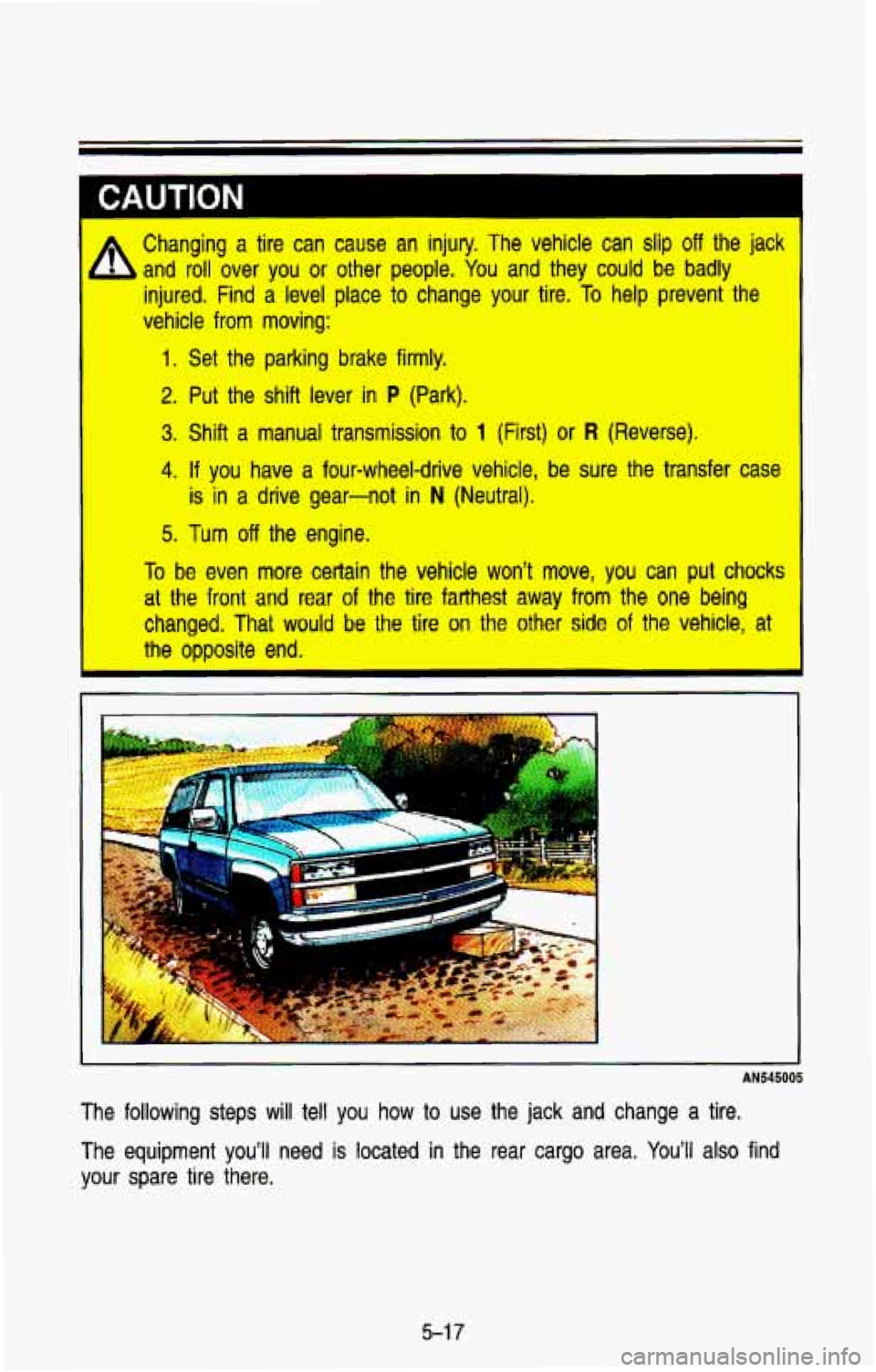
L
Changing a tire can cause an injury. The vehicle can slip off the jack
injured. Find a level place to change your tire. To help prevent the
vehicle
from moving:
- and roll over you or other people. You and they could be badly
1. Set the parking brake firmly.
2. Put the shift lever in P (Park).
3. Shift a manual transmission to 1 (First) or R (Reverse).
4. If you have a four-wheel-drive vehicle, be sure the transfer case \
5. Turn off the engine.
is in a drive gear-not in N (Neutral).
To be even more certain the vehicle won't move, you can put chocks
at the front and rear of the tire farthest away from the one being
changed. That would be the tire on the other side of the vehicle, at
the opposite end.
I
L
I
The following steps will tell you how to use the jack and change a tire.
5-1 7
Page 257 of 386
1 CAUTION
* Rust or dirt on the wheel, or on the parts to which it is fastened, ’
h can make the wheel nuts become loose after a time. The wheel
I could corne off and cause an accident. When you change a wheel,
remove any rust or dirt fmm the places where the wheel attaches to
the vehicle. In an emergency, you can use a cloth or a paper towel
to do this; but be sure to use a scraper ~r wire brush later, if you
need to, to get all the rust or dirt off.
Remove any rust or dirt from the wheel bolts, mounting surfaces or spare
wheel. Place the spare on the wheel mounting
surface.
CAUTION
Never use oil or grease on studs or nuts. If you do, the nuts might
come loose. Your wheel could fall
off, causing a serious accident.
I
K2127
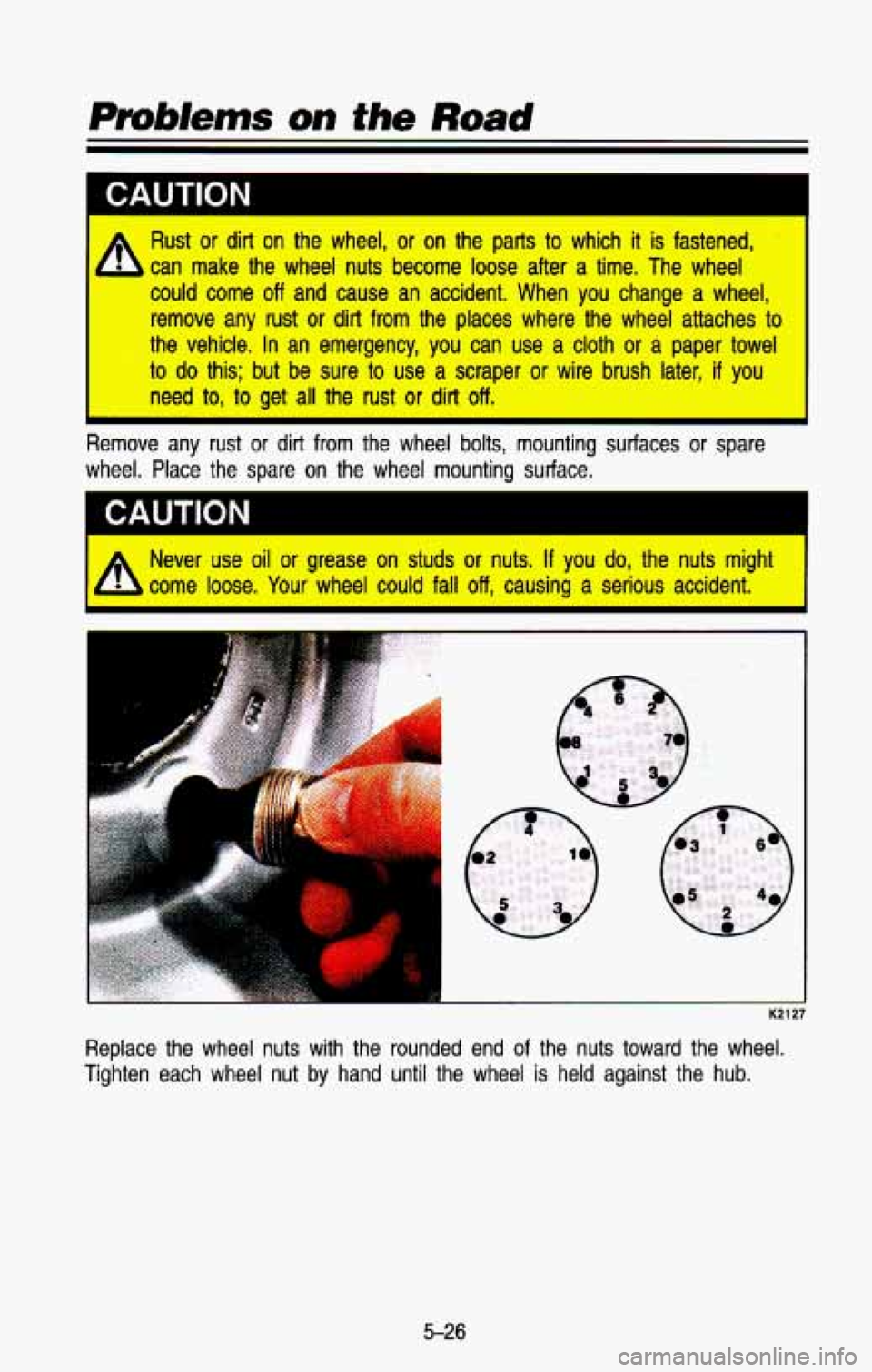
Replace the wheel nuts with the rounded end of the nuts toward the wheel.
Tighten each wheel
nut by hand until the wheel is held against the hub.
5-26
Page 317 of 386
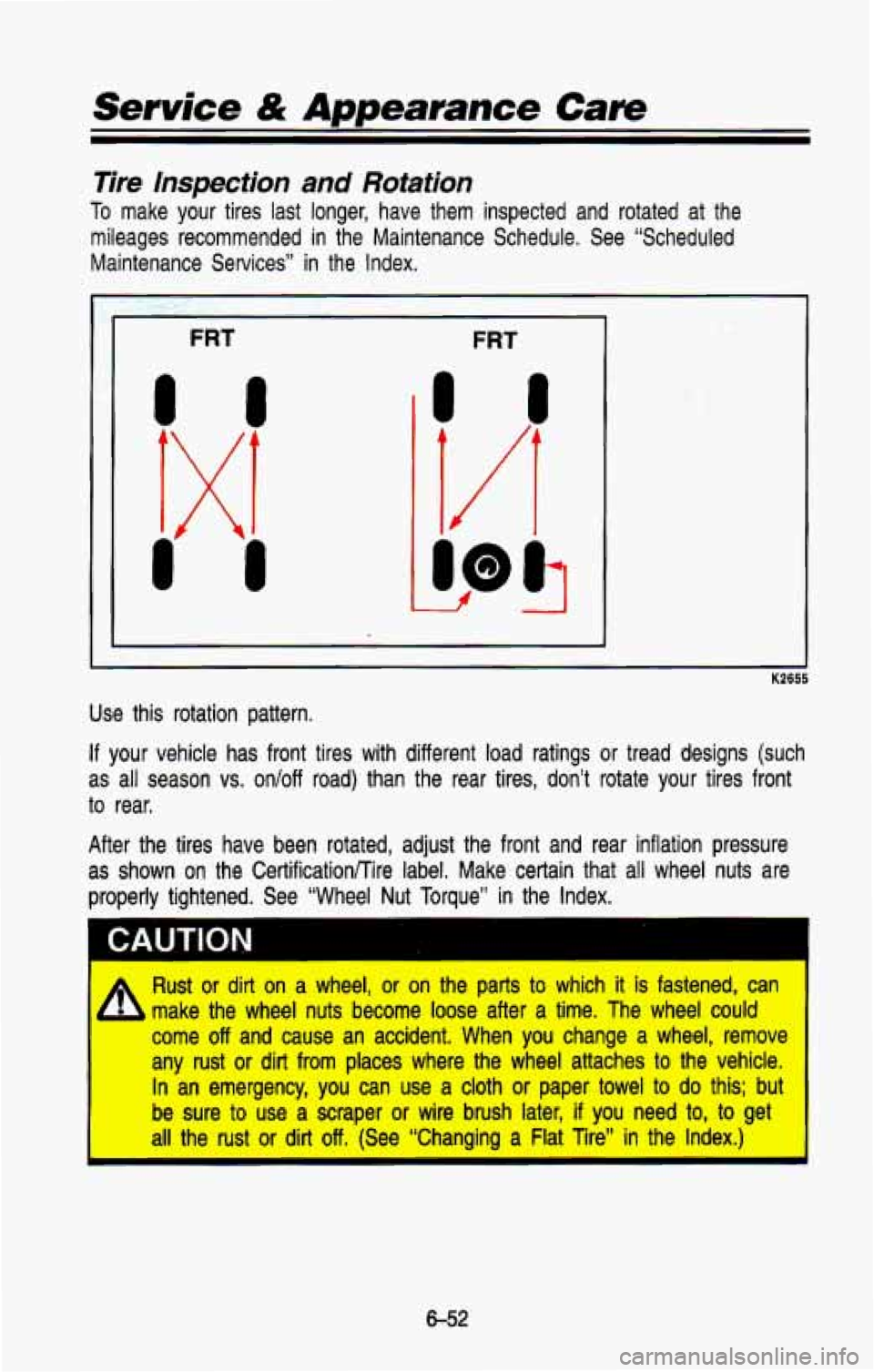
Service & Appearance Care
Tire lnspecfion and Rotation
To make your tires last longer, have them inspected and rotated at the
mileages recommended in the Maintenance Schedule. See “Scheduled
Maintenance Services” in the Index.
FRT FRT
L
I I
K2655
Use this rotation pattern,
If your vehicle has front tires with different load ratings or tr\
ead designs (such
as all season vs. on/off road) than the rear tires, don’t rotate \
your tires front
to rear,
After the tires have been rotated, adjust the front and rear \
inflation pressure
as shown on the CertificationRire label. Make certain that all \
wheel nuts are
properly tightened.
See “Wheel Nut Torque” in the Index.
1 CAUTION
Rust or dirt on a wheel, or on the parts to which it is fastened, can
make the wheel nuts become loose after a time. The wheel could
come
off and cause an accident. When you change a wheel, remove
any rust or dirt from places where the wheel attaches
to the vehicle.
In an emergency, you can use a cloth or paper towel to
do this; but
be sure to use a scraper or wire brush later, if you need to, to get
I
I all the rust or dirt off. (See ‘Changing a Flat Tire” in the Index.) I
&52