ESP CHEVROLET BLAZER 1993 Owner's Manual
[x] Cancel search | Manufacturer: CHEVROLET, Model Year: 1993, Model line: BLAZER, Model: CHEVROLET BLAZER 1993Pages: 386, PDF Size: 20.7 MB
Page 270 of 386
If you’re using fuel rated at 87 octane or higher and you still hear heavy
knocking, your engine needs service. But don’t worry
if you hear a little
pinging noise when you’re accelerating
or driving up a hill. That’s normal and
you don’t have to buy
a higher octane fuel to get rid of pinging. It’s the
heavy, constant knock that means you have
a problem.
What about gasoline with blending materials that contain oxygen,\
such as MTBE
or alcohol?
MTBE is “methyl tertiary-butyl ether.” Fuel that is no more th\
an 15% MTBE is
fine for your vehicle.
Ethanol is ethyl or grain alcohol. Properly-blended fuel that is no more than
10% ethanol is fine for your vehicle.
Methanol is methyl or wood alcohol,
NOTICE
Fuel that is more than 5% methanol is bad for your vehicfe. Don’t use ‘A
It can corrode metal parts in your fuel system and also damage plastic
and rubber
parts. That damage wouldn’t be covered under your warri ’y.
And even at 5% or less, there must be “cosolvents” and corrosion
eventers
in this fuel to help avoid these problems.
Gasolines for Cleaner Air
Your use of gasoline with detergent additives will help prevent depo\
sits from
forming in your engine and fuel system. That helps keep your engine in t\
une
and your emission control system working properly. It’s good \
for your vehicle,
and you’ll be doing your part for cleaner air.
Many gasolines are now blended with materials that called oxyge\
nates.
General Motors recommends that you use gasolines with these ble\
nding
materials, such as MTBE and ethanol. By doing
so, you can help clean the
air, especially in those parts of the country that have higher carbon monoxide
levels.
In addition, some gasoline suppliers are now producing reformulated \
gasolines. These gasolines are specially designed
to reduce vehicle
emissions. General Motors recommends that you use reformulated g\
asoline.
By doing
so, you can help clean the air, especially in those parts of the
country that have high
ozone levels.
You should ask your service station operators if their gasolines co\
ntain
detergents and oxygenates, and if they have been reformulated to reduce
vehicle emissions.
6-5
Page 282 of 386
I CAUTION
I 10 Operating the engine with the air cleaner off can cause you or others
to be burned. The air cleaner not only cleans the air, it
stops flame
if the engine backfires.
If it isn’t there, and the engine backfires, y(--
could be burned. Don’t drive with it
off, and be cr-ful working on
the engine with the air cleaner
off.
~
NOTICE I
If the air cleaner is off, a backfire can cause a damaging engine fire. And,
dirt
can easily get into your engine, which will damage it. Always have the
air cleaner
in place when you’re driving.
Ib remove the air cleaner filter on a gas engine, turn the wing nuts
counterclockwise. Remove the cover and change the filter.
-
Automatic Transmission Fluid
When to Check and Change:
A good time to check your automatic transmission fluid level is when the
engine
oil is changed. Refer to the Maintenance Schedule to determine when
to change your fluid. See “Scheduled Maintenance Services” in \
the Index.
How to Check:
Because this operation can be a little difficult, you may choose to have this
done at a General Motors dealership Sewice Department.
If you do it yourself, be sure to follow all the instructions here, or you could
get
a false reading on the dipstick.
NOTICE I
I
Too much or too little fluid can damage your transmission. Too much can
mean that some of the fluid could come out and fail
on hot engine parts,
I
starting a fire. Be sure to get an accurate reading if you check-your
transmission fluid.
Wait at least
30 minutes before checking the transmission fluid level if you
have been driving:
When outside temperatures are above 90°F (32°C).
At high speed for quite a while.
In heavy traffic-especially in hot weather.
While pulling a trailer.
6-1 7
Page 284 of 386
PO053
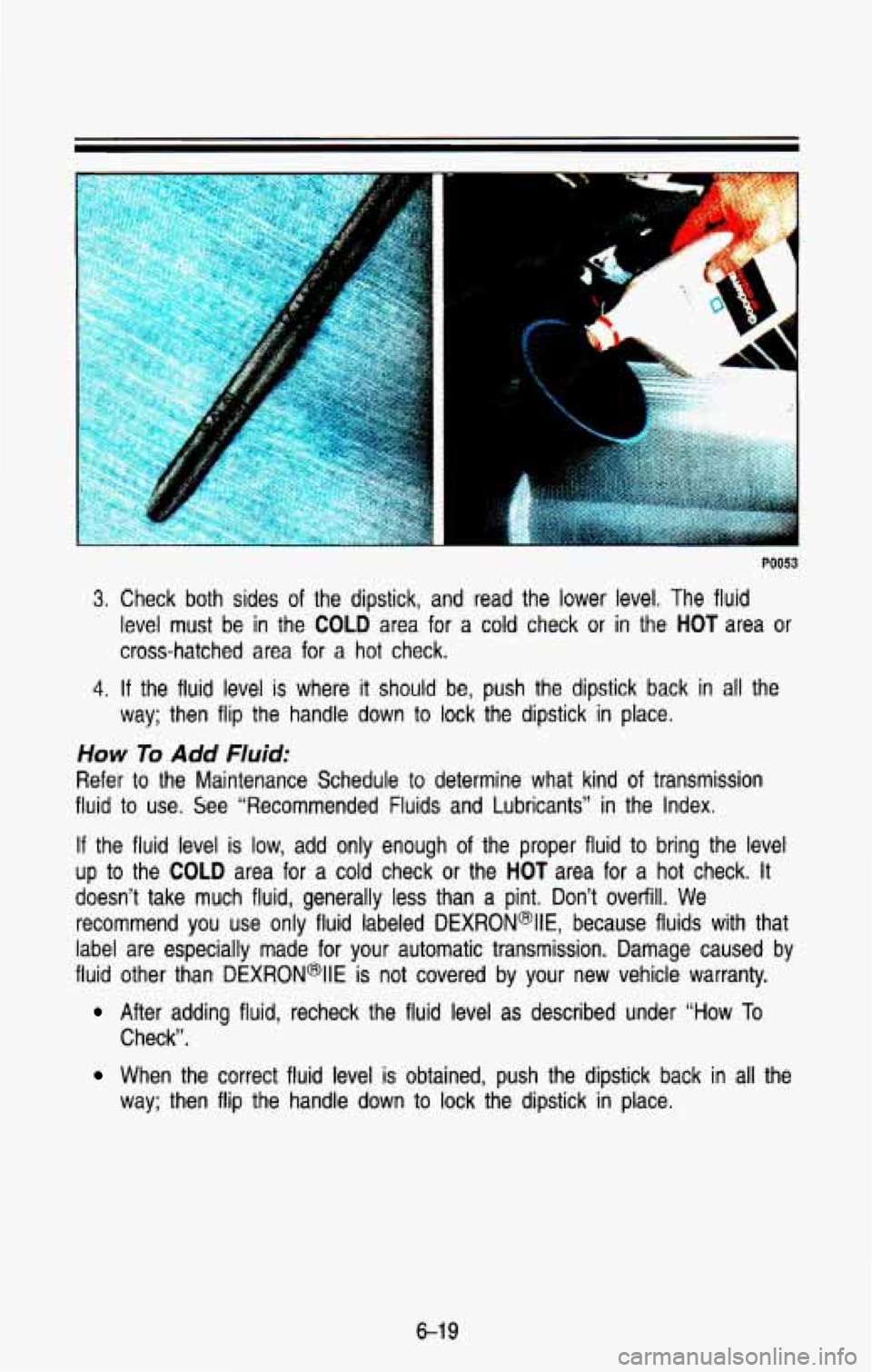
3. Check both sides of the dipstick, and read the lower level, The fluid
level must be in the
COLD area for a cold check or in the HOT area or
cross-hatched area for a hot check.
4. If the fluid level is where it should be, push the dipstick back in all the
way; then flip the handle down to lock the dipstick in place.
HOW To Add Fluid:
Refer to the Maintenance Schedule to determine what kind of transmission
fluid
to use. See “Recommended Fluids and Lubricants” in the Index.
If the fluid level is low, add only enough of the proper fluid to bring the level
up to the COLD area for a cold check or the HOT area for a hot check. It
doesn’t take much fluid, generally less than a pint. Don’t overfill. We
recommend you use only fluid labeled
DEXRON@IIE, because fluids with that
label are especially made for your automatic transmission. Damag\
e caused by
fluid other than
DEXRON@llE is not covered by your new vehicle warranty.
After adding fluid, recheck the fluid level as described under “How To
Check”.
When the correct fluid level is obtained, push the dipstick back in all the
way; then flip the handle down
to lock the dipstick in place.
6-1 9
Page 319 of 386

Service & Appearance Care
If you ever replace your tires with those not having a TPC Spec number,
make sure they are the same size, load range, speed rating an\
d construction
type (bias, bias-belted or radial) as your original tires.
I CAUTION
A
Mixing tires could cause you to lose control while driving. If you mix
tires
of different sizes or types (radial and bias-belted tires) the
vehicle may not handle properly, and you could have a crash. Be
sure
to use the same size and type tires on all wheels.
I
Uniform Tire Quarity Grading
The following information relates to the system developed by the United
States National Highway Traffic Safety Administration which grade\
s tires by
treadwear, traction and temperature performance. (This applies o\
nly to
vehicles sold in the United States.)
Treadwear
The treadwear grade is a comparative rating based on the wear \
rate of the
tire when tested under controlled conditions on a specified government test
course.
For example, a tire graded 150 would wear one and a half (1 1/2)
times as well on the government course as a tire graded 100. The relative
performance
of tires depends upon the actual conditions of their use,
however, and may depart significantly from the norm due to var\
iations
in
driving habits, service practices and differences in road characteristics and
climate.
Traction-A, B, C
The traction grades, from highest to lowesr are: A, 8, and C. They represent
the tire’s ability to stop on wet pavement as measured under controlled
conditions on specified government test surfaces of asphalt and concrete. A
tire marked
C may have poor traction performance.
Warning: The traction grade assigned to this tire is based on braking
(straight-ahead) traction tests and does not include cornering \
(turning) traction.
Temperature-A, B, C
The temperature grades are A (the highest), B, and C, representing the tire’s
resistance to the generation
of heat and its ability to dissipate heat when
tested under controlled conditions on a specified indoor laborat\
ory test wheel.
Sustained high temperature can cause the material
of the tire to degenerate
and reduce tire life, and excessive temperature can lead to sudden tire
failure. The grade
C corresponds to a level of performance which all
passenger car tires must meet under the Federal Motor Vehicle \
Safety
6-54
Page 320 of 386
Standard No. 109. Grades B and A represent higher levels of performance on
the laboratory
test wheel than the minimum required by law.
Warning: The temperature grade for this tire is established for a tire that is
properly inflated and not overloaded. Excessive speed, underinfla\
tion, or
excessive loading, either separately or in combination, can cause heat buildup
and possible tire failure.
Those grades are molded on the sidewalls of passenger car tires.
While the tires available as standard or optional equipment on \
General Motors
vehicles may vary with respect to these grades, all such tires meet General
Motors performance standards and have been approved for use on General
Motors vehicles.
All passenger type (P Metric) tires must conform to Federal
safety requirements in addition to these grades.
Wheel Alignment and Tire Balance
The wheels on your vehicle were aligned and balanced carefully \
at the
factory to give you the longest tire life and best overall performance.
In
most cases, you will not need to have your wheels aligned again.
However,
if you notice unusual tire wear or your vehicle pulling one way or
the other, the alignment may need to be reset.
If you notice your vehicle
vibrating when driving on a smooth road, your wheels may need to be
rebalanced.
Wheel Replacement
Replace any wheel that is bent, cracked or badly rusted. If wheel nuts keep
coming loose, the wheel, wheel bolts, and wheel nuts should be\
replaced.
If
the wheel leaks air out, replace it (except some aluminum whe\
els, which can be repaired). See your GM truck dealer
if any of these conditions exist. Your
dealer will know what kind of wheel you need.
Each new wheel should have the same load carrying capacity, di\
ameter,
width, offset, and be mounted the same way as the one it replaces.
If you need to replace any of your wheels, wheel bolts, or wheel nuts,
replace them only with
new GM original equipment parts. This way, you will
be sure you have the right wheel, wheel bolts, and wheel nuts\
for your
vehicle.
6-55
Page 369 of 386
Customer Assistance Information
-
Customer Satisfaction Procedure
Your satisfaction and goodwill are important to your dealer and Chevrolet.
Normally, any concern with the sales transaction or the operati\
on of your
vehicle will be resolved by your dealer’s Sales or Service \
Departments. Sometimes, however, despite the best intentions of all concerned\
, misunderstandings can occur.
If your concern has not been resolved to your
satisfaction, the following steps should be taken:
STEP ONE -Discuss your concern with a member of dealership
management. Complaints can often be quickly resolved at that le\
vel.
If the
matter has already been reviewed with the Sales, Service, or P\
arts Manager,
contact the owner of the dealership or the General Manager.
STEP TWO -If after contacting a member of Dealership Management, it
appears your concern cannot be resolved by the dealership without further
help, contact Chevrolet’s Customer Assistance Center by calling
1-800-222-1020. In Canada, contact the GM of Canada Customer Assistance
Center in Oshawa by calling 1-800-263-3777 (English) or 1-800-\
263-7854 (French).
In Mexico, call (525) 254-3777. In Puerto Rico or
U. S. Virgin Islands, call
1-809-763-1315. In all other overseas locations, contact GM International
Export Sales in Canada by calling 1-416-644-411 2
.
For prompt assistance, please have the following information ava\
ilable to give
the Customer Assistance Representative:
Your name, address, telephone number
Vehicle Identification Number (This is available from the vehicle
registration or title, or the plate attached
to the left top of the instrument
panel and visible through the windshield.)
Dealership name and location
Vehicle delivery date and present mileage
Nature of concern
We encourage you
to call the toll-free number listed previously in order to
give your inquiry prompt attention. However,
if you wish to write Chevrolet,
write
to: Chevrolet Motor Division, Chevrolet Customer Assistance Center, P.O.
Box 7047, Troy, MI 48007-7047.
A listing of all Chevrolet offices and offices outside the US. which can assist
you can also be found
in the warranty booklet. These services are not
available in Canada.
8-2