brake light CHEVROLET BLAZER 1993 Owner's Manual
[x] Cancel search | Manufacturer: CHEVROLET, Model Year: 1993, Model line: BLAZER, Model: CHEVROLET BLAZER 1993Pages: 386, PDF Size: 20.7 MB
Page 223 of 386
Your Driving and the Road
AN480044
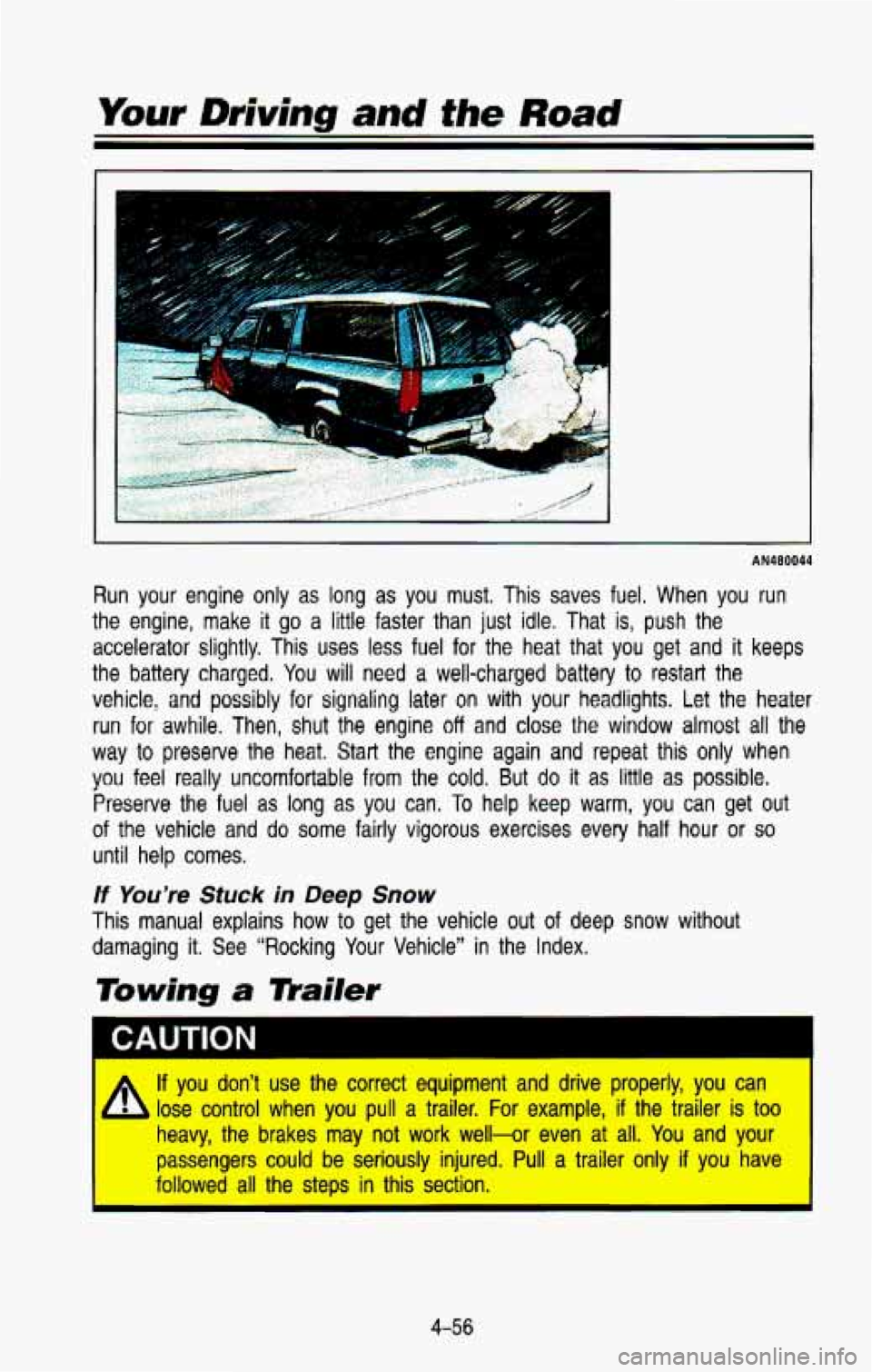
Run your engine only as long as you must. This saves fuel. When you run
the engine, make
it go a little faster than just idle. That is, push the
accelerator slightly. This uses
less fuel for the heat that you get and it keeps
the battery charged.
You will need a well-charged battery to restart the
vehicle, and possibly
for signaling later on with your headlights. Let the heater
run for awhile. Then,
shut the engine off and close the window almost all the
way to preserve the heat. Start the engine again and repeat this only when
you feel really uncomfortable from the cold. But do it as little as possible.
Preserve the fuel as long as you can. To help keep warm, you can get out
of the vehicle and do some fairly vigorous exercises every half hour or so
until help comes.
If You’re Stuck in Deep Snow
This manual explains how to get the vehicle out of deep snow without
damaging it. See “Rocking Your Vehicle” in the Index.
Towing a mailer
I A If you don’t use the correct equipment and drive properly, you can
lose control when
you pull a trailer. For example, if the trailer is too
heavy, the brakes may not work well-or even at all. You and your
passengers could be seriously injured. Pull a trailer only
if you have
followed all the steps in this section.
4-56
Page 227 of 386
Your Driving and 0% Road
Will you have to make any holes in the body of your vehicle when you
install a trailer hitch?
If you do, then be sure to seal the holes later
when you remove the hitch.
If you don’t seal them, deadly carbon
monoxide
(CO) from your exhaust can get into your vehicle (see “Carbon
Monoxide” in the Index). Dirt and water can, too.
Safety Chains
You should always attach chains between your vehicle and your trail\
er. Cross
the safety chains under the tongue of the trailer
so that the tongue will not
drop to the road
if it becomes separated from the hitch. Instructions about
safety chains may be provided by the trailer manufacturer. Follow the
manufacturer’s recommendation
for attaching safety chains. Always leave just
enough slack
so you can turn with your rig. And, never allow safety chains to
drag on the ground.
Trailer Brakes
If your trailer weighs more than 1,000 pounds (450 kg) loaded, then it needs
its own brakes-and they must be adequate. Be sure
to read and follow the
instructions for the trailer brakes
so you’ll be able to install, adjust and
maintain them properly.
Don’t tap into your vehicle’s brake system if the trailer’s brake system will use
more than
0.02 cubic inch (0.3 cc) of fluid from your vehicles master cylinder.
If it does, both braking systems won’t work well. You could even lose your
brakes.
Will the trailer brake parts take 3,000 psi (20 650 kPa) of pressure? If
not, the trailer brake system must not be used with your vehi\
cle.
If everything checks out this far, then make the brake fluid tap at the
port on the master cylinder that sends fluid
to the rear brakes. But don’t
use copper tubing for this.
If you do, it will bend and finally break off.
Use steel brake tubing.
Driving with a Trailer
Towing a trailer requires a certain amount of experience. Before setting out
for the open road, you’ll want
to get to know your rig. Acquaint yourself with
the feel of handling and braking with the added weight of the trailer. And
always keep in mind that the vehicle you are driving is now a good deal
longer and not nearly
so responsive as your vehicle is by itself.
Before you start, check the trailer hitch and platform, safety \
chains, electrical
connector, lights, tires and mirror adjustment.
If the trailer has electric brakes,
start your vehicle and trailer moving and then apply the trail\
er brake controller
by hand to be sure the brakes are working. This lets vou check your
electrical connection at the same time.
4-60
Page 228 of 386

I
If you have a rear-most window open and you pull a trailer with \
your
can’t see or smell
CO. It can cause unconsciousness or death (See
“Engine Exhaust” in the Index).
To maximize your safety when towing
a trailer:
- vehicle, carbon monoxide (CO) could come into your vehicle. You
Have the exhaust system inspected for leaks and make
Keep the rear-most windows closed.
If exhaust does come into your vehicle through a window in the
rear or another opening, drive with your front, main heating or
cooling system
on and with the fan on any speed. This will
bring fresh, outside air into your vehicle.
Do not use RECIR
because it only recirculates the air inside your vehicle. See
“Comfort Controls” in the Index.
necessary repairs before starting on your trip.
During your trip, check occasionally to be sure that the load is secure, and
that the lights and any trailer brakes are still working.
Following Distance
Stay at least twice as far behind the vehicle ahead as you would when
driving your vehicle without a trailer. This can help you avoid situations that
require heavy braking and sudden turns.
Passing
You’ll need more passing distance up ahead when you’re towing a tr\
ailer.
And, because you’re
a good deal longer, you’ll need to go much farther
beyond the passed vehicle before you can return to your lane.
Backing Up
Hold the bottom of the steering wheel with one hand. Then, to move the
trailer left, just move your hand to the left.
To move the trailer to the right,
move your hand to the right. Always back up slowly and,
if possible, have
someone guide you.
Making Turns
When you’re turning with a trailer, make wider turns than n\
ormal. Do this so
your trailer wheels won’t strike soft shoulders, curbs, road signs, trees, or
other objects. Avoid jerky or sudden maneuvers. Signal well in advance.
4-61
Page 229 of 386
Your Driving and the Road
Turn Signals When Towing a Trailer
When you tow a trailer, your vehicle has to have a different turn signal
flasher and extra wiring. The green arrows on your instrument \
panel will flash
whenever you signal a turn
or lane change. Properly hooked up, the trailer
lights will also flash, telling other drivers you’re about
to turn, change lanes,
or stop.
When towing a trailer, the green arrows on your instrument pan\
el will flash for
turns even
if the bulbs on the trailer are burned out. Thus, you may think \
drivers behind you are seeing your signal when they are not.
It’s important to
check occasionally to be sure the trailer bulbs are still working.
Driving on Grades
Reduce speed and shift to a lower gear before you start down a long or
steep downgrade. If you don’t shift down, you might have to use your brakes
so much that they would get hot and no longer work well.
On
a long uphill grade, shift down and reduce your speed to 45 mph (70
kmlh) or less to reduce the possibility of engine and transmission overheating.
If you have an automatic transmission, you should use D (or, as you need to,
a lower gear) when towing a trailer. Operating your vehicle in D when towing
a trailer will minimize heat buildup and extend the
life of your transmission.
Or,
if you have a manual transmission with fifth gear and you are to\
wing a
trailer, it’s better not
to use fifth gear, just drive in fourth gear (or, as you
need to, a lower gear).
Parking on Hilk
You really should not park your rig on a hill. If something goes wrong, your
rig could start
to move. People can be injured and both your vehicle and the
trailer can be damaged.
But
if you ever have to park your rig on a hill, here’s how to do it:
1. Apply your regular brakes, but don’t shift into P (Park) yet, or into gear
for a manual transmission.
2. Have someone place chocks under the trailer wheels.
3, When the wheel chocks are in place, release the regular brakes\
until the
4. Reapply the regular brakes. Then apply your parking brake, and \
then
chocks absorb the load.
shift
to P (Park), or R (Reverse) for a manual transmission.
5. If you have a four-wheel-drive vehicle, be sure the transfer case \
is in
a
drive gear-not in
N (Neutral).
4-62
Page 235 of 386
ground connection you don’t want. You wouldn’t be able to start your
vehicle, and the bad grounding could damage the electrical systems.
CAUTION
A You could be injured if the vehicles roll. Set the parking brake firmly
on each vehicle. Put an automatic transmission in
P (Park) or a
manual transmission in
N (Neutral).
If you have a four-wheel-drive vehicle, be sure the transfer case is
not in N (Neutral).
3. Turn off the ignition on both vehicles. Turn off all lights that aren’t
needed, and radios. This will avoid sparks and help save both \
batteries.
And it could save your radio!
I
I jou leave a radio on, it could be badly damaged. The repairs woulc
be covered by your warranty.
4. Open the hoods and locate the batteries.
Find the positive
(t) and negative (-) terminals on each battery,
CAUTION
A Using a match near a battery can cause battery gas to explode.
b People have been hurt doing this, and some have been blinded. \
Use
a flashlight if you need more light.
Be sure the batteries have enough water.
You don’t need to add
water
to the Delco Freedom@ battery installed in every new GM
vehicle. But if a battery has filler caps, be sure the right amount of
fluid
is there. If it is low, add water to take care of that first. If you
don’t, explosive gas could be present.
Battery fluid contains acid that can bum you. Don’t get
it on you. If’
you accidentally get it in your eyes or on your skin, flush the place
with water and get medical help immediately. c
5. Check that the jumper cables don’t have loose or missing insulation. If
they do, you could get a shock. The vehicles could be damaged, too.
Before you connect the cables, here are some things you should\
know.
Positive (t) will go to positive (t) and negative (-) will go to negative
5-4
Page 321 of 386
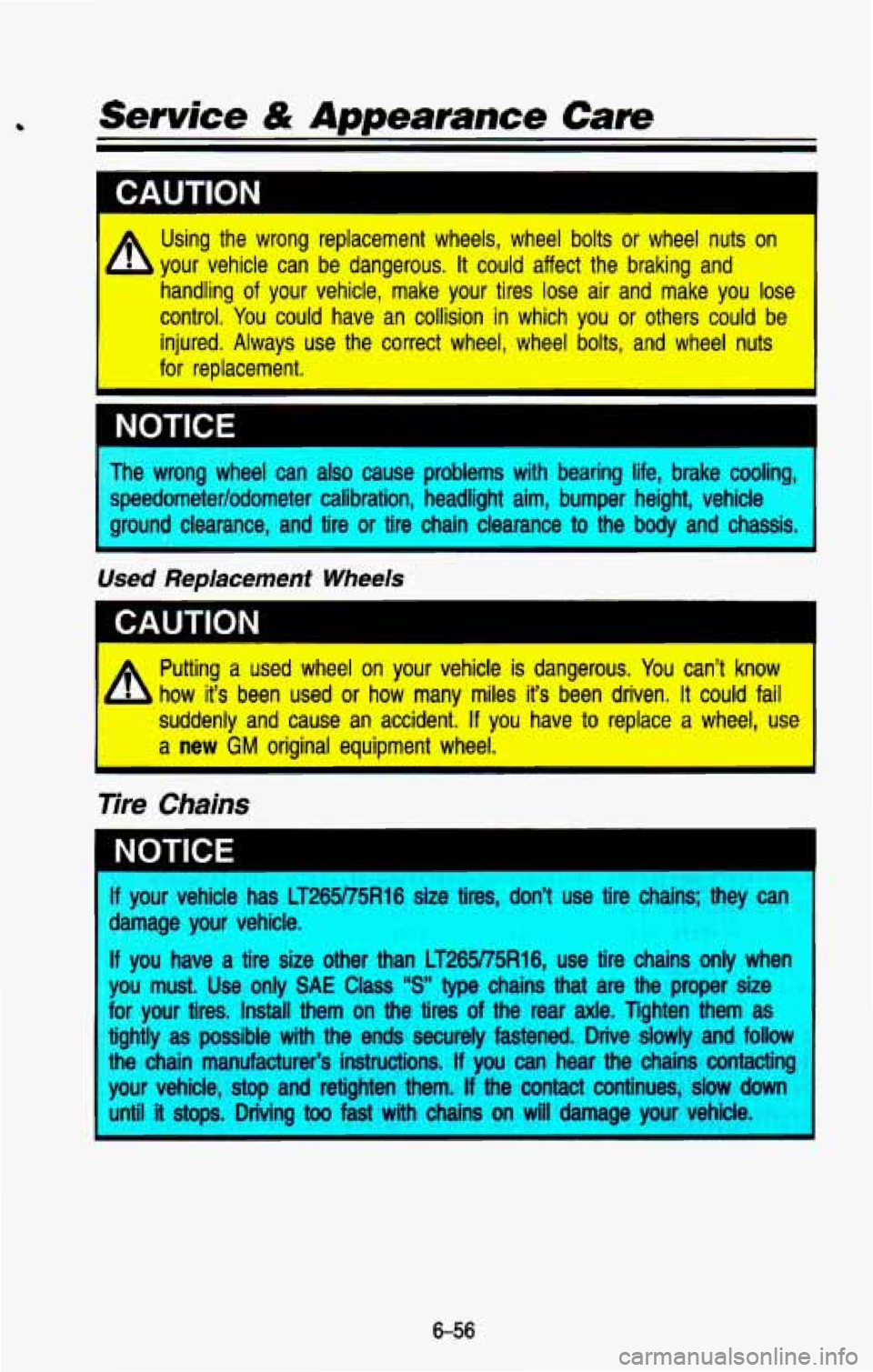
I CAUTION I
A Using the wrong replacement wheels, wheel bolts or wheel nuts on
your vehicle can be dangerous.
It could affect the braking and
handling
of your vehicle, make your tires lose air and make you lose
control. You could have an collision in which you or others could be
injured. Always use the correct wheel, wheel
bolts, and wheel nuts
for replacement.
I
I
I The wrong wheel can also cause problems with bearing life, brake cooling,
speedometerlodometer calibration, headlight aim, bumper height, vehicle
ground clearance, and tire
or tire chain clearance to the body and chassis.
A Putting a used wheel on your vehicle is dangerous. You can't know
how it's been used or how many miles it's been driven. It could fail
suddenly and cause an accident. If you have to replace a wheel, use
a new GM original equipment wheel,
I
Tire Chains
rNOTICE 'If put vehicle has LT265/75R16 size tires, don't use tire chams; they i can!
damage your vehicle.
6-56
Page 335 of 386
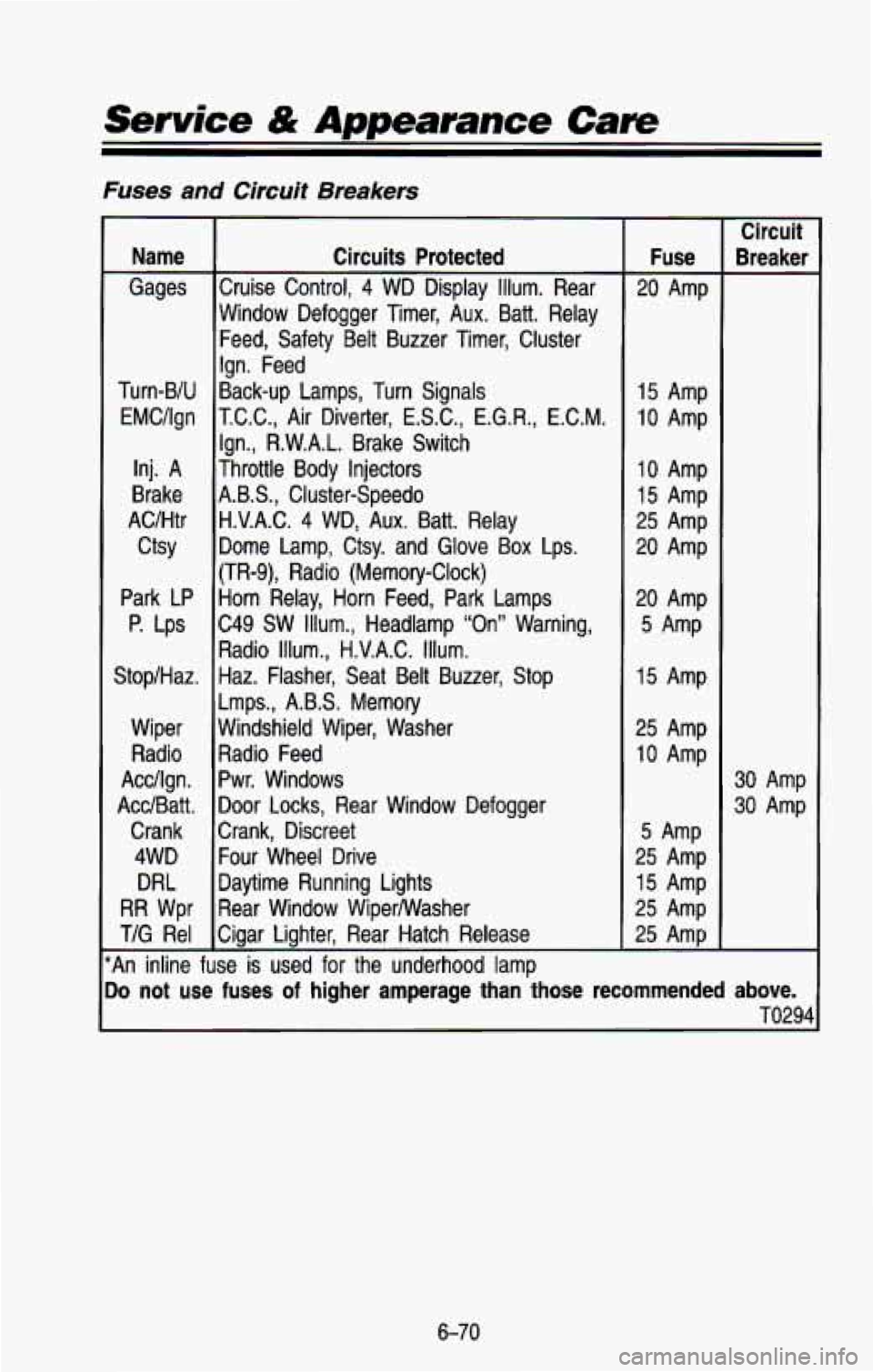
Fuses and Circuit Breakers
Name
Gages
Turn-BIU EMCIIgn
Inj.
A
Brake
AC/Htr
ctsy
Park LP
P. Lps
StopiHaz.
Wiper Radio
Acc/lgn.
AcdBatt. Crank 4WD
DRL
RR Wpr
TIG Re1
Circuits Protected
Cruise Control, 4 WD Display Illum. Rear
Window Defogger Timer, Aux. Batt. Relay Feed, Safety Belt Buzzer Timer, Cluster
Ign. Feed
Back-up Lamps, Turn Signals
T.C.C., Air Diverter, E.S.C.,
E.G.R., E.C.M.
Ign., R.W.A.L. Brake Switch
Throttle Body Injectors
A.B.S., Cluster-Speed0
H.V.A.C.
4 WD, Aux. Batt. Relay
Dome Lamp, Ctsy. and Glove Box Lps.
(TR-9), Radio (Memory-Clock)
Horn Relay, Horn Feed, Park Lamps C49 SW Illum., Headlamp
“On” Warning,
Radio Illum., H.V.A.C. Illum.
Haz. Flasher, Seat Belt Buzzer, Stop
Lmps., A.B.S. Memory
Windshield Wiper, Washer
Radio Feed
Pwr. Windows
Door Locks, Rear Window Defogger Crank, Discreet
Four Wheel Drive
Daytime Running Lights
Rear Window Wiperwasher
Cigar Lighter, Rear Hatch Release
Fuse
20 Amp
15 Amp
10 Amp
10 Amp
15 Amp
25
Amp
20 Amp
20 Amp
5 Amp
15 Amp
25 Amp
10 Amp
5 Amp
25 Amp
15 Amp
25 Amp
25 Amp
Circuit
Breaker
30 Amp
30 Amp
An inline fuse is used for the underhood lamp
Jo not use fuses of higher amperage than those recommended above.
TO291
6-70
Page 345 of 386

Scheduled Maintenance Services
GASOLINE ENGINES WITH LIGHT DUTY EMISSIONS-
If your driving conditions meet those specified in “Scheduled Ma\
intenancc
Services” in this section, use Maintenance Schedule
I (t).
Item Miles (000) 3 6 7.5 9 12 15 18
No. Service Kilometers (000) 5 10 12.5 15 20 25 30
1 Engine Oil Change*-Every 12 Months, or e
Oil Filter Change*-Every 12 Months, or e
2 Chassis Lubrication-Every 12 Months, or e
3 Clutch Fork Ball Stud Lubrication
5 Cooling System Service*-Every 24
6 Air Cleaner Filter Replacement* Months
or
7 Front Wheel Bearing Repack
8 Transmission Service**
25 Drive Axle Service**
26 Brake Systems Inspection**
FOOTNOTES:
**See “Explanation
of Scheduled Maintenance Services” in this section.
*An Emission Control Service
tTo determine the emissions classification of your engine refer to “Selecting
the
Proper Maintenance Chart”
in this section.
TO332
Page 376 of 386
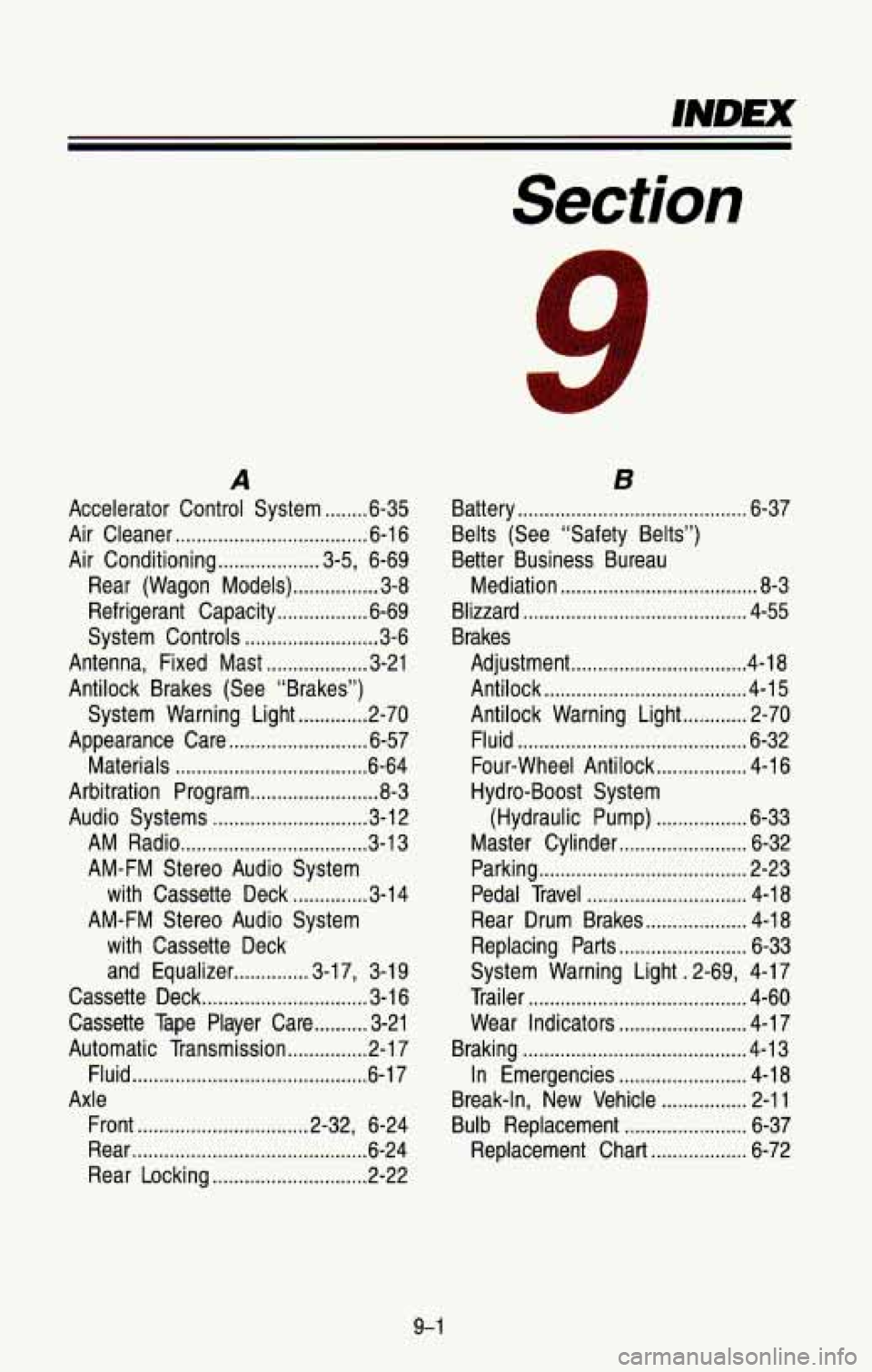
Section
A
Accelerator Control System ........ 6-35
Air Cleaner
.................................... 6-1 6
Air Conditioning
................... 3.5. 6-69
Rear (Wagon Models)
................ 3-8
Refrigerant Capacity
................. 6-69
System Controls
......................... 3-6
Antenna. Fixed Mast
................... 3-21
Antilock Brakes (See “Brakes”)
System Warning Light
............. 2-70
Appearance Care
.......................... 6-57
Materials
.................................... 6-64
Arbitration Program
........................ 8-3
Audio Systems
............................. 3-1 2
AM Radio
................................... 3-1 3
AM-FM Stereo Audio System
with Cassette Deck
.............. 3-14
AM-FM Stereo Audio System
with Cassette Deck and Equalizer
.............. 3-1 7. 3-1 9
Cassette Deck ............................... 3-1 6
Cassette Tape Player Care
.......... 3-21
Automatic Transmission
............... 2-1 7
FI uid
............................................ 6. 1 7
Axle
Front
................................ 2.32. 6-24
Rear
............................................ 6-24
Rear Locking
............................. 2-22
B
Battery ........................................... 6-37
Belts (See “Safety Belts”)
Better Business Bureau Mediation
..................................... 8-3
Blizzard
.......................................... 4-55
Brakes
Adjustment
................................. 4-18
Antilock
...................................... 4-15
Antilock Warning Light
............ 2-70
Fluid
........................................... 6-32
Four-wheel Antilock
................. 4-16
Hydro-Boost System
(Hydraulic Pump)
................. 6-33
Master Cylinder
........................ 6-32
Parking
....................................... 2-23
Pedal Travel
.............................. 4-18
Rear Drum Brakes
................... 4-18
Replacing Parts
........................ 6-33
System Warning Light .2-69, 4-17
Trailer
......................................... 4-60
Wear Indicators
........................ 4-17
Braking
.......................................... 4-13
In Emergencies
........................ 4-18
Break-In, New Vehicle
................ 2-11
Bulb Replacement ....................... 6-37
Replacement Chart
.................. 6-72
9-1
Page 378 of 386
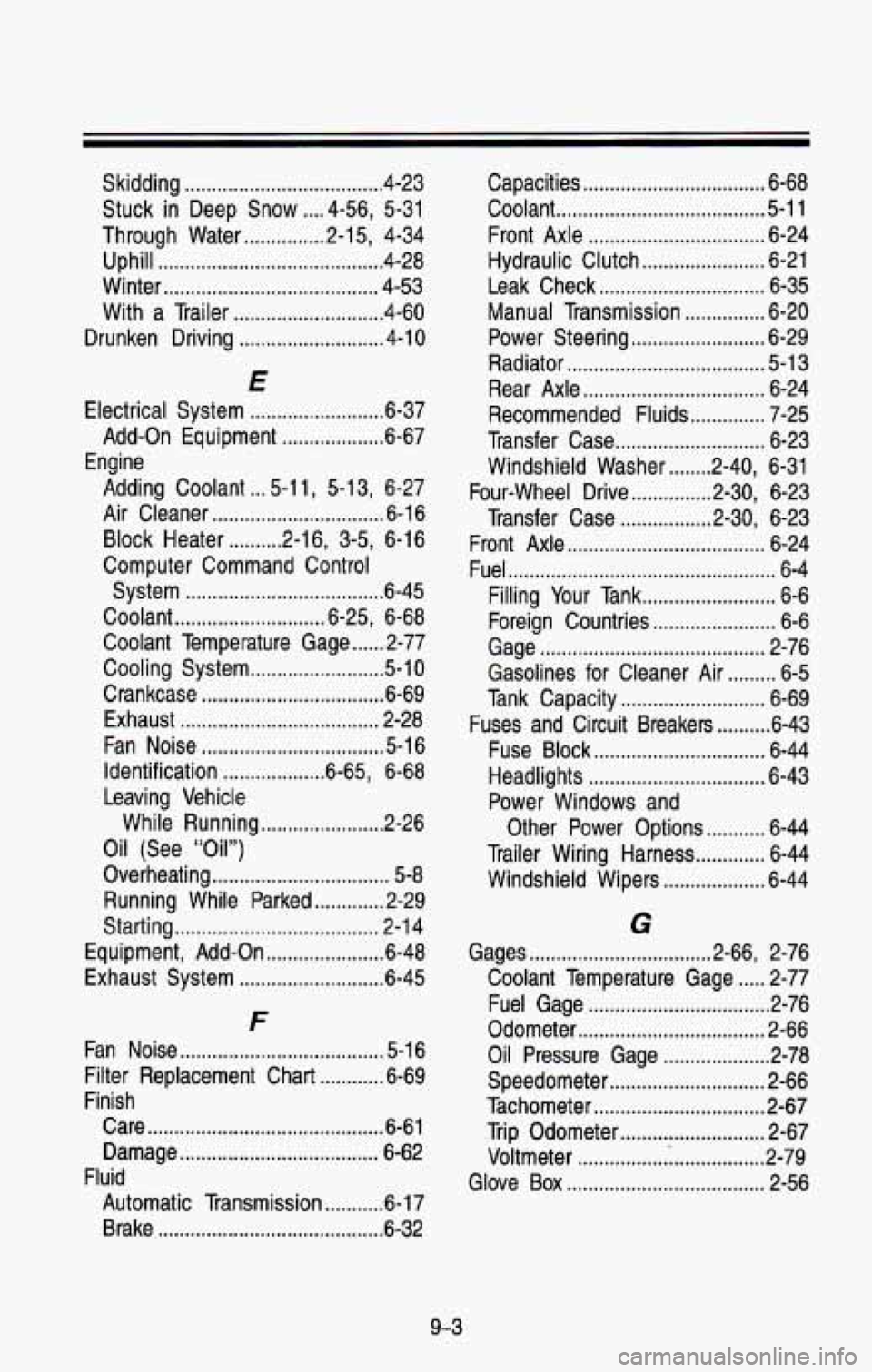
Skidding ..................................... 4-23
Stuck
in Deep Snow .... 4-56, 5-31
Through Water
............... 2-1 5, 4-34
Uphill
.......................................... 4-28
Winter
........................................ 4-53
With a Trailer
............................ 4-60
Drunken Driving
........................... 4-1 0
E
Electrical System ......................... 6-37
Add-on Equipment
................... 6-67
Engine
Adding Coolant
... 5-1 1, 5-13, 6-27
Air Cleaner
................................ 6-1 6
Block Heater
.......... 2-16, 3-5, 6-16
Computer Command Control
System
..................................... 6-45
Coolant
............................ 6-25, 6-68
Coolant Temperature Gage
...... 2-77
Cooling System
......................... 5-10
Crankcase .................................. 6-69
Exhaust
..................................... 2-28
Fan Noise
.................................. 5-1 6
Identification
................... 6-65, 6-68
Leaving Vehicle While Running
....................... 2-26
Oil (See
“Oil”)
Overheating ................................. 5-8
Running While Parked
............. 2-29
Starting
...................................... 2-1 4
Equipment, Add-on
...................... 6-48
Exhaust System
........................... 6-45
F
Fan Noise ...................................... 5-1 6
Filter Replacement Chart
............ 6-69
Finish
Care
............................................ 6-61
Damage
..................................... 6-62
Automatic Transmission
........... 6-17
Brake
.......................................... 6-32
Fluid Capacities
.................................. 6-68
Coolant
....................................... 5-11
Front Axle ................................. 6-24
Hydraulic
Clutch ....................... 6-21
Leak Check
............................... 6-35
Manual Transmission
............... 6-20
Power Steering
......................... 6-29
Radiator
..................................... 5-13
Rear Axle
.................................. 6-24
Recommended Fluids
.............. 7-25
Transfer Case
............................ 6-23
Windshield Washer
........ 2-40, 6-31
Four-wheel Drive
............... 2-30, 6-23
Transfer Case
................. 2-30, 6-23
Front Axle
..................................... 6-24
Fuel
.................................................. 6-4
Filling Your Tank
......................... 6-6
Foreign Countries
....................... 6-6
Gage
.......................................... 2-76
Gasolines
for Cleaner Air ......... 6-5
Tank Capacity
........................... 6-69
Fuses and Circuit Breakers
.......... 6-43
Fuse Block
................................ 6-44
Headlights
................................. 6-43
Power Windows and
Other Power Options
........... 6-44
Trailer Wiring Harness
............. 6-44
Windshield Wipers
................... 6-44
G
Gages .................................. 2-66, 2-76
Coolant Temperature Gage
..... 2-77
Fuel Gage
.................................. 2-76
Odometer
................................... 2-66
Oil Pressure Gage
.................... 2-78
Speedometer
............................. 2-66
Tachometer
................................ 2-67
Trip Odometer
........................... 2-67
Voltmeter
................. ................. 2-79
Glove Box
..................................... 2-56
9-3