lock CHEVROLET BLAZER 1993 Manual PDF
[x] Cancel search | Manufacturer: CHEVROLET, Model Year: 1993, Model line: BLAZER, Model: CHEVROLET BLAZER 1993Pages: 386, PDF Size: 20.7 MB
Page 281 of 386

Service & Appearance Care
oil. If time determines when you change your oil, change the filter ea\
ch time
you change your oil.
Engine Block Heater:
An engine block heater can be a big help if you have to park outside in very
cold weather,
0°F (-18°C) or colder. If your vehicle has this option, see
“Engine Block Heater” in the Index.
What to Do with Used Oil:
Used engine oil contains things that have caused skin cancer in
laboratory animals. Don’t let
used oil stay on your skin for very long.
Clean
your skin and nails with soap and water, or a good hand ,,:: :‘:-;
cleaner. Wash or properly throw away clothing or rags containing-:’-:;$ ~
used engine oil.
. ,A:<< --.
L. .. . .. ,-. f .- , L ., -J ’,: ._ - -
..:.: ;,i, j I -.. : j ,!
Used oil can be a real threat to the environment. If YOU change your own oil,
be sure to drain all free-flowing oil from the filter before disposal. Don’t ever
dispose of oil by putting it in the trash, pouring it on the ground, into sewers,
or into streams or bodies of water. Instead, recycle it by taking it to a place
that collects used oil. If you have a problem properly disposing of your used
oil, ask your dealer, a service station or a local recycling center for help.
Air Cleaner
c
PO21 6
Refer to the Maintenance Schedule to determine when to replace the air
cleaner filter and crankcase ventilation filter. See “Schedule\
d Maintenance Services” in the Index.
6-1 6
Page 282 of 386
I CAUTION
I 10 Operating the engine with the air cleaner off can cause you or others
to be burned. The air cleaner not only cleans the air, it
stops flame
if the engine backfires.
If it isn’t there, and the engine backfires, y(--
could be burned. Don’t drive with it
off, and be cr-ful working on
the engine with the air cleaner
off.
~
NOTICE I
If the air cleaner is off, a backfire can cause a damaging engine fire. And,
dirt
can easily get into your engine, which will damage it. Always have the
air cleaner
in place when you’re driving.
Ib remove the air cleaner filter on a gas engine, turn the wing nuts
counterclockwise. Remove the cover and change the filter.
-
Automatic Transmission Fluid
When to Check and Change:
A good time to check your automatic transmission fluid level is when the
engine
oil is changed. Refer to the Maintenance Schedule to determine when
to change your fluid. See “Scheduled Maintenance Services” in \
the Index.
How to Check:
Because this operation can be a little difficult, you may choose to have this
done at a General Motors dealership Sewice Department.
If you do it yourself, be sure to follow all the instructions here, or you could
get
a false reading on the dipstick.
NOTICE I
I
Too much or too little fluid can damage your transmission. Too much can
mean that some of the fluid could come out and fail
on hot engine parts,
I
starting a fire. Be sure to get an accurate reading if you check-your
transmission fluid.
Wait at least
30 minutes before checking the transmission fluid level if you
have been driving:
When outside temperatures are above 90°F (32°C).
At high speed for quite a while.
In heavy traffic-especially in hot weather.
While pulling a trailer.
6-1 7
Page 284 of 386
PO053
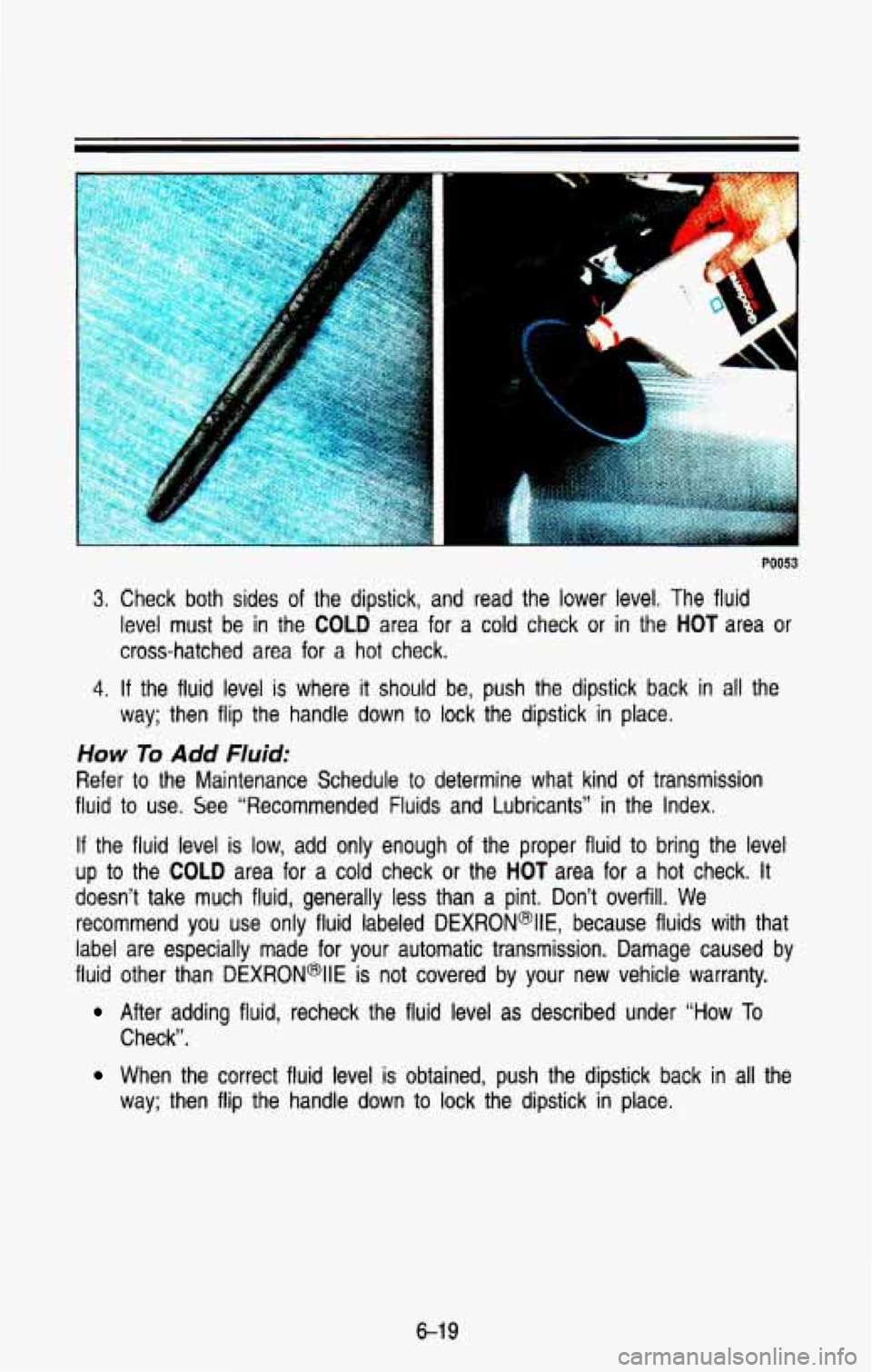
3. Check both sides of the dipstick, and read the lower level, The fluid
level must be in the
COLD area for a cold check or in the HOT area or
cross-hatched area for a hot check.
4. If the fluid level is where it should be, push the dipstick back in all the
way; then flip the handle down to lock the dipstick in place.
HOW To Add Fluid:
Refer to the Maintenance Schedule to determine what kind of transmission
fluid
to use. See “Recommended Fluids and Lubricants” in the Index.
If the fluid level is low, add only enough of the proper fluid to bring the level
up to the COLD area for a cold check or the HOT area for a hot check. It
doesn’t take much fluid, generally less than a pint. Don’t overfill. We
recommend you use only fluid labeled
DEXRON@IIE, because fluids with that
label are especially made for your automatic transmission. Damag\
e caused by
fluid other than
DEXRON@llE is not covered by your new vehicle warranty.
After adding fluid, recheck the fluid level as described under “How To
Check”.
When the correct fluid level is obtained, push the dipstick back in all the
way; then flip the handle down
to lock the dipstick in place.
6-1 9
Page 301 of 386
Service & Appearance Care
Hood Laiches and Hood Hinge
Your maintenance schedule will tell you how often to lubricate the hood latch
and hood hinge assembly. See “Recommended Fluids and Lubrican\
ts” in the
Index for the proper lubricant to use.
Propeller Shaft Slip Splines
See your maintenance schedule to find out how often the slip \
splines must
be lubricated, See “Recommended Fluids and Lubricants” in the Index for the
proper lubricant to use.
Constant Velocity Joints
See your maintenance schedule to find out how often the consta\
nt velocity
joints must be lubricated. See “Recommended Fluids and Lubricants”\
in the
Index for the proper lubricant to use.
Body
Normal use of your vehicle will cause metal to metal wear at some points on
the cab and body
if they are not lubricated.
For exposed surfaces, such as door checks, door lock bolts, lo\
ck striker
plates, dovetail bumper wedges, etc., a thin film of engine oil should be
applied.
The seat adjusters and seat track should be lubricated with ch\
assis grease, Door weather strips and rubber hood bumpers should be lightly \
coated with a
rubber lubricant.
Never use too much of any lubricant and be sure to wipe up any extra
lubricant when you are finished.
Your maintenance schedule will tell you how often to lubricate these items.
See “Recommended Fluids and Lubricants” in the Index
for the proper
lubricant to use.
Lock Cylinders
To be sure your locks operate properly, they must be lubricated, Your
vehicle’s maintenance schedule will tell you how often
to lubricate them. See
“Recommended Fluids and Lubricants”
in the Index for the proper lubricant to
use.
You should not use penetrating oils because they could wash out the factory
installed lubricant and cause the lock to bind. De-icers which contain alcohol
could also wash away the lubricant,
so be sure to lubricate the lock after
using a de-icer
of this type.
6-36
Page 304 of 386
Composite Headlights
1
PO2
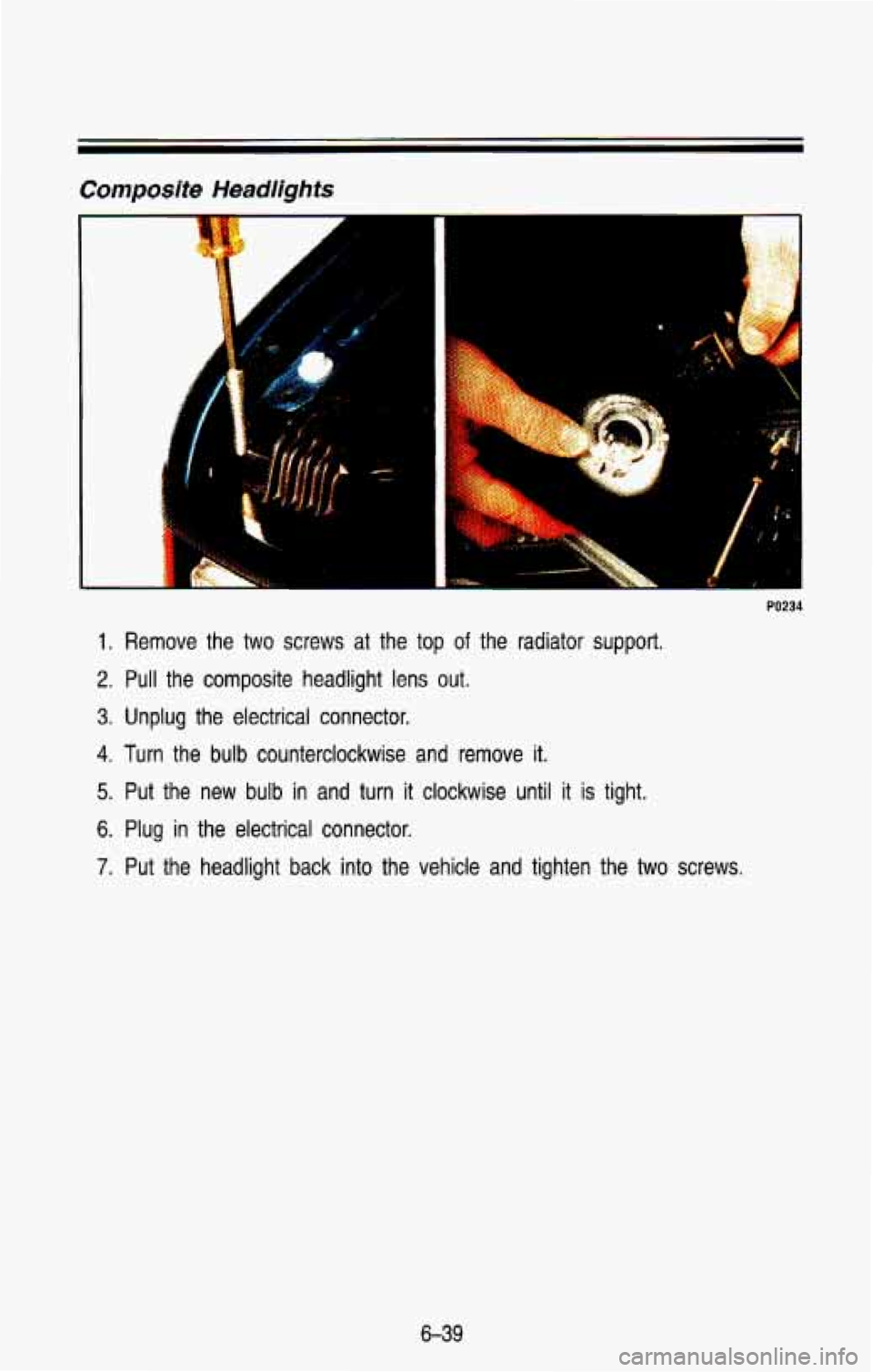
1. Remove the two screws at the top of the radiator support.
2. Pull the composite headlight lens out.
3. Unplug the electrical connector.
4. Turn the bulb counterclockwise and remove it.
5. Put the new bulb in and turn it clockwise until it is tight.
6. Plug in the electrical connector.
7. Put the headlight back into the vehicle and tighten the two screws.
6-39
Page 305 of 386

Service & Appearance Care
Front Parkingflurn Signal Lights
K2681
1. Remove the screws and take out the parkinglturn signal light a\
ssembly,
2. Squeeze the tab on the side of the light socket while turning the socket
counterclockwise.
3. Pull out the socket.
4. Push in gently on the bulb, turn it counterclockwise and remove it from
the socket.
6-40
Page 306 of 386

5. Put the new bulb into the socket, gently press in on the bulb and turn it
clockwise until it is tight.
6. Put the socket back into the light assembly and turn it clock\
wise until it
locks.
7. Put the parkinghurn signal light assembly back into the vehicle and
tighten the screws.
Side Marker Bulb
P
1 Remove the screws and pull out the parkinglturo signal light assembly.
2. Reach through the opening and turn the side marker bulb socket\
3. Pull the bulb straight out of the socket.
counterclockwise and remove it.
4. Put a new bulb into the socket and push it in until
it is tight.
5. Put the socket back into the side marker assembly and turn it clockwise
to tighten it.
6. Replace the parkinglturn signal light assembly and tighten the screws.
6-41
Page 309 of 386
Service & Appearance Care
Windshield Wipers
The windshield wiper motor is protected by a circuit breaker and a fuse. If
the motor overheats due to heavy snow, etc., the wiper will stop until the
motor cools.
If the overload is caused by some electrical problem and not
snow, etc., be sure to get
it fixed,
Power Windows and Other Power Options
Circuit breakers in the fuse panel protect the power windows and other power
accessories. When the current load
is too heavy, the circuit breaker opens
and
closes, protecting the circuit until the problem is fixed or goes away.
Trailer Wiring Harness
The optional seven-wire trailer wiring harness is protected by an in-line fuse
in the battery feed wire. This fuse is near the junction
block. See “Trailer
Wiring Harness” in the Index for more information.
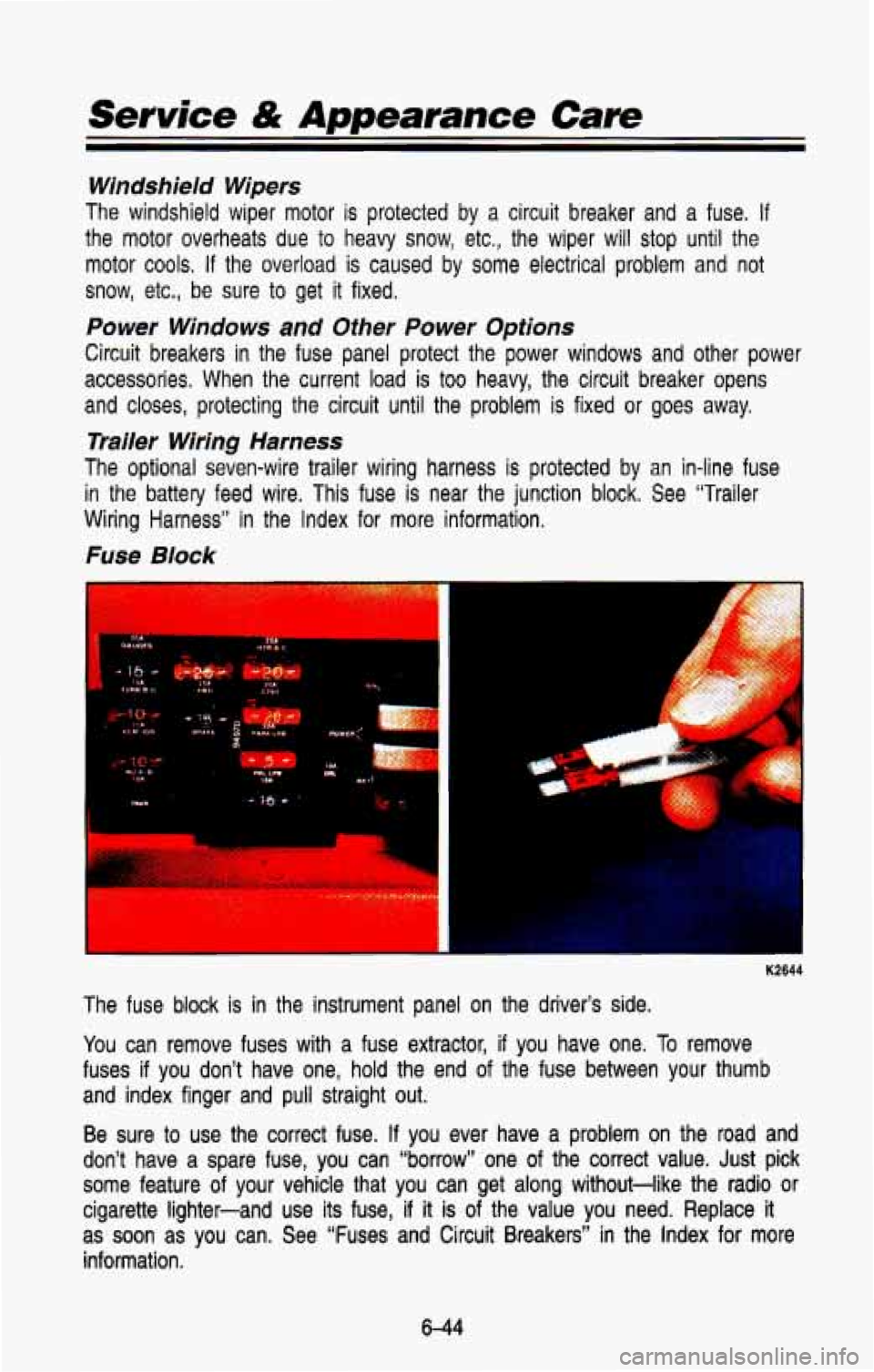
Fuse Block
m
, .. .
i
-+ lW -
-=
. . . . . . . . .
..
K2644
The fuse block is in
the instrument panel on the driver’s side.
You can remove fuses with a fuse extractor, if you have one. To remove
fuses
if you don’t have one, hold the end of the fuse between your thumb
and index finger and pull straight out.
Be sure to use the correct fuse.
If you ever have a problem on the road and
don’t have a spare fuse, you can “borrow” one of the correct value. Just pick
some feature of your vehicle that you can get along without-like the radio \
or
cigarette lighter-and use
its fuse, if it is of the value you need. Replace it
as
soon as you can. See “Fuses and Circuit Breakers” in the Index for more
information.
644
Page 335 of 386
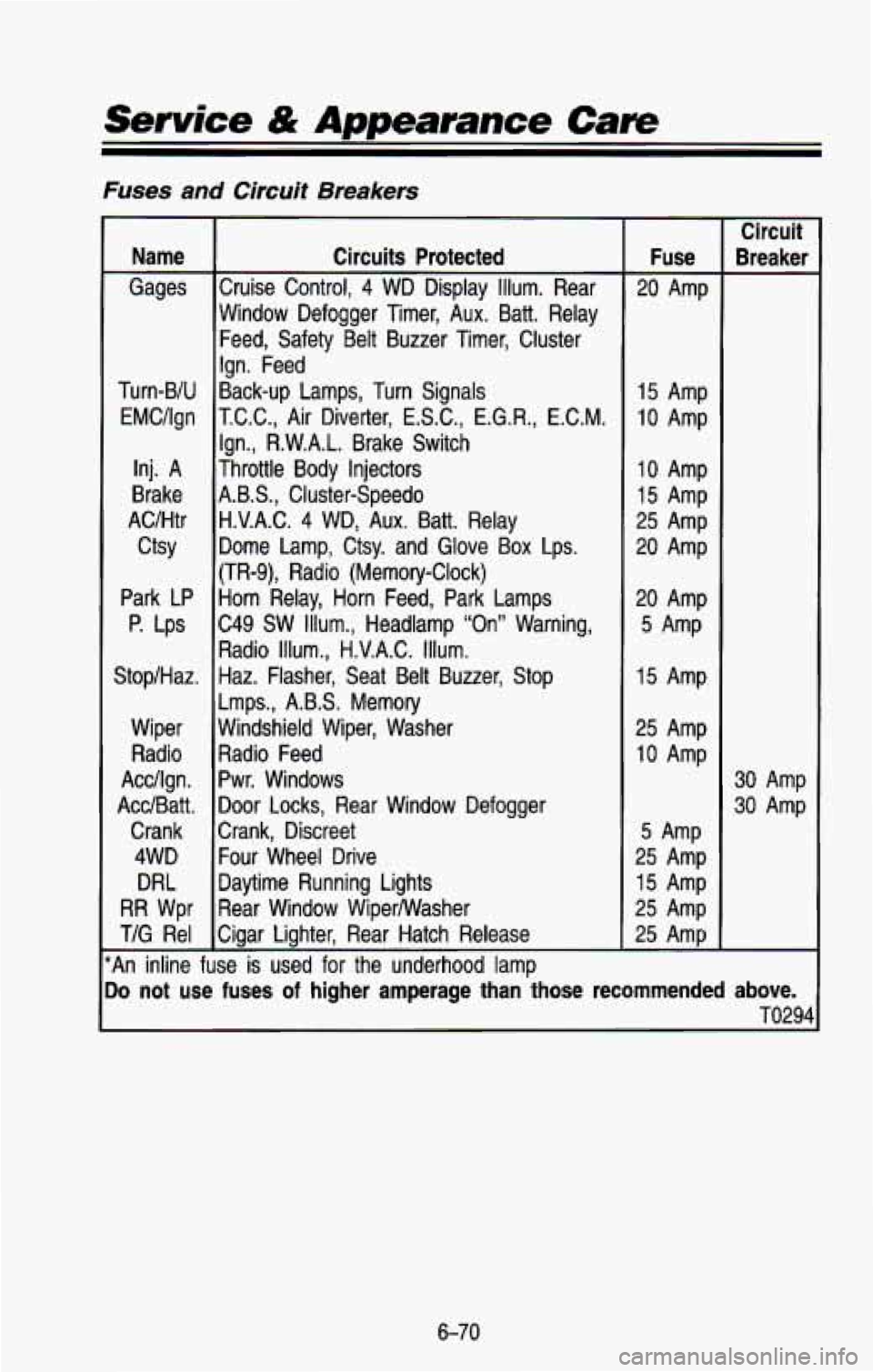
Fuses and Circuit Breakers
Name
Gages
Turn-BIU EMCIIgn
Inj.
A
Brake
AC/Htr
ctsy
Park LP
P. Lps
StopiHaz.
Wiper Radio
Acc/lgn.
AcdBatt. Crank 4WD
DRL
RR Wpr
TIG Re1
Circuits Protected
Cruise Control, 4 WD Display Illum. Rear
Window Defogger Timer, Aux. Batt. Relay Feed, Safety Belt Buzzer Timer, Cluster
Ign. Feed
Back-up Lamps, Turn Signals
T.C.C., Air Diverter, E.S.C.,
E.G.R., E.C.M.
Ign., R.W.A.L. Brake Switch
Throttle Body Injectors
A.B.S., Cluster-Speed0
H.V.A.C.
4 WD, Aux. Batt. Relay
Dome Lamp, Ctsy. and Glove Box Lps.
(TR-9), Radio (Memory-Clock)
Horn Relay, Horn Feed, Park Lamps C49 SW Illum., Headlamp
“On” Warning,
Radio Illum., H.V.A.C. Illum.
Haz. Flasher, Seat Belt Buzzer, Stop
Lmps., A.B.S. Memory
Windshield Wiper, Washer
Radio Feed
Pwr. Windows
Door Locks, Rear Window Defogger Crank, Discreet
Four Wheel Drive
Daytime Running Lights
Rear Window Wiperwasher
Cigar Lighter, Rear Hatch Release
Fuse
20 Amp
15 Amp
10 Amp
10 Amp
15 Amp
25
Amp
20 Amp
20 Amp
5 Amp
15 Amp
25 Amp
10 Amp
5 Amp
25 Amp
15 Amp
25 Amp
25 Amp
Circuit
Breaker
30 Amp
30 Amp
An inline fuse is used for the underhood lamp
Jo not use fuses of higher amperage than those recommended above.
TO291
6-70
Page 358 of 386

23. EXHAUST PRESSURE EGULATOR VALVE INSPECTION* -Check that
the valve works properly. Correct any binding. Inspect hoses fo\
r cracks,
chafing or decay. Replace parts
as needed.
24. TIRE AND WHEEL ROTATION AND INSPECTION -For proper wear
and maximum tire life, rotate tires
at the first 6,000 miles (10 000
kilometers) for Schedule I (t) or 7,500 miles (12 500 kilometers) for
Schedule
II (.) and then every 15,000 miles (25 000 kilometers)
thereafter.
Follow the instructions and patterns shown in Section 6.
Check tires for uneven wear or damage. If irregular or premature wear is
apparent, check wheel alignment.
Also, check for damaged wheels. See
“Tires” in the Index for more information.
For dual wheels, whenever the vehicle, wheels, or fasteners are new\
,
have the wheel fastener torque set at the first 100,
1,000 and 6,000
miles
(160, 1600 and 10 000 km).
For
3500 H.D. Models, block the tires opposite those being removed to
keep the vehicle from rolling.
25.
DRIVE AXLE SERVICE -Check readfront axle fluid level and add as
needed. Check constant velocity joints and axle seals for leaki\
ng.
Locking differential-Drain fluid at first oil change and refill. Check
fluid level and add as needed at subsequent oil changes. In dusty
areas, or trailer towing applications drain fluid at every
15,000 miles
(24 135 kilometers) and refill$
every oil change. In dusty areas,
or trailer towing applications, drain
fluid every 15,000 miles
(24 135 kilometers) and refi1l.t
Standard differential -Check fluid level and add as needed at
More frequent lubrication may be required on heavy-duty or off-road
use.
26. BRAKE SYSTEM INSPECTION -When the engine oil is changed,
inspect the lines
and hoses for proper hookup, binding, leaks, cracks,
chafing, etc. Check the parking brake adjustment, and the fluid level in
the master cylinder.
A low fluid level can indicate worn disc brake pads
which may need to be serviced$
*An Emission Control Service
tA fluid loss in these systems may indicate a problem. Have them
inspected and repaired
at once.
7-2 1