jack CHEVROLET BLAZER 1993 Owners Manual
[x] Cancel search | Manufacturer: CHEVROLET, Model Year: 1993, Model line: BLAZER, Model: CHEVROLET BLAZER 1993Pages: 386, PDF Size: 20.7 MB
Page 232 of 386

Here you’ll find what to do about some problems that can occur on the road.
Hazard Warning Flashers ........................................................................\
............. 5-2
Other Warning Devices ........................................................................\
................. 5-3
Jump Starting ........................................................................\
................................ 5-3
Towing Your Vehicle, ........................................................................\
..................... 5-7
Engine Overheating ........................................................................\
....................... 5-8
Engine Fan Noise ........................................................................\
....................... 5-1 6
If a Tire Goes Flat ........................................................................\
...................... 5-16
Changing a Flat
Storing the Jack
If You’re Stuck: In
Tire ........................................................................\
............... 5-16
and
Tire. ........................................................................\
...... 5-30
Sand, Mud, Ice or Snow ................................................... 5-31
5-1
Page 247 of 386

Engine Fan Noise
This vehicle has a clutched engine cooling fan. When the clutc\
h is engaged,
the fan spins faster
to provide more air to cool the engine. In most every day
driving conditions the clutch is not engaged. This improves fuel economy and
reduces fan noise. Under heavy vehicle loading, trailer towing \
and/or high
outside temperatures, the fan speed increases when the clutch e\
ngages.
So
you may hear an increase in fan noise. This is normal and sh\
ould not be
mistaken
as the transmission slipping or making extra shifts. It is merely the
cooling system functioning properly. The fan
will slow down when additional
cooling is not required and the clutch disengages.
You may also hear this fan noise when you start the engine. \
It will go away
as the fan clutch disengages.
If a Tire Goes Fiat
It’s unusual for a tire to “blow out” while you’re driving,\
especially if you
maintain your tires properly.
If air goes out of a tire, it’s much more likely to
leak out slowly. But if you should ever have a “blowout,” here are a few tips
about what
to expect and what to do:
If a front tire fails, the flat tire will create a drag that pulls the vehicle toward
that side. Take your foot
off the accelerator pedal and grip the steering wheel
firmly. Steer to maintain lane position, then gently brake
to a stop well out of
the traffic lane.
A rear blowout, particularly on a curve, acts much like a skid and may
require the same correction you’d use in a skid. In any rear blowout, remove
your foot from the accelerator pedal. Get the vehicle under co\
ntrol by steering
the way you want the vehicle
to go. It may be very bumpy and noisy, but
you can still steer. Gently brake to a stop, well off the road if possible.
If your tire goes flat, the next part shows how to use your jacking equipment
to change a flat tire safely.
Changing a Flat Tire
If a tire goes flat, avoid further tire and wheel damage by driving slowly to a
level place. Turn
on your hazard warning flashers.
5-1 6
Page 248 of 386
L
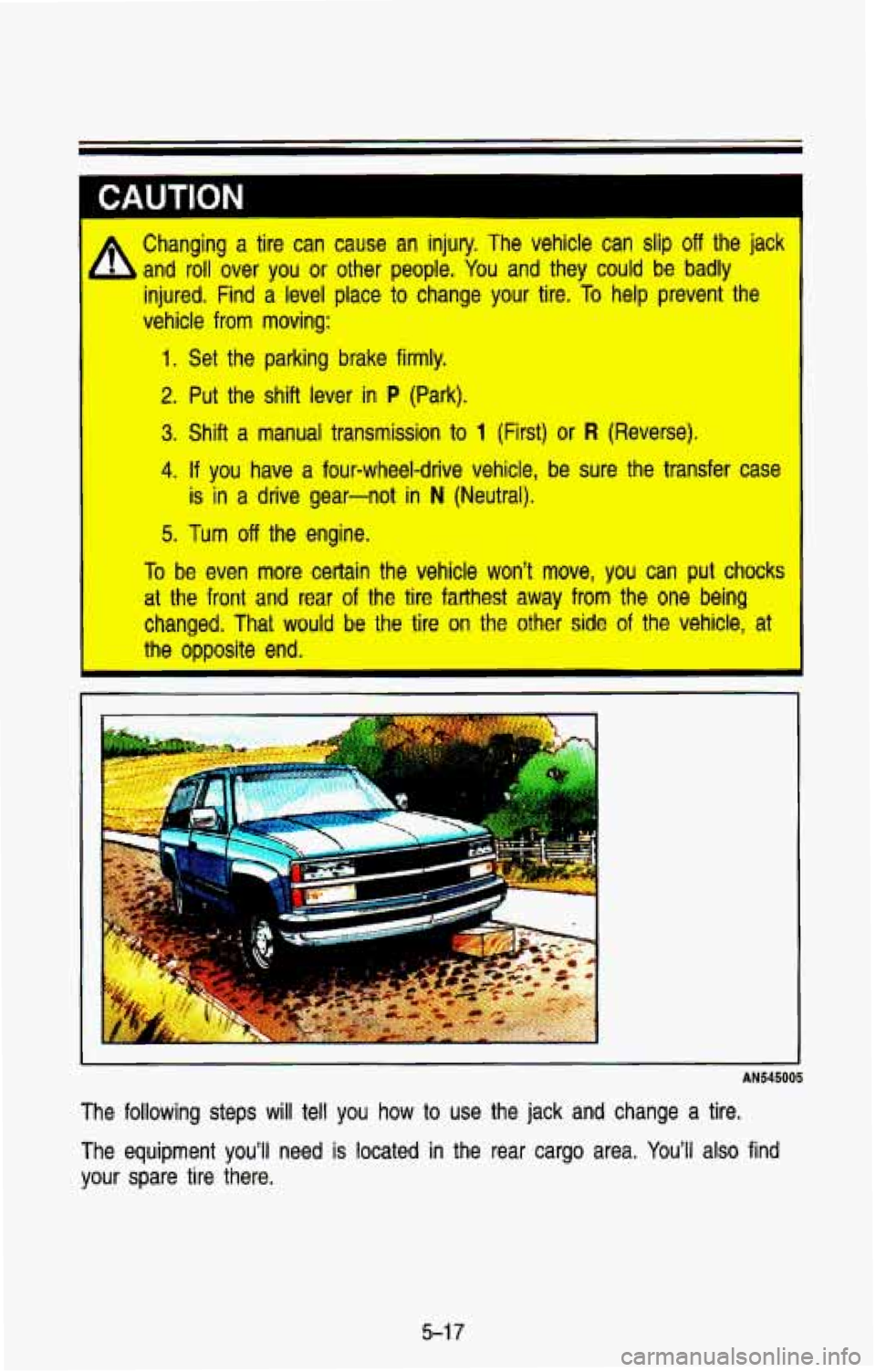
Changing a tire can cause an injury. The vehicle can slip off the jack
injured. Find a level place to change your tire. To help prevent the
vehicle
from moving:
- and roll over you or other people. You and they could be badly
1. Set the parking brake firmly.
2. Put the shift lever in P (Park).
3. Shift a manual transmission to 1 (First) or R (Reverse).
4. If you have a four-wheel-drive vehicle, be sure the transfer case \
5. Turn off the engine.
is in a drive gear-not in N (Neutral).
To be even more certain the vehicle won't move, you can put chocks
at the front and rear of the tire farthest away from the one being
changed. That would be the tire on the other side of the vehicle, at
the opposite end.
I
L
I
The following steps will tell you how to use the jack and change a tire.
5-1 7
Page 249 of 386

K2122
First open the tire cover, if you have one. Turn the wing nut counterclockwise
and take it, and the adapter, off the bolt. Take the tire out of the vehicle and
remove the
tire cover.
Jack and Tools
. .-
PO287
If your wagon model has a jack cover, lift the tab up to release the cover,
then take
it off.
Page 250 of 386
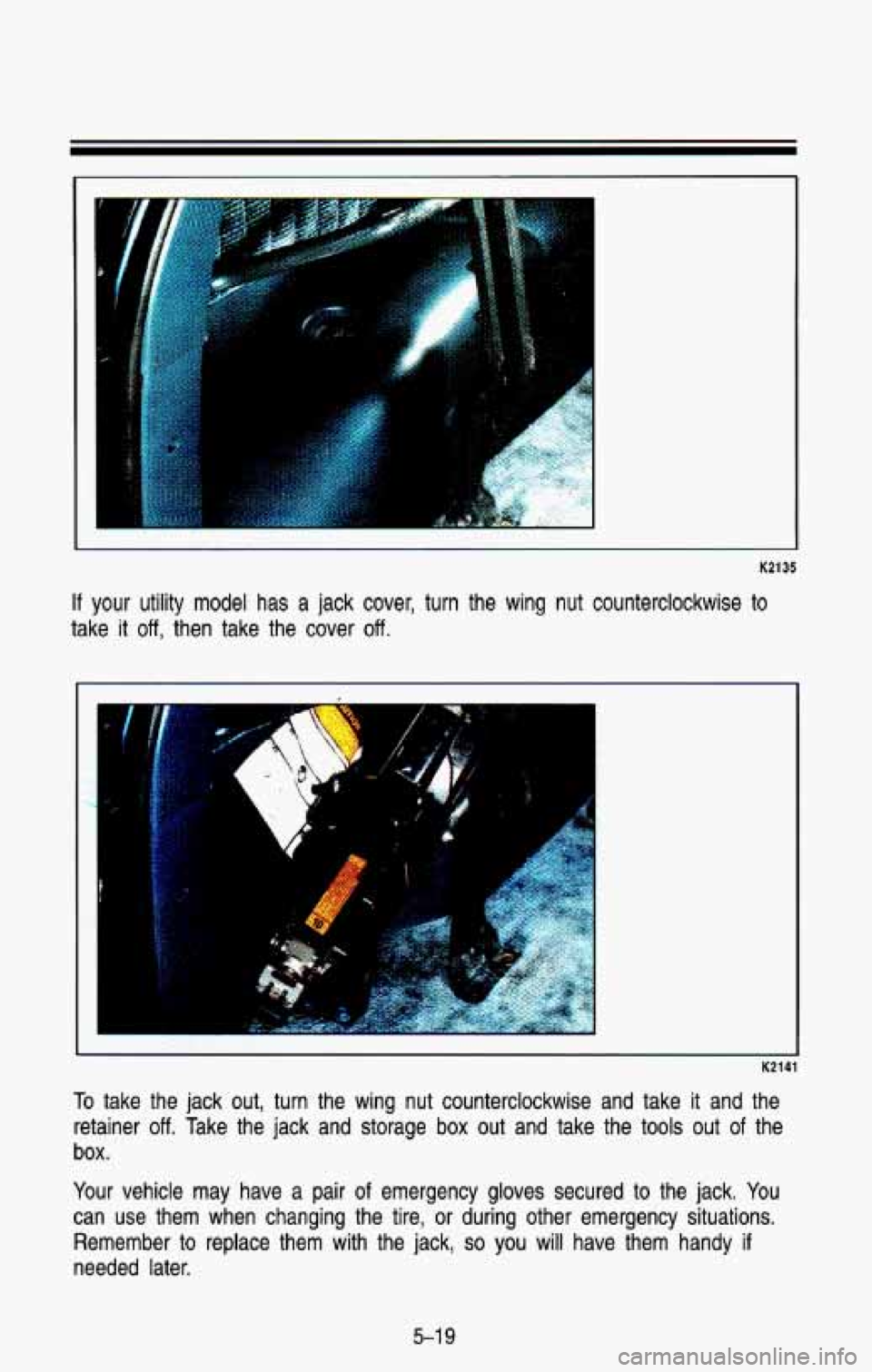
K2135
If your utility model has a jack cover, turn the wing nut counterclockwise to
take it off, then take the cover off.
". .. .
K214
To take the jack out, turn the wing nut counterclockwise and take it and the
retainer
off. Take the jack and storage box out and take the tools out of the
box.
Your vehicle may have a pair
of emergency gloves secured to the jack. You
can use them when changing the tire, or during other emergency situations.
Remember to replace them with the jack,
so you will have them handy if
needed later.
5-1 9
Page 251 of 386

manging the Tire
1
K2519
Start with the jack, the jack handle and the ratchet. If the flat tire is on the
rear
of the vehicle, you'll need the jack handle extensions also.
K2535
The ratchet has an UP and a DOWN marking.
5-20
Page 252 of 386
-4
1
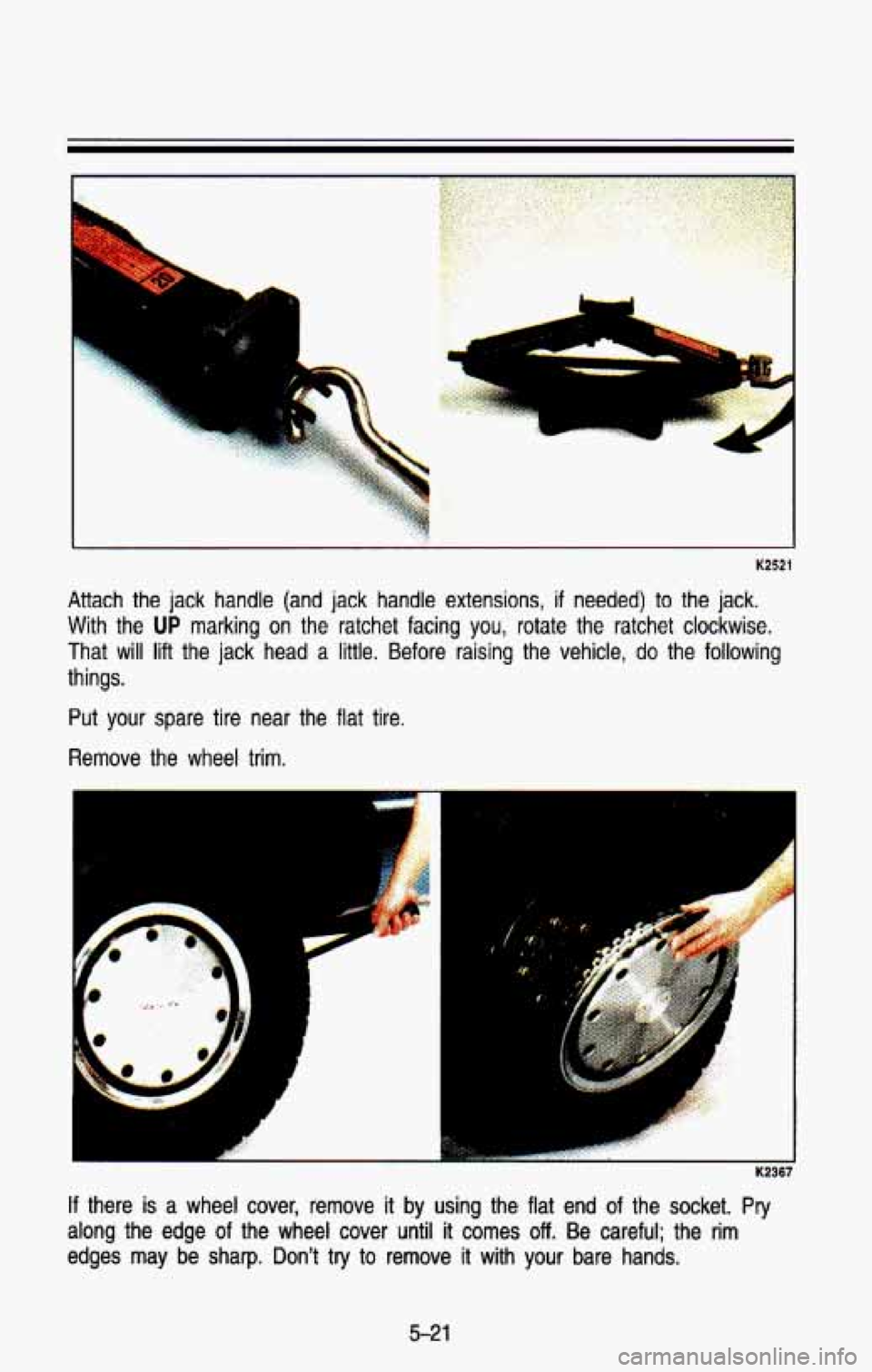
K2521
Attach the jack handle (and jack handle extensions, if needed) to the jack.
With the
UP marking on the ratchet facing you, rotate the ratchet clockwise.
That
will lift the jack head a little. Before raising the vehicle, do the following
things.
Put
your spare tire near the flat tire.
Remove the wheel trim.
1 K2367
If there is a wheel cover, remove it by using the flat end of the socket. Pry
along the edge
of the wheel cover until it comes off. Be careful; the rim
edges may be sharp. Don't try to remove
it with your bare hands.
5-21
Page 254 of 386
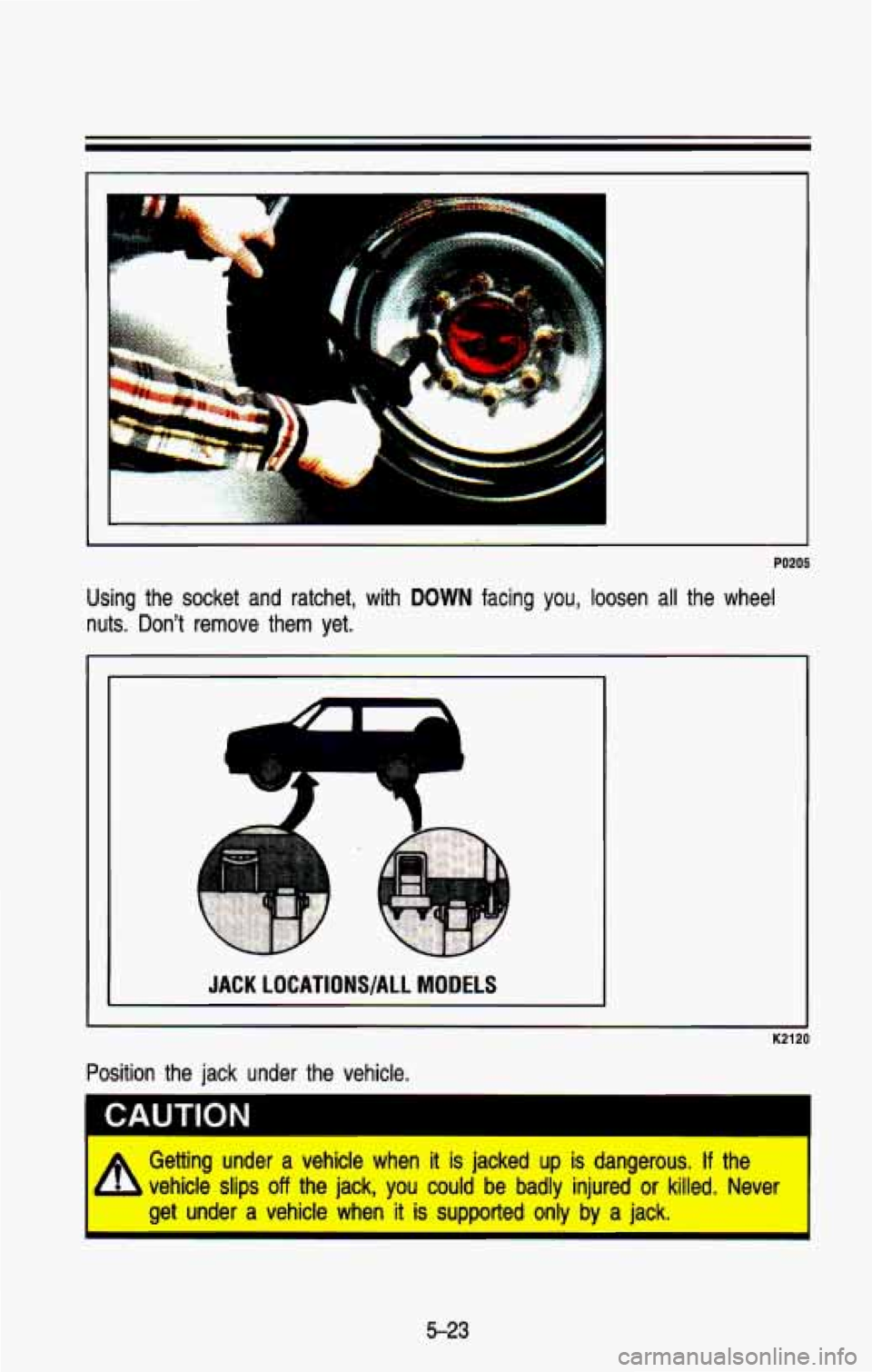
PO205
Using the socket and ratchet, with DOWN facing you, loosen all the wheel
nuts. Don’t remove them yet.
I JACK LOCATIONS/ALL MODELS
K2120
CAUTION
I A Getting under a vehicle when it is jacked up is dangerous. If the I
vehicle slips off the jack, you could be badly injured or killed. Never
get under
a vehicle when it is supported only by a jack. I
5-23
Page 255 of 386

NOTICE
- 'sing your vehicle with the jack improperly positioned will damage the
dehicle
or may allow the vehicle to fall off the jack. Be sure to fit the jack
ift head into the proper location before raising your vehicle.
Front Rear
-r-
1
'1
PO288
Raise the vehicle by rotating the ratchet clockwise. Make sure \
the UP
marking faces you. Use the jack handle extensions if the flat \
tire is on the
rear
of the vehicle. Raise the vehicle far enough off the ground so there is
enough room for the spare tire
to fit.
Page 259 of 386

CAUTION I
Incorrect wheel nuts or improperly tightened wheel nuts can cau\
se
the wheel
to become loose and even come off. This could lead to
an accident. Be sure to use the correct wheel nuts. If you have to
replace them, be
sure to get the right kind.
Stop somewhere as soon as you can and have the nuts tightened
with a torque wrench
to the promr toraue. I
For proper torque, see “Wheel Nut Torque” in the Index.
Put the wheel trim back on. For vehicles with plastic nut cap\
s, tighten the
caps until they are finger tight, then tighten them an additio\
nal one-half turn
with the ratchet. Remove any wheel blocks.
Storing
a jack, a tire or other equipment in the passenger
compartment
of the vehicle could cause injury. In a sudden stop or
collision, loose equipment could strike someone. Store all these\
in
the proper place.
5-28