torque CHEVROLET BLAZER 1993 Owners Manual
[x] Cancel search | Manufacturer: CHEVROLET, Model Year: 1993, Model line: BLAZER, Model: CHEVROLET BLAZER 1993Pages: 386, PDF Size: 20.7 MB
Page 82 of 386
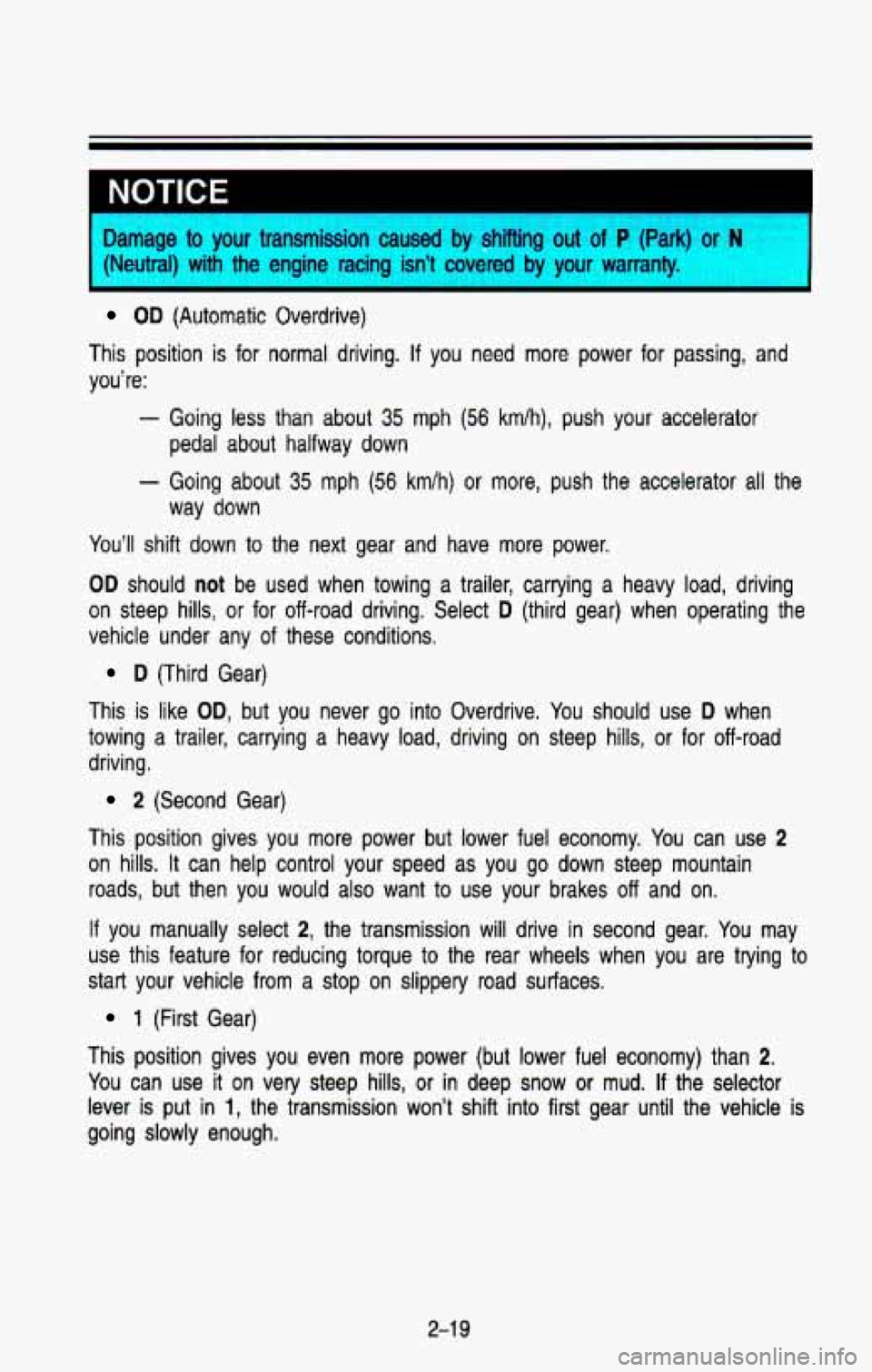
NOTICE
Damage to your transmission caused by shifting out of P (Park) or N
{Neutral) with the engine racing isn’t covered by your warranty.
OD (Automatic Overdrive)
This position is for normal driving.
If you need more power for passing, and
vou’re:
- Going less than about 35 mph (56 km/h), push your accelerator
pedal about halfway down
- Going about 35 mph (56 km/h) or more, push the accelerator all the
way down
You’ll shift down to the next gear and have more power.
OD should not be used when towing a trailer, carrying a heavy load, driving
on steep hills, or for off-road driving. Select
D (third gear) when operating the
vehicle under any of these conditions.
D (Third Gear)
This is like
OD, but you never go into Overdrive. You should use D when
towing a trailer, carrying a heavy load, driving on steep hills, or for off-road
driving.
2 (Second Gear)
This position gives you more power but lower fuel economy. You can use
2
on hills. It can help control your speed as you go down steep mountain
roads, but then you would also want
to use your brakes off and on.
If you manually select 2, the transmission will drive in second gear. You may
use this feature for reducing torque to the rear wheels when you are trying to
start your vehicle from a stop on slippery road surfaces.
1 (First Gear)
This position gives you even more power (but lower fuel economy) than
2.
You can use it on very steep hills, or in deep snow or mud. If the selector
lever is put
in 1, the transmission won’t shift into first gear until the vehicle is
going
‘slowly enough.
2-1 9
Page 87 of 386

Features & Controls
Torque Lock
The parking brake should be set first whenever leaving the dri\
ver’s seat. If
you are parked on a hill and the transmission is placed in P (Park) before
the parking brake is set, the weight of the vehicle may put too much force
on the parking pawl in the transmission. It may be difficult to pull the selector
lever
out of P (Park). This is called “torque lock.” To prevent this, the parking
brake should be set
BEFORE moving the selector lever to P (Park).
When preparing to move the vehicle, the selector lever should be moved out
of P (Park) BEFORE releasing the parking brake. Set the parking brake first,
then release the transmission from
P (Park), even on level surfaces.
If “torque lock” does occur, you may have to have another vehicle nudge
your vehicle uphill
a little to take some of the pressure off the transmission
while you pull the selector lever out of
P (Park).
Shifting lnto P (Park) (Automatic Transmission Models Only)
It can be dangerous to get out of your vehicle if the shift lever is not I
A fully in P (Park) with the parking brake firmly set. Your vehicle can
roll.
If you have left the engine running, the vehicle can move suddenl\
y.
You or others could be injured.
To be sure your vehicle won’t move,
when you’re on fairly level ground, use the steps that foll\
ow.
If you have four-wheel drive, and your transfer case is in N (Neutral), I
your vehicle will be free to roll-even if your shift lever is in P
(Park). So, be sure the transfer case is in a drive gear-not in N
(Neutral).
If you are parking on a hill, or if you’re pulling a trailer, also see
I “Parking on Hills” or “Towing a Trailer” in the Index. I
2-24
Page 219 of 386

Your Driving and the Road
AN470054
If there is no curb when you’re parking uphill, turn the wheel\
s to the right.
If there is no curb when you’re parking uphill on the left si\
de of a one-way
street, your wheels should be turned to the left.
Torque Lock (Automatic Transmission)
If you are parking on a hill and you don’t shift your transmi\
ssion into P
(Park) properly, the weight of the vehicle may put too much \
force on the
parking pawl in the transmission. You may find
it difficult to pull the shift lever
out of
P (Park). This is called “torque lock.” To prevent torque lock, always
be sure
to shift into P (Park) before you leave the driver’s seat. To find out
how, see “Shifting Into P (Park)” in the Index.
When
you are ready to drive, move the selector lever out of P (Park)
BEFORE you release the parking brake.
If “torque lock” does occur, you may need to have another vehicle push
yours
a little uphill to take some of the pressure from the transmission, so
you can pull the shift lever out of P (Park).
4-52
Page 259 of 386

CAUTION I
Incorrect wheel nuts or improperly tightened wheel nuts can cau\
se
the wheel
to become loose and even come off. This could lead to
an accident. Be sure to use the correct wheel nuts. If you have to
replace them, be
sure to get the right kind.
Stop somewhere as soon as you can and have the nuts tightened
with a torque wrench
to the promr toraue. I
For proper torque, see “Wheel Nut Torque” in the Index.
Put the wheel trim back on. For vehicles with plastic nut cap\
s, tighten the
caps until they are finger tight, then tighten them an additio\
nal one-half turn
with the ratchet. Remove any wheel blocks.
Storing
a jack, a tire or other equipment in the passenger
compartment
of the vehicle could cause injury. In a sudden stop or
collision, loose equipment could strike someone. Store all these\
in
the proper place.
5-28
Page 299 of 386
Service & Appearance Care
Front Suspension and Steering Linkage
Your maintenance schedule will tell you how often to lubricate the fittings. See
“Recommended Fluids and Lubricants” in the Index for the \
proper lubricant to
use.
Front Wheel Bearings
Your vehicle has front wheel bearings that must be cleaned and repa\
cked.
Your maintenance schedule will
tell you how often this must be done.
Front Shock Absorbers
The front shock absorbers of your vehicle do many things. They help the
vehicle ride smoothly and also control the travel of the suspension system.
When the shock absorbers are serviced, any replacement shock ab\
sorbers must be the same as the original equipment shock absorbers in \
both
extended length and strength.
Wheel Nut Torque
For vehicles with dual wheels, when the vehicle, wheel or fast\
eners are new,
have the torque set at the first
100, 1,000 and 6,000 miles (160, 1600 and
9600 km). Use the torque specified in the appropriate Specification \
Chart later
in this section.
Single Belt Accessory Drive
If your new vehicle uses a serpentine belt, it is lighter, and more durable
than systems with several belts.
The belt runs over or around the pulleys on the engine.
A tensioner is used
to keep the belt tight at all times. The tensioner also makes replacing the
belt easier. If you need
to replace the belt, be sure to get the correct
replacement belt. Your dealership or parts supplier can help you with this.
The Accessory Drive Belt Routing label on your vehicle will sh\
ow you how to route the belt your vehicle uses.
6-34
Page 317 of 386
Service & Appearance Care
Tire lnspecfion and Rotation
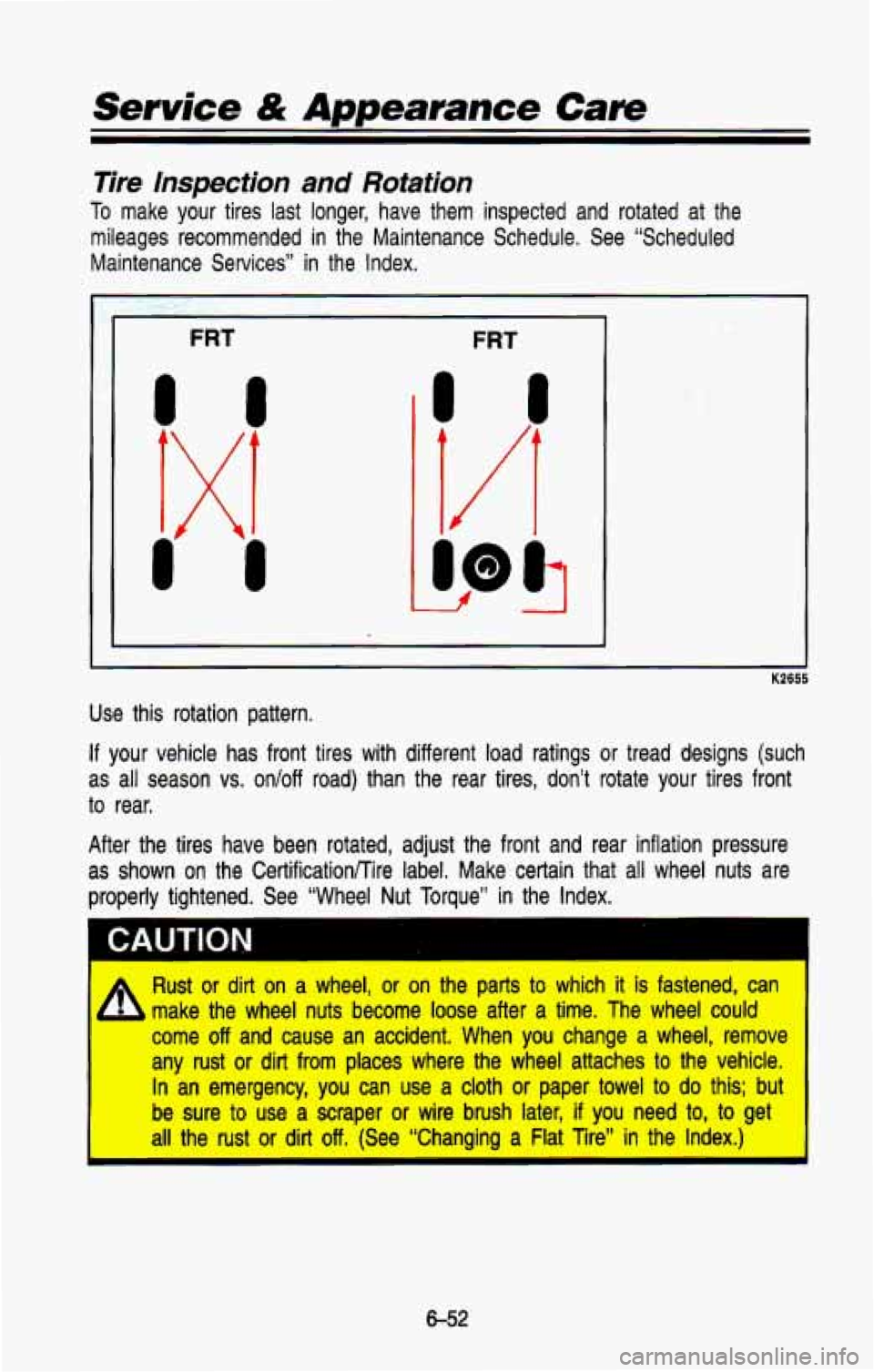
To make your tires last longer, have them inspected and rotated at the
mileages recommended in the Maintenance Schedule. See “Scheduled
Maintenance Services” in the Index.
FRT FRT
L
I I
K2655
Use this rotation pattern,
If your vehicle has front tires with different load ratings or tr\
ead designs (such
as all season vs. on/off road) than the rear tires, don’t rotate \
your tires front
to rear,
After the tires have been rotated, adjust the front and rear \
inflation pressure
as shown on the CertificationRire label. Make certain that all \
wheel nuts are
properly tightened.
See “Wheel Nut Torque” in the Index.
1 CAUTION
Rust or dirt on a wheel, or on the parts to which it is fastened, can
make the wheel nuts become loose after a time. The wheel could
come
off and cause an accident. When you change a wheel, remove
any rust or dirt from places where the wheel attaches
to the vehicle.
In an emergency, you can use a cloth or paper towel to
do this; but
be sure to use a scraper or wire brush later, if you need to, to get
I
I all the rust or dirt off. (See ‘Changing a Flat Tire” in the Index.) I
&52
Page 333 of 386
Service & Appearance Care
Specification Charts
Replacement Parts
Replacement part numbers listed in this section are based on the latest
information available at the time
of printing, and are subject to change. If a
part listed in this manual is not the same as the part used in your vehicle
when
it was built, or if you have any questions, please contact your GM truck
dealer.
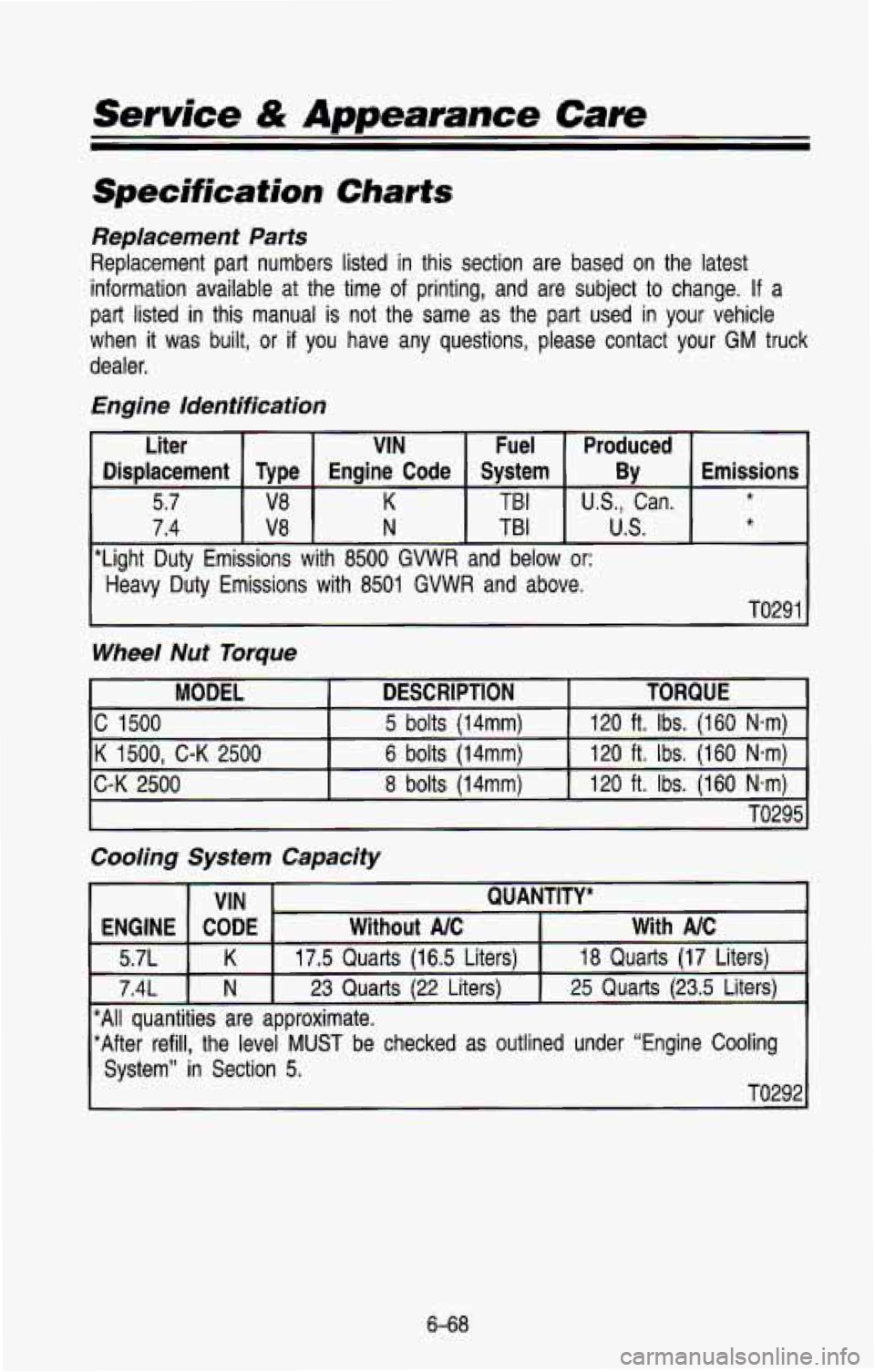
Engine identification
Liter VIN Fuel Produced
Displacement Type Engine Code System BY Emissions
5.7 V8 K TB I U.S., Can.
7.4 V8 N TB I us.
*
*
*Light Duty Emissions with 8500 GVWR and below or:
Heavy Duty Emissions with 8501 GVWR and
above.
TO291
Wheel Nut Torque
MODEL DESCRIPTION TORQUE
C 1500 5 bolts (14mm) 120 ft. Ibs. (1 60 Nmm)
K 1500, C-K 2500 6 bolts (1 4mm) 120 ft. Ibs. (160
N-m)
C-K 2500 8 bolts (14mm) 120 ft. Ibs. (160 Nem)
I TO2951
Cooling System Capacity
VIN QUANTITY*
ENGINE CODE Without NC With AIC
5.7L K 17.5 Quarts (16.5 Liters)
18 Quarts (1 7 Liters)
7.4- N 23 Quarts
(22 Liters) 25 Quarts (23.5 Liters)
*All quantities are approximate.
*After refill, the level
MUST be checked as outlined under “Engine Cooling
System” in Section
5.
TO292
6-68
Page 358 of 386

23. EXHAUST PRESSURE EGULATOR VALVE INSPECTION* -Check that
the valve works properly. Correct any binding. Inspect hoses fo\
r cracks,
chafing or decay. Replace parts
as needed.
24. TIRE AND WHEEL ROTATION AND INSPECTION -For proper wear
and maximum tire life, rotate tires
at the first 6,000 miles (10 000
kilometers) for Schedule I (t) or 7,500 miles (12 500 kilometers) for
Schedule
II (.) and then every 15,000 miles (25 000 kilometers)
thereafter.
Follow the instructions and patterns shown in Section 6.
Check tires for uneven wear or damage. If irregular or premature wear is
apparent, check wheel alignment.
Also, check for damaged wheels. See
“Tires” in the Index for more information.
For dual wheels, whenever the vehicle, wheels, or fasteners are new\
,
have the wheel fastener torque set at the first 100,
1,000 and 6,000
miles
(160, 1600 and 10 000 km).
For
3500 H.D. Models, block the tires opposite those being removed to
keep the vehicle from rolling.
25.
DRIVE AXLE SERVICE -Check readfront axle fluid level and add as
needed. Check constant velocity joints and axle seals for leaki\
ng.
Locking differential-Drain fluid at first oil change and refill. Check
fluid level and add as needed at subsequent oil changes. In dusty
areas, or trailer towing applications drain fluid at every
15,000 miles
(24 135 kilometers) and refill$
every oil change. In dusty areas,
or trailer towing applications, drain
fluid every 15,000 miles
(24 135 kilometers) and refi1l.t
Standard differential -Check fluid level and add as needed at
More frequent lubrication may be required on heavy-duty or off-road
use.
26. BRAKE SYSTEM INSPECTION -When the engine oil is changed,
inspect the lines
and hoses for proper hookup, binding, leaks, cracks,
chafing, etc. Check the parking brake adjustment, and the fluid level in
the master cylinder.
A low fluid level can indicate worn disc brake pads
which may need to be serviced$
*An Emission Control Service
tA fluid loss in these systems may indicate a problem. Have them
inspected and repaired
at once.
7-2 1
Page 380 of 386
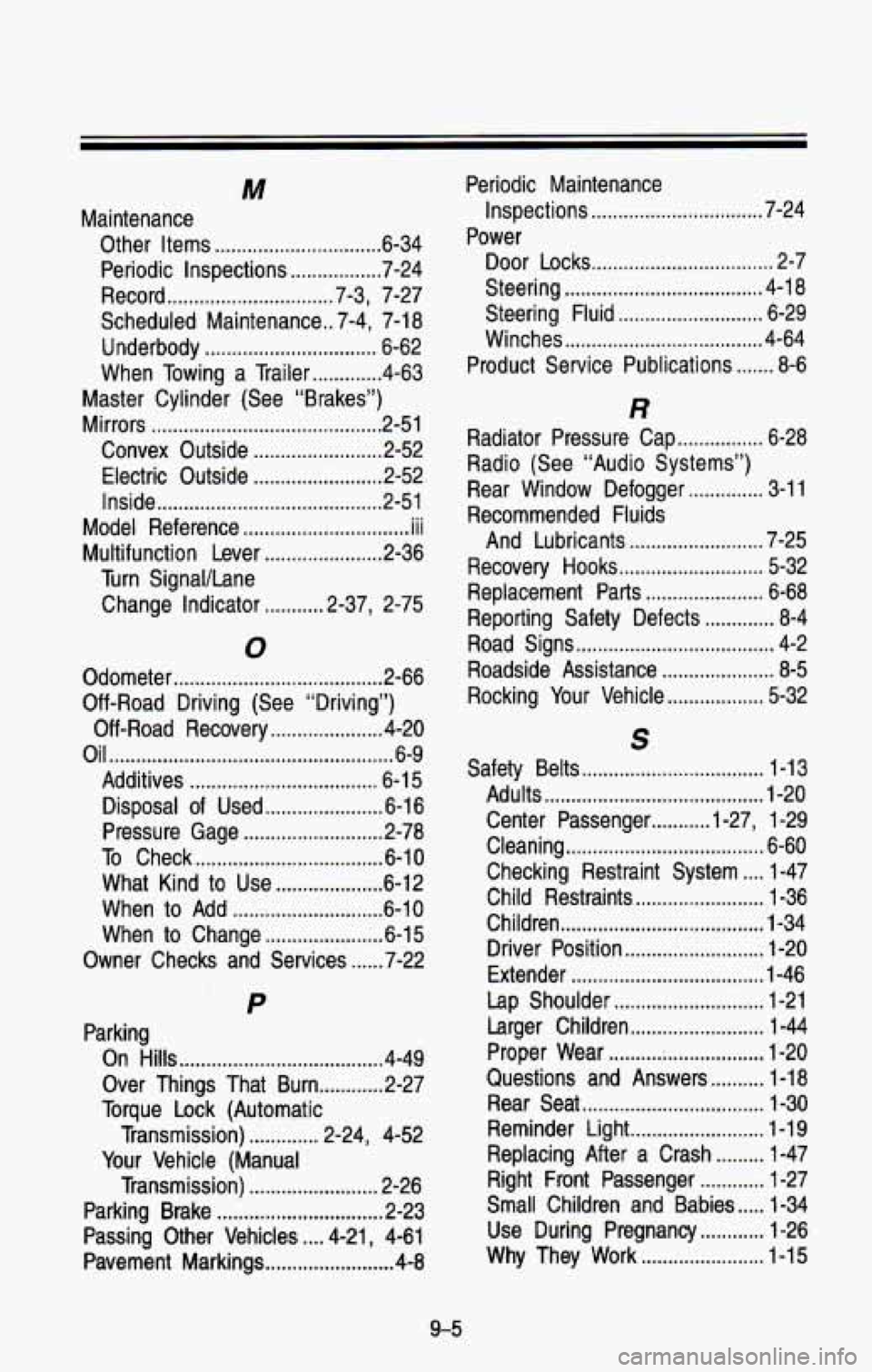
M
Maintenance Other Items
............................... 6-34
Periodic Inspections
................. 7-24
Record
............................... 7.3. 7-27
Scheduled Maintenance
.. 7.4. 7-1 8
Underbody
................................ 6-62
When Towing a Trailer
............. 4-63
Master Cylinder (See “Brakes”)
Mirrors
........................................... 2-51
Convex Outside
........................ 2-52
Electric Outside
........................ 2-52
Inside
.......................................... 2-51
Model Reference
............................... III
Multifunction Lever ...................... 2-36
...
Turn SignalLane
Change Indicator
........... 2-37, 2-75
0
Odometer ....................................... 2-66
Off-Road Driving (See “Driving”)
Off-Road Recovery
..................... 4-20
Oil ..................................................... 6-9
Additives
................................... 6-1 5
Disposal of Used ...................... 6-1 6
Pressure Gage
.......................... 2-78
To Check
................................... 6-1 0
What Kind to Use .................... 6-12
When
to Add ............................ 6-10
When
to Change ...................... 6-1 5
Owner Checks and Services ...... 7-22
Parking On Hills
...................................... 4.49
Over Things That Burn
............ 2-27
Torque Lock (Automatic
Transmission)
............. 2.24. 4-52
Your Vehicle (Manual Transmission)
........................ 2-26
Parking Brake
............................... 2-23
Passing
Other Vehicles .... 4.21. 4-61
Pavement Markings
........................ 4-8
Periodic Maintenance
Power Inspections
................................ 7-24
Door Locks
.................................. 2-7
Steering
..................................... 4-18
Steering Fluid
........................... 6-29
Winches
..................................... 4-64
Product Service Publications
....... 8-6
R
Radiator Pressure Cap ................ 6-28
Radio (See “Audio Systems”)
Rear Window Defogger
.............. 3-11
Recommended Fluids And Lubricants
......................... 7-25
Recovery Hooks
........................... 5-32
Replacement Parts
...................... 6-68
Reporting Safety Defects
............. 8-4
Road Signs
..................................... 4-2
Roadside Assistance
..................... 8-5
Rocking Your Vehicle
.................. 5-32
S
Safety Belts .................................. 1-13
Center Passenger
........... 1-27, 1-29
Cleaning
..................................... 6-60
Checking Restraint System
.... 1-47
Child Restraints
........................ 1-36
Children
...................................... 1-34
Driver Position
.......................... 1-20
Extender
.................................... 1-46
Lap Shoulder
............................ 1-21
Larger Children
......................... 1-44
Proper Wear
............................. 1-20
Questions and Answers
.......... 1-18
Rear Seat
.................................. 1-30
Replacing After a Crash
......... 1-47
Right Front Passenger
............ 1-27
Small Children and Babies
..... 1-34
Use During Pregnancy
............ 1-26
Why They Work ....................... 1-15
Adults
......................................... 1-20
Reminder Light
......................... 1-19
9-5
Page 381 of 386
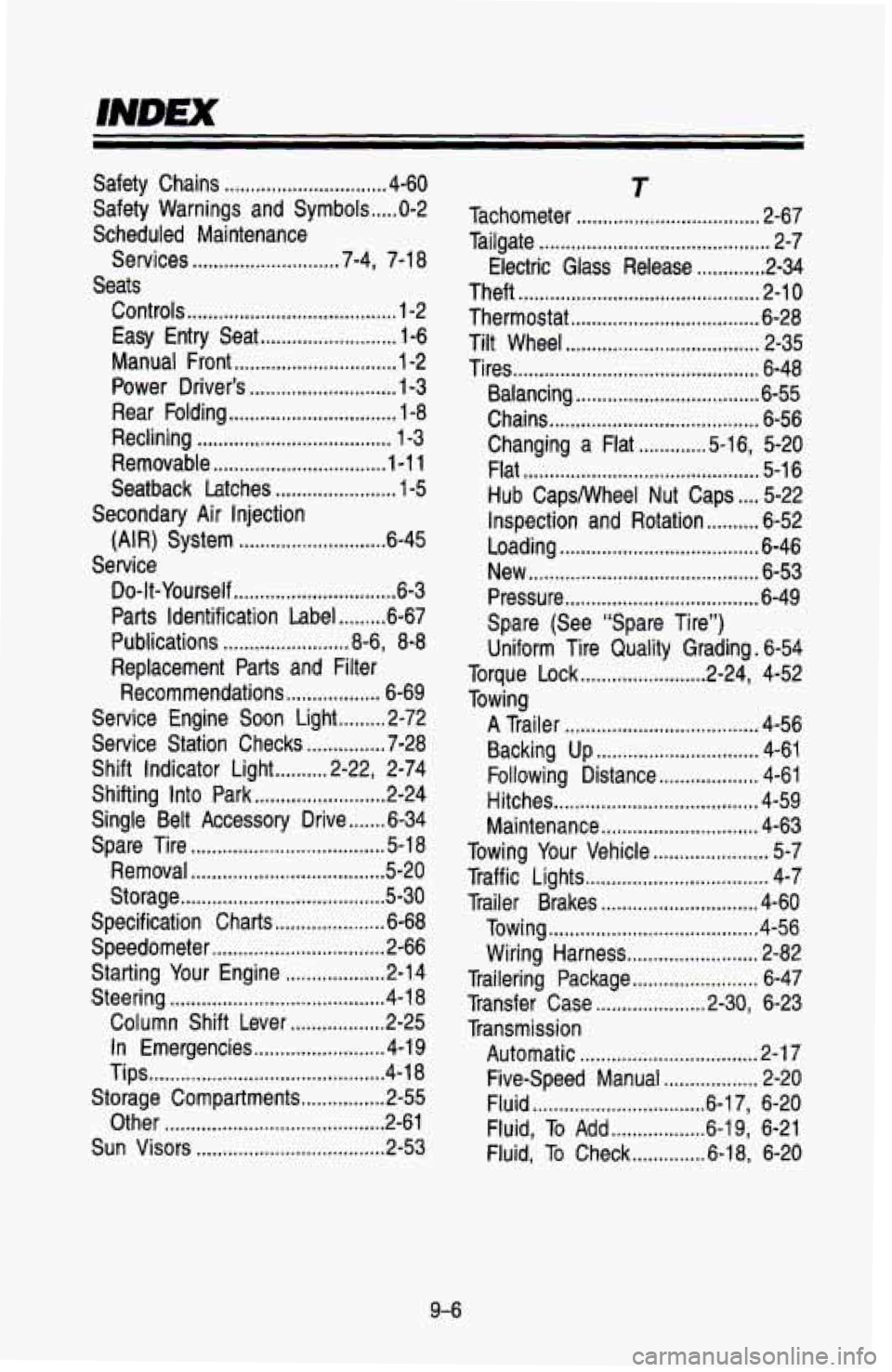
Safety Chains ............................... 4-60
Scheduled Maintenance
Seats Safety Warnings and Symbols
..... 0-2
Services
............................ 7-4, 7-1 8
Controls
........................................ 1-2
Easy Entry Seat
.......................... 1 -6
Manual Front
............................... 1 -2
Power Driver‘s
............................ 1-3
Rear Folding
................................ 1-8
Reclining
..................................... 1-3
Removable
................................. 1-1 1
Seatback Latches
....................... 1-5
(AIR) System
............................ 6-45
Do-It-Yourself
............................... 6-3
Parts Identification Label
......... 6-67
Publications
........................ 8-6, 8-8
Replacement Parts and Filter Recommendations
.................. 6-69
Service Engine
Soon Light ......... 2-72
Service Station Checks
............... 7-28
Shift Indicator Light
.......... 2-22, 2-74
Shifting Into Park
......................... 2-24
Single Belt Accessory Drive
....... 6-34
Spare Tire
..................................... 5-1 8
Removal ..................................... 5-20
Storage ....................................... 5-30
Specification Charts ..................... 6-68
Speedometer
................................. 2-66
Starting Your Engine
................... 2-1 4
Column Shift Lever
.................. 2-25
In Emergencies
......................... 4-1 9
Tips ............................................. 4-1 8
Storage Compartments ................ 2-55
Other
.......................................... 2-6 1
Sun Visors .................................... 2-53
Secondary
Air Injection
Service
Steering
......................................... 4-18
T
Tachometer ................................... 2-67
Tailgate
............................................ 2-7
Electric Glass Release ............. 2-34
Theft
.............................................. 2-10
Thermostat
.................................... 6-28
Tilt Wheel
..................................... 2-35
Tires
............................................... 6-48
Balancing
................................... 6-55
Chains
........................................ 6-56
Changing a Flat
............. 5-16, 5-20
Flat
............................................. 5-16
Hub CapsNVheel Nut Caps
.... 5-22
Inspection and Rotation
.......... 6-52
Loading
...................................... 6-46
New ............................................
Pressure ..................................... 6-49
Spare (See “Spare Tire”)
Uniform Tire Quality Grading
. 6-54
Torque Lock
........................ 2-24, 4-52
Towing
A Trailer ..................................... 4-56
Backing Up
............................... 4-61
Following Distance
................... 4-61
Hitches
....................................... 4-59
Maintenance
.............................. 4-63
Towing Your Vehicle
...................... 5-7
Traffic Lights
................................... 4-7
Trailer Brakes
.............................. 4-60
Towing
........................................ 4-56
Wiring Harness
......................... 2-82
Trailering Package
........................ 6-47
Transfer Case
..................... 2-30, 6-23
Transmission Automatic
.................................. 2-17
Five-Speed Manual
.................. 2-20
Fluid ................................. 6-1 7, 6-20
Fluid, To Add
.................. 6-1 9. 6-21
Fluid.
To Check .............. 6-18. 6-20
6-53
9-6