wheel size CHEVROLET BLAZER 1993 Owners Manual
[x] Cancel search | Manufacturer: CHEVROLET, Model Year: 1993, Model line: BLAZER, Model: CHEVROLET BLAZER 1993Pages: 386, PDF Size: 20.7 MB
Page 319 of 386

Service & Appearance Care
If you ever replace your tires with those not having a TPC Spec number,
make sure they are the same size, load range, speed rating an\
d construction
type (bias, bias-belted or radial) as your original tires.
I CAUTION
A
Mixing tires could cause you to lose control while driving. If you mix
tires
of different sizes or types (radial and bias-belted tires) the
vehicle may not handle properly, and you could have a crash. Be
sure
to use the same size and type tires on all wheels.
I
Uniform Tire Quarity Grading
The following information relates to the system developed by the United
States National Highway Traffic Safety Administration which grade\
s tires by
treadwear, traction and temperature performance. (This applies o\
nly to
vehicles sold in the United States.)
Treadwear
The treadwear grade is a comparative rating based on the wear \
rate of the
tire when tested under controlled conditions on a specified government test
course.
For example, a tire graded 150 would wear one and a half (1 1/2)
times as well on the government course as a tire graded 100. The relative
performance
of tires depends upon the actual conditions of their use,
however, and may depart significantly from the norm due to var\
iations
in
driving habits, service practices and differences in road characteristics and
climate.
Traction-A, B, C
The traction grades, from highest to lowesr are: A, 8, and C. They represent
the tire’s ability to stop on wet pavement as measured under controlled
conditions on specified government test surfaces of asphalt and concrete. A
tire marked
C may have poor traction performance.
Warning: The traction grade assigned to this tire is based on braking
(straight-ahead) traction tests and does not include cornering \
(turning) traction.
Temperature-A, B, C
The temperature grades are A (the highest), B, and C, representing the tire’s
resistance to the generation
of heat and its ability to dissipate heat when
tested under controlled conditions on a specified indoor laborat\
ory test wheel.
Sustained high temperature can cause the material
of the tire to degenerate
and reduce tire life, and excessive temperature can lead to sudden tire
failure. The grade
C corresponds to a level of performance which all
passenger car tires must meet under the Federal Motor Vehicle \
Safety
6-54
Page 321 of 386
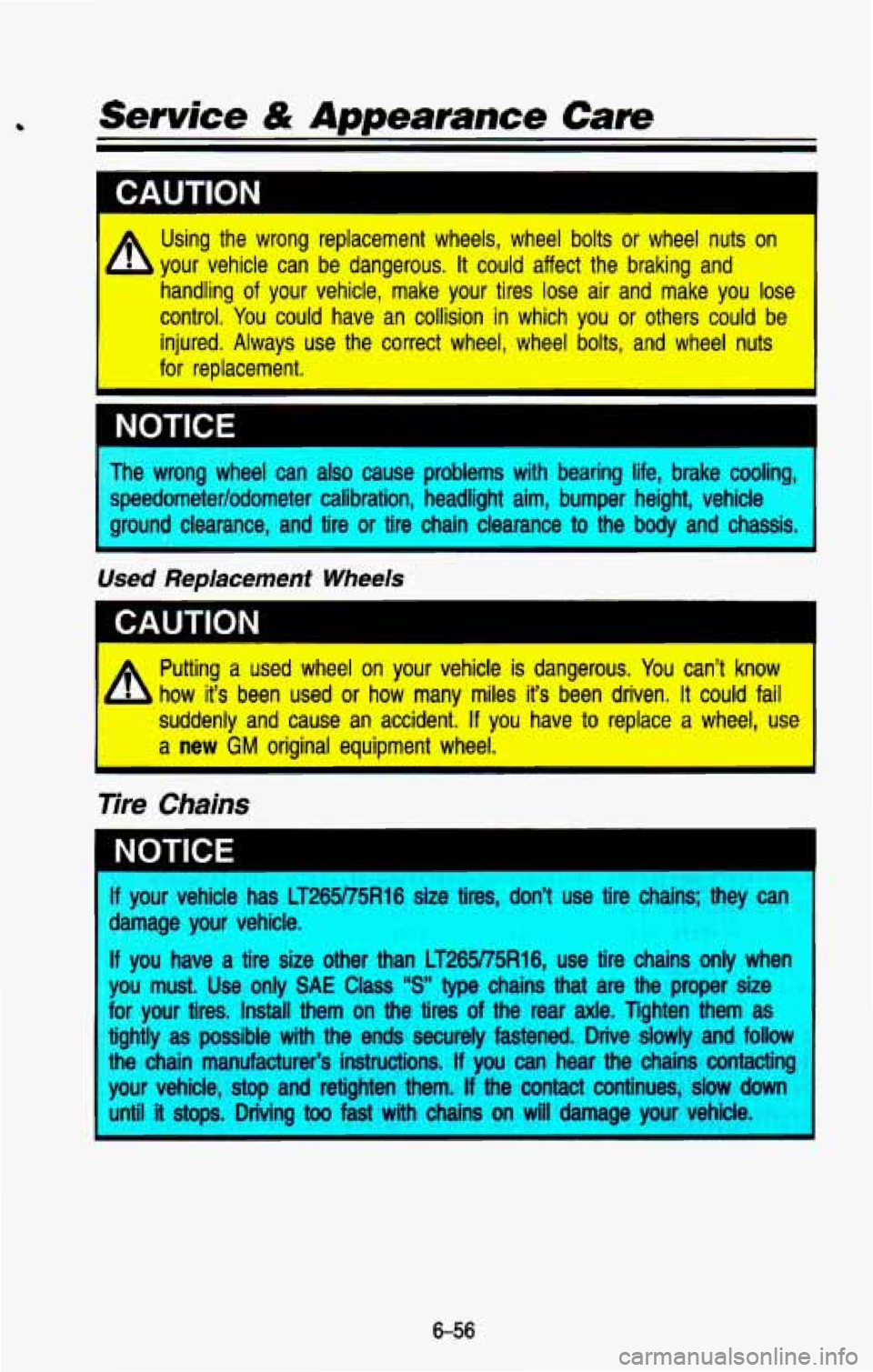
I CAUTION I
A Using the wrong replacement wheels, wheel bolts or wheel nuts on
your vehicle can be dangerous.
It could affect the braking and
handling
of your vehicle, make your tires lose air and make you lose
control. You could have an collision in which you or others could be
injured. Always use the correct wheel, wheel
bolts, and wheel nuts
for replacement.
I
I
I The wrong wheel can also cause problems with bearing life, brake cooling,
speedometerlodometer calibration, headlight aim, bumper height, vehicle
ground clearance, and tire
or tire chain clearance to the body and chassis.
A Putting a used wheel on your vehicle is dangerous. You can't know
how it's been used or how many miles it's been driven. It could fail
suddenly and cause an accident. If you have to replace a wheel, use
a new GM original equipment wheel,
I
Tire Chains
rNOTICE 'If put vehicle has LT265/75R16 size tires, don't use tire chams; they i can!
damage your vehicle.
6-56