ECU CHEVROLET BLAZER 1994 2.G User Guide
[x] Cancel search | Manufacturer: CHEVROLET, Model Year: 1994, Model line: BLAZER, Model: CHEVROLET BLAZER 1994 2.GPages: 348, PDF Size: 17.88 MB
Page 48 of 348
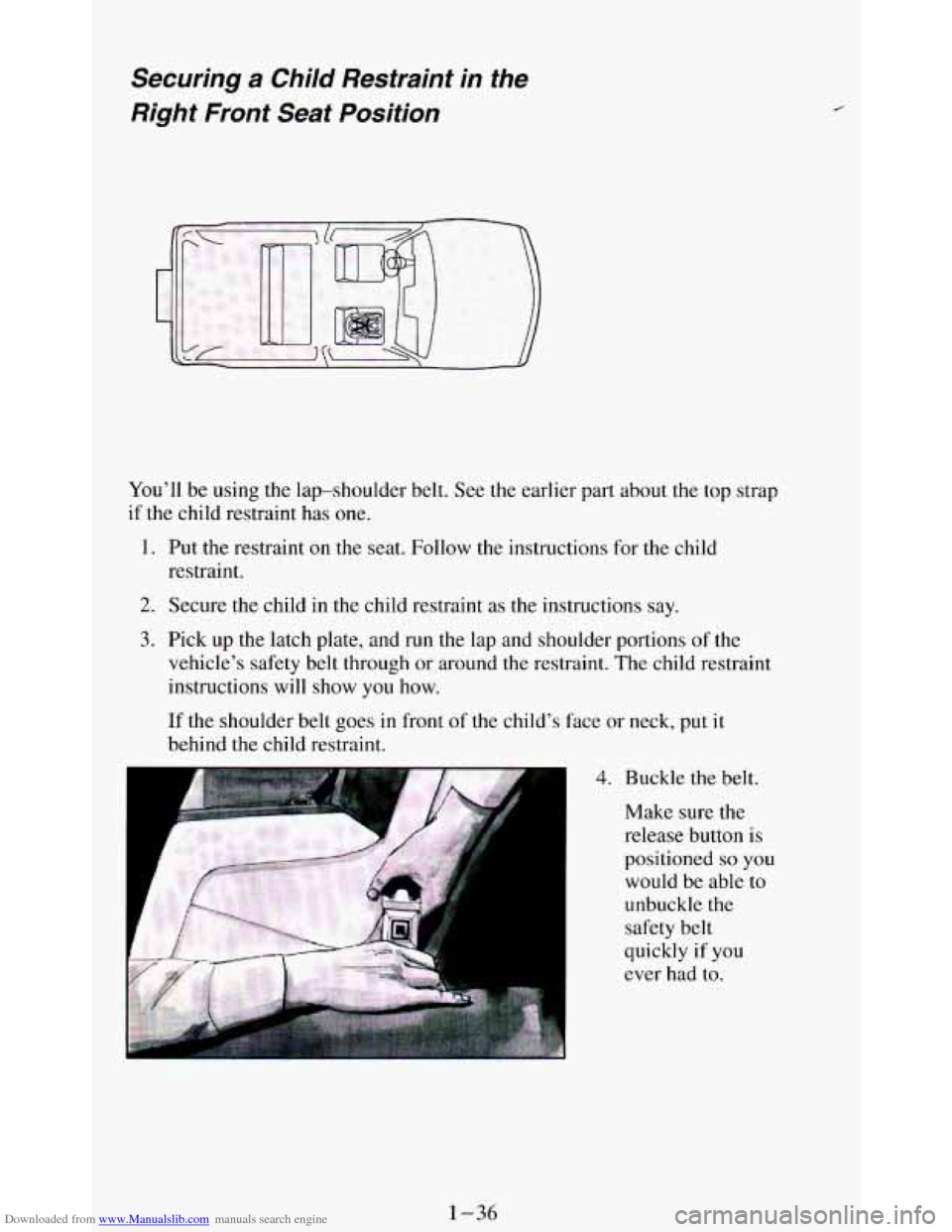
Downloaded from www.Manualslib.com manuals search engine Securing a Child Restraint in the
Right Front Seat Position
You’ll be using the lap-shoulder belt. See the earlier part about the top strap
if
the child restraint has one.
1. Put the restraint on the seat. Follow the instructions for the child
restraint.
2. Secure the child in the child restraint as the instructions say.
3. Pick up the latch plate, and run the lap and shoulder portions of the
vehicle’s safety belt through or around the restraint. The child restraint
instructions will show you
how.
If the shoulder belt goes in front of the child’s face or neck, put it
behind the child restraint.
4. Buckle the belt.
Make sure the
release button
is
positioned so you
would be able to
unbuckle the
safety belt
quickly
if you
ever had to.
1-36
Page 49 of 348
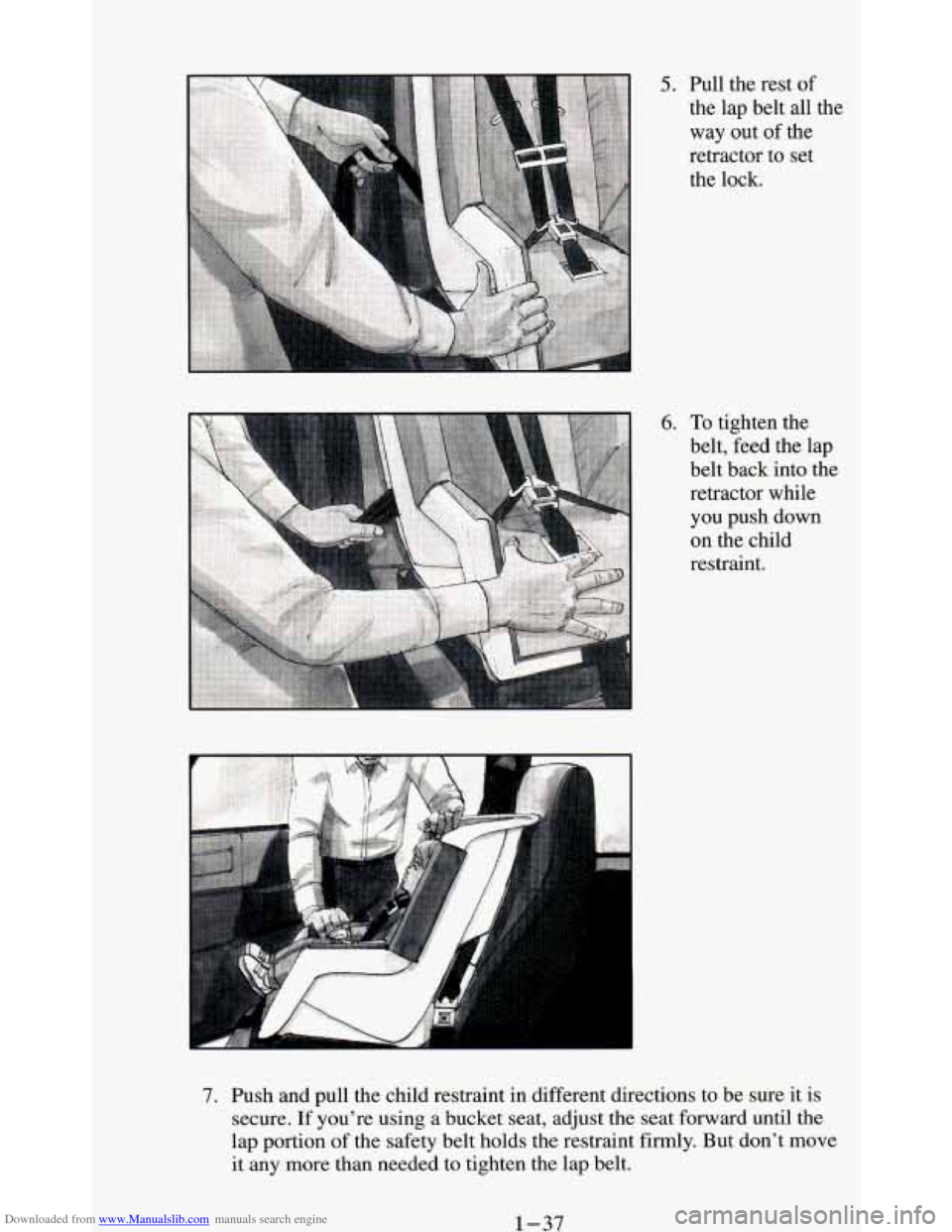
Downloaded from www.Manualslib.com manuals search engine 5. Pull the rest of
the lap belt all the
way out
of the
retractor to set
the lock.
6. To tighten the
belt, feed the lap
belt back into the
retractor while you push down
on
the child
restraint.
7. Push and pull the child restraint in different directions to be sure it is
secure. If you’re using a bucket seat, adjust the seat forward until the
lap portion of the safety belt holds
the restraint firmly. But don’t move
it any more than needed to tighten the lap belt.
1-37
Page 117 of 348
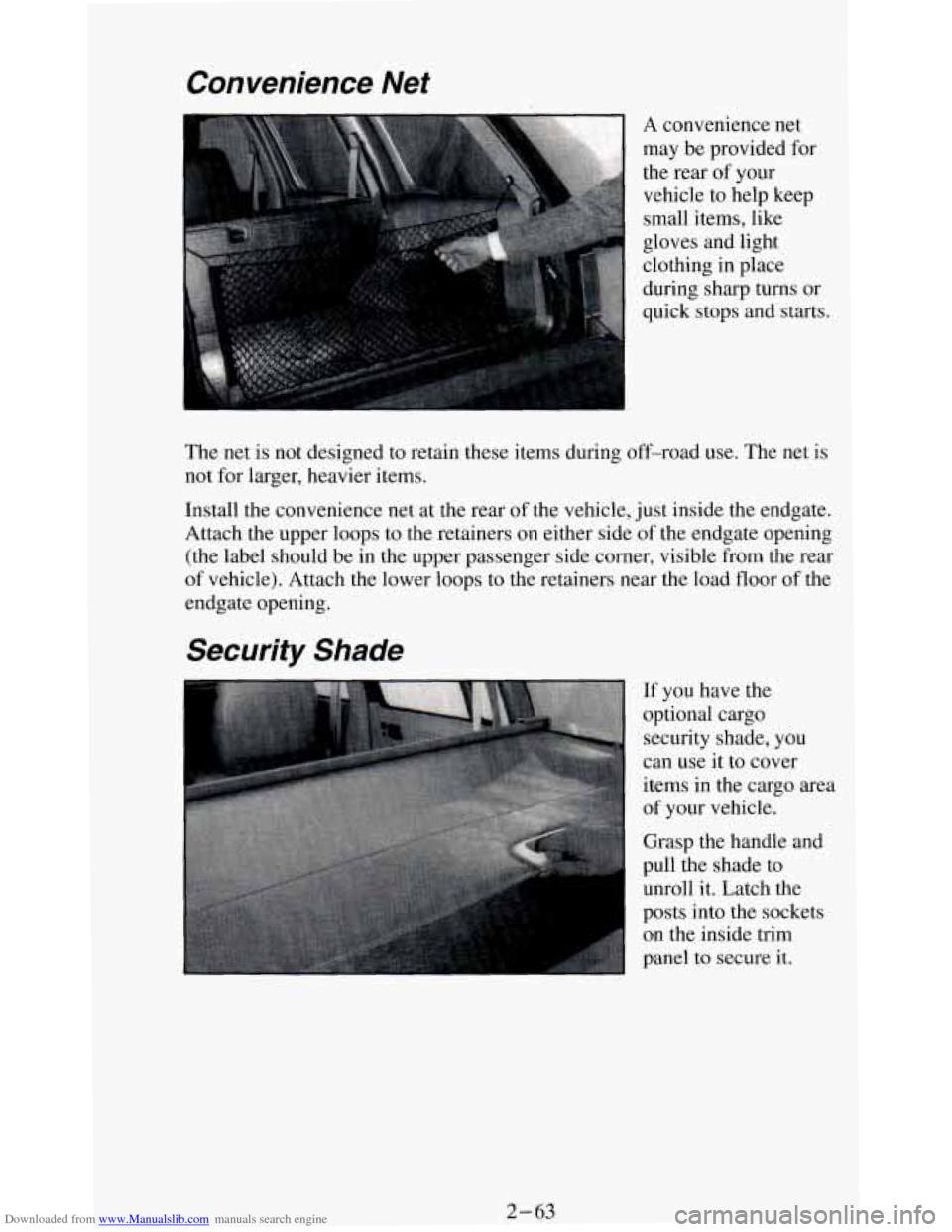
Downloaded from www.Manualslib.com manuals search engine Convenience Net
A convenience net
may be provided for
the rear of your
vehicle to help keep
small items, like
gloves and light
clothing in place
during sharp turns or
quick stops and starts.
The net is not designed to retain these items during off-road use. The net
is
not for larger, heavier items.
Install the convenience net at
the rear of the vehicle, just inside the endgate.
Attach the upper loops to the retainers
on either side of the endgate opening
(the label should be in the upper passenger side corner, visible from the rear
of vehicle). Attach the lower loops to the retainers near the load floor of the
endgate opening.
Security Shade
If you have the
optional cargo security shade, you
can use it to cover
items in the cargo area
of your vehicle.
Grasp the handle and
pull the shade to
unroll it. Latch the
posts into the sockets
on the inside trim
panel to secure it.
2-63
Page 133 of 348
Downloaded from www.Manualslib.com manuals search engine Be sure the cargo is properly loaded.
Carrying small, heavy loads on the roof is not recommended.
Tie the load to the moveable tie down, (two per each side of the
siderails). Use the cross rails only to keep the load from sliding,
If you need to carry long items, move the cross rails as far apart as
possible. tie the load to the moveable tie downs provided
in the side
rails.
Also tie the load to the bumpers. Do not tie the load so tightly that
the cross rails or side rails are damaged.
NOTICE:
~ ~~
Loading cargo that weighs more than 200 pounds (91 kg) on the
luggage carrier may damage your vehicle. when you carry large
things, never let them hang over the rear or the sides of your
vehicle. Load your cargo
so that it rests on the slats and does not
scratch or damage the vehicle.
Put the cargo against the side rails and fasten it securely t\
o the
luggage carrier. Put the main weight as far forward
as you can.
Don’t exceed the maximum vehicle capacity when loading your vehicle.
For
more information on vehicle capacity and loading, see “Loading Your
Vehicle”
in the Index.
To prevent damage or loss of cargo as you’re driving, check now and then to
make sure the luggage carrier and cargo are still securely fastened.
2-79
Page 157 of 348
Downloaded from www.Manualslib.com manuals search engine 8. Press BAND and 000 will appear again. Now you are ready to enter the
last three digits of your code.
9. Repeat steps 6 and 7 for the last three digits of your code.
10. Press BAND and rEP will appear for 5 seconds and then 000 will
appear.
11. Repeat steps
6 through 10. This time SEC will appear-indicating that
the radio
is secure.
To Unlock The System After A Power Loss
When battery power is reapplied to a secured radio, the radio won’t turn on
and LOC will appear on the display.
Enter your secret code as follows: pause no more than
15 seconds between
steps
.
1. Turn the ignition on. (Radio off.)
2. Depress the SET button. The display will show 000.
3. Enter the six digits of the code following steps 6-9 above. The display
will show the numbers as entered.
4. Depress the BAND knob and the time appears - indicating that the
disabling sequence was successful. If the display indicates
SEC, the
numbers did
not match and the unit is still secured.
Disabling The Theft System
1. Depress presets 1 and 4 for 5 seconds with ignition on and radio power
off. The display will show
SEC, indicating the unit is in the secure
mode.
2. Depress the SET button. The display will show 000.
3. Enter the first three digits of the code following steps 6 and 7 of the
preceding paragraphs. The display
will show the numbers as entered.
4. Depress the BAND knob. The radio will display 000.
5. Enter the second three digits of the code. The display will show the
numbers
as entered.
6. Depress the BAND knob. If the display shows “- - - ”, the disabling
sequence was successful. The numbers matched
the user-selected code
or the factory back-up code, and the unit is
in the UNSECURED mode.
If the display shows
SEC, the disabling sequence was unsuccessful and
the numbers did not match either of the codes and the unit will remain
in the SECURED mode.
3-23
Page 171 of 348
Downloaded from www.Manualslib.com manuals search engine Off-Road Driving with Your Four-wheel Drive Vehicle
This off-road guide is for vehicles that have four-wheel drive.
Also, see “Anti-lock Brakes”
in the Index.
If your vehicle doesn’t have four-wheel drive,
you shouldn’t drive off-road
unless you’re on a level, solid surface.
Off-road driving can be great
fun. But it does have some definite hazards.
The greatest
of these is the terrain itself.
“Off-roading” means you’ve left the great North American road system
behind. Traffic lanes aren’t marked. Curves aren’t banked. There are no
road signs. Surfaces can be slippery, rough, uphill or downhill. In short,
you’ve gone right back to nature.
Off-road driving involves some new skills. And that’s
why it’s very
important that you read this guide. You’ll find many driving tips and
suggestions. These
will help make your off-road driving safer and more
enjoyable.
Before You Go Off-Roading
There are some things to do before you go out. For example, be sure to have
all necessary maintenance and service work done. Be sure you read all the
information about your four-wheel drive vehicle
in this manual. Is there
enough fuel? Is the spare tire
fully inflated? Are the fluid levels up where
they should be? What are the local
laws that apply to off-roading where
you’ll be driving? If you don’t know, you should check with law
enforcement people
in the area. Will you be on someone’s private land? If
so, be sure to get the necessary permission.
Loading Your Vehicle for Off-Road Driving
There are some important things to remember about how to load your
vehicle.
The heaviest things should be on the load floor and forward of your
rear axle. Put heavier items as far forward as you can.
Be sure the load is secured properly, so driving on the off-road terrain
doesn’t toss things around.
4-13
Page 190 of 348
Downloaded from www.Manualslib.com manuals search engine Winter Driving
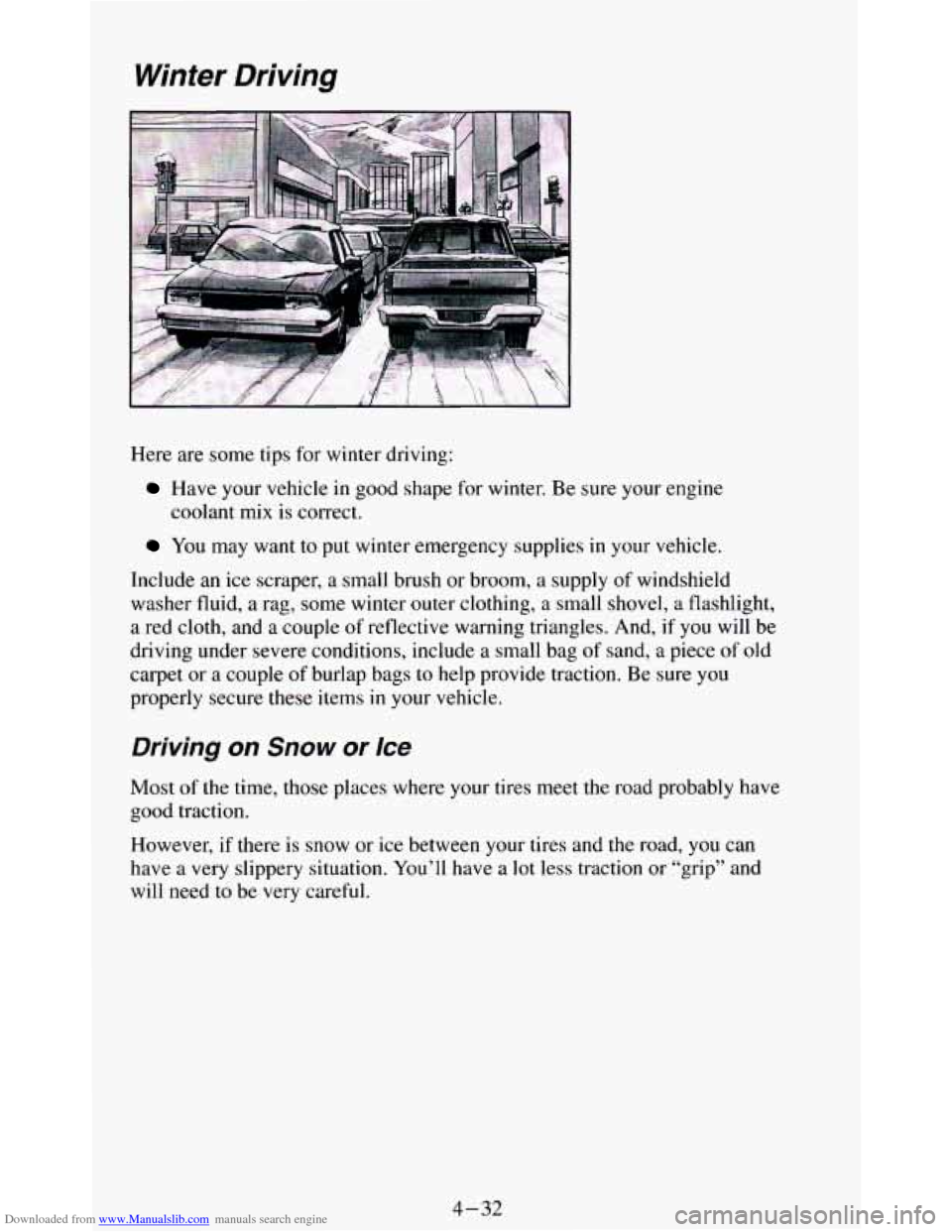
Here are some tips for winter driving:
Have your vehicle in good shape for winter. Be sure your engine
coolant mix is correct.
You may want to put winter emergency supplies in your vehicle.
Include
an ice scraper, a small brush or broom, a supply of windshield
washer fluid,
a rag, some winter outer clothing, a small shovel, a flashlight,
a red cloth, and a couple
of reflective warning triangles. And, if you will be
driving under severe conditions, include a small bag of sand,
a piece of old
carpet
or a couple of burlap bags to help provide traction. Be sure you
properly secure these items in your vehicle.
Driving on Snow or /ce
Most of the time, those places where your tires meet the road prob\
ably have
good traction.
However, if there
is snow or ice between your tires and the road, you can
have a very slippery situation. You’ll have a
lot less traction or “grip” and
will need to be very careful.
4-32
Page 199 of 348
Downloaded from www.Manualslib.com manuals search engine During your trip, check occasionally to be sure that the load is secure, and
that
the lights and any trailer brakes are still working.
Following Disfance
Stay at least twice as far behind the vehicle ahead as you would when
driving your vehicle without a trailer. This can help you avoid situations that
require heavy braking and sudden turns.
Passing
You’ll need more passing distance up ahead when you’re towing a trailer.
And, because you’re a good deal longer, you’ll need
to go much farther
beyond the passed vehicle before you can return to your lane.
Backing Up
Hold the bottom of the steering wheel with one hand. Then, to move the
trailer to the left, just move that hand to the left.
To move the trailer to the
right, move your hand to the right. Always
back up slowly and, if possible,
have someone guide you.
4-41
Page 227 of 348
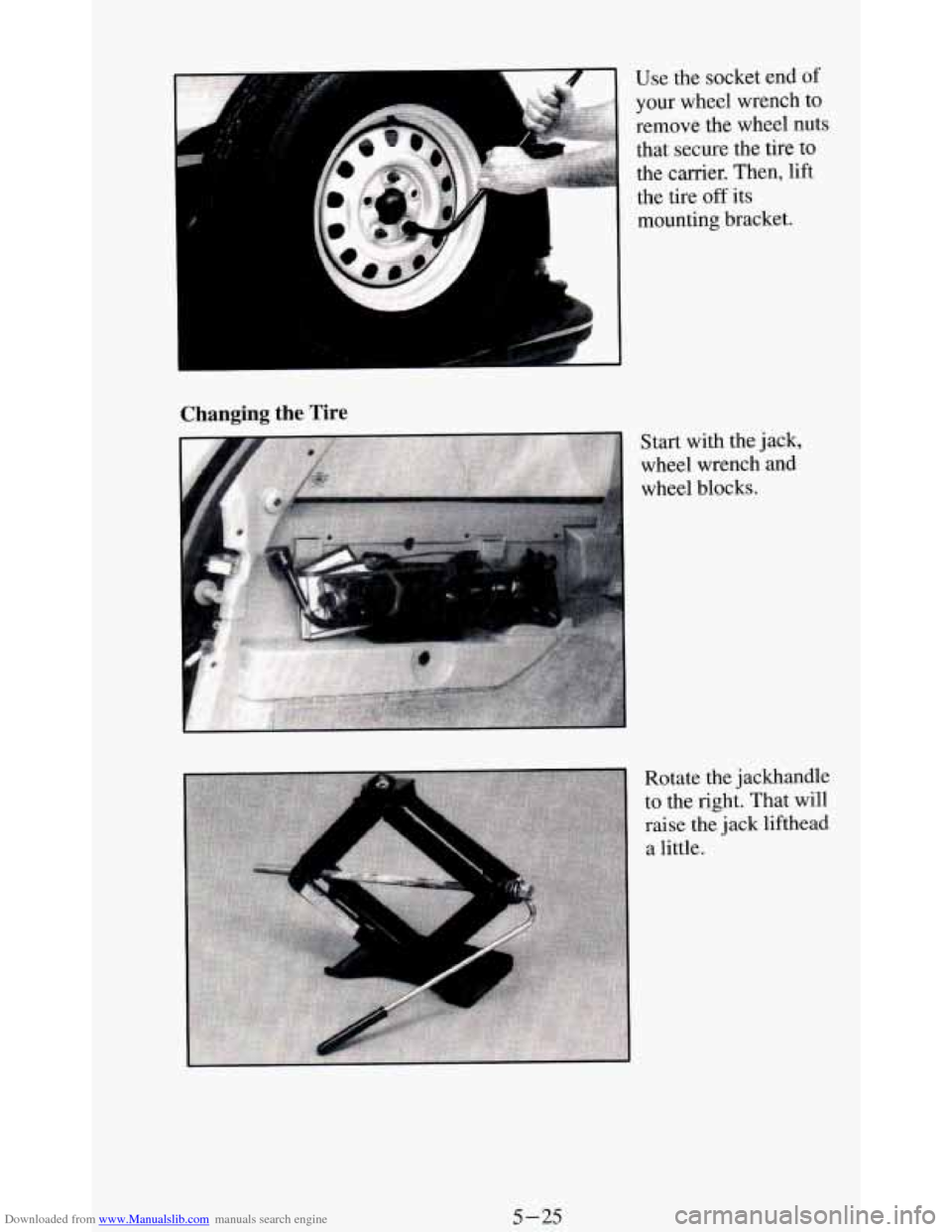
Downloaded from www.Manualslib.com manuals search engine Changing the Tire
Use the socket end of
your wheel wrench to
remove the wheel nuts
that secure the
tire to
the carrier. Then, lift
the tire
off its
mounting bracket.
Start with the jack,
wheel wrench
and
wheel blocks.
Rotate the jackhandle to the right. That will
raise the jack lifthead
a little.
5-25
Page 233 of 348
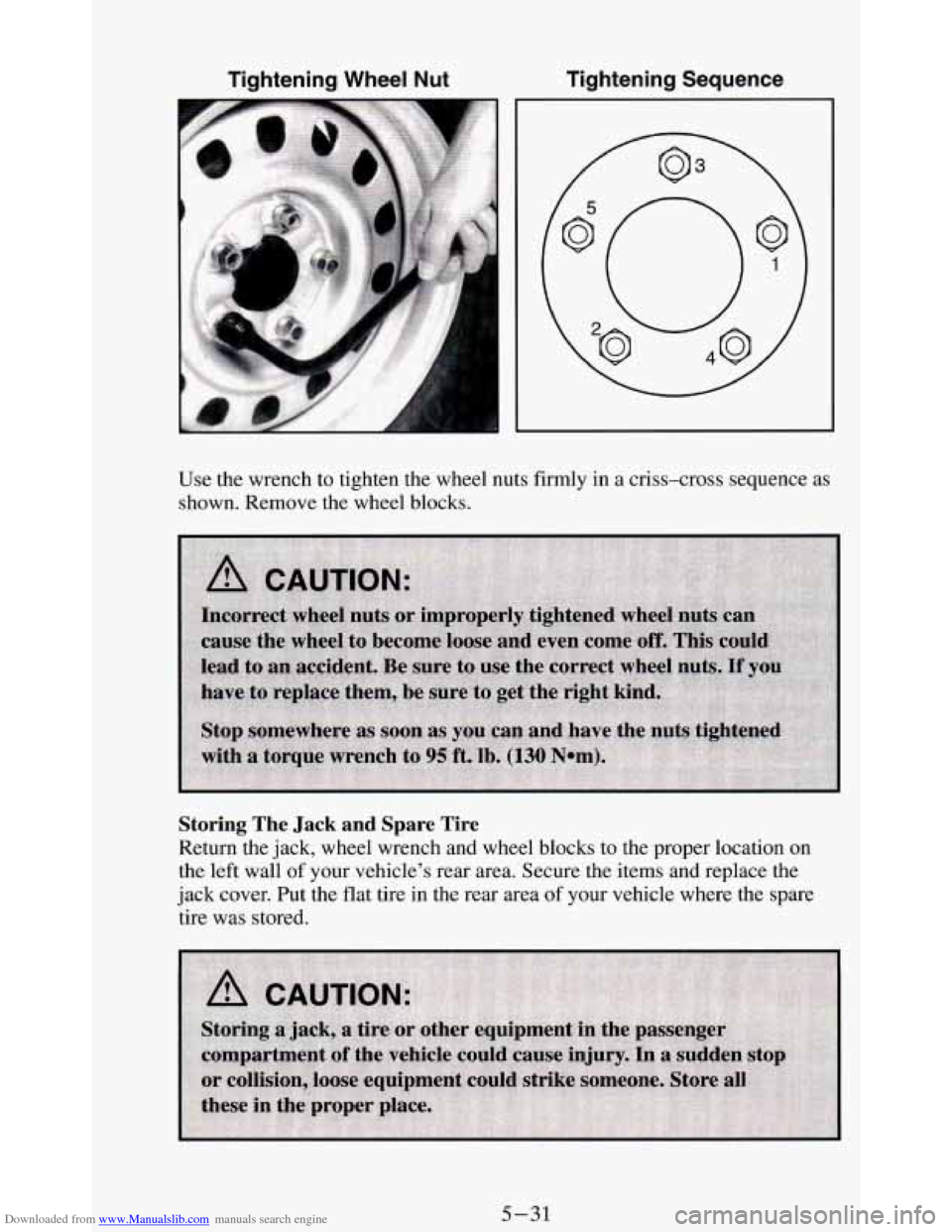
Downloaded from www.Manualslib.com manuals search engine Tightening Wheel Nut Tightening Sequence
Use
the wrench to tighten the wheel nuts firmly in a criss-cross sequence as
shown. Remove the wheel blocks.
Storing The Jack and Spare Tire
Return the jack, wheel wrench and wheel blocks to the proper location on
the left wall of your vehicle’s rear area. Secure the items and replace the
jack cover. Put the
flat tire in the rear area of your vehicle where the spare
tire was stored.
5-31