battery CHEVROLET BLAZER 1994 2.G User Guide
[x] Cancel search | Manufacturer: CHEVROLET, Model Year: 1994, Model line: BLAZER, Model: CHEVROLET BLAZER 1994 2.GPages: 348, PDF Size: 17.88 MB
Page 157 of 348
Downloaded from www.Manualslib.com manuals search engine 8. Press BAND and 000 will appear again. Now you are ready to enter the
last three digits of your code.
9. Repeat steps 6 and 7 for the last three digits of your code.
10. Press BAND and rEP will appear for 5 seconds and then 000 will
appear.
11. Repeat steps
6 through 10. This time SEC will appear-indicating that
the radio
is secure.
To Unlock The System After A Power Loss
When battery power is reapplied to a secured radio, the radio won’t turn on
and LOC will appear on the display.
Enter your secret code as follows: pause no more than
15 seconds between
steps
.
1. Turn the ignition on. (Radio off.)
2. Depress the SET button. The display will show 000.
3. Enter the six digits of the code following steps 6-9 above. The display
will show the numbers as entered.
4. Depress the BAND knob and the time appears - indicating that the
disabling sequence was successful. If the display indicates
SEC, the
numbers did
not match and the unit is still secured.
Disabling The Theft System
1. Depress presets 1 and 4 for 5 seconds with ignition on and radio power
off. The display will show
SEC, indicating the unit is in the secure
mode.
2. Depress the SET button. The display will show 000.
3. Enter the first three digits of the code following steps 6 and 7 of the
preceding paragraphs. The display
will show the numbers as entered.
4. Depress the BAND knob. The radio will display 000.
5. Enter the second three digits of the code. The display will show the
numbers
as entered.
6. Depress the BAND knob. If the display shows “- - - ”, the disabling
sequence was successful. The numbers matched
the user-selected code
or the factory back-up code, and the unit is
in the UNSECURED mode.
If the display shows
SEC, the disabling sequence was unsuccessful and
the numbers did not match either of the codes and the unit will remain
in the SECURED mode.
3-23
Page 193 of 348
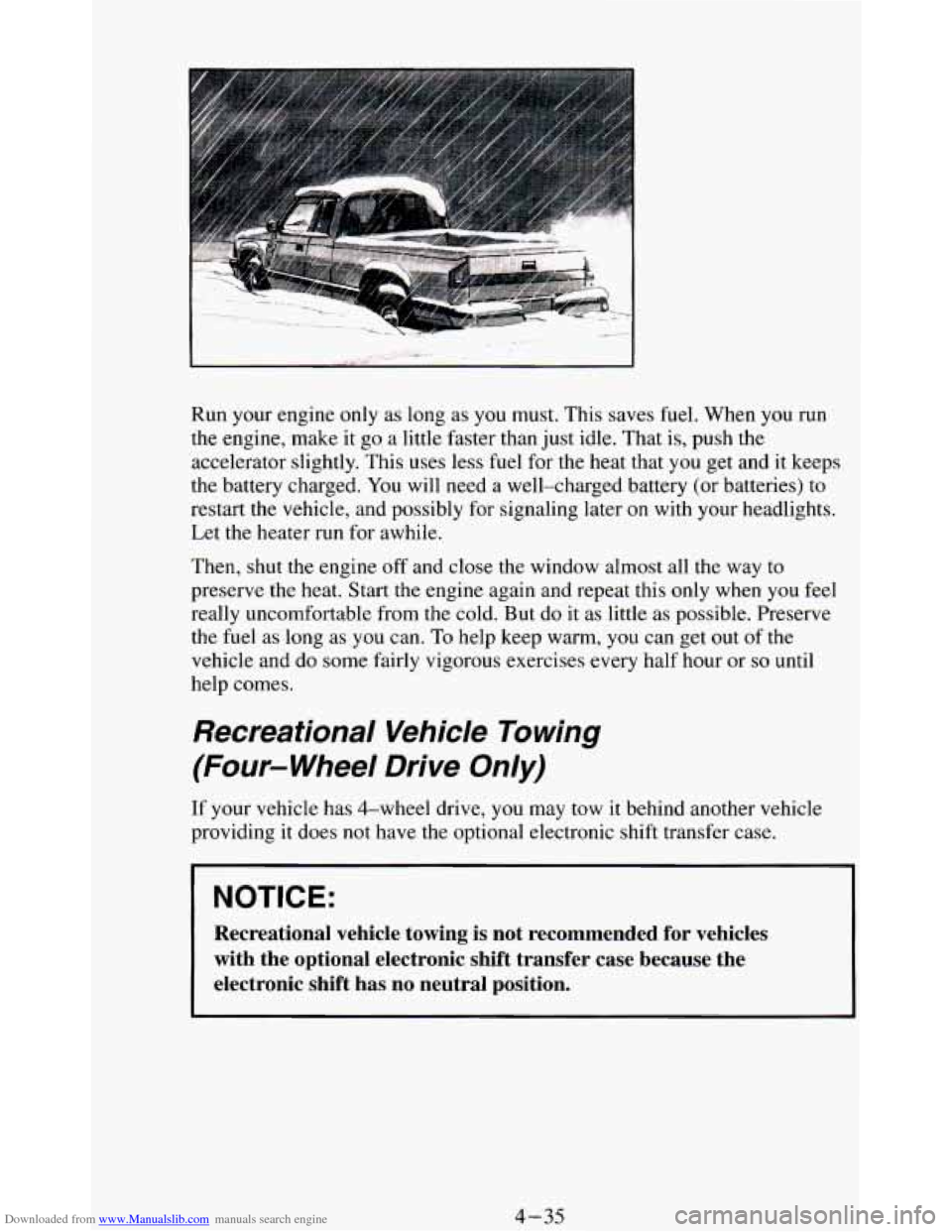
Downloaded from www.Manualslib.com manuals search engine Run your engine only as long as you must. This saves fuel. When you run
the engine, make it go a little faster than just idle. That is, push the
accelerator slightly. This uses less fuel for the heat that
you get and it keeps
the battery charged. You will need a well-charged battery (or batteries)
to
restart the vehicle, and possibly for signaling later on with your headlights.
Let the heater run for awhile.
Then, shut the engine
off and close the window almost all the way to
preserve the heat. Start the engine again and repeat this only when you feel
really uncomfortable from the cold. But
do it as little as possible. Preserve
the fuel as long as you can.
To help keep warm, you can get out of the
vehicle and do some fairly vigorous exercises every half hour or
so until
help comes.
Recreational Vehicle To wing
(Four-wheel Drive
Only)
If your vehicle has 4-wheel drive, you may tow it behind another vehicle
providing it does
not have the optional electronic shift transfer case.
Recreational vehicle towing is not recommended for vehicles
with the optional electronic shift transfer case because the
electronic shift has no neutral position.
4-35
Page 194 of 348
Downloaded from www.Manualslib.com manuals search engine Before towing, you should:
1. Set the parking brake firmly.
2. Place the automatic transmission in "P" (Park) or the manual
3. Firmly attach the vehicle being towed to the tow vehicle. Refer to the
transmission
in the lowest gear (1st gear).
hitch manufacturer's instructions.
4. Place the transfer case shift lever in "N" (Neutral).
NOTICE:
Removal of either propeller shaft is unnecessary.
1. Release the parking brake only after the vehicle being towed is firmly
attached to the tow vehicle.
2. Insert the ignition key into the ignition switch and turn it one notch
forward
of the LOCK position. This places the key into the OFF
position, which unlocks the steering column while preventing battery
drain. Unlocking the steering
column will allow for proper movement
of the front wheeldtires during towing.
NOTICE:
You should exercise extra care whenever towing another vehicle.
4-36
Page 205 of 348
Downloaded from www.Manualslib.com manuals search engine Other Warning Devices
If you carry reflective triangles, you can set one up at the side of the road
about
300 feet (100 m) behind your vehicle.
Jump Starting
If your battery has run down, you may want to use another vehicle and some
jumper cables to start your vehicle. But please follow the steps below to
do
it safely.
NOTICE:
Ignoring these steps could result in costly damage to your
vehicle that wouldn’t be covered by your warranty.
Trying to start your vehicle by pushing or pulling it could damage
your vehicle, even
if you have a manual transmission. And if you
~ have an automatic transmission, it won’t start that way.
To Jump Start Your Vehicle:
1. Check the other vehicle. It must have a 12-volt battery with a negative
ground system.
NOTICE:
If the other system isn’t a 12-volt system with a negative
ground, both vehicles can be damaged.
5-3
Page 206 of 348
Downloaded from www.Manualslib.com manuals search engine 2.
3.
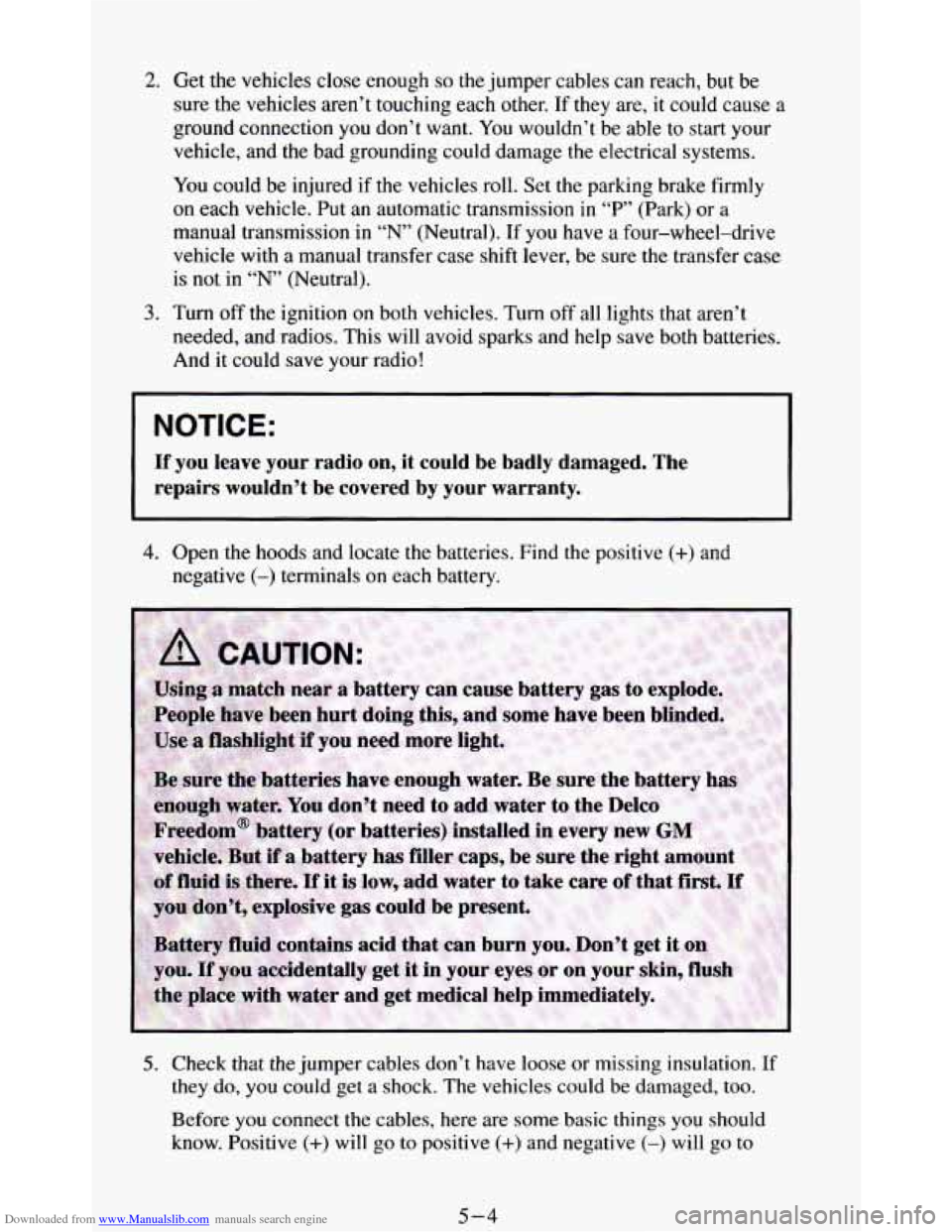
Get the vehicles close enough so the jumper cables can reach, but be
sure the vehicles
aren’t touching each other. If they are, it could cause
ground connection you don’t want. You wouldn’t be able to start you1
vehicle, and the bad grounding could damage the electrical systems.
You could be injured if the vehicles roll. Set
the parking brake firmly
on each vehicle. Put an automatic transmission in “P’ (Park) or a
a
manual transmission in “N” (Neutral). If you have a four-wheel-drive
vehicle with
a manual transfer case shift lever, be sure the transfer case
is not in “N” (Neutral).
Turn
off the ignition on both vehicles. Turn off all lights that aren’t
needed, and radios. This will avoid sparks and help save both batteries.
And it could save your radio!
~~~
NOTICE:
~~
If you leave your radio on, it could be badly damaged. The
repairs wouldn’t be covered by your warranty.
4. Open the hoods and locate the batteries. Find the positive (+) and
negative (-) terminals on each battery.
5. Check that the jumper cables don’t have loose or missing insulation. If
they do, you could get a shock. The vehicles could be damaged, too.
Before you connect the cables, here are some basic things you should
know. Positive
(+) will go to positive (+) and negative (-) will go to
5-4
Page 207 of 348
Downloaded from www.Manualslib.com manuals search engine negative (-) or a metal engine part. Don’t connect (+) to (-) or you’ll
get
a short that would damage the battery and maybe other parts, too.
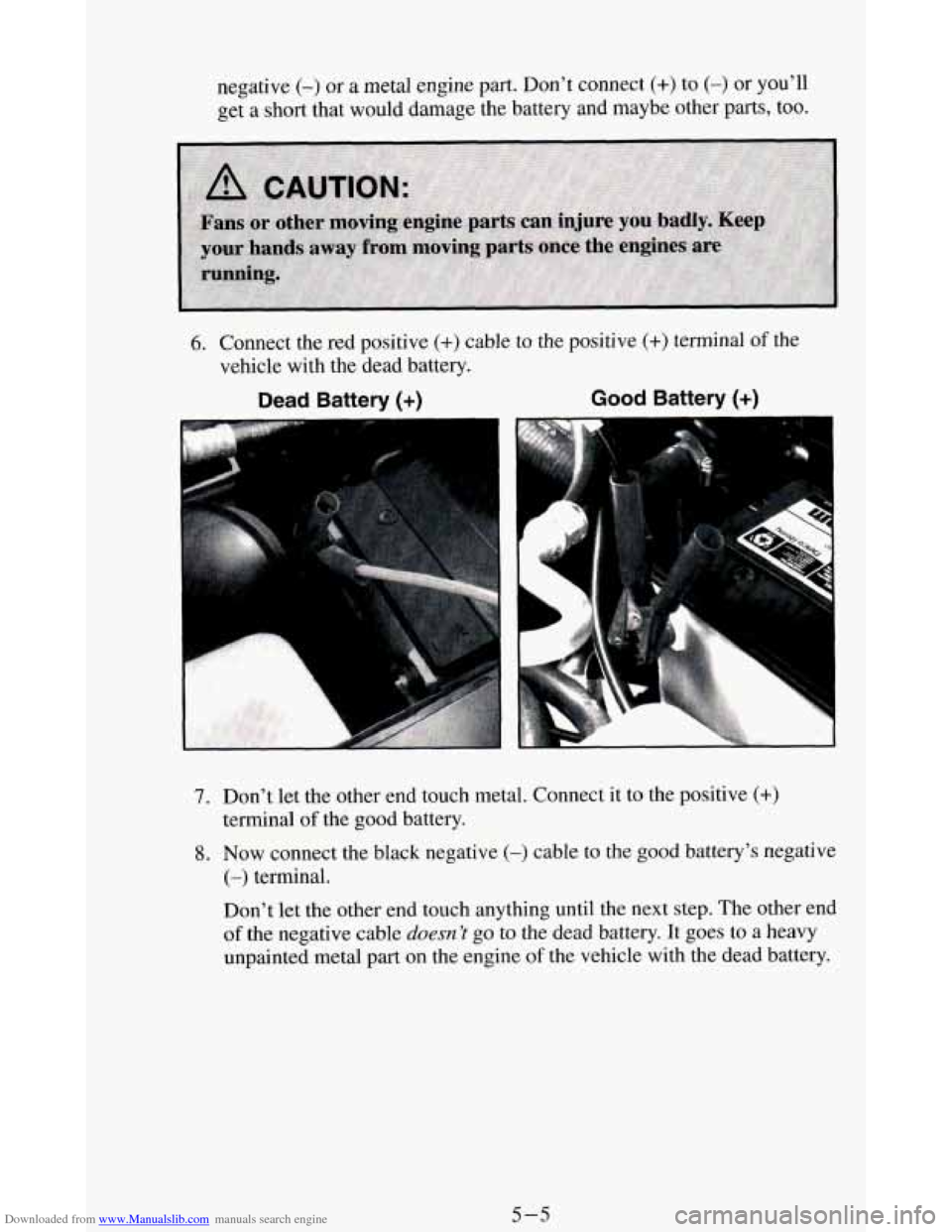
6. Connect the red positive (+) cable to the positive (+) terminal of the
vehicle with the dead battery.
Dead Battery (+) Good Battery (+)
I
7. Don’t let the other end touch metal. Connect it to the positive (+)
terminal of the good battery.
8. Now connect the black negative (-) cable to the good battery’s negative
(-) terminal.
Don’t let the other end touch anything until
the next step. The other end
of the negative cable duesn ’t go to the dead battery. It goes to a heavy
unpainted metal part
on the engine of the vehicle with the dead battery.
5-5
Page 208 of 348
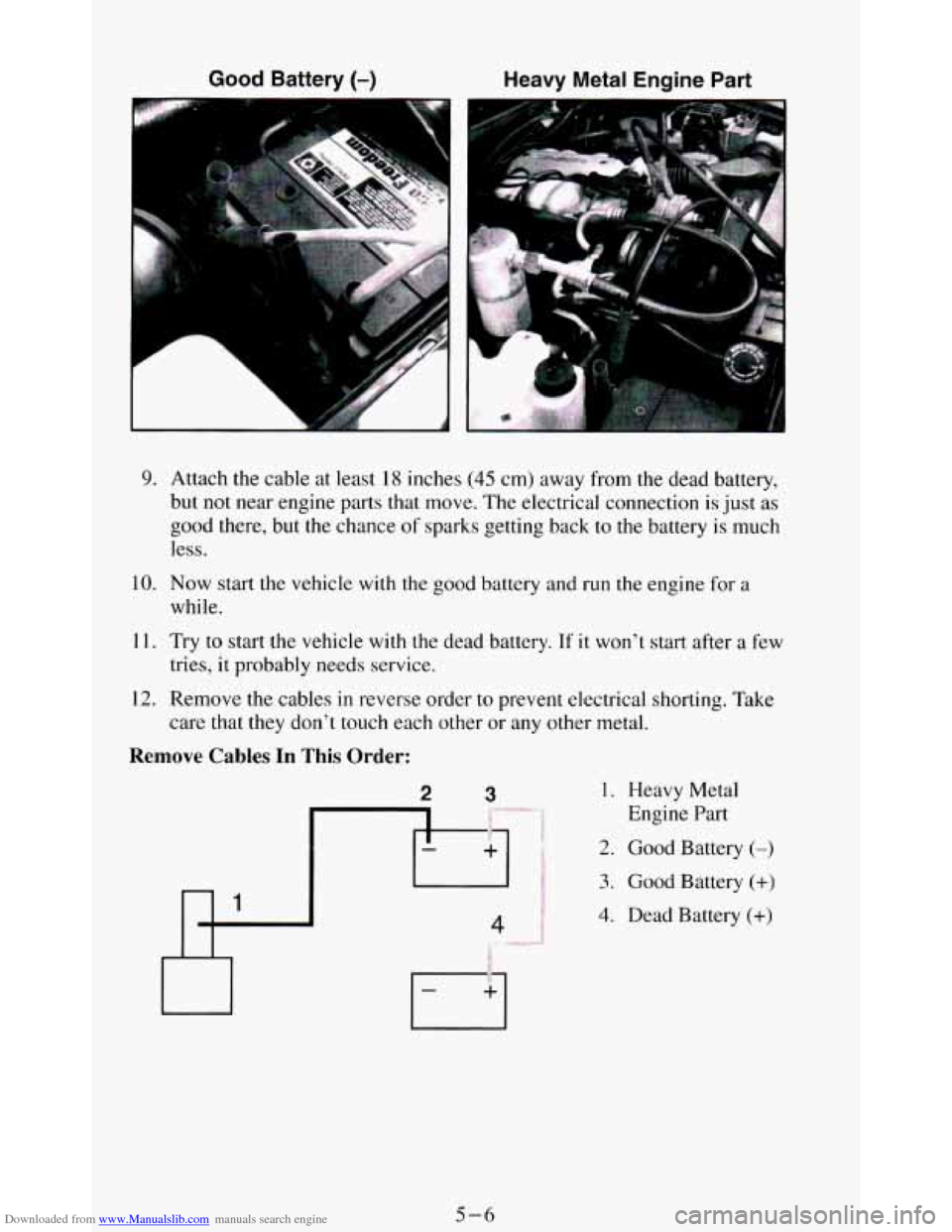
Downloaded from www.Manualslib.com manuals search engine Good Battery (-) Heavy Metal Engine Part
P
9. Attach the cable at least 18 inches (45 cm) away from the dead battery,
but not near engine parts that move. The electrical connection
is just as
good there, but the chance of sparks getting back to the battery is much
less.
10. Now start the vehicle with the good battery and run the engine for a
11. Try to start the vehicle with the dead battery. If it won't start after a few
while.
tries, it probably needs service.
12. Remove the cables in reverse order to prevent electrical shorting. Take
Remove Cables In This Order:
care that they don't touch each other or any other metal.
2 3 1. Heavy Metal
Engine Part
2. Good Battery (-)
3. Good Battery (+)
4. Dead Battery (+)
5-6
Page 237 of 348
Downloaded from www.Manualslib.com manuals search engine Service & Appearance Care
Section
Here you will find information about the care of your vehicle . This part
begins with service and fuel information. and then
it shows how to check
important fluid and lubricant levels
. There is also technical information
about your vehicle. and a section devoted to
its appearance care .
Service ................................................... 6-2
Fuel
..................................................... 6-3
Checking Things Under the Hood
.............................. 6-6
Engineoil
.............................................. 6-8
Aircleaner
............................................ 6-14
Automatic Transmission Fluid
............................. 6-15
Manual Transmission Fluid
............................... 6-18
Hydraulic Clutch ........................................ 6-20
RearAxle
............................................. 6-20
Transfer Case
.......................................... 6-21
FrontAxle
............................................. 6-22
Enginecoolant
......................................... 6-23
Power Steering Fluid
.................................... 6-26
Windshield Washer Fluid
................................. 6-28
Brake Master Cylinder
................................... 6-29
Replacing Brake System Parts
................................ 6-30
Battery
.................................................. 6-31
Vehiclestorage
......................................... 6-31
Bulb Replacement
......................................... 6-32
Other Maintenance Items
.................................... 6-35
Loading Your Vehicle
...................................... 6-39
Tires .................................................... 6-42
Appearance Care
.......................................... 6-49
Vehicle Identification Number (VIN)
.......................... 6-58
Service Parts Identification Label
............................. 6-60
Fuses and Circuit Breakers
.................................. 6-60
Capacities and Specifications Charts
........................... 6-62
6-1
Page 267 of 348
Downloaded from www.Manualslib.com manuals search engine you have to have new ones put in - be sure you get new genuine GM
replacement parts. If you don’t, your brakes may no longer work properly.
For example, if someone puts in brake linings that are wrong for your
vehicle, the balance between your front and rear brakes can change, for the
worse. The braking performance you’ve come to expect can change in many
other ways if someone puts in the wrong replacement brake parts.
Fluid Leak Check
After the vehicle has been parked for a while, inspect the surface under the
vehicle for water, oil, fuel or other fluids. Water dripping from
the air
conditioning system after it has been used is normal. If you notice fuel leaks
or fumes, the causes should be found and corrected at once.
Battery
Every new vehicle has a Delco Freedom@ battery. You never have to add
water
to one of these. When it’s time for a new battery, we recommend a
Delco Freedom@ battery. Get one that has the catalog number shown on the
original battery’s label.
Vehicle Storage
If you’re not going to drive your vehicle for 25 days or more, take off the
black, negative
(-) cable from the battery. This will help keep your battery
from running down.
Contact your dealer to learn how to prepare your vehicle for longer storage
periods.
For more information, contact your dealer’s service department, or write:
Adistra Corporation
17 1 Hamilton Street
Plymouth, MI
48 170
In Canada, write:
General Motors of Canada Limited
Customer Services Department
Oshawa, Ontario
L1J 5Z6 Canada
6-31
Page 297 of 348
Downloaded from www.Manualslib.com manuals search engine Headlights
The headlight wiring is protected by a circuit breaker in the light switch. An
electrical overload will cause the lights to go on and off. If this happens,
have your headlight wiring checked right away.
Windshield Wipers
The windshield wiper motor is protected by a circuit breaker and a fuse. If
the motor overheats due to heavy snow, etc., the wiper will stop until the
motor cools. If the overload is caused by some electrical problem and not
snow, etc., be sure to get it fixed.
Power Windows and Other Power Options
Circuit breakers in the fuse panel protect the power windows and other
power accessories. When the current load is too heavy, the circuit breaker
opens and closes, protecting the circuit until the problem
is fixed.
Trailer Wiring Harness
The optional seven-wire trailer wiring harness is protected by an in-line
fuse in the battery feed wire. This fuse is near the junction block. See
“Trailer Wiring Harness” in the
Features & Controls section.
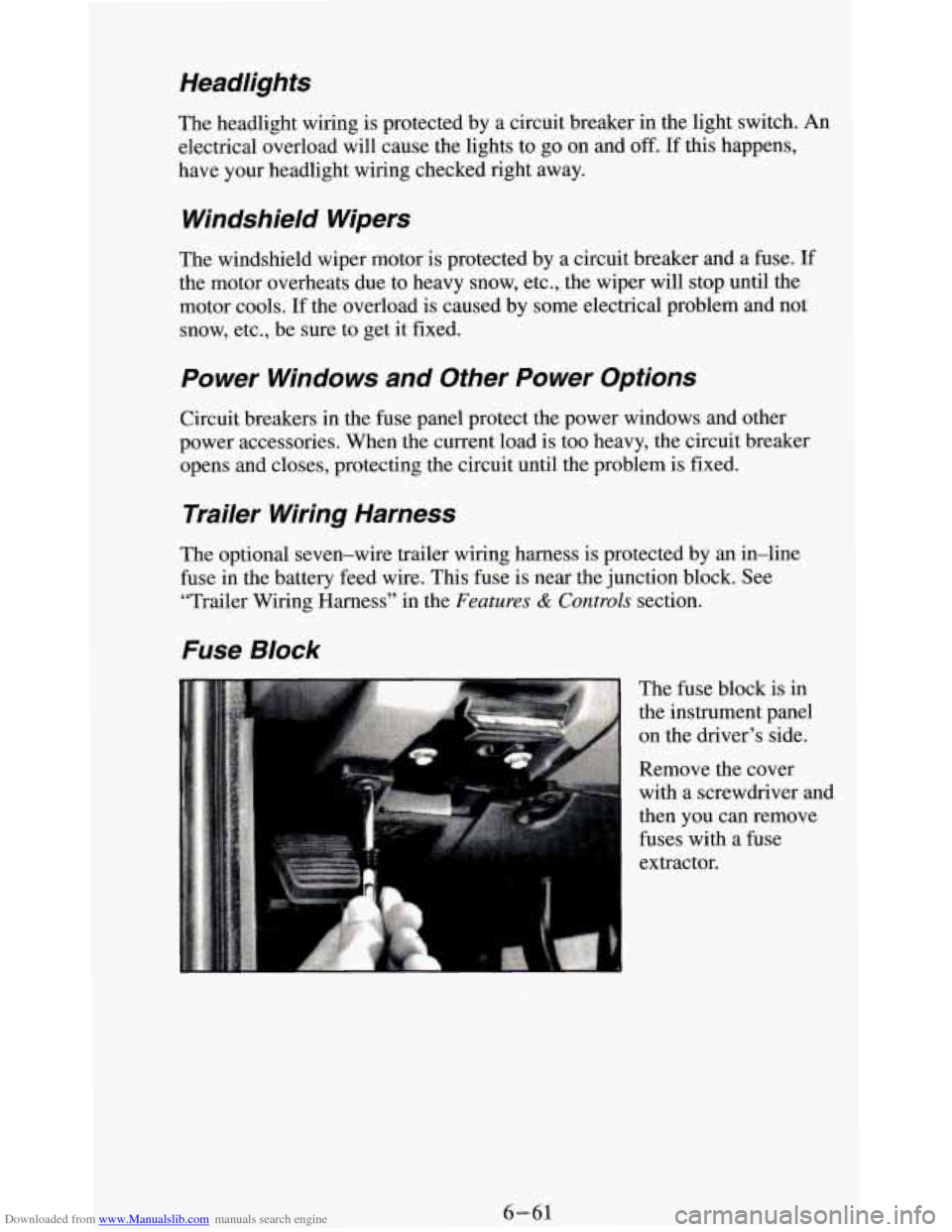
Fuse Block
The fuse block is in
the instrument panel
on the driver’s side.
Remove the cover
with a screwdriver and
then you
can remove
fuses with a fuse
extractor.
6-61