instrument panel CHEVROLET BLAZER 1994 2.G User Guide
[x] Cancel search | Manufacturer: CHEVROLET, Model Year: 1994, Model line: BLAZER, Model: CHEVROLET BLAZER 1994 2.GPages: 348, PDF Size: 17.88 MB
Page 113 of 348
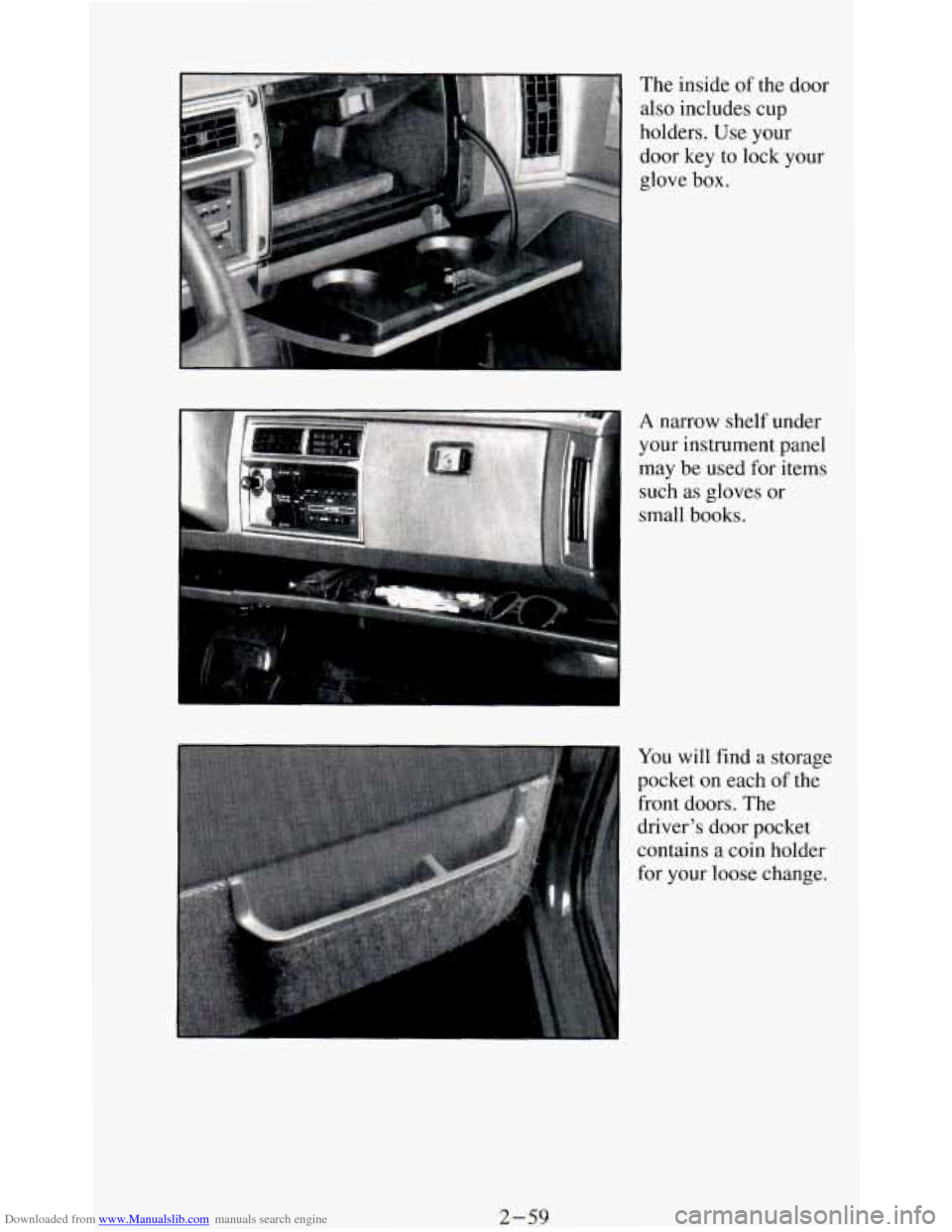
Downloaded from www.Manualslib.com manuals search engine The inside of the door
also includes cup
holders. Use your
door key to lock your
glove
box. I
A narrow shelf under
your instrument panel
may be
used for items
such
as gloves or
small books.
You will find a storage
pocket on each of the
front doors. The
driver's door pocket
contains a coin holder
for your loose change.
2-59
Page 118 of 348
Downloaded from www.Manualslib.com manuals search engine instrument Panel
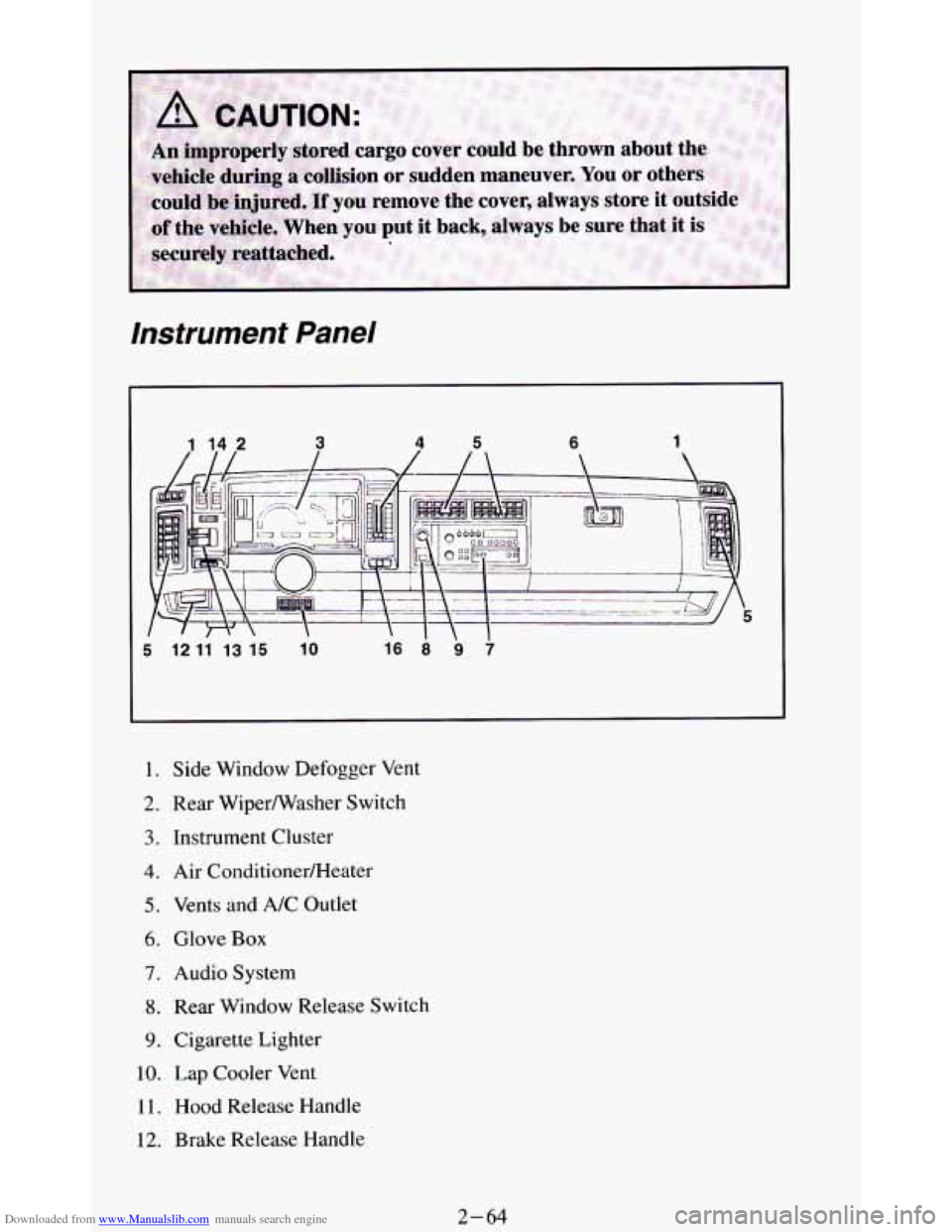
I l2 l1 l3 l5 lo
I. Side Window Defogger Vent
2. Rear Wiperwasher Switch
3. Instrument Cluster
4. Air ConditionerRIeater
5. Vents and A/C Outlet
6. Glove Box
7. Audio System
8. Rear Window Release Switch
9. Cigarette Lighter
10. Lap Cooler Vent
11. Hood Release Handle
12. Brake Release Handle
2-64
Page 137 of 348
Downloaded from www.Manualslib.com manuals search engine Air Vents
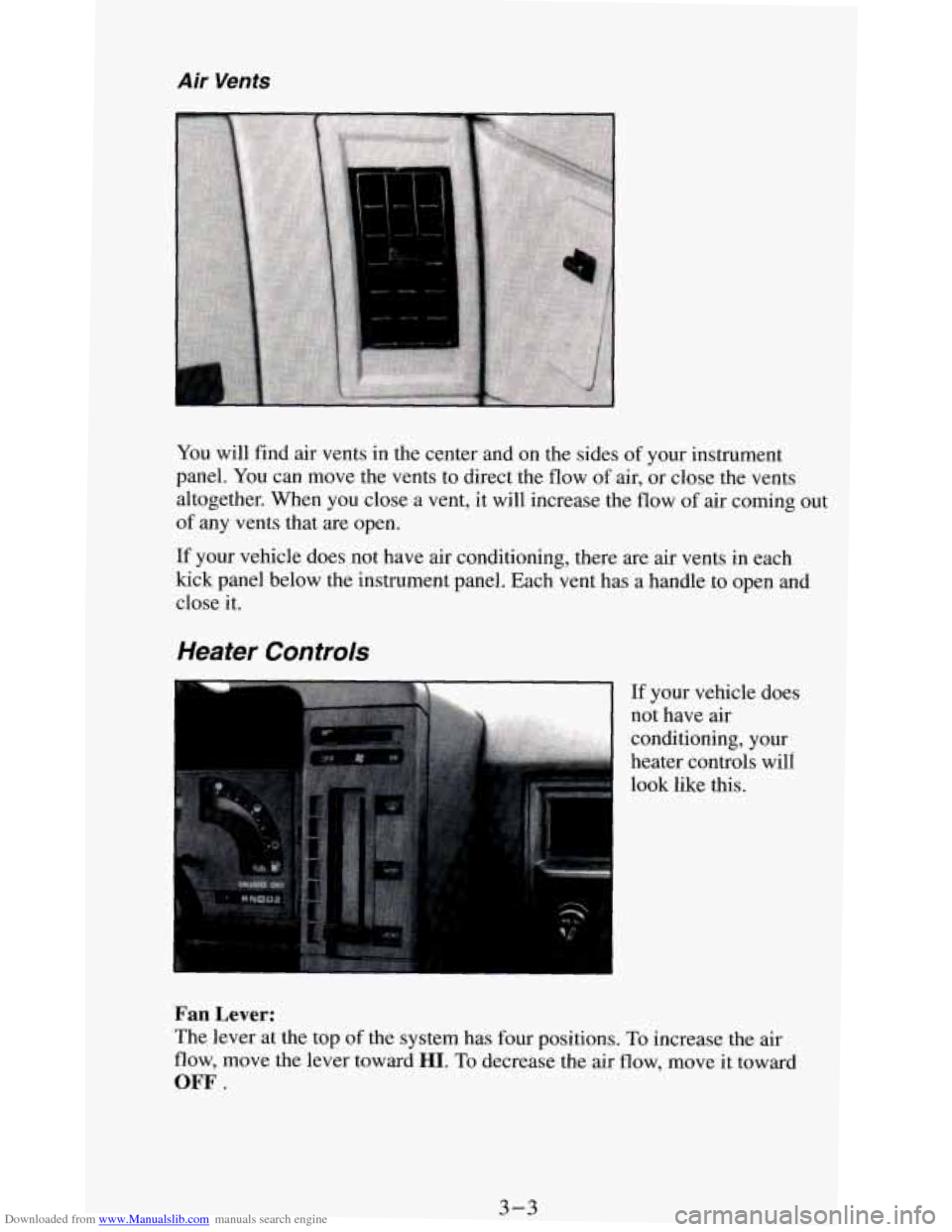
You will find air vents in the center and on the sides of your instrument
panel.
You can move the vents to direct the flow of air, or close the vents
altogether. When you close a vent, it will increase the flow
of air coming out
of any vents that are open.
If your vehicle does not have air conditioning, there are air vents in each
kick panel below the instrument panel. Each vent has a handle to open and
close it.
Heater Controls
If your vehicle does
not have air
conditioning, your
heater controls will
look like this.
Fan Lever:
The lever at the top of the system has four positions. To increase the air
flow, move the lever toward HI. To decrease the air flow, move it toward
OFF.
3-3
Page 138 of 348
Downloaded from www.Manualslib.com manuals search engine Temperature Lever:
The lever on the left of the system lets you select the temperature of the air
flowing into your vehicle. Move the lever up for warmer air. Move the lever
down for cooler air.
Mode Function Lever:
The lever on the right of the system can be moved to three different heating
functions.
DEFROST: This setting operates the defroster. Most of the air comes out
near the windshield,
with some going to the floor vents and side window
defrost vents. Use this when you get fog or ice on the windshield.
HTR (Heater): Most of the air comes out near the floor. The rest comes out
from the defroster vents under the windshield and at the front side windows.
This
is best for cold weather.
VENT: The air comes out at the vents on your instrument panel and at your
front side windows.
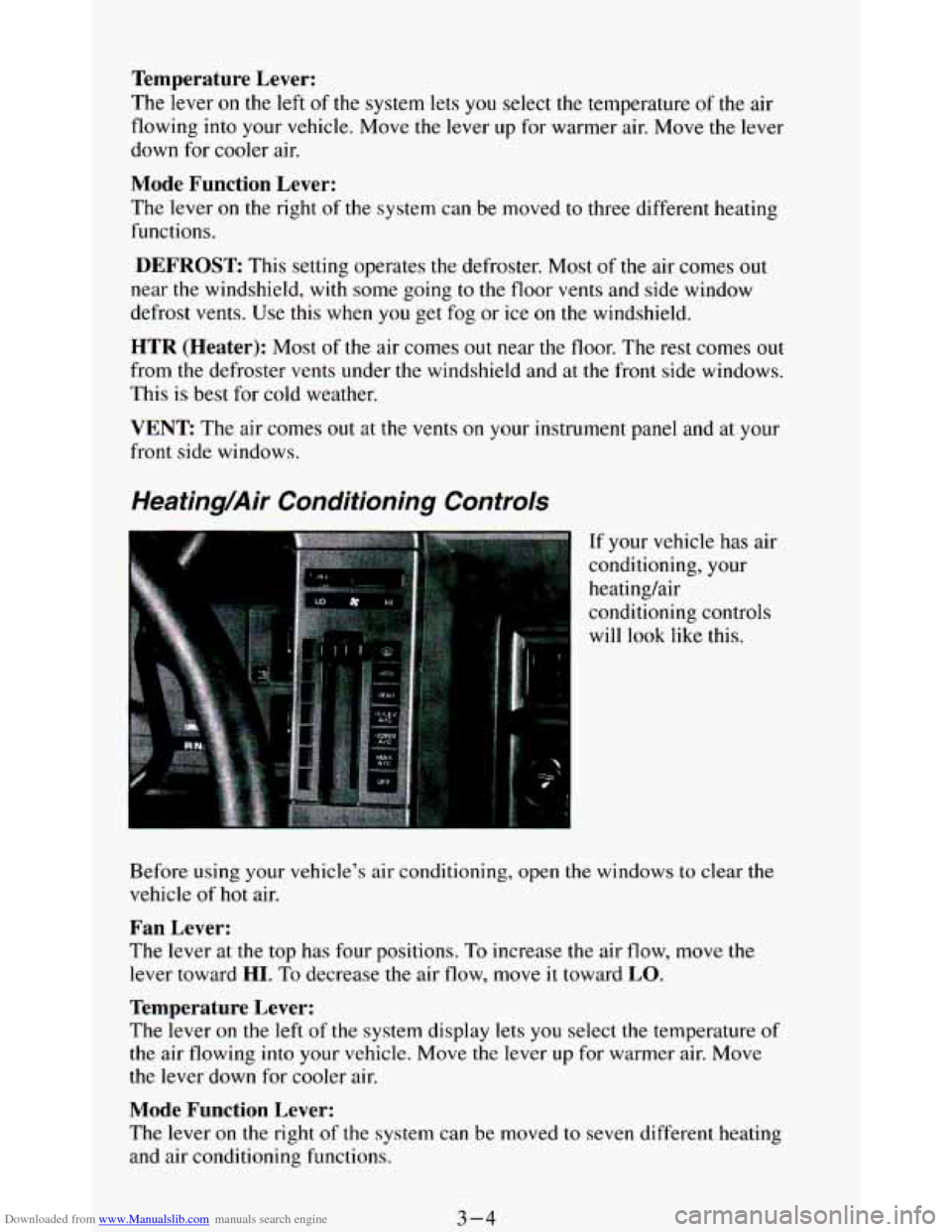
Heating/Air Conditioning Controls
If your vehicle has air
conditioning, your
heating/air
conditioning controls
will look like this.
Before using
your vehicle’s air conditioning, open the windows to clear me
vehicle of hot air.
Fan Lever:
The lever at the top has four positions. To increase the air flow, move the
lever toward
HI. To decrease the air flow, move it toward LO.
Temperature Lever:
The lever on the left of the system display lets you select the temperature of
the air flowing into your vehicle. Move the lever up for warmer air. Move
the lever down for cooler
air.
Mode Function Lever:
The lever on the right of the system can be moved to seven different heating
and air conditioning functions.
3-4
Page 139 of 348
Downloaded from www.Manualslib.com manuals search engine DEFROST This setting operates the defroster. Most of the air comes out
near
the windshield, with some going to the floor vents and side window
defrost vents.
Use this when you get fog or ice on the windshield.
HTR (Heater): Most of the air comes out near the floor. The rest comes out
from the defroster vents under the windshield and at
your front side
windows. This is best for cold weather.
VENT The air comes out at the vents on your instrument panel and at your
front side windows.
BI-LEV A/C: With this, outside air comes in through the heater floor vent
and the instrument panel vents. This setting is useful
in cool weather with
bright sunlight.
NORM A/C: This setting cools the outside air. If you first use MAX, use
NORM as soon as the vehicle has cooled down, so outside air will be going
through your vehicle.
MAX A/C: This cools the air the fastest. Move the other lever all the way to
Cold.
MAX lets in only a little air from the outside. You can use MAX at
first when it’s really hot outside and you need to cool off quickly.
NOTICE:
If vehicle is parked with function lever in MAX A/C position
and on an incline with the right side lower than the left, t\
hen water may leak into the passenger compartment in an unusually
heavy rain.
J
OFF: The blower is off, but air still will come from outlets at the front of
your vehicle. The system
will try to keep the air at the chosen temperature.
Engine Coolant Heater (Engine Block Heater)
If you use the optional engine coolant heater before starting your engine,
your heating system
will produce warmer air faster, to heat the passenger
compartment
in cold weather. See “Engine Coolant Heater” in the Index.
Rear Window Defogger
If your vehicle has this option the rear window will have lines running
across the glass. These lines heat your window.
For best results, clear the window
of as much snow or ice as possible first.
3-5
Page 140 of 348
Downloaded from www.Manualslib.com manuals search engine To turn on the rear
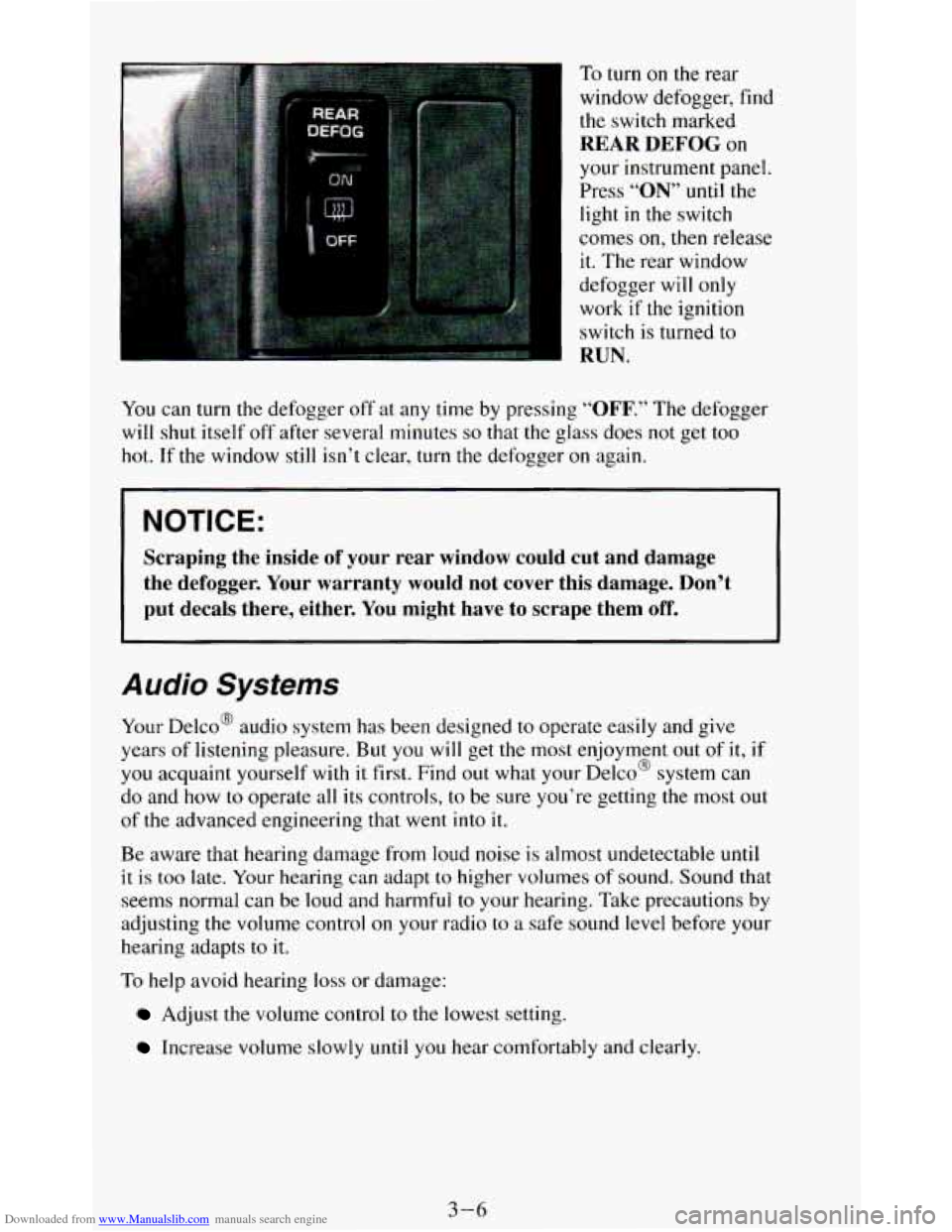
window defogger, find the switch marked
REAR DEFOG on
your instrument panel.
Press
“ON” until the
light
in the switch
comes
on, then release
it. The rear window
defogger will only
work
if the ignition
switch is turned to
RUN.
You can turn the defogger off at any time by pressing “OFF.” The defogger
will shut itself off after several minutes
so that the glass does not get too
hot. If the window
still isn’t clear, turn the defogger on again.
NOTICE:
Scraping the inside of your rear window could cut and damage
the defogger. Your warranty would not cover this damage. Don’t
put decals there, either. You might have to scrape them
off.
Audio Systems
Your Delco@ audio system has been designed to operate easily and give
years of listening pleasure. But
you will get the most enjoyment out of it,
you acquaint yourself with it first. Find out what your Delco@ system can
do and how
to operate all its controls, to be sure you’re getting the most o
of the advanced engineering that went into it.
if
I
IU t
Be aware that hearing damage from loud noise is almost undetectable until
it is too late. Your hearing can adapt to higher volumes of sound. Sound that
seems normal can be loud and harmful to your hearing. Take precautions by
adjusting the volume control
on your radio to a safe sound level before your
hearing adapts to it.
To help avoid hearing loss or damage:
Adjust the volume control to the lowest setting.
Increase volume slowly until you hear comfortably and clearly.
3-6
Page 200 of 348
Downloaded from www.Manualslib.com manuals search engine Making Turns
When you’re turning with a trailer, make wider turns than normal. Do this
so your trailer won’t strike soft shoulders, curbs, road signs, trees, or other
objects. Avoid jerky or sudden maneuvers. Signal well
in advance.
Turn Signals When Towing a Trailer
When you tow a trailer, your vehicle has to have a different turn signal
flasher and extra wiring. The green arrows
on your instrument panel will
flash whenever you signal a turn or lane change. Properly hooked up, the
trailer lights will also flash, telling other drivers you’re about to turn,
change lanes or stop.
When towing a trailer, the green arrows
on your instrument panel will flash
for turns
even if the bulbs on the trailer are burned out. Thus, you may think
drivers behind you are seeing your signal when
they are not. It’s important
to check occasionally to be sure the trailer bulbs are still working.
Driving On Grades
Reduce speed and shift to a lower gear before you start down a long or
steep downgrade. If you don’t
shift down, you might have to use your
brakes
so much that they would get hot and no longer work well.
On a long uphill grade, shift down and reduce your speed
to around 45 mph
(70 kdh) to reduce the possibility of engine and transmission overheating.
If you have an automatic transmission,
you should use “D” when towing a
trailer. Operating your vehicle in “D” when towing a trailer will minimize
heat buildup and extend the
life of your transmission. Or, if you have a
manual transmission with
fifth gear, it’s better not to use fifth gear, just
drive in fourth gear (or, as
you need to, a lower gear).
Parking on Hills
You really should not park your vehicle, with a trailer attached, on a hill. If
something goes wrong, your rig could start to move. People can be injured,
and both your vehicle and the trailer can be damaged.
But if you ever have
to park your rig on a hill, here’s how to do it:
1. Apply your regular brakes, but don’t shift into “P” (Park) yet, or into
gear for a manual transmission.
2. Have someone place chocks under the trailer wheels.
3. When the wheel chocks are in place, release the regular brakes until the
chocks absorb
the load.
4-42
Page 213 of 348
Downloaded from www.Manualslib.com manuals search engine Engine Overheating
You will find a coolant temperature gage on your vehicle's instrument
panel.
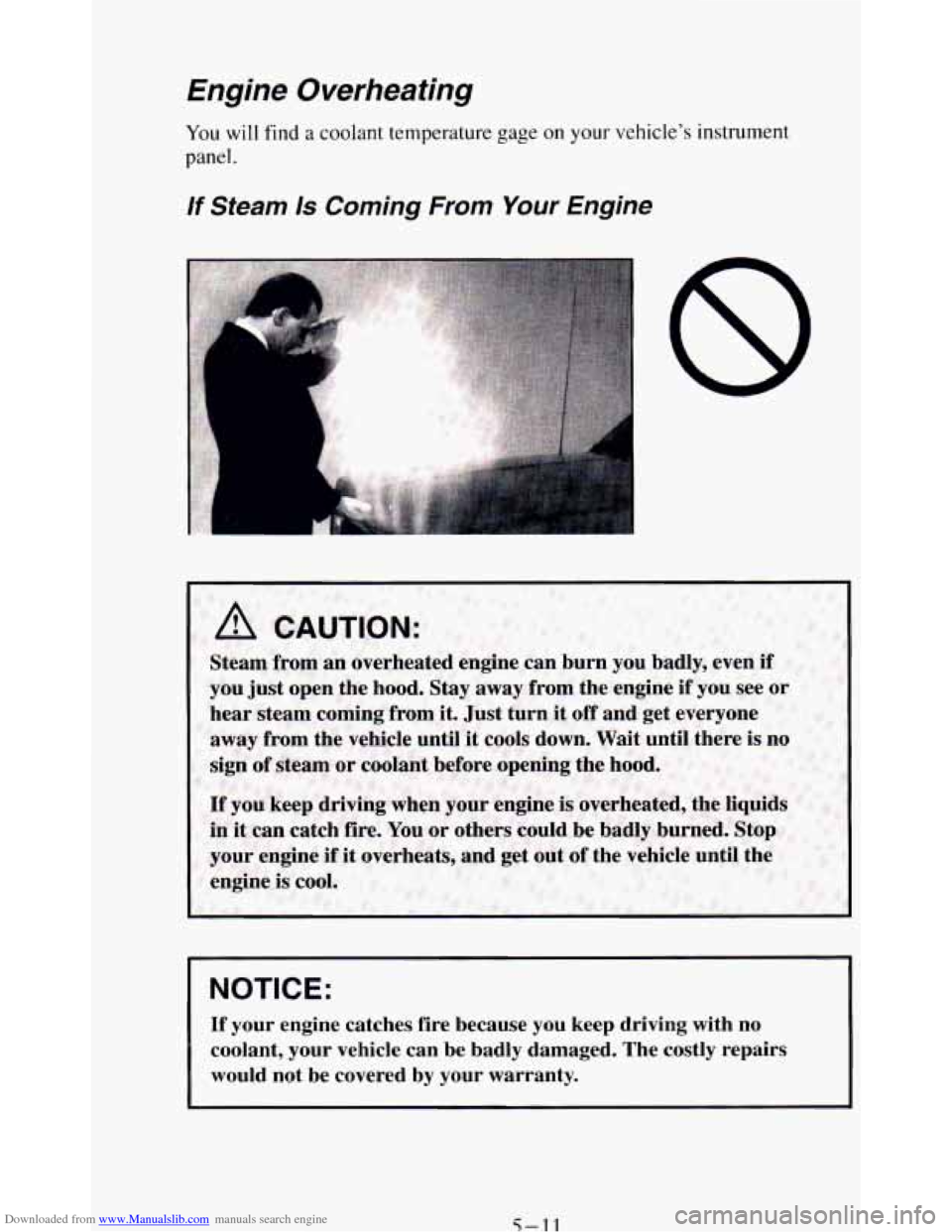
lf Steam /s Coming From Your Engine
NOTICE:
If your engine catches fire because you keep driving with no
coolant, your vehicle can be badly damaged. The costly repairs \
would not be covered by your warranty.
5-11
Page 239 of 348
Downloaded from www.Manualslib.com manuals search engine Fuel
The 8th digit of your Vehicle Identification Number (VIN) shows the code
letter for your engine. You will find the VIN at the top left of your
instrument panel. (See “Vehicle Identification Number”
in the Index.)
Use regular unleaded gasoline rated at
87 octane or higher. With the 4.3L
(Code W) engine, use premium unleaded gasoline rated at 91 octane or
higher for high power performance, when towing a trailer or with a high
payload requirement. But when operating with a light load as a normal
condition, you may use middle grade or regular unleaded gasolines.
The gasoline you use should meet specifications ASTM D48 14 in the
U.S.
and CGSB 3.5-92 in Canada. These fuels should have the proper additives,
so you should not have to add anything to the fuel.
In the U.S. and Canada, it’s easy to be sure you get the right kind of
gasoline (unleaded). You’ll see “UNLEADED” right on the pump. And only
unleaded nozzles will fit into your vehicle’s filler neck.
Be sure the posted octane is at least 9
1 for premium, 89 for middle grade
and
87 for regular. If the octane is less than 87, you may get a heavy
knocking noise when you drive. If it’s bad enough, it can damage your
engine.
If you’re using fuel rated at
91 octane or higher and you still hear heavy
knocking, your engine needs service. But don’t worry if you hear a little
pinging noise when you’re accelerating
or driving up a hill. That’s normal,
and you don’t have
to buy a higher octane fuel to get rid of it. It’s the heavy,
constant knock that means
you have a problem.
What about gasoline with blending materials that contain oxygen
(oxygenates), such as MTBE or alcohol?
MTBE is “methyl tertiary-butyl ether.” Fuel that is no more than 15%
MTBE is fine for your vehicle.
Ethanol is ethyl or grain alcohol. Properly-blended fuel that is no more than
10% ethanol is fine for your vehicle.
Methanol is methyl or wood alcohol.
NOTICE:
Fuel that is more than 5% methanol is bad for your vehicle.
Don’t use it. It can corrode metal parts in your fuel syst\
em and
also damage plastic and rubber parts. That damage wouldn’t be
covered under your warranty. And even at
5% or less, there
must be “cosolvents” and corrosion preventers in this fuel\
to
help avoid these problems.
6-3
Page 274 of 348
Downloaded from www.Manualslib.com manuals search engine Exhaust System
‘To help prevent damage to your exhaust system, do not continue to drive
your vehicle
if you notice:
Engine misfiring
Loss of performance
0 Other unusual operating conditions
Have your engine and exhaust system serviced regularly.
Three- Way Catalytic Converter
Your vehicle’s three-way catalytic converter is designed to reduce the
pollutants
in your vehicle’s exhaust. Use only unleaded fuel in your vehicle.
If you use leaded fuel, you could damage your three-way catalytic converter
and other engine components.
Engine Control Module System
This system has an oxygen (02) sensor that helps keep your engine’s
air-fuel mixture at a proper level. Use only unleaded fuel
in your vehicle. If
you use leaded fuel, you could damage your oxygen (02) sensor and affect
your vehicle’s emissions.
Malfunction Indicator Lamp (SERVICE ENGINE SOON )
This light on your instrument panel lets you know when your emission
system needs service. The light
will come on briefly when you start your
engine to let you know that the system is working.
If it does not come on
when you start your engine, or
if it comes on and stays on while you’re
driving, your system may need service. Your vehicle should still be
driveable, but you should have your system serviced right away.
6-38