fuel CHEVROLET BLAZER 1994 2.G Owner's Manual
[x] Cancel search | Manufacturer: CHEVROLET, Model Year: 1994, Model line: BLAZER, Model: CHEVROLET BLAZER 1994 2.GPages: 348, PDF Size: 17.88 MB
Page 242 of 348
Downloaded from www.Manualslib.com manuals search engine NOTICE:
If you need a new cap, be sure to get the right type. Your dealer
can get one for you. If you get the wrong type, it may not fit or
have proper venting, and your fuel tank and emissions system
might be damaged.
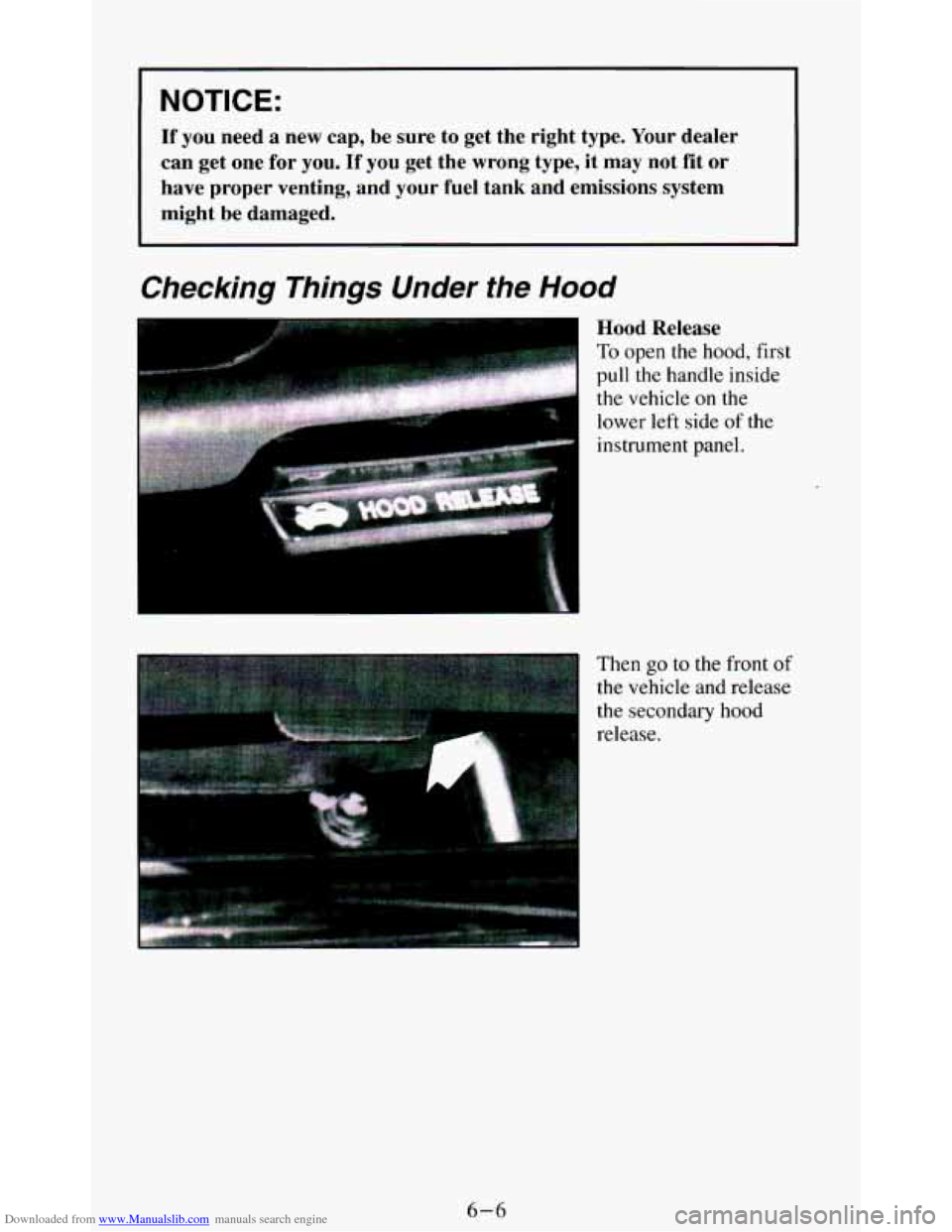
Checking Things Under the Hood
Then go to the front of
the vehicle and release
the secondary hood
release.
6-6
Page 244 of 348
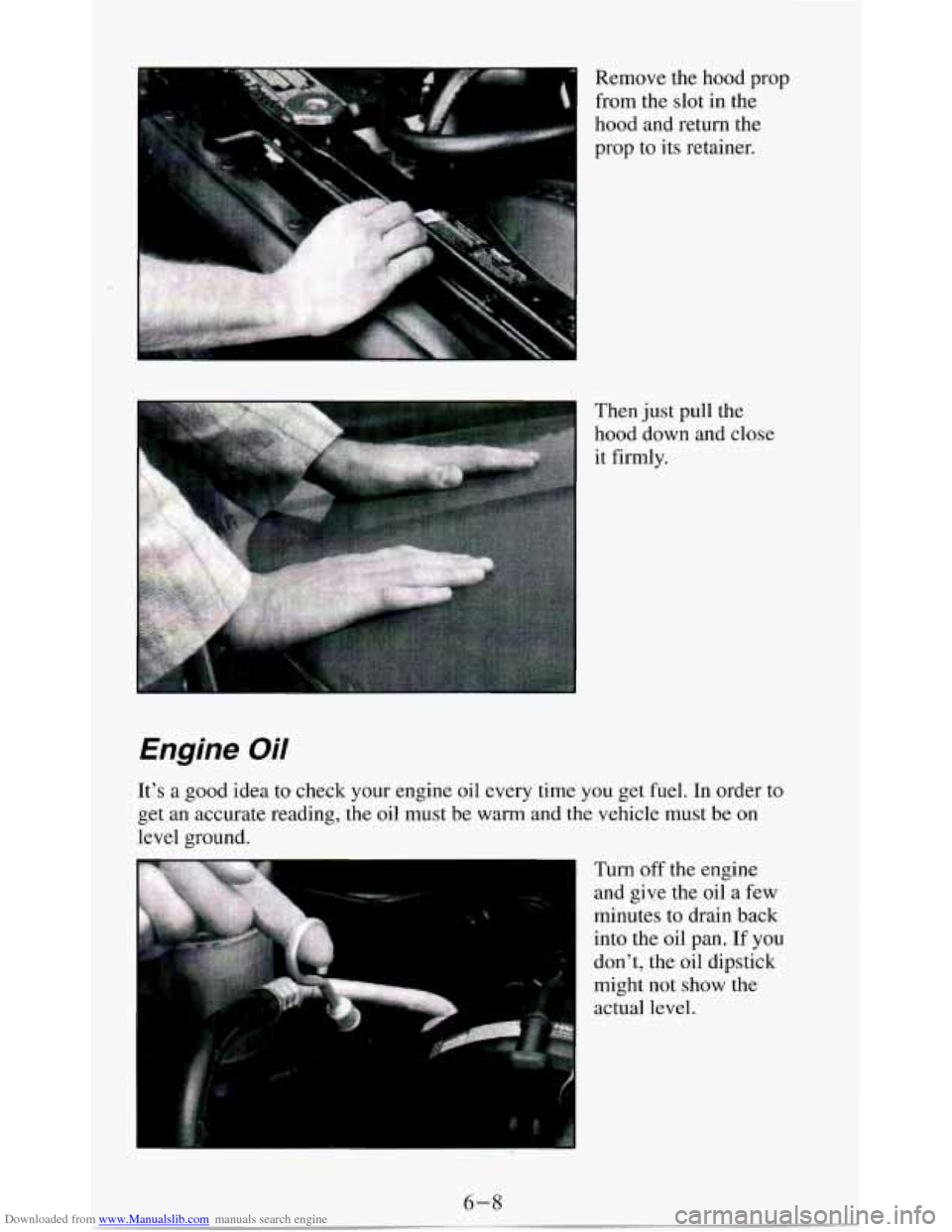
Downloaded from www.Manualslib.com manuals search engine Remove the hood prop
from
the slot in the
hood and return the
prop to its retainer.
Then just pull the
hood down and close
it firmly.
Engine Oil
It’s a good idea to check your engine oil every time you get fuel. In order to
get an accurate reading, the oil must be warm and the vehicle must be on
level ground.
I Turn off the engine
and give the oil a few
minutes to drain back
into the oil pan. If you
don’t, the oil dipstick
might not show the
actual level.
6-8
Page 247 of 348
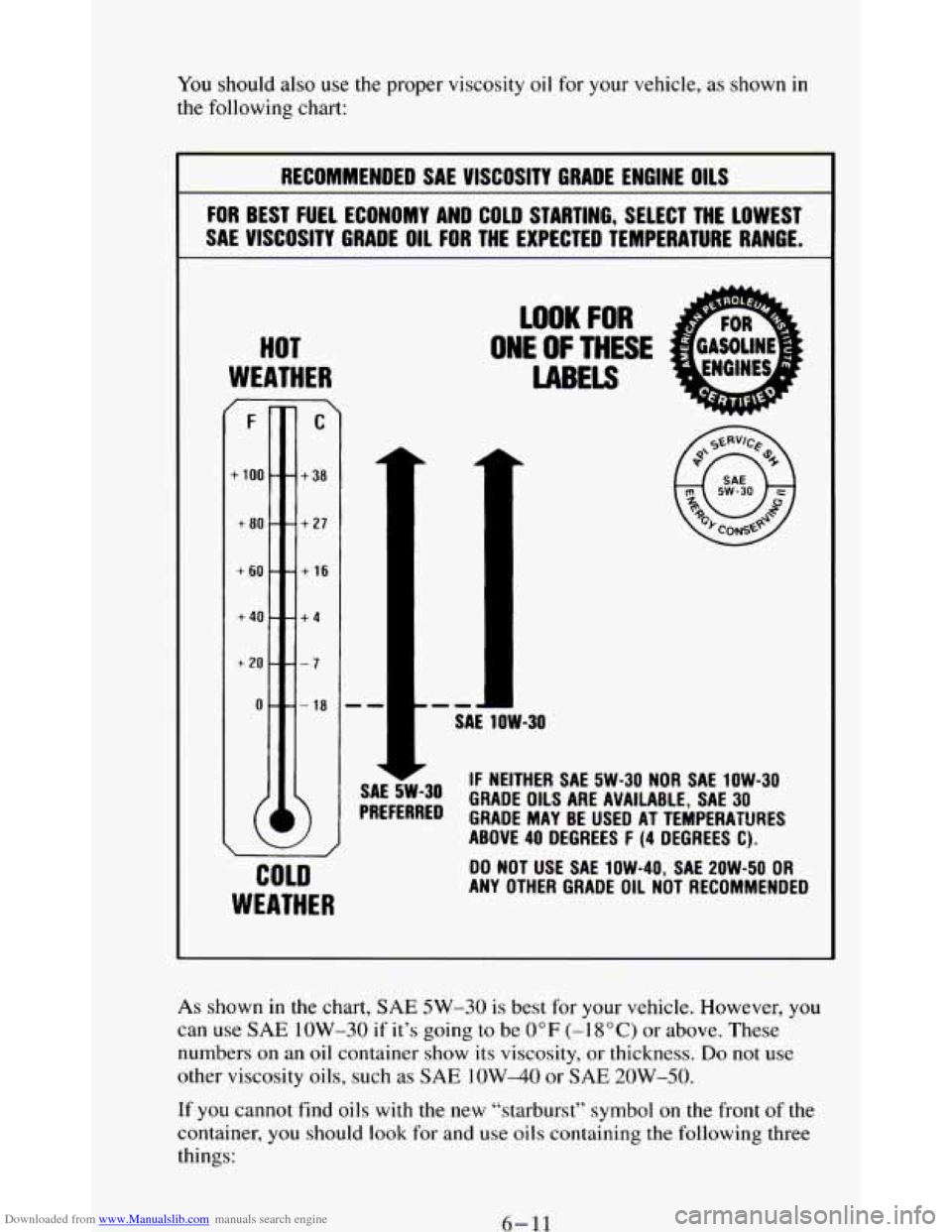
Downloaded from www.Manualslib.com manuals search engine You should also use the proper viscosity oil for your vehicle, as shown in
the following chart:
RECOMMENDED SAE VISCOSITY GRADE ENGINE OILS
FOR BEST FUEL ECONOMY AND COLD STARTING, SELECT THE LOWEST
SAL VISCOSITY GRADE
011 FOR THE EXPECTED TEMPERATURE RANGE.
HOT
WEATHER
[ + 60
+ 40
f 20
I
C
- +38
- +27
- +16
-+4
- -7
- -18
COLD
WEATHER
SAE 5W-30
PREFERRED
LOOK FOR
ONE OF THESE
LABELS
SAE 1OW-30
IF NEITHER SAE 5W-30 NOR SAE 1OW-30
GRADE OILS ARE AVAILABLE, SAE 30
GRADE MAY BE USED AT TEMPERATURES
ABOVE
40 DEGREES F (4 DEGREES C).
ANY OTHER GRADE OIL NOT RECOMMENDED
DO NOT USE SAE 1OW-40, SAE 2OW-50 OR
As shown in the chart, SAE 5W-30 is best for your vehicle. However, you
can use
SAE low-30 if it’s going to be 0°F (-1 8°C) or above. These
numbers on an oil container show its viscosity, or thickness.
Do not use
other viscosity oils, such as SAE 1OW-40 or SAE 20W-50.
If you cannot find oils with the new “starburst” symbol on the front of the
container, you should look for and use oils containing the following three
things:
6-11
Page 248 of 348
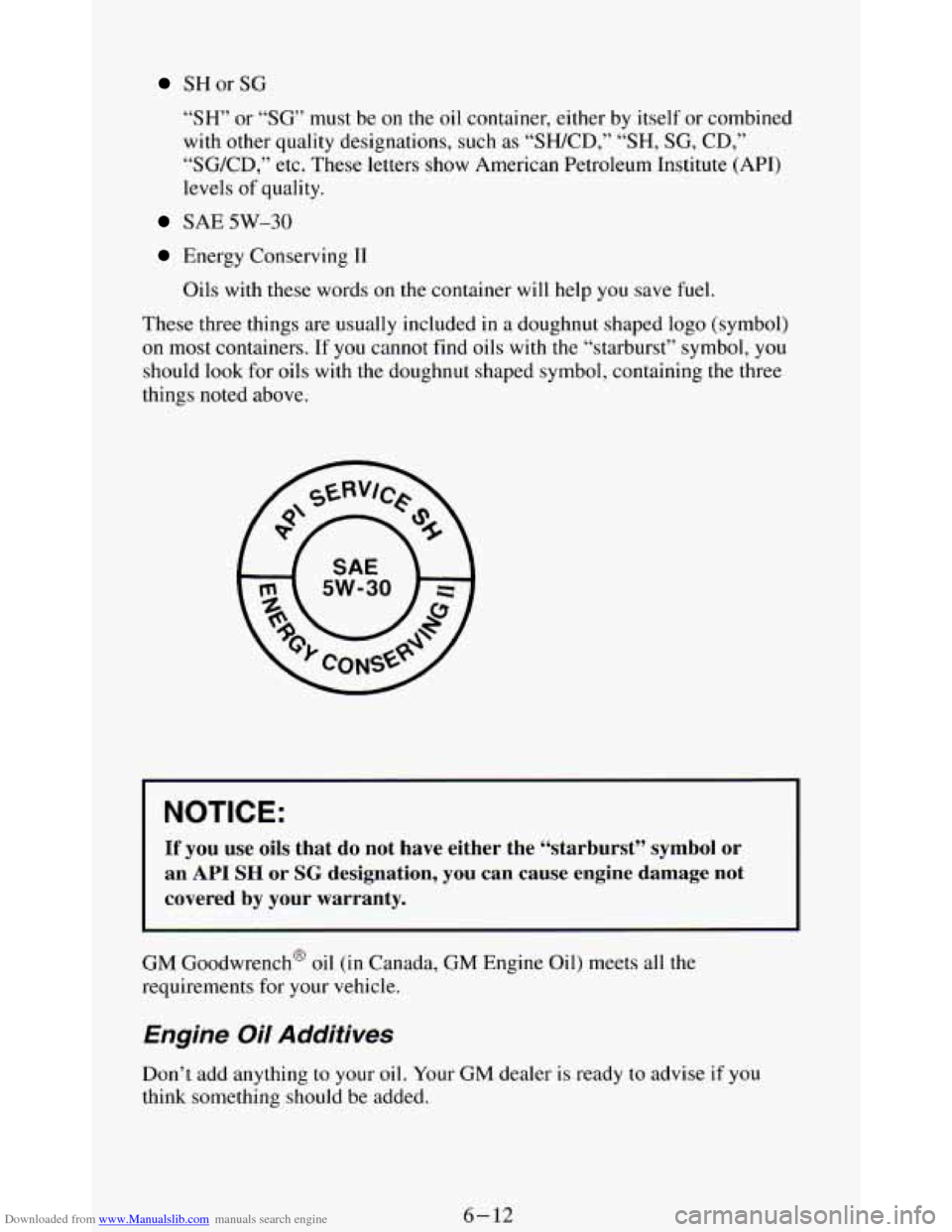
Downloaded from www.Manualslib.com manuals search engine SHorSG
“SH” or “SG” must be on the oil container, either by itself or combined
with other quality designations, such as “SH/CD,”
“SH, SG, CD,”
“SG/CD,” etc. These letters show American Petroleum Institute (API)
levels of quality.
SAE 5W-30
Energy Conserving I1
Oils with these words on the container will help you save fuel.
These three things are usually included
in a doughnut shaped logo (symbol)
on most containers. If you cannot find oils with the “starburst” symbol, you
should look for oils with the doughnut shaped symbol, containing the three
things noted above.
NOTICE:
If you use oils that do not have either the “starburst” symbol or
an API SH or SG designation, you can cause engine damage not
covered by your warranty.
GM Goodwrench@ oil (in Canada, GM Engine Oil) meets all the
requirements for your vehicle.
Engine Oil Additives
Don’t add anything to your oil. Your GM dealer is ready to advise if you
think something should be added.
6-12
Page 267 of 348
Downloaded from www.Manualslib.com manuals search engine you have to have new ones put in - be sure you get new genuine GM
replacement parts. If you don’t, your brakes may no longer work properly.
For example, if someone puts in brake linings that are wrong for your
vehicle, the balance between your front and rear brakes can change, for the
worse. The braking performance you’ve come to expect can change in many
other ways if someone puts in the wrong replacement brake parts.
Fluid Leak Check
After the vehicle has been parked for a while, inspect the surface under the
vehicle for water, oil, fuel or other fluids. Water dripping from
the air
conditioning system after it has been used is normal. If you notice fuel leaks
or fumes, the causes should be found and corrected at once.
Battery
Every new vehicle has a Delco Freedom@ battery. You never have to add
water
to one of these. When it’s time for a new battery, we recommend a
Delco Freedom@ battery. Get one that has the catalog number shown on the
original battery’s label.
Vehicle Storage
If you’re not going to drive your vehicle for 25 days or more, take off the
black, negative
(-) cable from the battery. This will help keep your battery
from running down.
Contact your dealer to learn how to prepare your vehicle for longer storage
periods.
For more information, contact your dealer’s service department, or write:
Adistra Corporation
17 1 Hamilton Street
Plymouth, MI
48 170
In Canada, write:
General Motors of Canada Limited
Customer Services Department
Oshawa, Ontario
L1J 5Z6 Canada
6-31
Page 274 of 348
Downloaded from www.Manualslib.com manuals search engine Exhaust System
‘To help prevent damage to your exhaust system, do not continue to drive
your vehicle
if you notice:
Engine misfiring
Loss of performance
0 Other unusual operating conditions
Have your engine and exhaust system serviced regularly.
Three- Way Catalytic Converter
Your vehicle’s three-way catalytic converter is designed to reduce the
pollutants
in your vehicle’s exhaust. Use only unleaded fuel in your vehicle.
If you use leaded fuel, you could damage your three-way catalytic converter
and other engine components.
Engine Control Module System
This system has an oxygen (02) sensor that helps keep your engine’s
air-fuel mixture at a proper level. Use only unleaded fuel
in your vehicle. If
you use leaded fuel, you could damage your oxygen (02) sensor and affect
your vehicle’s emissions.
Malfunction Indicator Lamp (SERVICE ENGINE SOON )
This light on your instrument panel lets you know when your emission
system needs service. The light
will come on briefly when you start your
engine to let you know that the system is working.
If it does not come on
when you start your engine, or
if it comes on and stays on while you’re
driving, your system may need service. Your vehicle should still be
driveable, but you should have your system serviced right away.
6-38
Page 275 of 348
Downloaded from www.Manualslib.com manuals search engine Loading Your Vehicle
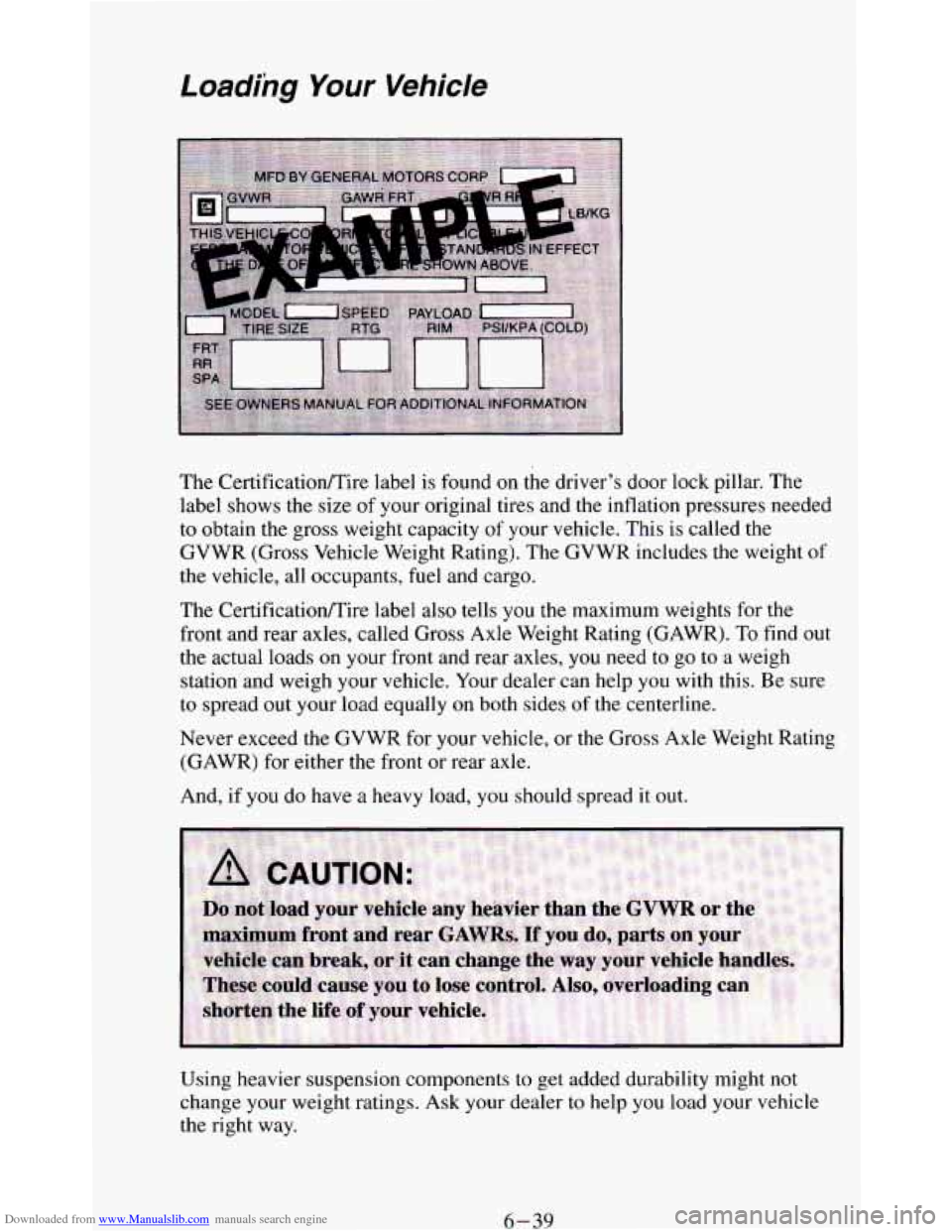
The CertificatiodTire label is found on the driver’s door lock pillar. The
label shows
the size of your original tires and the inflation pressures needed
to obtain the gross weight capacity
of your vehicle. This is called the
GVWR (Gross Vehicle Weight Rating). The GVWR includes the weight
of
the vehicle, all occupants, fuel and cargo.
The Certificationnire label
also tells you the maximum weights for the
front and rear axles, called Gross Axle Weight Rating (GAWR). To find
out
the actual loads on your front and rear axles, you need to go to a weigh
station and weigh your vehicle. Your dealer can help you with this. Be sure
to spread out your load equally on both sides
of the centerline.
Never exceed the GVWR for your vehicle, or the Gross Axle Weight Rating
(GAWR) for either the front or rear axle.
And, if you do have a heavy load, you should spread it out.
Using heavier suspension components to get added durability might not
change your weight ratings.
Ask your dealer to help you load your vehicle
the right way.
6-39
Page 279 of 348
Downloaded from www.Manualslib.com manuals search engine NOTICE:
Don’t let anyone tell you that underinflation or overinflation is
all right. It’s not. If your tires don’t have enough air
(underinflation)
you can get:
Too much flexing
Too much heat
Tire overloading
Bad wear
Bad handling
Bad fuel economy.
If your tires have too much air (overinflation), you can get:
Unusual wear
Bad handling
Rough ride
Needless damage from road hazards.
When to Check
Check your tires once a month or more.
How to Check
Use a good quality pocket-type gage to check tire pressure. Simply looking
at the tires will not tell you the pressure, especially if you have radial tires
- which may look properly inflated even if they’re underinflated.
If your tires have valve caps, be sure to put them back on. They help prevent
leaks by keeping out dirt and moisture.
6-43
Page 292 of 348
Downloaded from www.Manualslib.com manuals search engine Finish Damage
Any stone chips, fractures or deep scratches in the finish should be repaired
right away. Bare metal will corrode quickly and may develop into a major
repair expense.
Minor chips and scratches can be repaired with touch-up materials available
from your dealer or other service outlets. Larger areas
of finish damage can
be corrected in your dealer’s body and paint shop.
Underbody Maintenance
Chemicals used for ice and snow removal and dust control can collect on
the underbody. If these are not removed, accelerated corrosion (rust) can
occur
on the underbody parts such as fuel lines, frame, floor pan, and
exhaust system
even though they have corrosion protection.
At least every spring,
flush these materials from the underbody with plain
water. Clean any areas where mud and other debris can collect. Dirt packed
in closed areas of the frame should be loosened before being flushed. Your
dealer or an underbody vehicle washing system can do this for you.
Chemical Paint Spotting
Some weather and atmospheric conditions can create a chemical fallout.
Airborne pollutants can fall upon and attack painted surfaces
on your
vehicle. This damage can take two forms: blotchy, ringlet-shaped
discolorations, and small irregular dark spots etched into the paint surface.
Although
no defect in the paint job causes this, GM will repair, at no charge
to the owner, the surfaces of new vehicles damaged by this fallout condition
within 12 months or 12,000 miles (20
000 km) of purchase, whichever
comes first.
6-56
Page 298 of 348
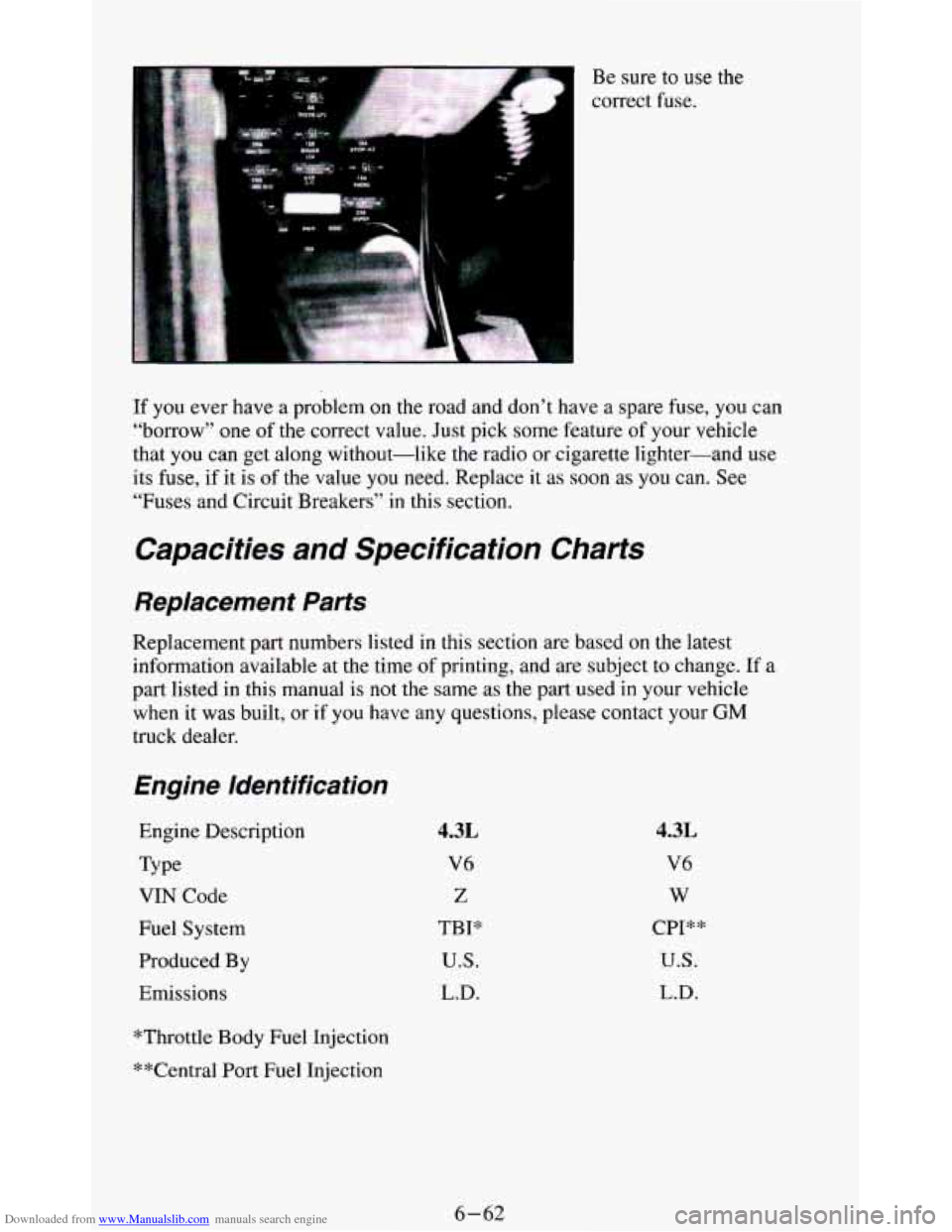
Downloaded from www.Manualslib.com manuals search engine Be sure to use the
correct fuse.
If you ever have a problem on the road and don’t have a spare fuse, you can
“borrow”
one of the correct value. Just pick some feature of your vehicle
that you can get along without-like
the radio or cigarette lighter-and use
its fuse, if it is
of the value you need. Replace it as soon as you can. See
“Fuses and Circuit Breakers”
in this section.
Capacities and Specification Charts
Replacement Parts
Replacement part numbers listed in this section are based on the latest
information available at the time
of printing, and are subject to change. If a
part listed in this manual is
not the same as the part used in your vehicle
when it was built,
or if you have any questions, please contact your GM
truck dealer.
Engine Identification
Engine Description
Type
VIN Code
Fuel System
Produced By
Emissions
4.3L
V6
Z
TBP
U.S.
L.D.
4.3L
V6
w
CPI**
U.S.
L.D.
*Throttle Body Fuel Injection
**Central Port Fuel Injection
6-62