lights CHEVROLET BLAZER 1994 2.G Owner's Guide
[x] Cancel search | Manufacturer: CHEVROLET, Model Year: 1994, Model line: BLAZER, Model: CHEVROLET BLAZER 1994 2.GPages: 348, PDF Size: 17.88 MB
Page 200 of 348
Downloaded from www.Manualslib.com manuals search engine Making Turns
When you’re turning with a trailer, make wider turns than normal. Do this
so your trailer won’t strike soft shoulders, curbs, road signs, trees, or other
objects. Avoid jerky or sudden maneuvers. Signal well
in advance.
Turn Signals When Towing a Trailer
When you tow a trailer, your vehicle has to have a different turn signal
flasher and extra wiring. The green arrows
on your instrument panel will
flash whenever you signal a turn or lane change. Properly hooked up, the
trailer lights will also flash, telling other drivers you’re about to turn,
change lanes or stop.
When towing a trailer, the green arrows
on your instrument panel will flash
for turns
even if the bulbs on the trailer are burned out. Thus, you may think
drivers behind you are seeing your signal when
they are not. It’s important
to check occasionally to be sure the trailer bulbs are still working.
Driving On Grades
Reduce speed and shift to a lower gear before you start down a long or
steep downgrade. If you don’t
shift down, you might have to use your
brakes
so much that they would get hot and no longer work well.
On a long uphill grade, shift down and reduce your speed
to around 45 mph
(70 kdh) to reduce the possibility of engine and transmission overheating.
If you have an automatic transmission,
you should use “D” when towing a
trailer. Operating your vehicle in “D” when towing a trailer will minimize
heat buildup and extend the
life of your transmission. Or, if you have a
manual transmission with
fifth gear, it’s better not to use fifth gear, just
drive in fourth gear (or, as
you need to, a lower gear).
Parking on Hills
You really should not park your vehicle, with a trailer attached, on a hill. If
something goes wrong, your rig could start to move. People can be injured,
and both your vehicle and the trailer can be damaged.
But if you ever have
to park your rig on a hill, here’s how to do it:
1. Apply your regular brakes, but don’t shift into “P” (Park) yet, or into
gear for a manual transmission.
2. Have someone place chocks under the trailer wheels.
3. When the wheel chocks are in place, release the regular brakes until the
chocks absorb
the load.
4-42
Page 204 of 348
Downloaded from www.Manualslib.com manuals search engine Hazard Warning Flashers
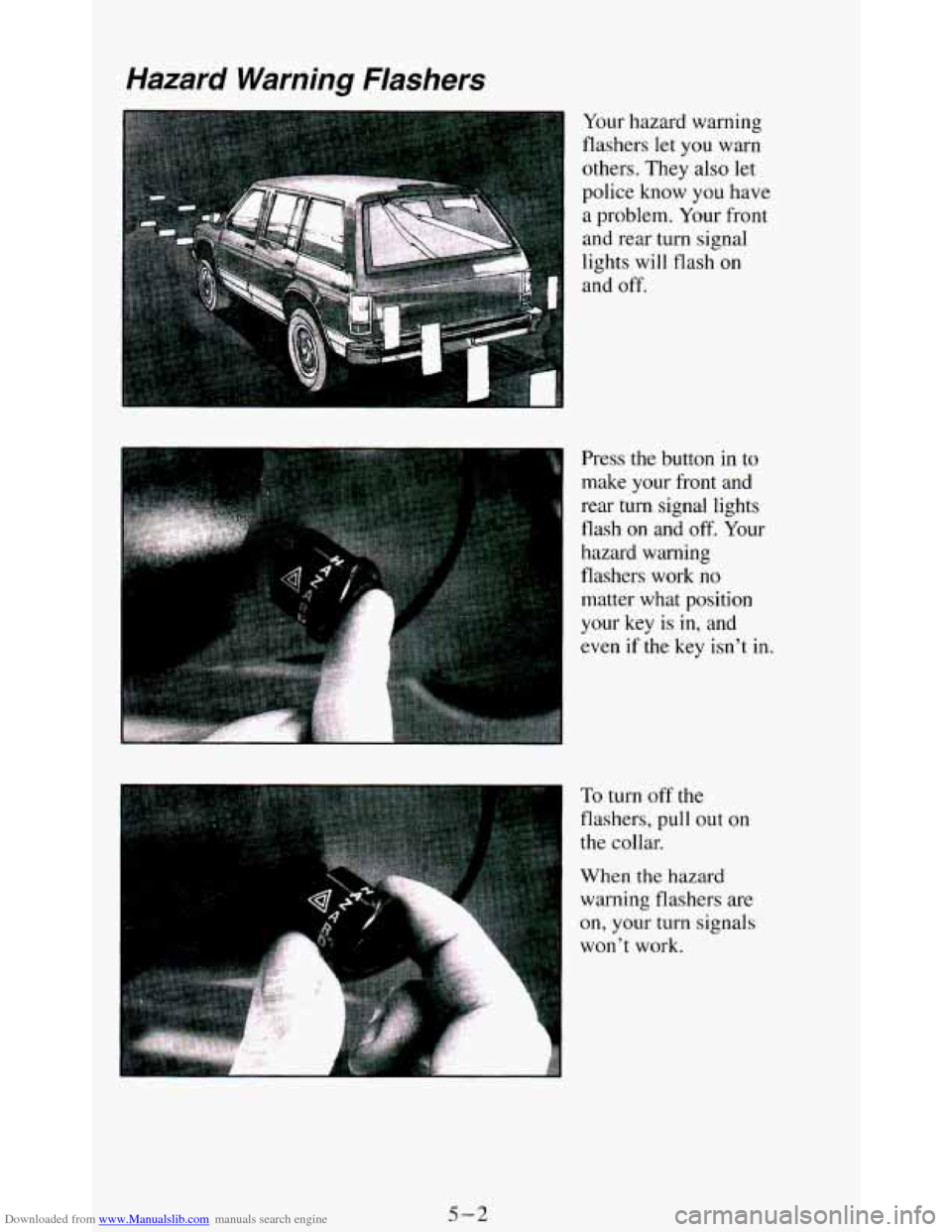
Your hazard warning
flashers let
you warn
others. They also let
~ police know you have
1 a problem. Your front
and rear turn signal
lights will flash
on
and off.
Press the button in to
make your front and
rear turn signal lights
flash on and
off. Your
hazard warning
flashers work no matter what position
your key is
in, and
even
if the key isn’t in.
To turn off the
flashers,
pull out on
the collar.
When the hazard
warning flashers are
on, your turn signals
won’t work.
5-2
Page 206 of 348
Downloaded from www.Manualslib.com manuals search engine 2.
3.
Get the vehicles close enough so the jumper cables can reach, but be
sure the vehicles
aren’t touching each other. If they are, it could cause
ground connection you don’t want. You wouldn’t be able to start you1
vehicle, and the bad grounding could damage the electrical systems.
You could be injured if the vehicles roll. Set
the parking brake firmly
on each vehicle. Put an automatic transmission in “P’ (Park) or a
a
manual transmission in “N” (Neutral). If you have a four-wheel-drive
vehicle with
a manual transfer case shift lever, be sure the transfer case
is not in “N” (Neutral).
Turn
off the ignition on both vehicles. Turn off all lights that aren’t
needed, and radios. This will avoid sparks and help save both batteries.
And it could save your radio!
~~~
NOTICE:
~~
If you leave your radio on, it could be badly damaged. The
repairs wouldn’t be covered by your warranty.
4. Open the hoods and locate the batteries. Find the positive (+) and
negative (-) terminals on each battery.
5. Check that the jumper cables don’t have loose or missing insulation. If
they do, you could get a shock. The vehicles could be damaged, too.
Before you connect the cables, here are some basic things you should
know. Positive
(+) will go to positive (+) and negative (-) will go to
5-4
Page 249 of 348
Downloaded from www.Manualslib.com manuals search engine When to Change Engine Oil
See if any one of these is true for you:
Most trips are less than 4 miles (6 km).
It’s below freezing outside and most trips are less than 10 miles (I 6 km).
0 The engine is at low speed most of the time (as in door-to-door
delivery, or
in stop-and-go traffic).
You tow a trailer often.
0 Most trips are through dusty places.
0 The vehicle is frequently operated off-road.
If any one of these is true for your vehicle, then you need to change your oil
andfilter every 3,000 miles (5 000 km) or 3 months - whichever comes
first.
If none
of them is true, change the oil every 7,500 miles (12 500 km) or
12 months - whichever comes first. Change the filter at the first oil change
and at every other oil change after that.
Four-wheel Drive Remote Oil Filter
If your vehicle has four-wheel drive, you will have a remote oil filter
located under the hood. It is mounted to the front left inner fender, behind
the headlights.
Engine Coolant Heater (Engine Block Heater)
An engine coolant heater can be a big help if you have to park outside in
very cold weather, 0°F (-18°C) or colder. If your vehicle has this option,
see “Engine Coolant Heater
” in the Index.
What to Do with Used Oil
Did you know that used engine oil contains certain elements that may be
unhealthy for your skin and could even cause cancer? Don’t let used oil stay
on your skin for very long. Clean your skin
and nails with soap and water,
or
a good hand cleaner. Wash or properly throw away clothing or rags
containing used engine oil. (See
the manufacturer’s warnings about the use
and disposal of oil products.)
Used oil can be
a real threat to the environment. If you change your own oil,
be sure to drain all free-flowing oil from
the filter before disposal. Don’t
ever dispose of oil
by putting it in the trash, pouring it on the ground, into
sewers, or into streams or bodies of water. Instead, recycle
it by taking it to
a place that collects used oil. If you have a problem properly disposing of
your used oil, ask your dealer,
a service station or a local recycling center
for help.
6-13
Page 259 of 348
Downloaded from www.Manualslib.com manuals search engine If the differential is cold, add enough lubricant to raise the level to 1/2 inch
(12 mm) below the filler plug hole.
What to use
Refer to the Maintenance Schedule to determine what kind of lubricant to
use.
See “Recommended Fluids and Lubricants” in the Index.
Engine Coolanr
The following explains your cooling system and how to add coolant when it
is
low. If you have a problem with engine overheating, see “Engine
Overheating” in the Index.
The proper coolant for your vehicle will:
0 Give freezing protection down to -20 “F (-29”C), or -34°F (-37°C) in
Give boiling protection up to 258°F (125°C).
Canada
and for
vehicles with the cold climate option.
0 Protect against rust and corrosion.
Help keep the proper engine temperature.
0 Let the warning lights and gages work as they should.
What to Use
Use a mixture of one-half clean water (preferably distilled) and one-half
antifreeze that meets “GM Specification 6038-M,” which won’t damage
aluminum parts.
You can use a recycled coolant conforming to “GM
Specification 6038-M,” with a complete coolant flush and refill. If you use
this mixture, you don’t need to add anything else.
6-23
Page 268 of 348
Downloaded from www.Manualslib.com manuals search engine ulb Replacement
Before you replace any bulbs, be sure that all the lights are off and the
engine isn't running.
Halogen Bulbs
Headlights
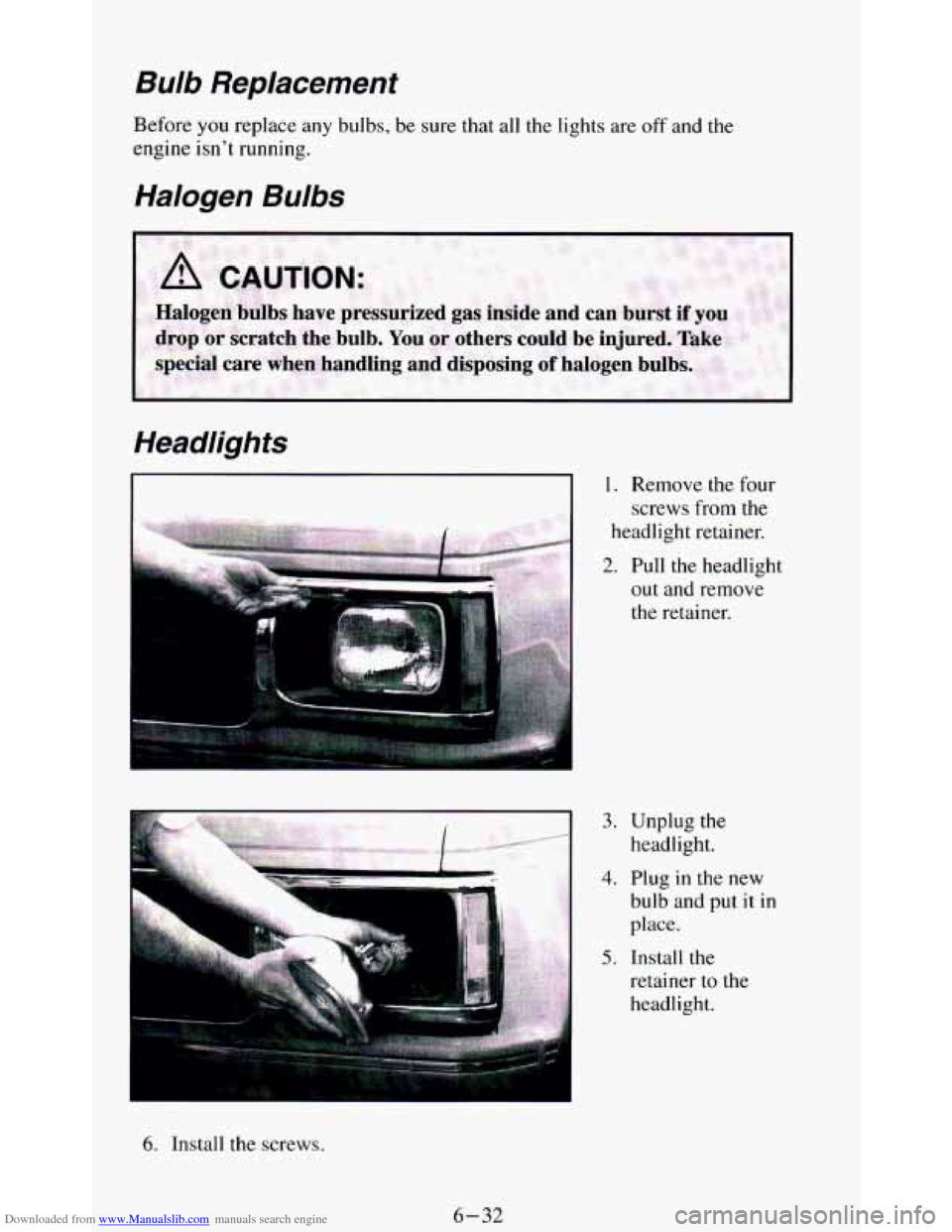
1. Remove the four
screws from
the
headlight retainer.
2. Pull the headlight
out and remove
the retainer.
:::
c
3.
4.
5.
Unplug the
headlight.
Plug
in the new
bulb and put it
in
place.
Install the
retainer to the
headlight.
6. Install the screws.
6-32
Page 269 of 348
Downloaded from www.Manualslib.com manuals search engine Front ParkingKurn Signal Lights
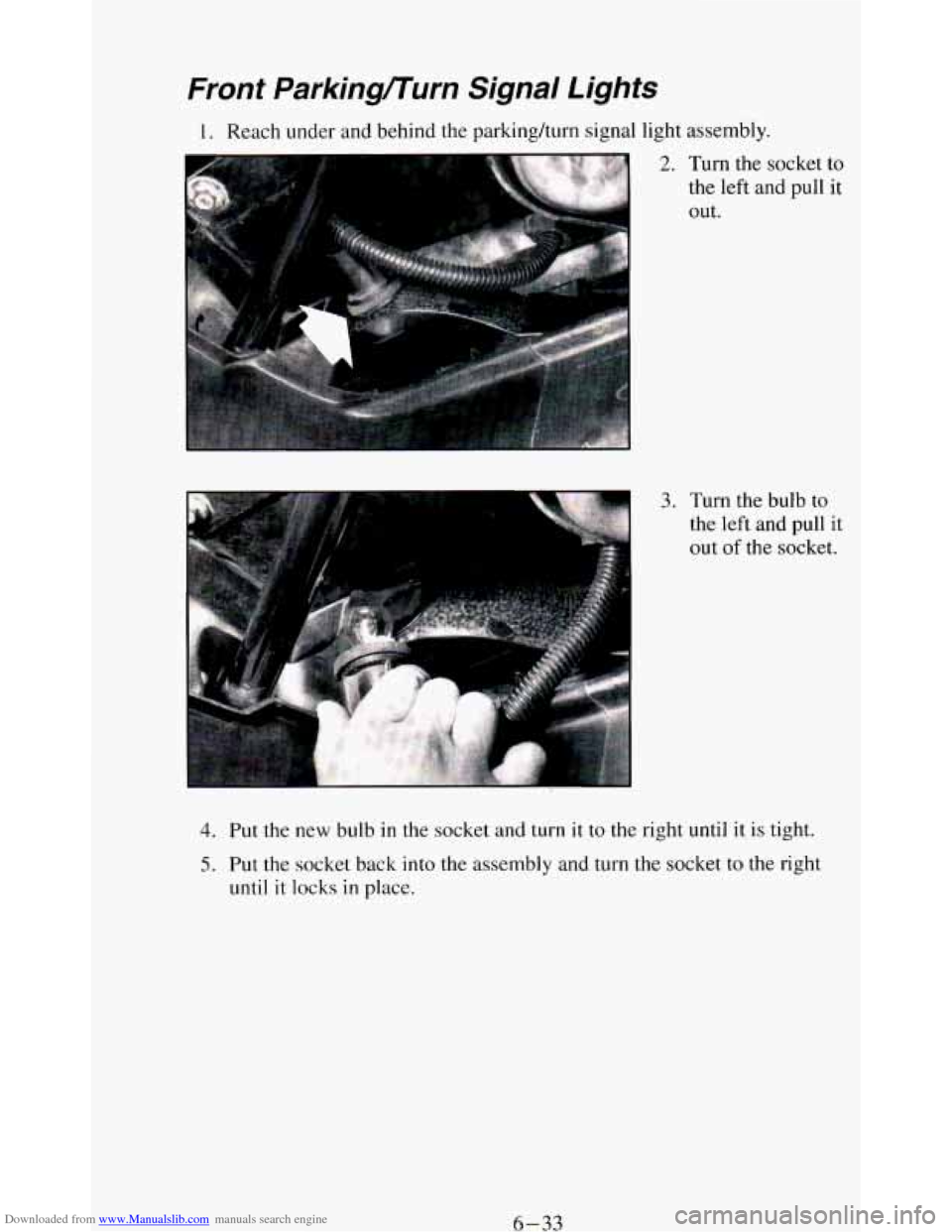
1. Reach under and behind the parkingkurn signal light assembly.
3. Turn the bulb to
the left and pull it
out
of the socket.
2. Turn the socket to
the left and pull it
out.
4. Put the new bulb in the socket and turn it to the right until it is tight.
5. Put the socket back into the assembly and turn the socket to the right
until it locks in place.
6-33
Page 270 of 348
Downloaded from www.Manualslib.com manuals search engine Rear Lights
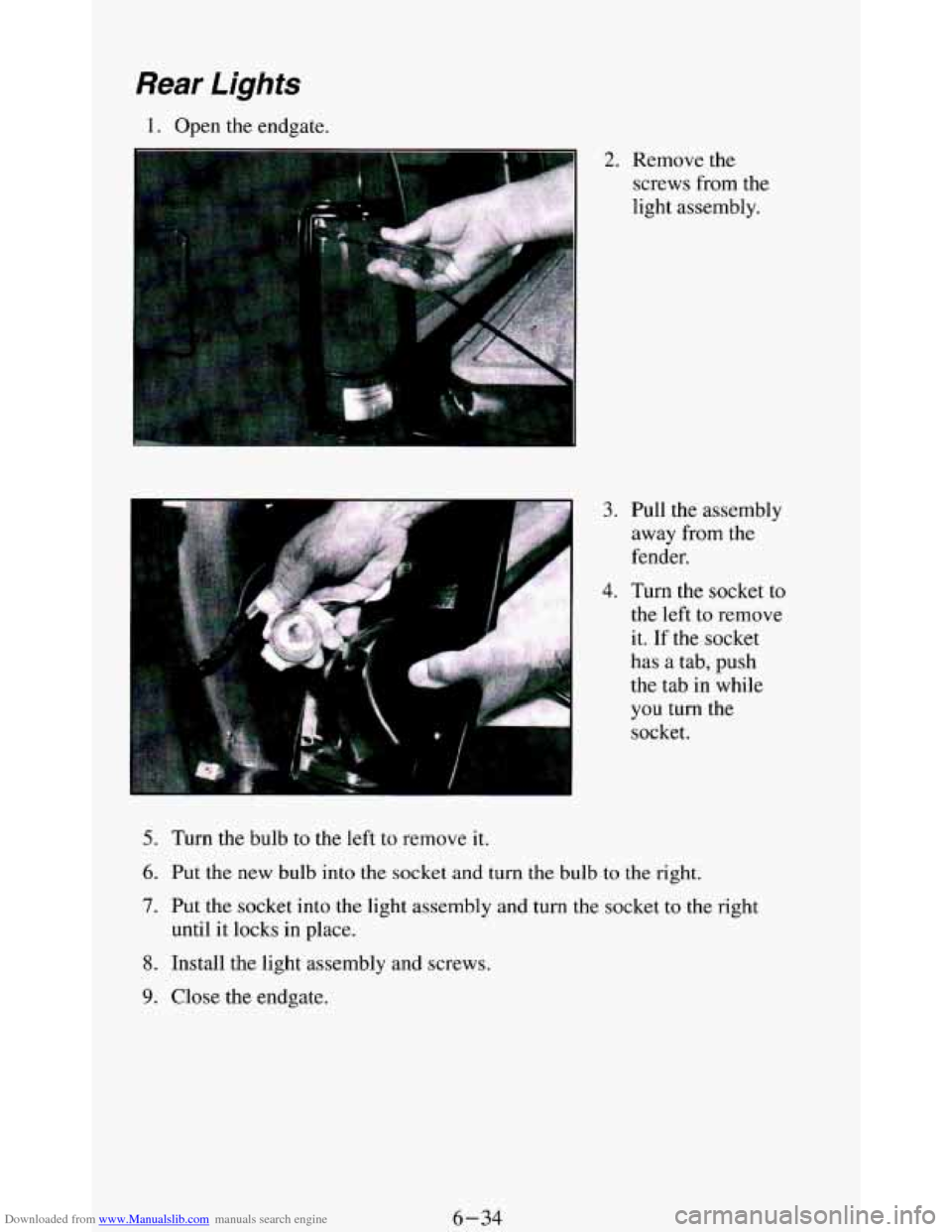
1. Open the endgate.
- 3. Pull the assembly
away from the
fender.
4. Turn tne socket to
the
left to remove
it. If the socket
has a tab, push
the tab in while
you turn the socket.
5. Turn the bulb to the left to remove it.
6. Put the new bulb into the socket and turn the bulb to the right.
7. Put the socket into the light assembly and turn the socket to the right
8. Install the light assembly and screws.
9. Close the endgate.
until
it locks in place.
6-34
Page 297 of 348
Downloaded from www.Manualslib.com manuals search engine Headlights
The headlight wiring is protected by a circuit breaker in the light switch. An
electrical overload will cause the lights to go on and off. If this happens,
have your headlight wiring checked right away.
Windshield Wipers
The windshield wiper motor is protected by a circuit breaker and a fuse. If
the motor overheats due to heavy snow, etc., the wiper will stop until the
motor cools. If the overload is caused by some electrical problem and not
snow, etc., be sure to get it fixed.
Power Windows and Other Power Options
Circuit breakers in the fuse panel protect the power windows and other
power accessories. When the current load is too heavy, the circuit breaker
opens and closes, protecting the circuit until the problem
is fixed.
Trailer Wiring Harness
The optional seven-wire trailer wiring harness is protected by an in-line
fuse in the battery feed wire. This fuse is near the junction block. See
“Trailer Wiring Harness” in the
Features & Controls section.
Fuse Block
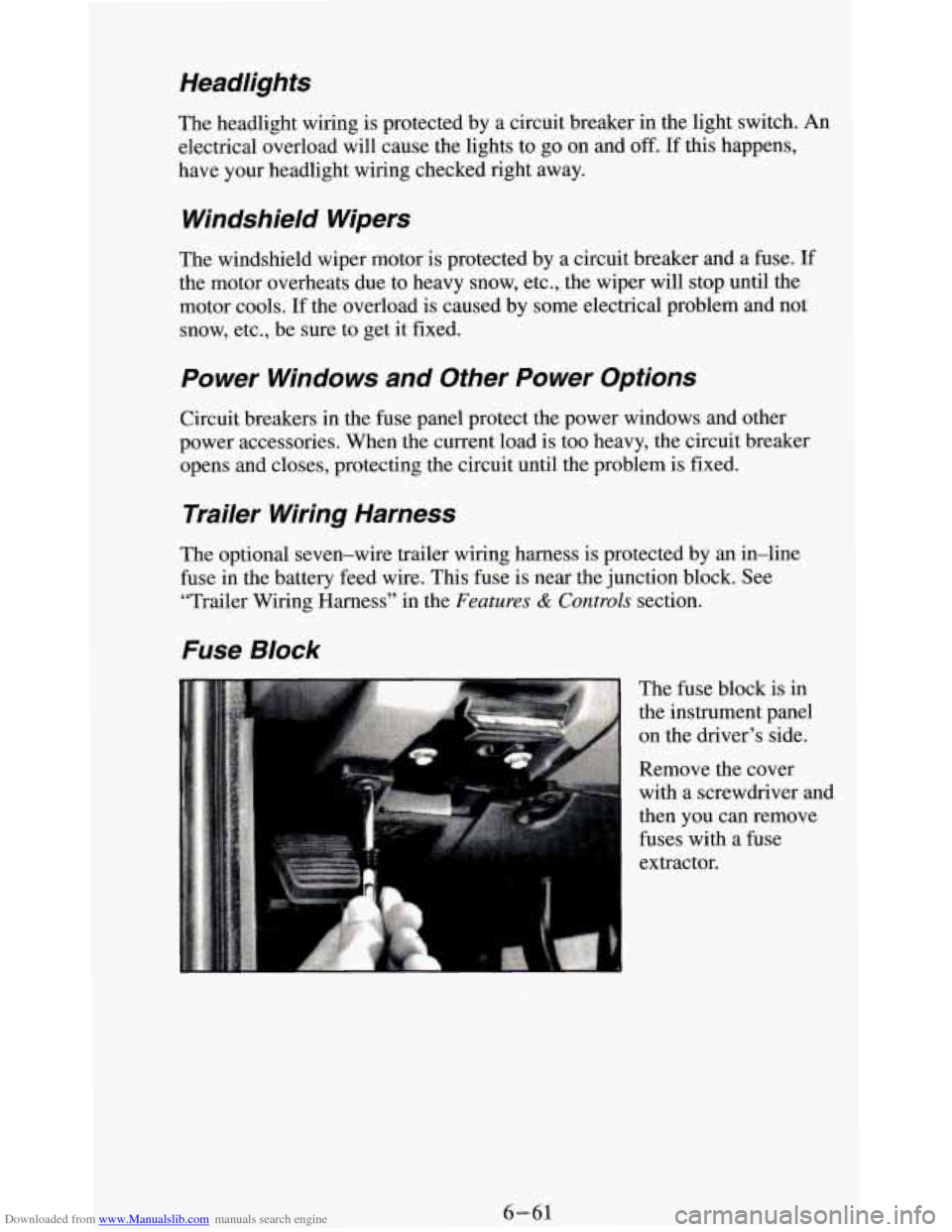
The fuse block is in
the instrument panel
on the driver’s side.
Remove the cover
with a screwdriver and
then you
can remove
fuses with a fuse
extractor.
6-61
Page 300 of 348
Downloaded from www.Manualslib.com manuals search engine INTERIOR LAMPS
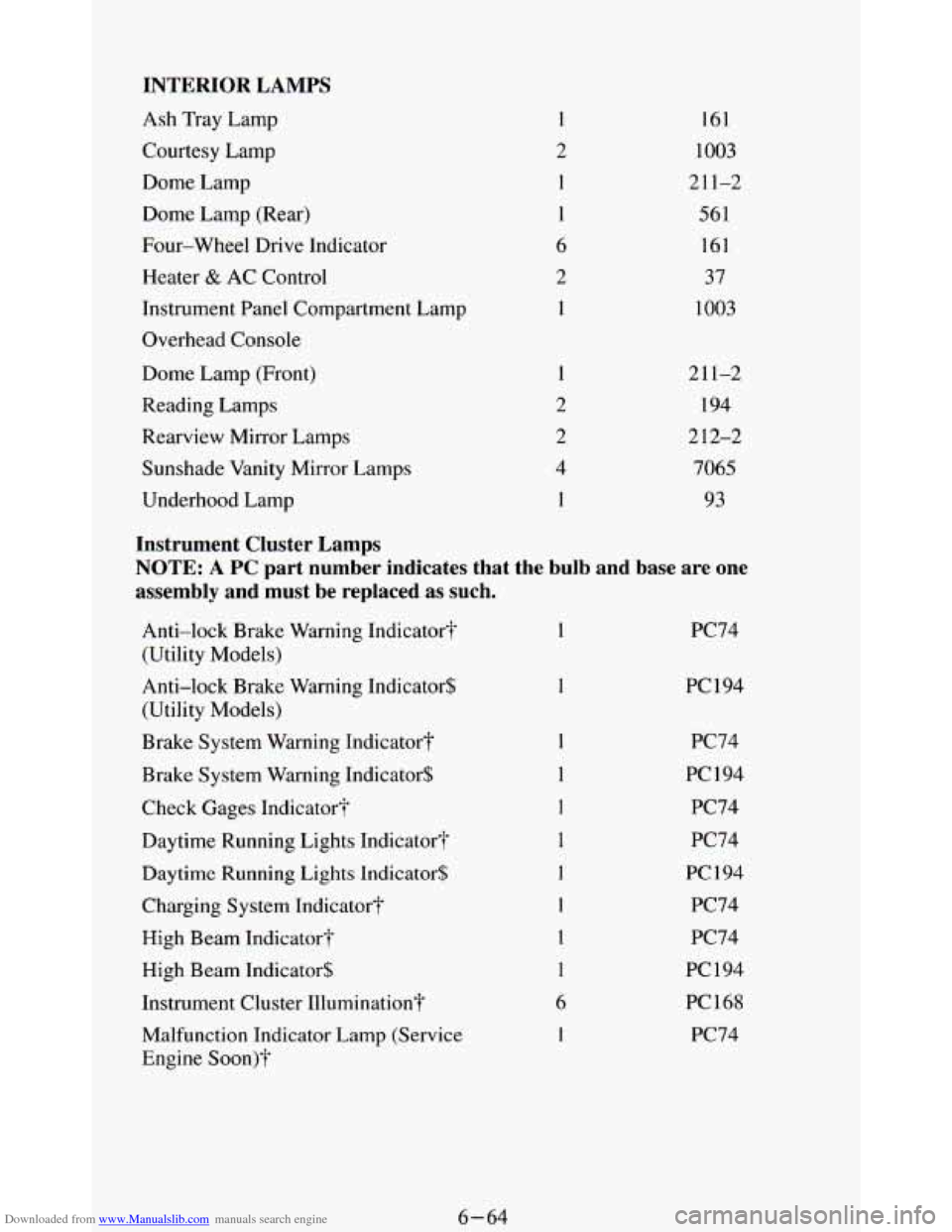
Ash Tray Lamp
Courtesy Lamp
Dome Lamp Dome Lamp (Rear)
Four-wheel Drive Indicator
Heater
& AC Control
Instrument Panel Compartment Lamp
Overhead Console
Dome Lamp (Front)
Reading Lamps
Rearview Mirror Lamps
Sunshade Vanity Mirror Lamps
Underhood Lamp
161
1003
21 1-2
561
161
37
1003
211-2 194
2 12-2
7065 93
Instrument Cluster Lamps
NOTE:
A PC part number indicates that the bulb and base are one
assembly and must be replaced as
such.
Anti-lock Brake Warning Indicator?
(Utility Models)
Anti-lock Brake Warning Indicator$
(Utility Models)
Brake System Warning Indicator?
Brake System Warning Indicator$
Check Gages Indicator?
Daytime Running Lights Indicator’f
Daytime Running Lights Indicator$
Charging System Indicator?
High Beam Indicator?
High Beam Indicator$
Instrument Cluster Illumination?
Malfunction Indicator Lamp (Service
Engine Soon)?
1
1
1
1
1
I
1
1
1
6
1
PC74
PC 194
PC74
PC 194
PC74
PC74
PC 194
PC74
PC74
PC 194
PC168 PC74
6-64